

Commander Charles Parry RN was born at Tahlee homestead at Port Stephens on 21 October 1833. He was the fourth child of Sir William Edward Parry, second Commissioner of the Australian Agricultural Company, and his wife Lady Isabella Parry.
Background Story
In 1826, Sir William Edward Parry, who was born in England married Isabella Stanley. He was knighted for his services to Arctic exploration in 1829. In that year he accepted the offer to become the second Commissioner of the Australian Agricultural Company, then based at Carrington, Port Stephens.
Sir Edward Parry (as he was known) arrived in Sydney in December 1829 with his wife Lady Isabella Parry, to begin his four-year term as the Commissioner of the Australian Agricultural Company. He kept a meticulous journal of his time in New South Wales, details of which are found at this link on the website.
Soon after arrival, Isabella gave birth in Sydney to twins, Edward and Isabella, in 1830. While the Parry family were resident at the Tahlee homestead at Port Stephens, Isabella gave girth to another two children, Lucy in 1831 and Charles on 21 October 1833 (28th anniversary of the Battle of Trafalgar).
Having completed his term as Commissioner of the Australian Agricultural Company, Parry and his family departed Sydney and returned to England on the ship Persian in May 1834. The journal of his return trip to England, as kept by Sir Edward, can be found at this link on the website.
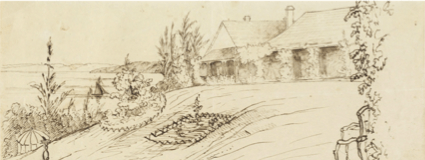
Drawing of the original Tahlee House – 8 February 1840 [State Library NSW]
After his return to England, Sir Edward Parry successfully held posts of comptroller of steam machinery at the Admiralty; Captain Superintendent of Haslar Hospital, Gosport; and from 1853, on attaining flag rank, Lieutenant-Governor of Greenwich Hospital, the home for naval pensioners.
Isabella Parry died on 13 May 1839 at Tunbridge Wells, England, two days after giving birth prematurely to twin boys who did not survive. She and the twins were buried together at Trinity Cemetery, Tunbridge Wells.
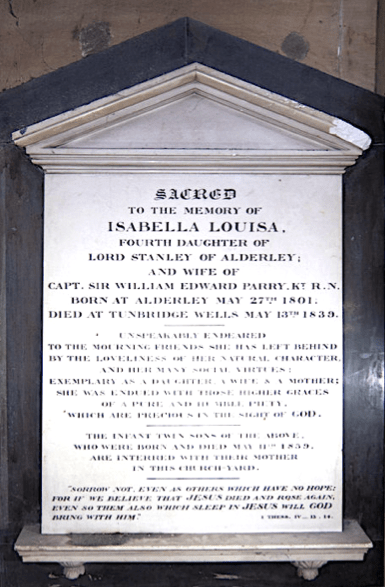
Memorial plaque to Isabella Parry [Trinity Cemetery website]
In 1841, Sir Edward Parry married Catharine, nee Hankinson, widow of Samuel Hoare, by whom he had three children. In his last years he helped to organize the search for the lost Franklin expedition which finally ended the search for a North-West Passage.
Sir William Edward Parry died at Bad Ems in Germany on 8 July 1855 and his body was returned to London, where he was buried at the Greenwich Hospital Cemetery. This has now become an historic park.
This paper is the story of the accomplishments of Charles Parry who followed his father in having a distinguished career in the British Navy.
Naval Career of Charles Parry
Shortly after the Parry family returned to England, Charles lost his mother at the age of five, and Sir Edward remarried in 1841.
At age twelve, Charles began his education at Dr. Burney’s Naval School in Gosport, England. His initial naval experience was as a cadet aboard the flagship St. Vincent of the Channel Squadron, appointed on 5 May 1847. Later that year, he was posted to the Vernon in the East Indies before returning to England in autumn.
Subsequently, Charles joined the frigate Cambrian serving three years on the East India and China Station. The Cambrian returned to Plymouth in October 1850.
In January 1851, Charles joined the Amphitrite. Sir Edward Parry, in a letter to his wife, reflected on the poignant farewell as his seventeen-year-old son departed from Spithead. For the following five years, Charles served on the Pacific Station aboard the Amphitrite, Portland, and Trincomalee.
Known for his strong Christian faith, Charles’s devotion was noted by his brother Edward, who recounted Charles’s public practice of prayer aboard ship. This was a rarity at the time and often met with ridicule from his peers. While anchored at Valparaiso in March 1853, Charles transferred to the Portland.
An accident aboard the Portland in September 1853, resulted in a serious injury to Charles’s right eye, requiring hospitalization in Valparaiso for three months.
Upon the arrival of the Trincomalee, Charles was offered an acting commission as lieutenant.
In September 1855, while docked at Vancouver Island, Charles received news of his father’s death. During his subsequent posting in Honolulu, Charles actively contributed to community efforts to support the establishment of a Sailors’ Home.
After departing the Trincomalee in early 1856, Charles undertook further training aboard the Excellent at Portsmouth, earning first-class certificates in gunnery and mathematics. He then served as First Lieutenant on the gun-vessel Surprise, participating in the bombardment of Canton in December 1857.
Subsequent assignments included service on the ‘Bulldog, where he was tasked with surveying for a transatlantic telegraph cable; positions on the Royal Yacht, Aurora, Duncan, and finally command of the Cordelia in the West Indies in 1867.
Charles Parry’s career ended while stationed aboard the ‘Arethusa‘ in Naples. He contracted dysentery and died on 10 October 1868, at the age of thirty-four.
His brother Edward Parry, D.D., Bishop Suffragan of Dover, gave an account of Charles’ funeral, describing the honours rendered by the British Squadron and the solemn procession to the Protestant Cemetery in Naples, where Charles was laid to rest.
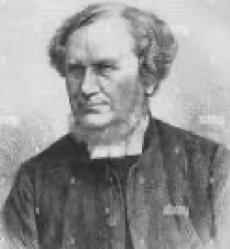
Edward Parry (1830 – 1890), Bishop Suffragan of Dover from 1870
Bishop Edward Parry wrote:
‘Sixteen hours afterwards – a stern and sad necessity – early on Sunday morning, the ensigns of the British squadron in Naples Bay were at half-mast, and a long procession of men-of-war boats followed the ‘Arethusa’s’ pinnacle to the Custom House stairs, whence the funeral train made its way, through a pitiless storm of rain, to the Protestant Cemetery. With the Union jack for his pall, he was carried by seamen – as a sailor might wish to be borne – to his grave on a foreign shore, not without loving hearts hard at hand. ‘While the coffin was being lowered into the earth the pouring rain ceased, and a cheerful streak of sunshine fell across the place where, within view of Vesuvius, Charles Parry’s body sleeps in hope.’
‘Memorials of Charles Parry’ published in 1870
Bishop Edward Parry complied a biographical tribute to his brother entitled Memorials of Charles Parry, Commander Royal Navy, which was published in London in 1870.
It is currently available as an ‘ebook’ on Google and can be at the following link. at this link.
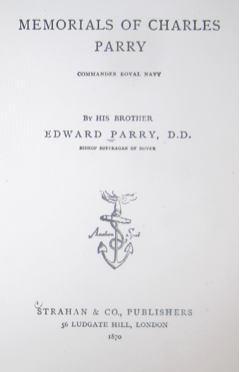
Title page of the ‘Memorials of Charles Parry’ compiled by his brother, Edward Parry D.D.
Chapter 1 reflects on the early life of Charles Parry and covers the period 1833 to 1850. The following excerpt from this chapter provides an insight into the character of Charles Parry:
‘Charles Parry was born on the anniversary of Trafalgar, October 21 st, 1833, at Tahlee House, Port Stephens, New South Wales, the temporary home of his father, Sir W. Edward Parry, who, soon after his return from his Polar voyage, had accepted for four years the post of Commissioner to the Australian Agricultural Company.
Sir Edward returned to England the next year, and “Charlie’s” boyhood was spent in various homes. When it became plain that he was to follow his father’s profession, he was sent at the age of twelve to Dr. Burney’s Naval School at Gosport.
His own mother, it may be well to say, had died when he was only five years old, and to the end of his life he regretted that he could not recall even the features or voice of one, to whose earnest prayers and loving Christian training he was so largely unconsciously indebted.
Sir Edward Parry married again in 1841, and how well a mother’s place was supplied to the children of the first marriage will be amply provided in the following pages. To his second mother is written the first letter of the boy, found among precious family memorials after his father’s death: –
“Royal Academy,
“November 1st, 1846.
“My Dear Mamma,
“I received your note this morning at breakfast, and I am sorry that I have not written to you for so long a time, but I will try to make up for it now. I am sorry to say that there will not be any examination, as it is not the custom at this school, so I shall not be able to know whereabouts I am in the school; but I think that I should not be very far from the top, as most of the boys are very backward.
“I can assure you, dearest mamma, that I also sincerely hope and pray that when the right time does come for me to go to sea, I may be under a truly good and Christian captain, and that I, for my part, may obey his commands as I would those of dearest papa.
I have just finished D’Aubigne’s ‘Reformation’, and I have not got any other book yet, but perhaps one of the boys an lend me, as I shall enjoy an hour or so with him very much.
I must now end, and with best love and wishes to all, believe me,
“Ever your very affectionate son”,
Charles Parry.’
Concluding Comments
The current Tahlee homestead situated near Carrington at the head of Port Stephens serves as a reminder of a much earlier colonial period.
Unfortunately, Charles Parry, unlike his parents, would not have had any memory of his early childhood at Port Stephens.
But as a native-born lad, he had a distinguished career in the British Navy and served the ‘Mother Country’ well.
Researched and compiled by Kevin McGuinness
September 2025

 Port Stephens - a history exploration