
Introduction
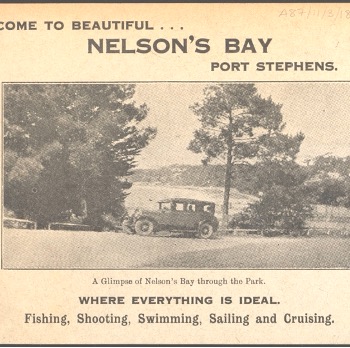
This paper looks at the promotion of tourism, as an industry, in the blue water paradise of Port Stephens. It is based on a collection of historic tourist brochures, newspaper articles and latter industry publications.
Tourism in the Port Stephens area has its origins in the 1870s, with the establishment of small fishing settlements such as Nelson Bay and Anna Bay on the southern side of the port and at Tea Gardens on the northern side.
‘Word of mouth’ would have been the main method of attracting visitors to enjoy the fishing and scenery of the area in the early days, followed later by newspaper articles written by various travellers.
Ocean Excursions for Tourists to Port Stephens
The first ocean excursions to Port Stephens commenced in the early 1870’s on an irregular basis. They were operated by the Newcastle Steamship Company using small steamships, such as the SS Samson and SS Sydney. After arrival at Port Stephens passengers were transferred to smaller vessels and landed on shore.
The construction of a wharf at Nelson Bay in 1889 facilitated transport not only for fishermen but quickly began to attract visitors traveling by steamboat on excursions from Newcastle and Sydney. The peak period for excursions to Port Stephens by steamship was between 1892-1928 following the formation of Newcastle and Hunter River Steamship Company (NHRS Co.).
The ocean excursions were extremely popular. Up to 700 people could travel on some of the company’s steamships which were large for their time. A band would often accompany the holiday excursionists on the steam ship.
The steamship company marketed their cruises. Firstly, they would place advertisements for forthcoming cruises in regional newspapers. Secondly, following the conclusion of each cruise, the company would send favourable reports to the Newcastle and regional newspapers for publication.
Other companies and interest groups also conducted excursions, to Port Stephens, for purposes such as fishing and shooting. These excursions did not operate on a regular basis and would often transport less than 50 persons. These small excursions went to places such as Nelson Bay, Tea Gardens and Myall River.
Further information on Excursions from Newcastle to Port Stephens by Sea is found at this link on the website.
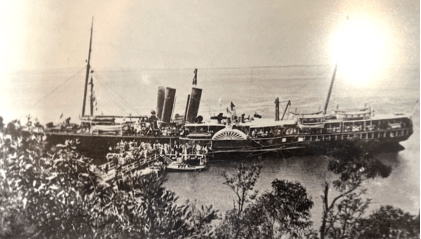
Paddle wheeler SS Newcastle at the Nelson Bay wharf with holiday excursionists from Newcastle
Travel to Port Stephens by Coach and Small Steamboat
Prior to the Second World War, for those wishing to visit Nelson Bay or the Tea Gardens area who did not wish to travel by sea, the only alternative was to use a combination of travel options between Newcastle and the Port Stephens area.
For instance, a land journey from Newcastle to Nelson Bay took almost a full day and involved the following travel arrangements: At Newcastle, travel across the Hunter River by ferry to Stockton; from Stockton travel by a horse drawn coach [often called a charabanc] to Salt Ash; at Salt Ash transfer to a small steam boat and travel along the Tilligerry Creek to Nelson Bay. At Nelson Bay the traveller would probably stay at the Sea Breeze Hotel, or travel across the harbour to Tea Gardens.
The travel route itself was an adventure, and various newspaper correspondents of the time wrote of their travelling experiences to Port Stephens. Four of their stories are found at the following links on the website
Journey from Maitland to Port Stephens – 1889
A four Day Excursion to Port Stephens – Christmas 1906
An Excursion to Port Stephens by Dr. Richard Arthur MLA – 1914
A Personal Tour of Port Stephens – 1914
Lakes Travel Route – 1907
In the early years of twentieth century, prior to the construction of the Pacific Highway along the route serving the mid-north coast of New South Wales, travel to the various coastal destinations, such as Port Stephens and the Forster area further north was a sea journey. That all changed in October 1907, when the NSW Government Tourist Bureau launched and promoted a new travel route between Sydney and the mid-north coast, via Port Stephens and the Myall Lakes. It was known as the Lakes Travel Route.
The new route basically promoted a five-stage travel itinerary for the following forward and reverse passenger journeys: travel to Newcastle and then a ferry to Stockton; coach travel to Salt Ash connecting with a steamer to Port Stephens, stopping at Tea Gardens; travel by launch from Tea Gardens up the Myall River and Myall Lakes to Bungwahl; coach travel from Bungwahl to Wallis Lake; and finally travel by launch up Wallis Lake to Forster; and then on to Tuncurry and Taree by coach.
Further information on Lakes Travel Route, via Port Stephens is found at this link on the website.
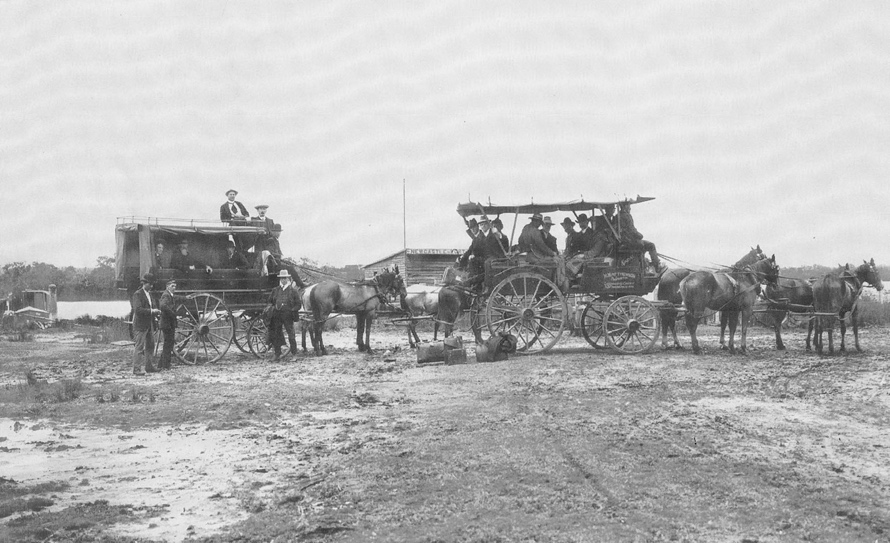
Travellers at the Salt Ash wharf, aboard a Mattiewson ‘charabanc’ with a small Port Stephens steam boat on the Tiligerry Creek at left of the photo. The shed in the background bears a sign ‘Newcastle – Port Stephens’
Promotion of Karuah as the Ideal Tourist Resort – 1912
The earliest promotion of tourism to Karuah, Port Stephens, was undertaken by a local storekeeper, Mr. T. Buckshi Ram, who had recently opened a comfortable Accommodation House, and had the following advertisement published.
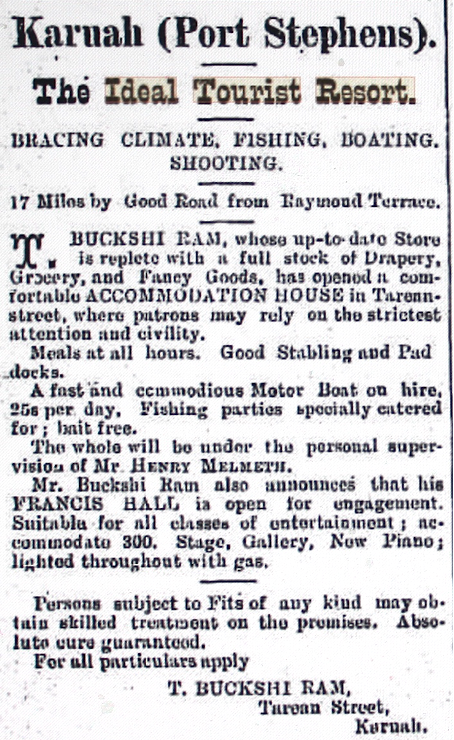
Advertisement for Karuah Accommodation House [Raymond Terrace Examiner and Lower Hunter and Port Stephens Advertiser, 7 June 1912]
Travel Guide for Port Stephens and the Myall Lakes – 1913
The Warialda Standard and Northern Districts’ Advertiser of 28 April 1913, page 3, published the following comprehensive travel guide for travelling to the Port Stephens and Myall Lakes areas. It would have been little used when the First World War began one year later in 1914:
‘Port Stephens and the surrounding tourist country, including the fine Myall Lakes, make up one of the prettiest holiday districts in the whole State. This area is fast coming into favour with pleasure seekers, who are going there in increasing numbers each year. With the extension of the North Coast Railway as far as Taree, a particularly fine tourist district has been opened up, and one that will well repay anyone who feels disposed to “explore” this extensive and pretty centre.
Every facility is offered those who desire to spend their holidays; and the many rail, steamer, launch, and motor runs within the bounds of this great tourist part of the State all provide interesting jaunts and, incidentally, delightful scenery. There is no finer nor more picturesque territory than portions of this great north country. Delightful drives, fishing, swimming, shooting, surfing, camping and other attractions are all to be had within the confines of this vast tourist area.
Travel is easy, comfortable, and enjoyable; in fact, all that can be desired; for the many ways of “doing” the tourist places within the borders of Port Stephens and the Lakes country enable one to start from almost any town or locality. Visitors to the Metropolis may leave Sydney any Tuesday or Friday at 3 p.m. for Port Stephens, by the “Karuah,” which calls at Newcastle en route. The Karuah reaches Port Stephens in good time for breakfast the following day and tranships passengers to the connecting link— the s.s “Myall River” — at the “Duckhole,” [on northern side of harbour] for Bulahdelah and Tea Gardens.
The “Karuah” also tranships passengers for Myall Lakes and Bungwahl to the “Nepean.” The “Karuah” herself proceeds to Karuah wharf, which is the head of navigation on the river bearing that name, a mile and a half from the main Hexham-Gloucester mail road, 6 miles from the township of Booral, and double that distance from the thriving town of Stroud. Regarding the return, the “Karuah” departs from Booral on Mondays and Thursdays at 7 o’clock in the morning, and makes calls at various places on the way, connecting with steamers from Bulahdelah and Bungwahl at the “Duckhole.”
In addition to these calls the “Karuah” also puts into Newcastle on her return spin, thus adding to the pleasure of the journey, and further breaking the long run from Nelson’s Bay to Sydney. From Bulahdelah the s.s. “Myall River” leaves every Monday and Thursday at half-past four, in the morning, and connects with the “Karuah” for Newcastle and Sydney.
As to the overland routes, one that can be highly recommended is as follows, viz. : — Leave by the 9.10 a.m. train for Newcastle (whence ferry is taken to Stockton), then proceed by coach at 2 p.m. for Salt Ash — on Mondays, Wednesdays, Thursdays, and Saturdays — which is a matter of 11 miles from Stockton.
Arrived at Salt Ash the tourist connects with the steamer “Reliance,” which proceeds to Anna Bay, a distance of 7 miles; Nelson’s Bay — 12 miles— and Tea Gardens (7 miles further), which latter place is reached at 7 p.m. After a night’s rest at Tea Gardens the launch “Replica” starts from here at 6.30 a.m. next day, and then proceeds 38 miles to Bungwahl, which is reached at 11 a.m. Here the coach connects for Wallis Lake, and launch for Forster; thence coach is taken to Taree. That thriving town is reached at 6 p.m. This itinerary, providing as it does an overland route to the Manning River and the north of New South Wales, is bound to prove very popular as the district becomes more favourably known.
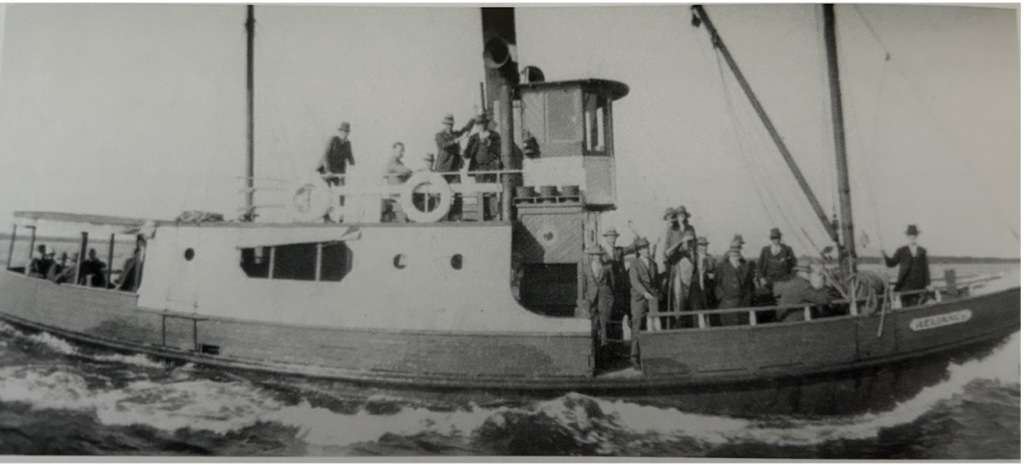
SS Reliance
It will thus be noticed that a tourist may travel from Newcastle as far as Taree by land and water without the necessity of putting to sea. On the return the coach leaves Taree at 6 a.m. on Sundays and Thursdays, and the launch departs from Forster at 9 o’clock in the morning, and connects with coach and steamer, the latter leaving at 2 p.m., after lunch at Bungwahl, reaching the Tea Gardens at 6 o’clock. The “Reliance” takes her departure from Tea Gardens for Salt Ash at 9 a.m. on Thursdays (connecting with the launch from Bulahdelah), and on Mondays, Wednesdays, and Fridays at 8. a.m. for Salt Ash, calling at Nelson Bay, where the coach meets the steamer on arrival., landing travellers in Newcastle about half-past one in the afternoon, thereby enabling them to join the five minutes past three train for Sydney. There is also a connecting motor car service, viz., the Taree-Port Macquarie-Kempsey line, which links up the fine northern towns of Taree, Port Macquarie, Kempsey, and Grafton.
Taking all the facilities provided, it must be conceded that this great northern tourist district, which embraces some of the most picturesque and fertile lands in Australia, though now in its development stages, bids fair to become a splendid asset to New South Wales as a magnet for tourists. The many fine rivers, lakes, bays, and beaches, added to the enchanting mountain and forest scenery north of Sydney, will well repay anyone who sets out to “do” the entire district.’
Funding Challenges to Tourism Promotion in Port Stephens – 1935
The Maitland Daily Mercury of 10 August 1935, page 4, reported on the views of Port Stephens Shire Councillors regarding the funding of tourism incentives to the region:
‘At the Port Stephens Shire Council meeting, Cr. G. J. Russell reported the business transacted at the Tourist Conference when a request for a donation came up. Whether the shire would benefit as a whole, he said was a question. The traffic on the Nelson’s Bay road would increase, and the shire got nothing out of it, and they could not make the road without aid. The better the road became the greater the traffic and the higher the cost of maintenance. But they did not want to be too parochial in the matter, because, speaking broadly, development of tourist resorts, and encouraging tourists might mean a lot for Australia, but it was a national matter as well as local.
The council could not put a surface road to Nelson’s Bay unless it received Government aid. Cr. Russell said the council was asked for a donation to establish the tourist activities at Newcastle, but he was inclined to wait and see what developed from the conference later. Cr. Markey said there was some talk of developing Nelson’s Bay as a tourist area, and Dr. Earle Page was to be invited to visit there. Perhaps £5 spent in aid of the conference’s suggestion about advertising the tourist places might induce people to go there and buy more land. Others there would be assisted by catering for the tourist traffic and perhaps assist in paying rates and storing more revenue to the council. If the area was developed, they might get a larger revenue.
Cr. Russell said a good car-parking area was essential now. If they found this convenience, established car owners might go back again. The parking accommodation was not sufficient last year. The president thought the matter should be held over for later consideration. Cr. Tranter said it was not a long time ago that the Health Department told the council that the sanitary conditions were bad, and it would devolve upon the council, to make more satisfactory arrangements. This would mean more money. The matter was held over as suggested.’
Post Second World War Tourism Promotion in Port Stephens
Prior to the Second World War, Tea Gardens was the main commercial area of Port Stephens as it was accessible by road. A significant milestone occurred when the main road to Nelson Bay was sealed in the early 1940s.
The post-war era saw Port Stephens become increasingly popular as a tourist destination This led to the development of many holiday cottages and campsites.
Each summer thousands of campers would arrive on both sides of the harbour. Many of the campers were miners from the Newcastle region mining areas. Further information on the History of Camping at Nelson Bay and Surrounding Areas is found at the following link on the this website.
Two early tourist brochures from the immediate post-war years are produced below:
A tourist brochure for Nelson’s Bay circa 1945 [NSW State Archives]
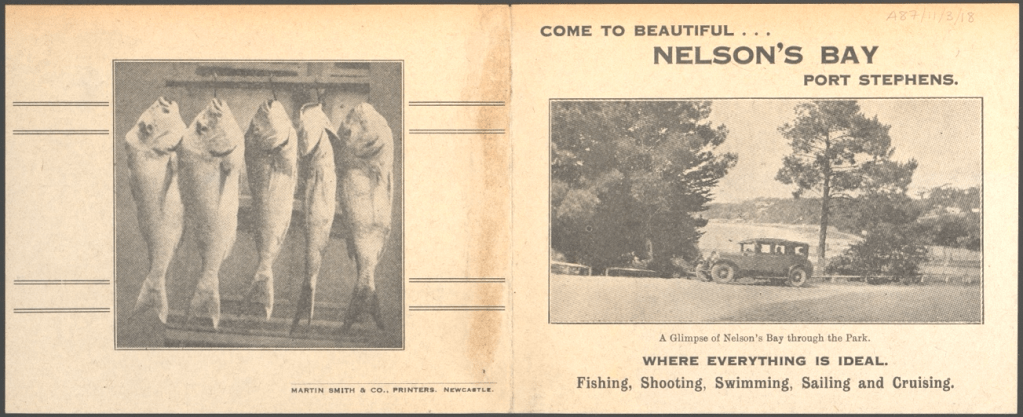
Front and rear pages the tourist brochure highlighting the attractions of fishing, swimming sailing and also including shooting.

Centre pages of the above tourist brochure
A tourist brochure for Tea Gardens circa 1950 [NSW State Library]
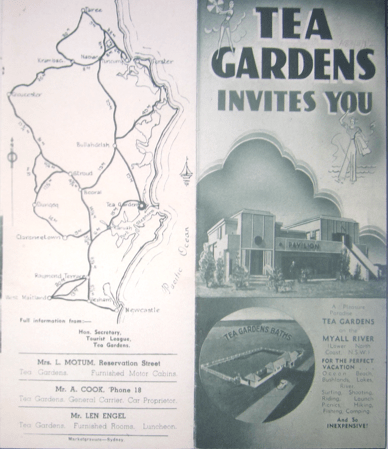
Cover and rear pages from a Tea Gardens tourist brochure, circa 1950, promoting the Pavilion Camping Ground at Hawks Nest and the Tea Gardens Swimming Baths. The design of Pavilion at Hawks Nest was ahead of its time for such a camping facility. [NSW State Library]
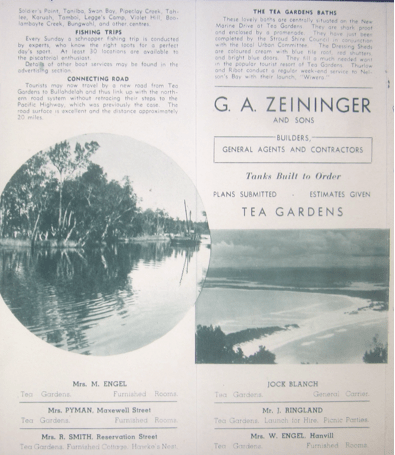

Inside pages from a Tea Gardens tourist brochure, circa 1950 [NSW State Library].
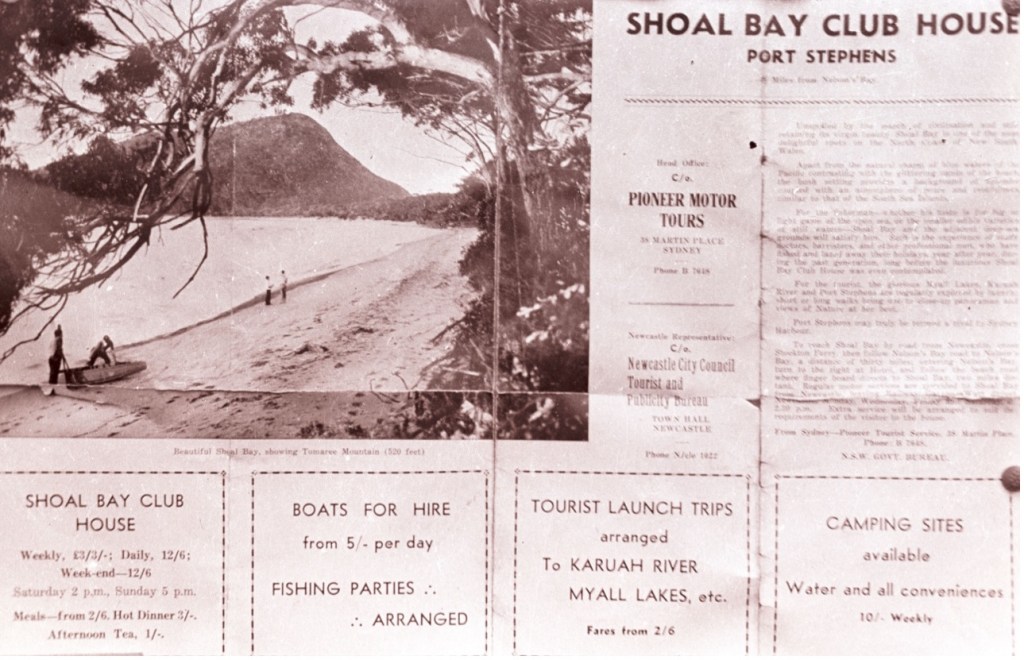
A Shoal Bay tourism brochure featuring the Shoal Bay Club House, circa 1950
With the opening of the Hexham Bridge over the Hunter River in 1952 and the Stockton Bridge in 1971, access to Port Stephens from Newcastle greatly improved. The opening of the Sydney – Newcastle Freeway also reduced travel times from Sydney, broadening the area’s appeal to Sydney residents.
With the growth in tourism in Port Stephens, individual tourist operators and associations generally did their own marketing and distribution of brochures and the like.
A significant event in tourism promotion came in 1967 with formation of the Tourist Organisation of Port Stephens (TOPS), which co-ordinated local tourist initiatives.
Examples of brochures and publications promoting tourist attractions over the years in various areas of Tea Gardens, Nelson Bay, Karuah and Tanilba, are shown below:
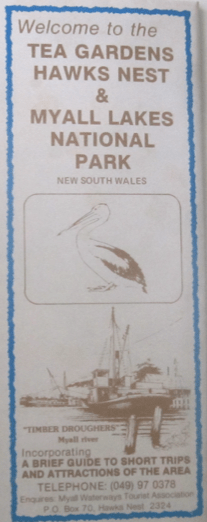
Pamphlet produced by the Myall Waterways Tourist Association, circa 1995. The brochure featuring local tourist attractions and the various businesses that served needs of tourists.
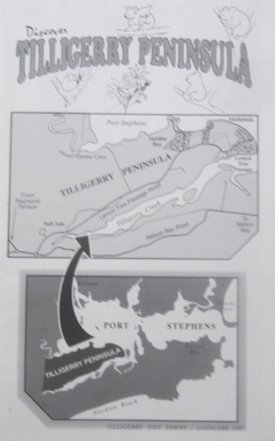
Tourist brochure for the Tilligerry Peninsula published in 1997
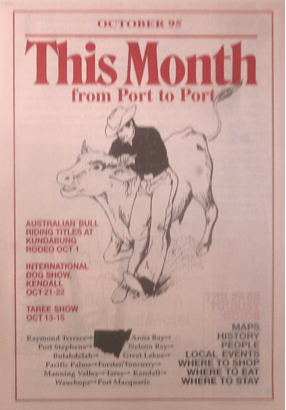
‘This Month from Port to Port’ published by This Month Publications Pty. Ltd – October 1995 edition. It included articles and advertisements for the greater Port Stephens area.
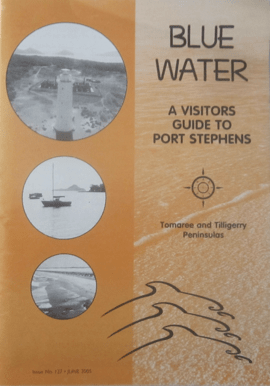
‘Blue Water a Visitors Guide to Port Stephens’ published monthly by Bay Printing Services – June 2005 issue no. 127
The guide covered attractions located on the Nelson Bay side of Port Stephens and featured numerous articles and advertisements.

Tea Gardens and Hawks Nest – Gateway to the Myall Coast – produced by CTC@Tea Gardens in 2018
At the time of this publication, a Tea Gardens Visitor Information Centre was located at 245 Myall Street, Tea Gardens.
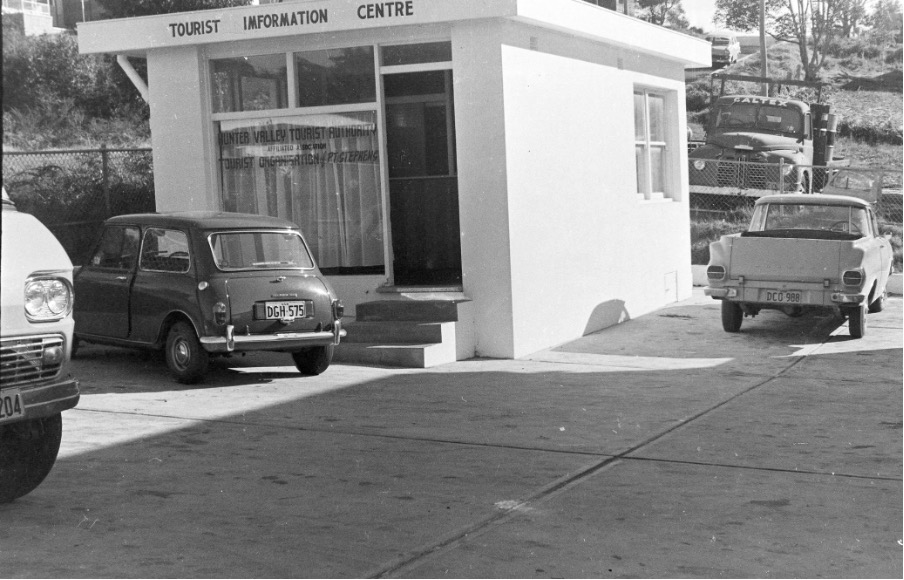
An early tourist office promoting the Port Stephens area.
Tourist Organisation of Port Stephens (TOPS)
The Tourist Organisation of Port Stephens (TOPS) was formed in 1967 as an alliance of local business owners. It was dedicated to promoting tourism initiatives targeting Sydney and other regions.
TOPS played a crucial role in raising the profile of Port Stephens, distributing informational materials and establishing a Visitor Information Centre (VIC) at Nelson Bay. Staffed by volunteers, the VIC evolved into a professionally run operation as the demand for tourism services increased.
TOPS was primarily involved in promoting tourism on the Nelson Bay side of the harbour but also publicized information relevant to the Karuah and Tea Gardens areas. A tourist information centre has also operated at various periods at Tea Gardens.

The original Visitor Information Centre at Nelson Bay – circa 1994 prior to renovations
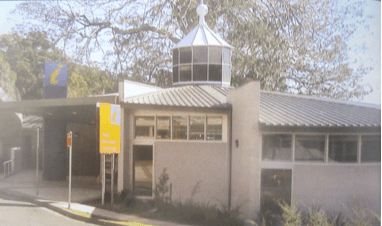
Present day view of the Visitor Information Centre at Nelson Bay
The original dome of the Point Stephens Lighthouse is located on the roof of the Visitor Information Centre in Nelson Bay. It was removed from the lighthouse in 1973.
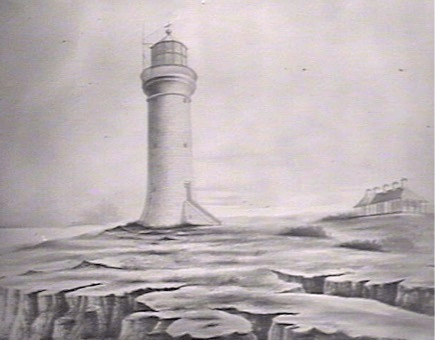
Sketch of Point Stephens Lighthouse [State Library of NSW. FL17655]. The light dome presently located on the roof of the Visitor Information Centre is seen in the sketch at the top of the lighthouse.
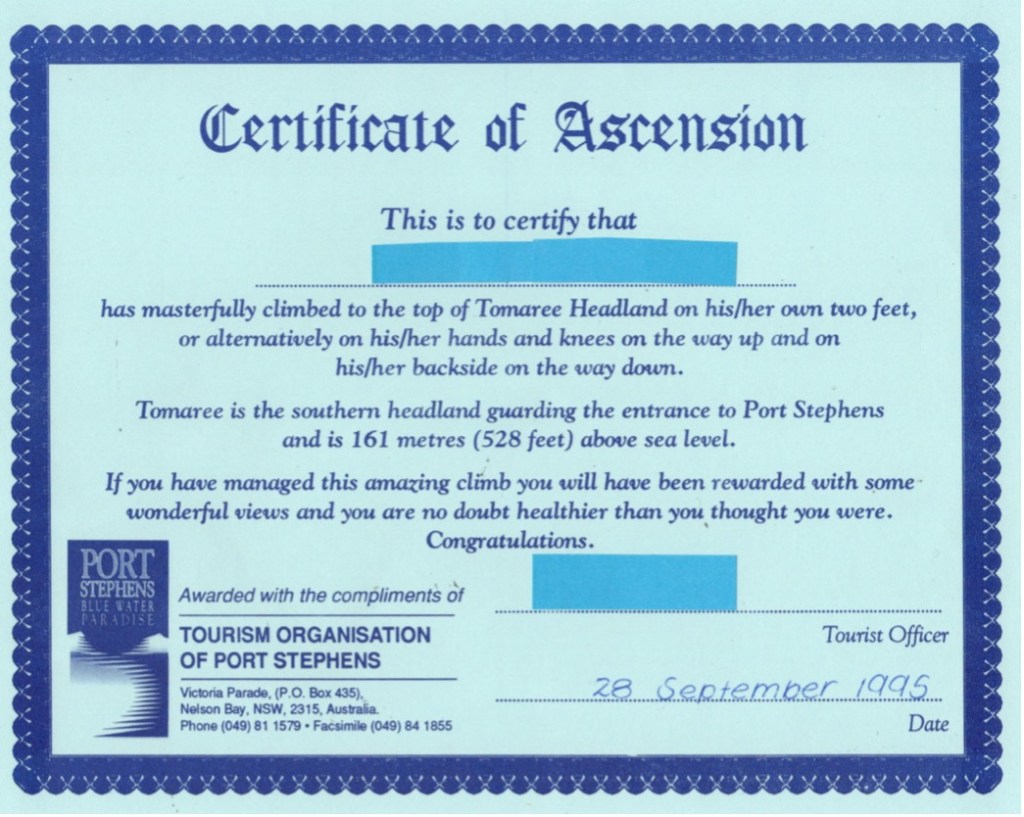
During the 1990’s, visitors who climbed Mount Tomaree were able to visit the Visitor Information Centre at Nelson Bay and receive a certificate with the compliments of TOPS to commemorate their achievement. At that time the modern walkway to the summit was not in place and visitors had to use the old military tracks.
A major initiative of TOPS was the publication of the ‘Visitors Gude’” to Port Stephens which was distributed free.
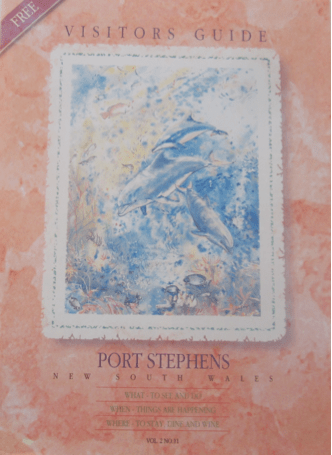
Port Stephens Visitor Guide 1994 – Vol 2, no. 11 published by TOPS.The cover featured an original painting of dolphins by local artist, Julie Savage
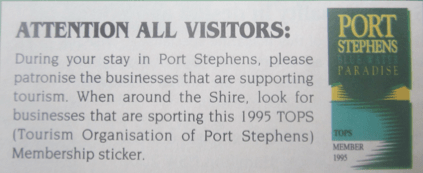
The above notice published in the 1994 Visitor Guide invited tourists to look out for the TOPS membership sticker and thus patronise the businesses that were supporting Port Stephens tourism.
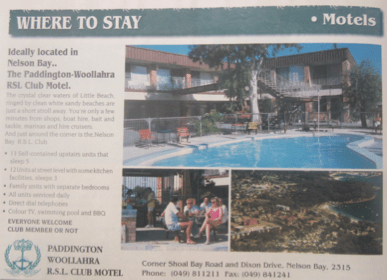
A perusal of the 1994 Visitors Guide illustrates how accommodation options change over time. For instance, it was advertised that an ideal place to stay was the Paddington Woollahra RSL Club Motel, as illustrated in the above advertisement. The motel has since been demolished and an extension to the Wests Nelson Bay Club now occupies the location [1994 Visitor Guide]
A further initiative of TOPS was the production of a brochure setting out the route of a tourist drive around the Tomaree Peninsula area of Port Stephens, published in 1987.
In conjunction with the brochure, route markings were placed on poles at intervals around the drive circuit to guide motorists. The tourist drive has not been promoted for many years and many of the markers are now missing.

Front page of Blue Water Wonderland Tourist Drive Guide issued by TOPS
Further information on the Blue Water Wonderland Tourist Drive is found a this link on the website.
Port Stephens Tourism Limited
TOPS was replaced in 1997 by a new promotional organisation called Port Stephens Tourism Limited (PSTL) which was a joint venture between business operators and the Port Stephens Shire Council.
PSTL commenced marketing Port Stephens as the ‘Blue Water Paradise’. In 2010 the marketing theme was altered to ‘Port Stephens, I Love You’.
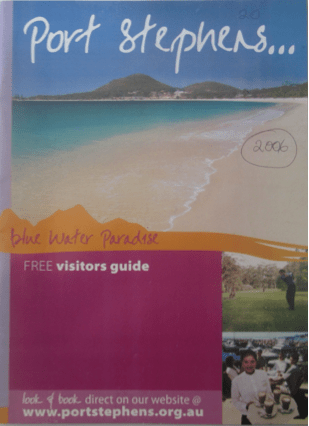
Port Stephens Visitor Guide 2006 – the first issue to promote the theme of a ‘Blue Water Paradise’
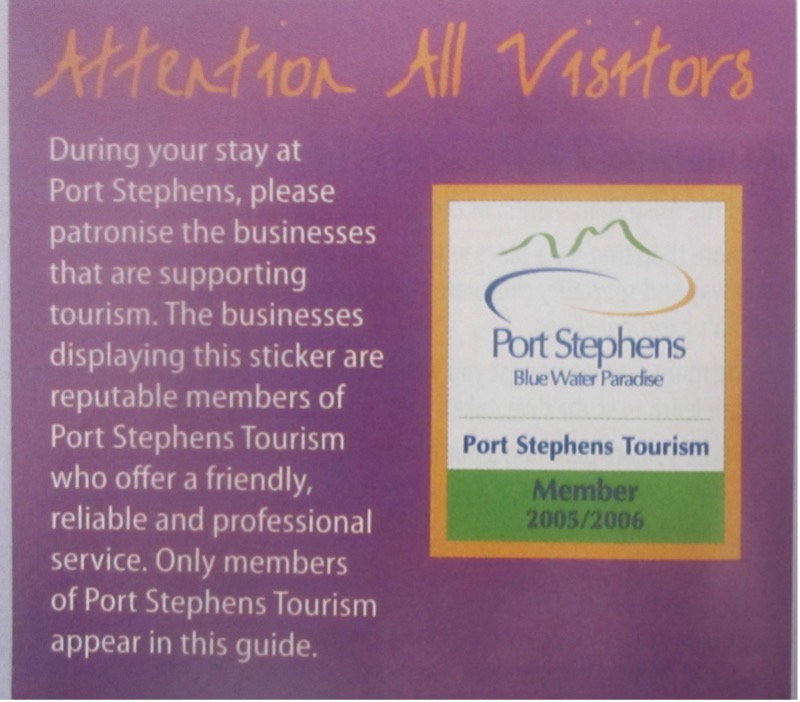
The above notice published in the 2006 visitor guide invites tourists to look out for the Port Stephens Tourism Limited membership sticker and thus patronise the businesses that were supporting Port Stephens tourism.

2010 Port Stephens Visitor Guide 2010 – the first issue to promote the theme of ‘Port Stephens I Love You’
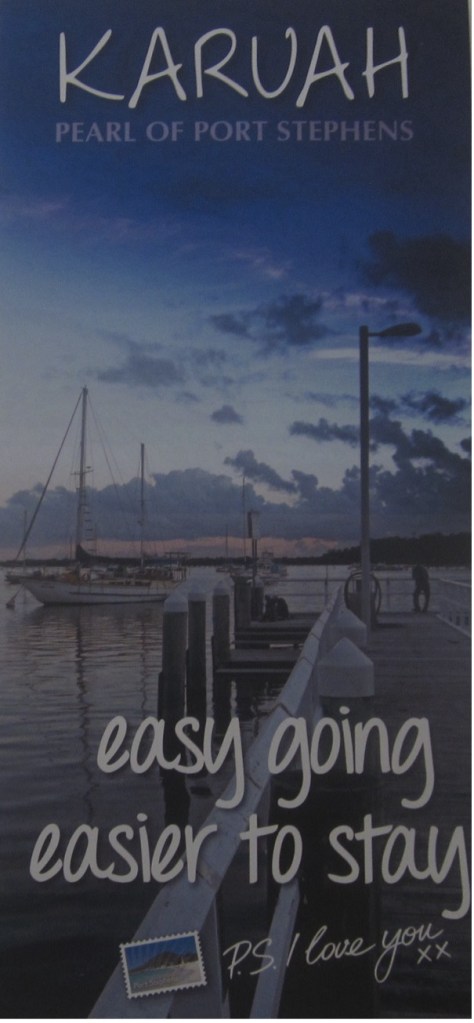
‘I Love You’ Brochure promoting the Karuah area.
Destination Port Stephens
In 2013, Destination Port Stephens took over the marketing of tourism to Port Stephens.
The theme of ‘Port Stephens I Love You’ was continued for several years. A new marketing programme started in 2021 by promoting the area as ‘Incredible by Nature’.

Port Stephens Visitor Guide 2021 – the first issue to promote the theme of ‘Incredible by Nature’
Apart from the publication and distribution of promotional material, Destination Port Stephens, also organises and markets special events that attract visitors to the region.
Concluding Comments
From its beginnings in the 1870’s, tourism promotion in the Port Stephens has progressed from an ad hoc promotion of individual attractions and local areas, to modern professional promotional initiatives.
While this paper focuses on the history of the promotion of the tourism industry as a whole, the industry has been underpinned by the activities of many dedicated tourist operators and organisations who have attracted many tourists to the blue water paradise of Port Stephens.
Information of some sporting activities that have also drawn competitors and tourists to the Port Stephens area can be found at the following links on this website:
Early History of Game Fishing at Port Stephens
Tea Gardens Horse Racing Track
Motor Cycle Racing at Morna Point Beach
Early Years of the Mungo Brush Regatta – Myall Lakes
Early Sailing Regattas at Port Stephens
POSTSCRIPT
A Changing Tourist Industry – a Walk Down Memory Lane
An examination of various Port Stephens tourist brochures and visitor guides illustrate that many attractions and accommodation premises have remained constant over an extended period.
There are however a number of attractions that are no longer operational. A look at the following brochures tell of the changing dynamics of the industry but are testament to the entrepreneurs of these activities and will bring back many memories.
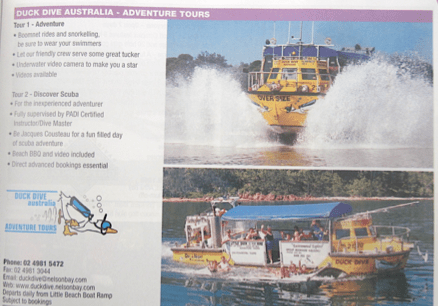
Duck Dive Adventure Tours that departed daily from the Little Beach, Nelson Bay [2005 Visitor Guide.
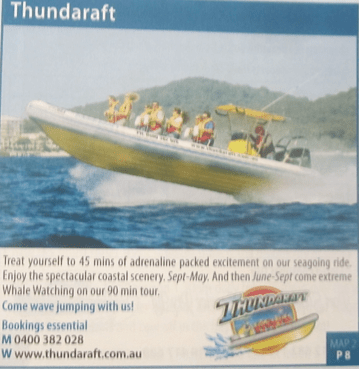
Thundaraft adrenaline packed excitement [Visitor Guide, 2006]

You can no longer tame the X-Factor at Port Stephens [2006 Visitor Guide]

Flights over Port Stephens in an Aeroplane Seaplane are no longer operated from the Anchorage Marina, Corlette [Visitor Guide 2006]

Newcastle Helicopters no longer operate flights from a helipad that was situated on Nelson Bay Road, near the Council Depot [2009 Visitor Guide]

While there are still plenty of things to see in Port Stephens it is no longer possible to see the sights in a ‘cheeky little topless Moke’ hired locally [Visitor Guide 1994]

Divers Luck Boutique Winery at ‘Hellenvale’, Bobs Farm is now closed [2005 Visitor Guide]
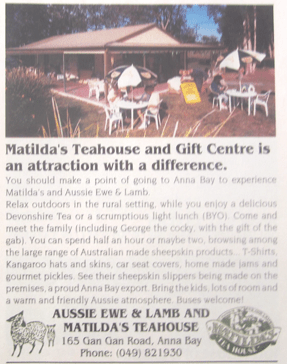
Assie Ewe and Lamb and Matilda’s Teahouse and Gift Centre at Anna Bay. A housing estate now occupies the site [1994 Visitor Guide]

Kids Romp and Stomp Fun World. Children can no longer Romp and Stomp at Nelson Bay [Visitor Guide 2006]
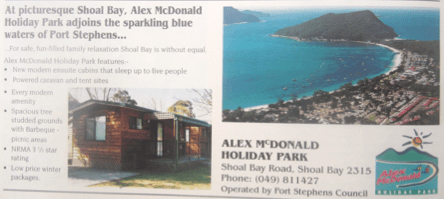
Alex McDonald Holiday Park is now branded as the Shoal Bay Holiday Park and is still operated by the Port Stephens Council [1994 Tourist Guide]
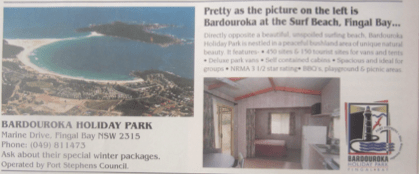
Bardouroka Holiday Park is now branded as the Fingal Bay Holiday Park and is still operated by the Port Stephens Council [1994 Tourist Guide]
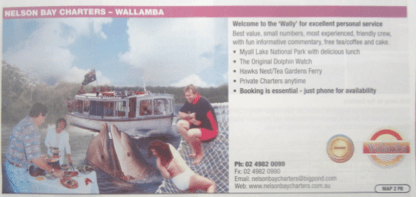
‘Wallamba’ [Wally] the Hawks Nest / Tea Gardens Ferry has been operated by The Original Tea Gardens Ferry Company since 2015 [2005 Visitor Guide]
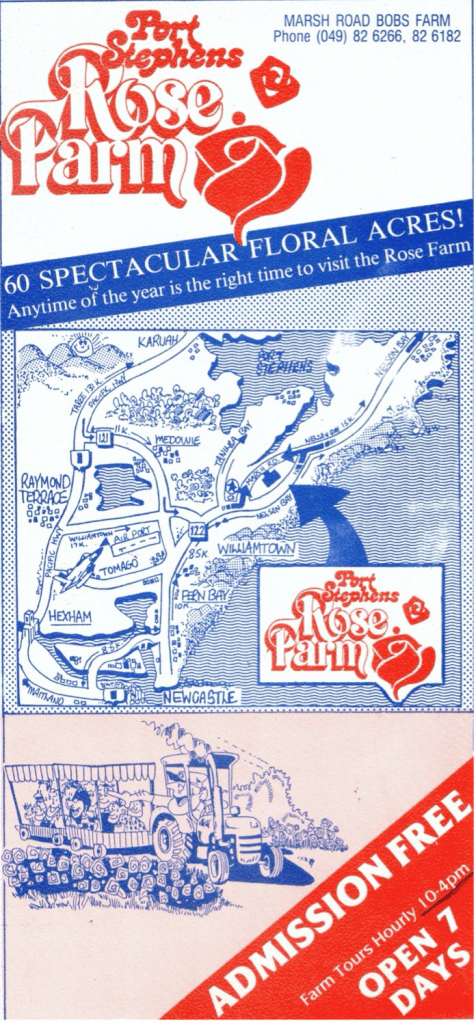
Port Stephens Rose Farm was a major tourist attraction on Marsh Road at Bobs Farm which opened in 1981. It closed in 1989 and is now the site of the Barramundi Farm.
Researched and compiled by Kevin McGuinness
August 2025

 Port Stephens - a history exploration