
Introduction
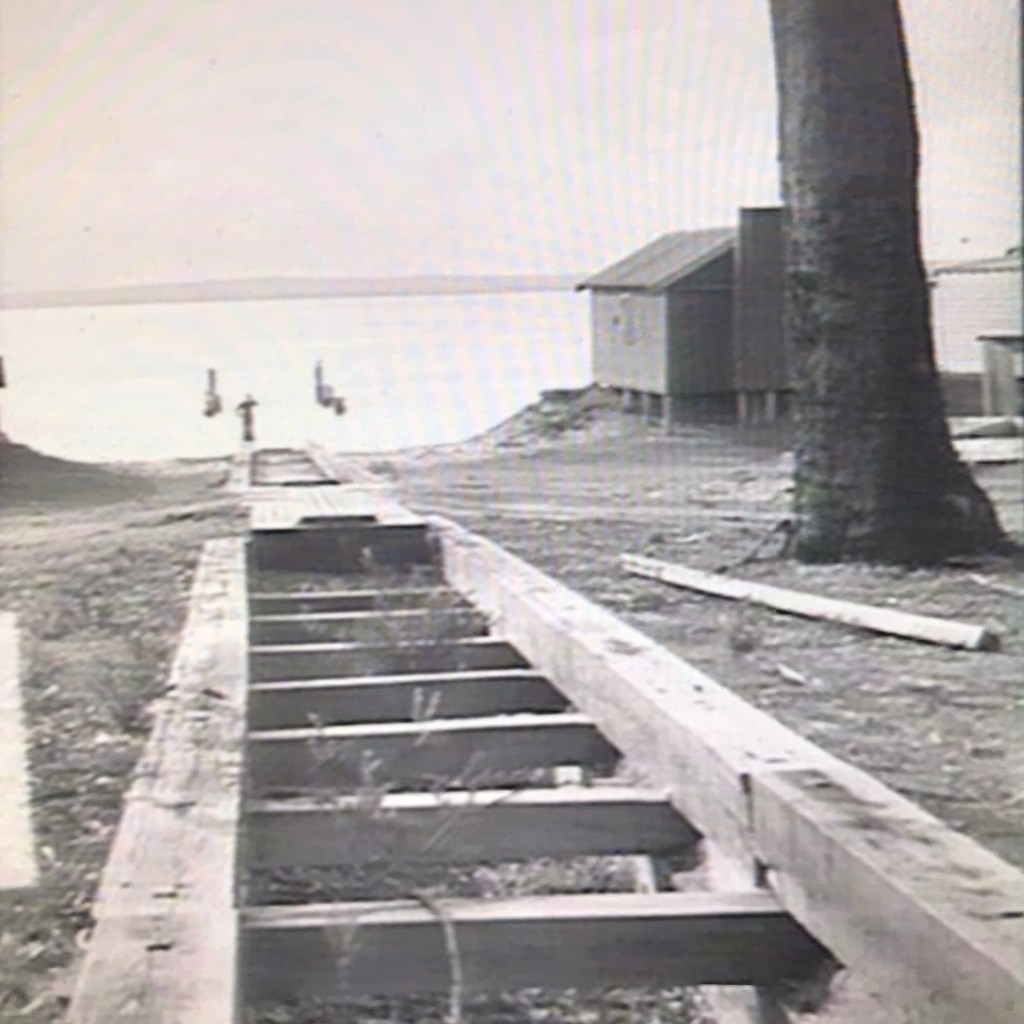
Prior to the Second World War, the northern side of Port Stephens was the location where most of the work on boat maintenance took place.
The boats requiring maintenance were those used in the fishing and timber industries, as well as passenger ferries.
Several slipways operated at various periods in the Tea Gardens area. This paper examines the history of the two more prominent ones, namely the Korsman slipway at Tea Gardens and the adjacent Birdwood Mill slipway that was moved from Winda Woppa to Tea Gardens.
Both slipways played important roles in keeping the extensive marine activities in Port Stephens operating efficiently.
The Korsman Family
Around 1901, Joseph Hollis Korsman, his wife, Esther Mary Diemar, and their children settled in Tea Gardens as oyster farmers. After their youngest children, Alfred James and Ivy L. were born in 1903, the family launched a boat and bus service mainly for transporting fish. It eventually expanded into a passenger ferry and mail service connecting nearby towns until 1955, when the Royal Mail contract ended.
The youngest son Alfred (Alf) James Korsman and his wife Dorothy Pearl [9nee Banks) also diversified into several local businesses, including running the Tea Gardens Service Station, starting bottled milk deliveries, and launching the first taxi service in 1950.
Korsman’s Slipway
In the early 1940’s, Tea Gardens lacked maintenance facilities to accommodate lthe arge Korsman ferries such as the 47-foot Yoothapuna, as both Engels slipway (on Witts Island) and Allen Taylor & Companys’ slipways (adjacent to the Birdwood Mill at Winda Woppa) were unusable.
Makeshift repairs on the beach proved inadequate, prompting Alf Korsman to see the need for a purpose-built slipway. In 1940, Alf chose a site for a slipway, opposite the family home at Tea Gardens, for its deep water and minimal tidal influence.
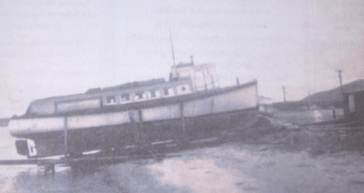
Ferry ‘Yoothapuna’ on the Tea Gardens slipway
The Dungog Chronicle of 21 June 1940, page 4, reported:
‘The District Surveyor of Lands advised of an application by A. J. Korsman for slipway 30ft. x 4ft. on Myall River, at Tea Gardens. (Tea Gardens Urban Committee approved the application). — Council approved.’
The Dungog Chronicle of 3 July 1948, page 3, reported:
‘Korsman Bros, are to install a new slipway at Tea Gardens. This site is opposite their private homes. It will have a deep-water frontage and accommodate boats used on their ferry service. Their fish and supply boat ‘Cambewarra’ which services the Myall Lakes is now under general repairs. When completed, the Nelson Bay-Tea Gardens ferry boat ‘Yoothapuna’ is to be refitted with a new ‘Gardener’ diesel engine.’
In 1948, Korsman Bros. successfully acquired and transported a Second World War ‘Government Slipway’ from Little Beach, Nelson’s Bay to Tea Gardens.
The Dungog Chronicle of 11 September 1948, page 5, reported:
‘Korsman Bros, were the successful tenderers for the naval slipway at Little Beach. This will now be transferred to Tea Gardens to a site opposite their residence, which has already been granted by the Land Board.’
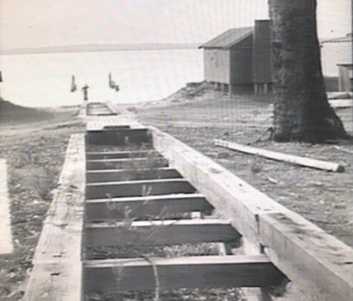
Second World War navy slipway at Little Beach, Nelson Bay – acquired by Korsman Bros. and transferred to Tea Gardens [Australian War Memorial]
The new Korsman’s Slipway began with a manual winch, later upgraded to combustion and then electric power. Construction occurred from September 1948 to December 1949.
The Dungog Chronicle of 9 July 1949, page 3, reported:
‘Korsman Bros.’ new slipway is getting well advanced. One of Allen Taylor’s punts (drogher) this week placed the heavy outer rail frames in position. It will not be long before we see trawlers and ferries being hauled up this slip way for repairs and cleaning. The main men doing this work are Mr. A. ‘Diver’ Duncan and Mr. C. Bagnall. These men have been the launch and boat doctors on the waterfront for years. Both claim they have built the best and fastest boats.’
The Dungog Chronicle of 10 September 1949, page 3, further reported:
‘The housing for the engine room for Korsman Bros.’ slipway is starting to take shape. This work has been hung up owing to the [coal] strike, getting wheels for the cradle for the slip being the chief factor.’
By November 1949, the Korsman slipway was operational, as reported in The Dungog Chronicle of 19 November 1949, page 5:
‘Korsman’s slipway is having a busy time. The trawler Betty Lou, which has just had her hull and bottom cleaned and painted, was water-borne on Sunday. The trawler Irene H took her place on the slip and had her bottom cleaned and painted and was water-borne on Monday. The passenger boat Yacaaba took her place; she was followed by the passenger boat Holly on Friday, and this will leave the ways on Sunday for the Hawk’s Nest ferry to be slipped on Monday. These boats are not overseas liners, but Korsman’s slipway is no Cockatoo dock with gangs of painters and dockers. Still it is one of the best assets launch and trawler men could have in this port. When labour conditions allow Korsman Bros, to complete the plant with repair and maintenance outfit it will save fishermen both time and money’.
Korsman’s Slipway continued to not only serve the Korsman family’s ferry fleet but was used for prominent vessels such as the Sirocco cruiser, belonging to Jack Davey, radio Quiz King and “Australian Amateur Hour” host.
The slipway also accommodated vessels from the Port Stephens Water Police, the former Hawkesbury ferry Berowra Star, private cruisers, Sep Tom, and the ‘Coweambah’.
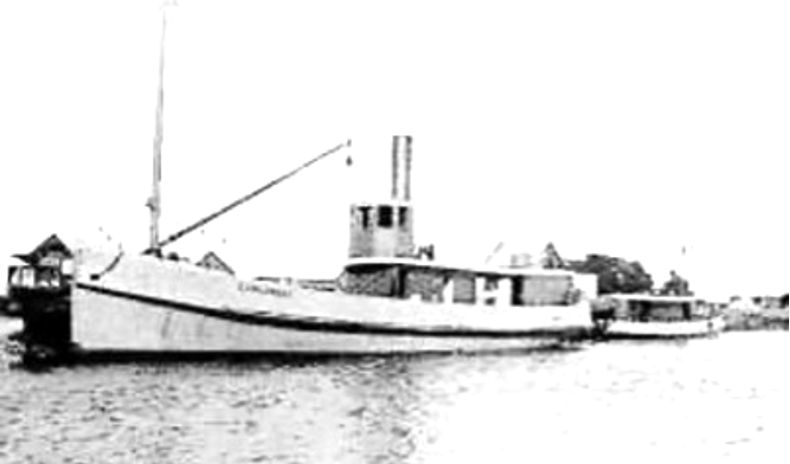
ss Coweambah
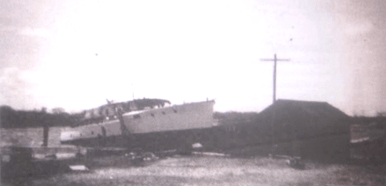
‘Sirocco’ – Jack Davey’s boat on the Tea Gardens slipway
Following the cessation of the Korsman ferry operations in 1955, ownership of the slipway passed to the Stroud Shire Council in 1956. Maritime operations at the Korsman’s Slipway ceased around 1961 and it was removed.
Current Tea Gardens Slipway
In 1954, the slipway of the Birdwood Mill at Winda Woppa was relocated to a site on the waterfront at Tea Gardens, adjacent to the Korsman slipway.
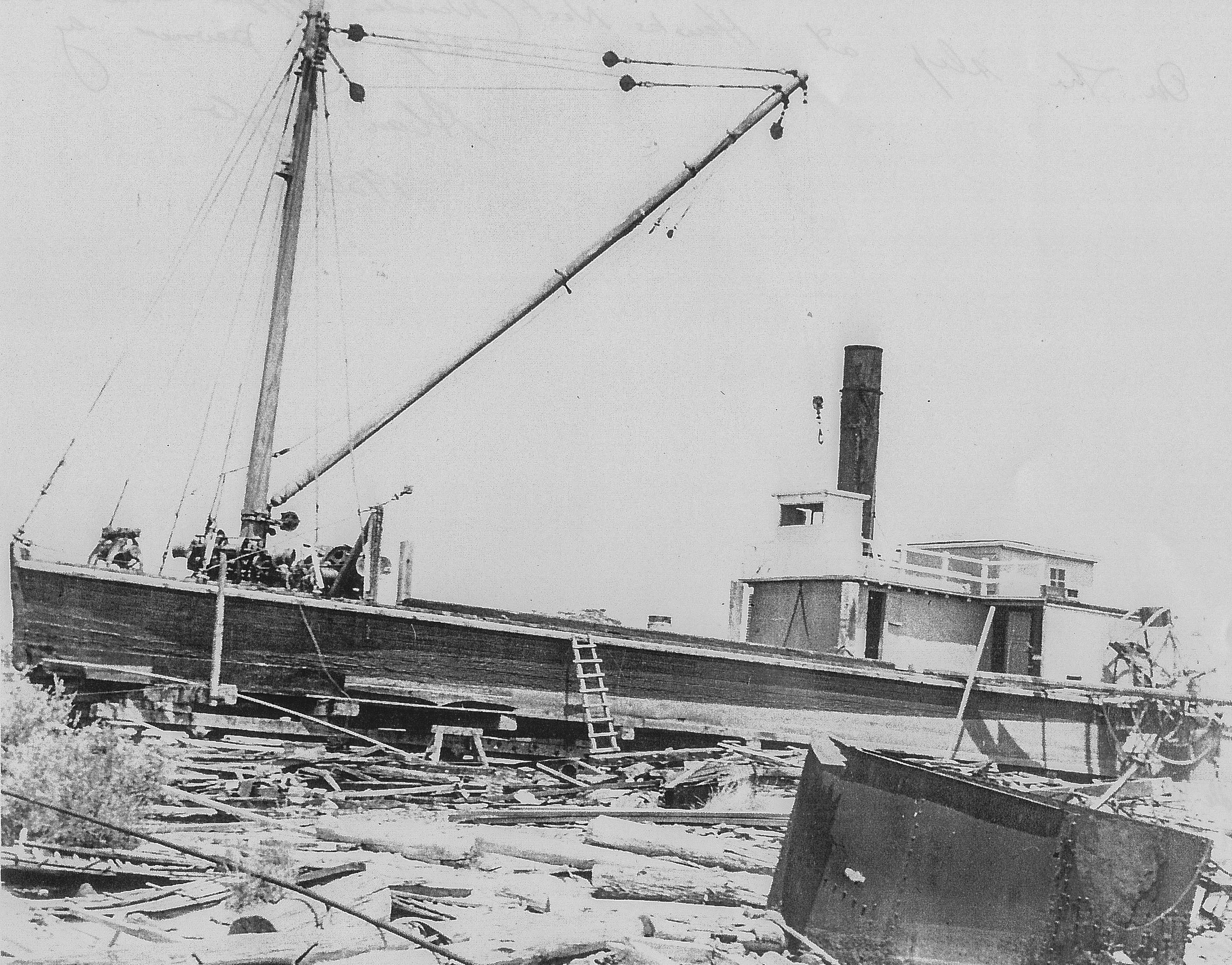
The ‘Swan Bay’ paddle wheel steamer drogher on Windy Woppa sawmill slip – 1950. The drogher was skippered by Eric Engel with Harry Phillips as engineer. The drogher previously operated in the Ballina area, before being purchased purchase by Stan Phillips to transport logs from Meyers Point and Bulahdelah to a mill at Oyster Cove. The winching gear was transferred from ex-wartime ships at Stockton prior to scrapping.
By 1980, local boat owners assumed operation of the Tea Gardens slipway as a community asset, leading to incorporation as an Association in 1988.
Over time, the Association replaced all the original Birdwood Mill equipment, leaving no remaining infrastructure from either the Korsman or Birdwood Mill slipways.
The current slipway occupies the site of the former Birdwood Mill slipway at Tea Gardens.
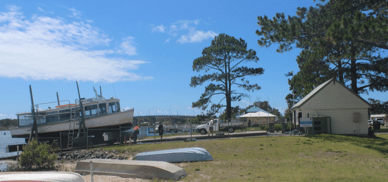
Ferry ‘mv Wallamba’ undergoing maintenance at the Tea Gardens slipway – December 2023 [Author photo]
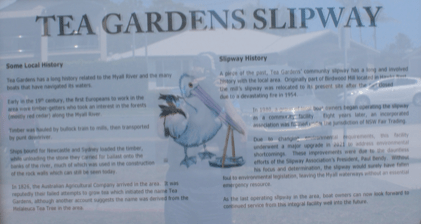
Signage at the Tea Gardens slipway [Author photo]
Concluding Comments
The current upgraded Tea Gardens slipway is all that remains on the northern side of Port Stephens of the boat maintenance operations that once thrived in the Tea Gardens area.
Other papers dealing with boat building at Port Stephens are found at the following links on the website:
History of Boat Building at Port Stephens
Historic Photos of Boat Building at Port Stephens
Researched and compiled by Kevin McGuinness
August 2025

 Port Stephens - a history exploration