
Introduction
The Sydney Morning Herald of 18 April 1936, page 13, published the story of Tea Gardens and surrounding areas written by its correspondent, W. Gilmour.
Soon after, the Dungog Chronicle of 22 May 1936 published an article written by a correspondent who used the pseudonym of ‘Observer’ . This looked at the shift of commercial enterprise away from Hawks Nest to Tea Gardens.
Both articles are reproduced in full and provide interesting insights into the early years of the development of the two settlements on the northern shore of Port Stephens
Story of Tea Gardens by W. Gilmour (Sydney Morning Herald, 18 April 1936)
‘Happily, placed on the green hills of the southern shores of Port Stephens, within three miles of the entrance, stands Nelson Bay. Compared to this pretty little holiday resort, with its mathematically arranged camping sections fringing the bay, its park, and pleasant outlook, Tea Gardens is nowhere. For the latter, backed by low swamp land and acres of uninviting scrub, appears as if it might be swept away by the first old man flood that comes down the Myall River.
Tea Gardens, however, has its own unassuming attractiveness, and, moreover, it is a timber, trading, and fishing centre, the link between the Myall Lakes and Port Stephens.
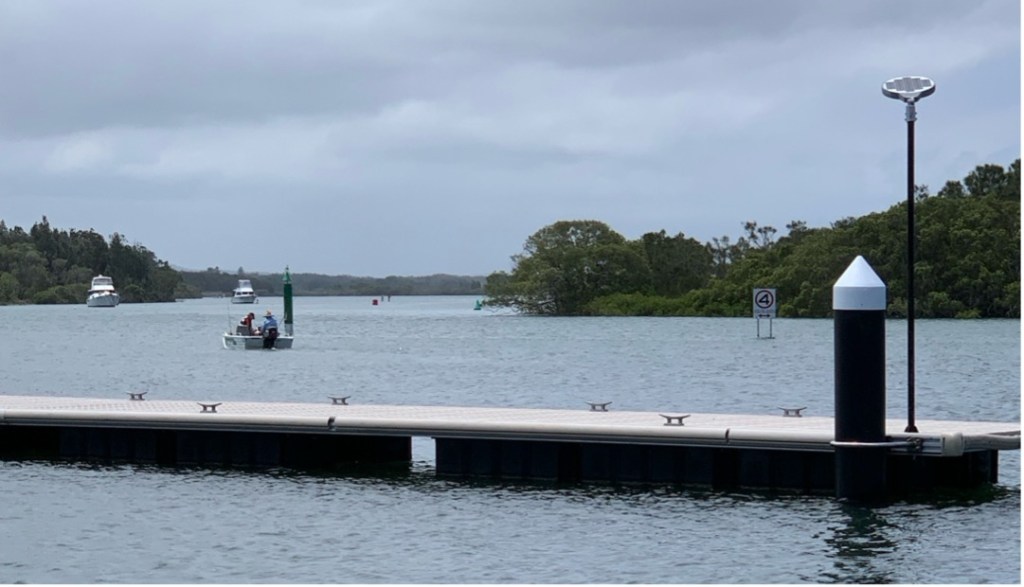
The Myall River at Tea Gardens [Author photo]
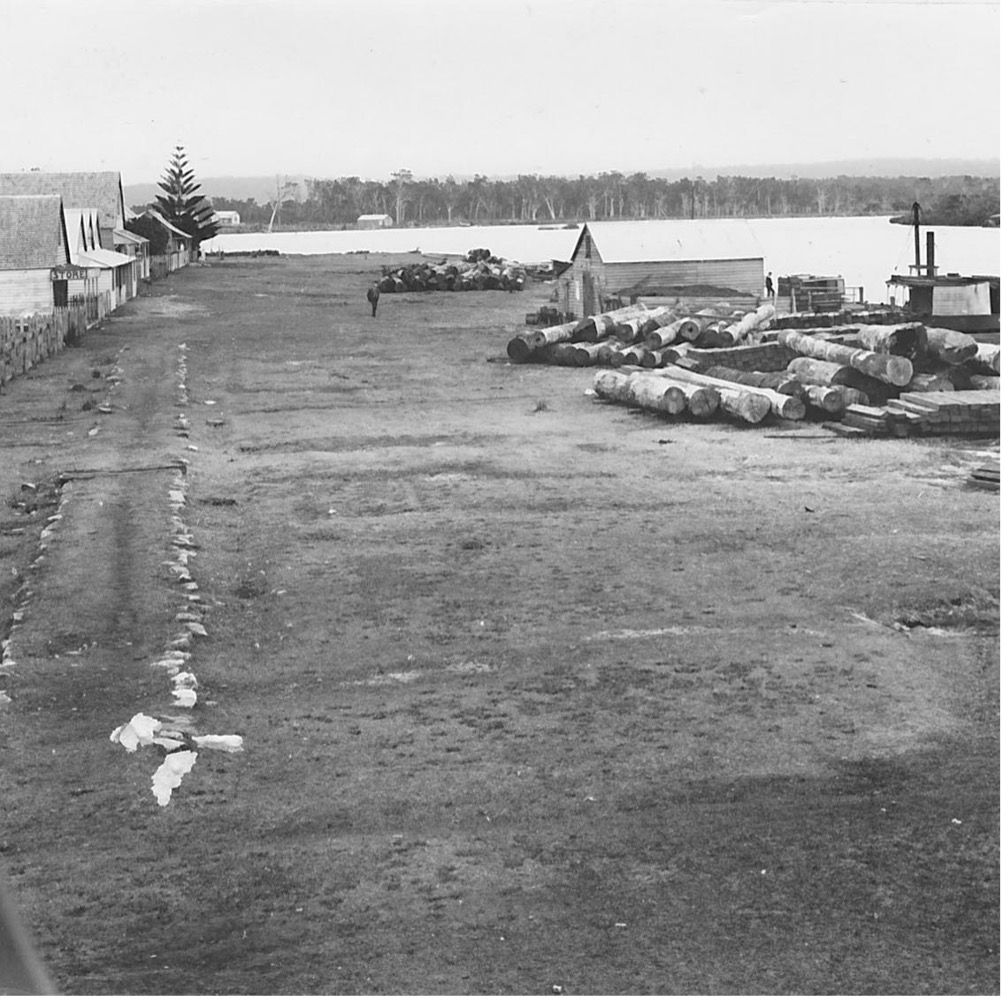
Most of the waterfront consists of a green riverbank, picturesquely untidy, with nets drying in the sun, upturned boats, launches idly rocking at little landing stages and wharves where small steamers are busily loading or discharging their cargoes. Tea Gardens, they say, got its name because fishermen boiled their billies on its foreshores long ago, and you will also hear the story of a wreck on the ocean beach of a sailing ship, from which wicker baskets of tea were brought to dry on the banks of the river. But these explanations must give way to another, in which a woman figures.
The waterfront at Tea Gardens [Sydney Morning Herald, 18 April 1936]
Sometime after the arrival in 1830 of Sir Edward Parry, the second commissioner appointed by the Australian Agricultural Company, a party on a visit of inspection passed up the river. One of the number, Lady Parry, impressed by the grace of the tall paper-bark tea-trees that grew behind the mangroves, made the suggestion (hardly to her credit, one must admit) that the company should grow tea at that place. Hence the name. It is just as well, however, that the whim did not materialise, for the estuary of the Myall is better fitted for the production of oysters than tea, as the wide oyster-beds of Holbert-town and Corrie Island have proved.
If, at sunrise, you chance to stroll along Tea Gardens’ extensive “promenade,” you will see a heterogeneous group of waterfowl stationed in the shallows between the mangroves of Slip Island and the mainland-black and white shags, drying their wings in the wind: fragile, motionless snow-white cranes, stealthily eyeing the flow about their stick-like legs; and dignified old pelicans, the last to take flight at your approach.
Throughout the day, great square, steam barges, loaded with logs from the Myall Lakes and throwing up fountains of water In their rear, make their stolid way to wharf or mill. And every morning at six a little launch, full of workmen, leaves the centre of the town for the Winda Wappa sawmill across the widening estuary, and returns with the same dependable promptness shortly after four o’clock in the afternoon. This [Birdwood] sawmill was built during the [First world] war and puts out 1000 super feet of sawn timber an hour. Its annual purchases amount to 3,000,000 super, feet of logs. It has been in continuous operation since its commencement, and, during the boom period, produced more timber than any other mill on the North Coast.
In the seventies, Tea Gardens was “all bush,” Michael Murphy’s bark hut being the only habitation. Forty years later the Engel brothers, who in 1888 had taken up grazing land in the Fens, several miles up the river, and were forced to give it up, owing chiefly to the disastrous floods of ’93 and ’95, came to Tea Gardens, and built up a butchering and baking business.
A Dungog party gathers wildflowers near Tea Gardens [Dungog Chronicle, 24 September 1937]
Meat was delivered across the lakes and as far south as Nelson Bay by oar and sail. To-day the company makes bi-weekly launch trips [via store boats] to the various settlements on the Myall Lakes and has a similar service to Port Stephens, supplying the isolated settler with anything he wants from a packet of biscuits to the latest wireless cabinet, whilst the 80-ton Coweambah, which runs to Newcastle twice a week, and has the reputation of adhering to her timetable in the face of anything less than a hurricane, caps her outward cargo with timber, and returns with a deck load of coal.
Hawks Nest, on the eastern bank of the Myall, halfway between Tea Gardens and Winda Woppa, was the first settlement. Over seventy years ago, Stewart Smith came here, and ten years after his arrival built the hotel which is now used as a dwelling. Those were the days when men wore home-made cabbage tree hats, valued at £3 a piece, and drank honey beer. The blacks received 10/ a kerosene tin for collecting wild honey, from which the beer was made, and there was always a demand for the clarified article in the Sydney market, where it brought 25/ to 30/ a tin.
Shell-digging for lime, fishing, and timber cutting were the first industries. A sawmill, the remains of which are to be seen on the river front, was run by Livingston and Buckman, and afterwards Henderson. Mr. William Hough, an old identity of the district, speaks of the days when he used to light a fire on the bank of the river, near the present ferry, to attract the attention of the mill workers who, seeing his smoke signal, rowed over to pick up their meat supplies.
At first, a retired doctor, by the name of Keogh, taught the few children at the settlement, but later a school was built, at which Mr. P. Kruckow was teacher. But Hawk’s Nest and its school lapsed with the growing importance of Tea Gardens,
As you tread the great sweep of white sand southward to the entrance of Port Stephens, you will notice a huge gap of 500 yards in length, through which, in times of storm, the breakers and inland waters almost meet.
A short climb takes you to the top of the tree-clad northern headland of Port Stephens, and from this 700-foot eminence of granite-like rock, grass, and scrub one of the finest panoramas of the coast of New South Wales is seen. Immediately across the narrow gateway to Port Stephens is Tomaree, 500 feet in height, its seaward cliffs aglow with rich colours, and its green summit bathed in sunshine. Eastward, a long strip of land terminates in the lighthouse.
Close inshore lies Cabbage Tree Island, with flat Boondelbah, like a sleeping monster, beyond, then stony Little Island, a spot on the surface of the sea. To the north is hummocked Broughton Island, noted for its lobsters. Southward, the rocky coast merges into sand towards Newcastle, whilst inland, the vast surface of Port Stephens spreads its waters of light and dark green bearing evidence of varying depths. The winding Myall, lost in bush, with the ranges on the horizon, complete the circle to the north, whilst Tea Gardens, at the mouth of the river, appears like a few scattered matchboxes on the water’s edge.’
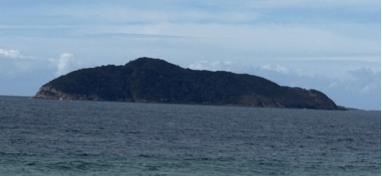
Cabbage Tree Island as viewed from Hawks Nest [Author photo]
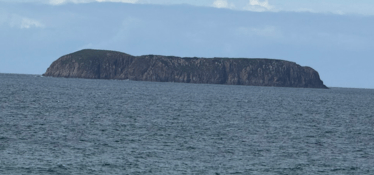
Boondelbah Island as viewed from Hawks Nest [Author photo]
Story of a Changing Tea Gardens (Dungog Chronicle, 22 May 1936)
‘It is extraordinary how, in a small space of years, everything, or practically everything, in a town can change. It is not so long ago that the late Mr. Hagan [1842 – 1930] shifted the town of Tea Gardens across the Myall River from Hawks Nest in a row boat. In those days the little town was isolated, being reached only per boat, the road not being fit for a bullock dray. Everything was on the water, mails, stores, butchers, etc, etc.
Some years went by and the late Mr. Franklin was elected as Councillor and had to journey to Stroud to attend the meetings. He had to travel to Newcastle and thence to Stroud Road by train, over 100 miles, instead of 30 odd. He agitated for the construction of the road, but did not get much encouragement from his fellow councillors, but not daunted he pegged away with the tenacity of a bulldog. He got the late Hon. W. Bennett, M.L.A., to work. The result was that big grants and loans were obtained from the Government to the tune of some thousands of pounds. A special rate was gladly paid by the landowners and eventually the track that was once a series of holes, ruts, and quagmires, became a road — not a highway it is true, but nevertheless trafficable, which meant that the little town which hid itself on the banks of the Myall became connected with the outside world by road.
Motor services were started, and have continued ever since, and until the end of 1935 the service by water, which carried the Royal Mail, was continued. However, in these days of speed, the mail route was changed and now comes overland by car, and sad to relate the route through our magnificent harbour is no longer traversed.
The industries have also had changes. The oysters, which were once taken from the rocks and the bed of the harbour and rivers are now cultivated, or I should say farmed, as since the oyster king, Mr. Frank Holbert, discovered that they thrived better on the mangrove sticks, improvements on improvements have been made until an up-to-date oyster lease is worked on the same principal as an agricultural farm.
The methods of netting fish have also improved, but many of those once famous for big hauls of fish have turned their attention to the new industry — prawning. The prawning industry is only in its infancy, nevertheless, I have known as much as £200 worth to be caught in a night. At the present time those engaged in catching the elusive prawn wait for him to come into the net. It should not be long before some enterprising prawner gets impatient and takes his net to the prawns’ haunts in the lakes.
The timber industry, still flourishes, and now the pine plantation is replacing some of the many forest giants that have been hewn in years past. The fish canning at Pindimar is booming and other small industries are pegging away. However I am getting away from my subject, so let’s get back.
Some ten or twelve years ago Mr. L. Bennett got a notion to shift Tea Gardens to the ocean beach and proceeded to do so with a horse and slide — sawn timber and iron by the load — and soon he had a cottage erected in the wilderness — a fit place for a hermit. Then a half chain track was cleared, but it was beyond comprehension what it was for as in those days no vehicle could cross the river, and he had it to himself to travel with the old horse and slide.
Then Lang Wood & Co. had a subdivision sale of Hawks Nest estate and a few cottages and “shacks” bobbed up.

Hawks Nest Estate plan [NSW State Library]
Then, thanks to the enterprise of Messrs. G. A. Engel & Sons, came the launch-towed ferry.
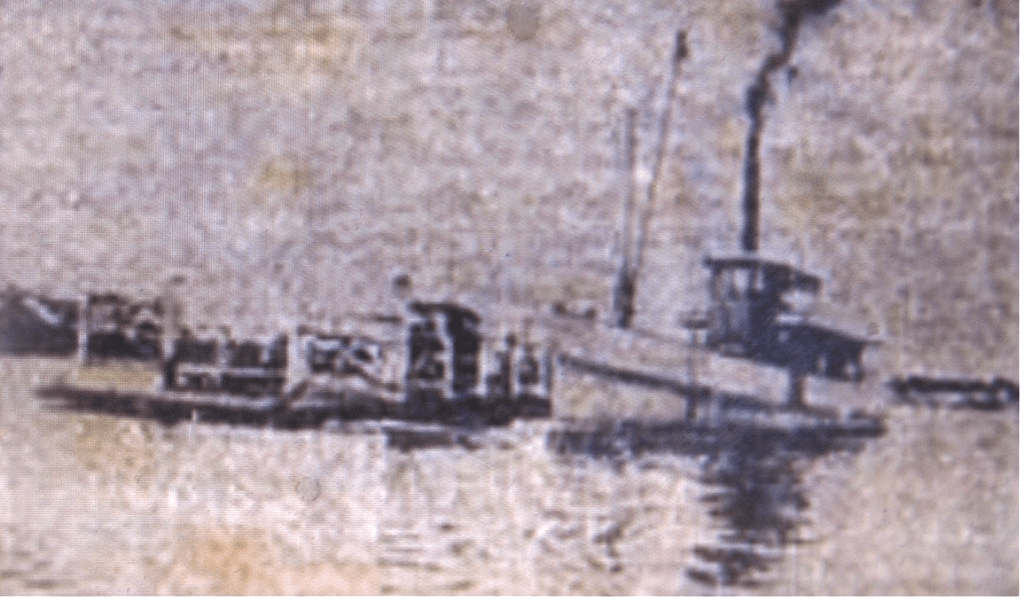
The first Tea Gardens – Hawks Nest ferry propelled by a launch
Then the park area at the beach began to attract notice, and Messrs. Pyman and McRae set to work in conjunction with the Progress Association or the Parents and Citizens’ Association (I am not sure which) and a spear point was put down and the pump brought forth beautiful clear-water. So it came to pass that fresh water was now available at the once fresh waterless beach. Fishermen and picnickers came in droves and with the funds of the Show Association a weather shed and sanitary conveniences were built. Then Engels made a road and jetty and put an up to-date punt to convey vehicles across the river, and obtained a lease of the park at the beach with a view to making it a camping area with all facilities and conveniences.
But seeing the wonderful possibilities the Urban Committee and Shire Council asked the firm to surrender the lease and give them the area to develop. This the firm agreed to do and for their generous action they deserve the thanks of the community. Now I understand there are to be installed hot and cold water showers, dance floor, kiosks, fire places, etc, etc., and the whole area is to be covered with nice green grass.
So many changes have been made that it makes one wonder whether that old horse and slide will change the site of our little town once again. Somehow, although I would hate to see it, I am afraid it will. We cannot lose sight of the fact that the beach is the finest in Australia and is within easy distance of Newcastle, Maitland, the mining centres, not to mention the country districts embracing from Singleton to Gloucester, and in these days of motor cars it is only a nice run from any of those centres.
Further, I understand, a road is to be made on to the beach so that motorists can have a 20 mile spin on the hard sand and inhale the ozone at the same time. In 1916 we were led to believe that this same land would be inundated with troops — now the soldiers are to be replaced by pleasure seekers. What a change!’
Concluding Comments
Three years before the publication of the above two articles, it appears that there had been growing local opinion that the name ‘Tea Gardens’ should be changed, which history shows did not happen. The Dungog Chronicle of 17 March 1933, page 4, published the following flippant article on the Tea Gardens name:
‘Opinion appears to be gaining adherents that the name of Tea Gardens is a misnomer and should be changed. Those unacquainted with the town assume it to be a tea plantation or something else that the name may appear to indicate. Visitors who happen along always ask how the town came to be christened Tea Gardens.
We are living in times of change, and it is thought the locality may under a new name justify itself in a manner more worthy to the historic past. It is said that a rose would smell as sweet by another, name, but after all there is something in a befitting name! If there is to be a change in name let it be truly Australian, and a compliment to the original Australian inhabitants who after all had a meaning significant to respective localities. In this they had wit and wisdom. We should emulate them in this matter at any rate. A certain circumscribed area of this district was known to them as Coweambah, but the urban area known today as Tea Gardens was known to the aboriginals as Bowairabah. Its meaning had reference to the Ti-tree which grows in abundance in the locality, and which by the way is being capitalised by Mr. Bill Ripley at Ripolin mill. No doubt this reference to the ti-tree was responsible for the town being dubbed Tea Gardens.
There is something euphonious in the name Bowairabah and having regard to facts serious objection should not be raised against a re-christening. Under a new name we may enjoy a new punt, a new tourist area, new roads, and a new prosperity.’
A number of other papers describing aspects of Tea Gardens and Hawks Nest history are published on this website and can be viewed at the following links:
Tea Gardens – Hawks Nest Ferry Service
History of Early Hotels at Hawks Nest and Tea Gardens
Installation of an Electricity Supply to Tea Gardens and Hawks Nest
Early Days of Hawks Nest – Port Stephens
Tea Gardens Urban Area Committee
St. Andrew’s Anglican Church at Tea Gardens
Going to the Movies at Australia Hall – Tea Gardens
Country Women’s Association – Tea Gardens
Tea Gardens Amateur Dramatic Society
Tea Gardens Aerial Plane Thrills – 1930
Tea Gardens Horse Racing Track
Researched and compiled by Kevin McGuinness
August 2025

 Port Stephens - a history exploration