

Introduction
The twin screw steamer Allenwood was originally launched as the Allenby, named in honour of Field Marshal Edmund Henry Hynman Allenby, 1st Viscount Allenby, on 17 December 1920.
The steamer was constructed by John Wright & Co. Ltd., shipbuilders of Tuncurry, for Allen Taylor & Co. Ltd, operator of the Birdwood Timber Mill at Winda Woppa, near Tea Gardens, Port Stephens.
Soon after construction, the name of the vessel was changed from Allenby to Allenwood. Prior to the Second World War, the steamship was a frequent visitor to Port Stephens to load timber.
The SS Allenwood was easily recognised among other similar vessels as she had two funnels. Throughout her operational history, the Allenwood encountered numerous incidents.
On 29 July 1941, the Allenwood was requisitioned by the Royal Australian Navy as an auxiliary minesweeper and fitted with armaments including a 12-pounder gun, a 20mm Oerlikon cannon, and a .303-inch Vickers machine gun. The vessel was then renamed the HMAS Allenwood.
This paper examines the launching and operational life of the steamship, before it was wrecked in 1951 near Norah Head, New South Wales.
Building of wooden steamers at Wrights shipyards at Tuncurry
The Allenwood was one of the many wooden steamships built at Tuncurry, on the NSW mid north coast. The Newcastle Morning Herald and Miners’ Advocate of 17 May 1947, page 5, published the following reflections by Frank Avery who helped build the ships at Wright’s and Company ship building yards at Tuncurry, including the Allenwood:
‘Australia’s largest wooden steamer, the Uralba (603 tons), commissioned in 1942, was built by hand tools at Wright and Co’s. shipbuilding yards, Tuncurry. For 85 years, ships have been built at Tuncurry with adzes, axes, chisels and other hand tools. Timber used in the ships is carried from forests, 40 miles from Tuncurry, by paddle-wheel punts.
A native of Tuncurry, Mr. F. R. Avery is foreman at the yards. He has been building ships for 44 years. ….
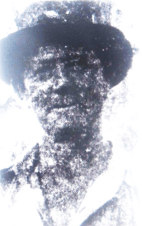
Frank Avery [Newcastle Morning Herald and Miners’ Advocate, 17 May 1947]
“You cannot beat a thoroughly made wooden ship,” said Mr. Avery. He pointed to a 126ft. hull on the slips. ‘”She has a piece of 12×12 iron bark. 75ft. long, in the keel. Like the kelson, stem and apron it was squared with axe and adze.” Mr. Avery said Australian hardwoods were ideal for shipbuilding. Tuncurry shipwrights use spotted gum, iron bark and tallow wood for hull timbers, and ti-tree for knees and decks.
At Cape Hawke (Tuncurry) ships were first built 85 years ago by the late John Wright, who came from Scotland. Many ships still trading on the New South Wales coast were built at Tuncurry. The yards are now managed by Mr. A. W. Wedlock, son-in-law of the late Mr. E. Wright, son of the founder.
During the war, the 56 men at the yard fashioned 23 small ships, ranging from 45ft. tugs to 85ft. cargo carrying ships. Since the war ended, they have been working on private contracts. Now on the slips is a 126ft. 200-ton Diesel passenger cruiser, its building for a Queensland owner, and two fishing trawlers. A third trawler is being fitted out. Coastal steamers well-known at Newcastle, which were built at Tuncurry, include the Tuncurry, Allenwood, Nambucca I, Nambucca II, Bellingen and Uralba.’
The Dungog Chronicle of 21 January 1953, page 2, also published reflections on early shipbuilding at Tuncurry:
‘About 1875, the late Mr. John Wright, the late Mr. Alex Croll and the late Mr. E. Rogers, of Camden Haven were in partnership in a sawmill at the Myall Lakes. On the dissolution of this partnership, Mr. Wright came to Tuncurry — then known as North Shore — and established a sawmill and store.
The place was then densely overgrown with low scrub, mostly ti-tree, with lofty cabbage tree palms dotted about in abundance. Among the workmen brought by Mr. Wright from the Myall Lakes were the late Mr. Abe Mills, who was his foreman for many years, and the DeLore brothers.
The late Mr. John Wright was a fine type of employer. In fact, his workmen’s sons and grandsons, as they grew to manhood, worked in the mill. Being a shipwright by trade, Mr. Wright also started a ship-building yard. The first vessel he constructed was the well-known tug, the Marian Mayfield. The Stanley, a ketch, was built at the yard, also the following steamers: Bellinger, Tuncurry, Comboyne, Glenreagh, Neranie, Tuncurry (the second), Allenwood, Wallamba, Nambucca, Our Jack, and the tugboat Buccra. Besides these, he built a number of small craft, log punts of various descriptions, pontoons, and ferry punts.
Launch of the Allenby (later reamed Allenwood) – 1921
‘The Manning River Times and Advocate for the Northern Coast Districts of New South Wales of 8 January 1921, page 6, reported:
‘On Friday, December 17, the 13th steamer built at Mr. Ern Wright’s shipyard [at Tuncurry] was successfully launched and is now riding the waves while her timbers are swelling, preparatory to being towed to Sydney to be fitted with her engines. This boat was built to the order of Messrs. Allen Taylor and Co., and as she left the ways to take the water she was christened the Allenby, after General Allenby, the pleasing little ceremony of swinging the bottle and giving the name being performed by Wilga Wright, daughter of Mr. Ern Wright, the builder.
The ship took the water beautifully, and the launching is described by those who witnessed it as the best yet carried out at the works. The Allenby has a length of 146ft. between perpendiculars, with 34ft. beam and 8ft 6in. moulded. There is a floor rise of 6in. Her dead weight capacity is 300 tons on a draught of 8ft. loaded. The top sides are built of Australian bluegum, while the bottom is of turpentine, with an oregon deck. The fittings throughout are galvanised.
She will have two 12 x 24 x 18 stroke compound surface condensing engines, and two 10 x 10 boilers set end on. There will be two smoke funnels, one fore and one aft. The electric light will be installed throughout. On deck she will be fitted with the McFarlane patent steam winches for handling cargo. The steamer is intended for cargo, principally hardwood timber, and in view of the fact that the Comboyne was recently lost, she will probably be put on to the Camden Haven trade.
The time usually occupied in the building of a steamer of this class is eighteen months but as this boat was required urgently a double staff of men—24 instead of 12—was employed, and she was run off the slips under twelve months. The steamer is to be loaded with about 120,000 feet of timber during the month, when she will be towed to Sydney to be fitted with machinery and equipment.’
Allenwood fitted with a Metters Windmill during trip to Sydney – 1921
The Manning River Times and Advocate for the Northern Coast Districts of New South Wales of 9 February 1921, page 2, reported:
‘The Tuncurry left for Sydney today, having in tow the new steamer Allenby, recently built at Wrights’ shipyards. Since being launched, the new hull has been fitted with a Metters windmill, which was doing the full complement of revolutions, and presented rather a novel appearance as she left the bay. Such device dispenses with the usual labour incurred in hand-pumping and consequently keeps the ship free of water and relieves the crew of any uncomfortable moments. Both craft are expected to reach Sydney during Sunday.’
Allenwood provides assistance to salvage the Wollongbar at Byron Bay – 1921
The Sydney Morning Herald of 16 May 1921, page 9, reported:
‘The North Coast S.N. Company’s steamer Wollongbar was blown ashore at Byron Bay on Saturday and is now resting in a dangerous position on the beach. She lies broadside on east of the Jetty, and has a list to seaward. …
Yesterday morning the North Coast Company despatched the steamer Allenwood to Byron Bay to salvage the stranded vessel. Under the directions of Captains Cuthbert and Gibson, of the Marine Underwriters’ Association, operations will be commenced immediately the vessel arrives. In the meantime, the steamer Orara, which left Sydney on Saturday for Byron Bay, has been ordered to stand by and render whatever assistance is possible. …’
The Richmond River Herald and Northern Districts Advertiser of 24 May 1921, page 2, further reported:
‘Allen Taylor’s new steamer Allenwood (which brought up the salvage gear for the Wollongbar) has now taken up the regular running between Camden Haven and Sydney. The Allenwood is a fine-looking vessel of 330 tons and is commanded by Captain Sivertsen. She has two funnels, twin screws, and replaces the steamer ‘Comboyne that was lost some months back at Brush Point, south of Wollongong. She has a draught of 7ft. 3in. forward, and 8ft. aft. when loaded, and can carry 120,000 feet of timber, and has sufficient deck spaces to carry piles 100 feet in length. The accommodation for officers and crew is spacious and quite up-to-date. Her cargo handling gear is modern and effective.’
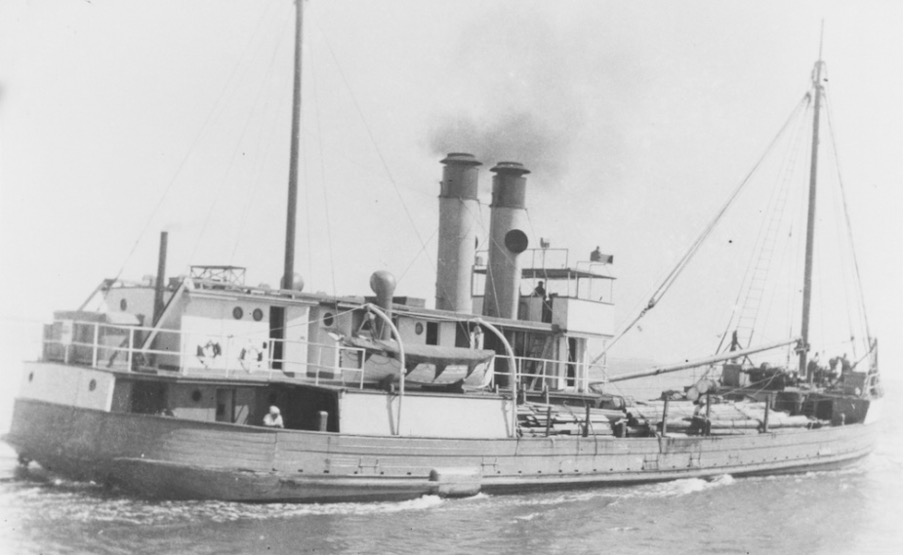
‘Allenwood’ loaded with timber
Allenwood goes adrift at Newcastle – 1922
The Sydney Morning Herald of 3 January 1922, page 7, reported:
‘The steamer Allenwood broke adrift [at Newcastle during a gale] and whilst she was being secured one of her crew had two of his fingers badly crushed.’
Allenwood collides with Coopernook Bridge – 1923
The Sydney Morning Herald of 6 November 1923, page 10, reported:
‘The steamer Allenwood, in going through the Coopernook bridge yesterday, on the Lansdowne River, ran into the structure and damaged it so that it cannot be closed. Some of the gear has to be sent to Sydney for repairs before traffic can be restored. Great inconvenience is caused, as the bridge is on the main North Coast-road.’
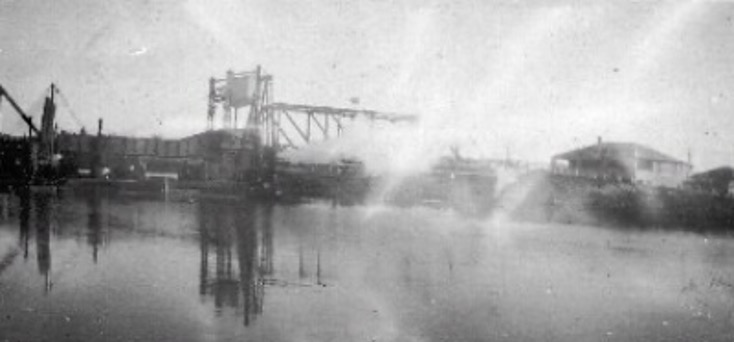
Coopernook Bridge with the lift span – 1934
Allenwood manned by a non-union crew during Industrial Dispute – 1926
The Telegraph (Brisbane) of 13 March 1926, page 9, reported:
‘The Allen Taylor steamer Allenwood, which was despatched to Camden Haven yesterday, was the last of the fleet of 20 coastal steamers to be manned by volunteer crews. The usual services now are being maintained without a hitch. Today a fleet of five steamers is listed to sail for various north coast ports, and four sailed yesterday for north and south coast ports. The position has ceased to cause any concern to the shipowners, who declare that the fleets are subject to less danger of delays under volunteers than under the union crews. The complete failure of the strike is being realised by both the seamen and waterside workers, and many are restive.’
Salvage gear despatched on Allenwood to the abandoned Steamer Jap – 1934
The Sydney Morning Herald of 4 April 1934, page 13, reported:
‘The wooden coastal steamer Jap (242 tons gross), which grounded on a spit about 200 yards north of the breakwater at Forster, near Cape Hawke, late on Monday night, is in a serious position. ….
The steamer went ashore shortly before 11 o’clock on Monday night, while being towed out of Forster by the tug Forster She was laden with timber for Sydney, and apparently swerved on to the spit. ….
Captain Stobo, marine surveyor for the Sydney Marine Underwriters’ and Salvage Association, Ltd left by train for Forster last night. He will inspect the Jap today. In case salvage was considered possible, pumping gear was despatched to the scene on board the coastal steamer Allenwood yesterday afternoon.’
The Newcastle Morning Herald and Miners’ Advocate of 7 April 1934, page 10, also reported:
‘Debris from the coastal steamer, Jap, which went aground near Cape Hawke on Monday night, is now being washed into Forster harbour. Wood, which comprised portion of the Jap’s cargo. as well as fittings from the ship itself, is now a menace to shipping, and night work is out of the question. The bar is in a bad condition for navigation, and the steamer Allenwood, carrying supplies for local storekeepers, has been bar-bound [outside the port] since Wednesday.’
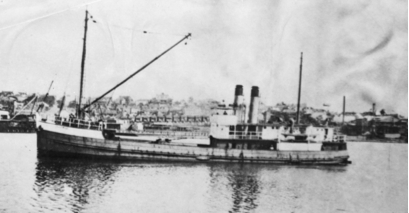
SS Allenwood [Australian War Memorial]
Allenwood tows a new steamship to Sydney – 1936
The Newcastle Sun of 17 June 1936, page 7, reported:
‘After battling five days to cover 123 miles the steamer Allenwood arrived at Sydney late yesterday from Cape Hawke with the hull of the new coastal steamer Nambucca in tow. The Nambucca, a wooden vessel, was built at Tuncurry for the North Coast S.N. Co., Ltd., and, when completed, will enter the Sydney to Nambucca River and Port Macquarie trade.
On Friday the Allenwood took the hull in tow. Progress at first was satisfactory, and then the weekend gale struck them. Most of Saturday the ships spent in shelter at Port Stephens. The Allenwood crept down the coast with her charge early on Sunday, but later in the day was forced to seek shelter again, this time at Broken Bay. The new ship behaved well, but the seas were so heavy that it would have been risky to continue. The Allenwood stayed in Broken Bay throughout Monday, and the tow was not resumed until yesterday.’
Sea Cadets save Allenwood from dock fire in Sydney – 1937
The Newcastle Morning Herald and Miners’ Advocate of 27 September 1937, page 7, reported:
‘Damage estimated at £25,000 was caused today when a fire at Cockatoo Island gutted a three storied store house. There were explosions when the outbreak spread to large drums of paints and oils stored in the building. The prompt action of sea cadets saved the Allenwood, a 400-ton steamer, which is owned by Allen Taylor and Company Ltd., timber merchants. Manning two launches, the cadets dragged the Allenwood, which was moored close to the blazing building, out of danger.’
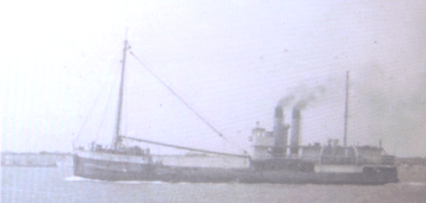
SS Allenwood [Australian National Maritime Museum]
HMAS Allenwood tows a barge into Port Stephens – 1944
The War Diary of the Tomaree Coastal Artillery Battery at Port Stephens for 28 November 1943 recorded:
‘American auxiliary launch seeking shelter in Port Stephens, damaged and with 10 degree to port having cut loose landing barge of Stephens Point, entry permitted into Port Stephens. H.M.A.S. Allenwood put to sea and towed barge to port.’
HMAS Allenwood under repair awaiting return to owner – 1946
The Canberra Times of 8 August 1946, page 4, reported:
‘The Government has made available the steamer Kindur for one and possibly two voyages from Coffs Harbour to Sydney to move timber [to improve timber supplies] from the North Coast, the Minister for Supply (Senator Ashley) announced yesterday.
He said that his Department was also exploring the possibility of using lighters towed between ports as a further means of assistance. “I am conferring with the Minister for the Navy with a view to doing everything possible to expedite the completion of repairs to the Allenwood and to speed the release of the Uralba, which would considerably improve the position,” he said.‘
The Newcastle Sun of 13 August 1946, page 12, also reported:
‘Four coastal steamers are to be handed back to the owners by the R.A.N. after war service. When the work of reconverting them for commercial voyages is completed in the next few weeks, they will relieve the cargo congestion in N.S.W. ports. The steamers are the Allenwood, Uralba, Birchgrove Park and Bombo.
The Allenwood and Uralba will be suitable for the carriage of timber from north coast ports to Sydney. The Birchgrove Park is a collier and the Bombo, before the war, brought blue metal to Sydney from Kiama. As the Navy is doing the reconversion work it is unlikely that the ships will be delayed by the shipyard lockout now contemplated.’
Allenwood arrives at Laurieton after War Service – 1946
The Manning River Times and Advocate for the Northern Coast Districts of New South Wales of 9 October 1946, page 2, reported:
‘After an absence of six years, the steamer Allenwood arrived at Laurieton on Friday and sailed again on Saturday with 90,000 feet of timber. The bar, which does not need dredging, carries good depth of water and the Allenwood crossed, in an hour and a half before high water, on a small tide.’
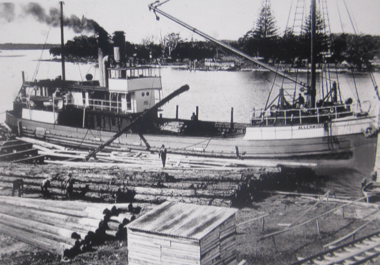
SS Allenwood loading timber at Laurieton
Allenwood shelters in Port Stephens – 1947
The Telegraph (Brisbane) of Thursday 23 January 1947, page 1, reported:
‘Far northern towns experienced a wild night with rain, wind, and big seas running. The cyclone is now, expected to reach towards Port Macquarie, and shipping men in Sydney said that big seas might be running near Sydney later as a result of the northern disturbances. …
At Port Macquarie this morning the steamer Allenwood was unable to enter port. She arrived from Newcastle and found heavy seas breaking over the entrance. The Allenwood was forced to turn about and returned south to Port Stephens to shelter.’
Damaged Allenwood Shelters in Port Stephens – 1948
In April 1948 the Allenwood was damaged when crossing the bar at Camden Haven. The Newcastle Sun of 22 April 1948, page 3, reported:
‘The damaged coastal steamer Allenwood (398 tons) with a crew of 16 men is having a hard battle against heavy weather to get to Sydney for repairs, in tow of two small tugs.
A wooden vessel, the Allenwood today sought shelter in Port Stephens. She suffered hull damage when she grounded on the bar at Camden Haven and stuck for a tide. Two tugs, not much bigger than launches, are trying to get her to Sydney. One propeller is damaged and the Allenwood is trying to assist the tugs with one engine. The voyage began yesterday morning from Camden Haven in fine weather, but big seas came up during the day and the three little ships were battered. They reached Port Stephens at 2 a.m.’
The Newcastle Sun of 26 April 1948, page 3. further reported:
‘Woman shipbuilder and mother of eight, Mrs. Dot Dobson, of Laurieton, joined the crew of the motor vessel Camden to see how her handiwork behaved on salvage work. She arrived in Sydney today when the Camden, with the Kapooka, brought the damaged steamer Allenwood (398 tons) to port in tow. The Allenwood grounded on the bar at Camden Haven, damaged the hull and lost one propeller.
The two motor vessels, really big deep sea fishing craft, towed the steamer and sheltered for two days in Nelson Bay because of bad weather. Mrs. Dobson made the trip with her husband, Mr. E. R. Dobson, shipbuilder, she did much of the work of building the Camden, which has just been completed.
As she worked about the deck of the Camden in Rozelle Bay today clad in navy slacks and blue sweater, Mrs. Dobson said she had enjoyed the trip thoroughly. “I didn’t,” said Mr. Dobson. “I was seasick.” Mrs. Dobson wants to return to Laurieton by boat. Mr. Dobson already is reaching for the railway timetable.’
Allenwood refloated at Narooma – 1950
The Newcastle Sun of 27 July 1950, page 5, reported:
‘The coastal steamer Allenwood was refloated last night after tons of timber had been placed on board as ballast. The Allenwood went aground when entering the bar. The timber was loaded by barges from a Narooma saw-mill to trim the ship so that the stern of the coaster, with its heavy engines would be lifted in the water.’
The Newcastle Morning Herald and Miners’ Advocate of 27 July 1950, page 1, also reported:
‘The coastal steamer Allenwood (398 tons), which was forced ashore at Narooma on Saturday, was refloated at high tide tonight. The Allenwood had called at Narooma to load timber for Sydney. A strong surge carried her stern on to the rocks. A barge went alongside her today and lifted timber from her after deck. The Allenwood, helped by the tide, was able to get clear of the rocks. She was not seriously damaged.’
Heavy seas force Allenwood to shelter behind Norah Head – 1951
The Border Morning Mail of 2 January 1951, page 10, reported:
‘Pounded by heavy seas, the 398-ton steamer Allenwood has been forced to shelter behind Norah Head on the North Coast. In a radio message to Sydney today the captain said he fought the gale until 8.45 am yesterday but had to take the Allenwood to shelter.’
Luck was about to run out for the Allenwood, near Norah Head.
Allenwood does ashore near Norah Head – 1951
The Newcastle Sun of 14 September 1951, page 1, reported:
‘The coastal steamer Allenwood (398 tons), with a crew of 16 men, ran ashore in fog before dawn today between Catherine Hill Bay and Norah Head, south of Newcastle. All members of the crew are safe, according to radio messages.
The ship has lost her starboard propeller and is hard aground on the beach. Because of the risk, she refused the assistance of an interstate freighter that offered to help her. The Allenwood cleared Sydney at 9.15 p.m. yesterday bound for the North Coast to load timber and at 5 a.m. sent a wireless call for assistance, saying that she was ashore on a sandy beach not far from Bird Island. No tug was available in Newcastle and Sydney tugs are also working at top pressure, but one has been released by the Waratah Company and is loading equipment today to put to sea this evening.
The Adelaide Steamship Company’s 3000-ton cargo steamer Bungaree, on her way from Fremantle to Newcastle, arrived in the bight that sweeps around from Norah Head to Catherine Hill Bay and signalled the Allenwood. She offered to assist but the Allenwood replied that she was so close inshore it would be dangerous for the Bungaree to assist.
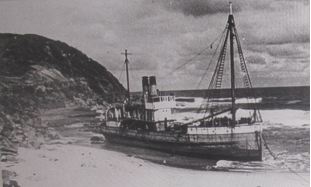
SS Allenwood aground near Norah Head
The Allenwood was hard aground with her bow well up on the beach at low tide. The vessel was on an even keel but dangerously close to submerged rocks. A forward line had been taken out and tied around a huge boulder about 100 yards up the beach. A light sea was breaking round the ship. Early salvage efforts will be governed by continuation of moderate seas and also as the vessel is in the curve of a bay, the difficulty of a tug getting a line aboard. Members of the crew could be seen standing on the deck and one was standing on the beach. The ship is a regular caller at Newcastle on its timber run to the north.’
The Daily Telegraph of 15 September 1951, page 3, also reported:
‘The tug Wonga, which left Sydney last night, will try to refloat the standed freighter Allenwood on this morning’s high tide.
Allenwood (398 tons) ran ashore yesterday in fog five miles north of Norah Head, on the North Coast. She lost her starboard propeller. Last night Allenwood was swaying in a fair sea and a moderate north-easter. Allenwood had firmly embedded her bow in four feet of sand. When the vessel hit the sand the bosun and a member of the crew waded ashore through the surf with a wire rope, and made Allenwood fast to a heavy rock well up the beach. Late in the afternoon the north-east wind swung the ship over with a slight list to port.
Seas broke over the decks from the port side Allenwood kept up steam throughout the day, in the hope of a rescue tug arriving. At nightfall, although the vessel had taken a fair buffeting, there was no water in the hold. A Daily Telegraph staff reporter who flew over Allenwood said last night: Allenwood was hard aground within 20 yards of a jagged reef near Wybung Point. If she had hit 100 yards farther north, she must have ripped her bottom out on sharp, saw toothed rocks.
When the tide went out, her bow was out of the water. Two of the crew were walking on the sand. Five seamen on deck waved, to the Daily Telegraph plane. One clasped his hands over his head to show that the crew were all right. Well-worn tracks run to within a few hundred yards of the point where Allenwood went aground. The tracks run from the Pacific Highway, which at this point is about three miles from the coast. The nearest houses are on the shore of Munmorah Lake, three miles from the ship.’
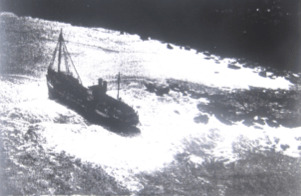
The stranded ‘Allenwood’ as seen from a Daily Telegraph plane [Daily Telegraph of 15 September 1951]
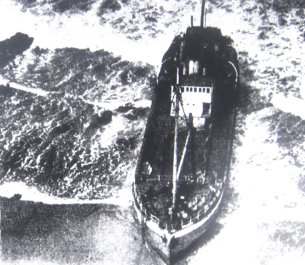
The stranded ‘Allenwood’ as seen from a Daily Telegraph plane [Daily Telegraph of 15 September 1951]
Crew Abandon Allenwood – 1951
The Daily Telegraph of 16 September 1951, page 3, reported:
‘The crew of the stranded steamer Allenwood will probably abandon the vessel today. Crew men said last night they would leave when the ship’s agents could arrange transport to take them to Sydney. They said the vessel was in the hands of the underwriters. The Allenwood (398 tons) ran ashore nose first at 5 a.m. on Friday five miles north of Norah Head.
Strong seas today drove her stern on to the rocks at the northern end of the beach. The Sydney tug Wonga radioed Sydney last night that the Allenwood’s master had ordered the tug to return to Sydney. The Wonga’s master, Captain B. Gwyer, said the Allenwood had told him, “Your services are not required.” Deputy-Director of Navigation Hooper, commenting on the Wonga’s return to Sydney, said: “Evidently the prospects of moving the Allenwood are not bright.
“If she cannot stand the strain of being moved she will be a total loss.” Norah Head lighthouse keeper C. S. Smith, said last night that no lights were showing on the Allenwood. But there was a big fire on shore, not far from the freighter. The crew may have left the vessel and camped on the beach, he said. Local residents’ yesterday trekked over the sand hills to watch rescue attempts.’
Allenwood Sold by Tender – 1951
The Dungog Chronicle of 29 September 1951, page 2, reported:
‘A retired marine engineer (Mr. J. P. Scott) of Warner’s Bay has bought the wrecked steamer Allenwood for £601. He intends to build a home from the wreck.’
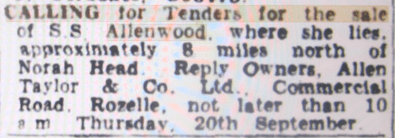
Tender advertisement for the ‘Allenwood’ [Sydney Morning Herald, 19 September 1951]
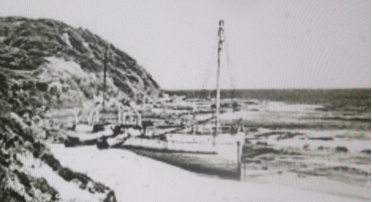
The ‘Allenwood’ after removal of the superstructure showing the two funnels lying on the sand.
Court of Marine Inquiry – 1951
The Daily Commercial News and Shipping List of 14 November 1951, page 1, reported:
‘A Court of Marine Inquiry at Sydney was unable to determine why the coastal steamer Allenwood was stranded and wrecked on September 14. …
The master, Captain Kristian Boutrop, of Leonard Street, Bankstown, told the Court that he passed Norah Head at a distance of about two miles on a course north by east by half east. This course, which was maintained until the ship was stranded should have kept the vessel clear of the land. He could not explain the mishap.
Giving judgment, the Court — which comprised Judge Markell and two marine assessors, Captains F. N. Wyatt and F. Carter —said it was not in a position to say that the Allenwood was not held on the course as stated by the master. If the course was maintained, however, it was very difficult for the Court to ascertain why the vessel became stranded. The ship, which was owned by Allen Taylor and Co. Ltd., was well found and properly manned.
From the evidence, the Court was unable to find that proper seamanlike care was not exercised in the navigation of the ship. But it considered that a lookout hand should have been placed on the fo’cle head instead of on the boat deck. In the circumstances, the Court was unable to determine the cause of the stranding.’
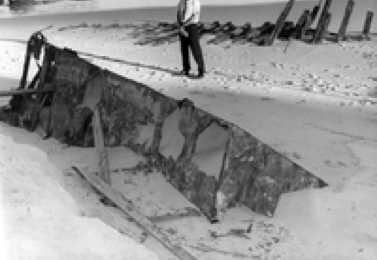
The remains of the ‘Allenwood’ in recent times [Newcastle Morning Herald]
Concluding Comments
The Allenwood was one of several ships owned by Allen Taylor & Co. Ltd, operator of the Birdwood Timber Mill, a large sawmill on the waters of Port Stephens at Winda Woppa, near Tea Gardens. Her dual funnels made her an easy steamship to recognise on its many visits to the area.
Further information on the timber industry in Port Stephens and the activities of the Waterside Workers Federation at Port Stephens, can be found at the following links on the website:
Early History of the Timber Industry in the Myall and Port Stephens Areas
Activities of the Waterside Workers Federation at Port Stephens
A Journal of the Port Stephens Waterside Workers Federation – 1924
Researched and compiled by Kevin McGuinness
August 2025
–


 Port Stephens - a history exploration