
Introduction
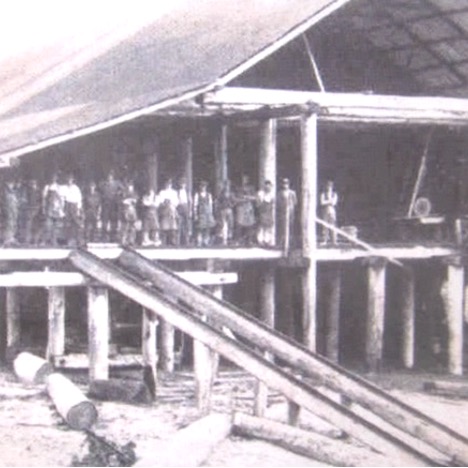
This paper presents a history of the large Birdwood Timber Mill at Winda Woppa, near Tea Gardens, Port Stephens.
Prior to the Second World War, numerous timber mills operated for varying periods along the Myall River and also at Tea Gardens and Hawks Nest. The first local mill was at Hawks Nest, that operated in the 1870s. Another was the Cooks Mill on the Tea Gardens waterfront, near Coupland Avenue, and the third was the Birdwood Mill at Winda Woppa, near Tea Gardens.
The Birdwood Mill at Winda Woppa was one of several operated by Allen Taylor and Company in New South Wales. The company also operated numerous steamboats and steam droghers to transport timber to its mills and other shipping ports. The sawmill employed between 20 and 30 men plus several crew on the company’s flat bottomed steam driven paddle wheel droghers. The fleet of droghers included the Salamander, Ability and Breeza.
Beside the mill was Birdwood’s boat slip that consisted of large 14″ x 14″ axe-hewn girders, 50 feet long, set on rollers atop double rail lines with crosswise beams forming a flat platform. The slip was used to pull droghers out of the water for maintenance.
Allen Taylor and Company was an Australian timber company founded by Allen Taylor in 1893 at Rozelle in Sydney. Taylor held positions as Alderman, Mayor, Lord Mayor, and served as a member of the New South Wales Legislative Assembly.
The company was acquired by Blue Metal Industries in 1970, by Boral in 1982, and most recently by Allied Natural Timber Enterprises Pty Ltd (a subsidiary of Pentarch Group) in 2021. The company also owned several steam ships, including the SS Allenwood whose story is found at this link on the website.
Tea Gardens relied on the Birdwood Mill to provide employment to many of its residents. It was particularly important during the Great Depression years of the 1930’s. Many of its workers also worked when required as waterside workers loading the large steam ships that entered Port Stephens to transport timber to Australian and overseas ports.
Working at a timber mill was a dangerous occupation. Several accidents at the Birdwood Mill, as reported by local newspapers, are included in this paper.
This paper also attempts to illustrate the life and times of the workers who undertook manual labour at the mill and on the droghers that transported the timber from the Myall River area.
Construction of the Birdwood Timber Mill – 1916
The Gloucester Advocate of 5 April 1916, page 2, reported:
‘Messrs. Allen Taylor and Company are erecting a new sawmill at “Winda Woppa,” Port Stephens. The firm is also having a large punt [Drogher] built by Mr Miles, of Forster, for the carriage of logs to the new mill. The same firm are also having about seven miles of tramway put down from Bulahdelah to tap the timber around Purgatory, between Bulahdelah and Stroud. This belt is said to contain an immense quantity of timber. Steel rails are being used and a steam locomotive will be engaged on the work. This, in conjunction with other progressive ventures in the district, points to the enormous advantages of Port Stephens being turned to the account which nature intended for such a splendid harbour.’

Steam locomotive, ‘Wootton’ built by Clyde Engineering in Sydney for Allen Taylor and Company, to operate on the timber tramway between Wootton and the wharf at Mayers Point on the eastern side of Myall Lake. The timber was then shipped to the Birdwood Mill at Winda Woppa, near Tea Gardens [Powerhouse Museum Collection]
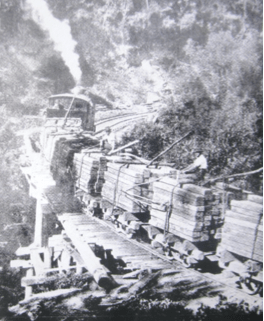
Timber tramline constructed by Allan Taylor and Company – showing the locomotive’Wootton’ pulling loaded railway sleepers. Much of the timber was sent by water from the Myall River to the Birdwood Mill and surrounding Tea Gardens area [Sydney Mail, 13 October 1920]
Adjacent Residence to Mill destroyed by Fire – 1917
The Raymond Terrace Examiner and Lower Hunter and Port Stephens Advertiser of 21 September 1917, page 3, reported:
‘An inquest was held on the 3rd September at the Court House, Tea Gardens, by the Coroner for the district, Mr. F. J. Callow, as to the cause of the destruction on the 21st August of a weatherboard cottage by fire the property of Mr. Henry Waddingham. The building which was destroyed was situated at Winda Woppa.
Evidence was given that on the night of the fire a strong gale was blowing from the west and north-west and that about seventy-five yards from the house there was a large heap of burning saw-dust belonging to Messrs Allen Taylor and Co., Ltd. Sparks were seen blowing from time to time from the heap towards the destroyed building, which was on the leeward side of the heap. The outbreak of fire was very sudden and an old man named Jack Lausonneur, who was sleeping in the house narrowly escaped being burnt to death, the hair on his face being singed and almost all his belongings, burned, including notes and silver, the latter about £ 2 10s being melted.
Mr. Burk representing the New Zealand Insurance Co. was present at the inquiry and also Mr. A. W. Allway, local manager for Allen Taylor and Co. Constable Dean was in charge of the case. An open verdict was returned by the Coroner.’
Timber Mill provides significant employment to Tea Gardens Area – 1917
The Newcastle Morning Herald and Miners’ Advocate of 4 December 1917, page 3, reported:
‘Notwithstanding the critical times and depression caused by the late strike [Great Coal Strike], the timber industry appears to be in full swing again. Messrs. Allen Taylor and Co’s sawmill is now turning out from 55,000 to 60,000 super feet of sawn timber weekly, and gives employment to a large number of men. With the big supply of sleepers coming forward from Wootton, Bulahdelah, and depots, Winda Woppa is now quite a busy centre, and seems likely to outrival Tea Gardens, and the Narani, Our Jack, and other steamers of the fleet now trade regularly to Port Stephens.’
Birdwood Mill damaged by Fire – 1923
The Gloucester Advocate of 16 March 1923, page 2, reported:
‘On Tuesday morning, 6th inst., a fire broke out at Birdwood’s Mill, Winda Woppa, Tea Gardens, the property of Allen Taylor and Coy. The fire was first discovered by Mr. H. G. Asquith who gave the alarm, and it was burning in the engine and boiler room. At 7 p.m. there was no sign of any fire and it is thought that sawdust near the boiler caught alight and the fire spread from that. There were no suspicious circumstances. Damage to the extent of £500 was done to the machinery and building, and the place was insured with the United and New Zealand Company.’
The Birdwood Mill was again damaged by fire in 1950.
Outlook for Birdwood Mill appears promising – 1924
The Newcastle Morning Herald and Miners’ Advocate of 6 December 1924, page 7, reported:
‘Notwithstanding the depression caused by the closing down of Messrs. Allen Taylor and Company’s two sawmills at Bulahdelah and Wooton, the outlook at their Birdwood (Winda Woppa) sawmill appears promising. At the present time Allen Taylor and Company are making extensive improvements, and have a large gang, chiefly skilled men, engaged erecting the engineer’s shop, which gear was recently transferred from Bulahdelah. The firm has installed a large oregon tank, capable of holding 20,000 gallons of water, which is pumped from a well sunk in the sand, and this will not only supply the sawmill and four lighters with feed water, but outside firms as well.
The sawmill is taxed to its utmost capacity, and turning out some fine timber, chiefly ironbark, tallowwood, and box. The chief difficulty is in coping with the export trade, which has assumed very large proportions, and in this branch there is very keen competition.’
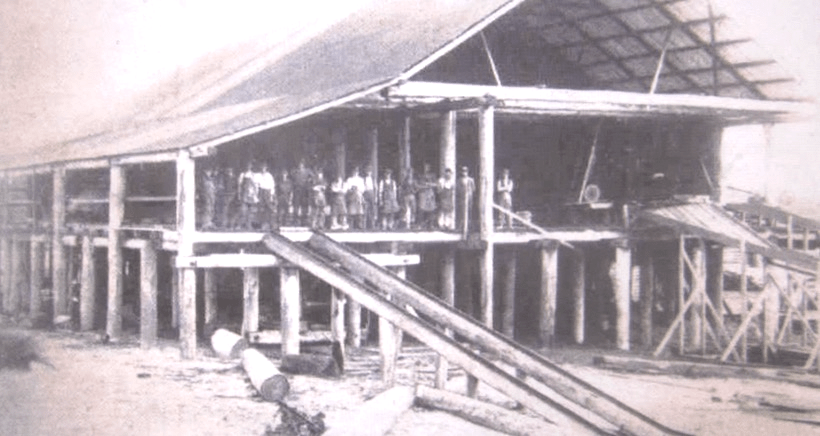
Birdwood Mill located on the shore of the Myall River at Winda Woppa, near Tea Gardens.

Birdwood Mill stacked with sawn timber. A steam Drogher is moored at the mill’s wharf.
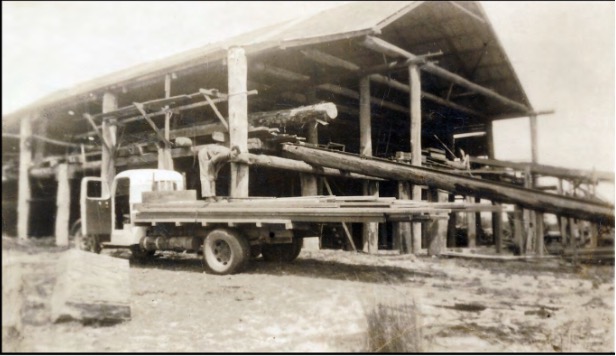
Truck picking up timber order from the Birdwood Mill
Treatment of timber worker raised in NSW Parliament – 1926
The Daily Examiner of 24 February 1926, page 5, reported:
‘Alleging that statements by Mr. Culbert in the Legislative Council last week were extraordinary and malicious, Sir Allen Taylor made a personal explanation when the House met today. Mr. Culbert had declared that Sir Allen Taylor’s company had treated an employee callously in the matter of compensation. The records, he said, showed that Watsford was injured on January 12, 1922, while employed at the Birdwood Mill, Port Stephens, his weekly wage being £4/8/6, as per the award.
He was injured as a result of being struck by a flitch of timber [a thick, flat piece of wood cut lengthwise from a tree trunk], and remained for some weeks at the hospital at the cost of his employers. He eventually recovered, said Sir Allen, and resumed duty about the middle of June, 1922. From the date of the accident until the resumption of work his wife was paid weekly £2/19/ for 22 weeks, say £65.
Three days after the resumption Watsford complained that he was not well enough to continue, and he automatically again came under the sick and accident pay and the local doctor for treatment. Later, at the request of the insurance company, he was brought to Sydney for medical attention, and placed in the Lewisham Hospital, remaining there until February 2, 1923. He was then declared to be better and was ordered back home.
On February 8, 1923, he was finally paid £165, giving the company a clean discharge. This was exclusive of hospital fees, amounting to £50, and also a Christmas gratuity to Mrs. Watsford in 1922. Watsford, he added, resumed work in March, 1923, at his old position, and continued until July 1924, for 16 months, without cessation. Early in August, 1924, he contracted influenza, followed by pneumonia, and died in October, 1924.’
The case outlined above was the first of many accidents at the Birdwood Mill reported in newspapers over the ensuing years.
Face Gashed – 1926
The Dungog Chronicle of 3 August 1926, page 4, reported:
‘At Birdwood Mill, Winda Woppa, Mr. W. Blanch had a very narrow escape from serious injury on Monday last. A piece of timber coming out of the shute struck him on the face, inflicting a very nasty wound. The strange part of the accident was that the flesh on each side of the nose was torn, but the nose itself was not touched. No time was lost in getting Mr. Blanch to the doctor at Tea Gardens, who found it necessary to put seven stitches in the wound. We are pleased to report that the patient is now doing well.’
Mr. Blanch was to suffer another accident at the Birdwood Mill in April 1932.
Accident – 1926
The Dungog Chronicle of 7 September 1926, page 5, reported:
‘Mr. J. Robards met with an accident at Birdwood mill, Winda Woppa, on Wednesday last, a piece of timber flew over the back of the saw striking him on the shoulder and bruising it considerably. First aid was rendered at the mill, after which Mr. Robards was taken to the doctor.’
Crushed by a Log – 1927
The Maitland Daily Mercury of 3 March 1927, page 4, reported:
‘D. Harvey, 36, married, living at Tea Gardens, employed as a labourer at Sir Allen Taylor’s timber mill, Tea Gardens, was engaged in loading logs, when he was caught by one of the logs, and sustained a probable fracture of the spine. He was conveyed to Salt Ash by launch and was then transferred to an ambulance car and taken to Newcastle Hospital, where he was admitted in a serious condition.’
Operations temporarily suspended – 1928
The importance of the Birdwood Mill to the local economy was demonstrated when the Maitland Weekly Mercury of 21 January 1928, page 9, reported:
‘The Birdwood Mill (Allan Taylor, and Co.) has temporarily suspended operations, and many men are out of work.’
Tragic Death – 1928
Warning: the following two newspaper reports of the death of an employee at the Birdwood Mill are graphic.
The Sydney Morning Herald of 12 July 1928, page 11, reported:
‘Albert George Sanders, 19, a sawmill employee, was literally whirled to death today at the milling plant of Allen Taylor and Co., Ltd. When he was attending some machinery one of Sanders’ arms became entangled in a rapidly-moving belt, which drew him in and flung him against a wall of the building. One of his arms was torn from the shoulder and remained entangled in the belt. Practically every bone in Sanders’ body was broken.’
The Dungog Chronicle of 20 July 1928, page 5, further reported on the Inquest before Mr. A. E. Hitchins, Coroner:
‘Concerning the death of Albert George Sanders, who was killed at Allen Taylor and Co.’s sawmill ‘Birdwood,’ Winda Woppa, Tea Gardens, on July 11th, William George Sanders deposed: The deceased was my son, he was born at Waverly, Sydney on April 6th, 1909. He was in the employ of Allen Taylor and Co., Ltd.
His duties at the mill were wheeling up the saw dust and attending to the sawdust blower belt. I did not see the accident. His life is not insured, but I believe he was insured under the Workers’ Compensation Act. My son resided with his parents at Winda Woppa. His salary was £ 4/5/- per week. My son assisted in keeping the home. He had no banking account. He practically handed the whole of his earnings to his mother. He was of very temperate habits and had no enemies and there was no one likely to do him an injury. I last saw my son alive about 10 a.m. on Monday 9th. I am employed at the ‘Birdwood’ Mill as a general hand.
William George Frederick Ringland, deposed: I am a sawmill manager for Allen Taylor and Co., Ltd., and reside at Tea Gardens. I know the deceased, he has been in the employ of the company for about four years. He was sober and reliable. On July 11th he was in the company’s employ and went to work at 7 o’clock. At about 9.35 a.m. W. Avery informed me that George Sanders was killed. I went to where the accident occurred underneath the mill and saw deceased lying about 9 feet away from one of the shafts. He was practically dead. His right arm and shoulder blade was entangled in the belting around the shaft.
The deceased’s duties at the mill was sawdust attendant. The greater portion of the sawdust was blown away by a sawdust blower driven by a belt connected with a shaft. It was part of the deceased’s duties to repair the blower belts. After the accident I examined this belt and found that the deceased had apparently been repairing it when the accident occurred. In my opinion the deceased attempted to throw the belt over the main shaft, which was revolving, and the end doubled round the shaft and caught his arm, before he could extricate himself the belt wound round the arm and shaft (shaft revolving at 2,000 revolutions) and the body was whirled round until the arm carried away.
To the Coroner: I taught the lad how to mend belt’s and the precautionary measures that had to be taken. That is to keep outside the guard rails when repairing the belt or hang it over the rail to prevent it being caught on the shaft. In this case I think deceased got inside the guard rails to carry out the repairs. After the accident, the guard rails, which are 3 x1 hardwood were smashed, as if the body had come in contact with them. The guards over the machinery comply with the Shop and Factories Act and have been inspected from time to time by officers of the Department. Every reasonable precaution was taken to guard against accidents, and this accident occurred in my opinion owing to deceased not carrying out my instructions. Deceased was insured under the Workers’ Compensation Act. His wages were about £4/5/ per week.
William James Avery deposed: I am foreman at Birdwood Saw Mill and reside at Tea Gardens, I know deceased, he went to work at 7 o’clock and was then in good health. His duties at the mill was sawdust attendant, which includes looking after the blower and belting. About 9.30 I heard a bumping sound and went below to see the cause. I then saw deceased lying on his back apparently dead, his right arm which was torn from the body was entangled in the belt on the shafting. There were two punctures on his face, and both legs were broken. I informed the manager and then removed the arm and informed the Doctor and Police.
I surmise that deceased was taking up the slack in the belt and was putting the end of the belt over the shaft with his left hand, and in catching the end with his right hand got entangled and was carried round it until the arm pulled out when he was thrown against the top floor, which would account for the noise I heard. The guards are always up about 4 ft. from shafting. After the accident the guards were broken, evidently by the body of deceased coming in contact with them whilst revolving on the shaft.
It was part of deceased’s duties to repair the belting. He has been on that work for about four years. I have always instructed the deceased to be careful and place the belt over the guard whilst repairing it. Had those instructions been carried out. the accident would not have happened. I can positively state the guard rails were up in the morning when deceased took up his duties. The shaft is the main driving shaft for all the mill machinery.
P. A. Bassett deposed: I am a Police Constable and reside at Tea Gardens. I came to Winda Woppa Mill about 11.15 a.m. on July 11th. I saw the dead body of Albert George Sanders lying on the ground under the top floor, there was a large quantity of blood about the deceased and his right arm was off at the shoulder, his two legs broken, small puncture on top lip. I examined some hair and blood about 11 feet from the ground on the bottom of the top floor, the hair was of the same colour as deceased, and the blood stains were fresh. The belt which drives the blower had been unlaced and was off the pulleys. The end of the belt had apparently been cut and new punch holes made, as though deceased intended taking up the slack. There are two guard rails 3 in. x 1in. hardwood about 4 ft. from the main shaft, which were smashed apparently by the impact of the deceased’s body while revolving after becoming entangled in the belt.
I agree with Mr. Ringland’s version of the accident, and that it was accidental. I consider the necessary precautions were taken to guard against accident. I believe the deceased was of temperate habits. The Coroner returned a verdict of accidental death.’
Accident – 1930
The Dungog Chronicle of 7 March 1930, page 4, reported;
‘Mr. Fred Hill of Tea Gardens, employed by Allen Taylor and Co., at Birdwood Mill, Winda Woppa, met with a serious accident last week to one of his legs, through a large log rolling unexpectedly. It appears that the wedge used for holding the movement of logs slipped from position. Mr. Hill was immediately conveyed to Tea Gardens for medical treatment, and the local medico was of opinion that he had sustained a probable fracture, and after local treatment the patient was conveyed to the Newcastle Hospital per ambulance, where his leg will be x-rayed, and the nature of the accident will be determined.’
Manager of the Birdwood Mill involved in two accidents – 1930
Firstly, the Dungog Chronicle of 11 July 1930, page 4, reported on an injury he received at the Birdwood mill:
‘Mr. W. Ringland, Manager Birdwood Mill, Tea Gardens, after having been laid up with a sprained ankle and a dislocated thigh is improving, and it is expected that he will be able to walk in the near future.’
Secondly, the Dungog Chronicle of 1 August 1930, page 4, reported on a miraculous escape in a car accident weeks later:
‘A party consisting of Mr. W. Ringland, Superintendent, Birdwood Mill, Winda Woppa, wife, son Jack, and Mr. W. Ripley of Tea Gardens, whilst motoring to Newcastle on Saturday 25th inst., had a miraculous escape. It appears when taking the turn of the road about three miles on the Tea Gardens-Karuah road the car in which they were travelling left the road and landed into a causeway on the roadside. The fact that the car was kept under control made a timely save….. It will be remembered that Mr. Ringland recently met with a somewhat serious accident at Birdwood mill and has not fully recovered from the effects of that accident.’
His son, Mr. W. Ringland, junior, was injured at the mill in April 1933.
Cricket Match involving Birdwood Mill Staff – 1930
The Dungog Chronicle of 14 November 1930, page 4, reported:
‘A local cricket match was played on Saturday last between Birdwood Mill and the town.’
Birdwood Mill mainstay of Tea Gardens during Great Depression – 1931
The Dungog Chronicle of 8 May 1931, page 4, reported:
‘The Birdwood sawmill closed down temporarily on Saturday last. It is not known for how long, but it is expected that it will reopen in a week or two. It is one of the few mills that has kept going continuously since the advent of the depression. It must be admitted that the existence of this local industry providing work as it has done may be regarded as the mainstay of Tea Gardens. Since the price of oysters and fish has become demoralised, the town has suffered a setback more pronounced than anything experienced for many years. It is hoped that no untoward circumstance will intervene that will cause the timber industry in this district to become paralysed.’
Luckily, the Dungog Chronicle of 15 May 1931, page 4, reported good news:
‘It is understood that Allan Taylor and Co., Ltd., Birdwood Mill, Winda Woppa, will reopen next Monday. The closure of this mill has had a depressing effect. It forms one of the chief industries of this district and provides a large amount of employment in this and other districts on the north.’
Lastly, the Dungog Chronicle of 5 June 1931, page 4, reported:
‘The Birdwood mill, which has been closed for over a month, resumed work on Monday last, and it is understood that sufficient orders are now in hand to tide over the year. The effect of the mill’s closure has the effect of emphasising the depression locally.’
Braidwood Mill closes periodically during Great Depression – 1932
The Dungog Chronicle of 22 January 1932, page 4, reported on the resumption of operations:
‘The Birdwood mill will resume operations this week, which will be a good thing for the place. It is to be hoped that they have plenty of orders to carry them on, as this industry absorbs a big majority of the working men around here.’
Another mill closure was reported in the Dungog Chronicle of 18 March 1932, page 4:
‘A severe setback has been placed on Tea Gardens by the closing down of Allan Taylor and Co.’s Birdwood mill. This mill absorbed a good many of the working men around here, and it is to be hoped that it won’t be long before it is again going in full swing, the same as in the past.’
Good news was reported by the Dungog Chronicle of 1 April 1932, page 4:
‘The Birdwood mill, which closed down some weeks ago, began work again last Tuesday. This will be welcomed by the town in general, as from twenty to thirty men are employed there when going in full swing.’
Accident – 1932
The Dungog Chronicle 22 April 1932, page 4, reported:
‘Mr. W. H. Blanch, an employee at Birdwood Mill, cut his leg badly with an axe whilst engaged at his work last week. He was forced to lay up with it, the gash being the full width of the axe blade. Dr. Shallard attended to him.’
Mr. W. Blanch had previously been injured at the mill in August 1926.
Birdwood Mill temporarily closes again – 1932
The Dungog Chronicle of 23 September 1932, page 4, reported:
‘Owing to another shortage of mill logs the Birdwood Mill has again been forced temporarily to close. The winter rains together with a natural decrease in the number of teamsters in the district are the cause. Many former teamsters have turned their attention to primary production as a result of the depression. Tea Gardens suffers a heavy loss through the many processes of enforced deflation.’
The closure of the mill did not last long as reported in the Dungog Chronicle of 30 September 1932, page 4:
‘The Birdwood mill, after being idle a few days through a shortage of logs, has again begun operations, and with better weather conditions to allow the teams to work, the proprietors expect to keep going in the future.’
The mill operations did not last long as again the Dungog Chronicle of 14 October 1932, page 4, reported:
‘Owing to a shortage of logs the Birdwood mill is closed down again this week.’
Great Depression leads to loss of jobs at the Mill – 1933
The Dungog Chronicle of 10 February 1933, page 4, reported:
‘Several men were paid off at Allen Taylor’s mill at Birdwood last week, which means a loss to the town. It is to be hoped that the company can see their way clear to reinstate them in the near future.’
Accidents – 1933
Two accidents at the Birdwood Mill were reported in 1933.
Firstly, the Dungog Chronicle of 31 March 1933, page 4, reported:
‘Mr. W. Ringland, junior, met with a painful accident, discharging timber at Birdwood mill last week, through being struck on the knee with a log skid. —He was conveyed to his home and received medical attention, which revealed, a badly injured knee. Fortunately, no bones were broken.’
His father, Mr. W. Ringland, was previously injured at the mill during July 1930.
Secondly, the Dungog Chronicle of 19 May 1933, page 4, reported:
‘Mr. “Jum” McLeod, who had the misfortune to have his leg amputated following an accident at Birdwood Mill is doing as well as can be expected. He is an inmate of Newcastle Hospital.’
Accident – 1934
The Dungog Chronicle of 21 December 1934, page 4, reported:
‘Mr. H. Asquith had the misfortune to jar his hand while at work at the Birdwood Mill.’
Accident – 1936
The Dungog Chronicle of 24 April 1936, page 4, reported:
‘Mr. Alex Forsyth fell from a stack of timber at the Birdwood Mill last Friday and broke his ankle. The Ambulance took him to Newcastle hospital.’
New Motor Launch takes workers to the Birdwood Mill – 1937
The Dungog Chronicle of 17 September 1937, page 4, reported:
‘Mr. Hugh Thurlow, has sold his launch ‘Poilu’ to Mr. J. Ringland who put into it the engine from the ‘Unity,’ and the ‘Poilu’ now carries the men to and from work at the Birdwood Mill.’
Accident – 1938
The Dungog Chronicle of 21 January 1938, page 4, reported:
‘Mr. E. (‘Coulter’) Blanch met with an accident while at work at Birdwood Mill last Friday afternoon and had three fingers on his left hand cut off at the first joint by the circular saw.’
Accidents – 1939
Firstly, the Dungog Chronicle of 27 January 1939, page 4, reported:
‘While loading timber at Birdwood mill last Monday, Mr. E. W. Engel dropped a piece of timber on his ankle and sustained an injury.’
Secondly, the Dungog Chronicle of 14 July 1939, page 4, reported:
‘Mr. W. Curry cut his foot with an axe while working at Birdwood mill, and had to have four stitches inserted.’
Sir Allen Taylor visits Port Stephens – 1940
The Dungog Chronicle of 16 February 1940, page 5, reported:
‘Last weekend Port Stephens was honoured by a visit from Sir Allen Taylor, M.L.C., whose name has been associated with the timber industry there for over 40 years. The well-known mill at Winda Woppa is one of the firm’s main centres of the industry. Sir Allen was the guest of Mr. and Mrs. W. J Ringland, of Tea Gardens. Mr. Ringland is the manager of the mill.
”It is 14 years since I have been here,” said the visitor,” and I am surprised by the progress that has been made. Electricity, swimming baths, the beach pavilion and the improved roads are a credit to all concerned.”
Sir Allen and Mr. and Mrs. Ringland were entertained at tea by Mr. and Mrs. C. E. Bennett at their Hawks Nest cottage. The timber industry is the basis of the prosperity of the Port Stephens District, and the firm of Allen Taylor and Co. has played the major part in promoting the development.’
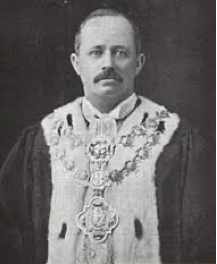
Sir Allen Arthur Taylor was an Australian businessman and a New South Wales state politician, Lord Mayor of Sydney, Mayor of Annandale and a member of the NSW Legislative Council [Wikipedia]
Accidents – 1940
Firstly, the Dungog Chronicle of 8 March 1940, page 4, reported:
‘Mr. S. (‘Tib’) Robards had his right hand cut with the saw at Birdwood mill last Friday. One finger is so cut that it might have to be amputated, at the first joint.’
Secondly, the Dungog Chronicle of 26 April 1940, page 4, reported:
‘Mr. Ken Robards had a finger crushed while at work at Birdwood mill last week.’
Accidents – 1943
Firstly the Dungog Chronicle of 8 January 1943, page 3, reported:
‘Friends of Mr. W. Ringland will sympathise with him in his misfortune in breaking his right wrist. He was at the wharf at Birdwood sawmill when a boat was loading timber and sustained a fall. But it has not kept him away from duty.’
Mr. W. Ringland was previously injured at the Birdwood Mill in July 1930.
Secondly, the Dungog Chronicle of 30 July 1943, page 3, reported:
‘Dutchie’ Davey, who is employed at Birdwood Mill, had an injury to his arm and is under medical treatment. It is understood an X-ray has been advised in order to determine the nature of his accident.’
Accident – 1948
The Dungog Chronicle of 15 May 1948, page 3, reported:
‘Mr. Clarrie Delore, who had a fall while at work, had to have medical aid. He is suffering from a torn muscle of the right arm. Clarrie has been engineer at Allan Taylor’s mill for many years.’
Timber clogs up spare wharf space near the Birdwood Mill – 1948
The Dungog Chronicle of 13 November 1948, page 3, reported:
‘Mr. Don Maslin is back after his holidays and has again taken up his duties at Birdwood Mill. He found that men have been working while he was away, and have blocked his wharf space up with interstate timbers, and put a log punt on his dock to have planks taken out of her under Maritime inspectors’ instructions. A coal strike on top of that will further delay shipping. Don thinks he would really be better off wheeling sawdust than with the manager’s job.’
Allen Taylor’s droghers help load Steamship Matthew Flinders – 1949
The Dungog Chronicle of 15 January 1949, page 3, reported:
‘The ‘Matthew Flinders’ loaded timber and poles this week for New Zealand ports. Allen Taylor’s punts were used to place the timber at the ship’s side. Wet weather delated loading operations. The ship would lose about 48 hours, which will not make much difference to her arrival in Wellington, as she is waiting for a berth at Coffs Harbour to finish loading.’
The ‘Matthew Flinders’ returned to Port Stephens again in September 1952 to again load timber.
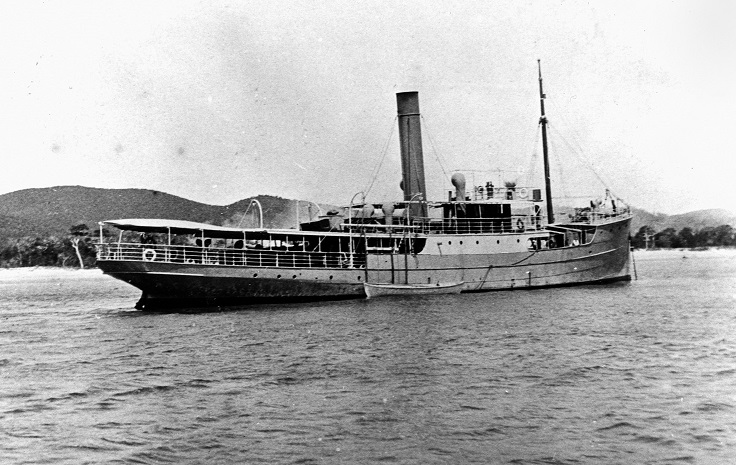
S.S. Matthew Flinders [Queensland State Library]
Mill hands help load timber onto the Steamship James Cook – 1949
The Dungog Chronicle of 21 May 1949, page 3, reported:
‘Allen Taylor’s sawmill was closed down this week; all the mill hands were engaged as wharf labourers loading their products into the “James Cook” for New Zealand. The loading of these interstate vessels solely depends on this Company’s droghers to get timber to them. When one looks up records to find the millions of feet timber that have been shipped, and the thousands of feet still being handled, the costs of rehandling, the loss of time and cost of labour waiting for timber at ship’s side, we wonder why there is not wharf or docks for ships to load at. Perhaps Union S.S. Coy. will be the pioneers of this venture. They have picked a site suitable for their ships for a general wharf, and space suitable for mills whose products can be at ship’s side when stacked off the saws, and a gateway to a harbour that will solve the problems of shipping the whole of the products of the North and North-west.’
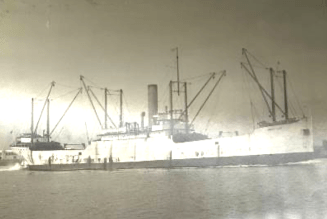
S.S. James Cook [Australian National Maritime Museum]
Accident – 1949
The Dungog Chronicle of 4 June 1949, page 3, reported:
‘Mr. Henry (‘Blue’) Asquith had one of his fingers crushed by a piece of timber while at work in Allen Taylor’s mill last week. He is off work and will be for some time. ‘
Sawn timber from Birdwood Mill stockpiled on wharf due to shipping delays – 1950
The Dungog Chronicle of 23 September 1950, page 3, reported:
‘Shortage of steamers on the coast is putting the cost of transport of timber up. Thomas Bros, who have had timber stored at Winds Woppa for months, have had to get it shipped back to Tea Gardens by drogher then loaded on to lorries to be carried to Sydney. Allen Taylor’s Mill at Birdwood has all the frontage of the wharf blocked with sawn timber.’
Paddle wheel drogher Swan Bay on the slipway at the Birdwood Mill – 1950
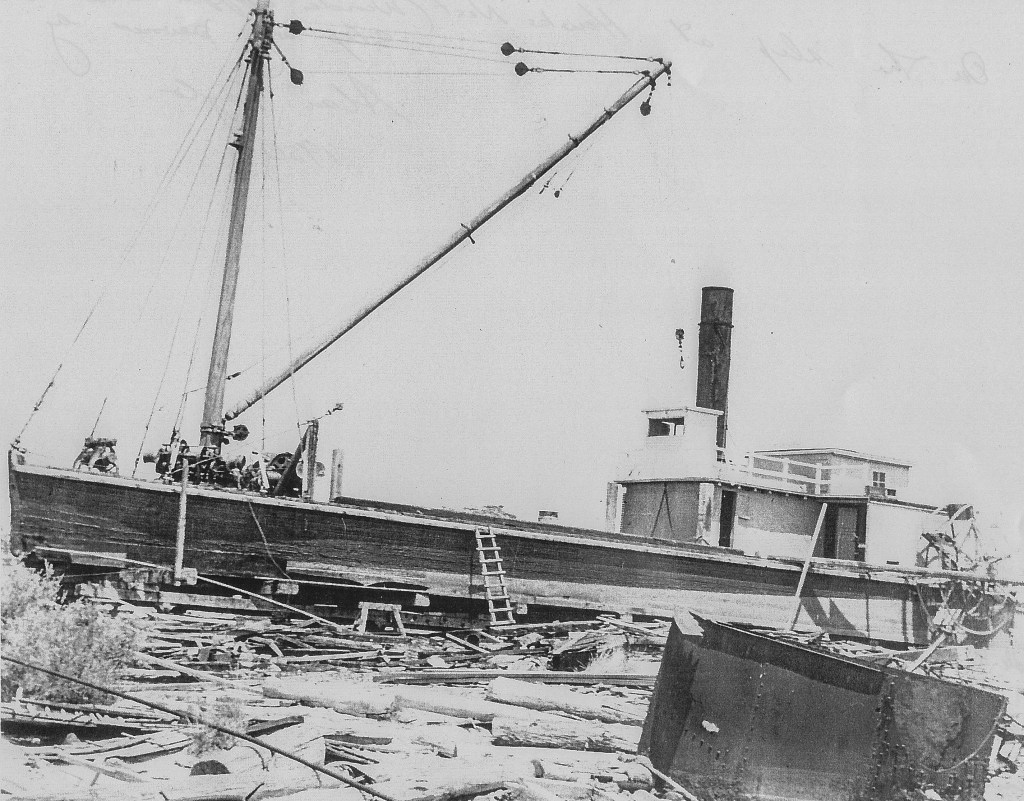
‘Swan Bay’ paddle wheel drogher on Windy Woppa sawmill slip -1950. The drogher was skippered by Eric Engel with Harry Phillips as engineer. The drogher previously operated in the Ballina area, before being purchased purchase by Stan Phillips to transport logs from Meyers Point and Bulahdelah to a mill at Oyster Cove. The winching gear was transferred from ex-wartime ships at Stockton prior to scrapping.
Bucket line saves Timber Mill – 1950
The Dungog Chronicle of 16 December 1950, page 3, reported:
‘One of the best saves on record was made on Friday evening last when Birdwood Mill, owned by Allen Taylor and Co., caught fire at Winda Woppa. The smartness of the few men and women living at Windy was the foundation of the saving of this mill which was well alight when the alarm was sounded. They worked …. with buckets which stayed the path of the fire till the first launch from Tea Gardens arrived with seven men with buckets to be shortly followed by several launches loaded with townspeople.
A chain of men passed water from the river to the mill while a chain of men and women passed water from the lagoon at the back of the mill to the fire. Many men were in dangerous positions and looked like drowned rats when the fire was under control. It was hard to estimate the number of people on the job, it would range from 150 to 200 people.
It is almost impossible to estimate the amount of timber and houses that could have been destroyed by the fire had it got out of hand. The manager, Mr. Ken Winning, Foreman Mr. Sid Davey, and Chief Clerk, Mr. L. Gazzard, were on the job, but leaders did not count everybody seemed to know what was wanted and fell into line. It was water that was needed and water poured into the mill and on to the fire as if by a power plant when men were tiring, the mill engineer, Mr. C. Delore got an engine going that gave water on the job.
To give a fire a big start in a fresh southerly breeze after a very hot day and “down it” was no mean feat and Mr. Ken Winning was right on the spot in thanking all those who took part for their efforts, for not only saving the mill but for saving the country a loss that would have knocked back hundreds of houses that are urgently needed for its people, it is expected that, although there was a big amount of damage done, little time will be lost before the mill is producing its regular output. Mr. Winning, on behalf of Allen Taylor & Co. wish specially to thank the ladies for their valuable assistance given the menfolk in saving the mill from destruction.’
Drogher Salamander sinks at the Birdwood Mill – 1952
The Northern Champion of 8 April 1952, page 4, reported:
‘The log punt, ‘Salamander,’ owned by Allen Taylor & Coy., timber merchants, sank at Tea Gardens last Wednesday afternoon. The punt had been undergoing repairs on the slips at Allen Taylor’s mill at Windy whopper. On being launched she took in more water than was expected and sank by one end onto the muddy bottom.
She was towed onto the sand bank in midstream and high pressure pumps were obtained from Newcastle. The punt was raised on Friday morning and is now back on the run. The ‘Salamander,’ which is about 30 years old, is one of a fleet of four steam-driven paddle steamers which ply along the picturesque 40 miles between Tea Gardens and Bulahdelah twice weekly. These punts are always a source of great interest for travellers passing through the district.’
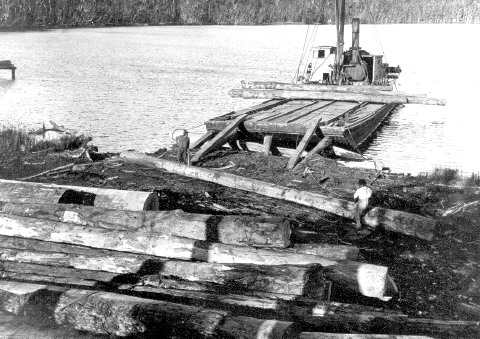
Drogher ‘Salamander‘ at Mayers Point, Myall Lake [Bulahdelah Historical Society]
Wooden poles stored ready for shipment – 1952
The Dungog Chronicle of 2 August 1952, page 1, reported:
‘Allen Taylor & Co. are again in full swing with their droghers after extensive overhauls under Maritime Services Board Survey. Logs for their Birdwood mill and all classes of poles for overseas are being stored ready for shipment.’
Allen Taylor’s droghers help load Steamship ‘Matthew Flinders’ – 1952
The Dungog Chronicle of 13 September 1952, page 6, reported:
The “Matthew Flinders” loaded poles, piles and sawn timber for New Zealand on Monday, Tuesday and Wednesday. Allen Taylor’s droghers had their usual busy time keeping the wharfies occupied. The “Matthew Flinders” is to finish loading at Coff’s Harbour as soon as a berth be-comes available.’
The Matthew Flinders had previously visited Port Stephens in January 1949.
Last shipment of timber for year- 1952
The Dungog Chronicle of 6 December 1952, page 1, reported:
‘New Zealand timber and poles are being shipped this week in Duckhole [near Tea Gardens] by Allen Taylor & Co. It is expected that it will be the last shipment this year for Island ports.’
Closure of Birdwood Mill – 1953
The Birdwood Mill closed permanently in 1953. The difficulty of obtaining timber from an area that had largely been cut and removed, no doubt was a major issue affecting the ongoing profitably of the mill.
Concluding Comments
The Birdwood Mill operated for 37 years, having outlived many other timber mills from the region that had much shorter periods of operation.
The origin of the Mill’s name ‘Birdwood’, opened during the First World War, is unclear, but it may refer to Field Marshal William Riddell Birdwood. Birdwood served with distinction in the Second Boer War and the First World War, commanding ANZAC forces at Gallipoli and later leading the Fifth Army on the Western Front.
When the mill closed, the specialist workforce was disbanded without redundancy, and two of the old droghers were sold. The Salamander was sold to an oysterman and Ability to Transfield Construction for work on the Karuah Bridge. The mill building was demolished, and the nearby wharves were mostly dismantled. Some locals purchased the slipway and relocated it to the Tea Gardens waterfront.
The site of the Birdwood Mill is now in parkland on ‘The Anchorage’ at Winda Woppa on the shore of the Myall River.
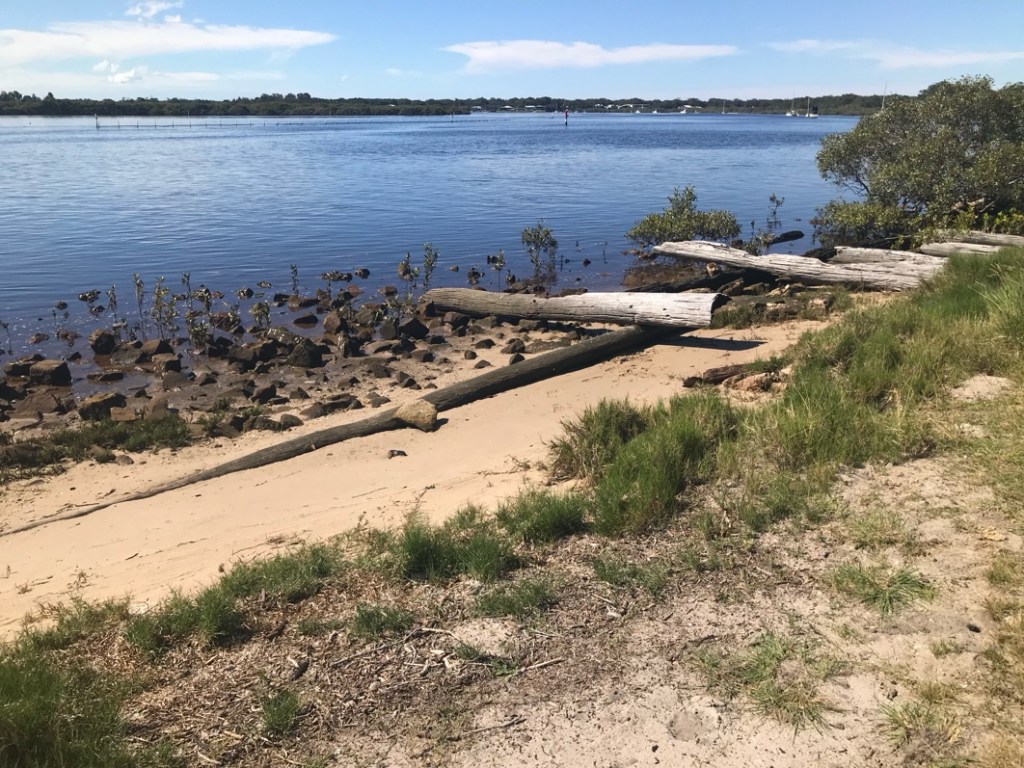
Onshore remains of a wooden wharf that serviced the Birdwood Mill at Winda Woppa [Author Photo – August 2025]
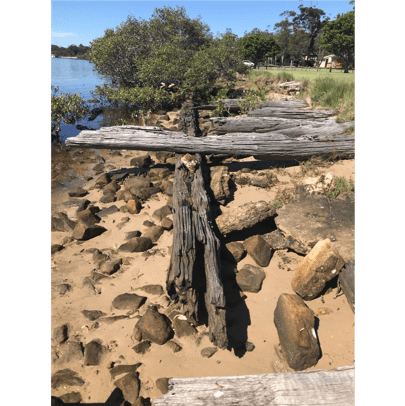
Remains of a wharf that serviced the Birdwood Mill. Ballast stones removed from ships that were to load timber are also visible [Author photo – August 2025]
The following papers relevant to the Birdwood Mill are published at the following links on the website
Early History of the Timber Industry in the Myall and Port Stephens Areas
Hulk of the Drogher ‘Salamander’ at Port Stephens
Hulk of the Drogher ‘Iluka’ at Port Stephens
Activities of the Waterside Workers Federation at Port Stephens
A Journal of the Port Stephens Waterside Workers Federation – 1924
Researched and compiled by Kevin McGuinness
August 1925

 Port Stephens - a history exploration