
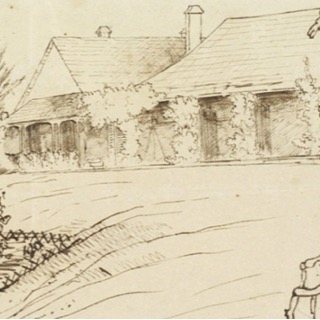
Introduction
This paper traces the history of Tahlee House at Tahlee near Carrington in Port Stephens. The historic homestead has in fact had two lives.
The first house was built around 1827 as the residence for the early Commissioners of the Australian Agricultural Company, viz:
- Robert Dawson (1826-1830)
- Sir William Edward Parry (1830-1834)
- Lieutenant Colonel Henry Dumaresq (1834-1838)
- Rear- Admiral Phillip Parker King (1839-1949)
Upon the relocation of its headquarters to Stroud in 1853, the Australian Agricultural Company sold its Tahlee Estate.
The original Tahlee House was completely destroyed by fire in 1860. It was rebuilt over time into by the heritage-listed residence that stands on the site today.
In 1880, businessman and politician, Robert Hoddle Drieberg White bought Tahlee House to use as his country residence. R.H.D White was the Member for Gloucester in the NSW Legislative Assembly (1882-1885) and later a Member of the Legislative Council (1888-1900).
During his ownership, he completed several upgrades to the house and was a prolific host and entertainer. In 1927, Mr. Alfred Becher Stewart White, his youngest son, inherited Tahlee House.
In 1943, the Gospel Fishermen Mission (G.F.M.) leased part of the premises for their activities. They conducted Missionary Training Camps there from 1951.
In 1959, G.F. M. brought Tahlee House and its surrounding grounds and commenced operations as the Tahlee Bible College. In 1976, G.F.M. changed their name to Gospel Service Mission. Presently activities at Tahlee are carried on under the name of YWAM [Youth With A Mission] Tahlee.
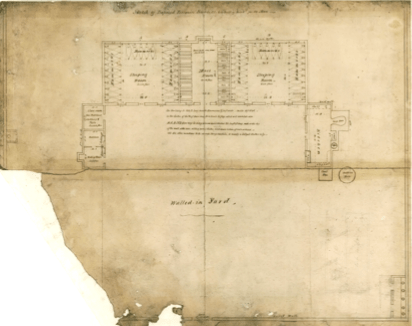
Plan of Tahlee House c1827 – the front of the house facing Port Stephens is at the top of the plan [University of Newcastle Living History Collections and Noel Butlin Archives, ANU]
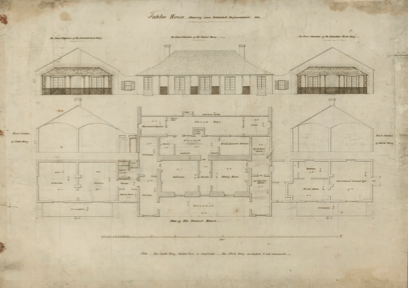
Plan of Tahlee House showing improvements completed and planned – 1830 [University of Newcastle Living History Collections and Noel Butlin Archives, ANU]
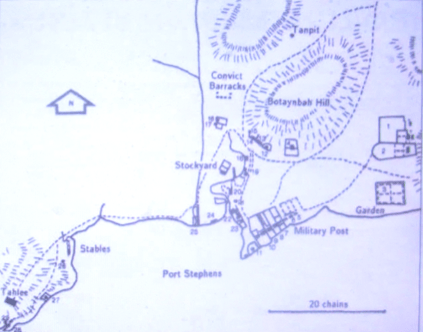
Early map of Carrington showing location of Tahlee House (at bottom left) – 1829
Tahlee House – the Residence of Sir William Edward Parry
Information on the history of Tahlee House during its occupation by Sir William Edward Parry and his family is published elsewhere on this website. Links to the various papers are set out in the conclusion of this paper.
A Christmas Story from Tahlee House – 1832, is especially interesting and was first published in 1927. It records a special event that happened on a Christmas day over 190 years ago and can be viewed at this link on the website
Tahlee House – Residence of Colonel Henry Dumaresq
The Maitland Mercury of 5 August 1950, page 2, reported:
‘This prosperity [of the Australian Agricultural Company], both in its agricultural and its coalmining ventures, continued under Parry’s successor, the second commissioner, Colonel Henry Dumaresq, who took up residence at Tahlee House.
Apparently, Dumaresq added three rooms to the house in addition to the two built on to it by the Parrys; for Lady Franklin, the wife of the Governor of Tasmania, another Arctic explorer, stated this when on a visit to Tahlee in May, 1839. “Building built with three front windows under verandah, a chimney at each end on a frame, with painted front built by Parry with two rooms.” Apart from the ballroom, of a later date, the description still fits. The verandah still runs the whole length of the front of the house, with a flower covered arched entrance in the middle.
A long flight of stone steps runs down through the grass of the sloping lawns forming a pathway to the gardens and the private landing-stage, and to the boats. Some guns are still in position in these grounds. Tahlee House continued to be used by officials of the A.A.Co. until Captain Marcus Freeman Brownrigg, General Superintendent of the Company, on his arrival [in 1852], chose Booral House for his residence (at Stroud) and there being no further use for Tahlee, it was sold, in 1880, to Mr. R. H. D. White, who went to live there with his family.’
A former manager [of the Company], Robert White, acquired the property in 1880, and it eventually passed to his youngest son at age 74. In 1949, the mission took over the site. Today, Tahlee is maintained as a historical property, reflecting changes in land use over time.’
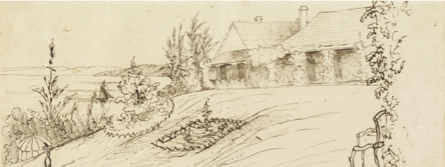
Drawing of the original Tahlee House – 8 February 1840 [State Library NSW]
A Reflection on the Australian Agricultural Company and Tahlee House
The Newcastle Sun of 28 September 1936, page 4, reported on memories on the early days of the Australian Agricultural Company and Tahlee House as written by Ald. W. J. Gould (then president of the Newcastle Historic Society):
‘Tahlee House at Carrington, Port Stephens, with its terraced gardens, tiny wharf, and boat harbor, is one of the historic homes of the State. Almost hidden from view by the towering trees and overgrown shrubs, it comes as a surprise to the tourist to find such a fine old homestead practically isolated in the bush.
Tahlee House is a relic of the days when the A. A. Company established its headquarters at Carrington (about 13 miles from the entrance to Port Stephens) hoping that it would eventually become a township of importance to the company and the Colony. But these hopes did not materialise, and the company’s headquarters were soon transferred to Stroud and later to Newcastle.
The homestead, eventually to become the home of the White family, was built in the ‘twenties as a residence for the governor of the company and it was here in 1830 that Sir William Edward Parry came to reside when he took charge of the company’s affairs. Sir William Edward Parry was born at Bath, England, on December 19, 1790. He joined the British Navy in 1803 and during the years 1818 to 1827 he made four voyages of exploration to the Arctic regions. For his efforts in this connection, he was knighted and received a substantial grant of money from the British Government. In July 1829 he accepted an appointment as governor of the Australian Agricultural Company’s settlements in Australia.
Sir Edward and Lady Parry (formerly the Hon. Isabella Louise, fourth daughter of Lord Stanley of Adderley Hall, Cheshire), arrived in Sydney on December 23, 1829. The governor took over command at Carrington on January 9, 1830, and he found things there in a state of chaos. His naval training standing him in good stead, he soon established law and discipline.
The settlement at Carrington was situated on the flat about half a mile from Tahlee House and consisted of storehouses, residences of the officials, cottages for the men and barracks for the military guard. A little wooden church was erected and here on Sundays Sir Edward Parry frequently conducted Divine service. At this time the company was negotiating with the Government for an exchange of 600,000 acres of their grant for a similar area in another part of the Colony. The directors of the company were greatly disappointed with the original grant which had been selected by their first agent, Robert Dawson, and which subsequently was found unsuitable for raising merino sheep.
Sir Edward Parry was given power to select 600,000 acres, which he considered more suitable, and in March, 1832 he left Tahlee House in company with Mr. Henry Dangar (the company’s surveyor) to inspect land upon the Liverpool Plains. Here he selected two large areas of land, one of 240,000 acres and the other of 360,000 acres. After considerable bickering with the Government, the exchange was effected and those two large estates known as Warrah and Goonoo Goonoo passed into the hands of the A.A. Company.
The taking over of the Government coal mines [at Newcastle], and the selection of 1933 acres of coal-bearing land in the district was also completed by Sir Edward Parry. John Henderson, colliery manager, and James Steele, engineer, were sent out from England and they sank the first A pit near the present corner of Church and Brown Streets, Newcastle. The opening on December 10, 1831, was the occasion of a function which was attended by all the citizens of the little township of Newcastle. This was the advent of the A.A. Company into Newcastle, where in later years it was to play such an important part in the progress of the district. …..
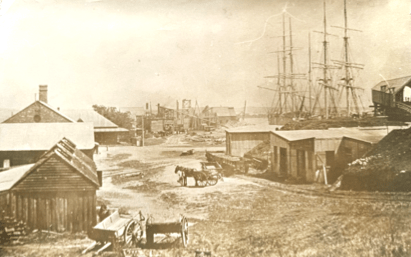
Early view of the Newcastle dock area circa 1880, from where the Australian Agricultural Company conducted commercial operations.
Sir Edward Parry ruled the settlement at Port Stephens with strict discipline, and at the same time earned the respect of those under his control. During his term he succeeded in bringing the company from the brink of disaster and established it upon a sound foundation. Ever a staunch churchman, he erected the church of St. John at Stroud, partly at his own expense, and persuaded the directors to appoint a resident pastor. On March 19, 1834. he and Lady Parry returned to England after having installed Lieut.-Col. Dumaresq as his successor. The directors of the company presented him with a piece of [silver] plate valued at 200 guineas in appreciation of his work.
In later years Sir Edward Parry filled the position of Controller of Steamships, Superintendent at Haslar, and finally Governor of Greenwich Hospital. In 1852 he was promoted to the rank of Rear-Admiral of the White, and on July 7, 1855, he died.
Soon after his departure for England the company’s headquarters were removed to Stroud and the buildings at Carrington gradually fell into disuse. In the late forties [1840’s] the company cut up part of their land at Port Stephens into small allotments and endeavoured to sell them. The little wooden church at Carrington was replaced by a stone-built one with a slate roof and heavy cedar celling. It was completed in 1846 and consecrated by Dr. Tyrell, the first Bishop of Newcastle, in March 1847, with the name of the Holy Trinity Church. This little church was evidently erected in anticipation of the expected influx of settlers, who unfortunately, did not come to Carrington. The church, a few cottages, and Tahlee House are all that remain to remind of the A.A. Company at Carrington…..
Two of the sons of Sir William E. Parry had distinguished careers. Edward, born at Government House, Sydney, in 1830, became Bishop of Dover (England), and was the first Australian-born to attain this rank. Commander Charles Parry, R.N., born at Port Stephens, was a famous navigator, geographer and explorer.
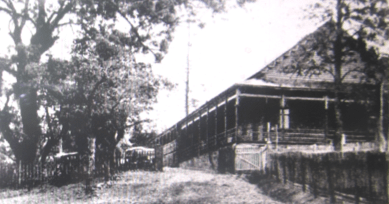
View of Tahlee House [Newcastle Morning Herald and Miners’ Advocate, 22 February 1937]
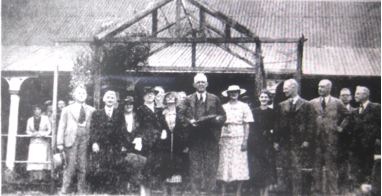
Members of Newcastle Historical Society who made an excursion to Tahlee House during February 1937. The President of the Society, Ald. W. J. Goold (and author of the above newspaper article) is in the centre of the group [Newcastle Morning Herald and Miners’ Advocate, 22 February 1937]
“New Colony of Port Stephens” – 1849
The Maitland Mercury and Hunter River General Advertiser of 17 October 1849, page 3, reported:
‘The first ship with immigrants (purchasers of the Australian Agricultural Company’s land, and their servants) is daily expected to arrive at Carrington, in the new colony of Port Stephens, as it is called in the London newspapers.
Letters have been received from Capt. King, R.N., who is not expected in the colony for six months at least. His ability and experienced aid will be highly valuable at the present moment in London, both to the directors of the company and to intending emigrants.
The numerous cottages in the settlement are being put in repair, for the comfortable reception of the immigrants; and Captain Corlette has received instructions to be upon the lookout for the appearance of the ship at the Heads [Tomaree and Yacabba], then to proceed hence, for the purpose of piloting her in safety to the anchorage in the commodious and beautiful harbour of Port Stephens.
The vines at Carrington, or Tahlee Garden rather (which have been esteemed as superior to any in the colony), are looking better this year than they have done for some years past. There is every prospect of an abundant crop. The gardens are all ” fresh and gay.” The late acceptable rains have produced a seasonable spring in the grass round the settlement, as well as in the bush between it and Raymond Terrace.’
Tahlee House destroyed by fire – 1860
The Sydney Morning Herald of 3 April 1860, page 2, reported:
‘We regret to have to record the total destruction of this splendid building, so long the residence of the Superintendent in Chief of the property belonging to the Australian Agricultural Company. During the night of Thursday last the inmates were alarmed by the fearful cry of fire; on rushing out the shingled roof was discovered to be in a blaze, the fire had already made so much progress that any effort to save the main building would have been fruitless. The family, with the few persons present, therefore used their utmost exertions to save the furniture and moveables, and we are happy to say that although at much personal risk from the falling timber, they succeeded in rescuing a considerable amount of property from the devouring element. In about three hours after the first alarm nothing remained of this fine old mansion but a pile of scorched and blackened walls.
Tahlee house, embosomed in groves of orange and lemon trees, interspersed with clumps of roses, was situated on the crest of a green hill, whose slopes subsided in the waters of Port Stephens. It was built by the Australian Agricultural Company as a residence for their Superintendent in Chief, and long formed one of the principal ornaments of the district.
This fire-property has but recently passed into the hands of Mr. Manton, who was in Sydney at the time of the accident. By a strange fatality, about twelve months since, the beautiful parsonage at Stroud was burnt down, and in bare walls maybe seen in the centre of the town, surrounded by a wilderness of fruit-trees and choice exotics. It is probable that both of these destructive fires have originated from the same cause, that is, the strong currents of air passing up the tall stacks of well-built chimneys have carried sparks of fire with them which have lodged upon the shingled roof and caused the mischief. Shingles are the most dangerous roofing that can be used for stone or brick edifices, arid it will be found that where this description of roof is in most general use conflagrations have been most frequent and destructive, particularly in crowded towns where the buildings are two or three stories in height.’
The Tahlee homestead as it stands today was subsequently rebuilt in the style of the original one.
Views From Carrington and Tahlee – 1885
The Illustrated Sydney News of 21 November 1885, page 3, reported:
‘The accompanying view [see below] of the harbour of Port Stephens is from a sketch taken from the veranda of Tahlee House, the property and country residence of Robt. H. D. White, Esq., M.P. On the left is the township of Carrington, the first settlement of the Australian Agricultural Company in Australia. The chairman of the London Directory of the company was John Abel Smith, of the firm of Smith, Payne, and Smith, who were the bankers of the company, and Carrington was so called after a branch of the Smith family, of whom Lord Carrington, the coming Governor, is a descendant.
A curious coincidence connected with Carrington, the fact that on his lordship’s arrival, he will find the once flourishing locality nearly deserted; the only occupants being one family of the name of Smith.
The sketch was taken in 1833, by Mr. J. C. White, father of the member for the district, one of the officers of the company, who landed on the spot on the 28 October, 1830.
The native name of Carrington was Carrabeen, and the Denie Kiln on the point beyond is still called by its native appellation – Cokrenoyoh – pronounced
Co-kre-no-yoh.’
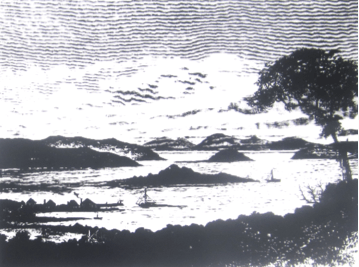
View from Tahlee – from a sketch in 1833 [Illustrated Sydney News, 21 November 1885]
Robert Hoddle Drieberg White – New Owner of Tahlee House – 1888
The Australian Town and Country Journal of 17 March 1888, page 12, published the following information on the distinguished Mr. White, who was the new owner of Tahlee House:
‘Mr. Robert Hoddle Driberg White, of Tahlee, Port Stephens, New South Wales, was born in Stroud, New South Wales, on May 19, 1838. He is a son of Mr. J. C. White (who was born in Ceylon, and was private secretary of Sir Edward Parry, at Tahlee, 57 years ago, and was afterward assistant general manager of the A. A. Company), and a grandson of Mr. Hoddle, a cadet of the Royal Engineers, who held the positions of Deputy Surveyor-General, Sydney, and Surveyor-General of Victoria, and laid out the cities of Goulburn and Melbourne with wide streets, in accordance with the teachings of modern hygienic science.
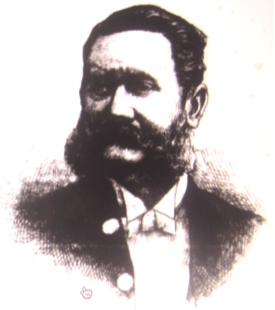
R. H. D. White – Member of the NSW Legislative Assembly [Australian Town and Country Journal, 17 March 1888]
The subject of this sketch [see above] was educated by Mr. Dodds, the Revs. J. B. Laughton, T. Aitkin, and R. L. King, and Judge Cary, of Sydney and also in Melbourne. He began life as private clerk to Captain Brownrigg, R.N., general manager of the A.A. Company, at Bowral, and for a time was in the office of the late Mr. T. S. Mort. He was afterward an officer of the Bank of New South Wales for 25 years. In 1858, while Mr. White was accountant of the branch in Deniliquin, the bank was “stuck up ” by bushrangers, who stole £8000; the whole of which was subsequently recovered by the late John Kelly.
Some years later, when in company with Mr. Buckland, manager of the Gympie branch of the Bank of New South Wales, Mr. White was again “stuck up” by armed bushrangers. On this occasion his services were rewarded by the bank with a magnificent silver tea service, and by the Queensland Government with a silver-mounted rifle. While in Queensland Mr. White held a commission as captain of the volunteer force. He is a justice of the peace for New South Wales, Victoria, and Queensland.
In December 1882, he was elected a member of the Legislative Assembly of New South Wales, for Gloucester, and was re-elected unopposed in October, 1885. He married the third daughter of Dean Cowper, of Sydney, and has a family of sons and daughters. In 1886 he went to England in connection with the Indian and Colonial Exhibition, and had the distinguished honour, with his wife and eldest daughter, of passing a day at Windsor Castle, and was presented to her Majesty, who was graciously pleased to accept a pair of beautifully carved emu eggs, mounted in silver. On the return voyage of Mr. White and his family from England, his eldest son (Edward Shepherd White) died on Christmas Day. Subsequently Mr. White then retired from public life, until he was nominated to the Legislative Council in December last.’
Description of the Tahlee House – 1888
The Maitland Mercury and Hunter River General Advertiser of 26 June 1888, page 4, published the following description of the second Tahlee House and its surrounds:
‘Tahlee, the beautiful and historical maison de campaign of the Hon. R. H. D. White, M.L.C., is pleasantly situated on the banks of the harbour of Port Stephens, some ten miles above Nelson’s Bay. Six years ago, it became the property of the present owner, who lost no time in setting about to make it one of the most commodious and comfortable marine residences in the northern district.
The visitor, being landed on the extensive wharf which projects a long way into the river, wends his way towards the mansion, which is reached by winding stairs of brickwork studded with large ornamental vases out of which are growing flowers of the choicest description. Almost in front of the main building is a magnificent lawn tennis ground 90 feet in length by 60 feet wide, enclosed with a wire netting 8 feet high; at one end is an ornamental conservatory and lounge for the tennis players. The whole is surrounded by lovely flower gardens. The fernery is one of the finest in the colony.
In leaving the principal dwelling and passing along an avenue of shrubs and lemon trees you arrive at a large building (lately erected), which is set apart as an organ room and several bedrooms. The organ is one of the best of its kind. Service is held in this building every Sunday when the family are residing at Tahlee, the Hon. R. H. D. White officiating. There is being added to this structure a billiard room, another organ room, bathrooms, etc.
In addition to the usual outbuildings, such as servants’ rooms, kitchens, and store rooms, carpenter’s shop, tool house, harness room, there is also an engine house, in which is erected the necessary machinery for lighting the whole premises with electricity; the engine (which is driven with gasoline), besides driving the dynamo, turns a lathe, saw bench, and grindstone. In an adjoining room are placed the accumulators for storing the electric fluid. There is a blacksmith’s shop, where all kinds, of work is turned out.
The other buildings on the estate comprise an overseer’s residence, a laundry and washhouse, a school, cottages for the working men, stables, cart sheds, etc. The vineyards and orchards are tastefully laid out, and in full bearing; the vegetable garden is admirable. ….There is adjoining the wharf a large store and boat sheds, also bathroom. There are boats of all kinds from the gig to the yacht, including a very smart steam launch of about 20 tons, purchased by the Hon. R. H. D. White when recently in England. There are numerous hands employed on the estate, as many improvements are still being carried out.
Tahlee [the original residence] was formerly the residence of Admiral King and was occupied by him during the very early days of the colony, he at that time being connected with the now prosperous A. A. Company.
About a mile from Tahlee is the small settlement of Carrington, comprising several dwellings and a very nice church, which has been recently renovated by the hon. gentleman. During the family stay at Tahlee divine service is held once a month. Through the hospitable invitations of the genial host, Tahlee is often visited by the elite of Sydney, who thoroughly enjoy themselves with fishing, shooting, boating, etc, and regret when the hour arrives for their leaving such a haven of bliss.
The Illustrated Sydney News of 16 July 1892, page 8, reported on the official visitors who were guests at Tahlee house:
‘The Hons. W. J. Lyne (Minister of Works) and J. Kidd (Postmaster-General) paid a visit to Stockton on Monday last and formally opened the new Council Chambers. The Ministers were accompanied by the Hon. R. H. D. White, whose guests they had been from the previous Saturday, to his residence, Tahlee, Port Stephens.’
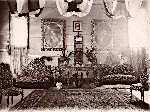
Tahlee House ballroom – 1890
Vice Regal Visit to Tahlee – 1892
The Australian Town and Country Journal of 22 October 1892, page 18, reported:
‘Lord and Lady Jersey, accompanied by Viscount Villiers, left Sydney on October 12 on a visit to Stroud and Port Stephens. The party arrived in Raymond Terrace on the following day in the Government launch from Newcastle, en route for Tahlee, the residence of Mr. R. H. D. White. The Mayor, the school cadets, the Raymond Terrace Band, and about 200 citizens welcomed the vice-regal party. His Excellency was presented with an illuminated address, which was read by the Mayor.
Leaving Raymond Terrace, the distinguished visitors proceeded to Stroud, where a hearty welcome was accorded them. Lord Jersey laid the foundation stone of the new School of Arts at Stroud, but the proceedings were marred somewhat on account of the heavy rain that was falling. A banquet was subsequently given to the party at the School of Arts, after which Lady Jersey performed the opening ceremony in connection with a bazaar, the proceeds of which are to go to the School of Arts funds.
The party then proceeded to Tahlee, at Port Stephens, where they remained the guests of Mr. E. H. D. White, M.L.C. A start was made for Sydney on October 15, where the Governor and party arrived safely, being well pleased with their brief sojourn in the country.’
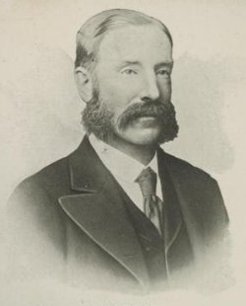
Sir Victor Albert George Child-Villiers, 7th Earl of Jersey. He arrived in Sydney from England on 15 January 1891. His wife arrived in March 1891 [National Library of Australia]
Edmond Barton – First Prime Minister of Australia visits Tahlee – 1893
The Newcastle Morning Herald and Miners’ Advocate of 8 July 1893, page 8, reported:
‘Mr. Edmund Barton, the Attorney-General, arrived in this city [Newcastle] by the steamer from Sydney yesterday morning. He proceeded at noon to Raymond Terrace, from whence he will be driven to “Tahlee,” the residence of Mr. R. H. D. White, M.L.C., at Port. Stephens. Mr. Barton intends to spend at least a fortnight with Mr. White, and states that for the past year his political duties have occupied the whole of his available time.’
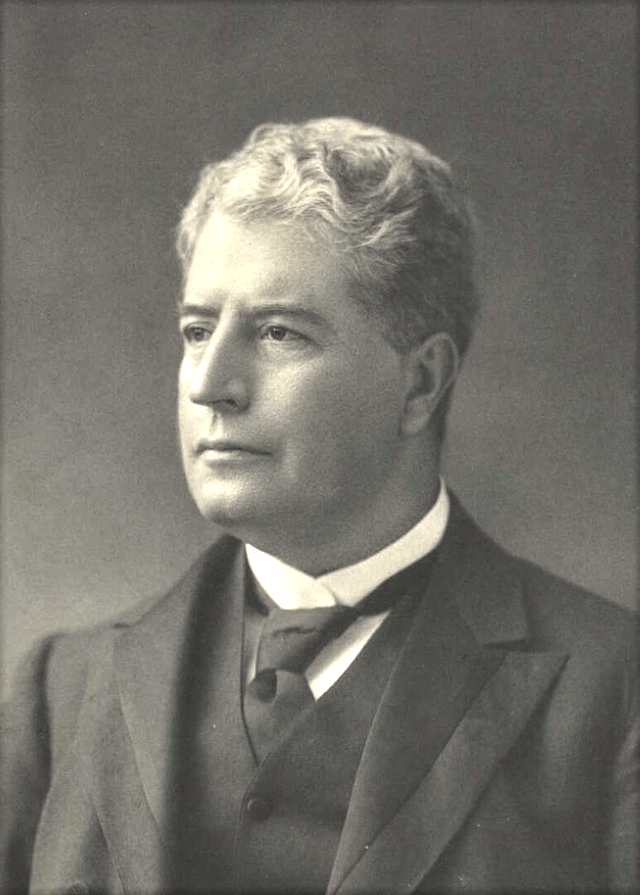
Sir Edmund Barton served as the first Prime Minister of Australia from 1901 to 1903. He spent two weeks at Tahlee in 1893.
Boating Accident – 1893
The Evening News of 1 August 1893, page 5, reported:
‘A sad boating- accident, resulting in the drowning of William Henry Oliver, engineer to Mr. E. H. D. White, M.L.C., took place at Port Stephens on Wednesday last. Oliver had taken Mr. White to Sawyer’s Point [Karuah] in a pulling boat, and on his return to Tahlee he borrowed a boat and sail, proceeding to Nelson Bay to get some things he expected from Sydney by the steamer Gosford. Finding the Gosford had left Nelson’s Bay wharf, and was anchored at the Gap, mouth of the Myall River, he sailed across, and when about 60 yards from the steamer jibed and upset the boat.
Stuart Smith boat went to his assistance and started him off again to Nelson’s Bay. Oliver remained at the hotel [Sea Breeze Hotel] for a short time, and then started back for Tahlee. The boat was last seen just before dusk near Middle Island, one of the most dangerous parts of the harbor, owing to the strength of the current.
Finding Oliver had not returned, Mrs. White telegraphed to Nelson Bay and Tea Gardens, next morning, and dispatched two boats to search the harbour. Boats have been out ever since, and Oliver’s body had not been found on Monday. On Friday Senior-constable Stone, of Tea Gardens, found the boat bottom upwards on the rocks on North Head, Port Stephens. He has been searching ever since on the one side of the harbor, Mr. Laman, Custom-house officer, on the other side, Mr. White’s boats and those of Messrs. Smith, of Carrington, together with other searchers, and the blacks’ boats, in other portions of the harbour.
Oliver leaves a wife and four children quite unprovided for at Tahlee. He served 10 years in the Royal Navy; first in the Britannia, afterwards in the Indue, Northumberland, and lastly as stoker in the Nelson. He left the service with first-class certificates and has been in Mr. White’s service for over three years, looking after the yacht Kingfisher, the electric light plant at Tahlee, and other engines.’
Hon. R. H. D. White – Squire of Tahlee – 1895
The Bird O’ Freedom of 14 September 1895, page 1, reported:
‘The sailing season is with us once again, and after so many tales of prolonged drought, of midsummer heat, and fearful bush fires, it comes as a pleasant relief, bringing as it does the recollection of many a pleasant hour spent on the sparkling waters of Port Jackson. Of the Sydney clubs the oldest established is the Royal Sydney Yacht Squadron, having as its Commodore the subject of our sketch, the Hon. Robert Hoddle Drilberg White M.L.C.
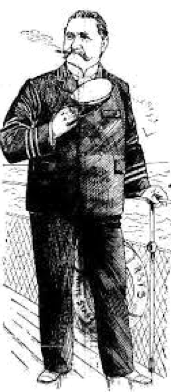
Commodore of the Royal Sydney Yacht Squadron – Hon. Robert Hoddle Drilberg White M.L.C. [‘Bird O’ Freedom, 14 September 1895]
Mr. White is a grandson of the late Richard Hoddle, Esq., late Surveyor-General of Victoria, from whom he inherited a large fortune, and his father was Mr. J. C. White, at one time manager of the Bank of New South Wales at Toowoomba, for which constituency he was defeated when standing for Parliament by the present member, Mr. W. H. Groom, who has held the seat ever since — thirty-three years ago.
As the representative for Gloucester from January 1883, to November, 1885, and afterwards as a member of the Council from 1887 to the present day, Mr. White is a well-known Parliamentary figure, but he is probably far happier when treading the decks of his favourite cruiser, the s.y. White Star. The possessor of a charming residence, Tahlee, situated at Port Stephens, Mr. White keeps in that well-known haven a fine little steam yacht, the Kingfisher, 14 tons, on board of which many cruises are made in search of the wily schnapper.
For more extended cruising the s.y. White Star was built. She is a vessel of 107 tons, constructed in 1889 by W. Dunn, of Sydney, from a design by E. W. Cracknell, and is a very constant visitor to Farm Cove. At the last general meeting of the Yacht Squadron Mr. White, who had previously held the position of vice-commodore, was unanimously elected Commodore, vice Mr. Jas. R. Fairfax, resigned. The members of the Squadron showed sound common sense in this, as a better man for the position could not have been found. A thorough-going yachtsman, a sailor to his fingertips, and a very hospitable man, Mr. White’s name is almost a household word, and when the signal letters B.G. under the burgee are seen flying on the Commodore’s ship fellow yachtsmen are bound to be in for a good thing.
An enthusiast in all matters appertaining to the sea, the Squire of Tahlee is a member of the N.S.W. Fisheries Commission. His fellow-members were offered the loan of the White Star to prosecute their enquiries along the coast, but visions of mal-de-mer [sea sickness] stood in the way, and the offer was refused, something more in the line of an ocean mail boat being required. Mr. White has also placed his yacht at the disposal of the committee of the squadron with a view to proceeding to Melbourne to welcome the new Governor, Lord Brassey, and no doubt the offer will be gladly taken advantage of. A trip of the kind in the comfortable cruiser, with such a host as the Commodore in charge, would require to be marked in red ink for ever afterwards. Naturally a popular man with all who know him, and their name is legion, kind-hearted and generous to a fault, everyone will unite in the wish that it may be many a long day before the blue burgee, with its white cross and golden crown, is finally hauled down on the White Star.’
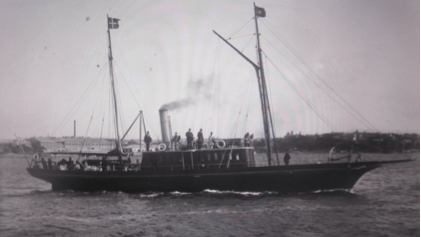
Steam yacht ‘White Star’ – owned by Mr. R. H. D. White [Tyrell Photographic Collection, Powerhouse Museum]
Christmas Celebrations at Tahlee – 1895
The Evening News of 28 December 1895, page 5, reported:
‘Christmas festivities at Tahlee, Port Stephens, at the residence of the Hon. R. H. D. White, passed off with great success. The music hall was gaily decorated with flags and divine service held therein at 11.30, all joining heartily in the Christmas hymns to the tones of the organ. The blacks, piccaninnies, and half castes mustered in good numbers and had a good feed. A bullock was killed for them, as usual for years past at Tahlee.
At 8 o’clock between 70 and 80 people assembled in the music room where they were entertained with organ music, songs, tableaux, &c., in the missle [mistletoe] of which the Christmas tree was exposed to view, and presents given to all the children. The company adjoined to the veranda, where refreshments were partaken of, and finished up by giving three cheers.’
Death of the Hon. R. H. D. White – 1900
The Murrurundi Times and Liverpool Plains Gazette of 3 November 1900, page 2, reported:
‘The Hon. Robert Hoddle Driberg White, M.L.C. of Tahlee, Port Stephens, passed away on Sunday last in his 63rd year. The deceased was a representative colonist. He was the eldest son of Mr. James Charles White and of Sarah Elizabeth, the only child of Mr. Robert Hoddle, the Surveyor-General who laid out Melbourne in 1837. He was born at Stroud, Gloucester on May 19, 1838, and represented that district in Parliament. He commenced life in the services of the Bank of New South Wales, and was connected with that institution for a quarter of a century. In 1880 Mr. White represented the colony at the Colonial Exhibition held in London. In December, 1887, he was called to a seat in the Upper House. Both as a public and private man Mr. White had a wide circle of friends.’
Commonwealth Festivities Held at Tahlee – 1901
The Newcastle Morning Herald and Miners’ Advocate of 5 January 1901, page 7, reported:
‘Commonwealth festivities were held at Tahlee, Port Stephens, the beautiful residence of Mrs. R. H. D. White. In previous years all the residents of the district were invited to a Christmas tree, but this year, owing to the absence of the family, this was dispensed with. Mrs. White, feeling that something should be done to celebrate the consummation of the Federation of the colonies commissioned Messrs. J. A. Smith and F. Lee to arrange a picnic and sailing race for all in the district.
The day opened hot and sultry, though this did not deter fully 150 persons from putting in an appearance, everyone thoroughly prepared to have a good time. Proceeding were to have commenced by sending the six boats entered for the race on their journey, but owing to the light wind it was decided to wait till after lunch. All wended their way to the chosen ground, where the usual picnic games were indulged in till the lunch was ready, when they sat down to a spread consisting of all the delicacies of the season, to which justice was done.
The wind commencing to rise a start was made with the race. The following boats started:- Florence, 18ft, 6min start (W. Evans); Valkyrie, (W. Manton); Thelma, 20ft, 4min start (E. Barclay); Vesta, 21ft, 3min start (F. Morant); Mystery, 22ft, 2min start (J. Evans); Sea Gull, 24ft, scratch (J. Johnson). The course was over 12 miles, and after a good race Florence, which was splendidly handled, won, with Valkyrie close up second. The others were not in it.
During the time the race was in progress, there was racing amongst the youngsters, boys and girls. In addition to the prize won every boy and girl on the ground was presented with a toy. Just as the boat race was finishing one of the heaviest squalls ever seen here came up. The Vesta and Seagull were two miles away in the full force of it, and wives, mothers, and sweethearts had an anxious half-hour till it lifted a little, and the boats were seen scudding under bare poles, and all safe. Everyone got drenched, and this stopped all further sport. After a cup of good tea, and giving three hearty cheers for Mrs. White, and three more for the federated colonies, all wended their way home thoroughly satisfied that they had had one of the best days ever spent in Port Stephens.’
Death of Eliza Jane White – 1927
The Sydney Morning Herald of 6 August 1927, page 19, published the following obituary for Eliza White, the widow of the Hon R. H. D. White:
‘The death is announced of Mrs. Eliza Jane White, widow of the late Hon. R. H. D. White, M.L.C., at the age of 83 years. A daughter of the late Dean Cowper, a former Dean of Sydney, Mrs White was born at Stroud, New South Wales. Following her marriage, at the age of 18 years, she lived for some time at Gympie, where her husband carried on gold-buying operations. Mr. White later acquired property at Tahlee, Port Stephens, and here the family lived for several years.
Four years after his election as member for Gloucester, in 1882, he visited England as the representative of New South Wales at the Indian and Colonial Exhibition in London and following his return his appointment to the Upper House was announced.
After the death of her husband Mrs White took up residence in Sydney. Her death occurred yesterday at her home, Boanbadah [Boondelbah], Mosman. She is survived by two daughters—Lady Cullen, wife of Sir William Cullen, formerly Chief Justice, and Mrs. L. Hungerford, of Tasmania; and by two sons— Messrs. C. C. and A. B. S White, of Sydney. The funeral will take place this morning at the South Head Cemetery.’ [Her Mosman residence was named after the Port Stephens island named ‘Boandabah’, that lies between Soldiers Point on the south side of the harbour and the Pindimar area on the northern side and was visible from Tahlee House].’
The Dungog Chronicle of 12 August 1927, page 2, also reported:
‘A link with the early political and church life of New South Wales was severed by the death of Mrs. White, widow of the late R. H. D. White, M.L.C., at her residence, Raglan Street, Mosman.
Mrs. White was a daughter of the late Dean Cowper and was born at Stroud 83 years ago. After her marriage she went with her husband to Gympie, Queensland, where Mr. White bought gold for the Bank of New South Wales. They then went to Mudgee, where Mr. White was manager of the branch of the bank. After his retirement in 1881 from the services of the bank Mr. White bought the well-known station property Tahlee, Port Stephens.
Mrs. White was a noted hostess, for Mr. White as Commodore of the Royal Sydney Yacht Club, entertained very largely. Tahlee was a favourite meeting place for many of the big political men of the day. Mrs. White is survived by two sons and two daughters. The eldest daughter is Lady Cullen, wife of the former Chief Justice, and the other daughter, Mrs. L. Hungerford, of Ferntree Gully, Tasmania. The sons are Mr. C. C. White, of Wahroonga, and Mr. A. B. S. White, of the Sydney Stock Exchange.’
Memories of Tahlee and Nearby Carrington – 1927
The Sydney Morning Herald of 29 October 1927, page 11, published the following memories of Joan A. Lemm of her memories of Tahlee, the historic homestead:
‘The report of the death, early in August, of Mrs. Elza Jane White, widow of the late Mr. R. H. D. White, M.L.C., of Boandabah [Boondelbah], Mosman, and Tahlee, Port Stephens, recalled to my mind a delightful visit paid early this year to the latter, an historic and beautiful homestead.
The late Mrs. White was an octogenarian, at the time of her death, and her visits to Tahlee House were very infrequent for some years past. In the intervals between her visits the property was left in charge of caretakers, and it was they who showed us the various points of interest around the place.
The grounds deserve more than a passing mention. They extend to the water’s edge, and though much of the growth is tangled, one can glimpse much beauty in the uncommon shrubs, the quaintly patterned privet hedges and the flowering trees. Here and there one stumbles on a little crumbling cannon, once put to grim use, when a convict labourer was rash enough to attempt escape from the estate.
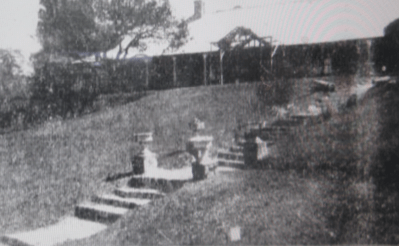
Stairs leading to the Tahlee homestead [Farmer and Settler, 23 December 1927]
Right opposite the house, and quite a decided feature of the landscape, lies a small wooded island [Garden Island], which has its own romantic history. It was claimed tentatively as part of the Tahlee Estate, but stern red tapedom in England forbade such a claim, unless it were possible actually to drive upon it from the mainland. This was accomplished at low tide, and so the islet went in with the rest.
Going up across the wide lawns, one comes to the house, a long, low structure in the true homestead style, built of rough stone, and in good repair. It is, of course, the older portion of the house that claims one’s interest, the two most interesting rooms we saw being the billiard-room and the chapel. The furniture in both was very massive. A huge billiard table occupied the centre of the former, the walls being covered with old sporting prints, while the fireplace was filled with wonderful bluish ornaments of beaten copper. The most interesting feature of the chapel is the organ, with its beautifully carved and painted pipes, though, unfortunately, its golden tongue remained silent for us, since we were told that the chatelaine [house mistress] preferred that it should not be touched by strangers.
Directly in front of this is a lectern, and the seating for the worshippers consisted of brocaded chairs for the important members of the household, and plainer wooden ones for the less distinguished. For a moment the chattering crowd about seemed to vanish, and shadowy figures of a bygone day took their place, becapped maids ogling the men-servants in the row behind them, or commenting on their mistress’s latest toilette, as she moved to take her place of dignity in the handsome chairs of the front row, and in the soughing of the pines outside, or the lapping of the water on the rocks below, there was mingled the drowsing noise of the preacher to this little flock.
Beautiful pictures of a religious or symbolical significance—including a couple of fine Renaissance prints—adorned the walls, and one interesting canvas contrives to present three faces in one. According to the viewpoint, the spectator may see Queen Victoria, King Edward, or Queen Alexandra. Collections of shaded seaweeds and delicate corals, preserved under glass cases, rival in interest dragon-sprawled vases from old China, and the frailer beauty of Dresdon ware from old England, and stately blackwood chairs inlaid with mother-of-pearl. A veritable treasure-house is here!
I was told that a certain provision attached to ownership of the property, is to the effect that this older portion of the house must be opened up during the day and remain so until sunset—and in those hours who knows what shade of other days may slip there to con lovingly these loved, and lovely things?
Outside, there were several features of interest, the crumbling stone lookout whence watch was kept for runaways or incoming ships, the farm, the blacksmith’s shop., the slaughter yards, all throbbing once with busy convict-labour.
We next made the trip of perhaps half a mile across the estate to the deserted village of Carrington, the sole inhabitants of which are two aged spinster sisters and their two bachelor brothers. Outside the church, which is small but very solid, there is fast sunken into a stone, a large old bell, green with age, bearing about its base the inscription “A.A. Company, 1829.” The interior of the church impresses one chiefly by the extraordinary thickness of the walls, and the solid appearance of the seating, which was made from locally obtained timber. Our old guide displayed with great pride a beautifully embroidered alter-cloth, but this and the matting and hassocks appear to be fairly modern acquisitions, for service is still held in the old church, and such occasions are the chief joy of the old folk who live in this, beautiful but lonely spot.
From a small book, now out of print, entitled “The Australian Agricultural Com-pany, 1824-1875,” by Gregson, General Superintendant of the Company, 1876-1905, gleaned the following details about “Tahlee House” and its surroundings.
A certain Mr. Robert Dawson was the first official of the famous company to be connected with the place. In a book called “The Present State of Australia,” published in 1830, he wrote optimistically: “I had reasonable hopes that Port Stephens would become the permanent settlement of the A.A. Company.” But unfortunately, he had acted with great precipitancy, backed by little colonial knowledge or experience of sheep. Within six months of his arrival in this country a substantial settlement was formed here, and by the end of 1826 a thousand head of cattle, two thousand head of sheep, and two hundred and fifty persons were located among these picturesque but, in many ways, unsuitable surroundings.
But the prosperity of the settlement was short-lived. Towards the middle of 1829 a deputation waited on Sir George Murray with the report that Mr. Dawson’s selection had proved unsuitable for sheep-raising, and he had been dismissed. Sir Edward Parry had been appointed Commissioner for the company and begged that he might be authorised to select from 400,000 to 600,000 acres in some other part of the colony in lieu of an equivalent area at Port Stephens. This was granted.
He arrived at Port Stephens early in 1830, and his subsequent administration was such as to make him something of a god in the company’s history. Tahlee House was his residence, having been built on rising ground overlooking the harbour near the river mouth, and its garden was celebrated as the finest in all the district round. [The original Tahlee homestead was destroyed by fire in 1860].
Less than half a mile east, the little township of Carrington was situated on the flat ground by the water’s edge, and must have been a hive of activity with its storehouses, church, and the residence of the minor officials, and the cottages of the men, for it was a kind of military headquarters and the centre of business. But even the apparent prosperity of the place was no excuse for remaining there permanently, and Sir Edward Parry proceeded to inspect thoroughly the Port Stephens country, and, disapproving of it, he organised and sent out parties in search of better. Ultimately a district between the Warrah and Peel Rivers was selected, and a huge estate in this part known as Goonoo Goonoo passed into the company’s possession. Thus the hum of activity ceased in the little township of Carrington, and it became in truth a “deserted-village,” and the beautiful old home in its far-famed gardens was left with only crowding memories off the building-up and bustle that had gone on round it.’
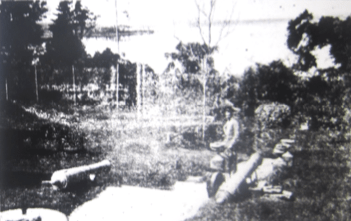
Old cannons at Tahlee House, 1928. Only one cannon currently remains at Tahlee House [Gloucester Advocate, 17 January 1928]
Pipe Organ Removed from Tahlee – 1932
The Newcastle Morning Herald and Miners’ Advocate of 4 February 1932, page 6, reported:
‘The pipe organ taken from Tahlee, Port Stephens, the historic home of Mr. A. B. S. White, has been removed to St. Philip’s [Anglican] Church, Eastwood, Sydney, and dedicated by Archdeacon Martin. The organ was imported from England by the late Mr. White in 1890. It was built by Messrs. Hele and Co., under the direction of the late Sir Frederick Bridge, the organist of Westminster Abbey.’
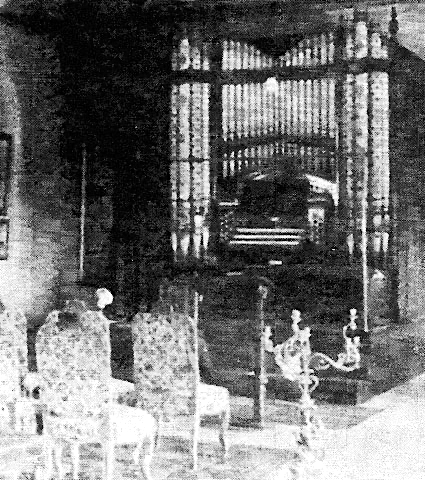
Organ in the organ room at Tahlee House
The organ has since been broken up.
Reflections on Tahlee House – 1934
The Sydney Morning Herald of 29 December 1934, page 7, reported:
‘In 1847, when the little church was built, Carrington must have been a busy place. It consisted of a settlement of stone cottages, with barracks for the convicts and the military, whose presence was necessary to keep order. There was constant traffic with Sydney by boat. The residence of the Commissioner at Carrington and called Tahlee House was erected in the early days about a quarter-mile from the company’s settlement [at Carrington]
Carrington’s importance began to fade about a decade later as the work of the company extended and the population moved, and other settlements arose, with the consequent transfer of the people employed. The little church fell into disrepair, and the furniture was loaned to a church some distance off.
The palmy days [period of prosperity] came again to Carrington in the early eighties, when the Hon. R. H. D. White, M.L.C., came to reside in the Gloucester district, where he was born and brought up as a lad. He bought Tahlee Estate, and made the old house habitable, and built fine additions thereto. He caused the church to be renovated. The church fittings were returned, and to ensure attendance Mr. White arranged for a steamer to bring people from surrounding districts.
Mr. White’s wife was a daughter of Dean Cowper, who later, in 1901, performed the marriage ceremony at the Carrington church between Miss White (his granddaughter) and W. P. Cullen (afterwards Sir William). Mr. Cyril White was married to a daughter of Canon Kemmis.
On a recent visit to Carrington, Mr A. B. White, the present owner of Tahlee, showed us over the property The old home is now used only occasionally, but it is delightfully situated overlooking the bay, and contains many reminders of its old-time grandeur The grounds themselves bristle with cannons as if their presence was necessary to repel an invader, quite a number of old six-pounders (said to have been removed here from Dawes’ Battery when it was dismantled) are to be found on the lawn in front of the house, amongst other much older and bigger ones, bearing dates showing that they were cast in 1812 and in 1819.
The old trig station on the hill overtopping the homestead, can still be ascended. The flagstaff, of course, is a successor or one of the successors of that used a hundred years ago by Sir Edward Parry. There is still remaining a fairly large dripstone filter similar to that recently removed from Burdekin House. Two large Norfolk Island pines, and a fine old fig tree have survived. The large ballroom contains fine oil paintings, a large organ, furniture, including chairs, settee, and card table, all of the time of Louis XV., and many other interesting things not the least of which is an organ stop from the organ at Westminster Abbey, when that famous instrument was being reconstructed. This was given by Sir Frederick Bridge to Mr White when he was the New South Wales Commissioner at the Colonial Exhibition held in London in 1886.’
Visit to Tahlee House – 1936
A correspondent (W. Gilmour) for the Sydney Morning Herald of 15 February 1936, page 13, reported on a visit to Tahlee House:
‘After leaving the wharf, with its little boat harbour of crumbling stone, like a Devonport in miniature, you ascend the grass-grown drive and presently you are standing beneath ornamental trees planted last century and facing an old stone bungalow that overlooks its terraced garden to the wide stretch of Port Stephens.
This is Tahlee, the residence, 100 years ago, of the manager of the Australian Agricultural Company, and of which S. Slune, in his “Emigrant’s Journal,” speaks: “The Beagle anchored off the settlement of the Australian Agricultural Company, a straggling village called Carrington … To the westward is the residence of the superintendent, a situation which, to enhance the pleasure of our visit, was held by Captain P. P. King, R.N. Tahlee, the name of the spot, surpassed in beauty all I have ever seen in Australia. It stands on the crest of a steep grassy slope, over which are scattered numerous small bushy lemon trees, the deep verdure of their foliage, interspersed with golden fruit, contrasting charmingly with the light green carpet from which they spring.”
I was standing close to one of the small cannon, which in these days of modern warfare look pathetic enough, and thinking of the sorry service it may have rendered in the early half of last century by warning the guard on the southern shores of Port Stephens [at present day Soldiers Point, Port Stephens], the escape of a convict. For attempts were frequently made to gain freedom by swimming the bay at its narrowest point opposite bush clad Middle Island, which served as a resting point, before negotiating the deep and dangerous tidal channel that separates this island from the southern mainland.
My musings, however, were cut short by the emphatic toot of the fussy launch, and in a couple of minutes I was aboard listening to wireless music, though my mind was still with the bearded escapees of those dreadful days, and thinking that their chances of reaching Newcastle and finding a vacant ship would be poor, when even James Demarr, who tells of his visit to this district in his “Adventures in Australia,” was imprisoned on the mere suspicion of being a convict, and had some difficulty in convincing the authorities of his innocence.’
Newcastle and Hunter District Historical Society visit Tanilba House – 1950
The Maitland Mercury of 22 July 1950, page 2, reported:
‘The drogher (transporting the Society members to Tahlee) pulled in at a private wharf belonging to Mr. A. B. S. White, the harbour trip having taken about an hour. The old ballroom had two roomy old-fashioned fire places, above which massive mantel mirrors reached to the extremely high ceiling. The fine white marble fireplaces were really capacious, and logs were placed in them and set alight, so that wet clothing could be attended to. The warmth, too, was most welcome. This courtesy was greatly appreciated, as also were the attentions of the helpers who provided the hot water for the tea.
The president of the Historical Society (Mr. Goold) related the story of Tahlee, and also thanked Mr. White, their host, for his kindness in allowing the guests this opportunity of seeing one of Australia’s most historical homes. Mr. White said the use of the large room was through the courtesy of the Gospel Fishermen. Evangelist Theobald, the director of the Gospel Fishermen’s Mission, says it is due to the graciousness of Mr. White that the Gospel Fishermen (GFM) are enabled to lease a section of his property, Tahlee, in which to conduct their youth camps (in connection with various churches) and children’s camps (mainly from city missions, orphan homes, and country districts).
The headquarters of the GFM are at Tanilba House, which was visited some time ago, when also their superintendent was most kind to our members. Mr. A. B. S. White personally conducted visitors around his home, Tahlee House, pointing out the most interesting items, especially in the combined dining and drawing room, forty feet long by twenty feet wide. Herein were pictures and furniture all evidence of the careful, solid, magnificent workmanship by some of the “great masters”—work that is never seen today unless in these fine “old” homes. Their graciousness and spaciousness provide the correct setting.’
150th Year Celebrations at Tahlee – 1976
On Saturday, 16 October 1976 there was a re-enactment of the arrival of Robert Dawson and his party in 1826 at Tahlee. Planned activities included performances by the Newcastle Divisional Band of the Salvation Army, participation from the Port Stephens Yacht Squadron and other sailing clubs, as well as the Raymond Terrace Sea Scout Troop.
The official opening and dedication of the auditorium at Tahlee Bible College, with guest speaker Rev James Payne, Commonwealth Secretary of the Bible Society of Australia, was scheduled for 3 pm, following the re-enactment of the arrival at 2 pm. A former manager, Robert White, acquired the property in 1880, and it eventually passed to his youngest son at age 74. In 1949, the mission took over the site.
A booklet titled ‘A Place Called Tahlee’ was published in 1977 to also commemorate the anniversary.
Photos of Tahlee House and its Surrounds – 2014
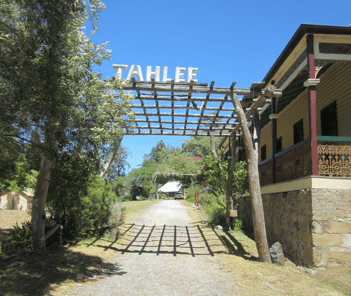
Side of Tahlee House [Author photo – 2014]

Front of Tahlee House [Author photo – 2014]
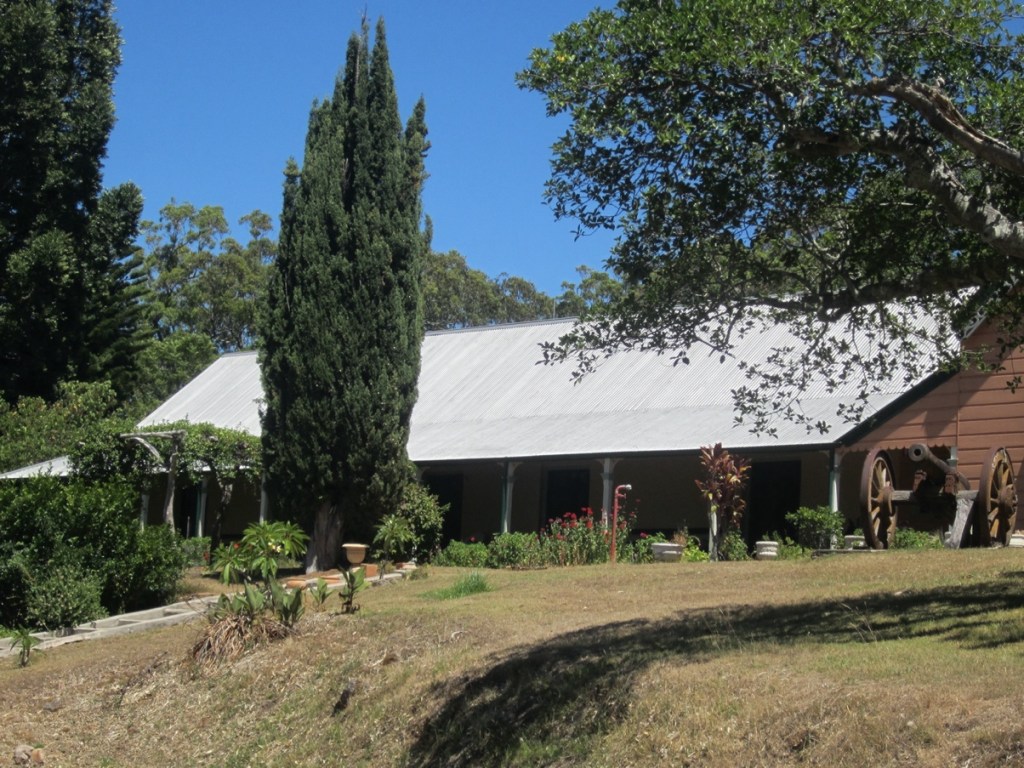
Front of Tahlee House [Author photo – 2014]
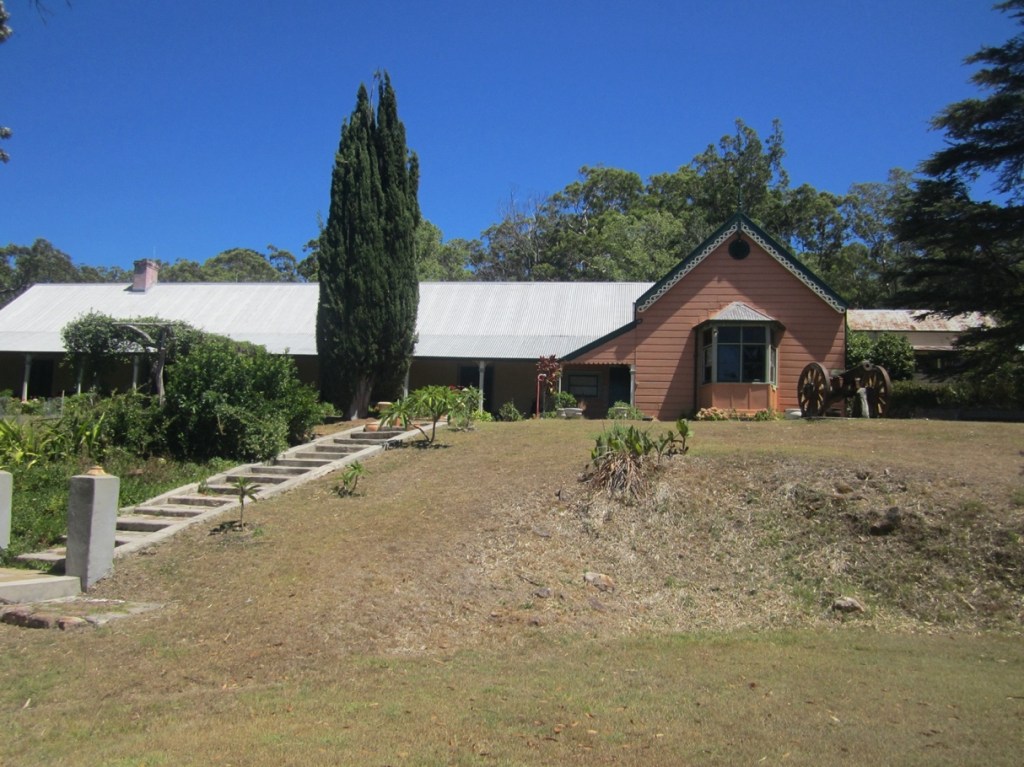
Front view of Tahlee House [Author photo – 2014]
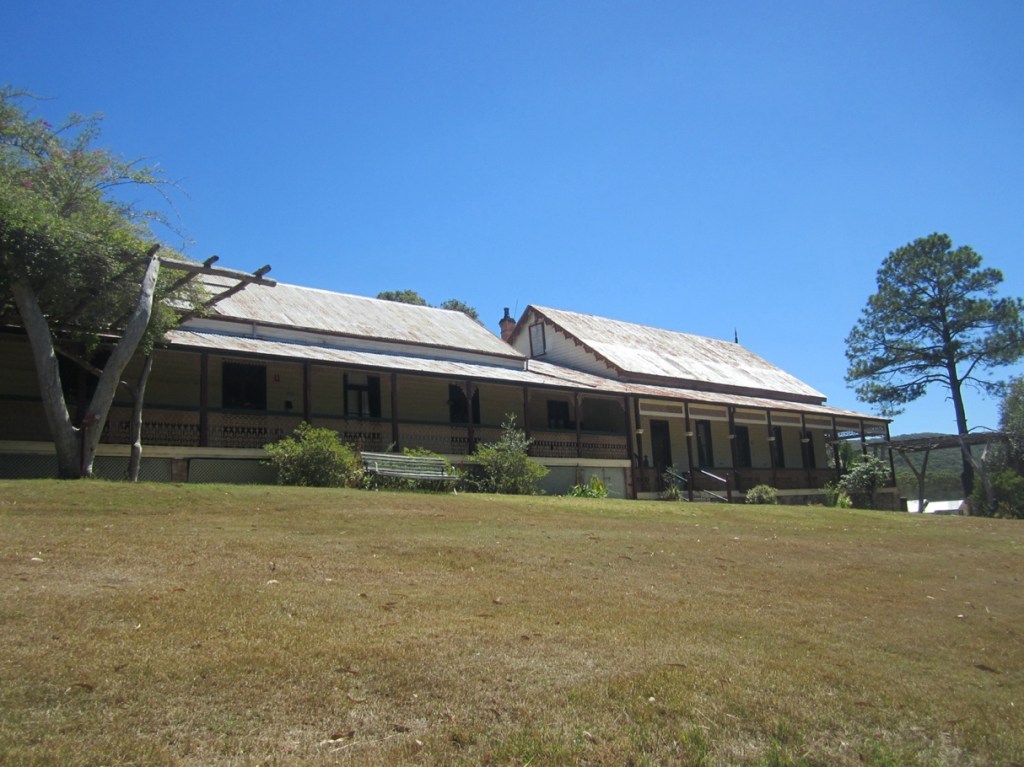
Side view of Tahlee House [Author photo – 2014]
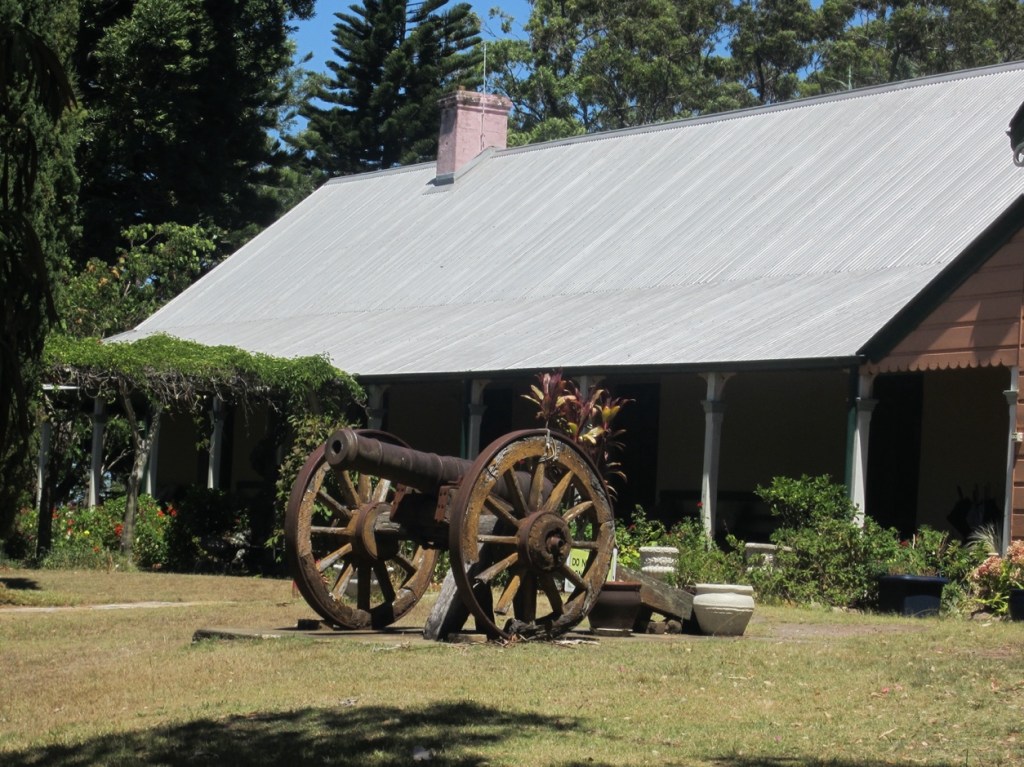
Cannon outside Tahlee House [Author photo – 2014]
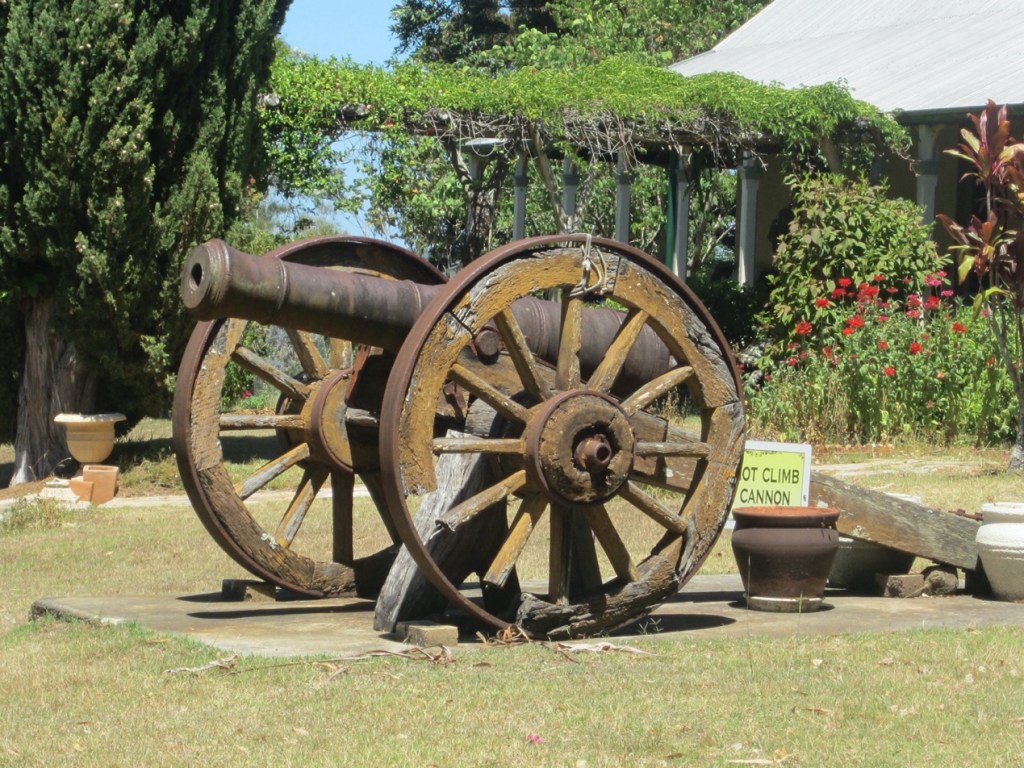
Cannon outside Tahlee House [Author photo – 2014]
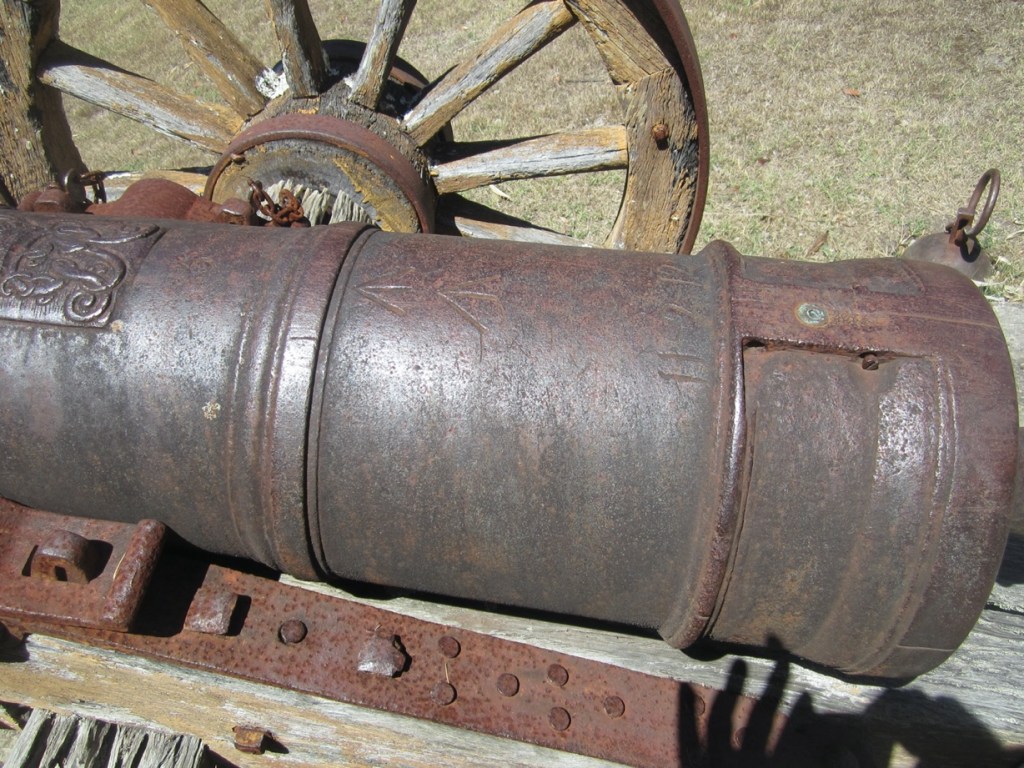
Detail of a cannon outside Tahlee House [Author photo – 2014]
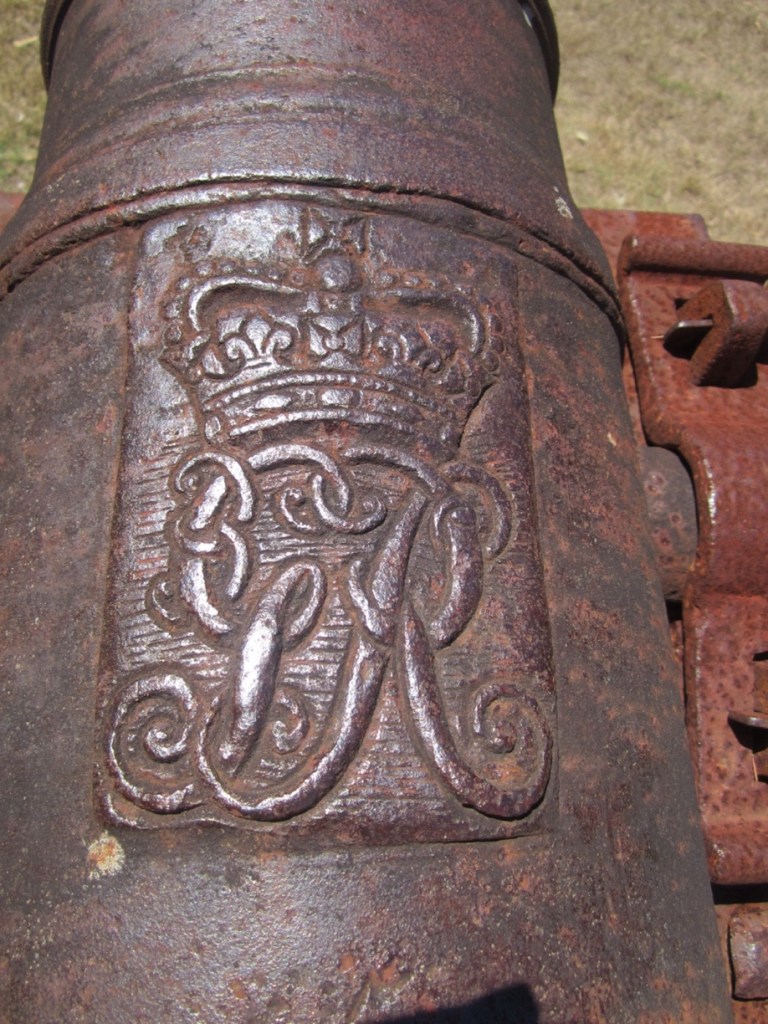
Detail of the Royal insignia of King George III as inscribed on the cannon [Author photo – 2014]
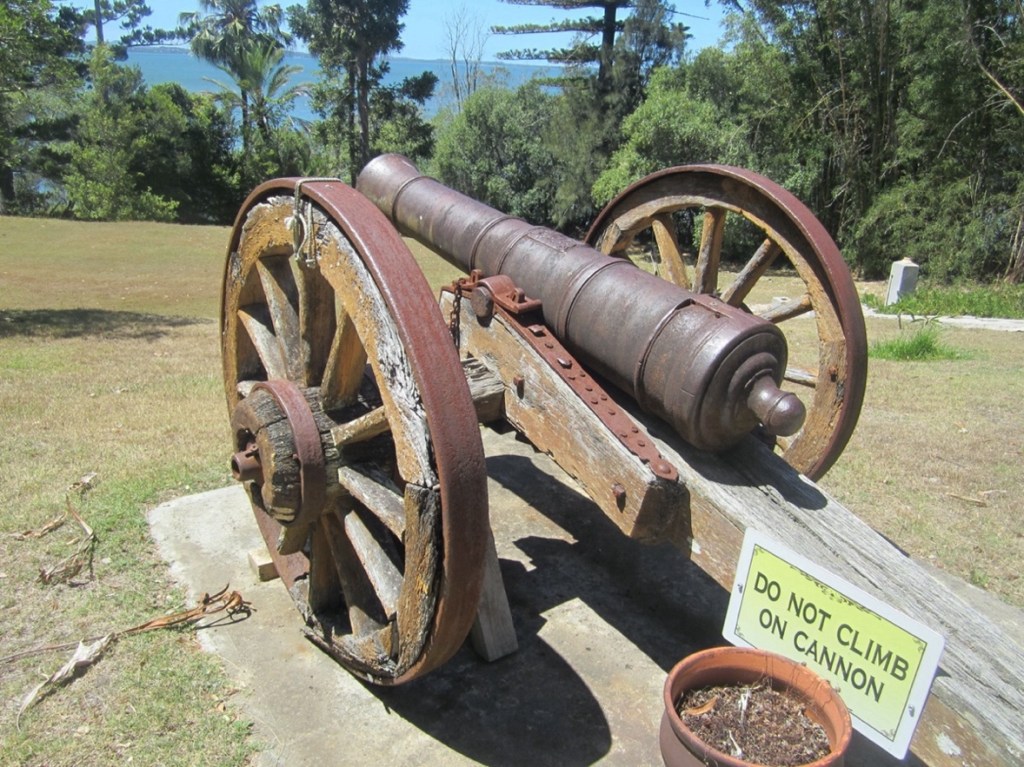
View of the cannon with the waters of Port Stephens in the background [Author – 2014]
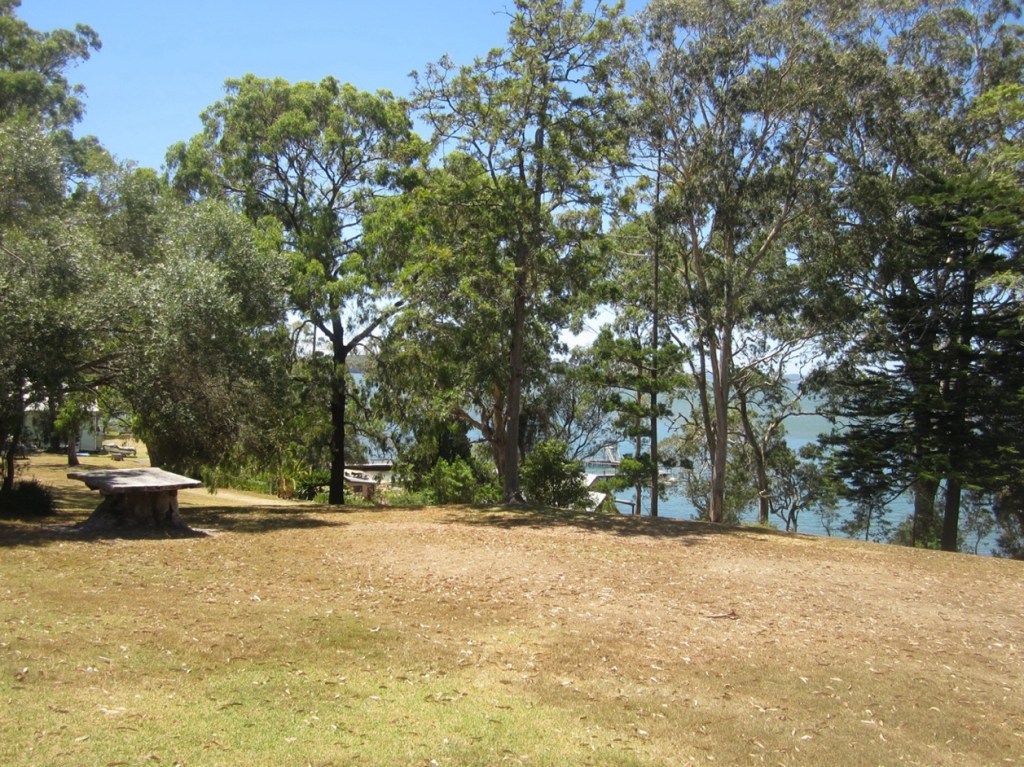
View over the Tahlee House lawn with the waters of Port Stephens in the background [Author photo – 2014]
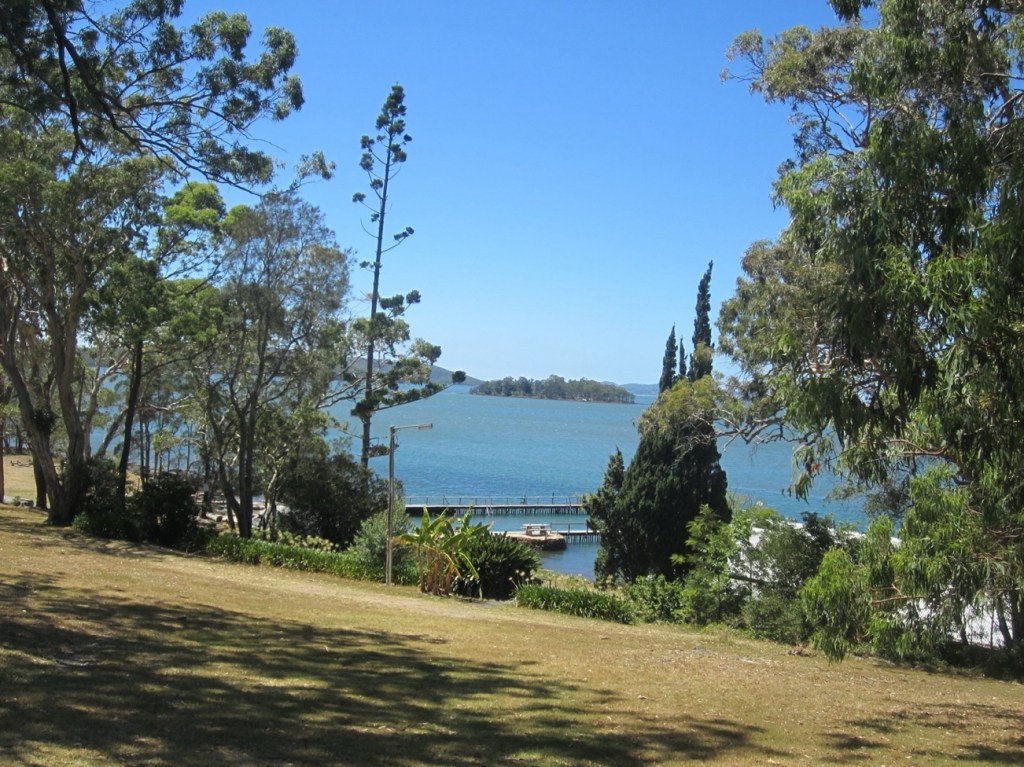
View over the Tahlee House lawn with Garden Island and the waters of Port Stephens in the background [Author photo – 2014]
Concluding Comments
Tahlee Estate was listed on the New South Wales State Heritage Register on 2 April 1999.
In March 2016, the Great Lakes Shire Council was advised by the Heritage Council of New South Wales that a permanent conservation order has been issued for the buildings known as Tahlee House, located in Tahlee, Port Stephens. This included the reception and ballroom wing, outbuildings, grounds, boat harbour, stone signal cairn, and cannon. The conservation order regulated the demolition, alteration, or new construction associated with these properties, requiring approval from the Heritage Council prior to any such activity.
Several papers have been published on this website concerning Sir Edward Parry, the Australian Agricultural Company and Carrington. They can be viewed at the following links on the website:
Return Journey of Sir Edward Parry to England – 1834
Journal of Sir Edward Parry – Commissioner of the Australian Agricultural Company 1830-1834
A Christmas Story from Tahlee House – 1832
The Carrington Church at Port Stephens
Researched and compiled by Kevin McGuinness
August 2025

 Port Stephens - a history exploration