
Introduction
On 18 May 1901, the wooden steamship Maud Weston was built in the Port Stephens area.
During its brief three-year life, the steamship operated continuously as a cargo vessel along the northern parts of the NSW coast. It was a familiar ship in the Port Stephens, Newcastle and Sydney trade and was known as one of the ’60-milers’, a colloquial name for ships that were used in the coastal coal trade.
It was owned and captained by Captain Joe Weston who also supplemented his income by undertaking numerous shipwreck salvage operations. The Maud Weston was employed by the Captain during each of his salvage missions.
It appears that on occasion the ship was used to transport heavy loads, which may have led to significant structural stress. In November 1904, the vessel suffered damage to its wooden hull while a heavy load was on board and subsequently took on water and foundered.
This paper examines the launching and foundering of the Maud Weston and the various salvage and rescue operations in which it was used. No image of the ship appears to exist.
Launch of the Maud Weston – 1901
The Newcastle Morning Herald and Miners’ Advocate of 22 May 1901, page 7, reported:
‘An interesting ceremony took place at Sydney on Saturday afternoon on the occasion of the launching and trial trip of the steamer Maud Weston. There was a large number of gentlemen interested in city and shipping pursuits present, and a number of ladles also. Amongst them were Messrs. R. Atkinson Price, M.P., T. H. Kelly, Dickson, Western, Ireland, Walsh, Sedgeley, Wildrich and Sinclair, Begg and Greig, Fairbairn, Anderson, and others.
The steamer left Smith’s wharf [at Millers Point near Darling Harbour, Sydney] at 2.30 and steamed to the Heads, the record being over 9 knots an hour. At the luncheon Mr. R. A. Price, M.P., presided, and after the usual loyal toast, proposed the health of the builder (Mr. Robert Davis), the consulting engineers (Messrs. Wildrich and Sinclair), and the firm of Messrs. Begg and Greig, who erected the machinery.
The chairman pointed out that the building of this vessel represented a new departure in connection with the trade of Port Stephens. This steamer was built at the Branch River [a triburary of the Karuah River], Port Stephens, in Gloucester [district]. Nearly the whole of the timber had been obtained in the Gloucster district and her trial trip fully realised the anticipation of her builder and owners. The machinery was designed by Messrs. Wildrich and Sinclair, and erected by Messrs. Begg and Greig. He described the steamer as ketch rigged, with a length of 105ft, beam 24ft, draft 6ft 6in. She had a tonnage of over 200 tons, and was designed to form one of a fleet to open the trade direct between Sydney, Port Stephens, and Newcastle. The light draught being specially adapted for navigating the shallows of the various rivers. Her engines were compound surface condensing, with a boiler pressure of 120lb and 145 h.p. indicator.
The trial trip they had experienced that day reflected credit upon all those who participated in the construction of the vessel. The occasion marked a new epoch in connection with the trade of Port Stephens and Newcastle, as this was only the beginning of extensive steamship building operations in connection with those ports.
Port Stephens was specially adapted for the construction of vessels, as the district is rich in timbers of every variety both hard and ornamental woods being easily and cheaply obtained. With the consummation of the Australian Commonwealth, he predicted a great future for Port Stephens in the shipbuilding industry. The toast was drunk with enthusiasm and responded to by the builder and designer (Mr. R. Davis), Mr. Robinson on behalf of Messrs. Wildrich and Sinclair, and Mr. Begg on behalf of Messrs. Begg and Greig. The toast of the skipper and owner (Captain Joe Weston) was proposed by Mr. Soppett and responded to by that popular shipowner. The toasts of the ladies (coupled with the name of Miss Weston, after whom the vessel was named) was proposed by Mr. Dixon.’
Fishermen rescued at Newcastle – 1903
The Evening News of 16 February 1903, page 4, reported:
‘During the westerly gale yesterday several fishing parties outside the [Newcastle] Heads came in for exciting experiences. A number of small open boats were fishing for flathead outside Nobbys, when, without any warning, the wind blew in sudden squalls off the land. Five boats were noticed to be in distress, and, despite the efforts of their occupants, were rapidly taken out to sea, disappearing in the dust and haze, which was blown out from land.
The pilot steamer Galatea was signalled to and went to their assistance, bringing one boat inside the breakwater. Another boat was found floating bottom upwards, with three occupants clinging to the side. They bad been in the water over half an hour. The Galatea picked up a third boat about seven miles off the land.
At about 5 p.m. the steamer Maud Weston, bound from Port Stephens to Sydney, came across the other two boats, which she took in tow as far as the breakwater, and then proceeded on her course.’
Salvaging the Shamrock – 1903
The Newcastle Morning Herald and Miners’ Advocate of 2 May 1903, page 5, reported:
‘Active preparations are now being made by the purchasers of the wrecked steamer Shamrock to float the vessel, and with that object the steamer Maud Weston arrived here on Saturday with the necessary salvage plant. The salvage operations are being conducted by Captain Green, a former commander of the Shamrock, who has a staff of twenty-one men employed. The work can only be carried on at low tide, but is it thought that the efforts of the salvage party will be successful.
The initial work lies in the direction of making the hatches water-tight and then pump the steamer out sufficiently to enable her reaching Sydney. To enable this to be done pumping gear is now being placed on board. The present spring tides and calm weather is facilitating the work, and in a few days it is expected operations will be sufficiently advanced for a trial to be made.’
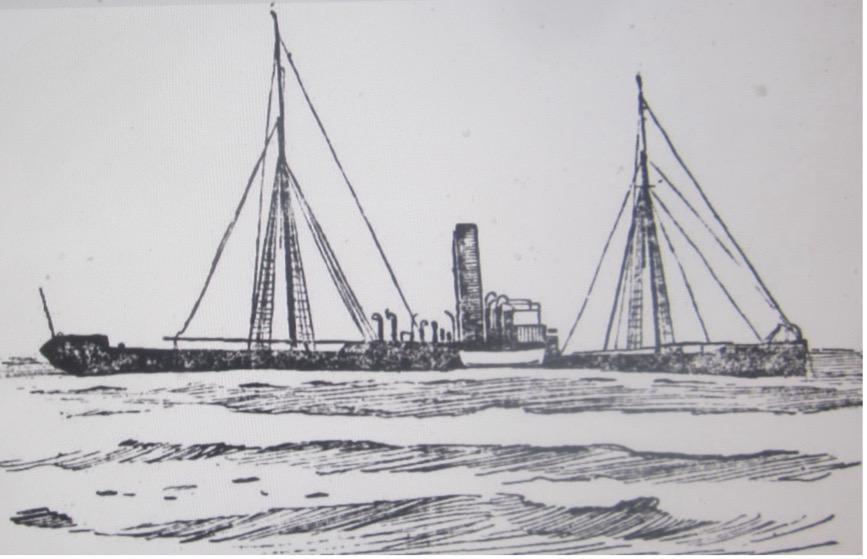
Illustration of the Shamrock, after being wrecked [Evening News, 2 April 1903]
The Sydney Morning Herald of 13 May 1903, page 5, further reported:
‘Salvage operations are being carried out here in connection with the floating of the Shamrock. The Maud Weston is the tender. It is intended to pump the wrecked steamer out and take her to Sydney. Over 20 hands are engaged on the work.’
Salvaging the Illaroo – 1903
The Sydney Morning Herald of 5 June 1903, page 5, reported:
‘There was no change yesterday in the position of the wreck of the steamer Illaroo at Catherine Hill Bay. The steamer Maud Weston is to be despatched to the scene of the wreck to-day with the salvage appliances, and it is hoped that operations will be commenced before the weekend.’
The Sydney Morning Herald of 6 June 1903, page 9, further reported:
‘A telegram received by the Sydney Underwriters’ and Salvage Association yesterday from the Chief Surveyor, Captain Spinks, now at the scene of the wreck of the steamer Illaroo at Catherine Hill Bay, stated that the position of the vessel remains unchanged.
The steamer Maud Weston, which has been chartered by the Underwriters’ Association, left Sydney last night with the pumps and other salvage gear. She will arrive at the scene of the wreck this morning, and as the seas have decreased salvage operations will be at once commenced.’
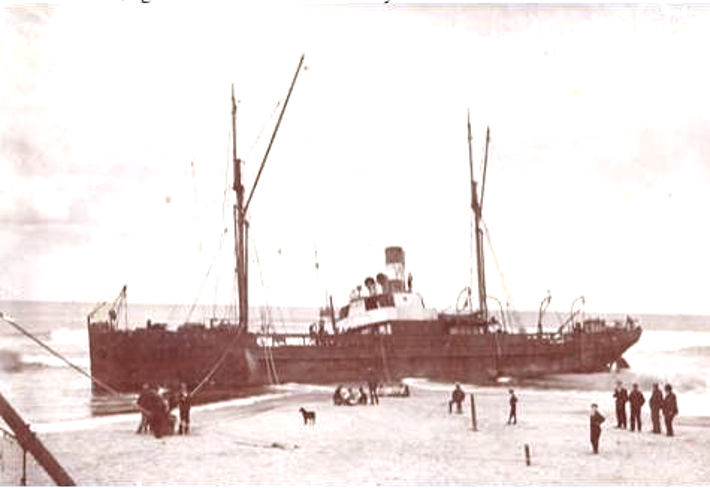
Illaroo
Salvaging the Oakland – 1903
The Macleay Argus of 18 July 1903, page 7, reported:
‘Captain J. Weston (who purchased the wreck of the Oakland for £40) returned to Sydney on Tuesday with the steamer Maud Weston, from the wreck of the steamer, off Port Stephens. The wreck was easily located near Cabbage Tree Island, and found to be in 15 fathoms of water, on a sandy bottom, with a slight list. The top of one mast was showing a few feet above water, and examination showed that this had carried away, and was held by the rigging to the wreck.
The Maud Weston was moored to the wreck, and three divers were employed in connection with the salvage work. Besides Captain Weston, the salvage party consisted of three divers and the vessel’s crew of 10 men. Operations were first directed to removing some submerged spars, which were knocking about dangerously close to the bottom of the Maud Weston. This wreckage being cleared away, about 100 tons of coal were removed from the wreck.
The divers then turned their attention to recovering the deck gear. The forward winch, weighing fully eight tons, was raised and stowed on the Maud Weston’s deck. Then the after winch and steering gear were picked up. Two anchors and over 175 fathoms of chain, as well as a number of blocks, wire falls, steam windlass, derricks, wire hawsers, &c., were also brought to the surface, all being in a splendid state of preservation.
The divers went through all the cabins and engine room and found everything intact. The engine-room telegraph was recovered, and an examination showed that the indicator was pointing to “Full speed ahead.” The opinion is expressed, after the reports of the divers, that the Oakland had been struck by a heavy sea, which burst the hatches and caused her to founder. The hatches were missing from the wreck. The Oakland’s funnel was broken off about 3ft. from the deck and both masts had also gone.
When the Oakland foundered, she had on board 300 tons of coal, and the divers found that a great deal of this had been washed out, but over 100 tons, were cleared out of the forehead hatch. Captain Weston intends to make an attempt to float the vessel. The Oakland was fitted with molasses tanks equal to a capacity of 180 tons. These were found to be uninjured, and Captain Weston is relying on the tanks to float the vessel. He intends pumping air into the tanks and forcing the water out of them and thus provide a large lifting power. Should the operations he successful, the Oakland will be taken into shallow water at Port Stephens.’
The Oakland was never refloated.
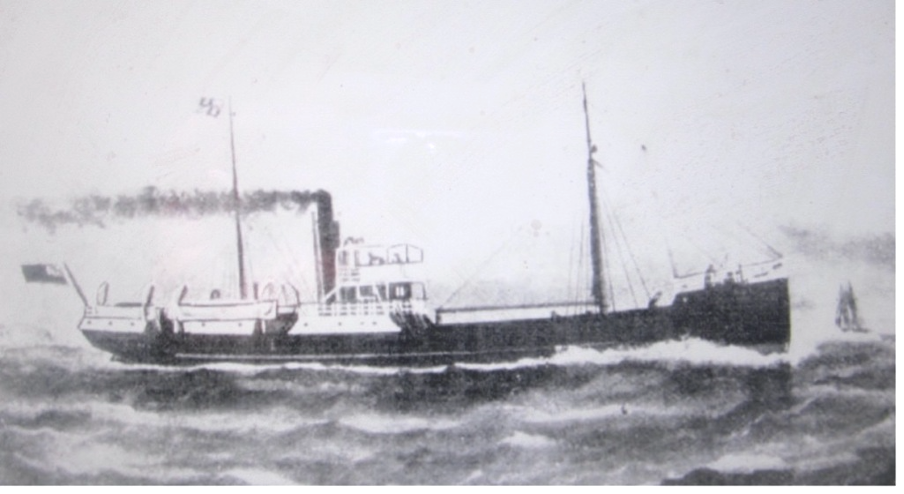
Oakland
Transport of Railway Sleepers – 1903
The Hawkesbury Herald of 18 September 1903, page 9, reported:
‘All the South African railway sleepers, which were cut in Colo and on the Wheelbarrow Ridge by Mr. H. J. Wholohan’s men, have now gone to Sydney. The s.s. Maud Weston, a collier of 160 tons burthen, took the last away during the past week.
The s.s. Daisy conveyed the sleepers that were cut in Whatley’s Swamp down to Mr. Wm. Jones’ wharf, the Maud Weston being of too deep a draught to go any further up Colo’s shallow waters than this latter place.’
Salvaging of the Ovalau – 1903
The Goulburn Evening Penny Post of 3 November 1903, page 2, reported:
‘The steamer Ovalau has foundered near Lord Howe Island. All hands were saved. A fire broke out amongst the steamer’s cargo of copra while on the voyage from Norfolk Island to Lord Howe Island. Attempts to extinguish the flames were futile, and on arrival at Lord Howe Island efforts to beach the steamer were unsuccessful.
The passengers and crew were safely landed, and shortly afterwards an explosion took place on the vessel. On the following morning the steamer sank at The Anchorage in deep water. The steamer Captain Cook is expected to return to Sydney today (Tuesday) with some of the passengers on board. It is anticipated that the remainder of the passengers and crew will arrive on Wednesday or Thursday by the steamer Ysabel.’
The Newcastle Morning Herald and Miners’ Advocate of 26 January 1904, page 4, further reported:
‘The steamer Maud Weston has returned to Sydney from the scene of the wreck of the steamer Ovalau at Lord Howe Island. Captain Weston, who purchased the wreck from the underwriters, stated that the salvage work had been very successful, a large quantity of material, including eight anchors, the vessel’s bronze propeller, a fan engine, 225 fathoms of cable, davits, and blocks being recovered. The bottom of the Ovalau was blown out, with the object of obtaining some pearl-shell, which was believed to be lying in the after-hold, but the work in that connection was fruitless. Captain Weston states that the vessel was lying in about ten fathoms of water, and he had no difficulty in locating her.’
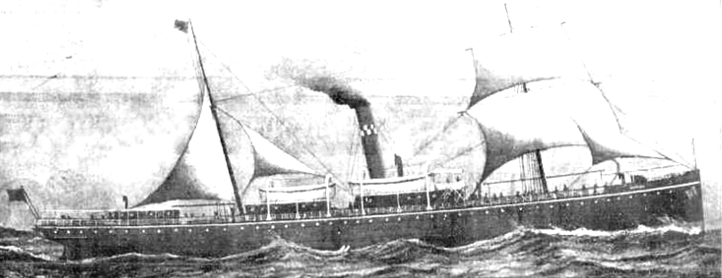
Ovalau
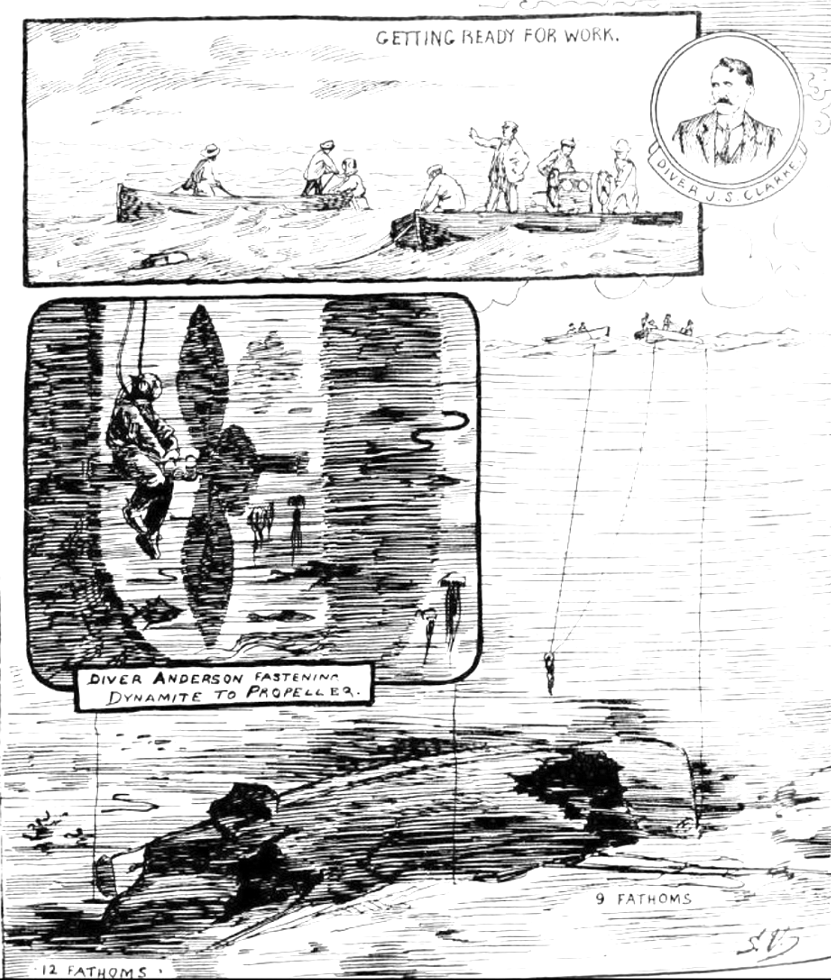
Illustration of the salvage work on the Ovalau [Sydney Mail and NSW Advertiser, 3 February 1904, page 293]
Foundering of the Maud Weston – 1904
The Daily Telegraph of 12 November 1904, page 9, reported:
‘Norah Head, which will be remembered as the locality of the wreck of the Newcastle steamer Gwydir, has been the scene of another shipping casualty. The steam collier Maud Weston, en route from Newcastle to Sydney, in charge of Captain Weston, sprang a leak off the head, and foundered whilst running for the beach. The boats had previously been lowered, and the crew, 10 all told, landed safely. They proceeded to the residence of Mr. Smalley, a farmer living close by, and eight of them were driven over to Gosford. They arrived in Sydney yesterday afternoon and reported the disaster to the Department of Navigation.
Mr. Wagner, the engineer, when seen by a “Daily Telegraph” representative, stated that the vessel left Newcastle at 10.30 on Thursday morning for Sydney, with 150 tons of coal on board, shipped on the owner’s account. All went well until reaching the vicinity of Tuggerah Lakes, at half-past 3 in the afternoon, when it was discovered that the vessel was leaking badly. The leak was evidently under the engine room floor.
All available pumping appliances on board were got to work, and it was soon evident that they were not able to cope with the inflow of water. Mr. Wagner expressed fears for the safety of the vessel, and Captain Weston then decided to run for the beach. It was a most anxious time, as the water was gaining rapidly, and the vessel was settling down. The wind was fresh from the east-north-east, and the Maud Weston carried her mainsail. A course was shaped for Boat Harbor, situated just to the southward of Tuggerah Lakes, but the engine room becoming flooded it was found that there was no hope of reaching there. The steamer was then headed for the nearest beach. By this time matters were looking very serious, and the crew feared the vessel would sink from under them.
When the steamer was about a quarter of a mile from the beach the crew took to the boats. Captain Weston and Mr. Wagner, however, remained by the vessel, and made a plucky effort to beach her. Mr. Wagner was working up to his waist in water, and Captain Weston, remained on the bridge. Their efforts, however, were unavailing, for gradually the vessel lost steerage way, and when almost under the Terrigal Highland she struck the bottom and had to be abandoned. A few minutes later she was swept by the rollers. The seas broke heavily over the vessel, washing away the captain’s house on the bridge, the bridge, and deck fittings, hatches, etc. The cabins were also being rapidly broken up when the boat left the steamer.
Mr. Wagner is of opinion that the Maud Weston will become a total wreck. When he left the scene she had a heavy list to port, the seas sweeping her fore and aft. The vessel was lying on a rocky bottom, and at high tide was almost completely submerged. The Maud Weston is a wooden vessel of 130 tons gross and 75 tons net and was built at Port Stephens in 1901. Her dimensions are: — Length. 98ft. 7in.; beam, 21ft. 6in.; and depth, 6ft. 2in. She is insured in the South British Fire and Marine Company for £2000, the greater part of this being re-insured.
Running under the auspices of the Port Hunter and Sydney Packet Company, the Maud Weston has been trading to Newcastle in conjunction with the steamers Sophia Ann and Tarshaw, all being owned by Captain Weston. A steamer is despatched nightly from Sydney with general cargo, and it is the custom to load coal for the return trip. Latterly the Maud Weston has been carrying gear to Sydney from the wrecked barque Adolphe, which lies on the Oyster Bank at the Newcastle entrance [see report below].
Arrangements were made during yesterday afternoon to send salvage gear to the scene of the disaster. Pumps and other appliances were shipped by the steamer Sophia Ann, which left last night, and Captain Weston, who has had considerable experience in salvage work, particularly at the wreck of the Ovalau, at Lord Howe island, will have charge of the operations.’
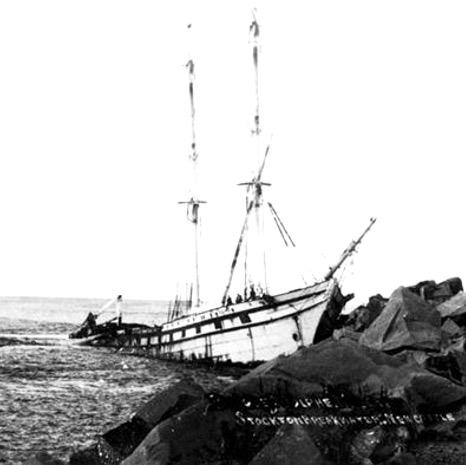
The Maud Weston, prior to being wrecked itself, had been carrying gear to Sydney from the wrecked Adolphe barque. The Newcastle Morning Herald and Miners’ Advocate of 3 October 1904, page 5, reported on the wreck of the Adolphe:
‘There were no developments in connection with the wrecked barque Adolphe on the Oyster Bank yesterday. The vessel remains in the same position as when she went aground. Mr. J. C. Reid, Consular Agent for France, and Captain Layec, master of the vessel, went on board yesterday, and all of the ship’s papers, and the captain’s and crew’s effects were saved. Coxswain McKinnon, of the lifeboat, acted as pilot for the party. They boarded the vessel, and found the decks were all dry, and had very little trouble in getting what they wanted.
The crew of the Adolphe will probably leave Newcastle on Saturday, and proceed home to France in the F.M.S Caledonien, on Monday. Messrs. J. and A. Brown are advertising today for offers from persons willing to undertake salvage work in connection with the wreck. Captain McKilliam, of the Aberdeen liner Damascus, speaking to a ‘Newcastle Herald’ representative last night, referred to the work done by the lifeboat crew. He said it was magnificent work, and he thought it had never been excelled by any lifeboat crew. Nothing better could have been done by any lifeboat service. The coxswain and men ought to be rewarded for their heroic deeds. He was prepared to put his name on a subscription list to recognise such gallant services. The men risked a lot in doing what they did, and he hoped that they would not be forgotten. It was marvellous how they got the boat over the old wrecks and saved all hands.’
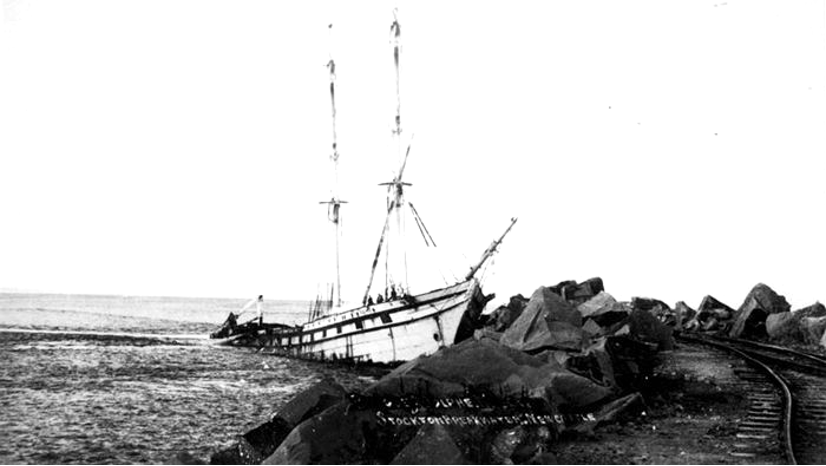
Wreck of the Adolphe
Findings of the Marine Court concerning the Maud Weston – 1904
The Evening News of 14 December 1904, page 3, reported:
‘The inquiry by the Marine Court into the circumstances attending the wreck of the steamer Maud Weston, near Terrigal, on the North Coast of N.S.W., on November 10, was concluded today. In reply to Judge Backhouse, who asked what the Department of Navigation did to prevent the overloading of vessels like the Maud Weston that had no loading line.
Mr. Wood, who appeared for the Superintendent of Navigation, said the practice, ordinarily, was for an inspection to be made by one of the department’s inspectors. There were two inspectors at Newcastle and three in Sydney, whose duty it was to go around continually, to see that vessels were not overladen.
Walter Reeks, naval architect, gave expert evidence respecting the construction of the vessel. After inspecting the plans, he said the length of the vessel in comparison with her depth was abnormal, and that was a source of weakness in her construction. Wood, under ordinary circumstances, required considerable strengthening, and in vessels constructed like the Maud Weston the fastening should be very much increased.
The Court found that the probable cause of the leaking was the vessel’s opening out, which arose from inherent weakness of construction, aggravated possibly by a squeeze she received from the steamer Moorabool while lying at the wharf in Newcastle Harbour in August last. One of the inspectors at Newcastle saw the accident, and afterwards made an examination of the vessel, but there had been no such survey as in the opinion of the Court should have been made. The evidence did not show that the Maud Weston was overladen, but as she had no load-line, being a coast trade vessel under 80 tons, there was necessarily some uncertainly on that point.
In the opinion of the Court, the law should be amended so that the marking of a load-line should be compulsory in all sea-going vessels, and that until that alteration was made there should be, at least very frequent inspection of vessels of that class after they were loaded before leaving port. As to whether that was done in the case of the Maud Weston was not clear on the evidence.’
Concluding Comments
The short sea life of the Maud Weston, a boat built in the Port Stephens area, is illustrative of the life of some of other vessels built in that area, the histories of some of which are currently unknown.
Three other relevant papers can be viewed at the following links on this website:
History of Boat Building at Port Stephens
A History of 110 Shipwrecks at Port Stephens 1800 – 1950
Shipwrecks Inside Port Stephens – 1869 to 1950
Researched and compiled by Kevin McGuinness
June 2025

 Port Stephens - a history exploration