
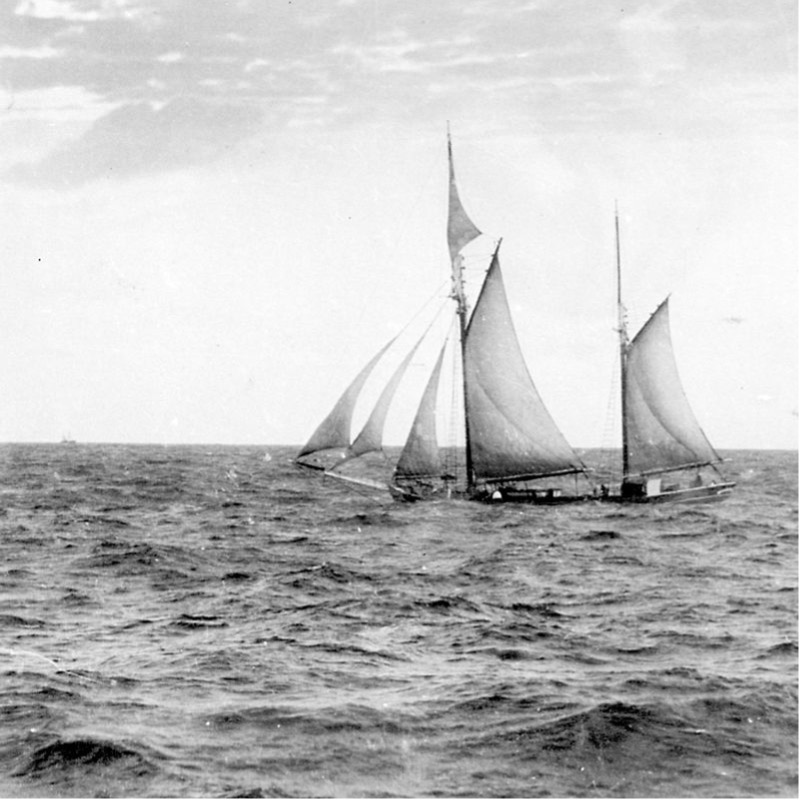
Introduction
This paper tells the story of marine vessels that were wrecked or damaged inside the bay of Port Stephens.
It supplements the paper, A History of 110 Shipwrecks at Port Stephens 1800 – 1950 which is found at this link on the website, and mainly covers shipwrecks in the ocean waters in the vicinity of Port Stephens.
Several of the vessels that were wrecked inside the port in close proximity to the Tomaree and Yacabba Heads are covered in both papers. These are cross-referenced in this paper to the above website link, using items numbers, wherein further information can be found.
The major cause of wrecked vessels within Port Stephens was severe weather that damaged craft or drove them onto the shore or rocks.
The first recorded potential wreck was recorded in 1829, when the boat named ‘Samuel’, that was carrying the NSW Attorney General, Alexander MacDuff Baxter, to Sydney, was forced to enter Port Stephens, as it was damaged and had water in its hold. The Sydney Gazette and New South Wales Advertiser, of 17 September 1829, page 2, reported:
‘We are sorry to hear that the Attorney General was suffering under a severe illness at Port Stephens, when the Samuel left for Sydney, brought on by his exertions when the vessel sprung a leak on the passage from Newcastle. A few hours after the Samuel left Newcastle, heavy squalls came on which obliged her to shorten sail, and about 9 o’clock at night there were two feet water in the hold, which increased so rapidly before she could be run into Nelson’s Bay that notwithstanding the utmost exertions of Mr. Baxter [Attorney General], Mr. Lang and Mr. Harvey, in baling her with buckets when the pumps became choaked, she had made upwards of four feet water when she was moored. Since writing the above, we were pleased to learn that Mr. Baxter arrived at Head Quarters in good health on Tuesday morning.’
The National Library of Australia’s ‘Trove‘ newspaper collection was primarily utilised in preparing this paper. Any omissions may not have been covered in newspaper articles.
Wrecks of the Lavinia and Lurline – 1869
The Newcastle Chronicle of 14 September 1869, page 2, reported:
‘Intelligence reached us, yesterday, that the above well-known coasters, trading to and from Newcastle, were wrecked at Port Stephens during the late gale, but that, fortunately, no loss of life occurred. The particulars that have been supplied to us are, although reliable, somewhat scanty.
They are as follows: — On Tuesday, the 7th instant, the Lavina, Captain McLaughlin, left Newcastle for Sydney, with coals, and on Wednesday night, she was caught in the southerly gale, and was necessitated to run into Port Stephens for shelter — the captain deeming it imprudent to face the gale. On Thursday, she made Nelson’s Point, Port Stephens, where she cast anchor, the wind at the time blowing very strong, and a heavy sea on.
On the same day, the Lurline, Captain Jackson, in ballast, also ran into Port Stephens for protection, and anchored at a short distance from the Lavina. On Friday, the gale increased, and at its height, the cables of both vessels parted, and, drifting ashore, they soon became total wrecks. The crews swam ashore with considerable difficulty — some of them being almost exhausted. Nothing was saved from either of the vessels.
On Sunday, both captains travelled overland to Raymond Terrace, where they arrived in the evening, much fatigued. They proceeded to Sydney yesterday morning, by the Coonanbarra, to report the wrecks to the owners of the vessels. The crews were, on Saturday, put on board a Sydney-bound schooner, at Port Stephens. During the gale, there was a tremendous heavy sea on at Port Stephens. As yet we have not heard of any other wreck northward of Newcastle. The Lavina was the property of Mr. John Henderson, of this city. She was insured for £500, which will not, we understand, cover his loss by fully £300
Further information on these two vessels can be found at Item numbers 37 and 38 in A History of 110 Shipwrecks at Port Stephens 1800 – 1950.
Wrecks of Coomba, Hawke and Lillian – 1876
The Evening News of 14 September 1876, page 3, reported:
‘A telegram from Port Stephens last evening, stated that the ketches Coomba and Lillian were total wrecks on the North Beach, and that the steam-collier Waratah arrived there in safety. The telegram reached here at seven o’clock. A telegram from Port Stephens this morning, conveyed intelligence of the wreck of the ketch Hawke at that place, and the supposed loss of all hands. Other vessels are supposed to have succumbed to the force of the gale. Altogether, this gale is by far the most disastrous that has visited this coast for many years.’
Further information on these vessels can be found at Item number 51 in A History of 110 Shipwrecks at Port Stephens 1800 – 1950.
Wreck of Fanny – 1885
The Newcastle Morning Herald and Miners’ Advocate of 21 April 1885, page 5, reported:
‘The schooner Fanny went ashore at North Beach, Port Stephens. The crew were saved.’
The Fanny was a schooner of 164 tons. The vessel was lost by parting from her anchors and drifting ashore, during a southerly gale, on the North Beach of Port Stephens.
Further information on this vessel can be found at Item number 62 in A History of 110 Shipwrecks at Port Stephens 1800 – 1950.
Wreck of Bound to Win – 1893
The Sydney Morning Herald of 24 October 1893, page 5, further reported:
‘The Government steamer Thetis arrived on Saturday from Port Stephens, with Captain Mills on board, the sole survivor of the wreck of the ketch Bound to Win, capsised on Friday afternoon whilst entering the heads at Nelson’s Bay. The inquiry is to be held in Sydney. Captain Mills was looked after here, receiving admission to the Sailors’ Home and a pass by the steamer to Sydney on Saturday night.’
Further information on this vessel can be found at Item number 73 in A History of 110 Shipwrecks at Port Stephens 1800 – 1950.
Wreck of Sea Foam – 1894
The Daily Telegraph of 1 February 1894, page 5, reported:
‘The ketch Sea Foam, which was driven ashore in Shoal Bay on Monday night at 10 o’clock during a heavy easterly squall, has since become a total wreck. On Tuesday the tide shifted her about 8ft. further on the beach, and during the night a heavy sea, with strong wind from the north-east, came in, knocking the Sea Foam about on the beach, and causing her to become a total wreck. She is now full of water, and breaking up fast.
Had prompt assistance been sent, the captain thinks the vessel could have been saved. The tug Hero, with Captain Hall, of the Sydney Underwriters’ Association, on board, cleared Sydney Heads at 9 o’clock last night for Port Stephens. Captain Hall is proceeding to the wreck of the Sea Foam at Shoal Bay.’
Further information on this vessel can be found at Item number 74 in A History of 110 Shipwrecks at Port Stephens 1800 – 1950.
Vessels Wrecked in Port Stephens During Maitland Gale – 1898 [Item 79]
At Port Stephens, five vessels were driven ashore and two of those totally wrecked during the Maitland gale. The Daily Telegraph of 9 May 1898, page 6, reported:
‘Nelson’s Bay, a well-known sheltering ground for coasting vessels, situated about 20 miles north of Newcastle, had the full sweep of the recent gale, and of the vessels sheltering these five were driven ashore, two of which are totally wrecked. When the gale set in six vessels were anchored in the bay, viz.: — Steamers Express and Ethel; Ketches Coral, Merlin, Mabel White, and Lena and Lillian. The fleet had put into the bay for shelter from the wild weather outside, and during the hurricane squalls on Friday afternoon five of them drove ashore, viz., steamer Ethel, and the ketches Merlin, Coral, Mabel White, and Lena and Lillian.
With the exception of the Lena and Lillian, which went ashore on Pig Island [in Port Stephens], all the vessels drove on to the north beach, and two of them, the steamer Ethel and the ketch Coral, are total wrecks. The other vessels are apparently in a good position for salvage.
When the gale set in the Lena and Lillian was at anchor in Nelson’s Bay, but during Friday morning early commenced to drag anchor, and was driven ashore near Pig Station. The Ethel went to the assistance of the Mabel White, and when towing her in broke her shaft, and was driven ashore, completely breaking in two. The schooner Shannon, anchored in Shoal Bay, commenced dragging her anchors at 6 o’clock on Friday morning. She was rescued by the steamer Express. The ketches Coral and Merlin were also at anchor in Shoal Bay. They commenced dragging their anchors about 2 p.m. on Friday and tried to get under way.
The Coral had almost succeeded in reaching Nelson’s Bay, when she was driven rather close to the breakers on the Spit in the middle of the bay. She dropped anchor and held for about six hours. The gale increasing, the anchors would not hold, and the Coral was driven on the north shore, becoming a total wreck. The Merlin was driven ashore before she could set sails to clear the breakers. The captain of the Ethel states that seeing the schooner Mabel White in a perilous position inside the bar, he went to her assistance, and succeeded in placing a towline aboard twice, but each time when she commenced to tow the line broke. The third time the line was placed aboard proved fatal to the Ethel, as she broke her shaft, and was left to the mercy of the big sea, and, with the Mabel White, was driven ashore near the other wrecks, the Ethel striking the ketch Merlin on her stern, breaking her bulwarks. The Coral, Merlin, and Lena and Lillian were loaded with hardwood, the Mabel White was loaded with pine; the Ethel had been schnapper-fishing. The ketch Laura and the schooner Jane managed to get safely into Salamander Bay.’
Further information on these vessels can be found at ‘The Maitland Gale – 1898‘ on this website and also at Item number 79 in A History of 110 Shipwrecks at Port Stephens 1800 – 1950.
Wreck of Lady Mabel – 1900
The Armidale Chronicle of 23 May 1900, page 2, reported”
‘The barque ‘ Lady Mabel’ has been’ wrecked at Nelson’s Bay.’
The Daily Telegraph of 24 May 1900, page 4, further reported:
‘The brigantine Lady Mabel, which went aground on Saturday, was safely towed off by the tug Hero. At low tide today the Hero, under the supervision of Captain Banks ran out anchors from the Lady Mabel, and at high tide, after about two hours’ towing, got her into deep water. The Hero left the bay at 5 o’clock with the Lady Mabel in tow.’
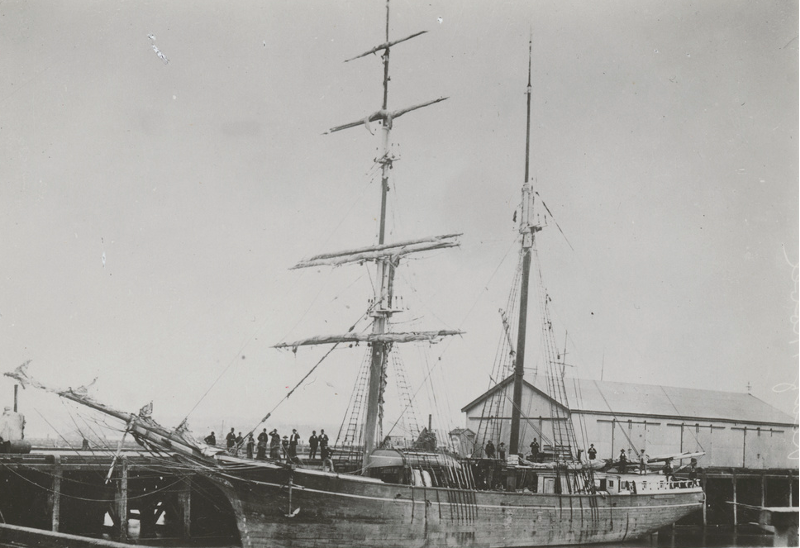
Lady Mabel [State Library South Australia]
Wreck of Jane – 1900
The Newcastle Morning Herald and Miners’ Advocate of 11 June 1900, page 5, reported:
‘During Friday night the schooner Jane, timber laden, bound from Port Stephens to Sydney, sank in about six fathoms of water at her anchorage in Shoal Bay. All hands were saved. Captain Simone (master of the Jane) stated in the course of an interview at Port Stephens on Saturday that he left Port Stephens on Thursday morning at 8 o’clock. All went well till he reached Red Head, when the wind came in very freshly from the south-west. He decided to make for Newcastle, but while endeavouring to head in the vessel lost her head sail, and the fore gaff carried away. Finding it impossible to get into Newcastle harbour, he turned about and made for Port Stephens, which was reached at 2 o’clock on Friday morning.
While crossing the bight he lost his boat; the bulwarks were smashed in, and everything movable on deck was washed overboard. The vessel was severely shaken, and throughout the day, from morning till after dark, the crew had a terrible experience. The crew were taken off the sinking vessel by the crew of the schooner Cynthia, and the Jane, a vessel of about 60 tons, sank at her anchorage shortly after nightfall. …..
The vessel shows every sign of fast breaking up. A piece of the bulwarks bearing the schooner’s name was picked up this morning. Part of the poop with the wheel attached floated on to North Head this afternoon, and the masts are now afloat. The weather is still bad, and heavy seas are breaking over the spot where the schooner sank.’
Further information on this vessel can be found at Item number 84 in A History of 110 Shipwrecks at Port Stephens 1800 – 1950.
Wreck of Forest Queen – 1902
The Daily Telegraph of 26 June 1902, page 7, reported:
‘The ketch Forest Queen is reported to have gone ashore near the inner light at Port Stephens on Monday morning last, and the probabilities are that she will become a total wreck. Two seamen named Richard Payne and Francis Simmon Ord came to Newcastle last evening from Port Stephens by the launch Defender and stated that they were on the ketch at the time of the mishap.
They were supplied with tickets to Sydney by Mr. Frank Gardner, representative of the National Shipwreck Relief Society. The captain and mate of the Forest Queen are standing by her, but the prospects of saving the vessel, appeared to Payne and Ord to be very small. This opinion is shared by Mr. Allingham, of the Defender. On Tuesday, he says, the launch made an effort, assisted by anchors, to tow the ketch off, but she could not be moved. The Forest Queen is a wooden vessel, 60ft. long, 19ft. 1in. wide, and 6ft. 7in. deep. She was built at Auckland 30 years ago. Mr. Henry Miles is her owner, and her port of registry is Sydney. At the time of her stranding the ketch was in ballast.
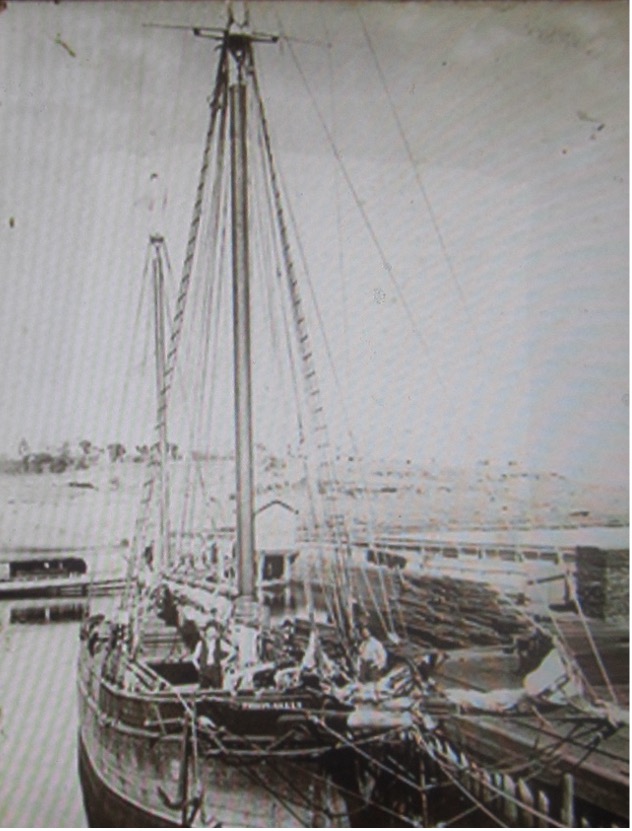
Forest Queen [Great Lakes Museum]
Wreck of Oceano – 1911
The Sun of 7 April 1911, page 7, reported:
‘The steamship Oceano, of the mail line, has gone ashore at Port Stephens. A message received at Sydney this morning from the lighthouse keeper states that the vessel, which left Newcastle early this morning, had, in attempting to reach Salamander Bay, inside Port Stephens, got on the South Spit. She was going in to load timber in the bay prior to setting out for San Francisco.
The Oceana belongs to the same owners as the steamship Boveric, which was reported ashore at Nukualofa, in the Tongan group, on Wednesday. The Oceano is of 4657 tons register, and the Boveric of 4445 tons. Thus Messrs. Andrew Weir and Co. have two steamers of a total tonnage of 9012 tons in trouble in Pacific waters at the present time, and both are Australian mail liners.
When she left Sydney the Oceano carried some 300 tons of general cargo, but loaded 7000 tons of coal at Newcastle, of which over 1400 tons was for bunker purposes. Her cargo gave her a draught of about 23 feet in the regular channel at Port Stephens. There is not less than 24ft of water anywhere at low tide.
Messrs. Howard Smith and Co. are the Sydney agents for both the Oceano and the Boveric. They have advice to the effect that the Oceana is ashore, and that she was signalling for a tug. No time was lost in getting the services of a towboat, and soon one of Messrs. J. and A. Brown’s tugs was hurrying from Newcastle to Port Stephens.
Although more than one vessel has been lost at Port Stephens, it is regarded as a safe entrance, and a good port to navigate. About four years ago the steamship Thordis a big tramp, flying the Norwegian flag, got ashore on the north headland when attempting to put to sea in a blow. She soon went to pieces, but the crew were saved. A barque was also lost there very many years ago, but latterly many big sailers, and several steamers of greater tonnage than the Oceana, have safely passed in and out of Port Stephens. It is only during the last six years, however, that regular trade has been opened up between Sydney, Newcastle, and Port Stephens, and that big vessels have visited there.
Captain Hacking, Acting-Superintendent of Navigation, received a telephone message at 6 a.m. today from Newcastle, announcing that the Oceano was ashore on Entrance Shoal. He instructed the Deputy Superintendent, who is stationed at Newcastle, to proceed to the scene on the pilot steamer Ajax, and to report the vessel’s exact position to him later in the day. This information was placed before a well-known shipmaster this morning, who said: “If the Oceana is on Entrance Shoal she is in a most dangerous position. A tremendous sea works up on the Shoal, and unless she is got off quickly her chance of being refloated is not a good one.”
Captain Phillipson, of the Newcastle and Hunter River Company’s steamer Karuah, which is a regular trader to Port Stephens, was seen after the Karuah’s arrival from the northern port this morning. The captain was at a loss to understand which was South Spit, but, producing a chart, said: — “You see, there is no spit marked as South Spit in Port Stephens. It must mean either Entrance Shoal, near the entrance, or Deep Shoal. It is probably the latter, as I believe it is sometimes referred to as South Spit, although everyone round about Port Stephens knows it as Deep Spit.
These big vessels generally load timber in Salamander Bay, which is about 4 miles from the entrance to the port, therefore I am inclined to think that the Oceana has got on to Deep Spit, which is quite close to Salamander Bay and alongside the channel.” “Other vessels have been in trouble at Port Stephens. Is it a dangerous port?” the captain was asked. “Dangerous!” ejaculated the captain. He smiled and then said: “There is not a finer port anywhere, and it is easy to navigate. Many big vessels have gone In and out without any trouble whatever. Only recently the ship Alta left there drawing 24ft., and with the largest cargo of timber that has ever been taken out of the port in one bottom. You could not get a better harbour, nor a better entrance with care in navigating it. It Is a regular shelter or haven for ships. You can lay well inside and never feel any ‘range’ when a big sea is running outside. It is better than Newcastle.” “If the Oceana is on either Entrance Shoal or Deep Spit, what is her position?” “I believe she would be quite safe. If she is on Deep Spit she is sheltered from heavy weather.”
Wreck of Ida – 1911
The Newcastle Morning Herald and Miners’ Advocate of 20 June 1911, page 5, reported:
‘The small ketch Ida was blown ashore in Nelson’s Bay yesterday afternoon, and in less than half an hour she became a total wreck. The vessel had loaded timber and oil for New Guinea, and was at anchor in the bay. There had been a strong westerly wind blowing in the morning, but in the afternoon it increased to a gale. The little craft strained heavily at her moorings, and eventually the anchor chain carried away, whereupon the ketch drifted over on to the beach. The crew, numbering three all told, managed to get ashore safely, but they were cold and wet.
The ketch drifted higher up on the beach, and at half-past two, half an hour after her anchor chain carried away, she was a total wreck, with the bottom torn clean out of her. The master of the vessel has communicated with the owners, advising them that he will sell whatever is left. Captain Cumming, deputy superintendent of navigation, was notified of the wreck, and on being told that the crew had lost everything, he communicated with Mr. F. Gardner, representing the Shipwreck Relief Society, who authorised him to arrange for the men to be looked after. They were given quarters at the local hotel and supplied with dry clothes.
A tug-master, speaking last night about the wreck, said:—”The people who talk about making that place a port should have seen it today. The bay was white with waves; the wind blew across it very hard, and as there is no shelter the ketch had no chance.” The master of a small coaster said nothing has a hope at anchor in the bay, except steamers. The westerly blows from across country, and has a clean sweep of about four miles over water, with nothing to stop it. Nelsons Bay as a safe port in a westerly blow is right out of it, said the authority quoted.’
Further information on this vessel can be found at Item number 92 in A History of 110 Shipwrecks at Port Stephens 1800 – 1950.
Narrow Escape for Premier Ketch – 1912
The Evening News of 16 July 1912, page 7, reported:
‘The ketch Premier narrowly escaped becoming a wreck this morning at the [Port Stephens] Heads. The vessel had been anchored at Shoal Bay for several days, and on Sunday tried to make Nelson’s Bay; but had her sails blown away; and, dragging her anchors, drifted dangerously near the Middle Bank at Port Stephens Head, where she lay till about 1 o’clock this morning, when the sea became so heavy that she flew signals of distress.
The steamers Ballangarra and Macqaurie went to her assistance. The former succeeded in getting a line aboard, and brought her safely into Nelson’s Bay. There were six men aboard. The steamers Ballangarra, Macquarie and Tuncurry, have been anchored here since Sunday, and there is little chance of their getting away for a few days yet, as the light-keeper at Nelson’s Head states it is the biggest sea he has seen at the Heads during his long term there.’
Grounding of the Phil Forbes – 1914
The Sydney Morning Herald of 15 July 1914, page 14, reported:
‘The ketch Phil Forbes, which has been lying on the rocks near Fly Point [at Nelson Bay] for seven days, may now be regarded as a total wreck. She has been subject to the whole of the westerly gale which has been blowing during that period and still continues. The bottom now appears to be entirely gone. Should the westerly continue, it is feared the main mast will go, as it is leaning heavily seawards. Her bows are now fast ashore with wire rope. Should this snap, she will probably slip into deep water. The crew, with the exception of Captain Harris, returned to Sydney by the steamer Karuah yesterday.’
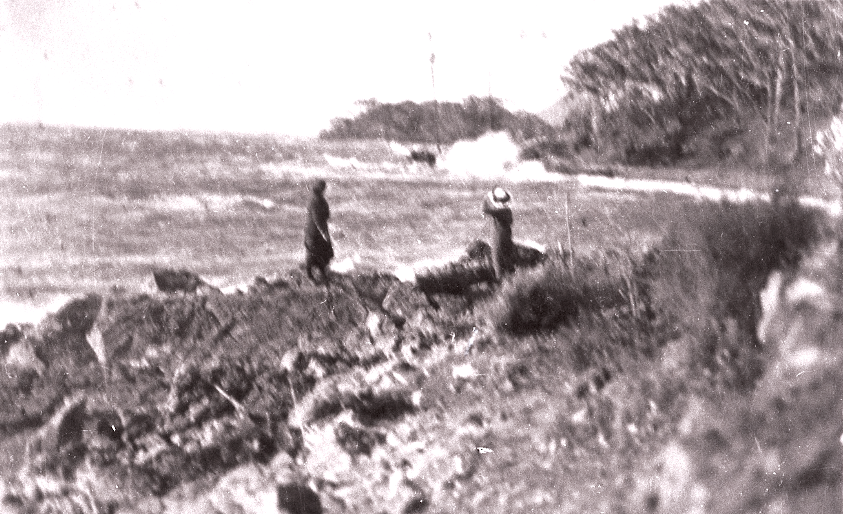
‘Phil Forbes’ aground off Fly Point Nelson Bay – 1914
Later in 1914, Mr. Barry-Cotter purchased and repaired the ketch, Phil Forbes that was aground off Fly Point.
Further information on the story of the Phil Forbes and Mr. Barry-Cotter can be found at ‘History of the Port Stephens Fire Brick Company on the website.
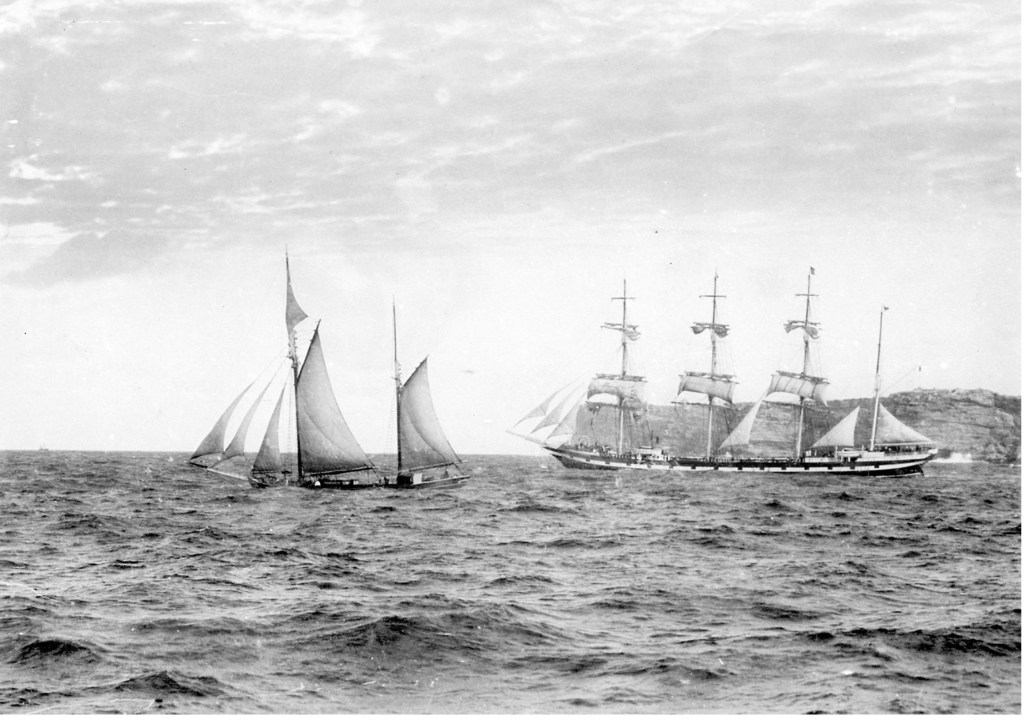
Ketch ‘Phil Forbes’ (left) and barque ‘Medway’ (right) [State Library of Victoria]
The Phil Forbes later foundered off Broughton Island on 5 June 1922. Further information on this vessel can be found at Item number 100 in A History of 110 Shipwrecks at Port Stephens 1800 – 1950.
Storm Damages Numerous Vessels at Port Stephens – 1922
The Newcastle Sun of 28 July 1922, page 5, reported:
‘During the recent cyclonic disturbance, 568 points of rain were registered at Karuah. The river rose, and the large quantity of debris brought down with the rush of water caused one of the posts holding the punt wire to draw out, and as a consequence the punt to the Tea Gardens was off duty for two days. With such force did the southerly gale blow that Mr. Dobson’s oil launch was wrenched from its moorings at Pindimar and thrown on the rocks. She is almost broken up.
The fisheries launch of Southern Port Stephens was also driven ashore and sustained considerable damage. A large punt used in oyster culture was almost broken up on the rocks, and numerous small boats were sunk.
Former Navy Warship, Psyche, Foundered in Port Stephens – 1924
The Sydney Morning Herald of 9 December 1924, page 9, reported:
‘A report received yesterday by the Department of Navigation from the Lighthouse keeper at Nelson’s Bay intimated that the hulk Psyche, formerly a warship, had sunk in Salamander Bay, Port Stephens. The cause is not known.
In her prime a British warship, the Psyche was recently a hulk, and at the time of her sinking was used for the storage of timber. She had on board a quantity of hardwood, which was awaiting shipment. The vessel has been in use at Port Stephens as a hulk for a few months. Prior to that she was laid up in Sydney Harbour for about two years.
The Psyche was built In England In 1898, and was for many years stationed in Australian and New Zealand waters. During the war she carried on a large amount of work in the Indian and Pacific Oceans, and at one time, in 1917, encountered the German raider Wolf.
In August 1922, the Psyche was disposed of to Mr. William Waugh, who dismantled the vessel and converted her into a hulk. She was sold for use at Port Stephens a few months ago. Shipping has been warned of the sinking, as the submerged vessel is a menace to navigation.’
Further information on this vessel can be found at Item number 103 in A History of 110 Shipwrecks at Port Stephens 1800 – 1950.
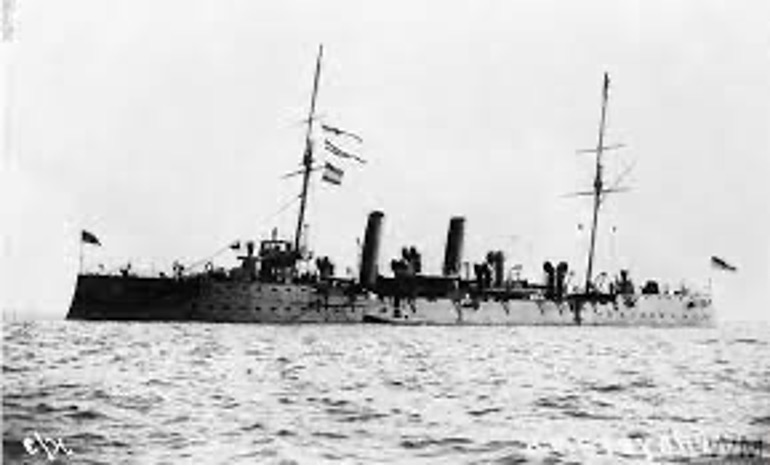
Psyche [Wikipedia]
Gale Damages Numerous Vessels at Port Stephens – 1928
The Dungog Chronicle of 22 June 1928, page 4, reported:
‘Early on Thursday morning a storm of terrific violence struck Port Stephens that did considerable damage. The wind at times reached a velocity of about 80 miles per hour, levelling fences, lifting roofs and stripping trees of their branches and uprooting them. …….
Owing to the telephone lines being down, full particulars of the damage done in the Bay are not to hand, but the news that has filtered through states that Smith’s launch was washed from Lemon Tree Passage and is now a total wreck; Garth’s launch at Bundabah was torn from her moorings and was seriously damaged; Rigby’s hulk “the Governor Musgrave” dragged her anchors about 200 yards; Ward’s big punt was swept from her anchorage and deposited on the oyster leases nearby.’
Launch Sinks Near Nelson Bay in Pitch Darkness – 1930
The Newcastle Sun of 8 July 1930, page 5, reported:
‘Two men had a thrilling fight for life in the icy waters of Nelson’s Bay when their launch swamped and sank there last night. The men were an hour in the water, and swam 100 yards to shore.
A strong swell was running and heavy waves pounded the shore when Messrs. W. and J. Mitchell, of Swansea, attempted to cross the bar into the harbor at Nelson’s Bay. The Mitchells — father and son — are experienced fishermen, who had plied their trade for many months at Swansea, and then decided to try out the fishing grounds at Port Stephens.
Yesterday they set out in their launch from Swansea. The craft was 25 feet long and propelled by powerful engines. It towed a dinghy in its wake. For several hours the fishermen beat their way up the coast in a moderate sea, but at dusk, when the blinking eye of Port Stephens inner light appeared off their port bow, a stiff breeze from the south-east made matters uncomfortable.
With a making sea following, the fisherman attempted to cross into Nelson’s Bay. The passage through the heads was almost accomplished when the little craft shipped an ugly cross sea and almost filled with water. The crew made for the trailing dinghy, but suddenly another cross wave completely engulfed the launch, and she sunk, dragging the dinghy and men with her.
The men were sucked down, swirled helplessly about in the whirlpool, and then thrown, more dead than alive, on to the surface 40 yards away. For minutes, which seemed like an eternity to the men, they floated, separated from each other, in the darkness. Father called to son and was overjoyed when an answering cry came back. Both at least were alive, and floating debris from the lost launch gave them hope.
Clutching their frail supports, the men eventually came together again, and chilled by the icy water, propelled themselves towards the lights on the shore, 100 yards away. For more than an hour the men were in the water, and eventually landed, still from exposure and unable to stand. After a short rest, however, they made their way to a house occupied by Mr. Dickenson, which stands on the shores of the bay. They were taken in, warm clothing and hot meals were provided, and they were accommodated for the night.
The launch lies in approximately three fathoms of water, and there is a possibility of her being salvaged. The Mitchells today were none the worse for their experiences but are really thankful at having escaped from the sharks of that particular part of the coast.’
Gale wrecks Garuah, an Australian Agricultural Company Vessel – 1934
The Maitland Daily Mercury of 24 November 1934, page 9, reported:
‘During a heavy gale on Friday, the 12th inst., the Garuah, a small craft belonging to the A. A. Company, was returning from the heads of Port Stephens, where she had been to take in some timber, and whilst rounding the head that forms the eastern part of Nelson’s Bay she was unable to clear the point, and was driven on shore, where she immediately went to pieces. The rigging was saved.’
Gale Wrecks Two Vessels at Shoal Bay – 1950
The Newcastle Sun of 19 January 1950, page 1, reported:
‘A north-easterly gale which lashed the coast last night was estimated by Shoal Bay residents to have exceeded in violence the 80-mile-an-hour blow experienced there several years ago. The maximum wind velocity recorded at Nobbys [at Newcastle] was 66 miles an hour. At Shoal Bay the gale completely wrecked a £700 launch, extensively damaged another valued at £400 and sank several other small launches. …..
The launch which was driven from its moorings and pounded to pieces on the beach at Shoal Bay was owned by Mr. J. Robinson, who resides there. This morning the wreckage was strewn along the beach. A 24ft. launch owned by the Shoal Bay Country Club was also driven aground in the storm and the manager (Mr. Randall) said this morning that it was so extensively damaged that its salvage was not certain. Several small motor launches were missing this morning, but are believed to have been sunk at their moorings. Mr. Frank Barsley, launch proprietor of Shoal Bay, spent the entire night looking after his own fishing vessel and rowing the owners of launches out to their craft to make them more secure. At times it was difficult for him to make any headway against the wind.
A yacht owned by Mr. H. De Lore of Newcastle was also driven from its moorings on to the beach but was towed off this morning by a trawler. Mr. De Lore went to Shoal Bay early this morning after a police message had been sent to him, and he was able to arrange for the yacht to be refloated and anchored safely. During the storm a tree crashed through the roof of a garage at Shoal Bay.’
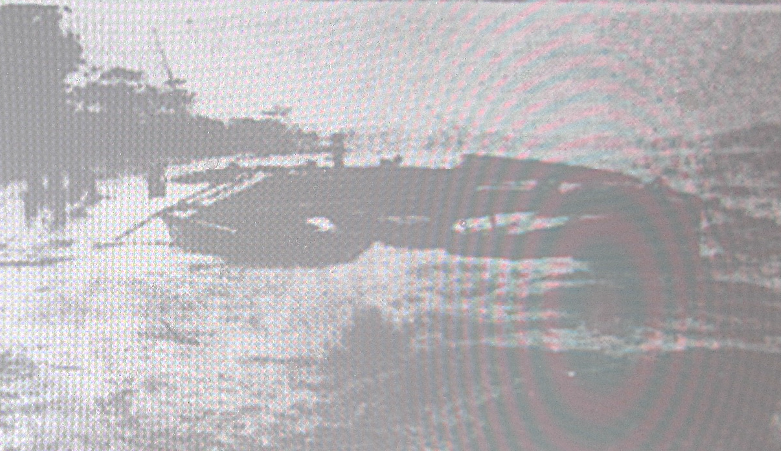
Launch owned by the Shoal Bay Country Club [Newcastle Sun of 19 January 1950]
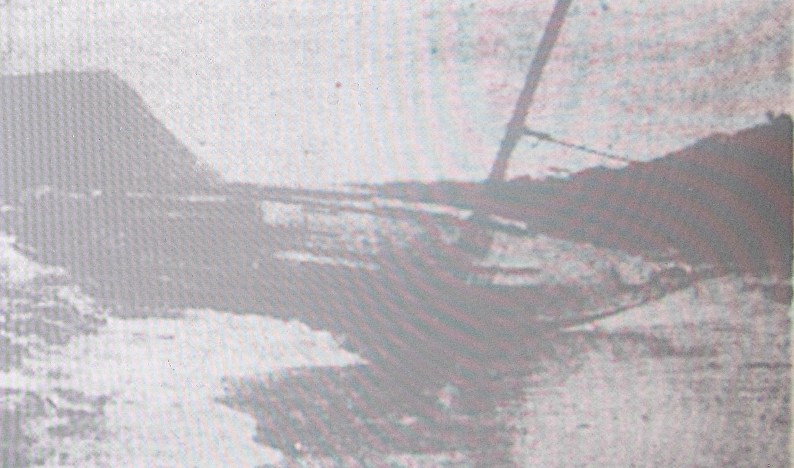
Yacht owned by Mr. H. De Lore, of Newcastle [Newcastle Sun of 19 January 1950]
Severe weather capsizes Italia Star after seeking shelter – 1959
On 15 March 1959, severe weather created dangerous seas at Port Stephens. Three Sydney-based, Italian-owned trawlers waited out the storm at Seal Rocks (north of Mungo Brush) but were forced into deeper water as conditions worsened. The Porpoise safely entered Port Stephens, but the Italia Star was capsized by large waves inside the harbour; only one crew member, Carmelo Musumeci, survived after swimming nearly a mile. The two others were never found despite extensive searches. A third boat, the San Francisco, stayed offshore and returned safely to Sydney.
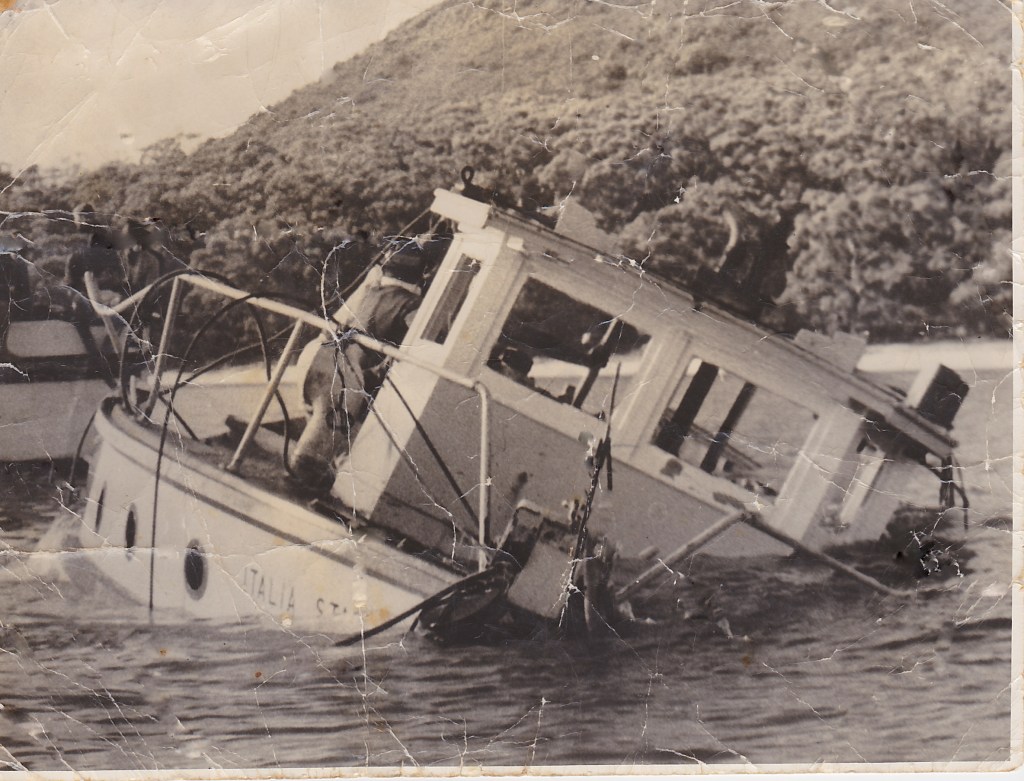

‘Italia Star’ capsized inside Port Stephens after being swamped by heavy seas
The Italia Star was later salvaged and repaired locally.
POSTSCRIPT
Ship’s Knee found at Shoal Bay, Port Stephens – 2023
Ship’s knees are a form of wooden bracing used in boat building. The knee is a natural curved piece of wood.
The artifact found at Shoal Bay beach in 2023 is a ship’s knee made from hardwood. The dimension of the knee is 1.09m x .8m. The longer length has been damaged by fire and by marine borers. Metal fastenings remain in place on the knee.

Ship’s Knee Found at Shoal Bay, Port Stephens in 2023
While it is unknown from which boat the ship’s knee originated , it is an interesting artifact.
Researched and compiled by Kevin McGuinness
June 2025

 Port Stephens - a history exploration