
Introduction
At the end of the Second World War, the NSW Government had plans to construct a Mental Hospital on the former site of the HMAS Assault military facility at Fly Point, Nelson Bay. The plan was abandoned in 1946 due to local opposition.
In 1947, the Commonwealth Department of Defence transferred the site of the Australian Army’s former military camp on Tomaree Head to the NSW Department of Public Health. It was to be used as a convalescent hostel for mental health patients from State mental hospitals.
The first patients were admitted in 1947 and modification of the facilities was commenced.
In the 1950s, some of the old army huts were demolished and new facilities, including a recreation hall, were constructed.
By 1952, the number of patients was recorded as 118.
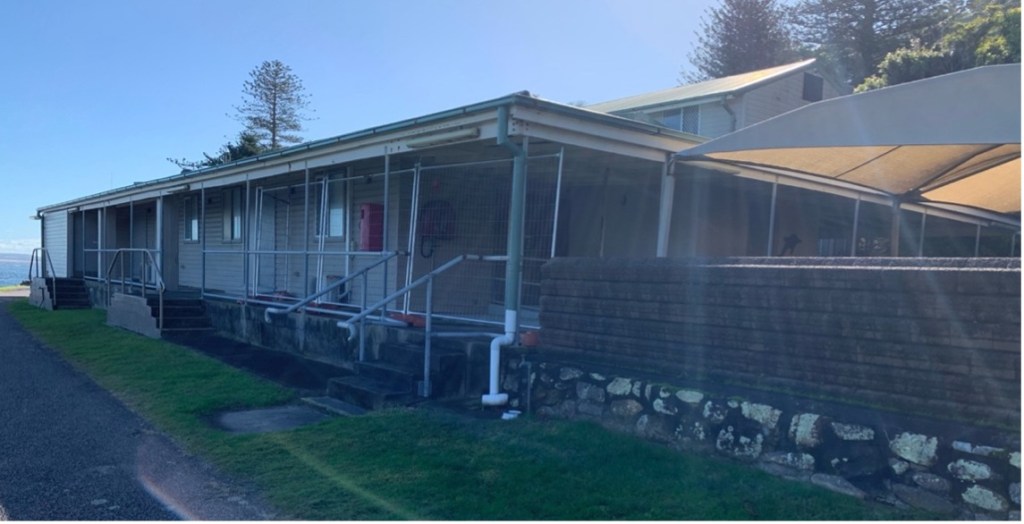
Former Recreation Hall at Tomaree Hostel
In 1960, a holiday scheme was introduced for male patients providing them with a two-week holiday at Tomaree. Facilities for female patients were opened in 1966. The practice of providing holiday beds ceased in 1985.
In 1989, the State Government proposed selling the Tomaree Lodge, as it was then known, but later retracted the decision due to local opposition.
From 1992, Tomaree Lodge provided long-term accommodation for people with developmental disabilities.
This paper is the story of the Tomaree Convalescent Hostel as obtained from the following sources.
New Boat for Convalescent Hostel – 1948
The Dungog Chronicle of 4 December 1948, page 5, reported:
‘A. Adolphson and Sons …. completed a new boat for the Convalescent Home at Tomaree Head.’
Adaption of Ex-Army Huts for Convalescent Use – 1949
The Sun of 14 September 1949, page 12, reported that at the Convalescent Hospital, Tomaree works were underway to adapt ex-Army huts for use of convalescent patients.
Inmates Help in Search for Missing Man – 1949
The Newcastle Morning Herald and Miners’ Advocate of 28 October 1949, page 1, reported:
‘Police dogs were sent last night to assist in the search for [a man] who has been missing from the Country Club, Shoal Bay, since ‘Wednesday morning. …
Mr. McCoy, who is Superintendent of the hostel at Tomaree, led inmates in a search of the area. The hostel’s launch was used in a search from South Head to False Bay [Fingal Bay]. Local fishermen also assisted.’
Proposed Reclamation of Land at Convalescent Hostel Site – 1950
The Museums of History NSW holds documentation relating to the proposed reclamation of land at the Tomaree Convalescent Hostel site to provide for an additional area to accommodate recreational facilities. To reduce the cost of the land reclamation it was proposed that the labour of inmates at the Hostel be used to undertake the work. The location of the current sea wall indicates that the proposed works were not undertaken. Several photos and illustrations from the Archive documents are set out below:
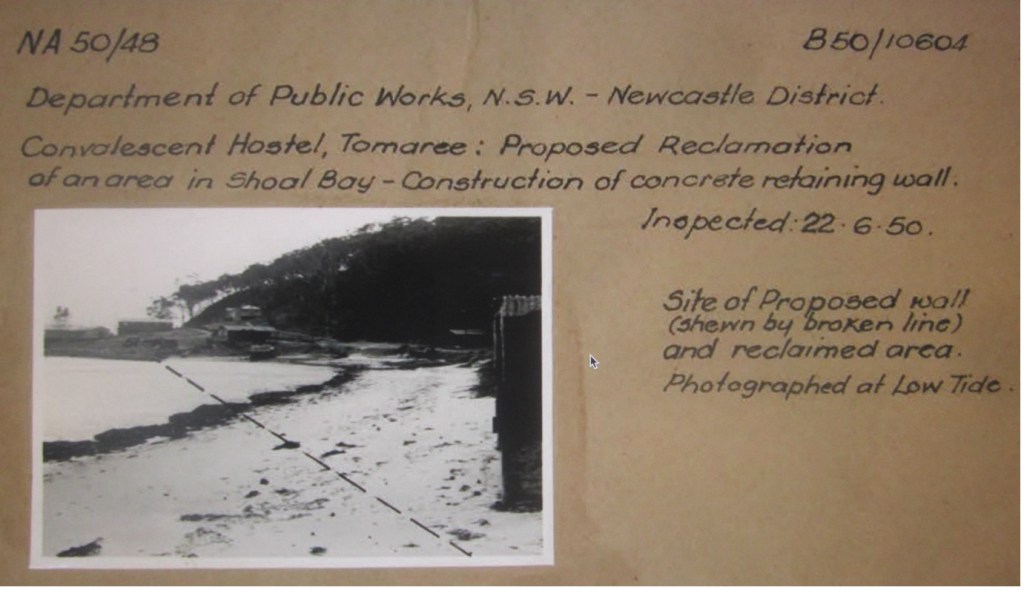
Looking North
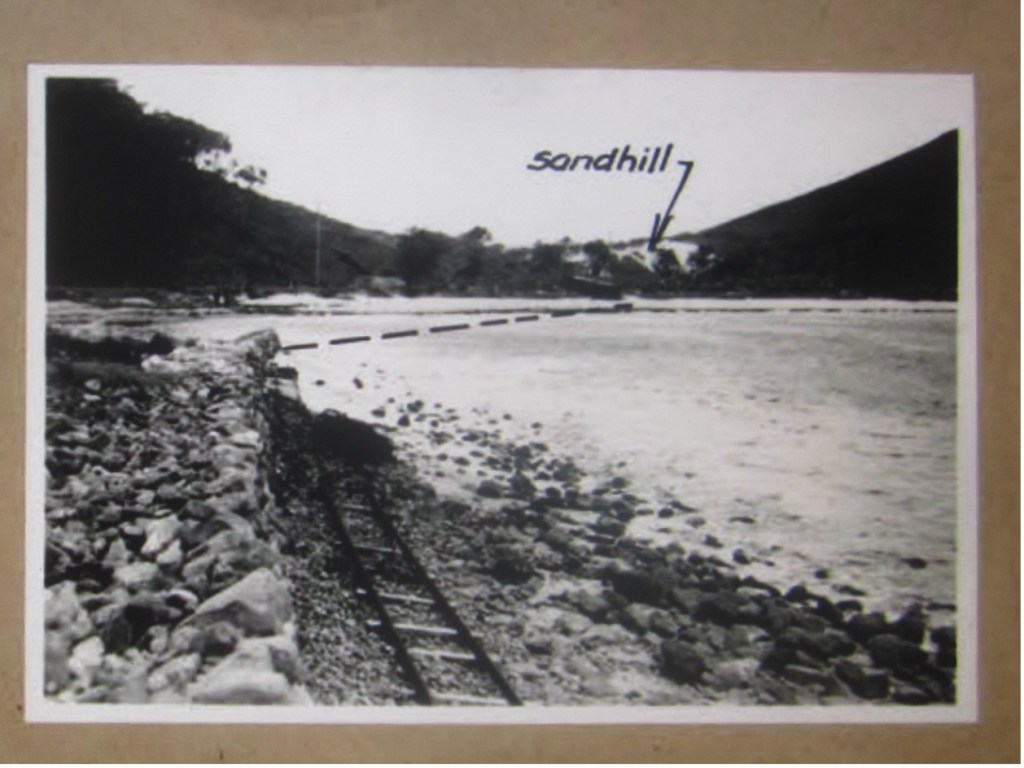
Looking South
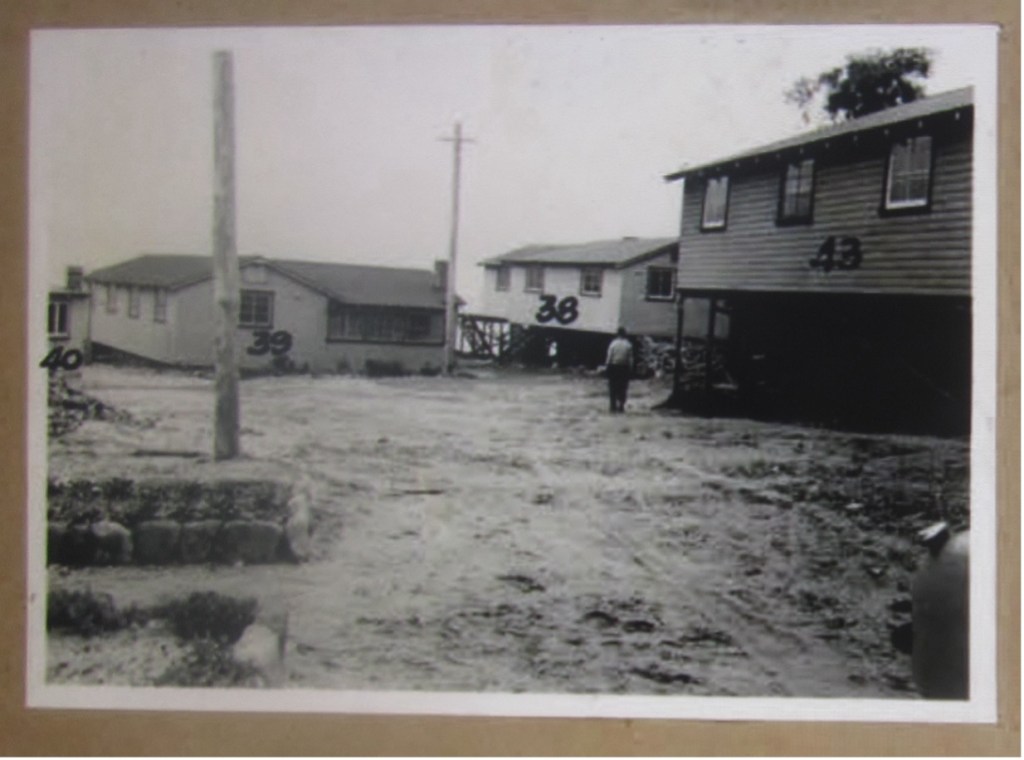
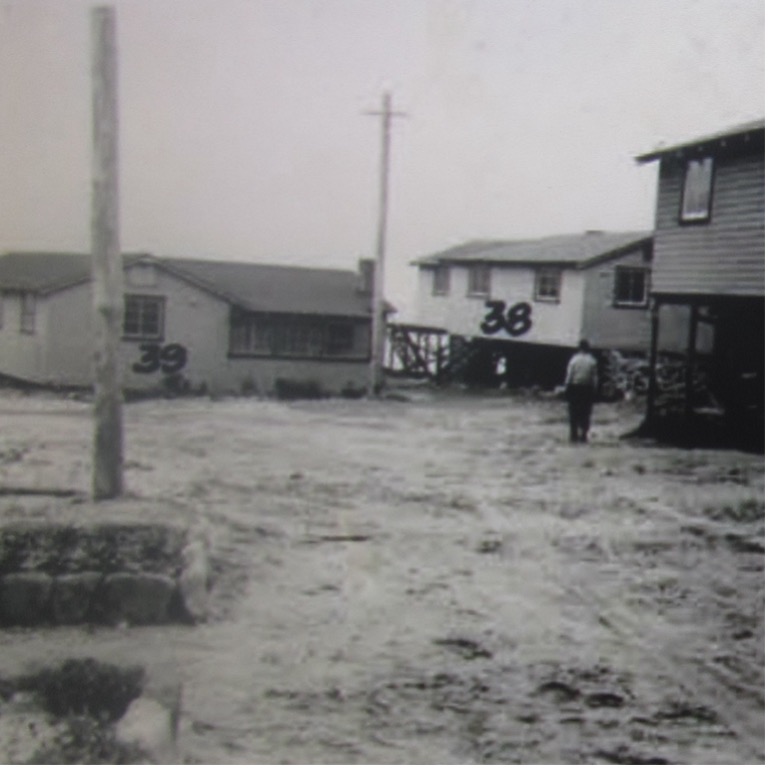
Four accommodation buildings (numbered 38, 39, 40, 43) on the upper level of the Hostel site. Buildings have since been demolished and replaced by new facilities.

Diagram of the Tomaree Convalescent Hostel site showing proposed roads and reclamation works.

Current view of the proposed reclamation area [Author photo]
Patients Help with Newcastle Concert – 1951
The Newcastle Morning Herald and Miners’ Advocate of 21 June 1951, page 4. reported:
‘Patients of Watt-street [Newcastle] and Stockton Hospitals and Tomaree Convalescent Hostel joined lustily in community singing at a recreational-therapy concert at Stockton last night. After an invitation to “try to lift the roof,” they showed what a hospital officer described as their “remarkable memory” for songs heard on the air. “After hearing a song two or three times, they know every word,” he said. “There are radios in every ward.” The patients listened silently and attentively and applauded vigorously when fellow patients and members of the hospital staffs presented items.
Among the artists were Mary, an 88-year-old, grey-haired patient who played the piano; Ada, a mouth-organ soloist; and John and Agnes, vocal duettists. Part of the concert was recorded for delayed broadcast from a Newcastle station. The Manager of Stockton Hospital (Mr. W. N. Todd), who was compere, said it was planned to make concerts a regular feature, in addition to sporting activities. The plan was part of a recreational social therapy programme for the good health, contentment and enjoyment of patients.
Swings, slippery dips and other playground equipment were to be installed for the younger patients, and it was hoped to have a sports nurse to teach softball and other games, he said. Officers of the hospitals and hostel agreed that concerts in which the patients took part were “invaluable.” “The patients have talked about nothing else for weeks,” one officer said. “They have been rehearsing for two and a half weeks.” City artists and members of an industrial concert party assisted at the concert. Among those who attended was Mr. R. C. Cobcroft, a Department of Public Health welfare officer, who represented the Inspector General of Mental Hospitals (Dr. E. S. Morris).’
Nelson Bay CWA Sends Christmas Parcels to Hostel Patients – 1953
The Raymond Terrace Examiner and Lower Hunter and Port Stephens Advertiser of 10 September 1953, page 2, reported:
‘It was also decided to send an individual parcel to each of the patients at Tomaree Convalescent Hospital during Christmas week. The gifts will be parcelled, and gifts will be purchased and parcelled by the members.’
Water Supply Extended to the Convalescent Hostel – 1954
The Raymond Terrace Examiner and Lower Hunter and Port Stephens Advertiser of 15 July 1954, page 1, reported:
‘The Hunter District Water Board advised that the Minister has approved of a revised scheme for provision of a water supply to Nelson Bay, (including extension to Shoal Bay and Tomaree Convalescent Mental Hospital), as being eligible for financial assistance and will meet half the capital cost of the combined scheme.’
Ptovision of Recreational Facilities
With the adoption of a “five-year plan of general development” in 1950, various modifciations were made to the Hostel over the following years. These included a recreational hall, a swimming pool, two tennis courts and a concrete cricket pitch.
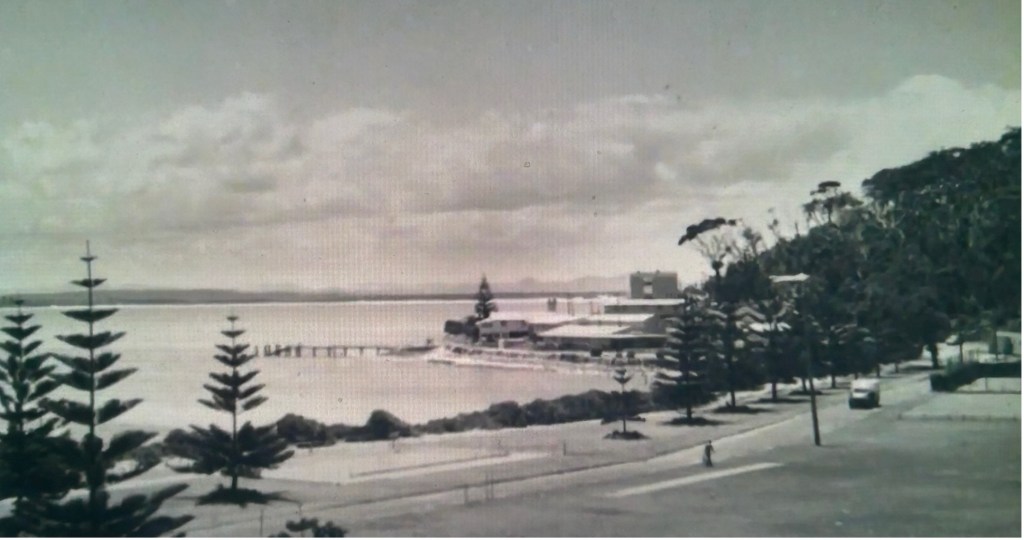
Tomaree Convalescent Hostel site – 1960 showing wharf in centre of photo, with swimming pool and cricket pitch in middle foreground.
A new fresh-water swimming pool and facilities were constructed in 1965.
The Western Herald of 11 November 1966, page 6, reported:
‘Women patients at Bloomfield Hospital can look forward to a seaside holiday at Port Stephens. Previously only male patients were able to have the holiday, but a new block opened recently means that women will have the same benefits. The Minister for Health, Mr. Jago, opened the new block at Tomaree psychiatric holiday camp at Port Stephens. Tomaree has a swimming pool, a mini golf course, tennis courts, a cricket pitch, bowling green, barbecue, picnic area, TV, radio and a library.’
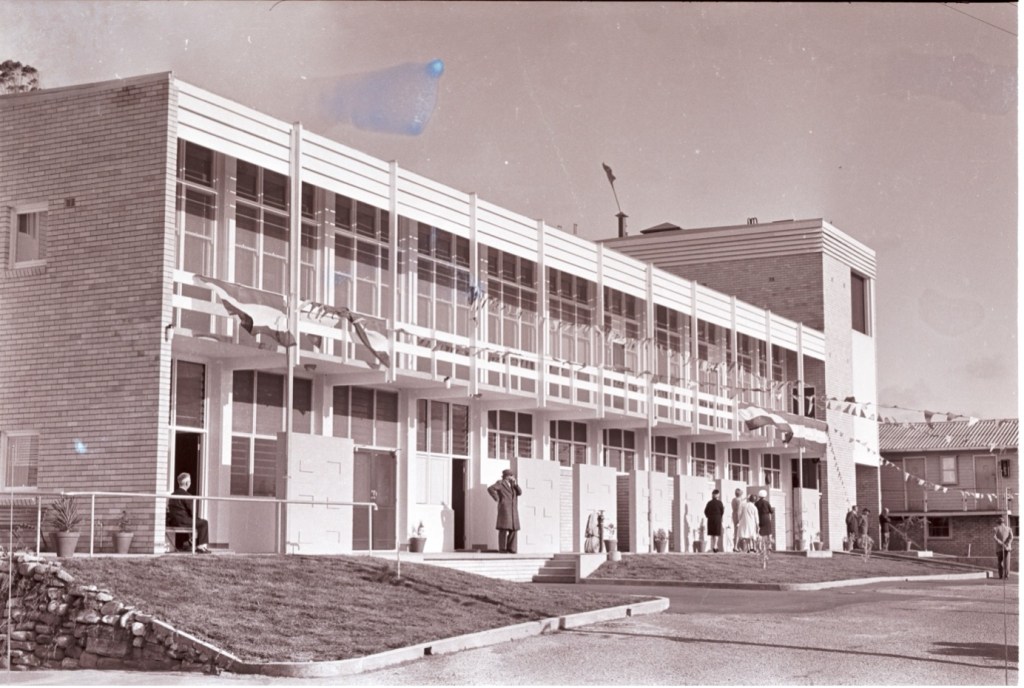
Opening of the accommodation building -1 966
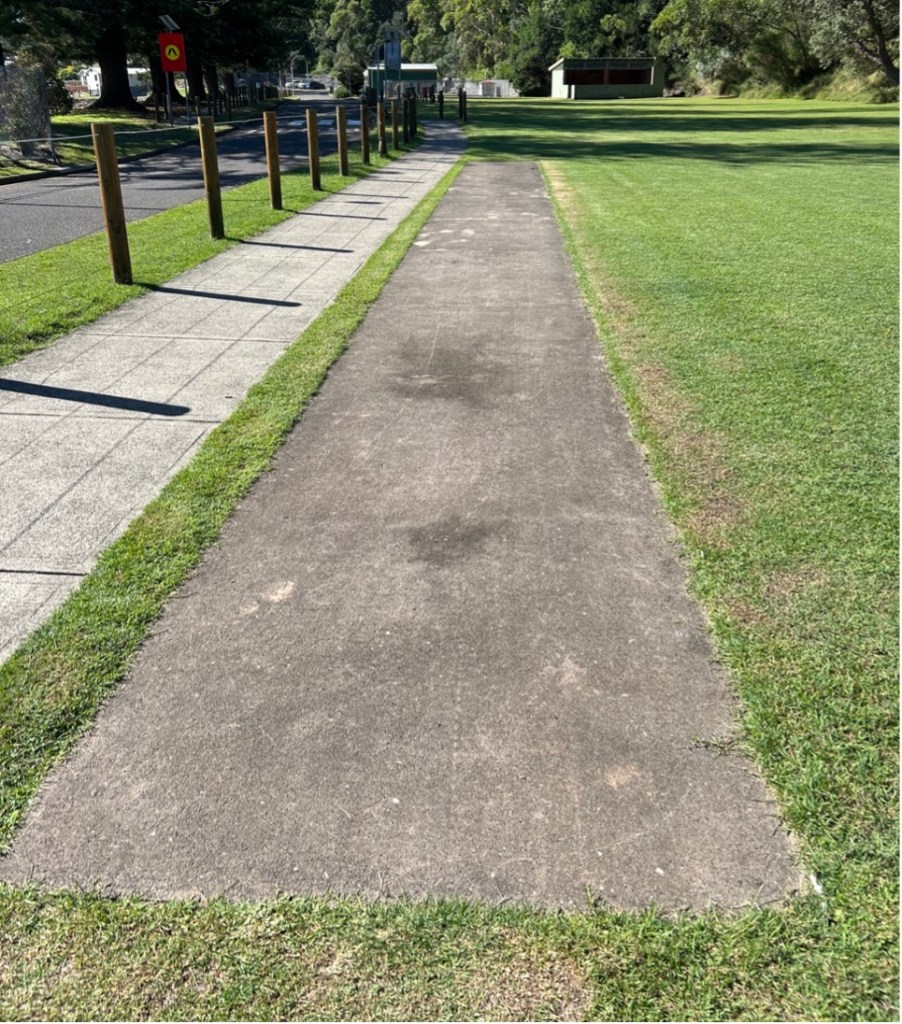
Cricket wicket installed c 1955 [Author photo]

Putt putt golf course – 1966
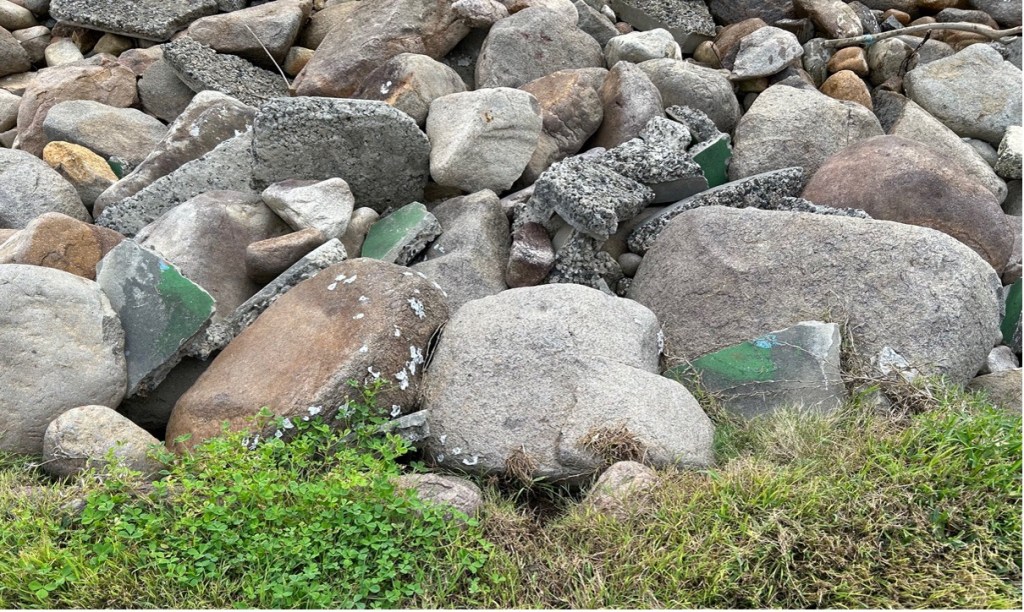
Remnants of the former putt putt golf facility (green painted concrete pieces) dumped on the sea wall [Author photo]

Swimming pool (now covered) built in 1965 for use of patients [Author photo]
Wind Up of the Tomaree Convalescent Hostel – 1984
The Government Gazette of the State of New South Wales of 27 July 1984, page 3908, published the following notice concerning the Tomaree Convalescent Hostel:
‘In pursuance of the provisions of section 10 of the Mental Health Act, 1958, I, Air Marshal Sir James Anthony Rowland, Governor of the State of New South Wales, with the advice of the Executive Council, do hereby revoke all appointments of Tomaree Convalescent Hostel, Nelson Bay, or part thereof, as a mental hospital. Dated this 11th day of July 1984.’
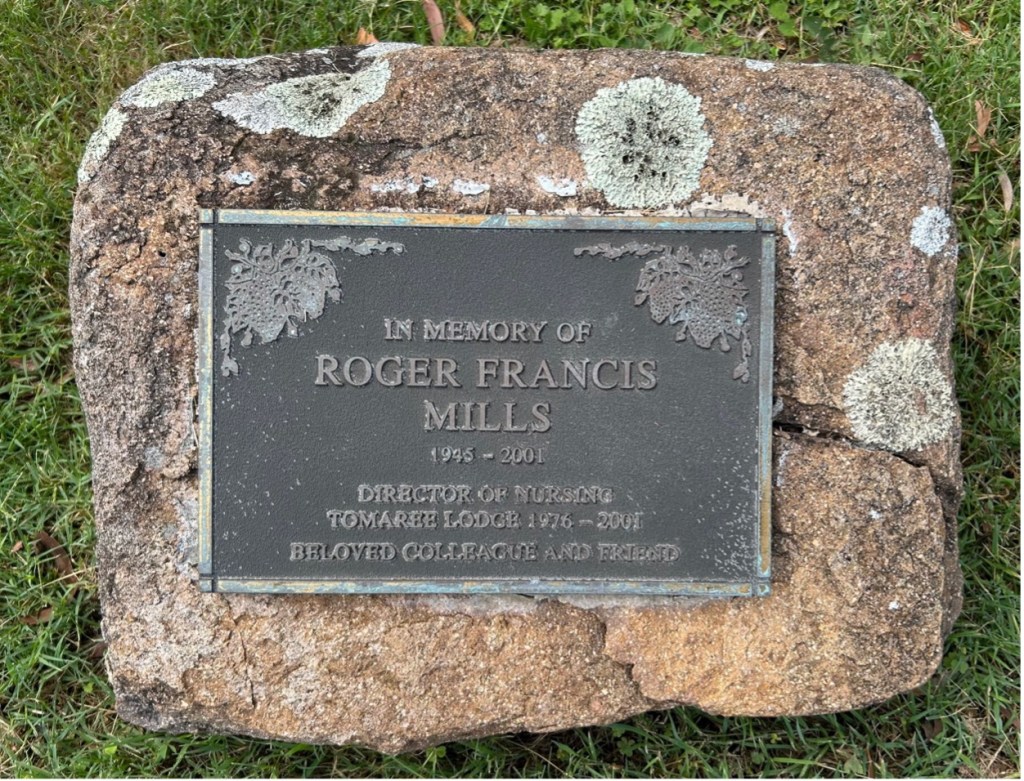
Memorial to Roger Francis Mills, Director of Nursing, who served at the Tomaree Lodge from 1976 to 2001. Memorial located near the remains of the Torpedo Tubes at Tomaree Head [Author Photo]
Concluding Comments
From 2001, the NSW Department of Ageing, Disability and Home Care [DADHC] operated Tomaree Lodge which accommodated around 45-50 disability residents.
In 2015, the State Government announced its closure, aiming to redevelop the site and privatise services under the National Disability Insurance Scheme. The remaining residents were relocated to Group Homes.
Community groups expressed concerns and proposed managing the site under a trust to preserve public ownership.
In 2019, a community group named the ‘Friends of Tomaree Headland’ formed, and later incorporated as ‘The Tomaree Headland Heritage Group Inc.’, representing various community sectors.
Under its then jurisdiction, the NSW Department of Communities and Justice engaged consultants to advise on the the future use of Tomaree Lodge site.
Several papers on the history of Mount Tomaree and Tomaree Headland Precinct are published at the following links on this website:
Proposed Mental Hospital at Nelson Bay – 1945
Camouflage of Mount Tomaree – 1941/42
War Diary of Tomaree Coastal Artillery Battery – 1942/1944
‘Reckless Kelly’ Movie Set – Port Stephens 1992
Arthur Ernest Dickinson – Pioneer Ranger at Port Stephens
Mount Tomaree on Fire – February 2018
Tomaree Headland Precinct at Port Stephens
Researched and compiled by Kevin McGuinness
June 2025

 Port Stephens - a history exploration