
Introduction
In 1942, the Gan Gan military camp was built as an amphibious training centre by the United States military at Port Stephens. It was part of the Joint Overseas Operational Training School (JOOTS) facility established in conjunction with HMAS Assault, to train both Australian and American troops in land/sea warfare.
Following the withdrawal of the United States military from the Port Stephens area after the War, the Gan Gan site was maintained by the Australian Army and used extensively in the post war period as a training facility.
It was also available to other groups, such as school cadets and university students, for training exercises.
Seven papers of the Gan Gan post-war history are published on this website.
This paper is the story of two visits by university students featuring the Gan Gan Military Camp – the first, an official visit in 1950 and the second, in a more humorous vein, in 1962.
Links to the other six papers are found at the end of this document.
University Students’ Conference – 1950
Background
From January 14 to 24 January 1950, the fourth Annual Conference of the National Union of Australian University Students was held at Gan Gan. This was the first departure from the use of the Gan Gan camp for military training.
The Newcastle Sun of 13 January 1950, page 4, reported:
‘More than 300 students from Sydney, Armi-dale, Melbourne, Perth, Adelaide, Hobart and Auckland will attend the University Students’ Congress which opens at Gan Gan on Sunday.
The congress, which will be officially opened by the Lord Mayor (Ald. Quinlan) will combine lectures and discussions with a ten-day holiday. The students, from first-year students of 18 to a number of ex-servicemen who are 30 years of age, will include men and women. There will be special speakers each day and students will hold discussions on matters of social and academic interest which, they have not had time to discuss during the year.
Arrangements for the congress have been made by Mr. G. Pittendrigh, who has been organising it since August. He has been assisted by Mr. I. Bathgate. The Lady Mayoress (Mrs. Quinlan) will accompany the Lord Mayor when he attends the congress on Sunday for the official opening. They will be guests at an official dinner. Mr. W. Morrison of Freshwater is in charge of a life-saving service, which will be provided for the protection of swimmers.’
The Newcastle Morning Herald and Miners’ Advocate of 14 January 1950, page 2, further reported:
‘The Lord Mayor (Ald. Quinlan) will officially open the University Students’ Congress at Gan Gan tomorrow afternoon. About 300 students from all States and New Zealand will attend. The 10-day conference will take the form of addresses, films and discussion by students on subjects of social and academic interest.
The programme includes talks by Mr. W. H. C. Eddy and Mr. R. Lockwood on “The Student as an Influence for World Peace”; Mr. E. J. Hook, Secretary of the Universities Committee, “Commonwealth Scholarship Scheme”; Dr. W. K. G. Duncan, “Education For The Educated”; Mr. A. J. Nelson, “U.N.E.S.C.O.”: and Dr. T. Kaiser, “Science and Security.” A discussion on the National Union of Australian University Students and international student relations will be led by Mr. K. Tolhurst.
The programme includes an inspection of the B.H.P. Steel Works. The Lady Mayoress (Mrs. Quinlan) will accompany the Lord Mayor to the congress. …. The camp has been placed at the students’ disposal by the Army.’
Congress Opened
The Newcastle Sun of 16 January 1950, page 6, reported:
‘Three hundred students form universities throughout Australia and New Zealand yesterday commenced the fourth annual congress of the National Union of Australian University Students at Gan Gan army camp.
The congress was officially opened at 2 p.m. by the Lord Mayor (Ald. H. D. Quinlan) who was entertained at luncheon by the students. The Lord Mayor said that he had great pleasure in welcoming the students to Newcastle. It was only by educating the younger generation that future wars could be avoided. Lectures and discussions on social matters will be held during the ten days’ congress. The president of the N.U.A.U.S. (Mr. F. G. Brennan) will speak on ‘The Student in Society.’ Other lecturers will include Dr. W. K. Duncan, Dr. T. Kaiser and Messrs. W. H. Eddy, R. Lockwood and A. J. Nelson. Members of the faculty bureaus will meet to discuss everything from teaching methods to the lack of finance for study. ….. Several married returned soldiers are attending the camp and are accompanied by their wives and families. A life-saving squad organised by Mr. Bill Morrison, of Freshwater, is operating near the camp.’
The Congress
The Newcastle Morning Herald and Miners’ Advocate of 21 January 1950, page 5, reported:
‘Of all the double-talk placenames—the Kurri Kurris and Wagga Waggas—on the Australian map, Gan, Gan is probably the least important. It is nothing but an Army camp. Lonely and small, but one of the most picturesque camps to come out of World War II., it sits in the sandy soil beside Stockton highway, two miles from Nelson’s Bay. The men who built its huts, with an eye to camouflage, seemed to fit them into spaces between the trees, and someone surely not the Army—went to the beautiful trouble of adding rock walls to the track to its cookhouse door.
Here, periodically, peacetime soldiers, out for field training, go to bed (as distinct from paliasse or groundsheet) with pillows, and to mess at tables set with clean, white cloths. Today, in the camp’s rather holiday atmosphere, with a whisper of collegiate pranks, about 300 members of the National Union of Australian University students are attending their fourth annual congress. Between sessions, they surf at Anna Bay, play indoor games and glance at an art show in the recreation hut and, at night, grab whatever sleep they can in the crowded huts where mosquitoes zizz at the green nets over the bunks.
In the early hours—”about 3 o’clock”—Tuesday morning, a voice crackled over the loud speaker system, announcing a spur-of-the-moment dance in the camp’s assembly hall. Undergraduates tumbled out of bed to waggle through a conga. For the duration of the congress, the canteen hut has become “the Common Room.” Here, at a table cluttered with free reading matter, students may choose from the back number magazines and papers published by Australian and oversea universities . . . “Honi soit,” from Sydney; “On Dit,” from Adelaide; “Semper Floreat,” Brisbane; “Farrago,” Melbourne; “The Gateway,” from the University of Alberta, and others.’
Storming of Glovers Hill, Nelson Bay, by the University of NSW Regiment – 1962
An article was published in the University of NSW student magazine ‘Tharunka’ on 9 May 1962, page 10, written by a student reporter in a humorous manner, about a mock battle between opposing forces of the University of NSW Regiment at Glovers Hill, near Shoal Bay:
‘At 1130 hours the road past the huts at Gan Gan Military Camp was almost deserted. Only a few personnel remained to watch the Mess, the “Q” stores, the Regimental Aid Post and the Chaplain’s hut. Here and there tired young recruits who had been rescued from their first route march sat on steps and nursed blistered feet. “This way,” said a man in uniform. He led the way to a field tent, 100 yards from the main camp. There, Lieutenant Geoff Lindley, of the University of N.S.W. Regiment. and a bottle of mosquito repellent greeted us. There didn’t seem to be many mosquitoes about. “You’d better rub some on. They practically lift you up and carry you away out there.” “Where?” “Up on Glovers Hill. Rub plenty on your arms and face.
Well have to get going—its due to start in a few minutes.” We looked stupefied. Was there to be a parade, perhaps, on this thing called Glovers Hill. “The enemy is holding the hill. Our boys will make a siege and recapture it. We thought you might like to watch the battle.” Till you have tried to rub oily mosquito repellent over nylon stockings and make-up you will never appreciate the ordeals faced by a female War Correspondent unprepared for war. But this was it. We were loaded into a truck with crash gears. It rumbled and whined off along a black sand track, bound for Glovers Hill.
There was a distant boom. The battle was starting. As we tossed and whined along, I interrogated the driver, Sergeant John Robinson, who was cursing the gear-box. There was, it seemed, no cause for immediate alarm about the distant booming. The big gun noises were merely charges of gelignite. “If real ammunition isn’t used, how do the soldiers know if they have been ‘hit’?” “They have an umpire. He tells them if they’re dead.” The umpire’s jeep was just a few yards ahead of our truck. This was fortunate, because it was learnt that we could not go any further in a heavy truck and would have to transfer to the jeep. To make room for two extra passengers in the jeep, two wireless operators had to be abandoned at the roadside.

The road up to Glovers Hill, with a water tank in the background, near where the transfer to the jeep took place [Author photo, July 2022]
The smaller vehicle scuttled through the drifting sands, past groups of troops resting in the brush, over stumps, up rises. A big green water tank appeared on a hillside. The jeep screeched to a stop. We were two-thirds to the top of Glovers Hill. There was no signs of ambush or life. “Go out and let them know we’re here,” a major told a private. Another gelignite charge exploded somewhere on the hill and the major jumped out of the jeep. He called to the private to return. “There’s less fuss if a major gets blown up than if a private does,” he explained to the other passengers, and promptly set off up the hill himself. There were coo-ees and a few bangs. The major came back down the hill with a tall man in a roughly-shaped felt cap branded with a red star “Meet the enemy leader,” the major said. There was no interpreter to save us, so we tried English. And Captain C. H. Hunt, enemy leader, father of six, lecturer in Technical Engineering at the University of N.S.W., replied likewise. “You’ll see more up the top,” he said, taking my arm. In this manner, I managed to struggle up the rough slope, over logs and through ferns, despite high heels.
There was no retreating now I had burnt my bridges, fraternised with the enemy, and was left standing at the point where both armies would meet. However, I had so far succeeded in avoiding gelignite charges, and there was a superb view of the surrounding country and ocean from the hilltop. The bliss was short-lived. Without warning, there was a violent fusillade of rifle-fire from lower sections of the hill. The enemy retaliated. All around me the .303’s cracked. It was hard to believe they were firing blanks. Flames shot from the barrels. Gelignite boomed. Sub-machine guns with real ammo, were spitting into pits dug specially to receive the bullets. Diggers were scrambling up the slope. I remembered a painting on the wall at primary school—an impression of the landing at Gallipoli. I looked around for the photographer, expecting to see him lying in a huddled heap with flash bulbs broken in his pockets. He was still standing bravely on a log. There was nothing to do but clutch my handbag and hope that; if I got hit near the ears, my earrings would save me. The diggers were coming on. None fell. One man kept coming despite at least 20 direct hits in his chest. The enemy leader handed me his .303 and his cap. “Give them all you’ve got,” he urged. My pig-shooting experience of bygone days bubbled to my aid. Leaping into a foxhole. I started to fire madly at all moving things. The photographer dived for cover. The fatality rate among war photographers is usually high.
Suddenly I felt a blow on my right shoulder. A mortar had got me, surely. I turned to look at the gaping wound, but there was none. The other fellow in the foxhole had tapped me to ask if I’d mind standing up for a minute so he could pick up the bullets I was sitting on. Then, as suddenly as the thing had started, the battle ended. The enemy leader said: “It’s time for lunch.” Both armies lit cigarettes and started to collect their gear. Men emerged from “hootchies” — covered-in foxhole things that originated in Korea. An enemy soldier stepped out of a “hootchie” looking pained. “The worst part of that battle was when a meat ant bit me.” he complained. “But I gave it a couple of blasts.”
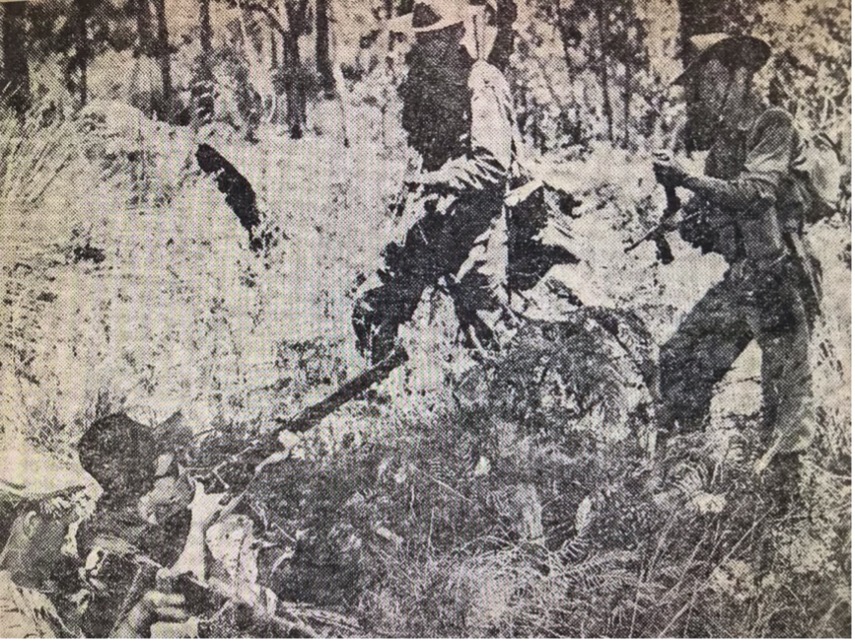
Student author firing at the ‘enemy’.
So, we left Glovers Hill and went back to the camp for lunch at 1330 hours. Everyone smelt of mosquito repellent, and everyone had black faces, hands and feet. One young officer said later: “This is the most vermin-infested country — flies, mosquitoes, snakes, bugs— and now us.”
After lunch, consisting of soup, baked dinner supplemented with rations, and plums with custard, it was decided that, before setting off home, we should be shown one more outpost. By means of the crank crash-gear truck, we arrived to find the companies getting together for another siege. “Where to this time?” he asked. “Glovers Hill — the last attempt wasn’t quite as perfect as we’d planned.” “Would you like to come?” someone asked. We declined with thanks. But, believe me, we did not retreat. We did as the Army says with much diplomacy, make a “tactical retirement.” It seemed foolish to tempt fate twice. Besides, my nylons were still in one piece. Not a ladder. It must have been the mosquito repellent.’
Links to the Six Other Papers of Post-War Activities at the Gan Gan Military Camp are as follows:
Post War Military Camp at Gan Gan – an Overview
15th Northern Lancers at the Gan Can Military Camp – 1949
Military Training Camp at Gan Gan – February 1951
School Cadets at Gan Gan Military Camp – April 1951
Army Commando Training Exercises at Gan Gan – 1953 and 1955
First Army Camp for Women of the Citizen Military Forces (CMF) at Gan Gan – April 1954
Researched and compiled by Kevin McGuinness
July 202

 Port Stephens - a history exploration