
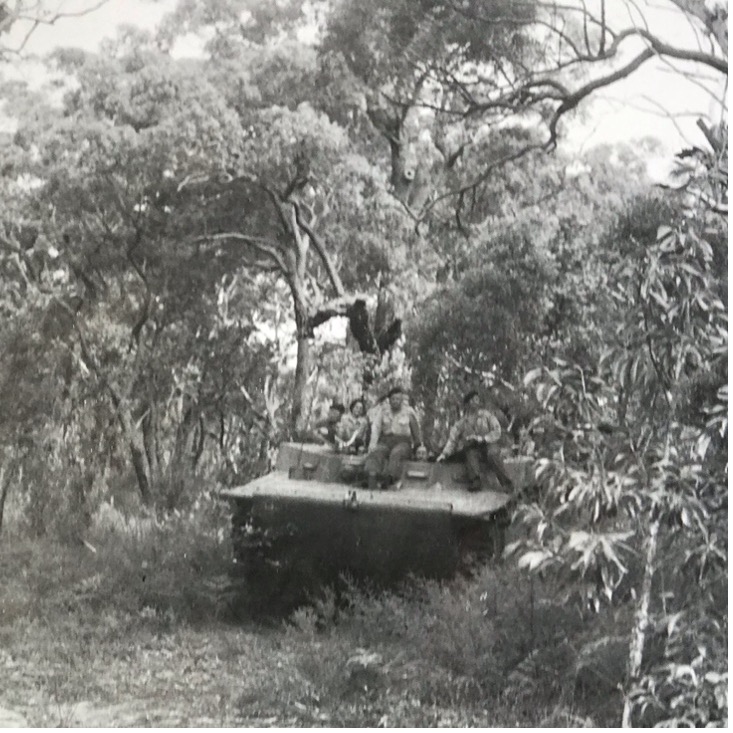
Introduction
In 1942, the Gan Gan military camp was built as an amphibious training centre by the United States military at Port Stephens. It was part of the Joint Overseas Operational Training School (JOOTS) facility established in conjunction with HMAS Assault, to train both Australian and American troops in land/sea warfare.
Following the withdrawal of the United States military from the Port Stephens area after the War, the Gan Gan site was maintained by the Australian Army and used extensively in the post war period as a training facility.
It was also available to other groups, such as school and university students, for training exercises.
Seven papers of the Gan Gan post-war history are published on this website.
This paper is the story of the military training camp held at Gan Gan in February 1951.
Links to the other six papers are found at the end of this document.
Military Training Camp at Gan Gan – February 1951
Several newspapers reported on this military camp at held at Gan Gan from 6-18 February 1951.
The reports and photos give a good insight into the preparation for the camp and what activities occurred during its two-week duration.
The Newcastle Sun of 3 February 1951, page 2, reported:
‘Four Army L.V.T. units and a duck left Shortland Camp, Newcastle, this morning for Gan Gan. A section of Newcastle 16th Company R.A.A.S.C., these units will participate in land and sea manoeuvres during the annual fortnightly camp which began today. The units took to the water at Shortland Camp, went through the heads and landed on Stockton Beach. They then travelled north along the beach to the camp.
Earlier a road convoy of eight vehicles left for the camp. Major E. H. Cottee, who commands the unit, watched the amphibious vehicles take the water. During the second week’s training the 16th Company will train with a small ships unit from Sydney.’
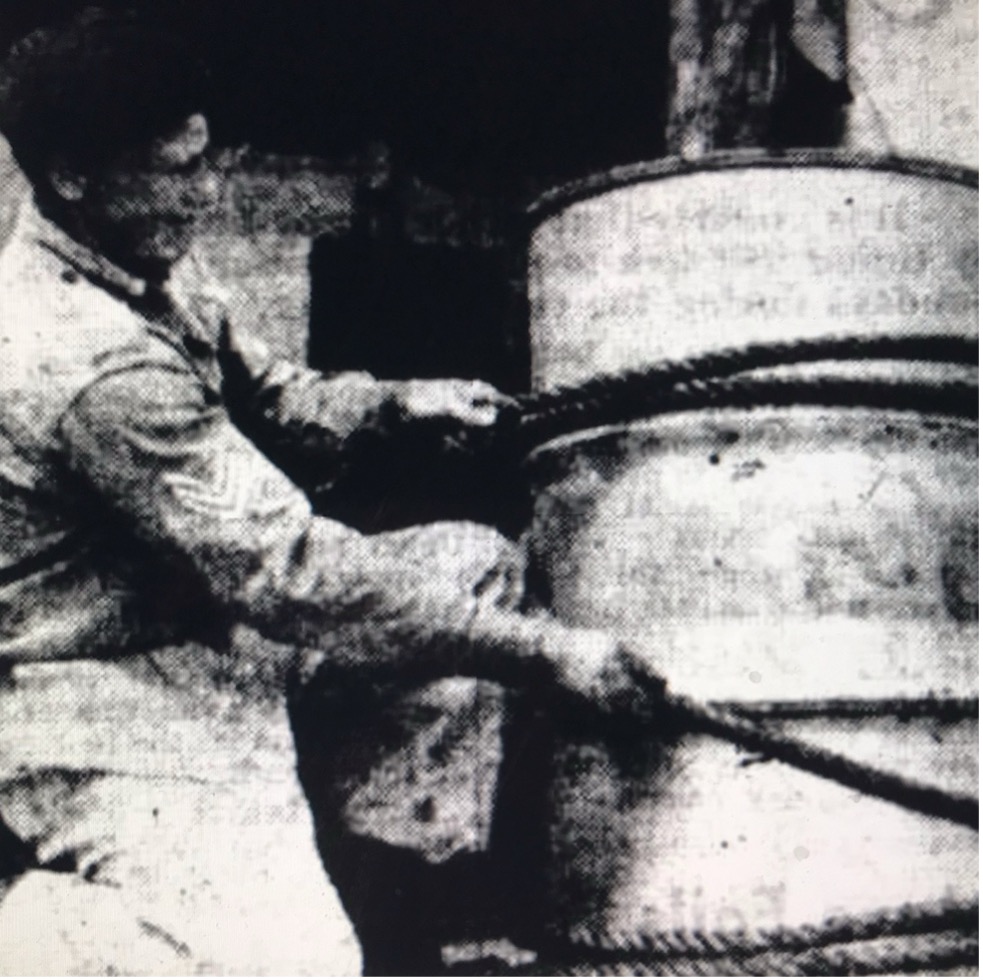
Sergeant H. H. James, unlashing a drum of high octane fuel when L.V.T.4’s arrived at Gan Gan Camp for land and sea. [Newcastle Sun, 5 February 1951, page 3]
The Newcastle Sun of 5 February 1951, page 5, published the following two photos relating to the forthcoming camp:
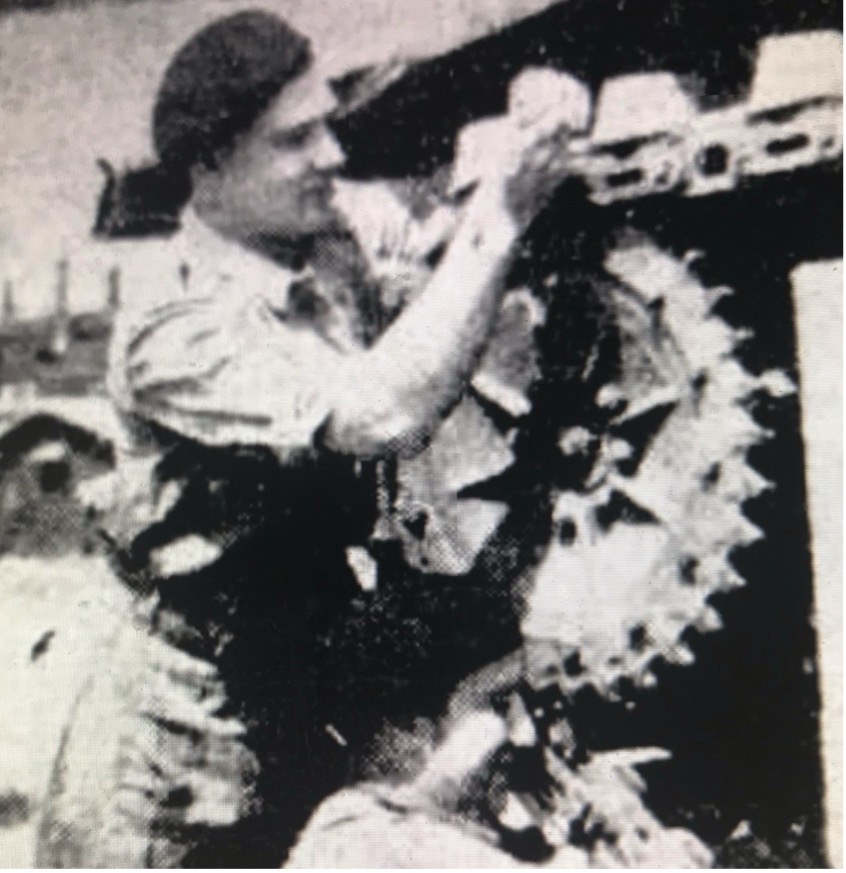
Trooper K. Wepper and Corporal J. Jones doing preliminary work on a L.V.T.4 before leaving for camp exercises at Gan Gan.
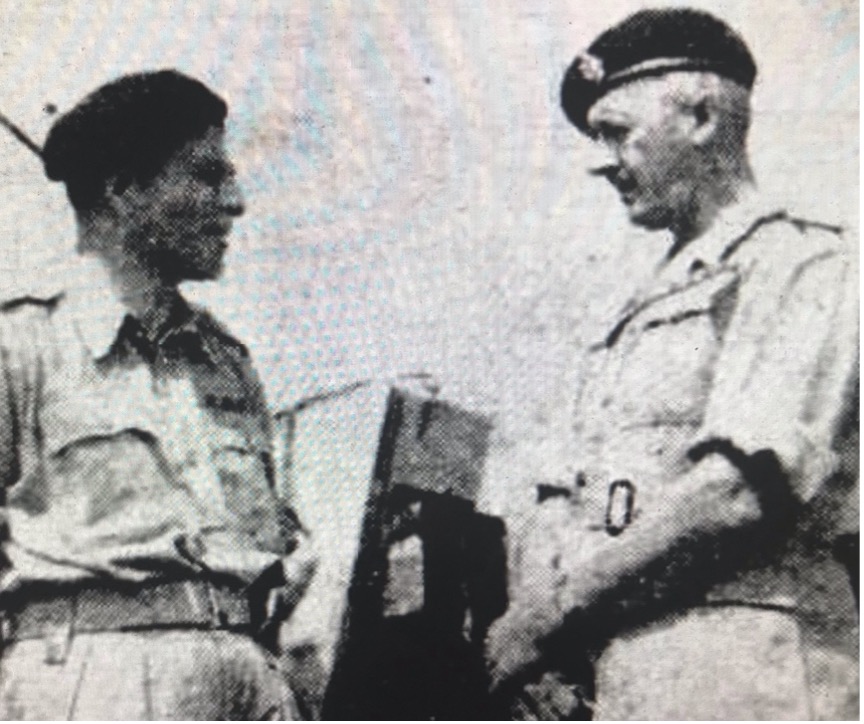
Capt. J. Evans, in charge of road vehicles, and Major E. H. Cottee, in charge of amphibious vehicles, discussing arrangements for the land / sea training camp at Gan Gan at the weekend.
The Newcastle Morning Herald and Miners’ Advocate of 13 February 1951, page 3, published the following photos of the Members of 16 Company R.A.A.S.C., a Newcastle amphibious unit at camp in the Gan Gan area, on manoeuvres in dense bush near the camp:

Tanks advance through a clearing in the bush, preceded by a skirmishing party of infantry.
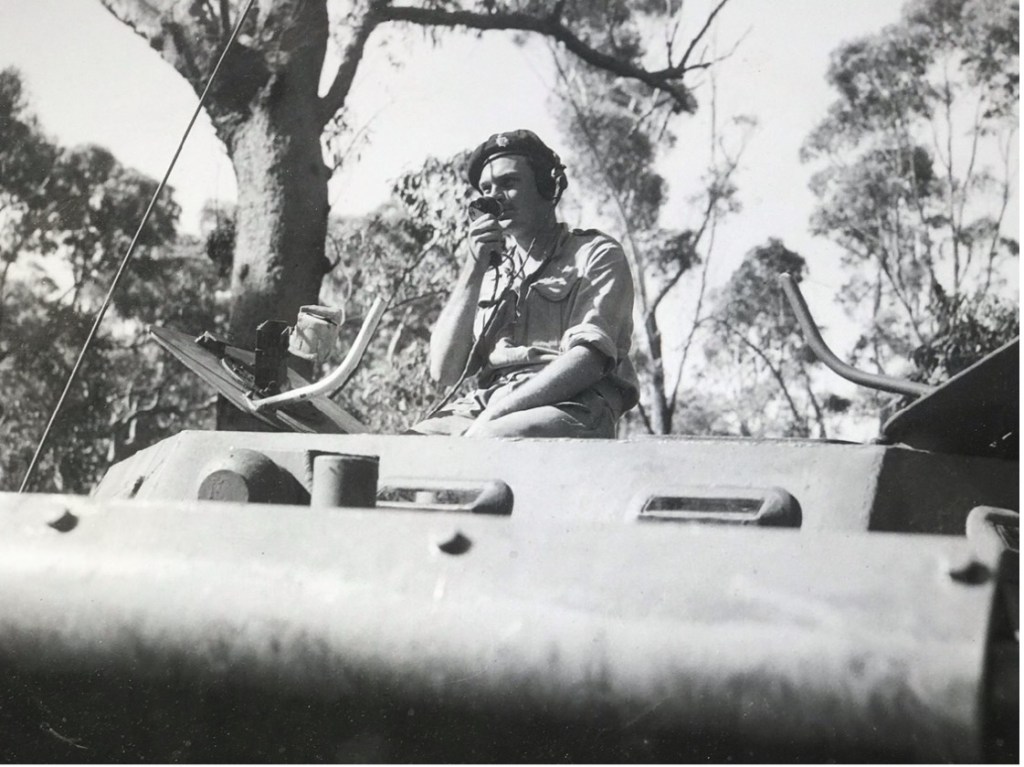
Corporal E. R. Sneyd radios a message to another tank group in the area.
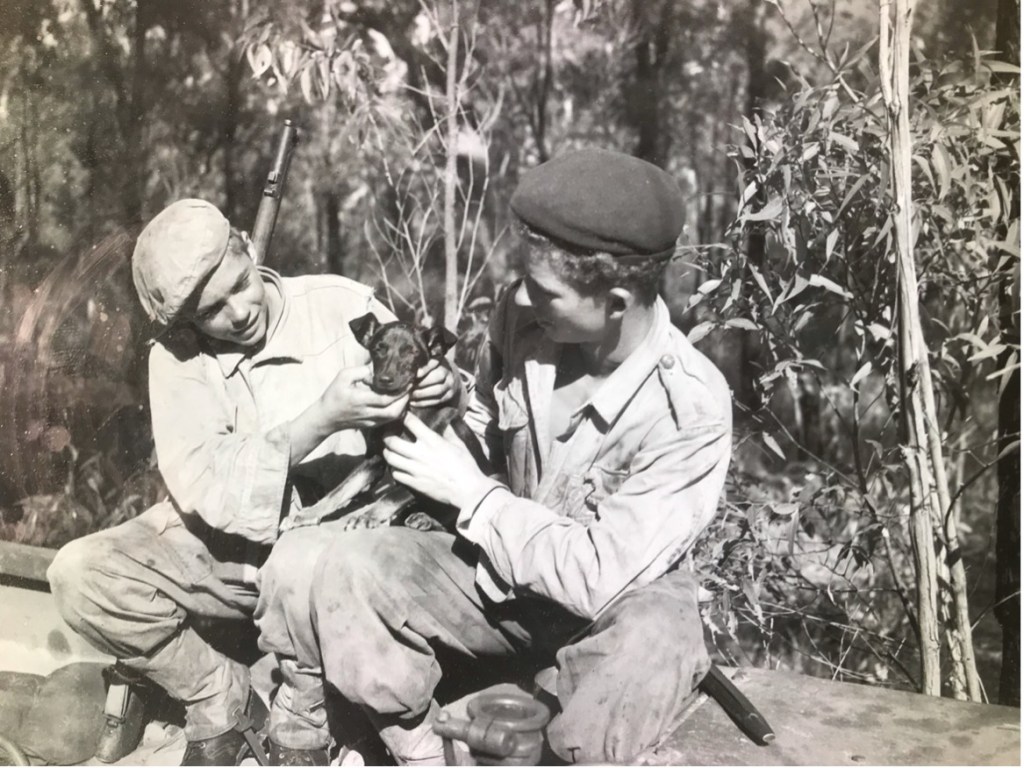
Cadet M. Daly, of Newcastle (left), and Trooper K. Dugan, of Fassifern, make friends with a young pup they found in the bush—and now their tank mascot.
Report on the Military Exercise
The Newcastle Morning Herald and Miners’ Advocate of 13 February 1951, page 2, reported on how the “Enemy” Won the “Battle” At Gan Gan:
‘At dawn to 9 p.m. Army exercise in Port Stephens area yesterday was designed to provide comprehensive field craft and map reading training and to demonstrate infantry-tank cooperation. The 16 Company R.A.A.S.C., a Newcastle C.M.F. unit, is in the final week of its 14-day annual camp at Gan Gan. A force of about 70 officers and men, on foot and in amphibious landing vehicles, manoeuvred in two sections in scrubby bushland, opposing a considerably smaller “enemy” force. The “enemy,” led by the company’s Second-in-Command (Captain E. L. Stooke), won, but had a distinct advantage. Equipped with two jeeps, it was engaged mainly in ambushing foot patrols and evading capture.
In its harassing tactics, the “enemy” laid booby-traps and mined 18 sections of the exercise area, using dummy mines which exploded with a bang and issued plenty of smoke, but caused no damage. The “enemy,” all highly-trained personnel, used live ammunition in their rifles and Bren-gun to add a realistic touch. They fired wide to avoid possibility of accident. Its snipers were so well camouflaged in the scrub that a “Newcastle Morning Herald” photographer, directed to their position, failed to spot them for five minutes.
The opposing force used blank ammunition and, like the “enemy,” was well supplied with dummy hand grenades which had the same effect as the mines. The R.A.A.F. aircraft which cooperated throughout the exercise were Mustangs from 78 Fighter Wing, Williamtown. On the “enemy” side, they “buzzed” the infantry and tank sections on “dry” (no ammunition) strafing runs. When a Mustang dived on them during the morning, Lieut. S. Chipchase and a number of troopers waded waist-deep through a swamp to cover. R.A.A.F. reports on the exercise will be studied by squadron officers.
Captain J. Evans led one of the opposing groups; Lieut. W. Andrews and Chipchase the other. The company’s Commanding Officer (Major E. E. Cottee) and a group of Permanent Army personnel from Fort Scratchley were observers. To-morrow, the company is expected to take part in a water convoy at Port Stephens with No. 1 Transportation Training Squadron, a Sydney C.M.F. small ships unit, which is visiting the area. On Thursday, the schedule includes a night landing by amphibious vehicles at Sandy Point. The camp ends on Saturday.’
Additional Report on the Military Exercise
The Newcastle Morning Herald and Miners’ Advocate of 17 February 1951, page 5, provided an additional comprehensive report on the military exercise, written by a reporter who travelled aboard the rations truck servicing the troops:
‘A fortnight ago, 80 officers and men of 16 Company, R.A.A.S.C. —one of Newcastle’s five C.M.F. outfits and the only amphibious sup-ply unit in Australia—set out for its annual 14-day camp at Gan Gan.
The camp ends today and most of the boys will be sorry. Their spell in the scrub, though it took in exhaustive training, has been—in their own words—”as good as a holiday.” One of the training highlights of the camp was a 14-hour simulated battle in the Gan Gan backwoods. Since the company’s Commanding Officer (Major E. E. Cottee) had suggested we might like to spend a day with the unit, we set out on Monday morning to see how the battle was going. We drove out through Stockton and Salt Ash with British-born Jim Blades, a “Newcastle Morning Herald” photographer, who served with the Fleet Air Arm in the North Atlantic and Pacific in World War II. ……
We turned along a bush track where a sign read: “16 Company, R.A.A.S.C.,” and a few minutes later pulled in at Gan Gan, Australia’s most picturesque Army camp. It was practically deserted. Permanent Army Corporal J. Allen was busy in the orderly room, and a trooper at a radio transmitter in a long, empty hut was making with the R-Toc. talk “Don Willie John to Cow Able Mabel 2—over.” Apart from them, there were only a few “bods” (as the Army has it) in sight. Some of the “bods,” apparently attracted by Jim’s camera, came up and asked if we had heard about an unexploded bomb being washed up on Anna Bay beach. Or if we would like them to take us across —some 200 yards into the bush—to see where American War Graves representatives, last Friday, disinterred the remains of four “forgotten” United States servicemen from their lonely graves to be taken home.
“The battle’s been on since early morning,” Corporal Allen said. “The enemy went out at five. The weather was terrible. Very heavy rain. What’s it been like in town?” We told him. “I don’t think you’ll be able to get out where they are in the car,” he said. “The rations truck will be going out in a few minutes. It might be the best idea if you went in that.” While the truck was being loaded, he escorted us on a quick tour of the camp—through the mesh window messes, the two-to-a-cubicle sleeping huts, and along the rockeried tracks where natural trees were left standing to camouflage the buildings.
When the truck was ready, Jim slung his camera case aboard and we hoisted ourselves up. The boys on the back invited us to make ourselves comfortable on the insulated hotboxes that were full of curried sausages, mashed potatoes and tea. As the truck headed out of camp and down the road to Nelson’s Bay, we began to know the men with whom we were riding— Catering Sergeant K. Scotman, printer’s guillotine operator, of Merewether West; Trooper-cook A. Brown, miner, of Boolaroo; Trooper-cook “Olly” Mission, fitter’s labourer, of Cardiff; and 16-year old Cadet J. “Scotty” Brown, grocer’s assistant, of Hamilton.
They had been given a map reference and had to proceed to that point, somewhere in the bush, to wait for a guide to take them to the mess rendezvous farther on. Meantime, they had to take care not to fall into an enemy trap. …..
The truck streaked through Nelson’s Bay township, past the Navy depot (H.M.A.S. Assault), the jetty where the three ships of the visiting C.M.F. transportation training squadron were lying, and out beyond the migrant camp into the scrub. As it lurched along an isolated track, the boys were on the look out for a water tank on a hill and a powerline which would help identify the spot where they had to wait [note: this would have been Glovers Hill at Nelson Bay]. Eventually the spot was found, and the truck parked among the trees.
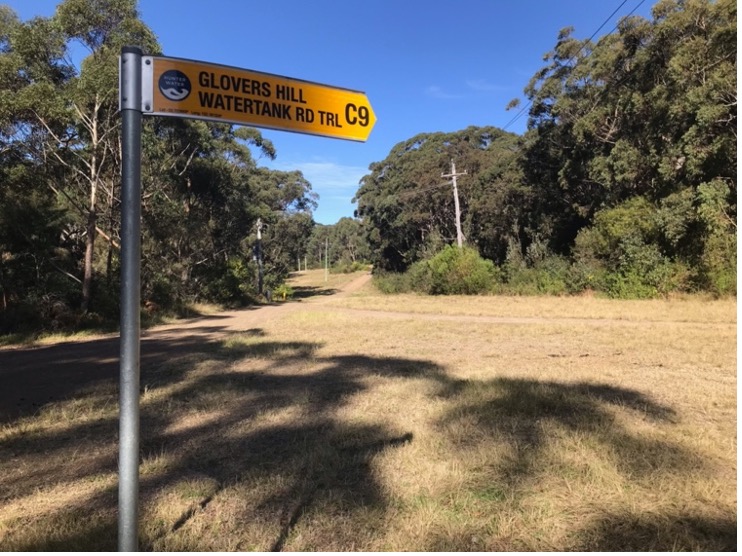
Area where the truck parked in the Nelson Bay Water Catchment Area [Author photo].
Crichton climbed out and walked ahead on a scouting mission. “If I get caught by the enemy,” he grinned, “drive on with the food.” “Watch where you’re going,” someone yelled. “That area’s mined in there.” The mines were dummies. They exploded with a bang and a puff of smoke, but would do no damage. “I’m not worried about the enemy,” Sergeant Scotman said. “I’m neutral. I’m Swiss. I’ve only got to give them their food.” R.A.A.F. Mustangs were buzzing overhead. One of them must have sighted the truck. It swooped low over us. “Hullo, we might cop a flour bag here,” said Trooper Brown. “Here ‘e cooms,” “Scotty” shouted, looking up. “Coom on. Drap one.” No flour bomb arrived. “Ar,” said “Scotty,” obviously disaspointed. The aircraft turned and made another low run. “Hit the beach; here ‘e cooms again,” yelled “Scotty.” “Did you see that picture” T’rooper Brown asked. They sat there discussing movies while the aircraft disappeared.
Crighton was sighted, under cover of a log. Sergeant Newton walk-ed across through the scrub to join him. The rest of us followed. “Seen anyone?” Sergeant Newton asked. “No.” The guide was supposed to arrive at 1200 hours. “What’s the time” Sergeant Scotman asked. “Has it gone 12 o’clock yet” “Yeah,” said the Sar-Major. “They can’t hear the City Hall clock from here.” “I wish this war would get mobile,” Sergeant Scotman said. We all crouched there, behind the log, with everything quiet except when we slapped at the invading mosquitoes and when the Mustangs came over. We could hear no sound of fighting. Trooper Brown idly pulled a large fern, and, just as idly, began stripping its leaves. He suggested we could all do the same, and he’d use the leaves to garnish the curried sausages. “I don’t suppose the guide can find us,” someone said. “
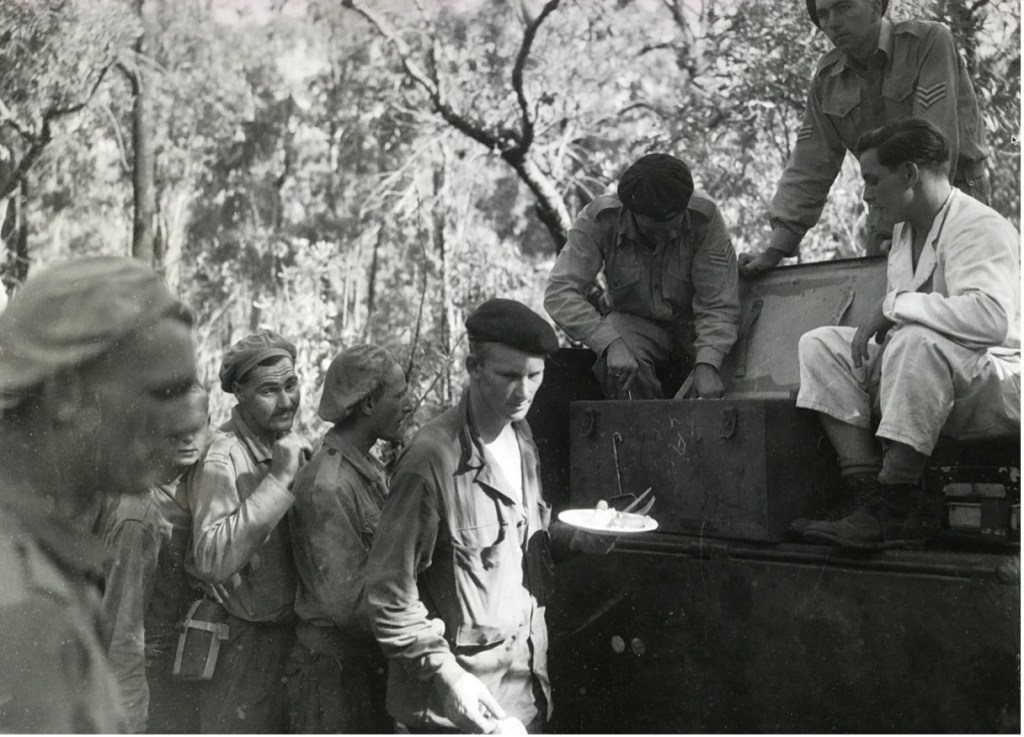
Around the hotbox (left to right): Acting Sergeant-Major Crichton, Sergeant Newton, and Trooper Brown.
We ought to dig a hole and bury the tucker, then give them a map reference and tell ’em to go and find it,” said Trooper Brown. “We should’ve brought half a dozen blankets to put the tucker on,” he added, wryly. “After all, you might reach down for a sausage and pick up a snake.” …….
We waited about half an hour. Then a jeep appeared from a track behind us. It was the enemy, led by the company’s Second-in-Command (Captain E. L. Stooke). Far from being worried by the enemy’s appearance, everyone gathered around to ask who was winning the battle. The enemy called a temporary truce, told us it was winning, and kindly led us along the mined tracks to the rendezvous. After leaving the truck, it raced away into the bush to ambush an infantry patrol in a reasonably realistic atmosphere of cracking rifles, exploding landmines and fireworks hand grenades. …..
The exercise went on through the afternoon and early night, with amphibious tanks crashing through water hazards and bracken, the enemy darting over the three-by two mile training area for sudden attacks, the R.A.A.F. making “dry runs” over the troops. We sped around with the enemy for a few hours, then decided it was time-to go home. On the road back, we discussed with Jim the small things about the day that would have impressed Ernie Pyle, the American “human interest” war correspondent whose stories were widely syndicated and who was killed in a beachhead landing in the last war. The small things . . . like the cadet, too young to shave, who sat in the back of an amphibious tank, nursing the friendly, black mongrel pup he found lost in the bush . . . the tough sergeant who filled in time picking and studying wild flowers . . . the trooper with the writing pad tucked down his shirtfront . .. the snipers who lay, camouflaged, in the scrub for nine hours, reading paperback novels while they waited for the enemy to come along.

A meal of curried sausages was fully consumed.
Like the trooper who said he would much rather be lunching at the Country Club” . . . and the tired lieutenant who sat back and laughed about the fake blackout the boys pulled on in camp so they could sneak off with the hessian mock-up tarp he’d built for their further training.’
Photos of the Military Exercise
The Newcastle Sun of 14 March 1951, page 7, published the following six photos of ‘A’ Squadron 15th Northern Rivers Lancers are in camp Gan Gan:
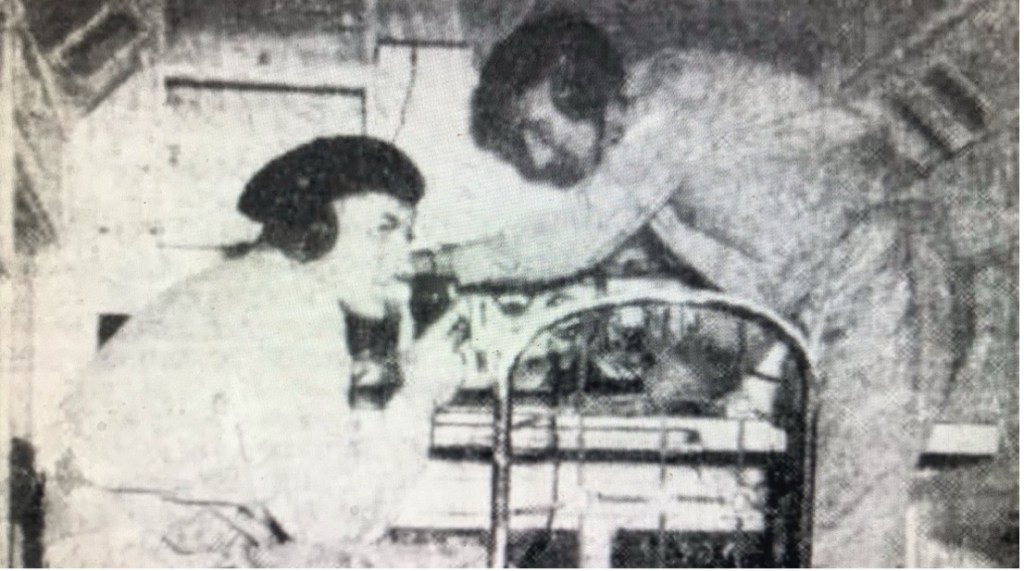
Wireless operators taking part in the exercises yesterday – Trooper R. Parsons and Cpl. J. Walker.
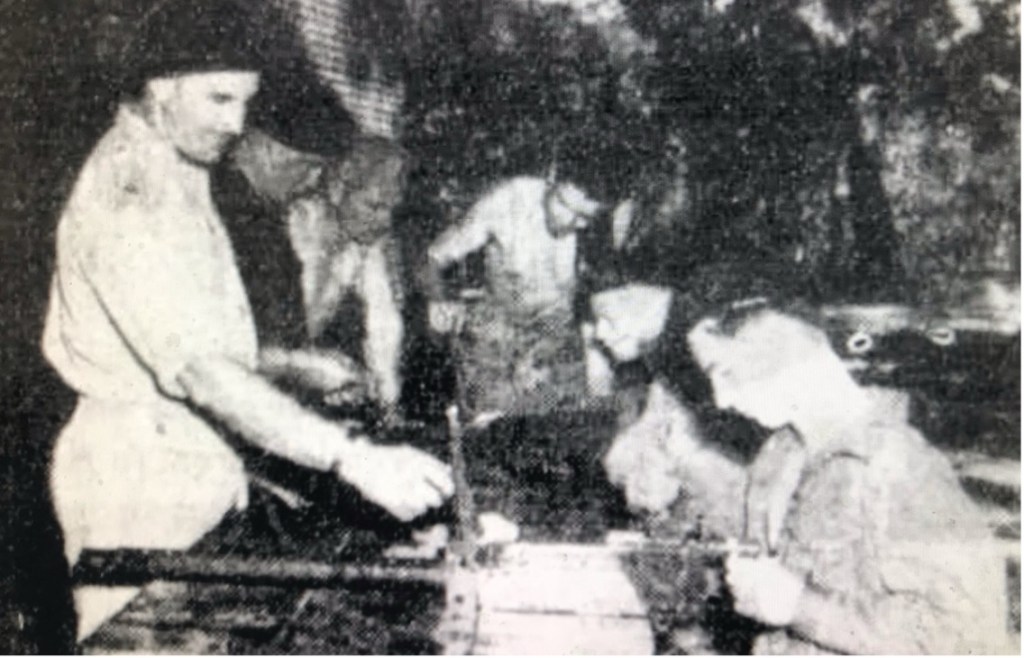
Browning machine gun instruction (l. to r.), Major James, Sergt. Robinson, Troopers Oughton and Bartlett, L/Cpl. Ovenden, Trooper Sharpe.
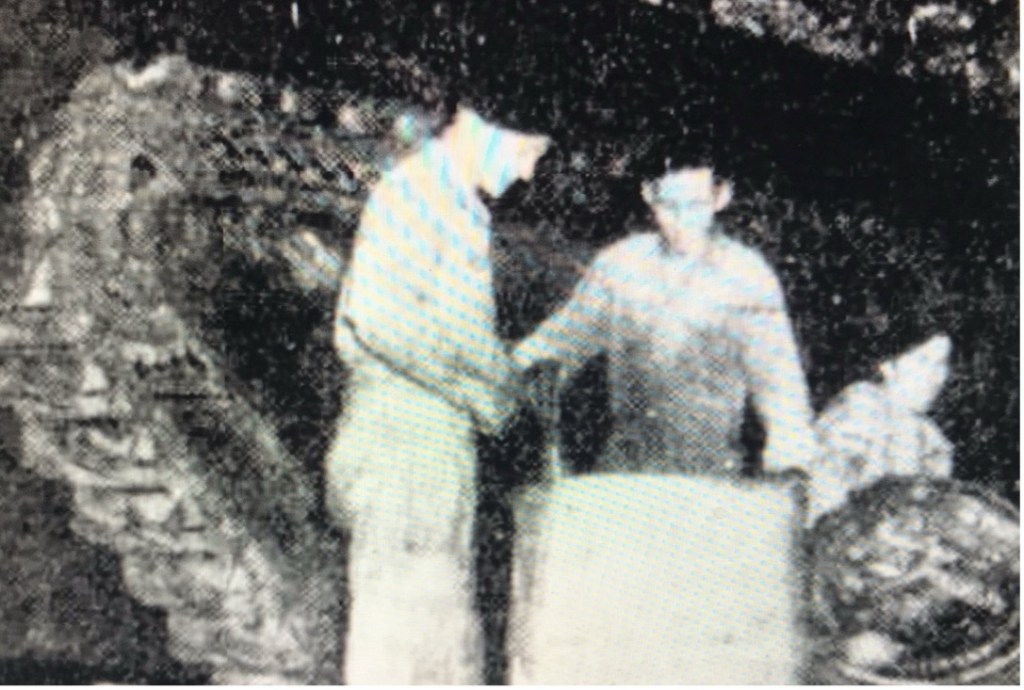
Refuelling a tank for the exercises, L./Cpl. Gibson, Trooper Brighton, Cpl. Pye and Trooper Lendon.
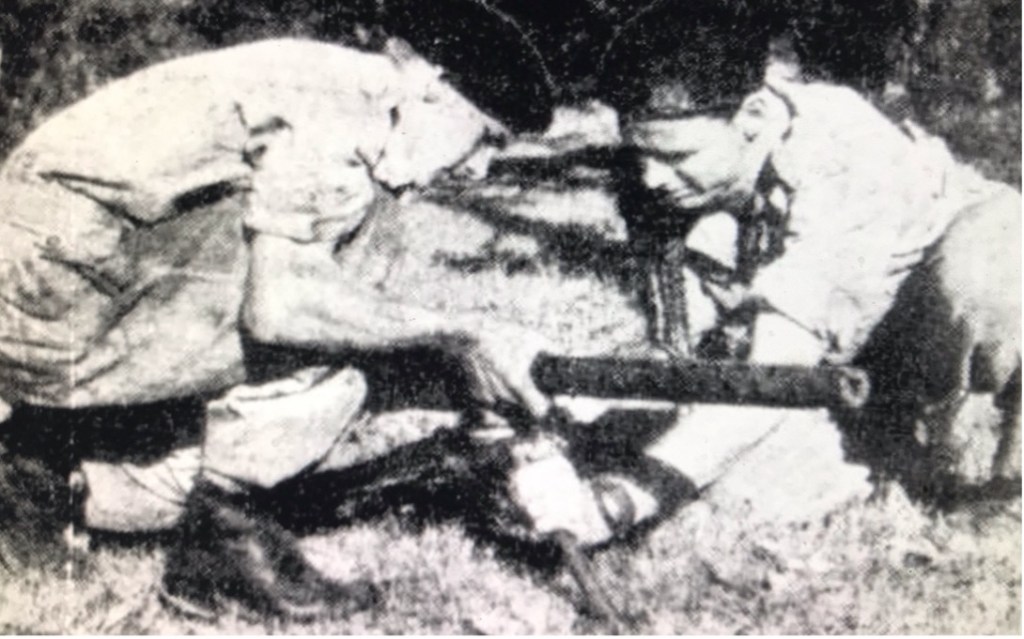
Trooper R. Bryant and L./Cpl. R. Hew-ston mounting a Browning machine guns at Gan Gan Camp.
Resting between rifle practice on the miniature range.

C.M.F. members practising with Austin sub-machine guns.
Additional Photos of the Camp
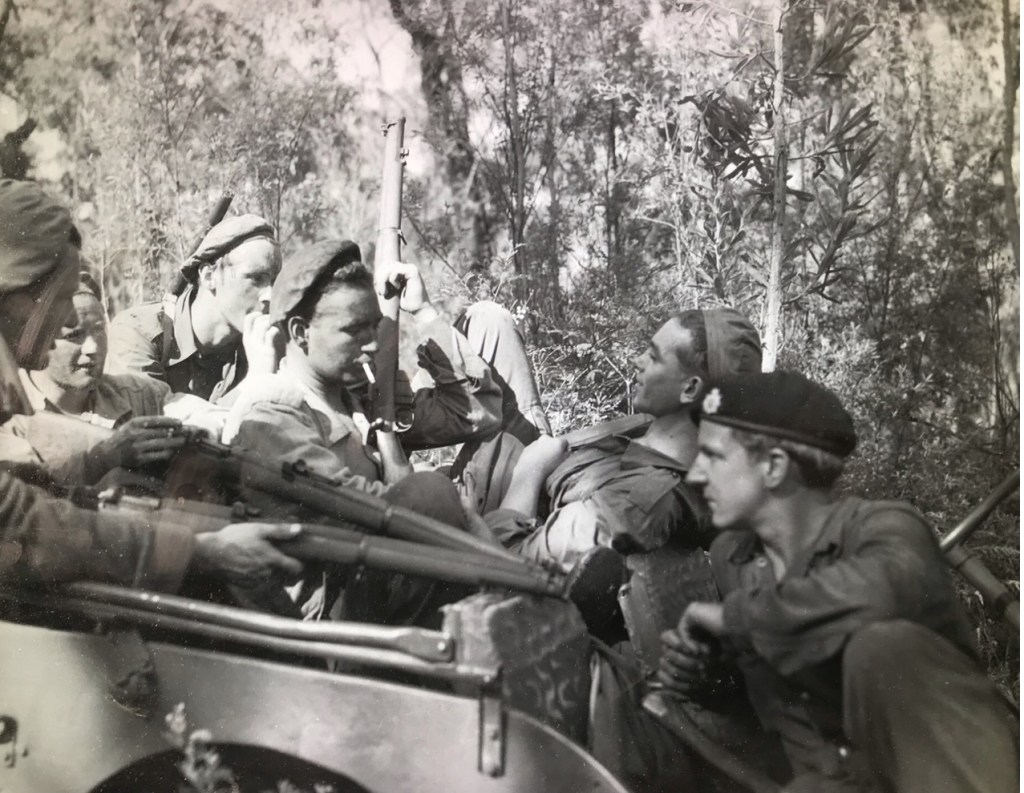
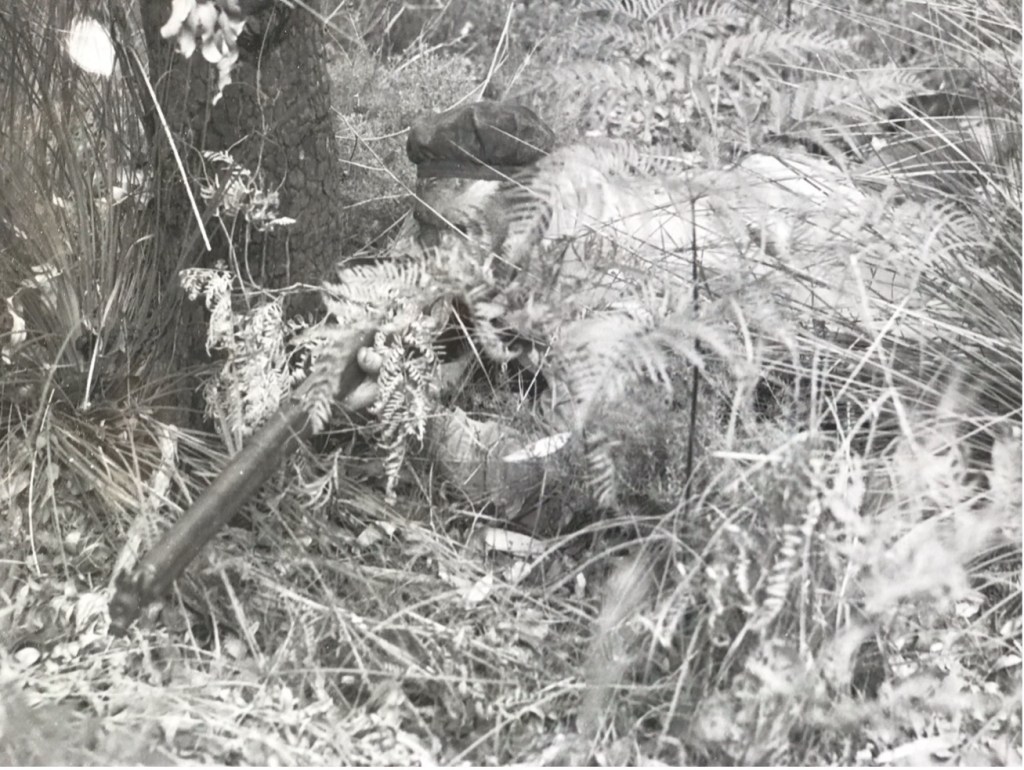
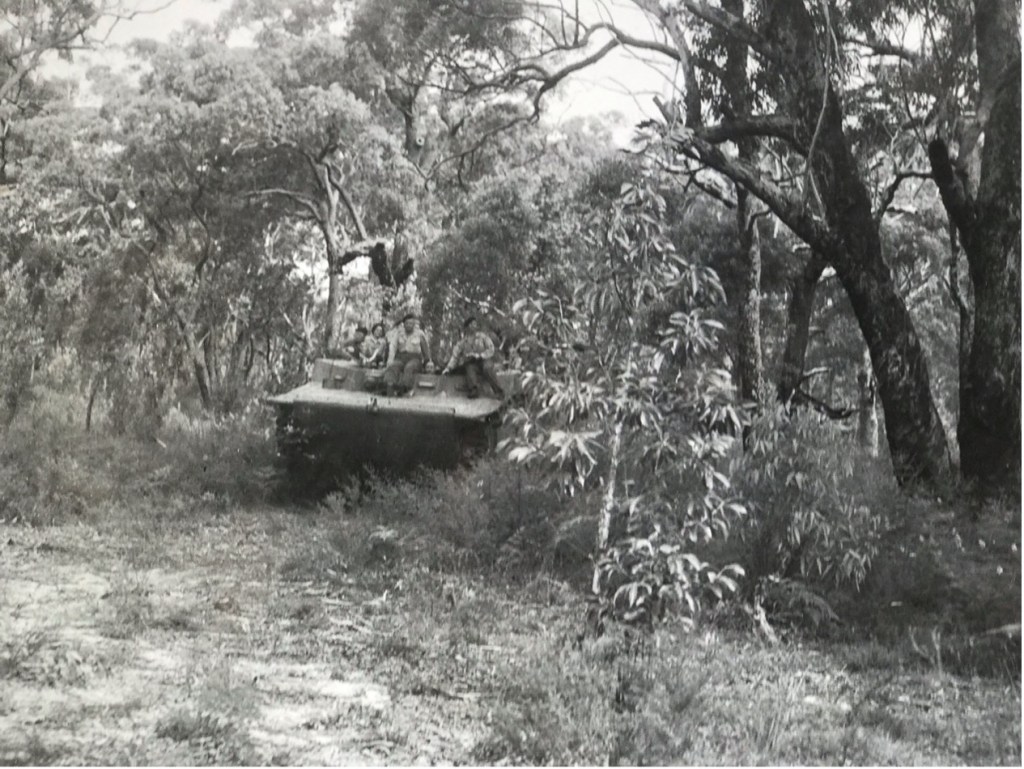
The following six photos are from the National Library of Australia collection of photos from the February 1951 military camp at Gan Gan (the photos do not have individual descriptions):


Last Phase of the Camp
The Newcastle Morning Herald and Miners’ Advocate of 14 March 1951, page 2, reported:
‘Lieut.-Colonel C. Pearson recently appointed Director of the Royal Australian Armoured Corps, arrived at Gan Gan yesterday for the last phase of the annual camp of “A” Squadron, 15th Northern Rivers Lancers. The squadron will break camp at the weekend. Colonel Pearson, with the Commanding Officer (Major J. A. James) today will visit Broughton Island, where the squadron held an amphibious assault landing exercise last week. Tomorrow, he will watch a night exercise by troops in the Gan Gan area.’
Links to the Six Other Papers of Post-War Activities at the Gan Gan Military Camp are as follows:
Post War Military Camp at Gan Gan – an Overview
15th Northern Lancers at the Gan Can Military Camp – 1949
School Cadets at Gan Gan Military Camp – April 1951
Army Commando Training Exercises at Gan Gan – 1953 and 1955
First Army Camp for Women of the Citizen Military Forces (CMF) at Gan Gan – April 1954
University Students at the Gan Gan Military Camp – 1950 and 1962
Researched and compiled by Kevin McGuinness
July 2022

 Port Stephens - a history exploration