

Introduction
Throughout Australia, celebrations were organised in 1951 to mark fifty years since Federation on 1 January 1901.
Federation unified the six former British colonies of New South Wales, Victoria, Queensland, South Australia, Western Australia, and Tasmania to form the Commonwealth of Australia.
This paper looks at the various Jubilee events and activities held in Sydney and Newcastle. It then focusses on the Jubilee fishing competitions held in the Tea Gardens and Hawks Nest areas of Port Stephens which drew numerous participants from across Australia.
Sydney Jubilee Celebrations.
The Ovens and Murray Advertiser of 6 January 1951, page 6, reported:
‘This year Australians will celebrate their Golden Jubilee as a nation — the 50th birthday of their Commonwealth. They will celebrate fifty years of tremendous growth and development.
The Prime Minister (Mr. R. G. Menzies) said recently that to every Australian 1951 should be a year of ‘national stock taking.’ He was addressing the Commonwealth Jubilee Celebrations executive committee, which has been charged with the central work of making every Australian citizen realise the importance of this golden milestone in their nation’s history.
Fifty years ago, with Queen Victoria’s signature on the Royal Assent, Australia became a Commonwealth — a single, federated nation. The occasion was equally important to the six Australian States because they then matured from colonies into sovereign statehood.
Jubilee Celebrations hinge upon two significant dates in Australian history — January 1, 1901, and May 9, 1901. New Year’s Day saw the Royal Proclamation of the Australian Constitution in London, and the swearing-in of our first Governor-General, Lord Hopetoun, before 100,000 people in Centennial Park, Sydney.
The second date, May 9, was when the Duke of York (later King George V.) opened the nation’s first Commonwealth Parliament in Melbourne.
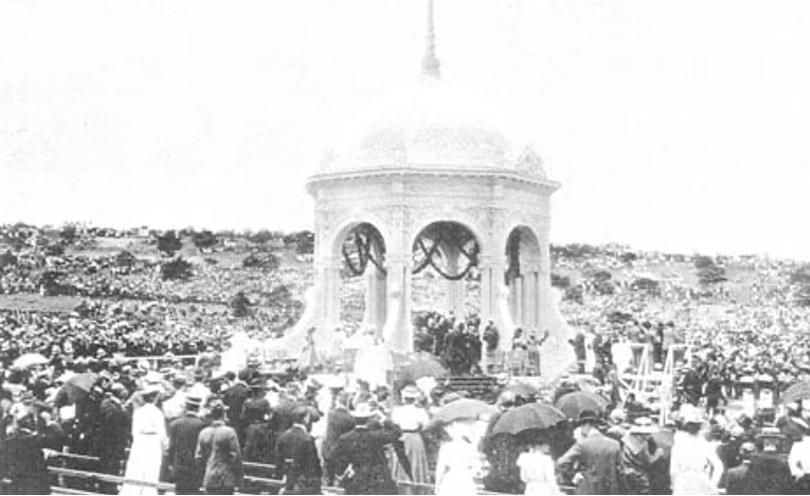
Swearing-in ceremony at Centennial Park Pavilion, Sydney with Governor General taking the Oath of Allegiance, 1 January 1901
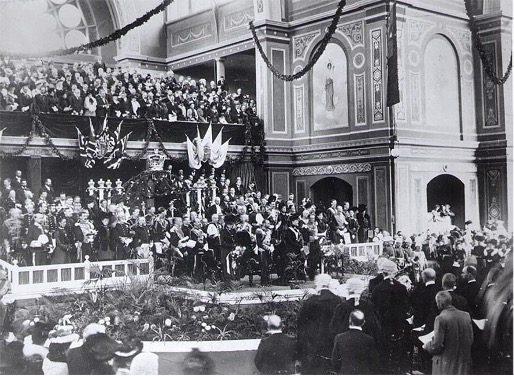
Opening of the first Commonwealth Parliament of Australia at the Melbourne Exhibition Building – 9 May 1901 [National Archives of Australia]
Now the Federal and State Governments, aided by Australian citizens from all walks of life, hope to outdo any previous period of national rejoicing in the nation’s history.
The Prime Minister told his committee: “This is a time in which we wish to demonstrate our progress in the arts, in learning, in science, and in industrial development, as well as in sport. We should strive to express the determination of the Australian people to work for the development and prosperity of the country, and to make the next fifty years of our national existence even more important than the first fifty,” added Mr. Menzies.
For a central figure to make the 1951 celebrations a memorable success, the Government needed a man who combined the qualities of fervent patriotism and brilliant planning ability, in addition to being an able mixer.
In selecting Lieutenant-General F. H. Beryman, Government leaders paid a compliment to the organising prowess of the Army and to the prestige, of one of its distinguished officers, G.O.C. of Eastern Command, and Director of the 1949 Royal Tour before it was postponed, General Berryman has an outstanding leadership record in the Libyan, Syrian and Pacific campaigns of World War II.
General Berryman has the twofold task of drawing up comprehensive Federal programmes and coordinating the Jubilee plans of the individual States. General Berryman believes the celebrations will be a complete success only if every single Australian, even those in the most remote inland areas, takes part in them.
He does not want the year to be one of pageant parades, flag-waving, and fine speeches alone. He is convinced that important national themes can be pressed home at every Jubilee garden party and sporting fixture.
General Berryman’s Jubilee themes are direct but urgent: Assimilation of New Australians, conservation of natural resources, decentralisation of industry and population, and most importantly, a much-strengthened national defence backed up by increased production.
“We want to sell Australia to our own people,” says General Berryman, “and awaken the spiritual note of thanksgiving and appreciation of conditions not enjoyed in other parts of the world. “Let 1951 be a time for national homage to our hard-working, adventurous pioneers who won us this bountiful heritage,” he adds.
Helping General Berryman on the spadework for the Federal Celebrations are five sub-committees headed by convenors picked from men who have influence and knowledge in the community. …..
Celebrations will begin in January with special functions and parades, continue in many and varied forms for five months until they reach a fitting climax on May 9 with the reopening of Parliament accompanied by Jubilee banquets, balls and pageants. Other celebrations, particularly in the art and sporting fields, will continue throughout the rest of the year.
All three Services, especially the Army, will play important roles in the celebrations. Servicemen will parade at most official functions and participate in pageants, while the Army will stage spectacular military tattoos in most capital cities. Each State is arranging its own side of the celebrations. Parades, festivals, firework, and youth displays are included in their programmes.
In arranging the celebrations, the Federal Government allotted £350,000 to be spent. States were granted these amounts to supplement their own contributions: New South Wales £52,000; Victoria £42,000; Queensland £27,000; South Australia £17,000; Western Australia £14,000; Tasmania £6,000; Territories £2,000. ……
One important feature of the celebrations will be visits to Australia by many notable overseas personalities during 1952. It is hoped that the Prime Ministers of other British Commonwealth countries will attend the celebrations, but this depends greatly on the prevailing world situation.
In the political field, no central figure will be spotlighted. But tribute to the work and statesmanship of such Fathers of Federation as Sir Henry Parks, Sir Edmund Barton, Sir George Reid, Sir Samuel Griffith, Andrew Fisher, Alfred Deakin and W. C. Wentworth will be paid.
The man amongst the living who will most epitomise the Jubilee will be Mr. W. M. Hughes, M.H.R., the former Prime Minister today remains the only man still active in politics who was active in pre-Federation colonial politics.’
Sydney Jubilee Parade
TheSun of 29 January 1951, page 1, reported on the first Jubilee activity conducted in Sydney:
‘Nearly 400,000 people cheered a spectacular display of Australia’s agricultural, industrial, social and cultural development in the Cavalcade of Jubilee through city streets in brilliant sunshine today. Thousands, in holiday spirit, made Sydney’s first major celebration in the Commonwealth’s jubilee year one of the most colourful parades in years.
Wildly enthusiastic spectators packed five and six deep along the route of the procession from Fort Macquarie [now site of Sydney Opera House] to the Showground. The cavalcade took 85 minutes to pass the saluting base outside Parliament House in Macquarie Street, where the Governor (Sir John Northcott) took the salute. Sailors, soldiers and air-men — some veterans of two World Wars — combined with auxiliary services, representatives of all phases of 20th century life, and new Australians in colourful national dress made up the cavalcade.
Fort Macquarie was a sea of colour as the parade assembled within a few hundred yards of where the foundation of the first white Australian community was set on January 26, 1788. Earlier the weather was overcast, but as the procession moved off at 9.30 the sun broke through. As a smart detachment of mounted police headed the march along Macquarie Street, the crowd took up the applause and swelled it to a mighty roar as the saluting base was reached. A formation of RAAF fighters zoomed across the city as the procession moved along. Federal and State Ministers, members of the diplomatic and consular corps, with other State guests, viewed the procession from enclosures in Macquarie Street.
Federal and State members, parliamentary officials, their wives and families, crowded the balconies at Parliament House, where the Speaker (Mr. Lamb) and Mrs. Lamb welcomed official guests. A special cheer went up as the new Australians’ float, carrying new citizens in national costume and surmounted by Miss Australia enthroned, moved past. Former nationals of half-a-dozen European countries, all in gay traditional dress, followed on foot. People good naturedly booed and jeered a float called “50 Years of Progress with Electricity.’” There were shouted comments of “That will be the day.” ….
Fine and mild conditions are predicted for the metropolitan area tonight, when the Venetian carnival will be held on the Harbour. When the procession ended there was a wild scramble to find transport for the Jubilee Gala at the Showground, Randwick races and the Sheffield Shield cricket match. Thousands packed Elizabeth Street and crowded trams, while taxis were at a premium.
In the Darlinghurst-Moore Park area, hundreds of cars which jammed every side street and back lane were immobilised for nearly three-quarters of an hour after the procession passed. More than 30,000 saw the Cavalcade at the Sydney Showground. Children immediately took charge of most of the floats, swarming over the old steam tram, pulling the bell, and souveniring some of the coal. As floats arrived, they were greeted with prolonged applause.’
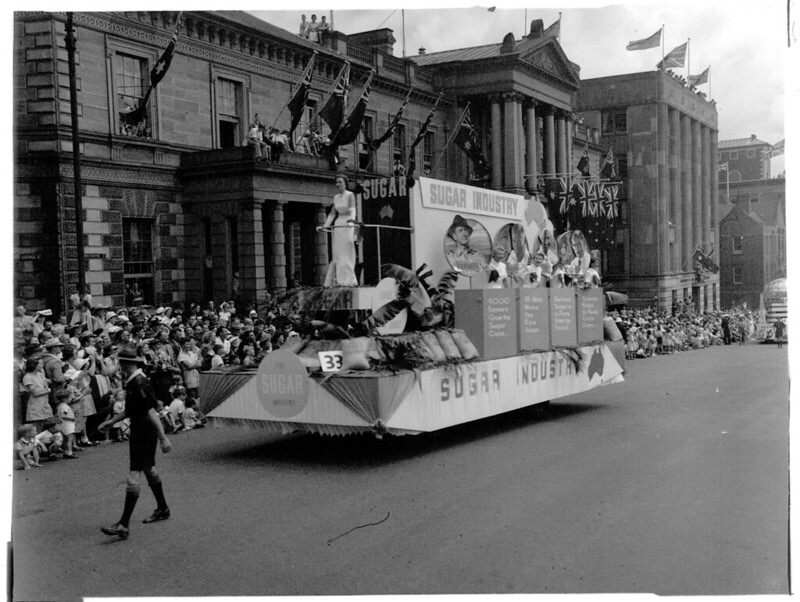
Jubilee parade float in Sydney – wine industry [NSW State Archives]
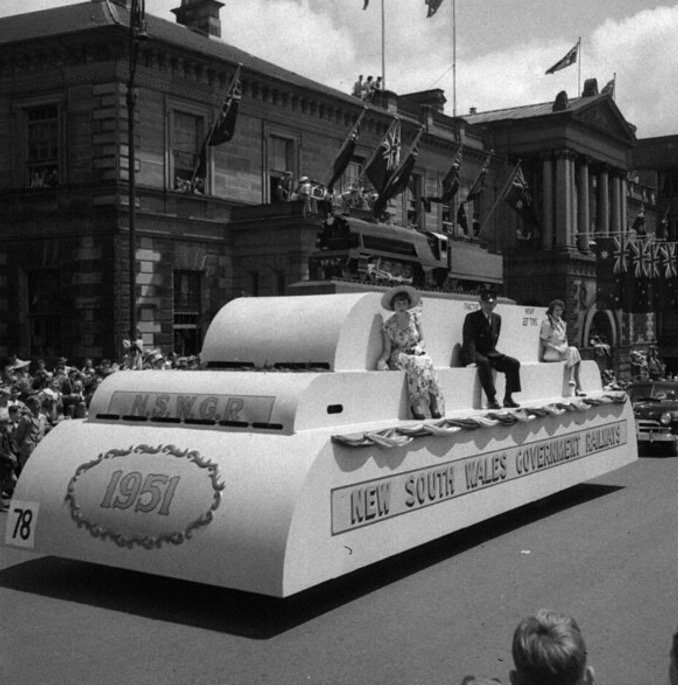
Jubilee parade float in Sydney – NSW Government Railways [NSW State Archives]
Newcastle Jubilee Celebrations
The Newcastle Morning Herald and Miners’ Advocate of 25 January 1951, page 4, reported:
‘Major attractions were being planned for the main Newcastle Jubilee celebrations between April 15 and 25 and on May 9, the Organiser (Mr. J. Gale) said yesterday. The proposals included—
* An Australia-wide band contest with prizes worth £1200. It would run for two days in April.
* A fireworks display at Newcastle Beach on April 13.
* A Mardi Gras carnival and square dancing in Hunter-street at night on April 14.
* Presentation of Gounod’s opera, “Faust,” by massed choirs from Newcastle and the Hunter Valley on a date to be fixed.
* Photographic exhibition at Nesca House, opening on April 16.
* Re-enactment of the opening of the first Federal Parliament and other presentations, including a living map of Australia, by 12,000 schoolchildren at No. 1 Sports Ground on April 18.
* Jubilee procession and Cavalcade of Progress to the Showground on May 9.’
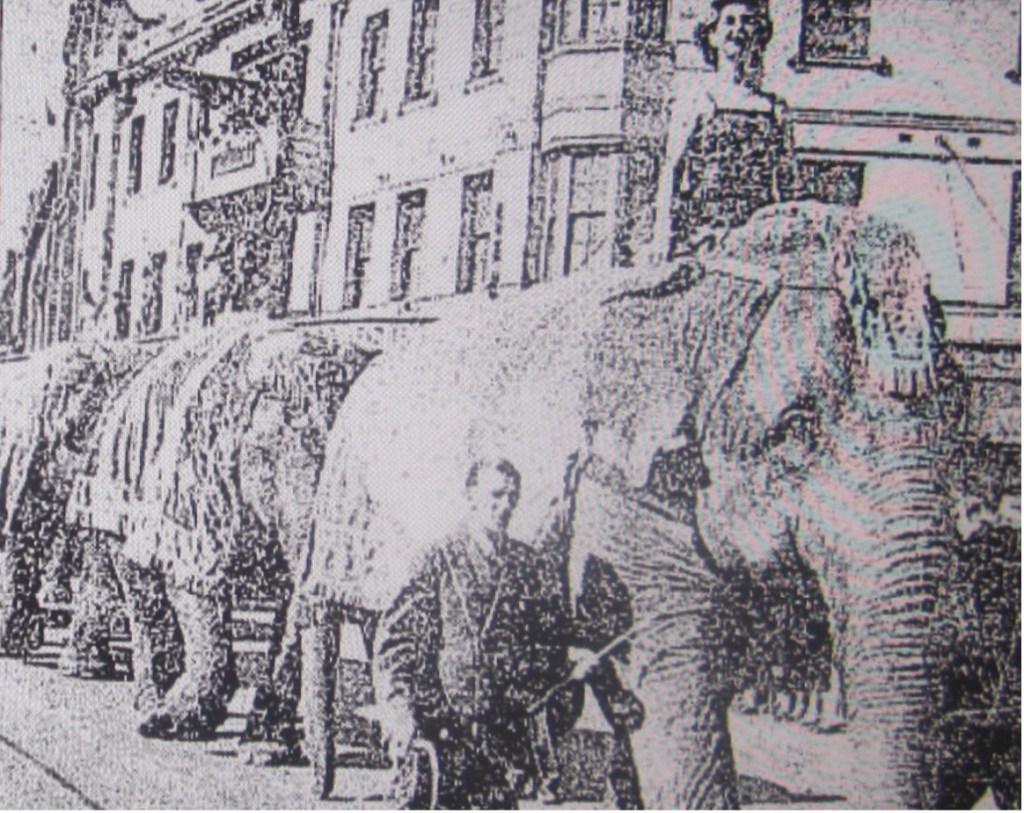
Elephants in Hunter Street, Newcastle in the Jubilee Parade [Newcastle Morning Herald and Miners’ Advocate, 10 May, 1951]
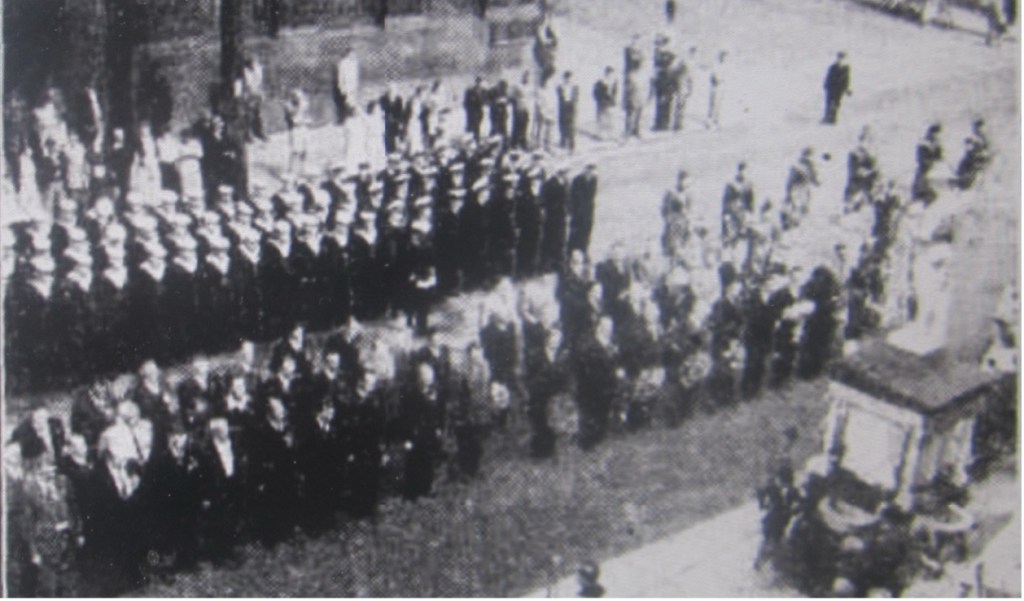
Tobruk Day Commemoration service at the Soldiers Monument in Hunter Street, as part of the Jubilee celebrations [Newcastle Sun, 16 April 1951]
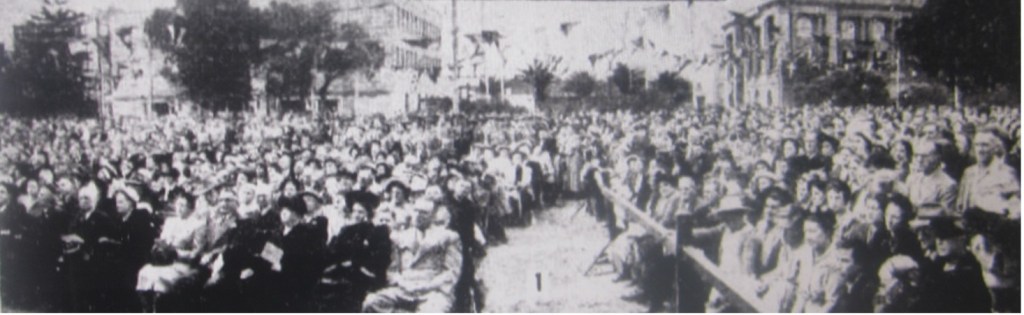
Scene at Civic Park when the Governor, Lieut.-General Sir John Northcott, gave the opening address at the Jubilee Thanksgiving service. [Newcastle Sun, 16 April 1951]
Jubilee Fishing Competitions at Tea Gardens and Hawks Nest – Port Stephens
The Newcastle Morning Herald and Miners’ Advocate of 17 April 1951, page 8, reported on the biggest fishing contests ever held in Australia:
‘The biggest fishing contests ever held in Australia will begin at Tea Gardens and Hawks Nest next week as part of the Commonwealth Jubilee Celebrations. Champion anglers from all States will compete. Bob Dyer, well known Sydney big game fisherman, will take part in deep sea events. Between 30 and 50 members of the Underwater Spear Fishermen’s Association will give a demonstration at Hawks Nest on Sunday, April 29.
Tea Gardens is enflagged and festooned. The Shire Council is cooperating with the Australian Anglers’ Association to make the area attractive to tourists and competitors. Graders are working on the road from Pacific Highway to Hawks Nest to have it in good order when the competitions begin. Free transport will be provided between the ferry and Hawks Nest. Application to grant concession fares on the ferry has been made.
Trophies will be displayed in the window of a hunter-street sports store this week. They include four presented by the Commonwealth Government. One is for the champion of champions.
Control centres for the competitions have been set up at Hawk’s Nest and Tea Gardens and have been linked by telephone. Entries can be made at either centre. More than 300 have been received. All fish caught will be weighed and recorded at these centres. State Team The team to represent New South Wales in the Commonwealth championships will be selected by Messrs. H. Hopkins, S. Cohen and the N.S.W. Divisional Secretary (Mr. J. Allen). Nominations will be received by any of the three.
A booklet, to be published, will give full details of all fishing localities in the area embraced by the competitions. It will be fully illustrated with aerial photographs. All angling clubs in the district have cooperated to make the occasion a success. The Federal President of the association (Mr. N. Rodgers). Federal Secretary (Mr. H. Le Marchant) and Field Officer (Dr. Jack Thomas) have been kept busy.
Accommodation for visiting anglers has been arranged. Inquiries should be made to Mr. Le Marchant. Information regarding rules and competition procedure will be supplied by Dr. Thomas. The competitions will open with a civic reception to visiting anglers by the Lord Mayor of Newcastle (Ald. Purdue) in the City Hall at 2 p.m. on April 27. Contests will continue till May 6.’
The Newcastle Sun of 19 April 1951, page 12, also reported:
‘Competitors in the Australian estuary and beach fishing championships from April 27 to May 6 at Port Stephens, will use as a guide, aerial photographs of these areas taken by a “Newcastle Sun” photographer and published in ‘The Newcastle Sun’ last year.
Mr. W. Southam, of Sydney, contacted noted Newcastle big game fisherman Mr. Athel D’Ombrain, who completed arrangements for a supply of the photographs. The championships competition in beach, estuary and deep-sea fishing are part of Newcastle’s sporting contribution to the Commonwealth Jubilee Celebrations and are being controlled by the Australian Anglers’ Association.
In addition to amateur fishermen from Newcastle and the coalfields there will be a large number of competitors from clubs in many other parts of this State, also 100 from Queensland and 50 from Victoria. The Queensland contingent is bringing to the Lord Mayor of Newcastle, Ald. Purdue, greetings from the State Governor, Sir John Laverack, and the Lord Mayor of Brisbane, Ald. J. B. Chandler. Among N.S.W. competitors in the big game section will be Bob Dyer, notable radio personality and big game angler.
In addition to the competitions the annual convention will be held at Tea Gardens and on Sunday, April 29, members of the Underwater Spear Fishermen’s Association will give a demonstration at Hawks Nest. Visiting competitors will be tendered a civic reception by the Lord Mayor of Newcastle. Ald. Purdue, at the City Hall at 2 p.m. next Friday and the competitors will leave the same afternoon for the scene of operations. A commemorative booklet will give full particulars of the areas to which the competitors are limited, and it is illustrated with aerial photographs of some of the Newcastle district’s fishing grounds.’
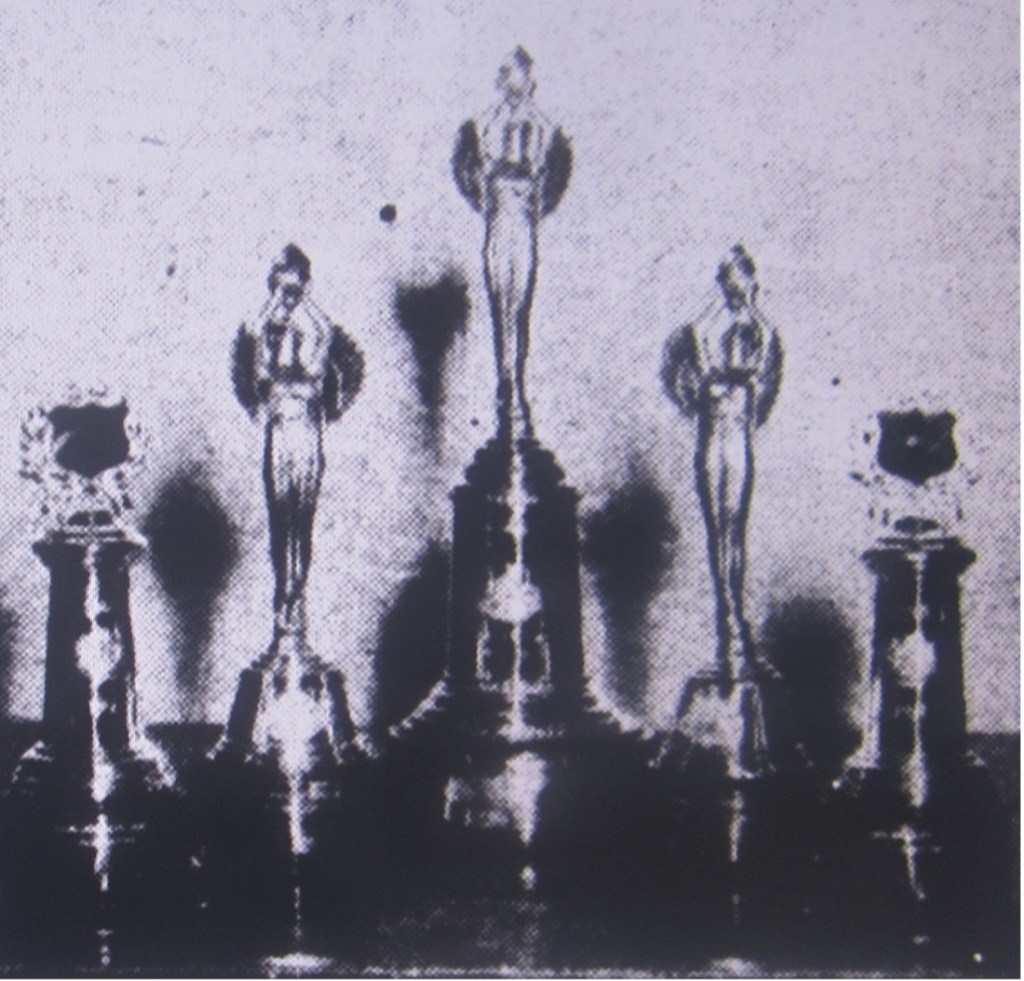
Trophies for the Jubilee Australian fishing championships. The large trophy in the centre is for the champion of champions and the other four are for the interstate teams competitions. The three middle trophies featured the golden angel over the Australian Coat-of-Arms [Newcastle Sun, 19 April 1951]
Organization of the Port Stephens Fishing Competitions
The Newcastle Sun of 27 April 1951, page 11, reported:
‘The Australian Angling Championships, which are being conducted this year by the Australian Anglers’ Association in conjunction with the Commonwealth Jubilee celebrations, will commence at Port Stephens at midnight tonight and continue until May 5.
Most of the Queensland party of 70 have already arrived and are in camp at Tea Gardens and Hawk’s Nest. They were tendered a civic reception by the Lord Mayor of Newcastle (Ald. Purdue) at 2 o’clock this afternoon, when the first copy of the souvenir booklet and guide was presented to Ald. Purdue. After the reception the party left by bus for Tea Gardens.
A Victorian contingent reached Newcastle at 3.20 o’clock this afternoon and after being welcomed by the Lord Mayor proceeded by bus to the scene of operations. Numerous other anglers from Sydney, Newcastle and Coal-fields districts and many other parts of N.S.W. will also be present for the competitions. A late bus tonight for Tea Gardens will leave at 7 o’clock.
Provided the weather holds favourable, prospects or good fishing in the competitions are bright. All grounds embraced in the area of operations are carrying plenty of mixed varieties of fish. There are bream, blackfish, jewfish and flathead at Corrie Island; whiting, bream, flathead and black fish at Tea Gardens and inner Hawk’s Nest; bream, flathead, tailer and jewfish on the Hawks Nest outer beach; schnapper and other reef fish off Broughton Island, and kingfish and other big game about in the outside waters.
On the Broughton Island reefs on Sunday, 16 members of the Commonwealth Steel Fishing Club caught 410lb of fish (cleaned), mainly schnapper. At False Bay [Fingal Bay], bream are still biting well, one party getting 48 there on Saturday night. The area embracing Soldiers’ Point and adjacent islands, and reefs, Lemon Tree, Tilligerry Creek and Cabbage Tree Island continues to yield good catches of a variety of fish (whiting, bream, flathead, squire, flounder and a few tailer). Messrs. Baker and Lamb, concentrating on flathead near the beacons at the mouth of Lemon Tree Passage on Sunday, bagged 12 up to 8lb. and other launch parties out from Lemon Tree the same day had big mixed catches.’
The Newcastle Morning Herald and Miners’ Advocate of 28 April 1951, page 2, further reported:
‘Enormous quantities of bait had been obtained for the Australian Anglers’ Association contests at Port Stephens over the next seven days, the Federal President (Mr. R. N. Rodgers) said yesterday. He said it was not unusual for some experts to use a kerosene can of green prawns in one night’s fishing. The association had in store at Newcastle five 44-gallon drums of mullet gut and several tons of prawns at Tea Gardens. Fresh mullet would be caught daily for use as fish bait.
Mr. Rodgers said that about 400 anglers would attend the week’s convention. There were 70 from Queensland, 50 from Victoria, and the remainder from New South Wales. South Australian anglers had been prevented from attending because the convention coincided with their state’s jubilee celebrations.
As far as the association could learn, the convention was the largest held, except those on the West Coat of America. Association members had been in training for the events. Some Queensland representatives had turned up with as many as six rods prepared to fish continuously for 14 hours if the fish were on, he said. The anglers were camped at Tea Gardens and Hawks Nest, he added.
The contests for estuary, beach, deep sea and game fishing would continue till Friday. The convention would be held next Saturday morning. Prizes would be presented in the afternoon. Two control posts, each connected by phone had been set up to handle catches and check them officially, he said. Five fishing boats had been chartered for deep sea fishing and a sixth held in reserve. There would be free transport for angers between Hawks Nest and Tea Gardens. Mr. Rodgers said the Main Roads Board and Shire Council had had the road to Tea Gardens repaired especially for the convention.
About 100 anglers attended a civic reception by the Lord Mayor (Ald. Purdue) yesterday afternoon before they left for Tea Gardens. Speakers were Mr. Rodgers, the Queensland President (Mr. W. Sanders), Mr. W. Giles, representing the N.S.W. President, the associations Patron (Mr. O. J. Collidge), Federal Field Officer (Dr. J. Thomas), Federal Secretary (Mr. H. Le Marchant), and State President of the Underwater Spear Fishing Association (Mr. R. Charles). Mr. Sanders presented the Lord Mayor with a message of welcome from the Deputy Mayor of Brisbane (Ald. Moon). He said the Queensland contingent included one woman angler.
Mr. Charles said that 30 to 40 underwater fishermen would attend the convention. They would include two ex-naval divers. One had been a Navy instructor. They would wear “salvus” suits. During the Christmas holidays the Underwater Spear Fishing Association had been perturbed about the use of suits because three members had nearly been drowned through not being able to release themselves from them quickly enough. On Sunday, Mr. P. Williams would demonstrate a new quick release to allow fishermen to divest himself of the suit and rise to the surface in a few seconds, he said. Another demonstration would be given of the “cold water suit.” It was invented and designed by a vice-president of the association (Mr. L. Hawley). It enabled underwater fishermen to enter the coldest water.’
Concluding Comments
Occurring six years after the end of the Second World War, the Jubilee fishing competitions at Port Stephens would have brought much prosperity to the Tea Gardens area. No doubt this would have led to the purchase of residential allotments in that area, that were being marketed by several land developers at that time.
Further information on early land sales in the Tea Gardens and Hawks Nest areas are available at the following link on the website.
Some of the Jubilee fishing competitions involved deep sea fishing.
Further information on deep sea game fishing in the Port Stephens area is available at this link on the website.
Researched and compiled by Kevin McGuinness
May 2025

 Port Stephens - a history exploration