
Introduction
The main recreational activities at Port Stephens have traditionally been fishing and boating.
From the 1880’s up until the Second World War, there was an additional outdoor sporting activity undertaken in the Myall Lakes district, Port Stephens, and that was recreational shooting.
Groups would travel to Port Stephens for the combined activities of fishing and shooting. For many years from the late 1880’s, fowls, ducks, swans and wallabies around the Myall Lakes area were under continued attack from recreational shooters. Some reporters of such shooting excursions would use the word ‘slaughter’ when describing the number of creatures killed.
This paper looks at a variety of reports of recreational shooting expeditions reflective of that era, using the resources of the National Library of Australia’s Trove newspaper collection.
Some of the material presented in this paper consists of descriptions of travel excursions by tourists or sporting parties to the Port Stephens area, in which recreational shooting formed a major component.
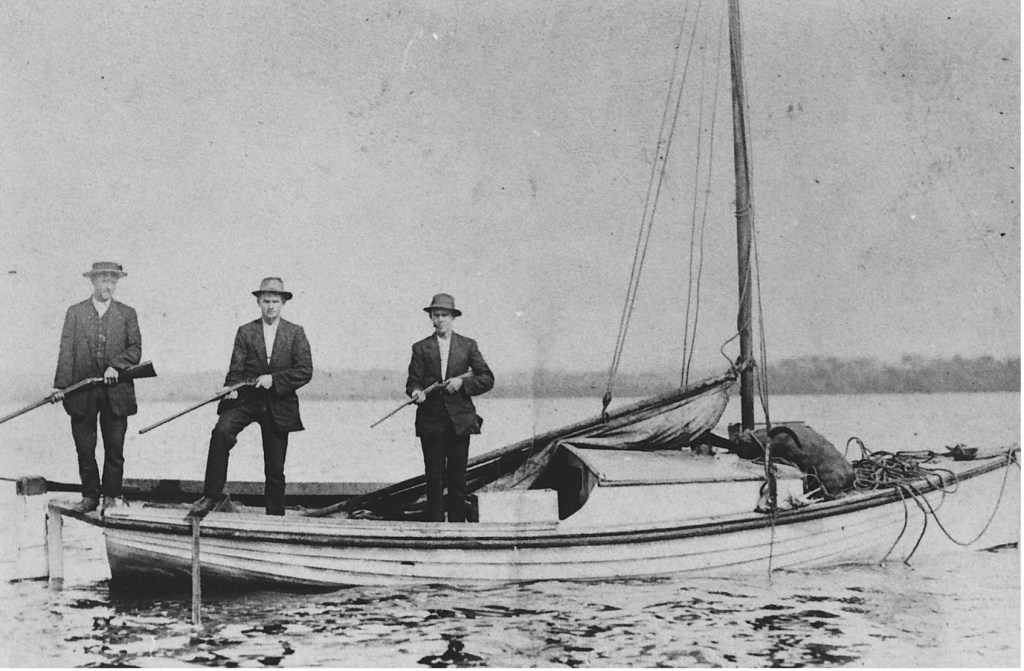
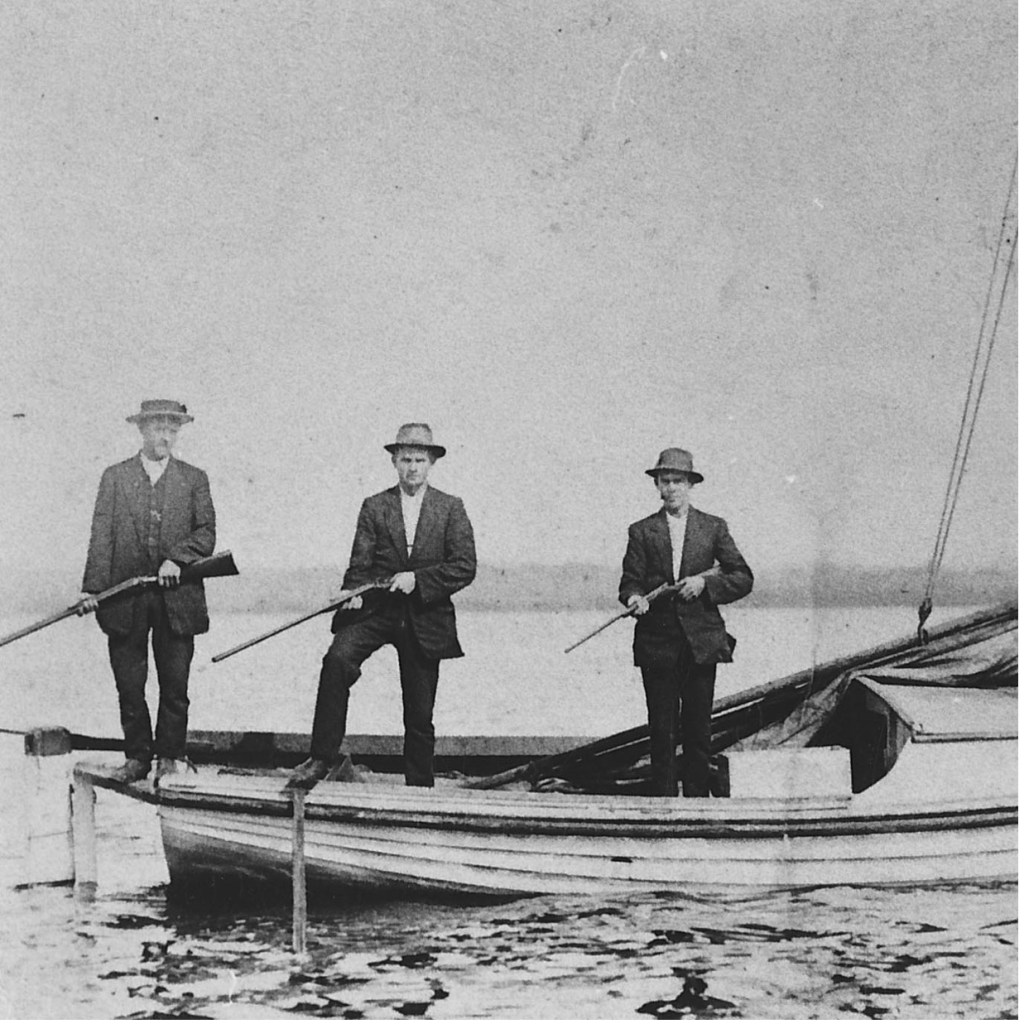
The Korsmans on the water for a shooting excursion – 1905 aboard the ‘Greyhound’ which was brought to Tea Gardens by Diver Duncan
‘Superb’ fishing and shooting opportunities at the Myall Lakes – 1882
The Newcastle Morning Herald and Miners’ Advocate of 12 June 1882, page 3, reported:
‘No greater treat can be afforded a lover of beautiful scenery than a trip to Port Stephens, and thence up the Myall Lakes. The fishing and shooting to be done is superb, the lakes being literally crowded with swan and duck, besides schnapper, mullet, bream, and other specie too numerous to mention.’
Trip to the Myall – 1884
The Maitland Mercury and Hunter River General Advertiser of 22 January 1884, page 3, reported:
‘Jones and I had often talked of taking a pleasure trip together, and the recent excessive heat brought matters to a crisis. We had neither of us been to the Myall, and consequently determined to go there on this occasion, and, being supremely unselfish, it was proposed by Jones, seconded by me, and carried unanimously, that a report of our movements and doings be sent to you pro bono publico. ………
At about 9 p.m. we reached Mr. Engel’s selection, on the shores of Port Stephens harbour, at a part called Little Swan Bay, and were most hospitably welcomed. …. The house inhabited by the Engels was built by themselves, and is a triumph in its way; indeed one might safely wager that it would carry the palm against all competition for the excellency of the work. …… The sons have a first-class boat, called the ‘Brothers’, and well they know how to manage her.
Two of them got the boat ready, for Jones had engaged them for the week, and all our belongings were soon transferred to the shore and we were ready for sea. We had guns and ammunition with us, not of course with the view of shooting game, but only for defensive purposes, and with the idea that we might be able to destroy sundry destructive and horrid creatures that are not included in the Game Act. Let none suppose that we meditated infringing the law; Jones is a very good and law-abiding citizen, and so am I. ….
At 10 p.m. we left the Tea Gardens and started with the song “Row Brothers Row.” ……. By two in the morning our boatmen had brought us to Tomboy, which is a bend in the River at the entrance to the Myall Lakes; here we camped, starting again at five. A very few minutes and we were on the lake, and had the pleasure of seeing many hundreds of wild fowl, swan and ducks predominating. It required all the virtue we possessed for us to refrain from shooting, though Jones, just to relieve his feelings discharged his gun in the air several times, and so did I. And now I have something painful to relate.
We had been firing in this reckless manner for some time, when two swans who ought to have known better got in the road of the shot and came to grief; we did everything we could to alleviate their sufferings, and Jones who is clever enough at dealing with accidents of this kind did his level best, but all to no purpose.
During the rest of the trip the same accident happened several times until I was forced to conceal the powder, and shot so that Jones could not indulge in this dangerous practice……
We camped that night on the bank of the river, and at peep of day started once more, the only incident worthy of note in our downward journey being the shooting of a dingo, who was standing at the water’s edge, curiously watching us. As dingoes are not in the Game Act his death was not accidental. In the afternoon we reached the Tea Gardens, and let me here add that any travellers going this route will find all they desire at Witt’s Hotel.’
Proposed shooting party to the Myall Lakes- 1892
The Newcastle Morning Herald and Miners’ Advocate of 14 April 1892, page 5, reported:
‘A party consisting of Messrs. J. Paton, F. Berne, R. Lester, C. Donaldson, and 11 other gentlemen have arranged to spend their Easter at the Myall Lakes. They leave at 12 o’clock tonight by the steamer ‘Stormcock’, and upon reaching Nelson’s Bay will tranship into the steamer ‘Tarlee’ by which they will journey on to their destination. They intend taking a large fishing net, an abundance of lines, several rifles and duck guns, and a large stock of ammunition, and, as the country to which they are going abounds in game, and the lakes are full of fish, they should have a splendid time, and break the piscatorial record of the city. They will return on Monday night.’
Promotion of a shooting expedition to Port Stephens – 1892
The Newcastle Morning Herald and Miners’ Advocate of 24 December 1892, page 3, reported:
‘The steamer ‘Gosford’ will leave the Queen’s Wharf [Newcastle] for Port Stephens and the Tea Gardens at 9′ o’clock. The scenery of the northern port is famous for beauty, and the fishing and shooting are exceptionally good. With fine weather the outing should prove delightful, as the boat is well-known for her steaming qualities and commodious accommodation.’
Trip to Port Stephens – 1897
The Newcastle Morning Herald and Miners’ Advocate of 28 April 1897, page 6, reported:
‘On Thursday, the eve of Good Friday, a party of 21 from Newcastle, Stockton, Wallsend, Sydney, Raymond Terrace, and elsewhere, met at Morgan’s Cosmopolitan Hotel, Raymond Terrace, and thence proceeded, early on Friday by coach, buggy, and bicycle, to Sawyer’s Point [Karuah], 18 miles distant, where they embarked upon the ‘Allyn’ and proceeded upon a four days’ cruise on the Myall Lakes. …..
On the way up the Myall River [after leaving Tea Gardens] several members of the party tried to bring down a few ducks, but the birds were shy and rather scarce, and very small bags resulted. ….. After a record run, with an hour midway lying at anchor while two of the party went off in the boat after ducks.
Excursion to Port Stephens – 1897
The Dungog Chronicle of 21 May 1897, page 3, reported:
‘Last week a number of gentlemen at Stroud arranged with the proprietor of the steamer ‘Gosford’ to come to Booral wharf one evening and take a number of excursionists out to the Port Stephens heads for schnapper fishing. …..
We were informed by Mr Hagan and others [at Tea Gardens] that the Myall River and the neighbouring lagoons were never before known to be frequented by such clouds of wild duck and other fowl. We were solemnly assured that the ducks were wont to assemble not in thousands, but in acres, upon the face of the lakes, and the most ardent sportsmen could find more than enough to satiate his appetite for slaughter. It is thought that the dry weather in the interior is driving waterfowl and all sorts of game down to the lakes and swamps along the coast, hence the unusual quantity of game that abounds there. We would certainly recommend anyone wanting a few days’ shooting to visit Tea Gardens and the Myall River.’
Promotion of Port Stephens for health and pleasure – 1898
The Sunday Times of 18 December 1898, page 18, reported:
‘If you consider the two essential motives of holiday-seeking— health and pleasure— these places [Port Stephens, Myall River, and Lakes] are all that could be desired. …..
Proceeding inward by boat [from Nelson Bay], about five miles, you arrive at the Tea Gardens, a picturesque little spot on the Myall River. There you may spend two or three days to advantage in shooting, boating, and fishing. In the surrounding bush there is plenty of game, especially a mile or two out. At the Tea Gardens you can hire a boat, and one of the small steamers that ply up the river will give you a tow into the Lakes and direct you to where the game abounds.’
Travel to Myall Lakes with ‘guns and tackle’ – 1903
The Newcastle Morning Herald and Miners’ Advocate of 30 May 1903, page 7, reported:
‘On Thursday evening a party of seven from Newcastle and the surrounding district left for a shooting and fishing expedition on the Myall Lakes. ….. From there [Soldiers Point] a start was made straight for Tamboy Lake, by the Tea Gardens, which was reached about nightfall. Tamboy is famous, not only for its fish, but also for its flying foxen, the camp of which suffered from the disturbance caused by the breech-loaders of the party. The mass was so thick that one particular discharge accounted for thirty. After leaving a heap of nearly 400 of these fruit ravagers on the ground, the party returned to camp and started fishing until the moon had risen, making a fine haul of white bream.
Next morning a start was made for Swan Point, the party reaching there at one o’clock, and established the final camp. Here the ducks and swans make their home, myriads of them being seen flying and swimming about. Plenty of red-bill abounded here also, but they are not troubled there, as the ducks are plentiful. Around a little elevated piece of land called Middle Island, the party made their biggest bags, the ducks coming under the lee of the island whenever a strong breeze blew, literally covering the water for hundreds of yards. The best record was 30 ducks with three barrels.
Wild ducks were on the bill of fare every day, a change being made with coot and water hen when the sportsmen were indisposed to go to Middle Island in the boats. Water hen move about in flocks over there, which is a sufficient guarantee of their platitude. For a few days’ shooting and fishing, this place, though somewhat distant, is undoubtedly, one of the best places along the coast.
At nigh time trapping opossums was the chief sport, the party being able to find them without dogs, and mooning them. One afternoon accounted for eight wallabies, which were not as plentiful at that particular spot, although it was stated that two miles from the camp the party could shoot as many as they had cartridges for. After a few days of thorough sport, the party returned home on Thursday, greatly pleased with their trip.’
Port Stephens Trip – 1904
The Newcastle Morning Herald and Miners’ Advocate of 19 July 1904, page 6, reported:
‘Having decided on a holiday in the Port Stephens district, I journeyed to Raymond Terrace, from whence I drove to the Tea Gardens, but not being able to get an early start, had no opportunity of seeing that part of the country through which we travelled until a few days after when I had several days’ shooting between Sayers’ Point [Karuah] and Tea Gardens.’
Sports available at Port Stephens – 1912
The Sydney Mail of 19 June 1912, page 15, reported:
‘The Myall Lakes have a strong attraction for tourists and sportsmen, though they are not nearly well known by either section as they deserve to be. If time is limited, the return trip from Sydney may be done in four days. ………….
A large party sets out in the launch and boat in quest of ducks, with all the shooting kit, retrievers, and decoy ducks on board. The “guns”, singly or in pairs, are posted at various points round the lakes, to wait for the arrival of the birds. The decoy ducks prove very useful, frequently attracting the attention of a flying flock which, thinking that all must be well, alight on the water alongside their dead deceivers. These decoy ducks, moving round over the water as the breeze prompts them, are very cleverly made, and it often happens that a raw “gun” blazes at them. Such a mistake leads to endless chaff when the party reaches home with its bag, and the experiences of the day’s sport are recounted.
The parties having been posted, the launch and boat retire. In these lakes, which are far from being “shot out,” it seldom happens that the waiting “guns” are disappointed. When the sun is sinking behind the ti-tree forest fringing the lake, the whistling of wings brings all the “guns” near the rushes to the alert. A big flock settles, and after some patient waiting, the duck float within range. “Bang,” “Bang,” go left and right barrels, and a couple of brace of ducks are floating just outside the rushes. Almost simultaneous with the report, the retrievers dash into the water, and soon land the game.
Now and again the muffled report of guns tells of other men around the lake having a hand in the sport. A stay is made until darkness makes a “hit” out of the question, and across the calm water comes a hail from someone out on the lake. A reply is shouted back, and presently out of the gloom a big sail is blurred on the starlit sky. The 20-footer looks double its size, and resembles some slave show sneaking down an African coast after its cargo. The canoes put off, swish through the rushes and leap on to the open water. The “guns” throw their bag and pieces on board, and as soon as the retrievers, which swim out, are picked up, the sail is shaken out, and a course set to pick up the other “guns”. After knocking about the lake for a while the light for the launch is picked up, and as soon as it comes alongside the sail is taken down, and the launch tows the boat home.
Besides duck shooting, there are large numbers of wallaby in the bush a mile or two back from the accommodation house. Next day the duck family is given a holiday, and most of the party go out with guns and hounds to chase wallaby. For variety of sport these lakes cannot be excelled. There are plenty of flathead, whiting, and perch to be caught, and there are delightful camping spots without number. At Mungo Brush, on the Broadwater, there is a sand bank running out some hundred of yards into the lake, and covered with several feet of water, which forms an ideal bathing-place.’
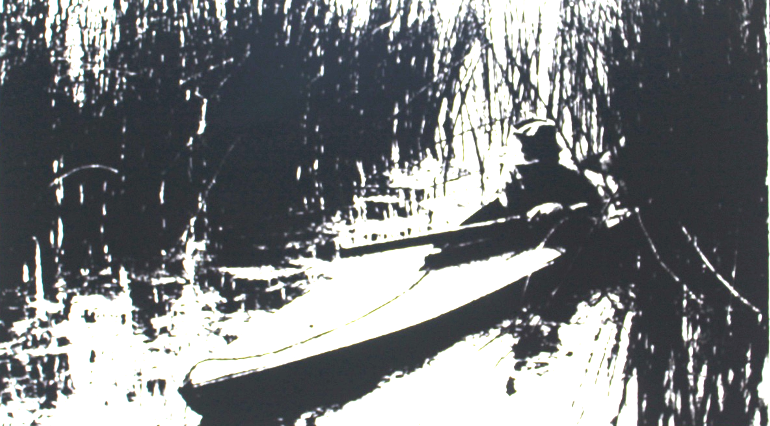
Duck shooting from a canoe at Myall Lake [Sydney Mail, 19 June 1912]
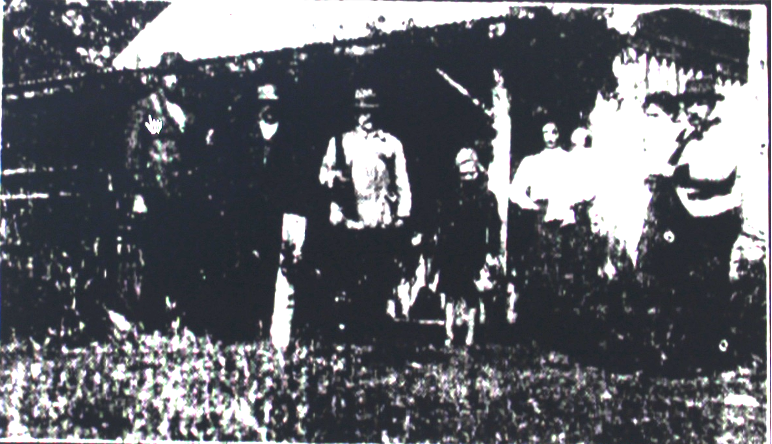
Shooting Party at Myall Lakes [The Sun, 20 December 1913]
Officers from the ‘Renow’n’ at Port Stephens – 1920
The Maitland Daily Mercury of 29 July 1920, page 4, reported:
‘On the occasion of her visit to Maitland on Sunday to see the Prince of Wales, Miss Ferguson, teacher of the aborigines’ school at Karuah, told us of an interesting visit paid last month by a party of officers from the ‘Renow’n, including the commander, to the Karuah aborigines. …..
After partaking of refreshments, the visitors went for a shooting expedition in Mr. Longworth’s launch, returning to Karuah at 6 p.m., and then left by car for Newcastle en route to Sydney. The visitors expressed their appreciation of their entertainment and loyal welcome of which they promised to tell the Prince.’
A fishing party from Newcastle – 1920
The Sydney Mail of 29 December 1920, page 15, reported:
‘The Myall Lakes are not so generally well known as their beauties and varied sporting advantages warrant. The people of Newcastle and surrounding districts, however, fully appreciate their good fortune in having Port Stephens and its charming waterways. …… Splendid fishing and shooting are to be had, and swimming may be enjoyed in beautifully clear water without fear of sharks.’

A fishing party from Newcastle [Sydney Mail, 29 December 1920]
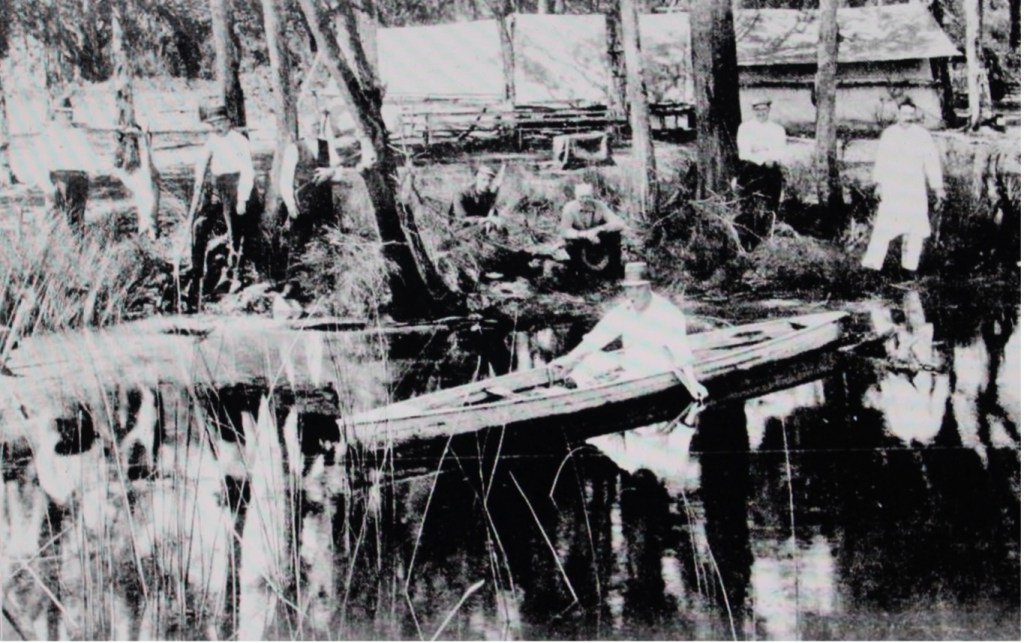
Sportsmen’s camp at Mungo Brush [Sydney Mail, 29 December 1920]
Promotion of the Waterview Estate – 1922
The Dungog Chronicle of 23 June 1922, page 2, reported:
‘The public are notified that Mr. R. A. Elkin is in town selling blocks on the beautiful Waterview Estate, Tea Gardens…… Dungogites who want a block of land at Port Stephens where a magnificent holiday, fishing, shooting, etc., can be spent should get in early and secure a block.’
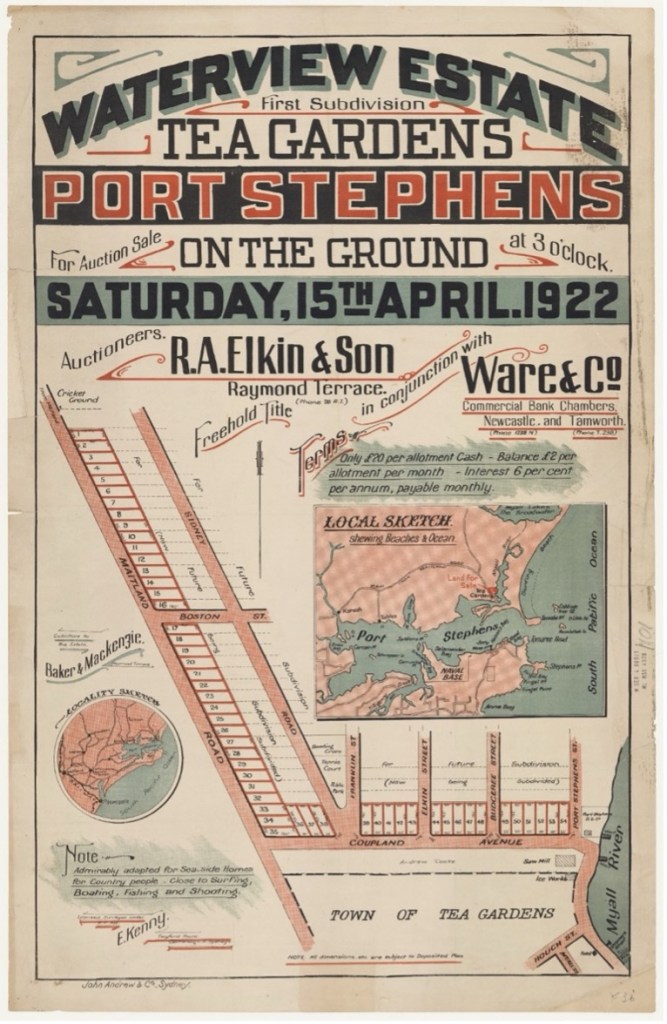
Advertisement for Waterview Estate at Tea Gardens
Fish and Birds – 1926
The Newcastle Sun of 24 March 1926, page 6
‘Three lovers of fishing ….. have returned to their homes in the Newcastle district after an eight day excursion in the locality of Port Stephens and Myall Lakes. …..
The party succeeded in catching over 600 fish of many kind. …. Shooting in the bush was also enjoyed, and many parrots and other birds were secured. The visit was full of interest, from a scenic point of view, and the party considers that the area over which it travelled is well worth seeing by others.’
Bird life in the Myall Lakes – 1932
The Dungog Chronicle of 8 April 1932, page 4, reported:
‘Quite a large number of swans, duck and coot are now to be seen on the Myall Lakes. These flocks of birds add to the grandeur of the scene. Of course, the expanse of water is too great and the game too wary to enable the shooting fraternity to do much damage.’
Concluding Comments
Recreational shooting in the Port Stephens area had ceased by the start of the Second World War.
By 1939, parts of the Myall Lakes had been declared a sanctuary area. The Dungog Chronicle of 24 February 1939, page 4, reported:
‘Ducks and swans are plentiful on the Myall Lakes, and shooters are always after them. As this area has been declared a sanctuary, Mr. A. E. Dickinson, of ‘Parklands,’ intends to protect the birds, and with the assistance of two more rangers will patrol the area.’
Mr. Arthur Dickinson had previously been an honorary ranger at Mount Tomaree, Port Stephens. After leaving Mount Tomaree around 1939, Arthur Dickinson purchased a property named ‘Parklands’ near the Myall Lakes and resided there until his death in 1954.
Researched and compiled by Kevin McGuinness
June 2024

 Port Stephens - a history exploration