

Introduction
In July 1914, the Tamworth Daily Observer published four articles reporting on an excursion to Port Stephens by Dr. Richard Arthur, a NSW Parliamentarian, and ten interested parties.
The aim was to assess the prospects for the economic development of the region.
Several of the excursionists came from the Tamworth region where community action was promoting the formation of a new state in New South Wales, with Port Stephens as its port for domestic and international trade.
A journey undertaken by James R. Fulton, to Port Stephens in 1914, who was a strong supporter for this development is published at the link on this website
Further information on the New State Movement is also found at this link on the website.
The newspaper articles, as published, reflected on the potential of a major economic hub around the shores of Port Stephens. While this may not have been realised in its entirety, many of the advantages recognised have found their fruition in what the Port Stephens region is today.
Dr. Richard Arthur
Dr. Richard was born in Hampshire, England and was a member of the NSW Legislative Assembly for 28 years from 1904 to 1932. He was both a medical practitioner and a social reformer. While a Member of Parliament he was busy advocating in many public affairs areas. He was a prolific writer on subjects that took his interest, and one of those was the potential development of Port Stephens.
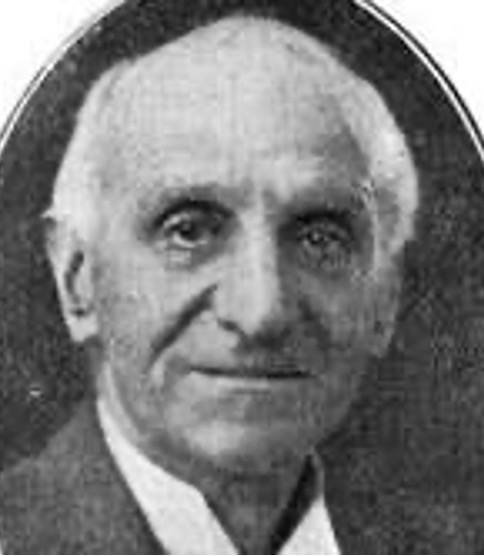
Dr. Richard Arthur
ARTICLE ONE
The Tamworth Daily Observer of 21 July 1914, page 2, reported:
How Dr. Arthur’s Excursion to Port Stephens Originated
‘There are two aspects to be dealt with in an account of this trip—one Dr. Arthur’s party, the other Port Stephens. The former needs only a comparatively short story, but the latter will require some telling; therefore it is as well to clear the subject of the unimportant, but none the less interesting personal element, before entering upon the bigger matter.
Dr. Arthur, M.L.A.
Everyone knows of this indefatigable little city Parliamentarian whose remarkable energies and persistent efforts are always being devoted to the education of the community upon national questions. Dr. Arthur is a man with a personality. He has the high almost massive forehead of the thinker, the eyes of the dreamer, the nose of the aesthete, and the mouth and chin of the unconquerable. He is an idealist, but with sufficient of the practical in his nature to enable him to achieve results. He is restless, and must constantly be doing something. That is why he is always writing letters to the papers. When he is not writing letters, he is engaged in arranging, or participating in some movement having, for its object the investigation of ports, or railway routes, or tourist resorts. There is a large lump of the explorer in Dr. Arthur.

Caricature of Dr. Richard Arthur, MLA
Spirit of Adventure
The reasons that actuated him in arranging a visit of inspection to Port Stephens are not hard to understand once you have seen the man and conversed with him. The subject of a new port appealed to his imagination. The trip to a practically unknown place aroused the exploring instinct. The chance of educating others prompted a desire to do so. Practically he was placing himself at the head of a band of explorers who were to ascertain for themselves whether this great neglected port, was all that it was claimed to be. The spirit of adventure was abroad in Dr. Arthur’s undertaking. Here was a happy combination of dreams for the future, delving into the unknown, and practical effort to help along a movement to make New South Wales, and Australia, greater than they are.
Possibly, also, Dr. Arthur saw in this pioneering exploit a means of providing him with material for writing reams of letters to the papers in the future. It is a good hobby, all the more useful in Dr. Arthur’s case because he writes on big topics and generally has a message to the thinking section of the community. Let him write on Port Stephens, and decentralisation. No one will begrudge him the delight he may derive from educating the people upon the possibilities of this nation-building vein of ore he has discovered. He may be sure that the people of the North and North-west will read his letters with pleasure, even if in Sydney the letters are unappreciated.
Proposed Statue to Dr. Arthur
Possibly in a generation or two, when Port Stephens having come into its own is the scene of immense commercial activity, with a large and prosperous population dwelling near its foreshores, and all the necessities of a great modern city in its midst, an enthusiastic writer in the “Port Stephens Morning Herald” will relate the story of Dr. Arthur’s little pioneering party, claiming possibly that this was the first serious public effort to bring the long-lost port to the front. Perhaps this unborn writer may even be striving to prove that Dr. Arthur was the actual “Father” of Port Stephens, if not its founder, and that the least a forgetful and not altogether grateful posterity might do is erect a statue in his honour.
An Historic Party
In all seriousness, however, Dr. Arthur’s party may become historic, for it was possibly the first one ever taken to Port Stephens with the deliberate object of spying out the land for the making of a future city. Much has been written and said about Port Stephens during the past few months. The agitation has been going on in these districts for over two years. But the cheerful little gathering which sat down to breakfast in a Newcastle hotel on Sunday morning last represented the first serious-minded attempt to drag Port Stephens from the abysmal depth of obscurity into which a century of purposeful neglect has plunged it.
Millions Club Stays in Sydney
Dr. Arthur had cause to complain, for he had been very shabbily treated by the very men in whose interest he had busied himself. When he saw that the farmers and settlers during the period of their annual conference in Sydney were going to discuss the question of opening Port Stephens, he conceived the idea of arranging a visit of inspection to the place. To this end he saw the head men of the Millions Club—of which he is one, though he informed the writer half apologetically that he merely “believed” he was—and said to them: “Here is your chance. [The Millions Club was founded in 1912 to assist Sydney to reach a population of one million persons]. You have been accused of being in existence for the sole purpose of boosting Sydney. Show that you desire to boost New South Wales.”
The Millions Club people signified their approval of the idea and promised to go to Port Stephens. They failed to transpire, with one solitary exception, a Mr. Harrison Tucker, who had better remain in Sydney, for the one idea in his mind is that the metropolis is the country’s best friend, and that Melbourne is Sydney’s natural enemy. The Millions Club must be written down as a decentralising agent. There are too many Sydney allotment vendors in that august body.
Farmers also Stay in the City
The farmers and settlers also failed to put in an appearance, although about 22 had signified their intention of making the trip.
Dr. Arthur had placed matters in the hands of the Sydney Tourist Bureau, the officials of which had telegraphed to the hotelkeeper at Port Stephens to prepare about 50 dinners; also to Mr. Thurlow, the Port Stephens ferry boat proprietor, who was warned to put on his biggest liner for the occasion. Alas, for the word of farmers who find themselves in Sydney where all the theatres are, and the nice barmaids, and the easy drinks. Only two who had promised kept faith. One was Mr. Boydell, a shrewd youngster who has the strenuous job of organising for the Liverpool Plains Farmers and Settlers’ Association. The other was a Mr. Stones from Cassilis, who admitted after the inspection of the port that his district was anxious to use this new movement for the purpose of furthering a local agitation for a connecting line of railway in opposition to the Maryvale Muswellbrook proposal. When told by the Tamworth representatives that the North wanted the best port first, and would worry about the rival railway routes after, he seemed to feel discouraged.
Tamworth Contingent
“This is simply scandalous; only five of my party have turned up,” said Dr. Arthur to the Tamworth visitors, Messrs. G. A. M. Nankervis, W. Upjohn (secretary Tamworth Chamber of Commerce), E. H. Baird (member Council of the Chamber), and V. C. Thompson (“Daily Observer”). The Doctor however was greatly heartened by the appearance of the four Tamworthites. “We will go through with it,” he said grimly. It may be mentioned that the circumstances were not inviting. It was raining heavily at Newcastle on the Sunday morning, and a wet day at Newcastle is calculated to damp the ardor of the most fervent.
The party consisted of eleven at the beginning, including Dr. Nash, M.L.C., Major Nicholson, member for Maitland, and a reporter from the “Daily Telegraph.” On arrival at Salt Ash by coach from Stockton over one of the worst roads round Newcastle, the party was augmented by Mr. Brown, member for Durham, an enthusiastic advocate of Port Stephens. With the exception of Mr. Brown, who lives at Raymond Terrace, and in whose electorate Port Stephens is, no one had previously seen the port.
The day was not an ideal one. It was bitterly cold, and a sharp cutting wind was blowing. Overcoats and goloshes were badly needed by those who had came without them. At Salt Ash, which is the head of Port Stephens, the party boarded Mr.Thurlow’s handy little ferry boat, “Reliance,” 22 tons, and in driving rain started off on the tour of inspection. What was seen, and what was thought about It, will make ample material for future articles.’
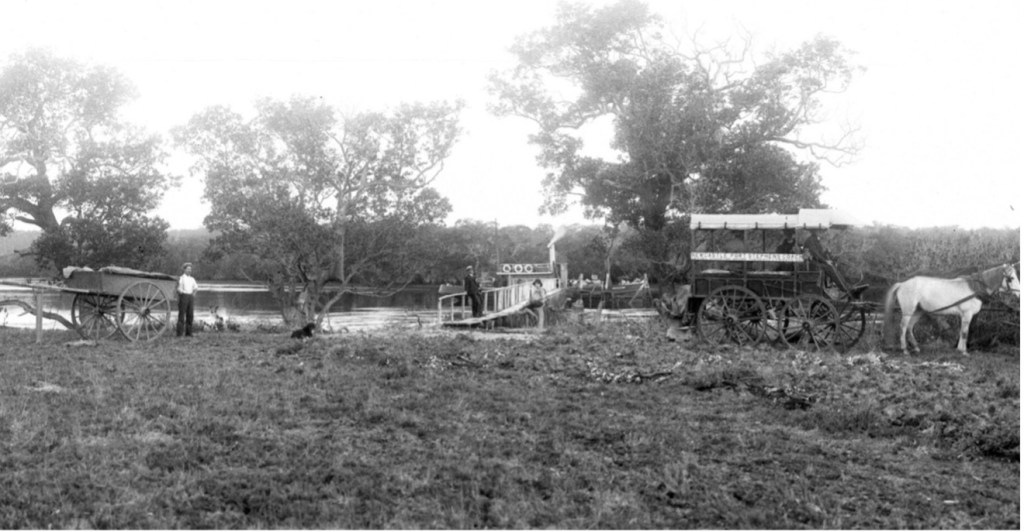
A steam boat at Salt Ash picking up travellers for Port Stephens who had arrived by coach. There was no road past this point to Port Stephens.
ARTICLE TWO
The Tamworth Daily Observer of 22 July 1914, page 2, reported:
Magnificent Natural Asset Wasted.
‘If Captain Cook had entered Port Stephens first, there would, in all probability, have, been a great city there today. It is just possible that Port Jackson would have been the neglected harbour; though the nearness of the latter to the southern portion of the State would probably have resulted in its being utilised. New South Wales would today have had at least two fine ports, and two large cities. But Captain Cook missed Port Stephens, and he entered Port Jackson, consequently the latter was the site of the first settlement. As the infant colony grew round the picturesque foreshores of Sydney harbor, the seeds of vested interests were sown, to eventually produce a crop of the toughest political problems that ever retarded the expansion of a civilised community.
Centralisation Begins
In a very short time, the handful of people centred in Sydney were given a powerful lever with which they were able to absolutely dominate the rest of the State. The first private enterprise railway built in Australia proved a failure, and the community had to take over and run it as a state concern. Sydney then held a monopoly of the political power, and naturally the commercial interests of the centre were able to exercise an irresistible influence. The railway system was under the control of these interests, and as the lines were pushed out to tap the resources of the country the inevitable tendency was to converge them upon Sydney in order to enhance its wealth, prestige and power.
Port Stephens Discovered
Port Stephens did not remain long undiscovered, but there was really no use for it. Settlement had not begun in the North. The advent of the Australian Agricultural Company gave the place an impetus, but not for long. The company had obtained a grant of a million acres of “the best agricultural land in the colony,” and the greater portion of the original grant was, through the mistake of the company’s first agent, selected at Port Stephens. The land proved unsuitable for the company’s purpose, and eventually was surrendered in exchange for a huge tract of country on the Liverpool Plains. The people of Tamworth know the rest of the story so far as this matter is concerned. They no doubt wish the company had remained at Port Stephens. To a certain extent it did. Coal was discovered at Newcastle, and this portion of the company’s estate was retained with much enthusiasm.
No History of Port Stephens
The history of Port Stephens has been nil since then. The centralisation policy, at first an accident, became a deliberate design on the part of the dominant political and commercial interests of Sydney. The rapid growth of Newcastle was also a considerable factor in the neglect of the adjacent port. For practically 100 years one of the world’s few fine natural harbors has been kept closed up and the city which should have grown there, and which Nature intended should have been there, has been prevented from coming into existence.
There is a tragedy associated with the history of Port Stephens. It has been criminally slaughtered for the sake of selfish vested interests. How many millions of money this wicked folly has cost New South Wales, and will yet cost it, is impossible to estimate, but the sum must be appalling. All the costly congestion evils from which the State is suffering today, all the burden some expense placed upon the backs of the producers through their inability to use natural trade outlets, all the wasteful expenditure upon makeshift harbors—these and numerous other debits must be put down in the account against the monstrous folly of keeping Port Stephens locked up and unused. Added to all this must be the immense revenue lost to the State through the lack of another big city.
Ignorance of Port Stephens
It is a striking commentary upon the Governmental neglect of this place that so few people have ever seen it. The port may be likened to a rich treasure chest buried away in some strange country where nobody is likely to find it. There is not even a trafficable road to Port Stephens. The hardy explorer who would reach there must first travel to Newcastle or some point, along the coast, whence he may take coach to the nearest water. Motor cars cannot journey to the port direct. When Dr. Arthur’s party was at Nelson’s Bay on Sunday the hotel-keeper displayed a petition he was having signed praying the Government or the Department responsible to construct a few miles of road to enable motor traffic to roach there. If only 14 miles of railway were built the place would be connected with the rest of the State in an easily get-at-able manner, and thousands of tourists would pour in there every summer.
Great Tourist Place
Yet all appeals to the present Government for roads or railways to Port Stephens fall upon deaf ears. The Labor bunch for Newcastle are there to stop any business of this kind. Already a few hundreds of tourists, chiefly from Sydney and Newcastle, and mostly on fishing bent, find their war to the port by the circuitous routes available; but with a little link of railway, and a few miles of decent road, tourists would swarm there every year. Once the place were properly known the people of the North and North-west who are now forced to go to Sydney in the summer, there to be fleeced by the exorbitant rents and the high cost of living, would never go past Port Stephens. It is the ideal holiday resort.
The much-boomed surroundings of Sydney are not in it with the unknown and utterly ignored surroundings of Port Stephens. The place is the amateur fisherman’s Paradise, the picnicker’s Garden of Delights, and the yachting man’s own sailing pond. There are three stretches of water at Port Stephens, on any one of which the greatest regatta in the world could be hold.
Thousands of Ferry Craft
In many respects Port Stephens is far superior to Sydney Harbour. Apart from its commercial advantages it would provide much greater opportunities for pleasure. There could never be any harbor congestion here, for there is too great an expanse of smooth water. Thousands of ferry craft could ply on the placid surface of Port Stephens and never come within a stone’s throw of each other or the big ships which are their greatest menace. There are no obstacles to unimpeded ferry traffic in this harbor as there are in Port Jackson. It is one broad magnificent basin of water in which Salamander Bay is the only secluded portion. Outside this bay every nook and corner of the harbor is visible in clear weather.
Well Protected
Port Stephens has the further advantage over Sydney harbour that it is well protected from the south-easterly gales. The heads, which are natural fortifications, are guarded on the southern side by an immense sandy bay from 1 to 1½ miles in length, terminating in Point Stephens. There is also an immense rock in the centre of the entrance which acts as a sort of door, breaking the force of the huge Pacific rollers. On Sunday a heavy sea was running outside the heads, yet just inside the water was so calm that the little ferry boat was able to skirt right under the central rock and scarcely gave a roll. During the recent heavy gale all the little coastal boats ran into this harbor when the stand-off signals were flying at Newcastle. It will be remembered also that even Sydney harbor was unsafe while this gale lasted; the Manly ferry service having to be discontinued, and a large Japanese liner almost going ashore near Kirribilli Point. Port Stephens is immeasurably better sheltered than Port Jackson
Great Inner Harbour
Another tremendous advantage at Port Stephens over Sydney harbor is the fact that there is an inner harbor cut off from the harbor proper, or the deep-sea portion, by two jutting peaks with an island in the centre. Between these two gateways an immense expanse of absolutely smooth water reaches for a distance of fully 15 miles in one direction and nearly the same in another. Unfortunately, this water is shallow, except for a few miles on one side near the entrance; but even here the depth range from 8 to 25 or 30 feet, and averages about 14 or 15 feet, which is ample for the largest kinds of ferry boats. There is scope for the greatest ferry service in the world at Port Stephens. The suburbs of the future city could lie along the foreshores of this inner harbor, which is dotted with numerous pretty little islands.’
ARTICLE THREE
The Tamworth Daily Observer of 23 July 1914, page 2, reported:
Immense Salamander Bay
‘Port Stephens has to be seen to be believed. The first impression made upon the visitor is the immensity of the place. Everyone is familiar with the Parramatta River and Middle Harbour, but Port Stephens can better these. Of course, the greater portion of the inner harbour is shallow. No big vessels could over go in there, except upon one side, where there is a depth of from 23 to 30 odd feet. But no liners could navigate the Parramatta or Middle Harbor, although these places are much deeper. The great point is the sufficiency of depth for ferry traffic, and in this connection the great inner harbour of Port Stephens could accommodate almost any sized craft up to a Manly boat. Suburbs could be built at any point round Port Stephens, and the residents could be provided with adequate ferry services.
A Fine Creek
Probably the better way to see the full advantages of the port is from the seaside, through the heads; but a very good idea can be obtained by going overland from Stockton to Salt Ash, which is the head of the upper reaches. The distance from the heads of Salt Ash, the terminal point, is about 21 miles, and the ferry boat can travel full steam ahead all the way. Tilligerry Creek, as it is called, is no meandering stream. It is in places a couple of miles wide and has an average width of fully a mile. The water is shallow, being from 8 to 14 feet. The banks along the creek, or river, as it should be called, are elevated and picturesque. None of the foreshores of Port Stephens are very low-lying, and they are not marshy. Possibly there is low-lying marshy back country in patches; but so there is round Sydney, and plenty of it.
The Inner Harbour
A run of five or six miles brings us to the big inner harbor, which opens out almost like an inland sea. This is called the north section of the harbor, and it is from 5 to 6 miles wide, with an average depth of about 14 feet. The wide waste of waters are broken only by an occasional pretty little island, and a few distant bays, named respectively Swan Bay, Pipeclay and Tanilba, and Little Swan Bay. The line from Maitland would run to about four miles south of Pipeclay, crossing Tilligerry Creek above Salt Ash, and would skirt Salamander Bay. The Karuah River runs into North Harbor. This river is about 50 or 60 miles long and has its source near Gloucester, past Stroud.
Soldiers Point
About 9 miles from Salt Ash is the famous Soldiers’ Point, which marks the entrance to the harbor proper. The entrance is fairly narrow. Soldiers’ Point, a steep, grassy knoll being on one side and an almost similar point on the other, with an island in the centre. In the early convict days soldiers were stationed on one point to prevent the prisoners from swimming to the island and so escaping to the mainland. It is merely a stone’s throw from one side to the other. Just inside this entrance, in the North Harbor is a fairly large area of deep water close to the shore, and in the event of the port being opened big ships could be taken in after unloading at Salamander Bay and allowed to berth; or else portion of the unloading could be completed in North Harbor. A large amount of wharfage accommodation could he provided in here.
Capacity of the Port
Entering the port proper through the Soldiers Point entrance one sees a vast expanse of almost smooth water, with not an obstruction between the twos sets of heads. Port Stephens is like an immense oval basin. Some idea of its size may be gathered from the fact that it is nearly as broad as it is long, and is about 7 miles wide and the same in length. Roughly the distance from the heads to Soldiers’ Point is between seven and eight miles. The harbour may in the mind’s eye be divided into two portions —one deep and the other shallow. The greater portion is deep, and includes the wonderful Salamander Bay. Right in the centre is a narrow line of whitish green water, showing the sandy bottom. People who are acquainted with Sydney harbour will know that only portion of it can be used by the big ships, the rest being only suitable for ferry traffic. Even Sydney harbor can only be used on one side, owing to the steep rocky cliffs, and the comparative shallowness of the water on the North Shore side. Port Stephens thus has no disadvantage compared with Sydney. It could only be used for deep-sea vessels on one side, but there is so much deep water on this side that quite as much shipping, if not more, could be accommodated as in Sydney harbour. In the port proper alone there could be at least seven miles of deep-sea wharfage, to say nothing of the additional accommodation that could be provided in the deep portion of the North harbour.
Great Salamander Bay
Salamander Bay is the big feature of Port Stephens, in width it is about two miles, and length 2½ miles. Its greatest depth un-dredged is 71 feet. The area of this great bay is about three-square miles! Sydney harbor has nothing to be compared with Salamander. The daily terrors of harbor congestion need never hang over the Port Stephens ‘cityites’ of the future. Once the harbour channel is dredged and properly equipped for big shipping, this bay will hold the largest vessels that are likely to be built in the next century. It could easily accommodate the navies of the world! Al-ready the Commonwealth has established a submarine naval base there, but so far only a small jetty has been built. The place is waiting for a railway, and until the line is built will never be of much use as a naval base. It is a severe indictment of the unpatriotic behaviour of the Governments of New South Wales that they have not hastened to build the short connecting line required, if only in order to strengthen the defences of the country and enable the Commonwealth to proceed with the works required at this base.
Nelson Bay
Passing Salamander Bay we soon arrive at Nelson Bay, a pretty little sheltered spot which may be likened to Farm Cove in Sydney. There is a clumsy retaining wall round it which is falling to pieces. Here the fishermen who supply Newcastle and some of the Sydney trade congregate. There are two piers in the bay—one for big ships and the other for smaller ones. Sheltering in Nelson’s Bay on Sunday last were a fleet of small coasters, some of which had run in from the heavy weather outside. Frequently large vessels make for this place, despite the fact that the channel is not bouyed or lighted, and no dredging has been done. A few months ago, an 11,000 ton cargo carrier went in, loaded and steamed out without the assistance of tugs. Once the channel is dredged, and marked, the largest vessels in the world can safely go in.
Nelson’s Bay is an ideal holiday resort. There is a commodious little hotel there, kept by Mr. W. C. Rush, and evidently it is located in a healthy spot, for it is called the Sea Breeze Hotel. Mr. Rush depends for his trade upon the fishermen and the sailor men; though every year he does a fairly good tourist business. There is also a good boarding house in the vicinity.
The Headlands
Passing Nelson Bay is a fine sandy beach called Shoal Bay. There are no breakers here, but the beach is magnificent and will provide an ideal recreation spot for the future population of Port Stephens. Then come the magnificent headlands guarding the entrance to the port. These are a mile apart, and stand up like two sentinels. Almost in the centre of the entrance is a huge rock which would make a fine fortification for heavy guns. The enemy’s ships would have a difficult task to break into Port Stephens. Between these headlands is the bar, over which there is a minimum depth of 31 feet, which could be dredged to any depth, as soundings made showed that the sand went down for fully 50 foot and still no obstruction was found. A great feature of this bar is that it grows very slowly. In the last half century, it has hardly increased. Once removed it would probably stay removed.
Outside the heads is a great breaker-washed beach extending in a curve for l½ miles to Point Stephens. This would be the future Manly or Coogee of the adjacent city. As explained in a previous article, this point affords natural protection against south-easterly weather. On the north side of the heads is a sandy spit about a quarter of a mile wide, which is the only barrier between the harbor and the sea, but this never alters, and may be regarded as a permanency. Nature has indeed been good to Port Stephens.’
ARTICLE FOUR
The Tamworth Daily Observer of 24 July 1914, page 2, reported:
Opportunity for the Town Planner
‘One of the greatest injustices done to Port Stephens by its Newcastle and other detractors is the systematic promulgation of the statement—a much shorter word would better describe it—that a decent city could never be built there owing to the swampy and low-lying nature of the land round the foreshores. The truth is that the very opposite is the case. Not only is there plenty of elevated land along the foreshores of the great inner harbor, but there is a long stretch of high land the whole length of the port upon the deep-water side [south side] from the heads to Soldiers’ Point, a distance of fully seven or eight miles in a straight line. The best comparison is with the North Shore side of Sydney harbor, with the difference that in the case of the latter the land is precipitous and therefore unsuitable for wharfage purposes, whereas in Port Stephens it is sloping enough to admit of easy access from any point.
The Low-Lying Land
The land along the south foreshores of the port—the deep side—may be best de-scribed as a series of terraces. In places it is almost mountainous. For the whole seven miles every portion is suitable for residential purposes, to say nothing of the great extent of fairly high land fronting practically every side of the inner harbor. At the back of the steep foreshore in the port proper is a large area of level country which is not marshy. The future city could be built on this site, and the evenness of the land would greatly facilitate building operations. There is actually more low-lying, swampy country round Newcastle than round Port Stephens. On Sunday last, after the heavy rains, practically the whole of the route from Stockton to Salt Ash was under water, with the exception of an odd patch here and there.
Planning the New City
There is a magnificent opportunity for the town-planner at Port Stephens. This city of the future could be laid out with mathematical accuracy. The streets could be broad and long, with wide footpaths, and trees down the centre of the roadway. Parks and public fountains could be interspersed at will. The public offices could be gathered together in one great block. The warehouses could be placed conveniently near the water frontage to minimise the carrying of merchandise from the ships to the stores. The tramways and railways could run without hindrance along smooth highways right to the edge of the harbor.
A short bridge connecting the north side with the south could be run across from Soldiers’ Point to North side with Middle Island as a natural central pier. The factories could be built along the inner harbor where there is a good stretch of fairly deep water; also on the north side of the harbor proper, where there is also a large usable area of deep water. A great quay could be constructed round Salamander Bay, where the ferry boats and the big ships could have unlimited wharfage accommodation.
[Author Comment – During the 1920’s numerous real estate developments, along the lines envisaged were established at Port Stephens. Chief among the developments were the Pindimar City and Port Stephens City at North Arm are found at these links on the website.]
State-Owned Land
Perhaps one of the greatest advantages of Port Stephens as a city site, from the public point of view, is the opportunity offered of building a State-owned city. No dry, drought-stricken Canberra upon which a mint of money will have to be spent, for the housing of a few score Government officials! This city would “go” from the very beginning, for once the port were opened to traffic people would flock there from all parts of Australia to avail themselves of the new opportunities of work and commercial enterprise.
The whole of the land along the deep side [south side] of the harbour is held by the Crown. An enterprising Government could lease it at nominal rentals at the commencement, with the hope of reaping the harvest of easy revenue in the future. Dr. Arthur, a member of the Liberal party, estimated that, eventually the State would be receiving a million pounds a year from ground rentals alone. What a boon this would be to a tax-burdened community! Instead of this money going into the pockets of private landlords—the speculators who in ordinary circumstances would grab all the land round Port Stephens at a song and make fortunes out of the unearned increment, when the city had grown—it would be diverted to the Treasury to be used for the development of the State as a whole.
If this scheme were adopted the Port Stephens’ householder of the future would be spared the burden now being carried by the people of Sydney. The State would never charge more than a fair rental, and would make the conditions of building so easy that workmen and the very poorest of the commercial class would be able to erect dwellings which to all intents and purposes would be their own.
Privately-Owned Land
Various alienations have been made regarding the amount of privately-owned land round Port Stephens. Mr. John Wetherspoon stated recently that one of his objections to the opening of the port was the speculative interest, in the place held by Sir Allan Taylor. It is a fact that a considerable portion of the land in the locality is held by private persons, including Sir Allan Taylor, i.e., unless the latter has disposed of his holdings recently. For some years he has been engaged in the industry there. The land on the north side of the port proper is mostly privately-owned, but it comprises most of the low-lying country about which so many complaints have been made. The good high and dry land is owned by the State, and this is the land upon which the future city would be built. The low-lying foreshore is upon the North side, where the shallow water lies; so that private enterprise in this connection would have no great “pull.” In any case, Port Stephens is under no serious disability on this account. Both Sydney and Newcastle, and in fact all other Australian cities with the exception of the newly-established Federal capital, are almost wholly in the hands of private landlords, who reap a rich harvest from the concentration of population. How can a “virtue” in respect to other cities be regarded as a crime against Port Stephens?
Factor in Favour
Actually this private ownership is a factor in favour of Port Stephens. The State holds the best land, which fronts the portion of the harbour that would be used for deep-sea shipping purposes, Inevitably the city would start, on this side and grow rapidly there. The opposite side, which is low-lying only by comparison with the south side, would have to offer special advantages to commercial enterprise to be taken up and used. The private owners would therefore be compelled to sell it or rent it at a low figure to attract investors; and they would also have to spend a lot of money upon it to provide wharfage and other conveniences for trade purposes. The probability is that this side would become an industrial or residential centre in itself, connected with the rest of the port, by an adequate ferry service. Once the great city started on the deep-sea portion of the foreshores, private enterprise would very soon make up its mind to take advantage of the situation by utilising its property, even if it had to do so under serious handicaps.’
Concluding Comments
Despite the many ideas put forward over the early years for the prospective development of the Port Stephens region, the major projects suggested were never realised.
No railway was ever built to either the northern or southern shore. The bridge connecting the two sides of the port at Soldiers Point, likewise, was never built. The propsaed Naval Base at Salamander Bay was abandoned.
Indeed, we are fortunate today that the envisaged development never took place, as we currently have a beautiful harbour, much of which is still in its native state.
Researched and compiled by Kevin McGuinness
November 2024

 Port Stephens - a history exploration