
Introduction
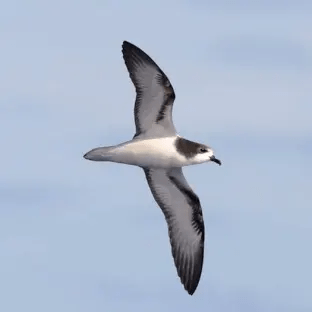
Several islands in the Port Stephens area are the main breeding grounds for the Gould Petrel, an endangered sea bird.
This species (Pterodroma leucoptera), also known as the white-winged petrel, spends most of its life at sea and comes ashore solely for breeding purposes.
In 1838, John Gould, a renowned English ornithologist, accompanied by his wife and artist, Elizabeth (nee Coxen) and their eldest son John Henry, set out on two-year expedition to Australia to conduct research on Australian birds and animals. Their studies were centred on Tasmania and in New South Wales, including the Hunter River district.
Gould collected many species of birds on this expedition including several in the petrel family (Procellariidae).
On his return to England, he published his works in the 1840’s in the seven-volume folio, The Birds of Australia (1848). A revised and updated version, Handbook to the Birds of Australia was published in 1865.
John Gould first described a white-winged petrel in Volume 7 of The Birds of Australia and named the species as Cook’s Petrel (Procellaria cookii).
In a later ornithological work, Birds of the Ocean (1928), W. B. Alexander deemed this species as Gould’s Petrel.
Prior to the 1990s, it was believed that the Gould Petrel only bred on Cabbage Tree Island. Today Cabbage Tree and Boondelbah Islands at Port Stephens are two of only three nesting sites for this endangered species. The other is Montague Island on the NSW south coast.
This paper tells the story of Gould’s Petrel, its habitat and the conservation efforts to preserve the species of the Gould Petrel in the Port Stephens area.
Two appendices provide commentaries on the life and work of John Gould and his expedition to Australia.
PART ONE: Gould’s Petrel and its Habitat
On his voyage to Australia (1838-1840), John Gould encountered a great number of birds of the petrel family (Procellariidae) in the waters of Bass Strait and the Tasman Sea.
In his book, The Birds of Australia he identified many species of petrels, one of which he named and illustrated as Cook’s Petrel (Procellaria cookii) in 1844.

Procellaria Cookii as Plate 51 in ‘The Birds of Australia’ Vol 7, with Cabbage Tree Island in the background
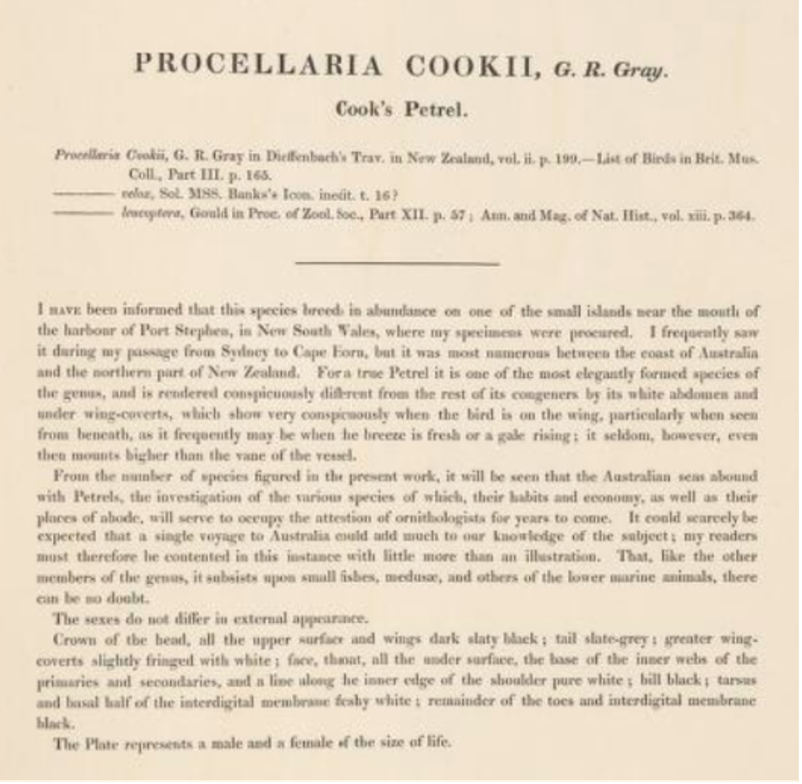
Description of Cook’s Petrel – p109, Vol 7 “The Birds of Australia”
In the subsequent publication, Handbook to the Birds of Australia, Gould had renamed the white-winged petrel found on Cabbage Tree Island at Port Stephens, labelling it as ‘Aestrelata leucoptera’ per the following extracts from pages 454-456 of the Handbook:
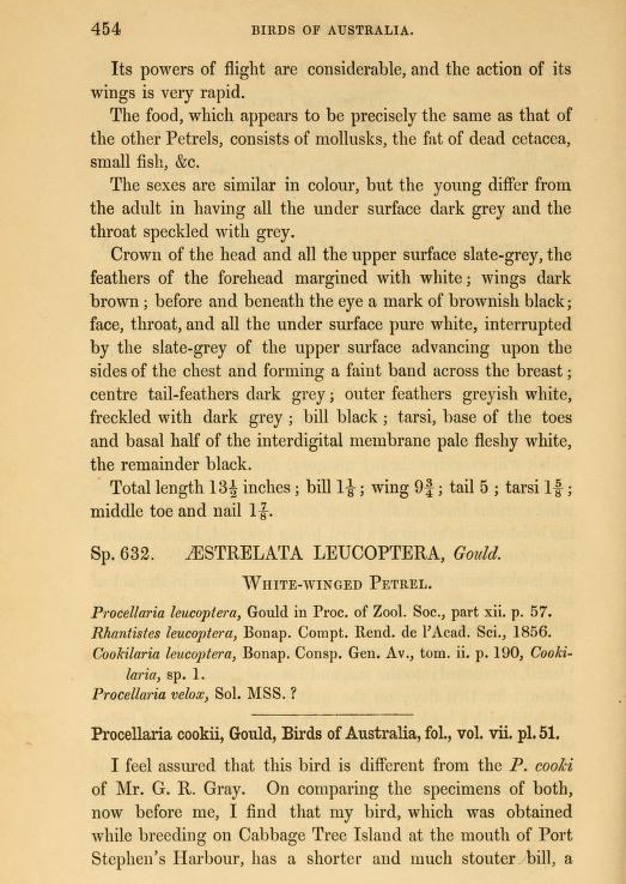
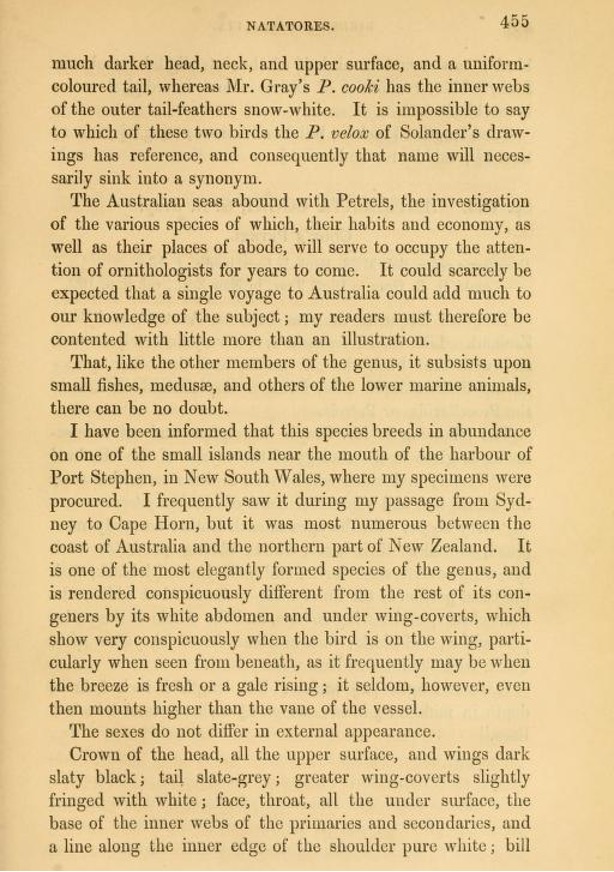
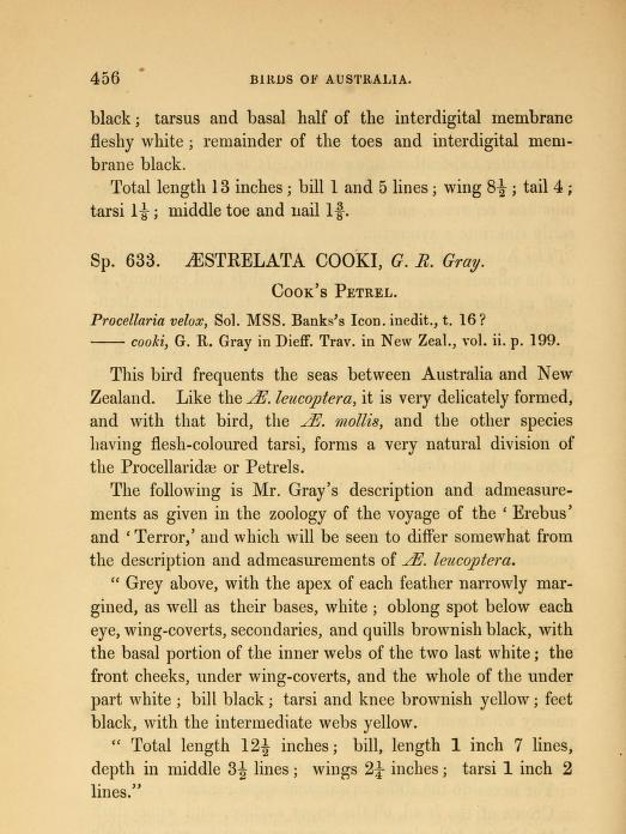
In a later ornithological work, Birds of the Ocean (1928), W. B. Alexander deemed this bird sub-species as Gould’s Petrel (Pterodroma leucoptera).
Expedition to the Islands of Port Stephens – 1930
The Sydney Morning Herald of 3 December 1930, reported:
‘A party of bird-lovers and others will visit Port Stephens next month, leaving Sydney and Newcastle on January 2. Cabbage Tree and Broughton Islands, off the coast, where numerous sea birds, especially little penguins, petrels, and mutton birds have their breeding haunts, will be explored, and Schnapper Island, in the bay, where night herons breed in thousands. The party will be led by Mr. E. F. Pollock.’
Visit to Cabbage Tree Island to Examine the Sea Birds – 1936
The World’s News of 3 June 1936, reported:
‘……. On visiting Cabbage Tree Island we found the Mutton Birds breeding, and the burrows mostly contained young birds. The interesting White-winged Petrels (Aestrelata leucoptera) were plentiful, and nesting under masses of the large fallen leaves of the Cabbage Palm (Livistona australis), or in small caves and crevices among the stones, where they laid one white egg. I photographed one of the young birds sitting in its nest and clothed in bluish-grey down. The great John Gould states in his wonderful work on Australian Birds, that he described this species from specimens which were collected on Cabbage Tree Island, where the birds were then breeding in great numbers. That would be about ninety-seven years ago.’
Wartime Artillery Practice on Cabbage Tree Island Prohibited – 1943
The Sydney Morning Herald of 8 November 1943, reported:
‘Cabbage Tree Island, the sole known resting place in Australia of the white-winged petrel, is no longer to be used as an artillery target. The Minister for the Army, Mr. Forde, has notified the Royal Zoological Society that he had issued instructions to this effect.
Mr. Athol D’Ombrain, of West Maitland, recently reported that the island was being used for gunnery practice and the secretary of the Zoological Society, Mr Basset Hull, pointed out that this might lead to the extermination of the birds which were very rare. The island is a sanctuary for fauna and flora under State laws.’
The Singleton Argus of 14 April 1944, also reported:
‘Artillerymen were using a little island off the New South Wales coast, until the Royal Zoological Society pointed out that it was the last Australian home of the rare white-winged petrel, and the species was in danger of extermination. Immediately a Ministerial edict went forth to change the target. Pen-name for the petrel is Pterodroma leuceptera. It was first made known about 1840, when it was found on this island, and 60 years later it was rediscovered there in the same steep rocky gully, overgrown by pseudo-jungle, above which peeped the crowns of cabbage tree palms, from which the island takes its name.
The bird is widely distributed over the Pacific Ocean, but Cabbage Tree Island is the only spot where it has been found breeding. Rather larger than a pigeon, it expresses itself in a parrot-like piping, has soft grey coat and soft white breast, and according to a leading ornithologist, “an endearing behaviour at the nest.”
Visit to Cabbage Tree Island for a Bird Count – 1948
The Newcastle Morning Herald and Miners’ Advocate of 28 January 1948, page 2, reported:
‘Mr. Athel D’Ombrain spent a morning at the weekend counting birds on an island near Newcastle. The birds—the white-winged or Gould’s petrel—were discovered by John Gould in 1840 on the island. This is the only known place in the world where the birds nest. Mr. D’Ombrain is acting for the Royal Australian Ornithologists’ Union in checking the population of these birds. He has also ringed a number with small metal bands in an effort to obtain information on their migration.
These, or similar birds, have been found on New Zealand beaches at certain seasons. It is thought they may fly the Tasman in yearly migrations. If some of the ringed birds are found in New Zealand, this question will be solved. The birds are unable to fly from land. They walk to the water before taking off. They have many natural enemies. One of the worst is the bird-lime tree which grows on the island on which they best. Seeds, covered with a sticky substance, fall from the tree. In clambering to the water, birds get their wings so matted with the seeds that they are unable to fly. Mr. D’Ombrain said vandals had been on the island, which was a sanctuary. He did not wish to disclose its name for fear of attracting other vandals to it.’
Visit to Cabbage Tree Island – 1951
The Land of 10 October 1951, reported in part:
‘….. The writer of this article wishes to thank Mr. A. F. D’Ombrain [Athel Fetherstonhaugh D’Ombrain], of Maitland, for consenting to come on this trip and explain many things associated with life on Cabbage Tree Island, of which he is an honorary ranger. Much of the knowledge contained herein is his knowledge.
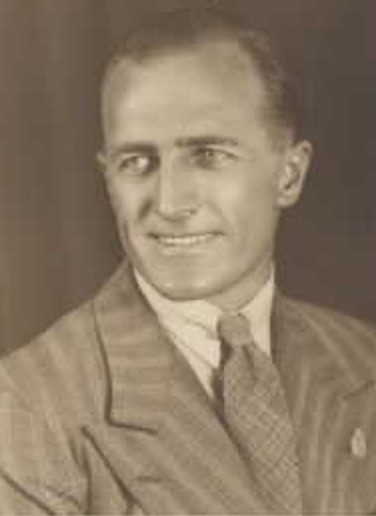
Athel Fetherstonhaugh D’Ombrain [Ancestry]
In the name of the world’s nature lovers, he must also be thanked for regularly visiting, for the past 15 years, this gem of the sea, thus proving himself its devoted custodian. A member of the Royal Australian Ornithologists’ Union, he is a son of Dr. E. A. D’Ombrain [Ernest Arthur D’Ombrain], a former president of the same society.
But, to many humans the most important of all this bird population is the Gould or White-Winged Petrel (Pterodroma leucoptera). Listen carefully now and fill your nature loving heart with all the ideals of protection you can muster.
Australia can claim many other species of Petrel as her own. But this small spot of the earth, this Cabbage Tree Island, is the only known place in the universe where the Gould Petrel breeds. To what regions it departs when its fledglings have gained wing-strength for the journey, no man knows. It comes, it goes, slipping in and out of the pattern of existence as quietly as do night and day.
In an endeavour to unravel this mystery some of the Petrels were, some years back, banded with rings supplied by the Victorian Division of Game and Fisheries. But so far, no light has been gained on their migration.
The Gould Petrel was first described by the great John Gould, in the 1840’s; it is mentioned in his work, “Handbook of the Birds of Australia,” published in 1865.
A small bird, it is dark, very dark grey on the neck and the back. This grey fades to an ashy paleness on the face and the breast. The underside of the wings are white, hence the term—”White Winged.”
The formation of this island includes two gullies which, while they are not marked by deep embankments, rise steeply from the rock-bound shore to just below the island’s summit. On these Mr. D’Ombrain has bestowed the names South Gully and North Gully. In these gullies the little Petrels breed. This nature lover knows what he terms “Gould Petrel country” step by step.
We left the sunny world behind on this early morning when we entered the green tunnel which is the South Gully. A quiet waiting world, a world of growth. A world of cathedral dimness with the blue sky shut out by the dense roof of green overhead. Here, too, green growth walled one in, to no small extent robbed one of a sense of freedom. In these gullies grows, even close to the edge of the sea, the Cabbage Tree Palm (Livistona australis) from which the island takes its name.
But if much of the vegetation in these gullies is beautiful the incredible, stone-covered floors also clamour for attention. It is difficult to describe those stones. From a few inches they range to boulders feet long and feet thick. A Gould Petrel nests among the rocks on Cabbage Tree Island. This weather-proof abode is warmly lined with pieces of palm frond.
The geological explanation is that in the beginning, the Toscanite rock was an unbroken sheet-like mass. Then, tinder the action of weathering and time, it gradually fell apart— first into boulders, and from boulders, into smaller fragments.
Now, many of the smaller stones are well embedded in the earth but many, too, lie loosely on the top of the floor of the earth. This looseness makes going difficult, even dangerous. The saying “watch your step” has no flippant value here. You must go ever upwards warily with a stout stick for support, clinging sometimes to the branch or the slim stem of a tree.
While in these gullies the Gould Petrels live happily, they have an enemy in the tree kingdom, the dreaded Bird-lime Tree (Pisonia Brunoniana).
As they have come fluttering into the nesting grounds under cover of the dark, the feathers of many a Gould Petrel have been covered with the viscid seeds or gum of this tree. Some of the little birds have survived by making their way to the water’s edge and washing themselves free of the sticky mass. But when the feathers are tightly gummed about the body or the little claws are gummed, then there is only one end.
Because he would see this little world safe and free for these birds he loves so well, Mr. D’Ombrain has gradually felled all the larger specimens of Pisonia. Even on this morning I saw him hack down the smaller ones he had missed. As far as the vegetation of our islands is concerned how much we have taken for granted! In the main we say: “It is the work of Nature.” And then how tightly we close our eyes to the possibility of a great romance; that the coming of the shrubs and the trees may have been the work, over unnumbered years, of the feathered populations and the winds.
Certain it is that seeds of some of these shrubs and trees on Cabbage Tree could have been carried from the mainland on the wings of the gales or again, they could have been carried in the crops of the shoreland and island birds.To support this contention most of the species of trees on the Island are also to be found in the brush forests of the adjacent coast.
The seeds of the Harsh Honey Rush which forms such a protective cover to a big acreage of many island’s, must have been warmly and safely carried across miles of ocean in the bodies of the little Fairy Penguins and other sea birds. How else can its wide distribution be explained?
As economic agents in clothing the land with plants, and among plants I include trees, how much we owe to the feathered friends! What thanks have we rendered them for these services? Possibly the minimum, and if possible, less. Indeed, the most truthful answer is that, by way of repayment, we have more often constituted ourselves their enemies than their friends.
The gully areas on Cabbage Tree could well be rated among our nation’s treasure vaults! Not because of rare plants but because of their unusual features.
The loose stone covers of the gully floor provide wonderful drainage systems for the plant life. The continual dropping of the palm fronds, the continual falling of leaves, the dense overhead screen of foliage through which the rain can only penetrate softly and which aids the retention of moisture so that all decay of foliage, seeds, and dead timber goes on at a deliberate pace, all these things must combine to maintain soil fertility at a peak point of magic.
I think if you paused here long enough, you would plainly hear the soil throbbing with life, that if you could reach deep down, you would feel the soil warm with life. I am sure I am right. By what other means could the seeds that fall be encouraged to put forth their shoots and find their way above that stone cover to set forth on their long journey to the sky?
I do not think any of the plant life in these gullies is of exceptional age. Here, possibly, age limits are a matter of steady come and steady go. Nevertheless, some of the palms and some of the figs must have known the moods of many, many seasons.
The native figs are not abundant on Cabbage Tree, but five which I saw growing within easy distance of each other are a joy to remember. Their girths were splendid. One of them sprang heroically from among great boulders and sent mammoth roots yards long in search of food. From these large roots sprang smaller ones to form a rich buff fretwork, more beautiful than many carvings, over the rocks.
Some of the other species of trees which I found here were the Elderberry Tanax (Tieghemopanax sambucifolius), the Black Plum (Disopyros australis), Guica semiglauca and Wilkiea macrophylla—all of these have strikingly handsome foliage. Added to these were the Pittospornm undulatum, Brush Cherry (Eugenia Myrtefolia) and Sea Rosemary (Westringia Gosmarinfolia). The Coastal Myall grows close to the island’s summit. Other species have yet to be identified. Vines with glossy tropical foliage also inhabit the gullies.
On one rock in the South Gully, I saw baby Bird Nest Ferns less than the size of three-pence, perhaps two months old. A green rosette of them rising to life on that which man says holds no nourishment. That alone was worth the trip to Cabbage Tree. From shore to top of this island is 475ft. and tough going. When Mr. D’Ombrain said we were almost at the top, I visualised a clear space, a space to rest. No such luck. We emerged from the green tunnel of the South Gully—how good to feel again the sweetness of the wind—only a few feet from the great Eastern rampart.
This scene is magnificent. Rocks and cliffs and islands yield grandeur to it, wide and distant sweeps of sky and ocean, immensity. Here, indeed, was rest and refreshment. Broughton Island in the north-east was a blue black blur. Close at hand but to the south, the ochre-coloured cliffs of Boondelbah, or Big Island, rose steeply like a challenge. Far south the outline of Shark Island was dimmed by distance. The high peaks and hills of the shoreline were darkly splendid.
The ocean heaved eternally, slow motion style, as oceans have since the third day of Creation. But the finest, the most beautiful thing in all that scene was surely the Falcon Rock, one with, yet slightly separated from, this rocky rampart of Cabbage Tree.
Though you look down upon it, it is over 300 ft. high. And here, well beyond the reach of man, how wisely they have chosen it, the Falcons nest and bring forth their young. Storms may sweep the citadel, but they will never shake it. And they will pass. The fury of the sea will die, and peace will come and with it days of easy fishing. All these things go to the making of a frontier of security.
We descended the island by way of the North Gully. Close to the shore Mr. D’Ombrain pointed to the spot where the Wanderer Butterflies are to be seen in summer. As our dinghy left heard again the Thrush sing. May it and its relatives ever sing there. May the little Gould Petrels forever flutter into the gullies in the nesting seasons with a sense of confidence in men in their hearts. And may the trust of all these feathered things never be betrayed.’
In 1975, Athel D’Ombrain, the naturalist from Maitland, was honoured by being made a Member of the Order of Australia, for his interest and enthusiasm in Nature. For 44 years Mr D’Ombrain studied the Gould Petrel an made 88 trips to Cabbage Tree Island in pursuit of that study.
Cabbage Tree Island Dedicated as a Fauna Reserve – 1954
The Sydney Morning Herald of 27 December 1954, reported:
‘Two faunal reserves have been established and dedicated under the N.S.W. Fauna Protection Act – one at Cabbage Tree Island, off Port Stephens, and the other on the Bulga-Comboyne Plateau.
Establishment of the reserves is announced in the monthly bulletin issued to rangers by the Fauna Protection Panel. Faunal reserves are, in many respects similar to the nature reserves in Britain. Their purposes are the preservation and scientific study of fauna.
The Chief Guardian of Fauna, Mr. F. J. Griffiths, saw that Cabbage Tree Island has been made a reserve to preserve the Gould petrel, which is not known to breed anywhere but on the island. The reserve has been named the John Gould Faunal Reserve after the great naturalist whose name the Gould petrel bears.’
Conservation of the Gould Petrel
In recent years much attention has been given to preserving the Gould Petrel which breeds primarily on the islands near Port Stephens.
In 1990, a team of specialist CSIRO Scientists and National Parks and Wildlife Services (NPWS) experts launched a survey in a bid to save the Gould Petrel. It was believed there were only 250 Gould Petrels in the world and they were all on Cabbage Tree Island. Two CSIRO scientists and two National Parks and Wildlife Rangers camped for four days on the island to complete the initial survey as preparation for further preservation action.
Remedial action was taken. In 1993, birdlime trees (Pisonia Umbrellifera), the sticky fruit of which immobilised birds were removed from Cabbage Tree Island. Pied currawongs which were major predators were also culled.
Rabbits were also eradicated from the Island In 1997. Seven rabbits infected with rabbit calicivirus virus were let free by National Parks and Wildlife Service to eliminate their impact on the Gould‘s Petrel habitat. Rabbits had been eating the dense rainforest groundcover, thus exposing the birds’ nests and young to predators.
In 1999, the National Parks and Wildlife Service successfully undertook one of Australia’s first full-scale translocations of a sea-bird with the establishment of a second breeding colony of nearly fully grown Gould Petrel chicks on nearby Boondelbah Island. This second site was seen as a major step in assisting the survival of Gould’s Petrel.
By 2010, NPWS estimated the total population of Gould petrels to be 2500 individuals and rising.
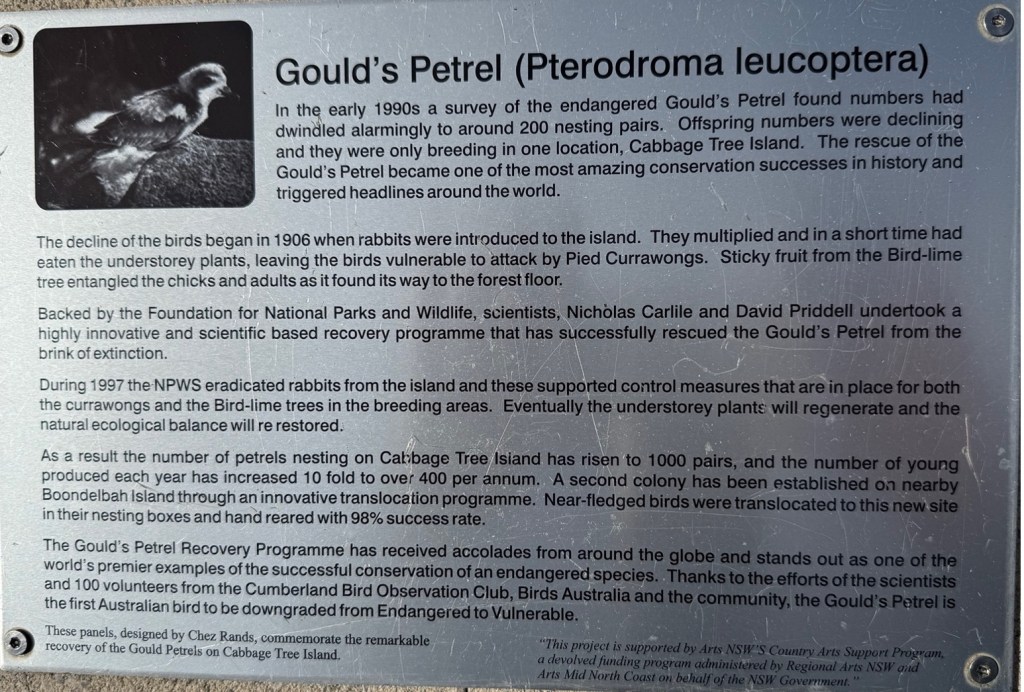
Signage at Bennetts Beach at Hawks Nest [Author photo]
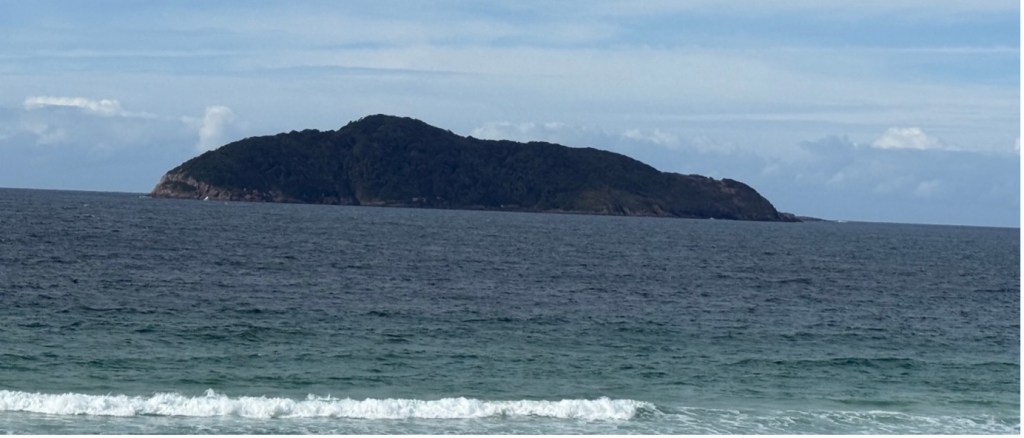
View of Cabbage Tree Island from Bennetts Beach [Author photo]
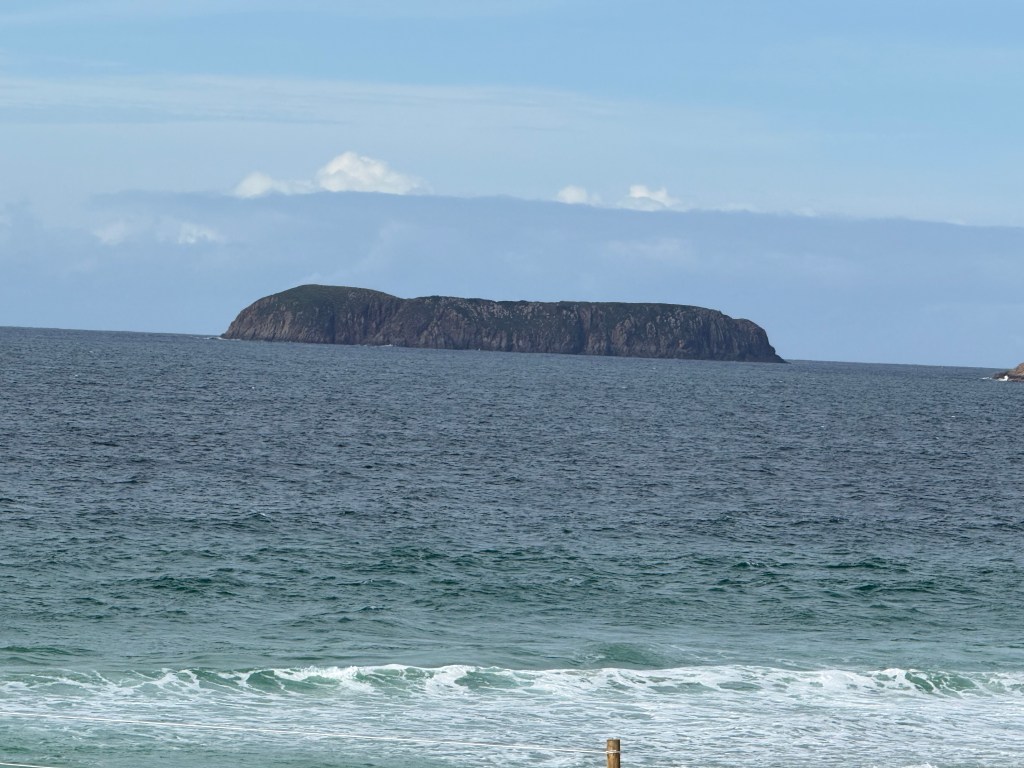
View of Boondelbah Island from Bennetts Beach [Author Photo]
Concluding Comments
In March 2025, the Tomaree Museum Association (TMA) staged an exhibition in the Visitor Information Centre at Nelson Bay on “The Islands of Port Stephens”.
A feature was the presentation to the TMA of a larger-than-life model of a Gould Petrel by local Sculptor, Matt Johnston.
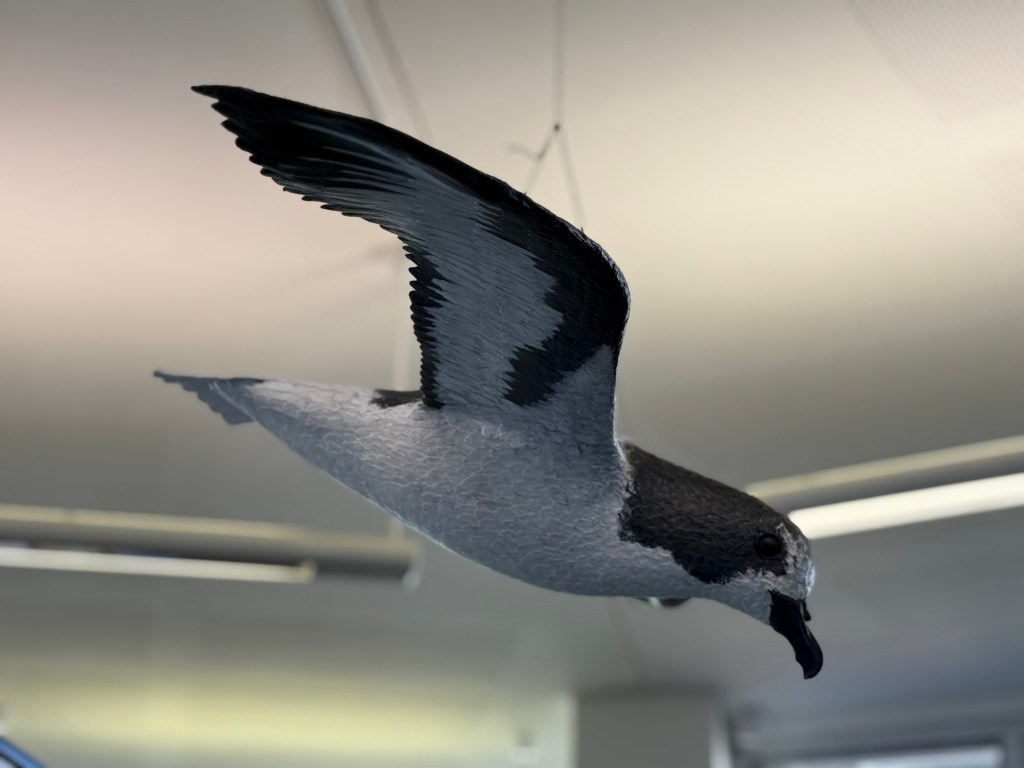
A model of the Gould Petrel commissioned by the Tomaree Museum Association for “The Islands of Port Stephens” exhibition 2025 [Author Photo]
Visitors to Tomaree Head at Port Stephens, who are desirous of climbing Mount Tomaree are informed to watch for the rare Gould petrel, which may be sometimes sighted in flight near this significant natural landmark.
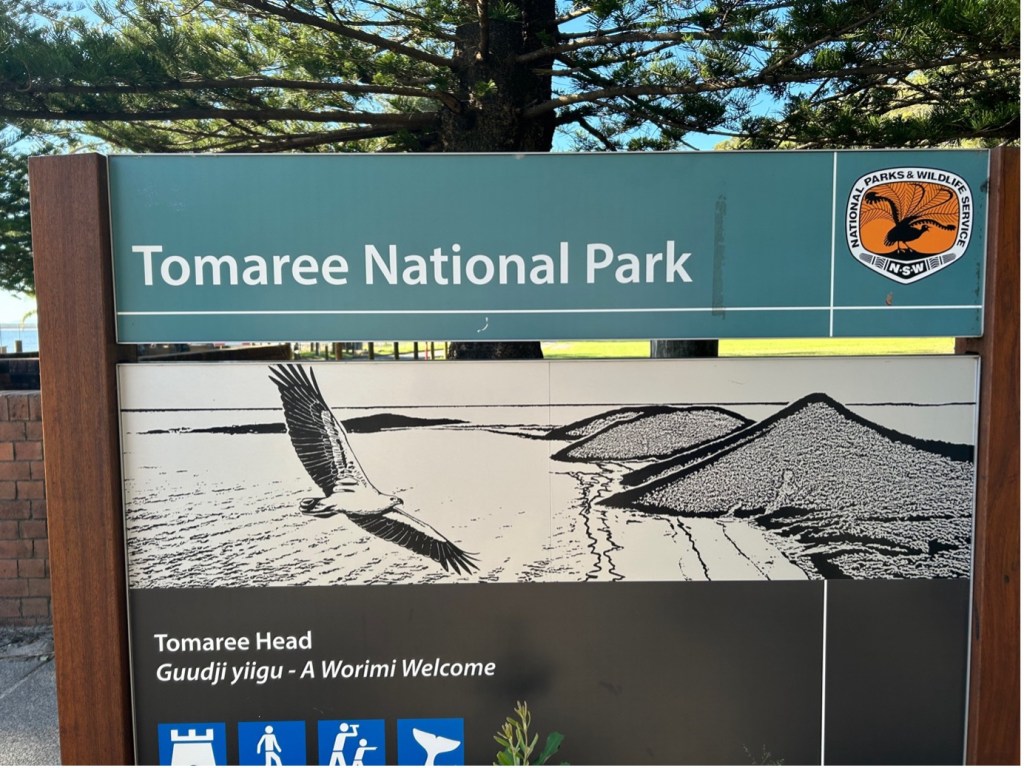
Tomaree National Park signage at Tomaree Head featuring the Gould Petrel [Author Photo]
PART TWO: APPENDICES
Appendix One: Life and Work of John Gould
The Daily Mirror of 11 May 1954, page 21, published the following article on John Gould and his work in Australia. While much of the information is informative, the reader of this article may not agree with some of the interpretations advocated:
‘Late in 1848, the limited cultural, artistic and social circles in the embryo British colonies of Sydney and Hobart were thrown into a flutter by publication of the seventh and last volume of a monumental work costing the then enormous sum of £100. In delicate colours, the volumes depicted most of the birds of Australia, the first time they had ever been assembled on such a vast and luxurious scale. Four men died violently collecting specimens and information for the books which were produced by an uncouth domineering ex-gardener’s boy and protege of kings by the name of John Gould. Gould was the world’s first ‘Bird Man.’

John Gould [Australian Museum]
His name has been given to many Australian societies pledged to the protection of birds. Which is curious, for in his day this “patron saint” of bird lovers slaughtered thousands of birds. He had to. There were no movie cameras then. The only way to study a bird was to shoot it, and this Gould did with gusto. Gould made the world bird conscious and cashed in on it. He sold skins, skeletons and eggs of birds. He pickled birds in all their plumage. He started the craze which placed a stuffed bird in the place of honour in many Victorian parlours. He also ate birds: Western nations owe Gould a debt for introducing the Australian love bird as a pet. They would not admire so much his habit of eating them by the score or more and declaring their flesh “delicious.”
To Gould, birds meant big money. He amassed a fortune from his books. At one period subscriptions on his waiting list amounted to more than £140,000. His books gave Britons their first true impression of beautiful birds they could never hope to see, such as Australia’s lyre bird. In “Birds of Australia” alone, there were 601 exquisite illustrations. Gould was born at Lyme Regis, Dorset, in 1804, son of a farm hand. His father became foreman-gardener at Windsor Castle where young John ran wild in the Great Park and gardens. He came early to the attention of the dissolute George IV, and his slighted, unhappy German Queen, Caroline. One of John’s earliest chores was to gather dandelions for Queen Caroline’s daily draught of dandelion tea.
Windsor Great Park was a sanctuary for wildlife. It was there John Gould developed his passion for birds. He started his collection with a nightingale which he killed as it sang at dusk. He skinned it, mounted it and decided to be a taxidermist. Though self-taught, he became Britain’s leading expert. He was only 23 when he was appointed taxidermist to the newly formed London Zoological Society. He earned the praise of George IV, then laying out royal Regent’s Park, by stuffing and mounting the first giraffe ever sent to England. Work at the Zoo convinced Gould that a fortune could be made by selling, stuffing, mounting sketching and describing birds. Britain’s empire was expanding apace. The people were eager to know all about the weird creatures found by colonists, explorers and soldiers in Australia, South Africa, Canada, India and the East.
Gould decided to satisfy the craving — and make a career of it. He started when London Zoo received a collection of bird skins from the Himalayas. It fired him to produce his first book. Meanwhile he took a little time off for romance. His position at the Zoo and the patronage of George IV had raised his social status. The gardener’s son had no difficulty in persuading Elizabeth Coxen, daughter of a country squire, to marry him. It was not all love. He had spotted her skill as an artist. When she asked “who will paint the pictures for your book?” he replied triumphantly, “You will.”
From then to her premature death 12 years later, Elizabeth Gould made over 600 full-colour sketches of birds and tediously re-drew them on stone blocks for printing by lithography. She also found time to bear three sons and three daughters. To Gould’s amazement, no London publishers would touch his first book, “Birds of the Himalayas.” They scoffed that sales would never recoup the great expense of printing. John Gould took a gamble. He begged the patronage of the new king, William IV and Queen Adelaide, still interested in the poor boy from Windsor, and sank all his savings in publishing it himself. At the royal nod, society rushed to buy. The book sold well at high prices. From then Gould published all his books himself.
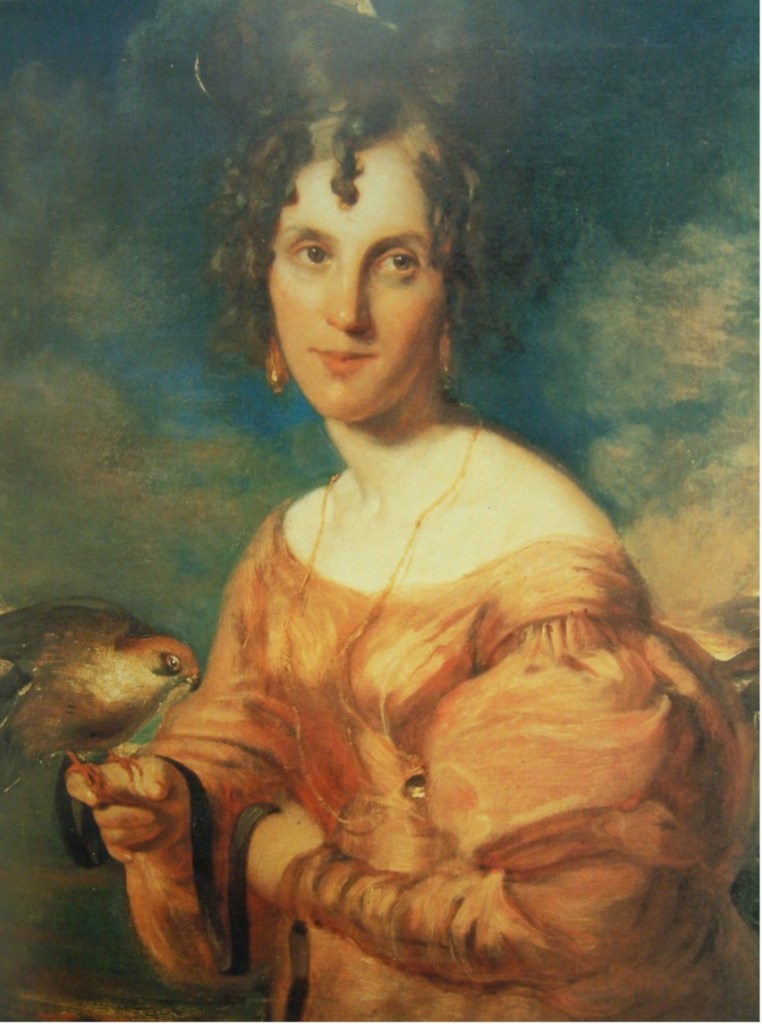
Elizabeth Gould, nee Coxen [Australian Museum]
Still only 28, he opened a stuffing business, employing the two best taxidermists in England, craftsmen Joseph and Baker. Coroneted carriages rolled up to his workrooms in Golden Square, London, bearing aristocrats with dead pets for mounting in life like poses. An army of collectors snared birds and robbed nests for him. He sold rare eggs at fantastic prices. He once bought an egg of the extinct great auk for £80 and sold it next day for £150 on condition that the purchaser also bought one of his volumes at £78 15s.
He next concentrated on another book “Birds of Europe,” for which his wife painted pictures from pickled or mounted specimens sent in exchange for British birds. When Gould left for Australia in May 1838, he had £7000 in the bank. He travelled in the 348-ton barque Parsee, accompanied by Mrs. Gould, her son Charles, her 15-years-old nephew Henry Coxen, and Gould’s assistant, John Gilbert. With them they took crates of preserving jars, barrels of preservatives, snares, guns, and letters of recommendation from high Government circles to Sir John Franklin, Governor of Tasmania.
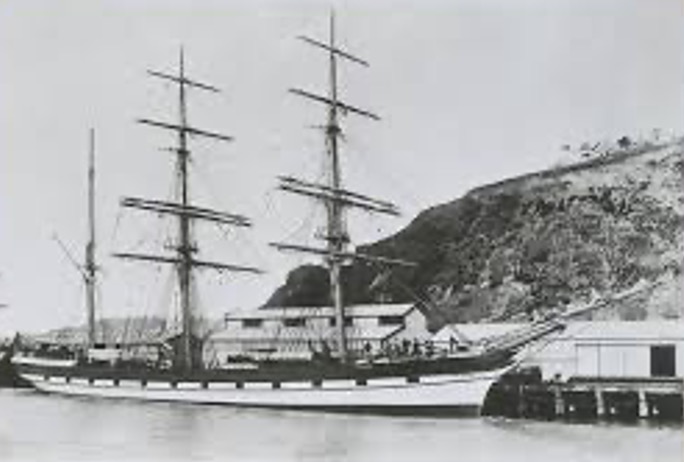
Iron barque ‘Parsee’ [State Library of South Australia]
When the barque was becalmed Gould and Gilbert lowered a boat, shot seabirds and pickled them. In Hobart, the party stayed at Government House. Sir John Franklin gave Gould the use of the Government schooner and sent the eccentric Lady Franklin along with him. Gould’s first act was to shoot a graceful wandering-albatross. He laughed openly at the seamen’s superstition that he who kills an albatross courts disaster. A few days later, a convict detailed to carry Gould’s gun slipped while landing on a Bass Strait island and blew out his brains. To Governor Franklin, Gould deplored the convict’s carelessness. Seamen, however, spoke ominously of the slaughtered albatross.
Gould and Gilbert earned some criticism in Hobart Town by blasting at point blank range the flocks of dainty, swift lorikeets— which fed on nectar from eucalypt blossoms along the streets. In Hobart, Mrs. Gould gave birth to a son, Franklin Tasman whom Lady Franklin wished to adopt. Gould and Gilbert then left for Sydney, spending most of the voyage luring white-headed petrels within gunshot with a floating bottle juggled by a string.
They toured south to Berrima and north to Yarandai on the Upper Hunter, home of Gould’s brother-in-law, Stephen Coxen. There, Gould organised his greatest expedition. Five Europeans, with two native boys to climb for eggs, plunged 400 miles inland along the Namoi, rapidly filling their preserving jars with new and beautiful specimens. Gould fell in love with the love birds, which he was to introduce to the western world as pets.
It did not prevent him, however, from shooting them for the pot. He declared their flesh “deliciously delicate,” and often wolfed a dozen at a sitting, spitting out the bones with deplorable coarseness. He returned to Hobart with 800 specimens of birds and 70 of mammals. Preserving 100 whole, he reduced the rest to skeletons. Gould then went to the new town of Adelaide. Explorer Charles Sturt took him on a survey expedition to the north, where they nearly perished of thirst. On this trip Gould shot the only pink robin and the only, purple-gaped honeyeater ever seen in South Australia. He rhapsodised over the tricolour-crested cockatoo. “This most wonderful and ecstatic being,” he called it till he tasted one. Then he condemned it as poor eating.
Gould found more than 300 new varieties of birds in Australia and tasted most of them. Wherever he went, his party killed for sport as well as for the pot. Their delight when they bagged a rare bird rings oddly in these days, when Australians are encouraged to protect wildlife. Gilbert would track a rare bird for hours and “come in as pleased as a child if he succeeded in shooting it.” As he skinned it, he would sing in a beautiful tenor voice.
Gould returned to England in 1840 to begin his work on ‘Birds of Australia.’ With him he took thousands of dead specimens and many live ones, including love birds which he introduced as pets. Gilbert remained behind in charge of the corps of collectors Gould had trained to continue the search. They were dogged by ill-fortune. Gilbert himself joined Ludwig Leichhardt’s expedition from Brisbane to Port Essington in 1845. Aborigines attacked them as they camped in wild country by the Gulf of Carpentaria. Gilbert fell dead with a spear through his throat. Two others were wounded before the raiders were beaten off. Gilbert is commemorated by a plaque in Sydney’s St. James’ Church.
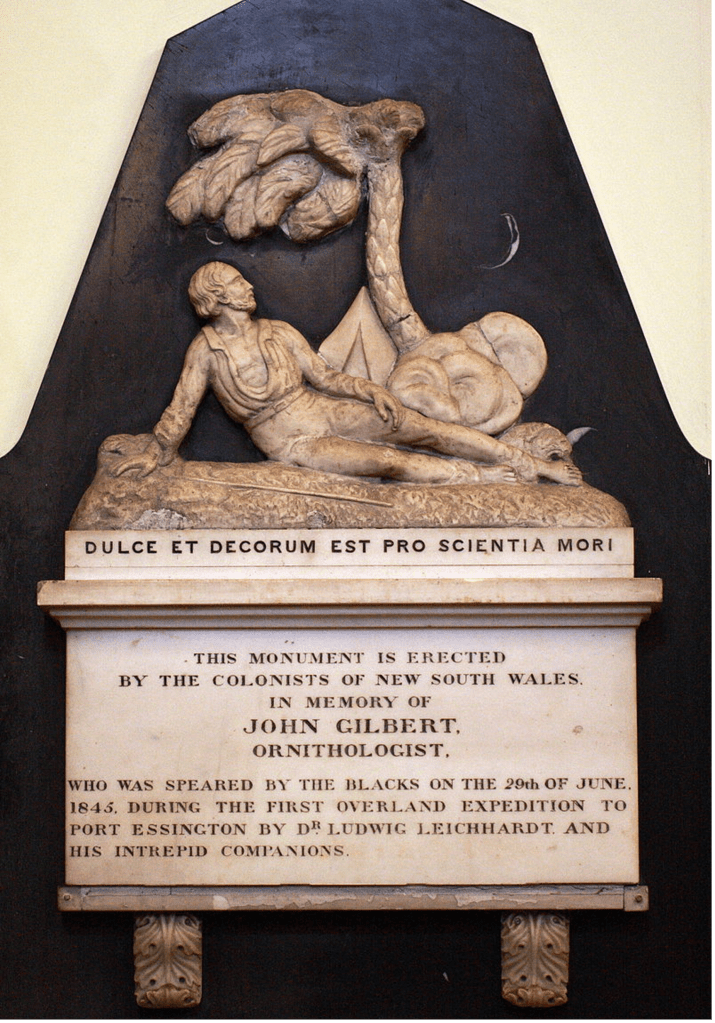
John Gilbert plaque in St. James Church, Sydney [Wikipedia]
Two other agents collecting for “Birds of Australia” met violent deaths. Johnston Drummond was speared by natives in Western Australia, while Gouldman F. Strange was similarly slain by a tribe on the Percy Islands off Queensland. Back in England a long run of personal tragedy struck Gould. His wife died in 1841 at the age of 37, worn out, it was said, by overwork on sketching birds and the strain of bearing six children. Gould named a newly discovered bird the Gouldian Finch in her honour. His son Henry died young in India as a missionary. Franklin died at 30 while convalescing on a sea voyage. His third son, Charles, vanished into the jungles of South America while seeking humming birds for his father.
Worldly honours and wealth however poured on Gould. He enjoyed the patronage of Queen Victoria and Prince Albert. The Royal Society made him a Fellow. Birds of Australia, illustrated by famous humourist Edward Lear, on which he had slaved for eight years, brought in a fortune at £100 a set. His ‘Mammals of Australia’ was also successful. Subscriptions soared to £147,000. An exhibition of humming birds in London in 1851 brought in £800 at sixpence a head. In quick succession Gould produced his ‘Birds of Great Britain’” followed by ‘Birds of Asia.’ He then offered high prices for New Guinea birds and began to prepare another book.
He died in 1881 aged 77. The New Guinea book was completed by a friend, Mr. R. B. Sharpe, of the British Museum. In his life John Gould studied and recorded the birds of all continents, except the United States and Africa. Never before had the subject been approached on such a vast scale. His 41 volumes were illustrated by 2999 plates laboriously coloured by hand. Thirty years after his death Australian bird lovers formed a society, named after Gould. It forbids Gould’s favourite past-time of killing birds and frowns on egg stealing. Most birds, especially the rare and beautiful, are protected. Stuffed birds are out of fashion in Australian and British parlours. Bird watching rather than bird killing is the vogue. If John Gould lived today, he would be the first to have it so.’
Appendix Two: Background to John Gould’s ‘Birds of Australia’ Book – 1841
The Australian of 18 September 1841, page 3, published a report which appeared in the Westminster Review in April 1841 to coincided with the commencement of the publication of Gould’s “The Birds of Australia”.
The report provides a comprehensive story of Gould’s exploratory tour of parts of Australia, including his visit to the Hunter region:
‘Arrived at Van Diemen’s Land, Mr Gould spent ten months in exploring that Island and the islands in Bass’s Straits. By way of interlude, however, he paid a short visit to New South Wales at the time of a severe drought, to which we shall have occasion to revert. This hasty trip, which he extended to the Liverpool Range, prepared Mr Gould for his great expedition, and enabled him to procure both entire specimens and skins of the Lyre bird (Menura superba), the former of which he transmitted to Professor Owen, of the Royal College of Surgeons, for dissection.
Omitting for the present any further reference to this hurried visit to the Australian continent, and reverting to Mr Gould’s arrival at Van Diemen’s Land, we have the grateful task of stating that he was there most cordially received by the Governor, Sir J. Franklin, whose polar expedition all are familiar with, and who, being himself a man of great science, and consequently capable of appreciating the value of Mr Gould’s undertaking, afforded him every assistance.
While making Van Diemen’s Land and Bass’s Straits the theatre of his operations, Mr Gould took the opportunity of visiting Flinders Island, where the scanty remnants of the Papuan Indigenes of Van Diemen’s Land still exist, sole survivors of their once numerous race — a race soon to become extinguished.
To a zoologist Flinder’s Island is interesting from its intermediate situation between the Australian continent and Van Diemen’s Land. Some of its productions, as might be anticipated, are common to both; its general fauna, however, is that of the latter. While in Van Diemen’s Land Mr Gould separated from his principal assistant, Mr J. Gilbert, whom he sent to the western coast of the Australian continent, while he himself proceeded to the south coast, making Adelaide his rendezvous. Here he was liberally supported in the prosecution of his enterprise by the Governor, Colonel Gawler and Captain Sturt. By these gentlemen he was furnished with the requisites for a campaign, and with trusty attendants.
According to the advice of Captain Sturt, Mr Gould proceeded to explore the Bush, or Great Scrub, which, for the extent of a hundred miles, borders the Murray, and he advanced nearly to the west bend of that noble river. The Scrub, which Mr Gould penetrated, stretches over a dead level, and is about twenty miles in width, and a hundred in length. It is composed of a close mass of brush-like trees, amongst which dwarf Eucalypti and pittosporums are abundant. In this vast plain, which Captain Sturt, in his overland journey from Sydney to Adelaide, had previously traversed, and where he was struck with the novelties around him, Mr Gould remained between two and three months, and was well rewarded for his toil by the riches of the country, to him not desert, but tenanted by beings of the highest interest,— birds and mammals new to science, and of various forms and habits.
From this wilderness, which the foot of white man had seldom trod, and which no zoologist had ever explored, he descended to the coast and crossed to Kangaroo Island. In this spot, covered with a dense forest of Eucalypti, but which holds out no inducements to the settler (for forests do not here, as in America, indicate the value of the soil to the colonist). Honey-eaters were hovering about the flowers, and glancing in the sun, and the rugged coast was tenanted with hawks and eagles, which there find a secure abode. The Wallaby kangaroo was seen in herds, and other mammalia were also plentiful.
Desirous of being in New South Wales at the breeding season of the birds, Mr Gould now left the southern coast, and arrived at that place in August. Here he received from the Governor-in-chief, Sir G. Gipps the most important assistance given in the most kindly spirit. Two or three trusty convict servants were assigned to him, and he was further supplied from the Government stores with tents and the necessary utensils and materials for loading the life of a bushman. His attention was first directed to the thick tracts of brush and the small islets at the mouth of the river Hunter. These islets consist of a deep alluvial soil, and are covered with the most luxuriant vegetation, the densest foliage. From the midst of a thick underwood rise numerous palms and huge fig-trees, entwined by creepers of the most graceful and fantastic forms.
Birds of the richest hues, honey-eaters on restless wings, regent birds, satin birds, and beautiful wood pigeons (Visago) enlivened by their presence those umbrageous wilds and added charms to the scenery. It was here that Mr Gould met with that extraordinary bird, the wattled tale-galla, or brush turkey of the colonists, of which so little was previously known that naturalists were divided as to whether it belonged to the vultures or the gallinaceous race.
From the mouth of the Hunter Mr Gould tracked its course to its rise in the Liverpool range of hills, stopping in various parts for the purpose of collecting specimens and making observations. It happened fortunately for Mr. Gould that a near relative, (a brother of Mrs. Gould), S. Coxen, Esq., a gentleman of extensive property, resided on the Dartbrook, a branch of the Hunter, nine miles from the base of the mountain chain. Here Mr. Gould not only occupied a most favourable position but was enabled to combine every advantage requisite both to render his examination of the flat tracts of this district successful, and also his excursions to the range itself, in the ravines and gullies of which he encamped for some time.
This mountain range, which abounds with lyre birds, black cockatoos, and with many species of kangaroo, is about one hundred and sixty miles from the sea at Newcastle, and two hundred and thirty east of Sydney, forming the limits of the colony in that direction. Hitherto Mr. Gould had only explored the country between the coast, and this mountain chain, but the districts beyond those mountains were too inviting, and promised too many novelties to the naturalist, to be left unvisited.
Accordingly, Mr Gould made preparations for crossing the range, and pushing his way to the distant interior by way of the Liverpool plains, which stretch out from the base of the mountains. In the accomplishment of this enterprise Mr Gould was materially assisted by Mr. Coxen, who supplied him with bullocks and drays. He started this expedition in December, with a party consisting of five Europeans and two intelligent natives, whose services he found highly valuable.
After encamping for some time on the rivers Namoi and Peal he descended the Namoi to the distance of about two hundred miles from the mountains. As was to be expected he found the productions of these plains altogether a different character from those between the mountains and the coast at Sydney. In the place of forests of timber or vast plains of brush, the country was for the most part open, covered with a peculiar vegetation of grasses and here and there variegated with thinly timbered forests. Thousands of beautiful grass parrakeets, and flocks of the little-crested parrot (Nymphicus), and of rose breasted cockatoos, were seen in every direction, restless and busy.
The elegant frill-neck (Calodera nuchelis), a bird of extraordinary habits, graced the woods with its presence; but neither the satin-bird, the regent bird, nor the wood-pigeon were to be seen. Emus were wandering over these plains, uttering their hollow drumming notes, and troops of kangaroos were quietly reposing in their primitive pasture grounds. Of the latter animals Mr Gould here discovered several new species, some of gigantic size, and capable of overcoming the strongest and boldest of his dogs.
In these plains, sloping from the hills and along the course of the Namoi, huts were scattered, in which the stock-keepers charged with the care of the flocks and herds depastured on this vast grazing ground reside, and to which, during the time of sheep-shearing, and at other seasons, the proprietors occasionally resort. At one of these huts Mr Gould pulled up his horse, and found it occupied by Lieutenant Lowe and his nephew, who had gone down there for the purpose of being present at the shearing of the flocks belonging to the former gentleman. Although strangers to Mr Gould, their reception of him was warm and hospitable, and he left them under a promise of making their abode his resting-place on his return.
His second welcome was such as friends receive from friends and rejoicing that he had made an acquaintance with persons so worthy and estimable, he left busy in their operations, happy and prosperous. Seven days after his departure from their dwelling heavy rains suddenly set in; the mountain streams swelled into foaming torrents, filling the deep gullies; the rivers rose, some to the height of forty feet, bearing all before them; the Namoi having widely overflowed its banks, rolled along with impetuous fury, sweeping away the huts of the stock-keepers in its course, tearing up trees, and hurrying affrighted men and flocks to destruction. Before there was time for escape the hut in which Mr Lowe and his nephew were sojourning was torn up and washed away, and the nephew and two men, overwhelmed by the torrent, sank and perished.
Mr Lowe stripped to swim, and going on the trunk of an uprooted tree, hoped to be carried down the eddying flood to some part where he could obtain assistance. But he was floated into the midst of a sea of water stretching as far as he could discern on every side around him. Here he slowly drifted; the rains had ceased, the thermometer was at 100°, a glaring sun and a coppering sky were above him; he looked in vain for help, but no prospect of escape animated him, and the hot sun began its dreadful work. His skin blistered, dried, became parched and hard, like the bark of a tree, and life began to ebb. At length assistance arrived, it was too late; he was indeed just alive and died almost immediately. He was scorched to death.
A more melancholy and painful event cannot be well imagined. Deep dry, or half-dry water courses, and torrent-worn mountain gullies, appeal with expressive signs to the settler on plains skirting the base of an elevated chain. They are the indicia of the occurrence of sudden and impetuous swells, when heavy rains set in, and prudence dictates the choice of a situation above the mark to which the highest floods can rise.
After an absence of six months Mr Gould returned to Sydney. Here he received letters and packages from Mr Gilbert, who subsequently proceeded to the north, making Port Essington his principal station, and where he is still actively engaged. It has been stated that while making Van Diemen’s Land the centre of his operations during the first month of his arrival, Mr Gould paid a hasty visit to New South Wales. It happened to be during one of the severest droughts ever known in the country. Little or no rain had fallen for fifteen months, the rivers and pools were all dried, the land was a parched waste, vegetation was burnt up, and famine was spreading destruction on every side.
It is easier for imagination to conceive than for pen to depict the horrors of that dreadful season. Thousands of sheep and oxen perished, bullocks were seen dead by the roadside, or in the dried up waterpits, to which, in the hope of relief, they had dragged themselves, there to fall and die; trees were cut down for the sake of the twigs as fodder; the flocks were driven to the mountains, in the hope that water might be found there in the springs and pools, and every effort was made to save the colony from ruin. In spite of all that could be done the loss was extreme.
To the same place Mr Gould returned after an absence of five months, but a change had passed over the face of the country. The rain had copiously fallen, and the plains, on which but a short time previous not a blade of herbage was to be seen, and over which the stillness of desolation reigned, were now green with luxuriant vegetation. Orchids and thousands of flowers of loveliest hues were profusely spread around, as if nature rejoiced in her renovation; and the wheat shooting up vigorously, gave promise of a plenteous harvest. Suddenly hosts of caterpillars made their appearance, and inundating country, commenced their work of devastation; but not unchecked, for in the train of those destroyers came vast flocks of birds, attracted by their prey. Hawks of three or four species, in flocks of hundreds, were busy at their feast; and thousands of straw-necked ibises (Ibis spinicollis), and of other species of the feathered race, were performing their allotted parts, and benefitting man, while they revelled in the profusion of, to them, a welcome banquet.
Mr Gould had now been actively and successfully engaged for two years in collecting not only the birds but the mammalia and other natural productions of Australia; and in that space of time, he bad gained, as he says himself, ‘a rich harvest of knowledge.’ Many considerations now induced him, unwillingly, to return to England; not, however, without making arrangements with Mr Gilbert for the continuance of his exertions, and from whom, now at Port Easington, he will doubtless receive extensive collections and valuable notes.
After a safe voyage Mr Gould arrived in London in August, 1840, bringing with him, as the fruit of his enterprise, the finest collection of natural history which perhaps it has ever fallen to the lot of one man to procure. Not the least interesting portion of it consists in the nests and eggs of all, or nearly all, the anodes (numbers of them new to science), of which he has a series in every stage of plumage. With every advantage for bringing his heavy and important undertaking to a successful issue, Mr Gould immediately commenced his labours, and the first part of ‘The Birds of Australia”,, which appeared on the 1st of December, 1840, is now before us.’
Researched and compiled by Kevin and Mary McGuinness
April 2025

 Port Stephens - a history exploration