

Introduction
By the early 1920’s it was known that Aboriginal artefacts, possibly thousands of years old, had survived in the Port Stephens area.
Aboriginal artefacts, such as stone flints, tools and hunting apparatus held great fascination to the scientific community at that time, inspired by the prolific collection of Daniel Cooksey of Mayfield, Newcastle.
Under the auspices of the Australian Museum, field research was carried out in the Lake Macquarie, Newcastle and Morna Point (Port Stephens) areas in the period 1926-1928, to investigate aboriginal artefacts.
Results of two studies in 1928 were published in the Records of the Australian Museum Vol 16, Issue 5. One being from the “Ethnological Notes No 1” of May 1928 by William Walford Thorpe, ethnologist of the Australian Museum.
The second being Some Aboriginal Flakes from Morna Point, New South Wales, of 29 May 1928 by Miss Lesley D Hall, a Scientific Research Scholar from the University of Sydney.
The coastline around Morna Point at Port Stephens is a rocky headland stretching from the southern end of One Mile Beach to the northern end of Birubi Beach. It was deemed to be a well-known “camping ground’’ for the Aboriginal people of the area.
The area is now readily accessible with completion of the Tomaree Coastal Walk.
Using the resources of the National Library Australia’s Trove newspaper collection and the Records of the Australian Museum, this paper looks at the findings from the research of William Watford and Lesley Hall.
Research of William Thorpe – 1926/28
Artefacts Discovered – 1926
The Maitland Daily Mercury of 3 May 1926, page 4, reported:
‘Mr. W. W. Thorpe Ethnologist to the Australian Museum, recently, under the guidance of Mr. T. H. Pearse, visited the Anna Bay district where the winds have uncovered the remains of a number of aboriginals. Flints, stone implements and the remains of campfires were discovered, but the winds have made several alterations since Mr. Pearse first saw the place. So interested was Mr. Thorpe that he waited in the neighbourhood a couple of days, and he intends returning. The cemetery is on Mr. Davidson’s properly two miles south of Morna Point.’
Further Searches for Aboriginal Artefacts – 1928
Almost two years later the Dungog Chronicle of 24 April 1928, page 6, reported:
‘Mr. W. W. Thorpe, Ethnologist to the Australian Museum, Sydney, has been spending the Easter vacation at Anna Bay, as the guest of Mrs. E. L. Blanch. Mr. Thorpe has made several visits to these parts in search of aboriginal relics. At Morna Point he secured four skeletons for the Museum, together with an extensive collection of stone implements formerly used at the native camp sites at the Point, and One Mile Beach.
At Morna Point there are extensive shell beds where the former inhabitants of this country lived, feasted, and died. Amongst the rejected shells one may find stone implements in chert, a flinty material which must have been traded, or brought from Merewether near Newcastle, where this stone formed part of the sea cliffs. At One Mile Beach the same material was used, and in addition the local porphyry, an igneous rock forming the coastal cliffs in the vicinity. Mr. Thorpe was accompanied by his son.’
The Newcastle Sun of 19 July 1928, page 6, reported on searches undertaken for aboriginal relics in the Lake Macquarie, Newcastle and Port Stephens areas:
‘Links with the days when aborigines roamed the shores of Lake Macquarie, in the form of shells and flaked work, are the subject of two papers from the museum record, which have just been published by the Australian Museum.
The late Mr. D. P. Cooksey, of, Waratah, drew the attention of the museum to the vast possibilities for the study of aboriginal flake work in Newcastle district, and some of the interesting discoveries made in the Lake Macquarie district and at Morna Point have been covered in the papers recently issued. For miles along the bank of the south channel of the Hunter River, west of the B.H.P.’s works, the shore is largely composed of midden material, it is pointed out, and at intervals aboriginal stone implements have been revealed by tidal erosion. Pictures of roughly-shaped ‘oyster knives’ of chert, are also shown, as well as the flaked chips, which are characterised by bulbs of percussion, which prove that they have been broken or flaked off in the process of fashioning an implement. Chipped work scenes, depicting the middens and aboriginal workshops among the dunes at Morna Point, are also shown. ……
Implements, chipped on the back, so that they might be used without cutting the hand, have also been found at Redhead and Anna Bay. In former years, it is stated, Lake Macquarie supported a large aboriginal population, and as a collecting ground for stone implements it has been practically untouched. An effort was, however, being made to interest local residents in those relics, which can be picked up on, or in the vicinity of the lake shores.
Finds to date include massive chipped-back implements, crescent-shaped knives or scrapers, axes, and other implements, which, laying about the fossil-beds of the district, would convey little to the thoughtless passer-by. Regarding the implements found at Morna Point, it is pointed out that the aborigines living near the sea were supplied with food in the form of shell-fish. Consequently, all along the coast, in places suitably sheltered, in heaps of shells, were to be found the remnants of flaked stone implements used for domestic purposes by the aborigines.
Very few weapons, such as spears and boomerangs, were to be found because these were carried by the hunter wherever he went and left distributed over wide areas. …..Heaps of broken shells showed that shell-ash must have been one of the chief articles of diet, although oppossums, kangaroos, and other animals, as well as vegetable foods, would be obtained from the sheltered timbered region nearby. Traces were also to be seen of their burial ground on the higher ground near the southern promontory. In a trough between two dunes collectors are busy gathering for the museum flaked work and fossils, which are valuable commentaries on the aborigines who inhabited the district.’
In retrospect, The Sydney Morning Herald of 3 January 1929, page 10, further reported on the completed 1928 expedition:
‘Under the auspices of the Anthropological Society, an expedition was recently undertaken to the Port Stephens district by Messrs. W. W. Thorpe (ethnologist of the Australian Museum), R. H. Goddard, and C. C. Towle (secretary of the society), with a view to finding the northern boundary of the cultural area of certain aboriginal types of artifacts, as indicated by the recent discoveries of rare stone implements on the Hunter River and northwards.
The areas visited by the party were Morna Point, One Mile Beach, Anna Bay, Fingal Bay, Shoal Bay, Tilligerry Creek, the Myall River, and northwards to Dark Point, near Broughton Island. In each area thorough investigations were made, and striking evidence was found of the aborigines’ ingenuity with tools of stone. Several areas were discovered which were literally their workshops, and the party has returned with excellent specimens of delicate chipped-back knives, axes, pounders, and the like.
In making their implements the natives took a piece of siliceous stone and flaked it to the desired shape and size by dextrous blows with a rounded pebble. In the districts visited the knives were made largely of chert, and as this material is found at Merewether, it was probably bartered by the local tribes to the surrounding country. Great patience must have been required in fashioning these delicate instruments, and the aborigines must have been experts at gauging the effect of a blow. If a flake ran thick, it would not be used as a knife but might be fashioned into a scraper. The aboriginal was economical in this respect, for all spoils were used for some purpose or another.
A rare find by Mr Thorpe at Dark Point was an adze, about 3¼ inches long and 1½ inch wide, of a siliceous material foreign to this area. The relic is interesting in so far as it resembles a Maori implement. How it came there is largely conjecture. It is on record that a Polynesian canoe was found on the North Coast some years ago, having been blown there after a storm, and therefore this relic may have found its way there in the same manner. It is well known that the Australian aboriginal never had implements of this sort.
Another interesting relic found was a small sandstone tool used in making fishhooks. The method of manufacture was to secure a suitable piece of shell, bore a hole in it with a burning stick, and gradually rasp it into shape with the stone tool. Other finds were axes and choppers which were fashioned in the same way as the delicate chipped-back knives and conform to the same type. The first discovery of the larger forms of chipped-back implements was made by the late Mr D. F. Cooksey in the Hunter River district, Mr. W. W. Thorpe in the Port Stephens district, and Mr. C. C. Towle in the Illawarra district. As New South Wales is such a large area, there is still a big scope for anthropological research work elsewhere, and further surveys are proposed.’
And further the edition of the Sydney Morning Herald of 19 January 1929, page 13, reported on the importance of the research into Aboriginal artefacts:
‘…..It is surprising that a subject of this kind which is so interesting in itself, and which has led to such important results in some other parts of the world, should have suffered from so much neglect locally. In Europe, the “stations” occupied by the men of the Stone Age have been carefully studied by experts whose researchers have revealed the existence in prehistoric times of several races of different types and cultures. In Australia we have no reason to believe that man has been here for so long a time as he has been in Europe, and we have no evidence of several races of men with different cultures succeeding each other as they did in the Old World.
But because of this the camping grounds of the Australian aboriginal should not be neglected. They still present many problems for investigation, and it is possible that some of them may eventually yield evidence of the greatest importance concerning the early history of the human race in Australia. The term “camping ground” includes workshops, kitchen middens, cave shelters, and so on; and the recent discovery on the coastal workshops and middens of a new type of flake work implement, with several varieties, indicates the casual nature of the work done until recently even along the well-settled coast of New South Wales.
What, then, are the questions which the investigation of the camping grounds may enable us to state more precisely, if not definitely to decide? First, a discovery of the greatest importance would be the finding, in situ, of the skeletal remains of an earlier type either akin to the Tasmanian, or to the Talgai race, which an authority has stated “does not belong to the modern type of Australian and probably dates back very many thousands of years from the present.” Second, a result of equal importance would be the finding of camping grounds showing evidences of very great age, on which the highest types of implements are either similar to the stone culture of the Tasmanians or are of different or lower cultural development than the types generally recognised as belonging to the present race.
An authority has stated that “Australia must have been peopled in the beginning by a most primitive stone-using people,” and he further states that he believes that the stone culture as we know it has been developed locally. If such discoveries could be made, especially if both were made at the same time and place, it may then be possible to assert with a high degree of certainty how long man has been in Australia, and what has been the nature of his development during the intervening centuries.
If the belief in the antiquity of man in Australia has any basis of fact, why, up to the present, have the investigations of the camping grounds been so unproductive of a mass of supporting evidence? It is sometimes, even frequently, asserted that Australia presents peculiar difficulties to the investigator, and that small results may be expected. But for two reasons this view is open to objection; first, if man has been in Australia for “thousands of years,” there can be little doubt that he will have left traces of his early occupation, which have not yet been identified; and, second, the work done on the camping grounds has so far been neither exhaustive nor extensive enough to yield results.’
Research Paper of Lesley Hall 1928
Miss Lesley Hall from the Department of Geography, undertook a study of aboriginal relics at Morna Point, Point Stephens. The Australian Museum published her research paper, dated 29 May 1928, entitled ‘Some Aboriginal flakes from Morna Point’.
The museum paper contained a detailed description of a series of flakes and chipped implements found at a deserted aboriginal camping ground among the sand dunes of Morna Point, New South Wales.
Some excerpts are as below:
‘The headland of Morna Point faces due south and has been attacked by marine erosion until it is now in the form of two rocky promontories didded by a small sandy beach, a quarter of a mile long, strewn with agglomerations of porphyritic boulders). The beach is quite narrow and quickly gives place to the sand dunes, from thirty to fifty feet high, which shelter it from behind. This secluded area has been, in the past, a favourite camping ground for aboriginal people. Along the sand are middens and conical shell heaps), reduced by the erosion of southerly storms, but still large enough to indicate how much more extensive they must have been in earlier days’.
‘A search among these heaps will reveal very few native weapons such as spears and boomerangs, for these were carried by the hunter wherever he went and were left distributed over wide areas. Segregated artefacts are limited to these small sharp-edged chips. of chert or other hard stone, which were struck off from a suitable pebble in hundreds, used indiscriminately for all manner of domestic purposes and then discarded. ….
This secluded area has been, in the past, a favourite camping ground for aboriginal people. Along the sand are middens and conical shell heaps (see two photos below)
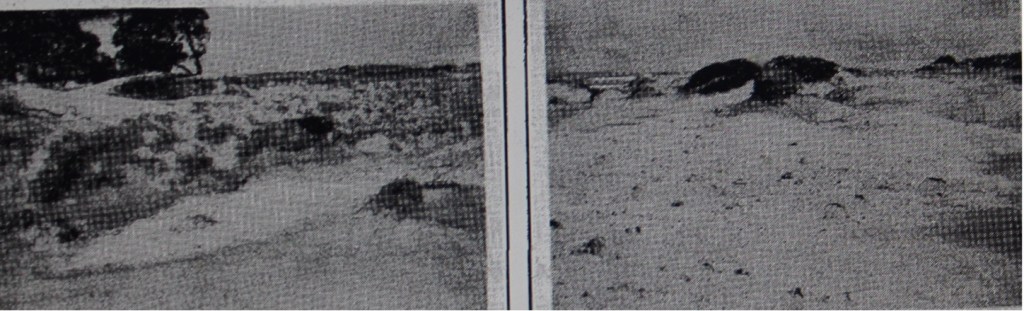
Middens and conical heaps in the Morna Point area [Photos published in the Australian Museum paper – May 1929]
The heaps of broken shells along the beach show that shellfish must have been one of their chief articles of diet, but opossums, kangaroos and other animals, as well as vegetable foods must have been obtained from the sheltered timbered region on the leeward side of the dunes. Their burial place is located on the higher ground near the southern promontory in a trough between two dunes where pieces of skeletons and individual bones are still to be seen scattered over the surface. ….
Flakes of all sizes were obtained in abundance from a certain restricted area on the high land behind the promontory. This sandy hill is a typical aboriginal workshop strewn with shells and innumerable flakes of chert intermingled with cores and “spoils” and a certain number of more carefully formed implements. Chips were also found in association with the middens on this beach.

Samples of ‘Chips’ found in the Morna Point area [Photo published in the Australian Museum paper – May 1929]
From this one area nearly all the specimens described below were collected, a new series being displayed after every wind storm. A few chips were found at the very northern-end of Stockton beach in association with aboriginal ovens. These ovens are now represented by rings of stones and small heaps of broken Donax or ‘pipi’ shells, but they indicate positions where the natives built their fires to cook their shell-fish. All round the rocky headlands of Morna Point broken shells point to the existence of middens now almost completely covered with grass….
The fragments were of every conceivable size and shape but those chosen for description have a definite cutting edge serrated by use, or else has been formed by secondary chipping…..
In the second group the implements are much larger and have been made from the igneous rock of the headland. They were at first overlooked and considered to be natural boulders and weathered fragments. closer examination showed that they were stone implements roughly shaped into a definite form by the removal of flakes. …The third group is represented by one specimen alone, which is not composed either of chert of igneous rock.’
Postscript
The Newcastle Morning Herald of 23 January 2025 reported that parts of the Worimi Conservations Lands would be closed over the Australia Day long weekend 2025 after ancient artefacts were unearthed during that week’s extreme weather at Port Stephens.
This could prove to be an important source of new research.
The following articles on the history of aboriginal people in the Port Stephens area, are published at these links on the web site:
Port Stephens Aboriginal Artefacts in the British Museum
Evidence of Early Aboriginal Settlement at Port Stephens
Aboriginal People of Port Stephens, Dungog and Gresford, by Gordon Bennett
Aspects of Aboriginal History at Port Stephens
Evidence of Early Aboriginal Settlement at Port Stephens
Aboriginal People of Port Stephens – Reminiscences of William Scott
Researched and compiled by Kevin McGuinness
January 2025

 Port Stephens - a history exploration