
Introduction
The first land sales in the Port Stephens area were made by the Australian Agricultural Company after it moved its business operations from Carrington, at the head of Port Stephens, to Stroud. These land sales were completed by 1851.
Over the ensuing years, various small parcels of land were sold in areas around Port Stephens where residential and commercial activities were developing, such as in the villages of Nelson Bay, Tea Gardens, Karuah and Anna Bay.
It was not until the 1920’s and 1930’s that the number and size of real estate developments grew in scale and marketing became more sophisticated.
During this period, there was much speculation that the Port Stephens area would be developed by the State government into a major commercial, shipping and residential area. In 1916, the Commonwealth government took control of a sizeable area of land at Salamander Bay where it was planned to establish a Naval Base.
Commencing in 1914, there was community agitation through northern areas of New South Wales for the Commonwealth Government to decentralise government functions to regional areas, away from Sydney, and also to form a new Northern State, with Port Stephens as its port for international shipping. As part of the decentralisation and northern state campaigns, there was also agitation for a railway to be constructed from the main northern line to either Pindimar or Salamander Bay, to service the industries that were expected to be established at Port Stephens.
Real Estate developers, particularly Henry F. Halloran, were quick to recognise the potential of the area. In the 1920’s, Halloran purchased large tracts of land throughout the Port Stephens area, particularly on the northern side of the harbour at North Arm and Pindimar, and subdivided them for sale as residential and commercial allotments.
These subdivisions were grand in design having long wide boulevards, cathedrals, railways, port facilities, large parks, together with commercial and residential sectors.
For many years, these estate developments were marketed with the expectation that the land purchased would escalate in value with the proposed railway and naval base and the large commercial operations that were bound to follow.
The promised infrastructure (rail, ports and naval station) and associated commercial operations never eventuated, resulting in many land speculators being left with land that was worth much less than they paid. The Pindimar City and Port Stephens City developments are prime examples of the failed land developments.
The subsequent limited economic development at Port Stephens also resulted in the land subdivisions taking many years to be sold. In 1938, Henry F. Halloran disclosed that over the previous ten-year period he had sold little land in his various Port Stephens subdivisions and that the value of land that he had previously sold had fallen significantly in value.
This paper looks at various real estate subdivisions that were undertaken from the early 1880’s through to the early 1950’s including those situated Nelson Bay, Tea Gardens, Shoal Bay, Hawks Nest, Anna Bay, Salt Ash, Anna Bay, Karuah, Tanilba Bay, Pindimar and North Arm.
Not all land developments are covered, and many were small in the number of land lots available for sale. Those land developments featured in this paper serve to provide an overview of how the various hamlets developed, the value of the land and how marketing methods used to attract consumer interest changed over time from the early speculative element to lifestyle benefits of the latter years. Some of the illustrated plans demonstrate a level of artistic imagination and licence.
A postscript is included on the most prominent land developer in the Port Stephens area in the period covered in this paper, Henry Ferdinand Halloran.
The following 26 land estates are covered in this paper:
1. Land Owned by the Former NSW Fish, at Nelson Bay – 1881
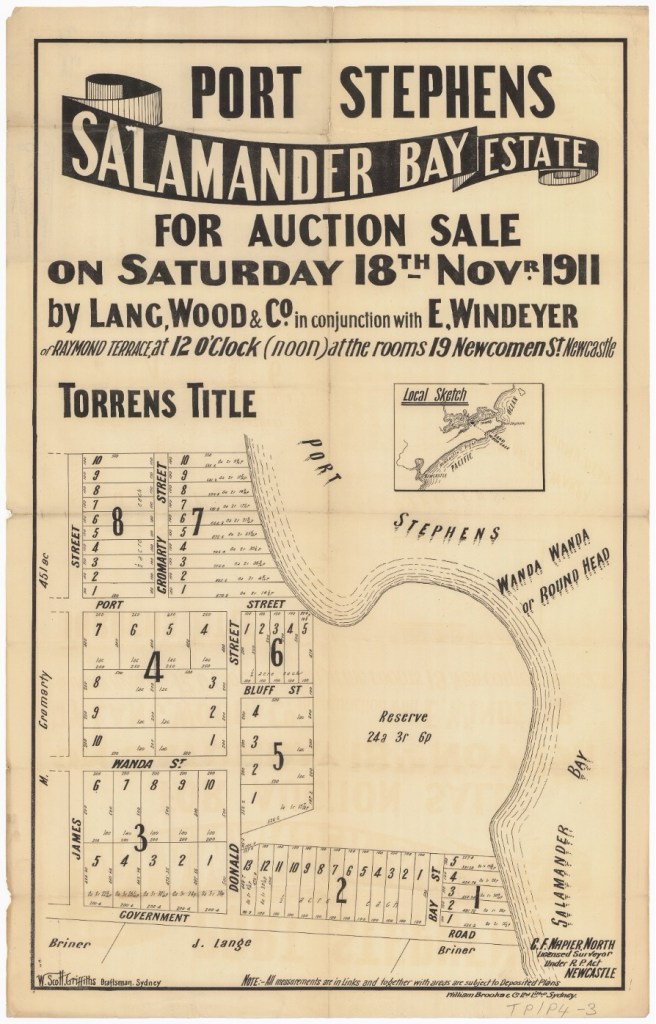
2. Salamander Bay Estate – 1911
3. Pindimar Township Subdivision – 1913
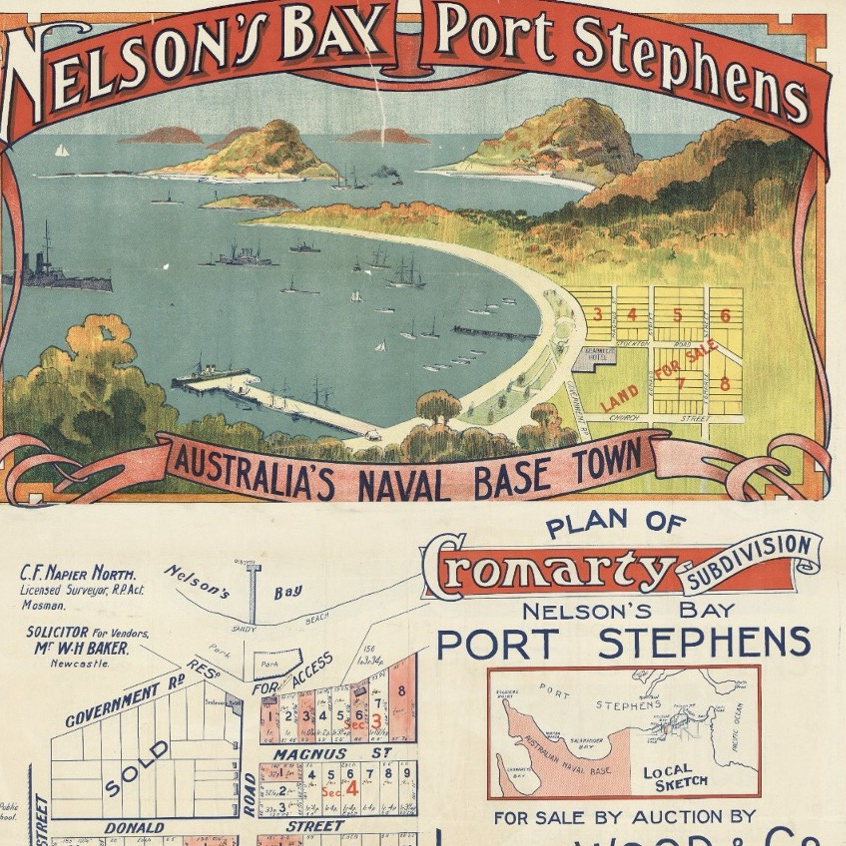
4. Cromarty Subdivision at Nelson Bay – 1915
5. Westward Ho! Estate, Nelson Bay – 1915
6. Salamander Estate – 1916
7. Tea Gardens Subdivision – 1916
8. Port Stephens City Estate – 1918
9. The Pindimar City Estate – 1918
10. Tanilba Bay Estate – 1918
11. The Mallabula Estate, Tanilba Bay – 1919
12. Tanilba House Estate, Tanilba Bay – 1920
13. Waterview Estate, Tea Gardens – 1922
14. Karuah Estate – 1922
15. Tilligerry Estate – 1922
16. Hawks Nest Estate – 1926
17. Thompson’s Estate, Tea Gardens – 1926
18. Nelson Bay Subdivision – 1927
19. White’s Estate, Nelson Bay – 1928
20. Salt Ash Subdivision – 1928
21. Kooindah Estate, Lemon Tree Passage – 1828
22. Anna Bay Estate – 1936
23. Bennet Beach Estate, Hawks Nest – 1947
24. Marine Drive Estate, Tea Gardens – 1948
25. Tomaree Estate, Shoal Bay – 1950
26. Dutchman’s Bay Estate, Nelson Bay – 1952
1. Sale of Land Owned by the Former New South Wales Fish Company, at Nelson Bay
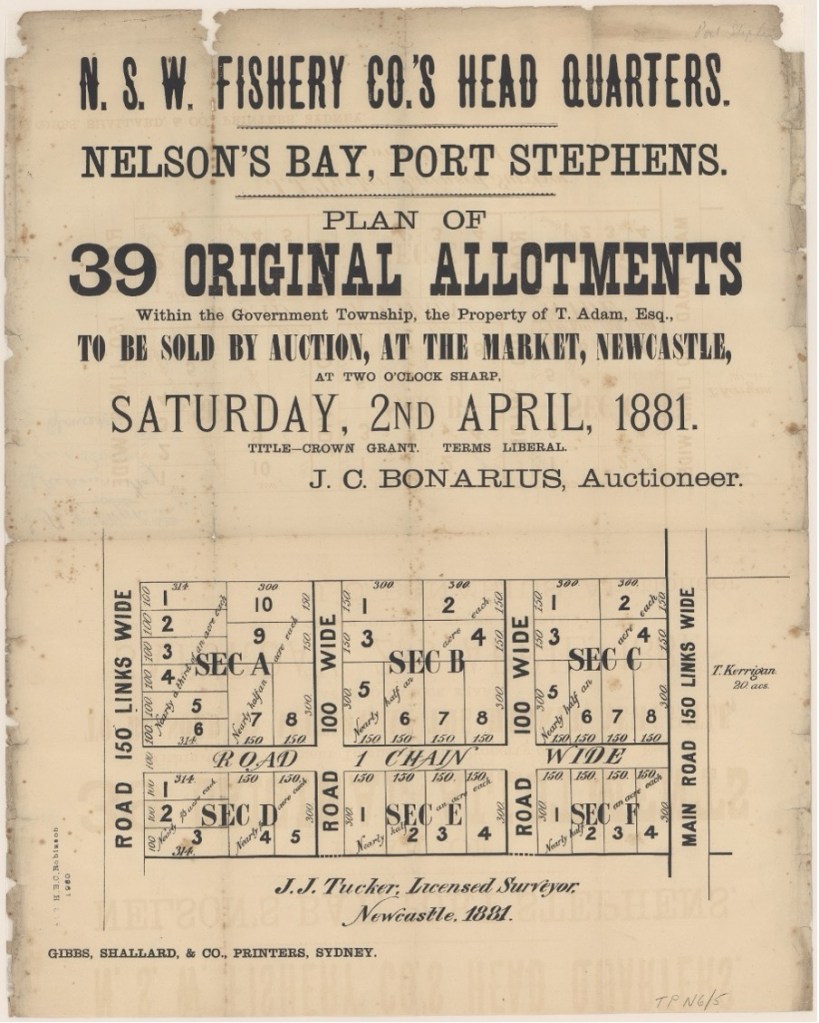
The New South Wales Fish Company ceased operations at Nelson Bay in February 1880, after which its land was sub-divided for sale in 1881.
The estate plan:
[NSW State Library].
The Maitland Mercury and Hunter River General Advertiser of 2 April 1881, page 4, advertised:
‘Mr. J. C. Bonarius, at the Borough Markets, Newcastle, at twelve, …… 39 allotments in the village of Nelson’s Bay, Port Stephens.’
The Maitland Mercury and Hunter River General Advertiser of 2 April 1881, page 4, also reported:
‘At the Borough Markets, Newcastle, to-day, at twelve o’clock, Mr, J. C. Bonanus will conduct a very important land sale. Among the lots to be submitted to public competition will be found …… 39 original allotments in the village of Nelson’s Bay, overlooking the Port Stephens Fishery. ….. As land in the localities referred to is fast enhancing in value no doubt the auctioneer will have keen competition.’
2. The Salamander Bay Estate – 1911
The estate plan:
[NSW State Library]
The Gloucester Advocate of 15 November 1911, page 5, carried the following advertisement which promoted how nearby developments would revolutionise the land value:
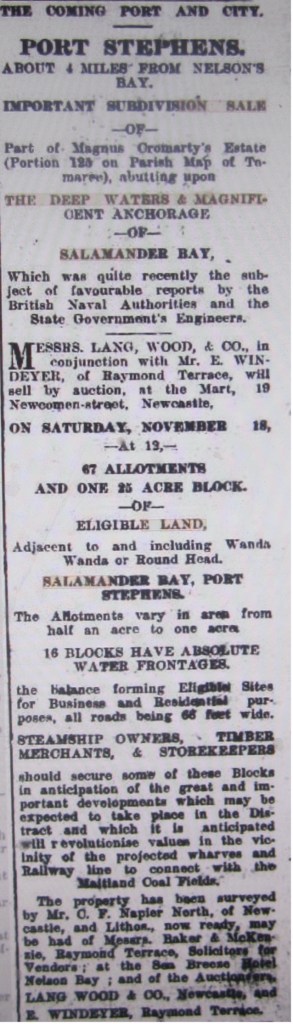
The Salamander Estate was still advertised in 1918 in the following style , as published in the Daily Observer of 1 November 1918, promoting ‘a fortune for the man who can see ahead’:
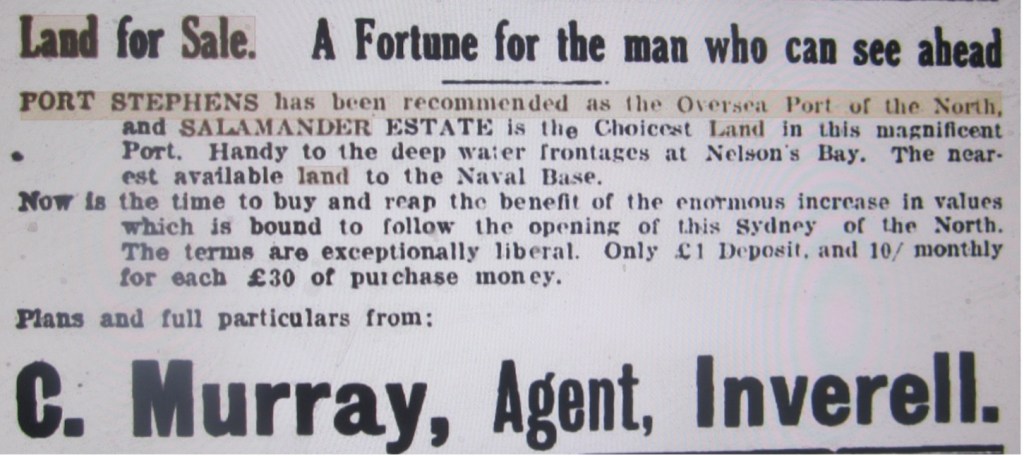
3. Pindimar Township Subdivision – 1913
This subdivision was the first version of a much larger subdivision named ‘Pindimar City’ that was to be marketed during the 1920’s and is covered later in this paper.
The estate plan:
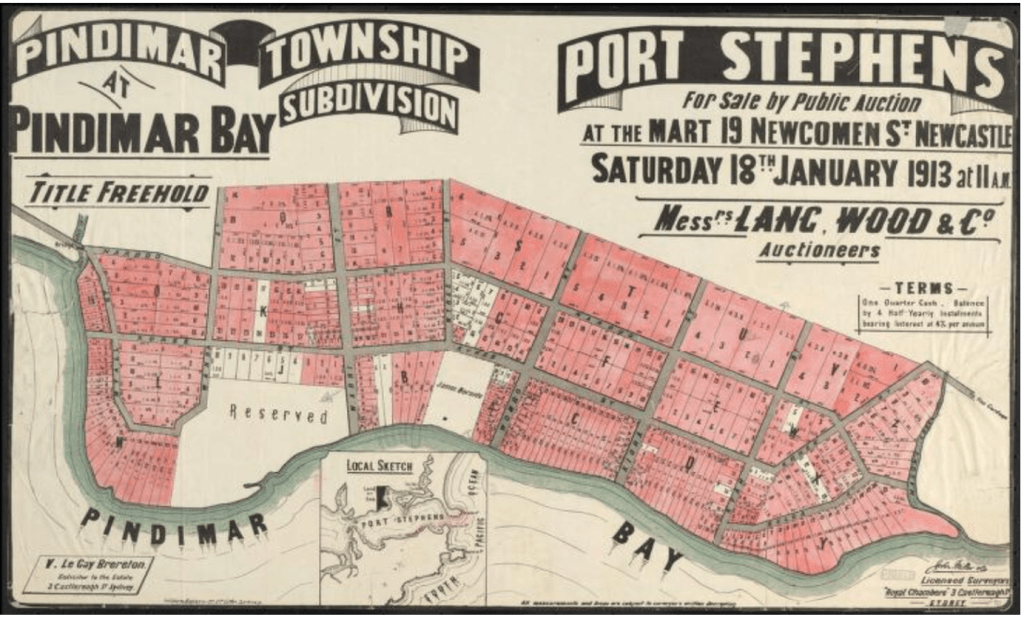
[National Library of Australia].
The Daily Telegraph of 4 January 1913, page 20, published the following advertisement which drew attention to the profits that could be made from investing in the estate due to infrastructure which was certain to be installed in the area:
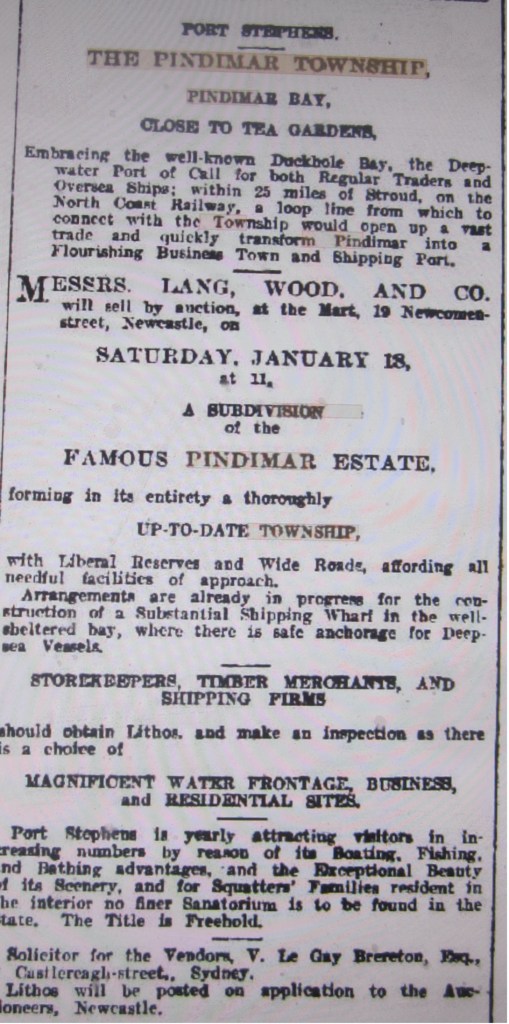
In 1920, the well-known land developer, Henry F. Halloran, launched a large city development of the Pindimar area with a development proposal, named Pindimar City. This development is covered later in this paper.
4. Cromarty Subdivision at Nelson Bay – 1915
The advertising promotes Nelson Bay as Australia’s Naval Base town.
The two versions of the estate plan:
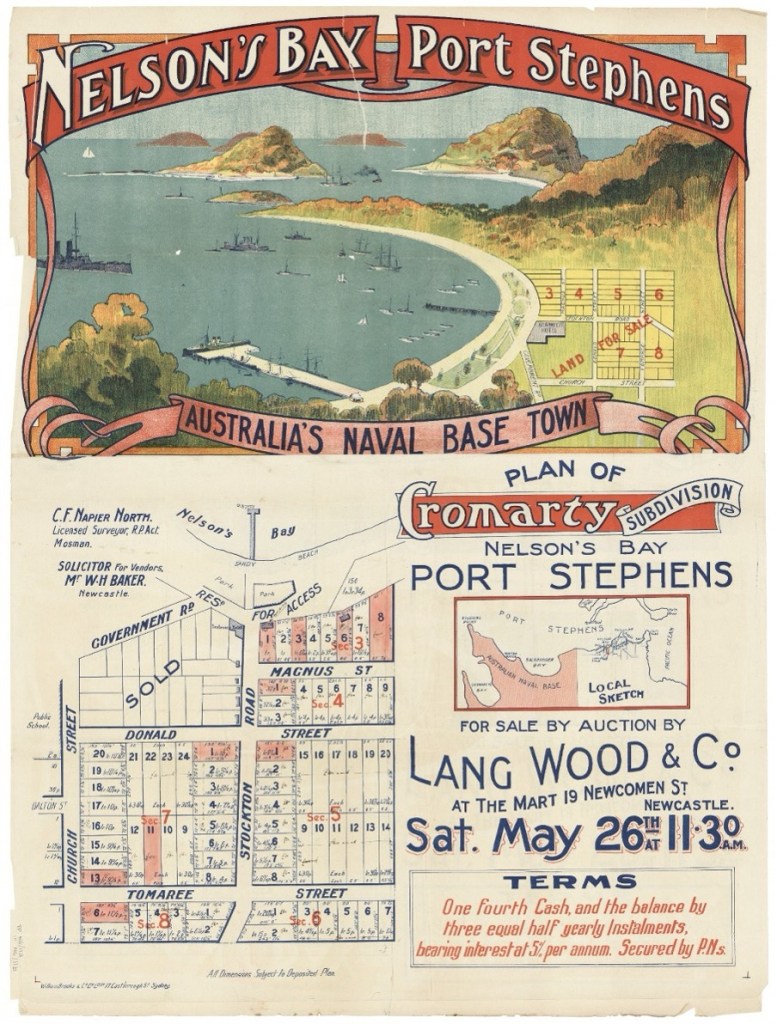
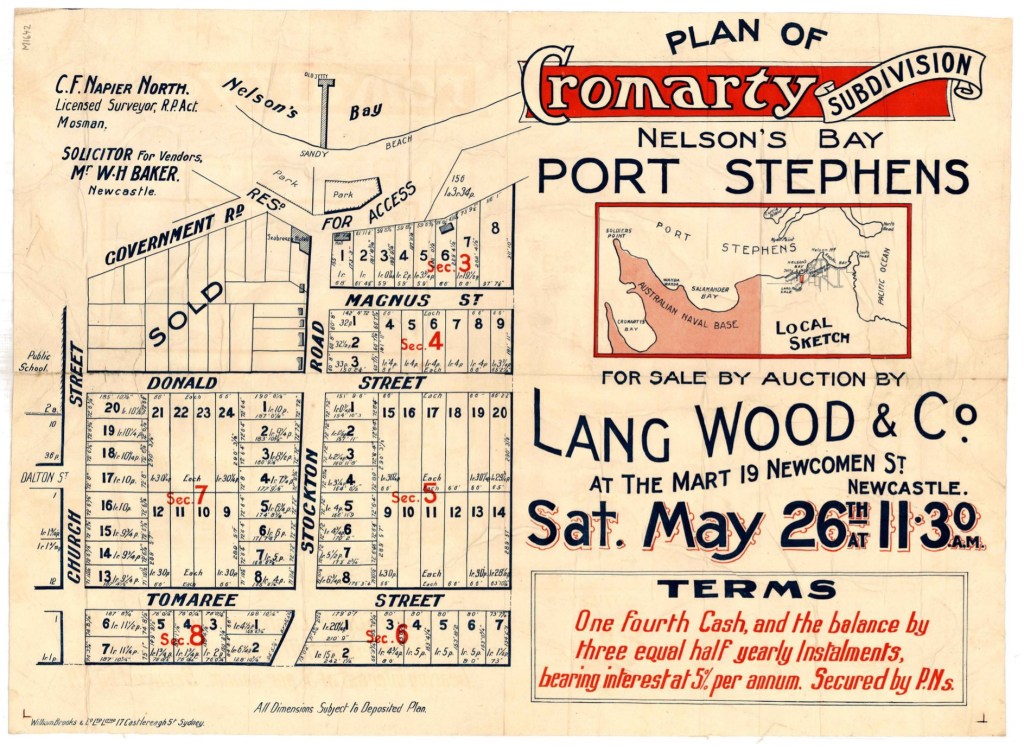
The following advertisement was published in the Newcastle Morning Herald of 26 May 1915:
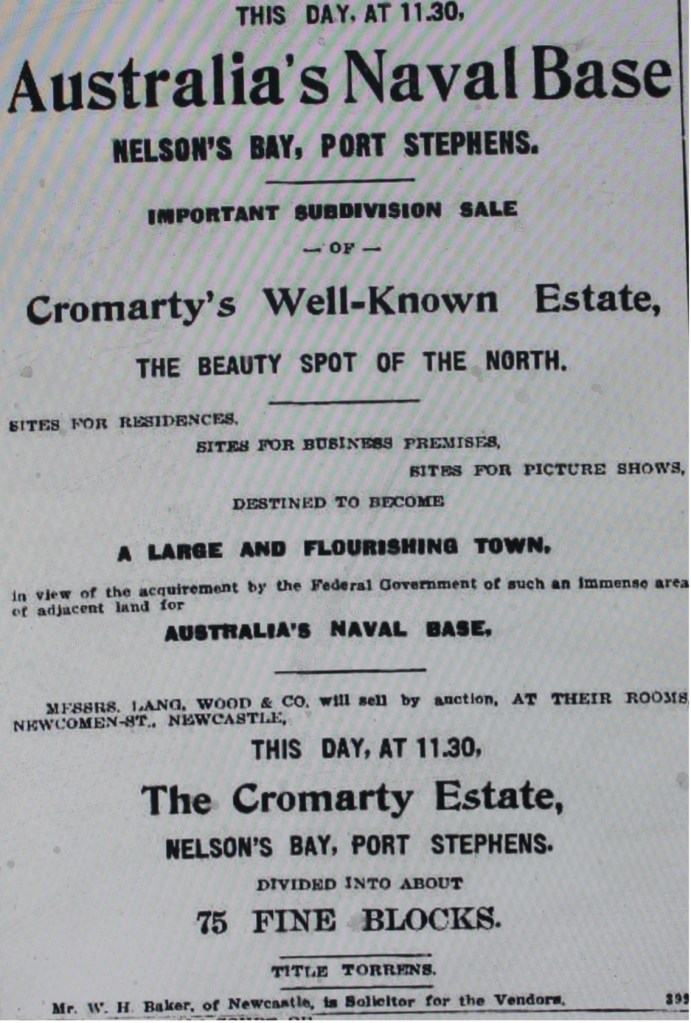
The Newcastle Morning Herald of 28 April 1917 also advertised:
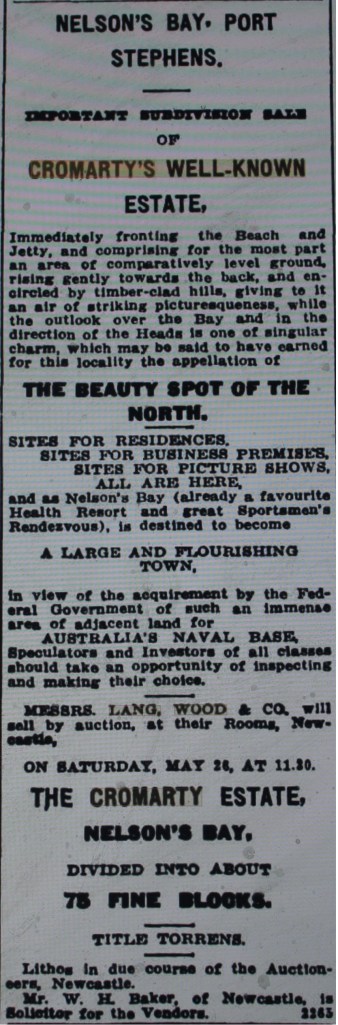
The Maitland Daily Mercury of 12 May 1917, page 4, reported:
‘An important property sale will be con-ducted at Nelson’s Bay, Port Stephens, on the 26th instant at 11.30 a.m., by Messrs. Lang, Wood, and Co., Newcastle, will submit the Cromarty Estate Sub-division, at auction. The land is divided into 75 fine blocks, immediately fronting the beach, and jetty. The fact that a large area of adjaccent land has been secured by the Federal Government as a naval base should ultimately make the progress and prosperity of the locality.’
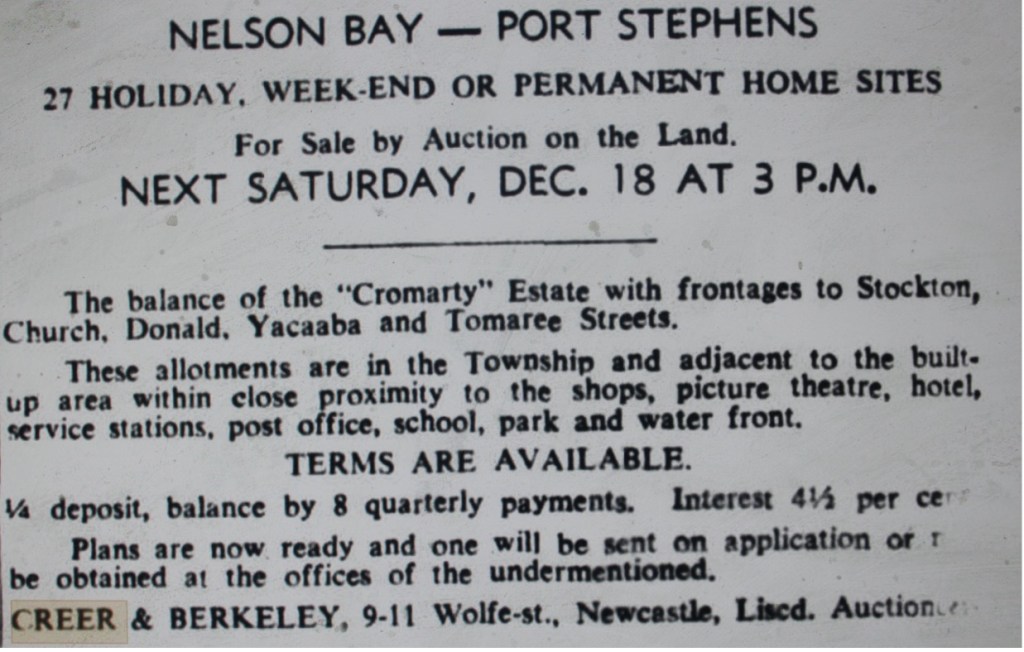
The balance of the Cromarty estate was still for sale in 1948. The following estate plan illustrated the land then for sale in Nelson Bay:
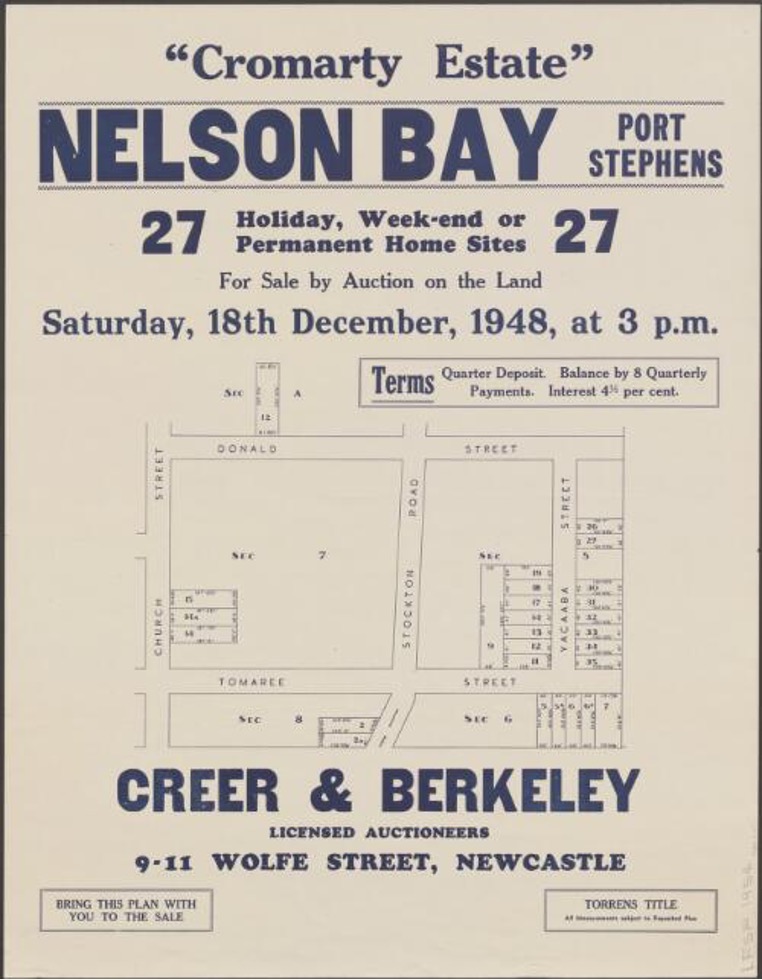
[National Library of Australia]
The Newcastle Morning Herald and Miners’ Advocate of 11 December 1948, page 10, published the following advertisement for the land sale:
5. Westward Ho! Estate, Nelson Bay – 1915
The estate plan:
The advertising promotes Port Stephens as the centre of game fishing. Splendid boating, fishing and shooting opportunities are also noted.
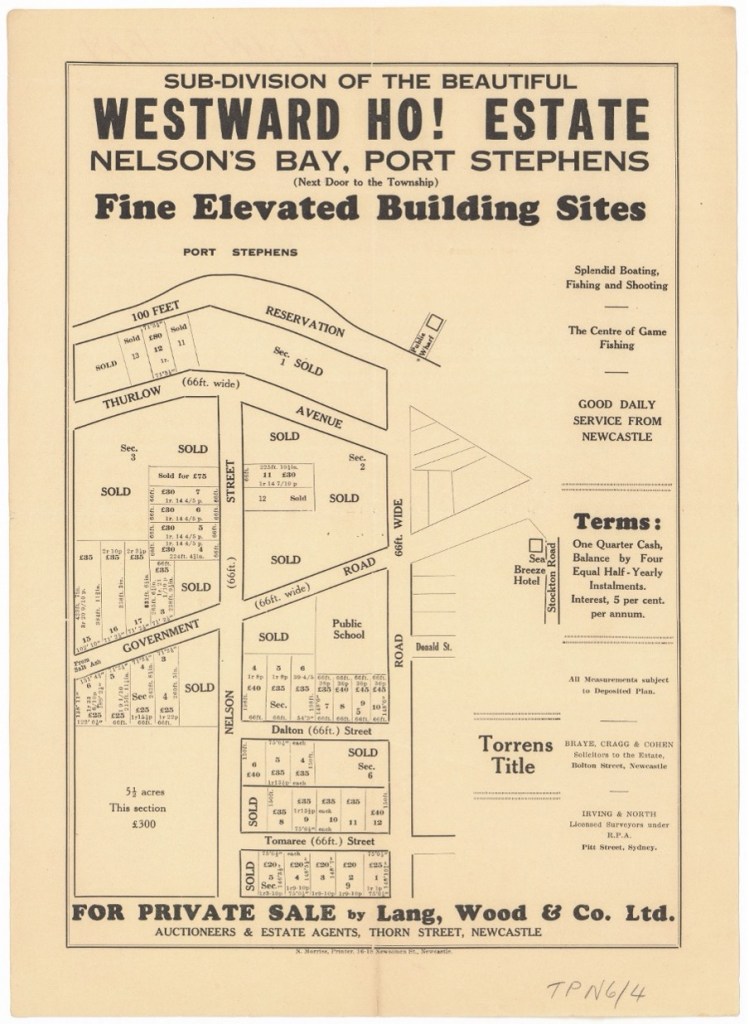
[NSW State Library]
This was one of the earlier land subdivisions that the Port Stephens Shire Council had to consider for approval. It led to a debate amongst councillors as the condition that roads should placed in prior to the council assuming responsibility for future maintenance. The Raymond Terrace Examiner and Lower Hunter and Port Stephens Advertiser of 7 August 1914, page 3, reported:
‘[Correspondence] from H. Thurlow and Co., submitting plans of the Westward Ho subdivision at Port Stephens, showing streets that it was proposed the council should take over. — Councillor Rush moved that the council take over the streets as desired when cleared. Councillor Swan seconded the motion.— Councillor Ralston moved as an amendment that the owners of the property be asked to place the streets in a macadamised condition [covered with crushed stone to form a solid base] before the council would take control. He pointed out that if the council took over the streets in a virgin state (almost) they would for all time be a burden on the council. — Councillor Shearman seconded the amendment.
Councillor Rush, in reply, stated that these subdivisions were the means of opening up the shire for increased population, and he felt sure that if the council compelled the owners of this land to do what the amendment asked the subdivision would not be gone on with, consequently by the estate not being cut up the council would lose a deal of revenue. There was no need for the roads and streets to be macadamised at this place for the next twenty years, and if the council insisted that it be done, the outcome would be that the council would have to macadamise the main roads in that locality. It was therefore unfair that these people should be asked to do a thing that the council were not prepared to do to their own roads. — The motion was carried.’
The Newcastle Morning Herald and Miners’ Advocate of 27 March 1920, page 8, reported:
‘Messrs, Lang, Wood & Co. announce that building sites in the Westward Ho Estate, Nelson’s Bay, Port Stephens, are now available from £35 to £165 per block.’
The Maitland Daily Mercury of 9 April 1915, page 4, reported:
‘The sub-division sale in the Westward Ho Estate, Nelson’s Bay, Port Stephens, will be conducted at their rooms, Newcastle, tomorrow, by Messrs. Lang, Wood, and Co. There ought to be good prospective value in the allotments to be offered, and doubtless the bidding will be spirited.’
6. Salamander Estate – 1916
In 1918, the prominent land developer, Henry F. Halloran, was selling land in two estates in the Newcastle and Port Stephens area. The following location map shows the positions of the Ferodale estate (this subdivision now lies under the Grahamstown Dam and was located outside the area covered in this paper) and the Salamander Estate. Henry Halloran did not own the land in this estate and sold it on behalf of Henry Wilson of Mosman in Sydney.
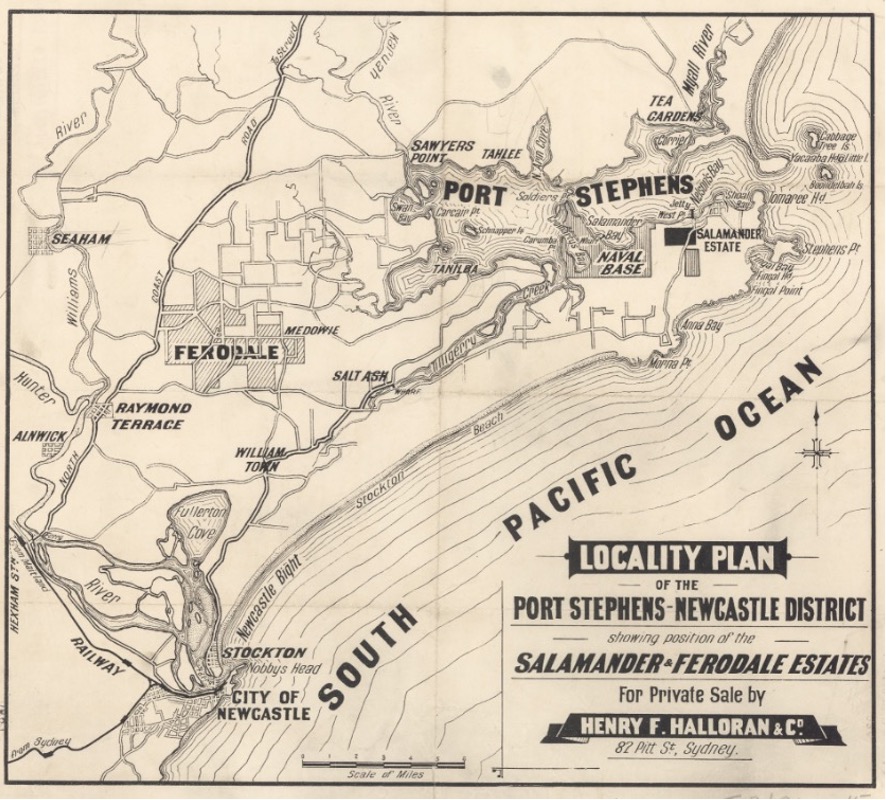
[National Library of Australia]
The newspaper advertisements:
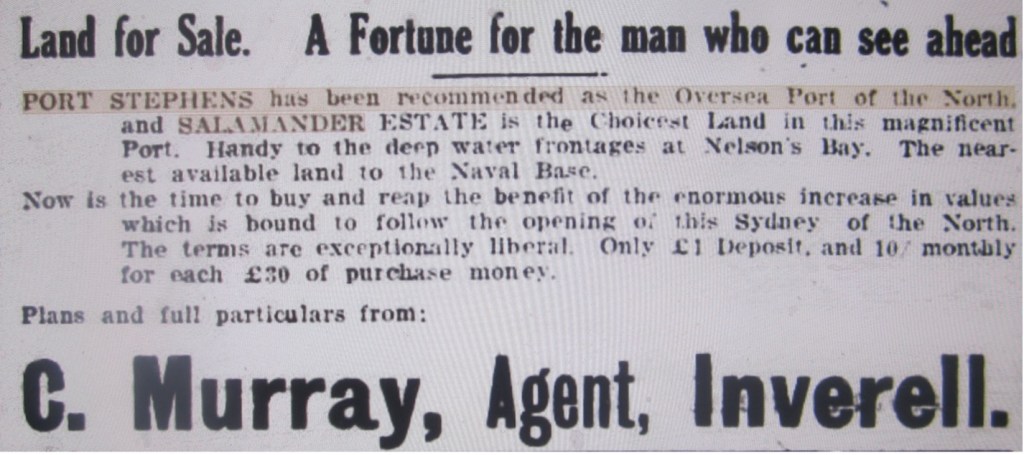
[Daily Observer, 28 October 1918]
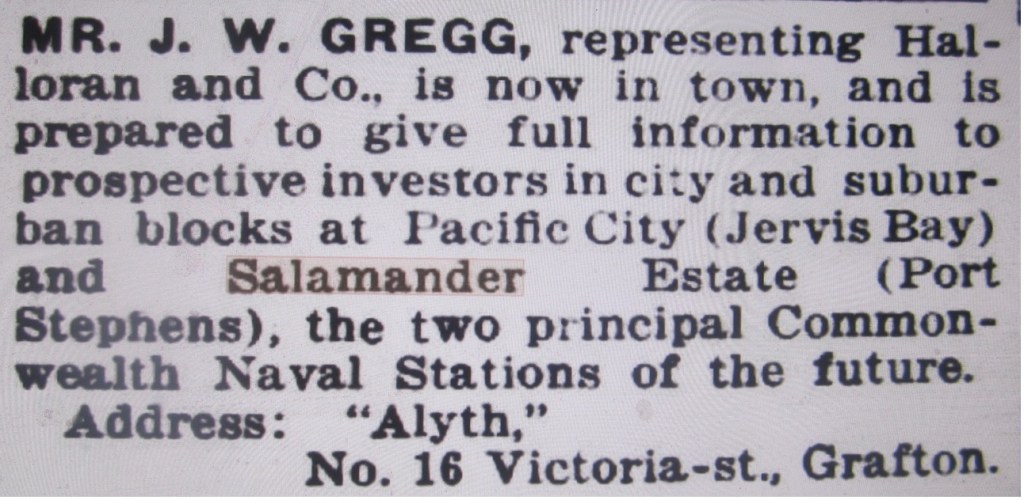
[The Grafton Argus, 9 December 1918]
The Daily Observer of 14 June 1918, page 5, reported:
‘Port Stephens, 21 miles north of Newcastle, will be a great, shipping centre for the whole of the rich northern district of New South Wales when a line is built to tap the general railway system. The construction of the line and the building of the city would add immensely to the tax-producing capacity of Northern New South Wales. This prospect has been foreseen by Mr. Henry F. Halloran, planner of Salamander Estate, situated close to the Commonwealth Naval Base in Salamander Bay, and with direct access both to the harbor and the ocean foreshore. The town boars the genial title of ‘Salamander,’ and it has been mapped out in a cluster of curving roads around a central depression and three hills. The roads follow the contours of the ground; the residential sites occupy the slopes in such a way as to give a magnificent view from each one, and the hilltops and depressions are reserved as parks flanked by allotments.’
7. Tea Gardens Subdivision – 1916
The advertising promotes Tea Gardens as a busy town convenient to fishing in harbour, river, lake or ocean.
The estate plan:
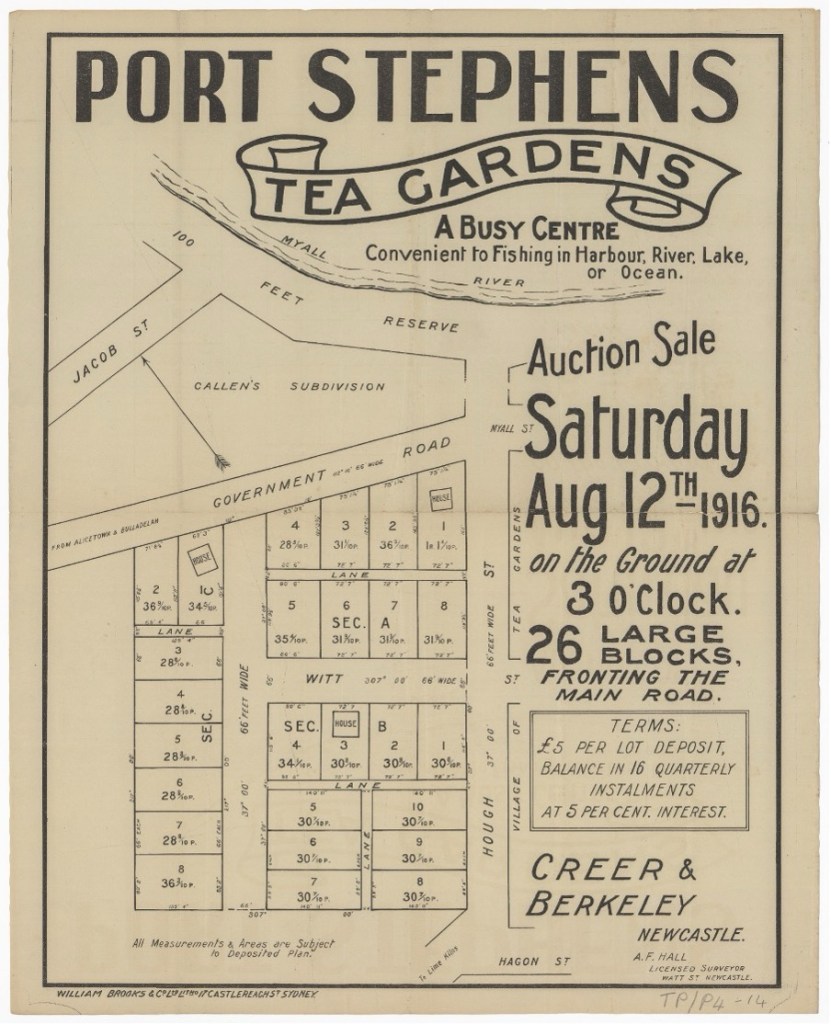
[NSW State Library]
The Morning Herald and Miners’ Advocate of 2 August 1916, page 12, advertised:
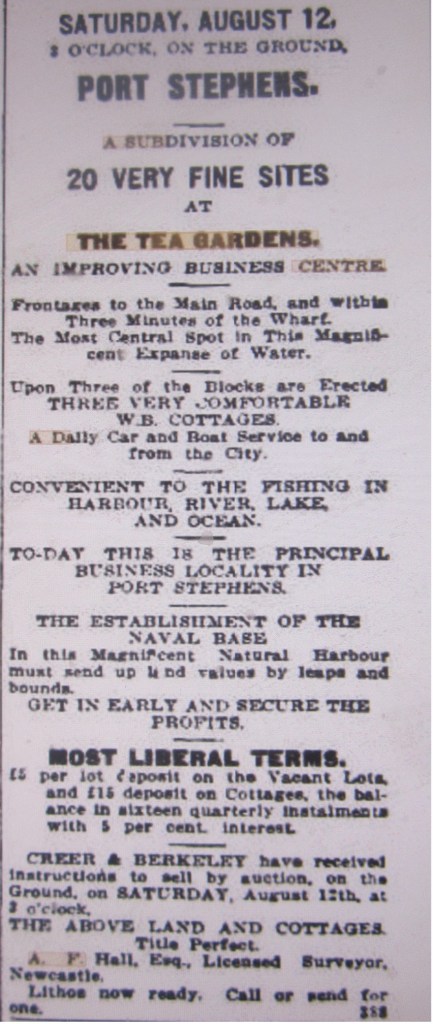
8. Port Stephens City Estate – 1918
First estate plan:
The first conceptual subdivision plan was prepared by Walter Burley Griffin, the famous architect that also drew up plans for Canberra city. The Plan was approved by Stroud Shire Council on 6 May 1918. The Port Stephens City at North Arm was promoted as a potential site for the proposed National Capital.
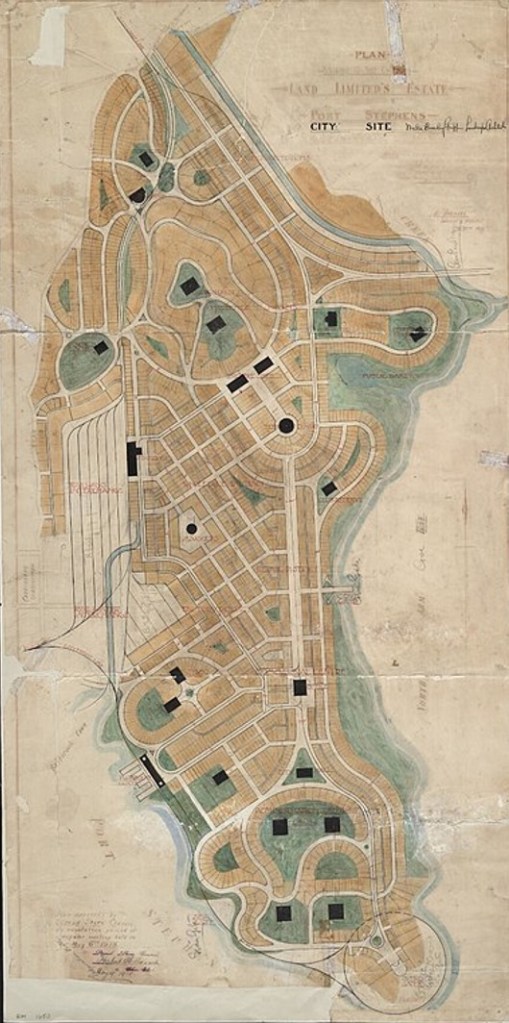
Plan showing 10 feet contours, Land Limited’s estate, Port Stephens, by Walter Burley Griffin, landscape architect [National Library of Australia]
Following the winding up of Walter Burley Griffin development company, the marketing of the Port Stephens City estate was taken over by Henry F. Halloran & Company, and an associated company, Realty Realizations Limited. This was Henry Halloran’s most notorious development as portions of the land were swamp. The ‘great maritime city of the near future’ that formed part of his sales pitch, never eventuated.
The first subdivision plan was initially marketed by Henry F. Halloran and later by the associated company Realty Realizations Limited:
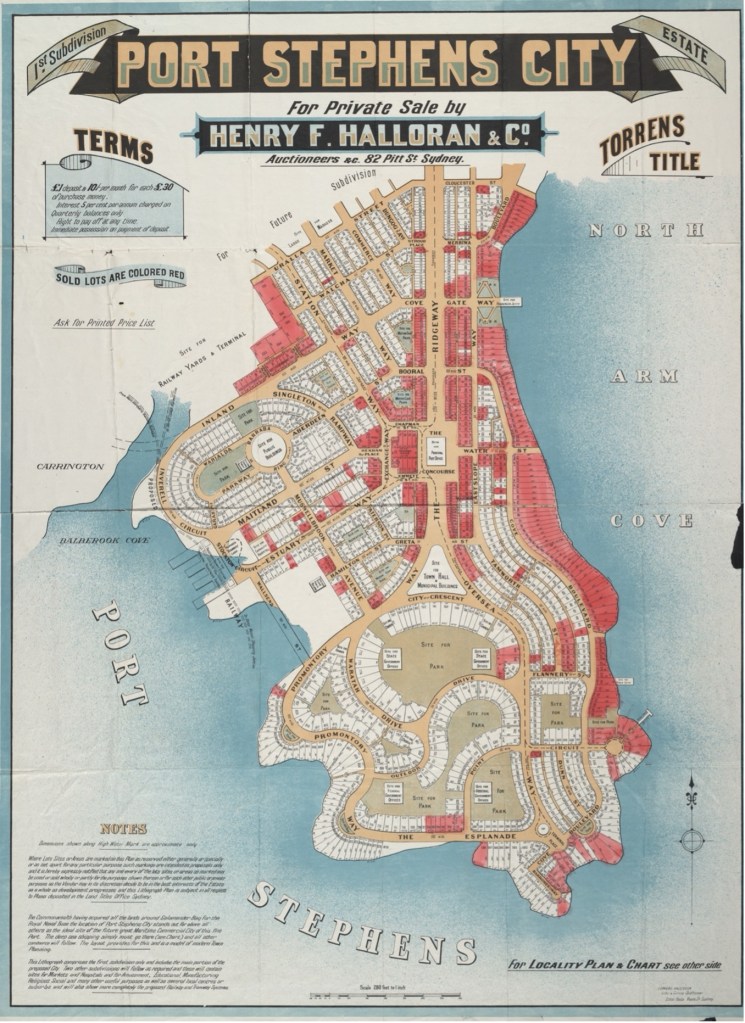
[National Library of Australia]
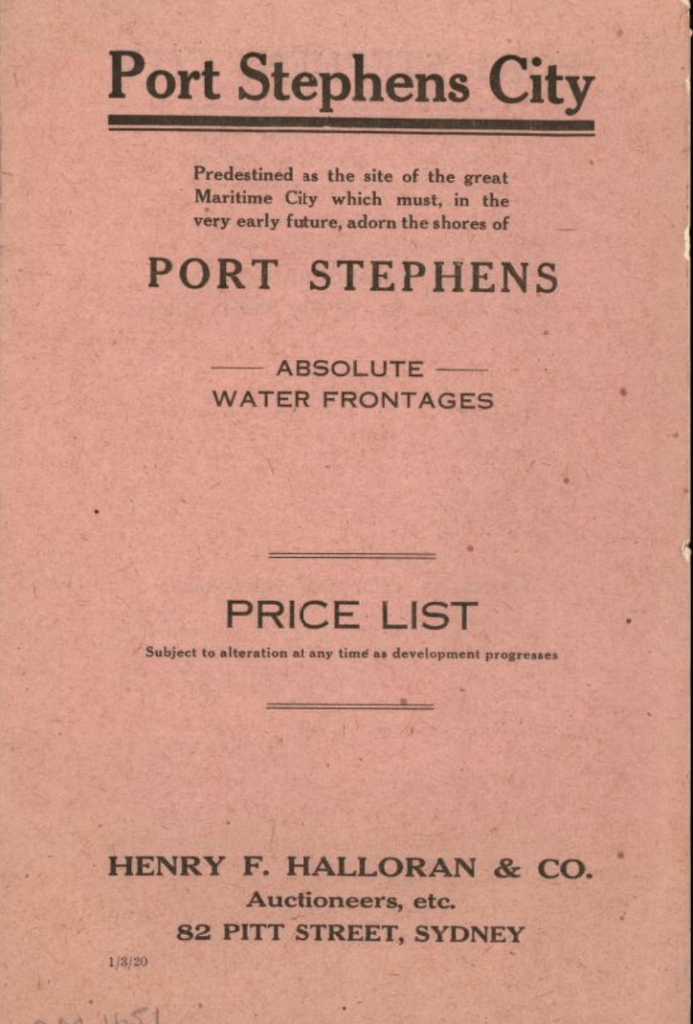
The above plan of Port Stephens City was accompanied by the above booklet: ‘Port Stephens city: predestined as the site of the great Maritime City which must, in the very early future adorn the shores of Port Stephens’ [National Library of Australia]
A later estate plan marketed by Realty Realizations Limited is illustrated below:
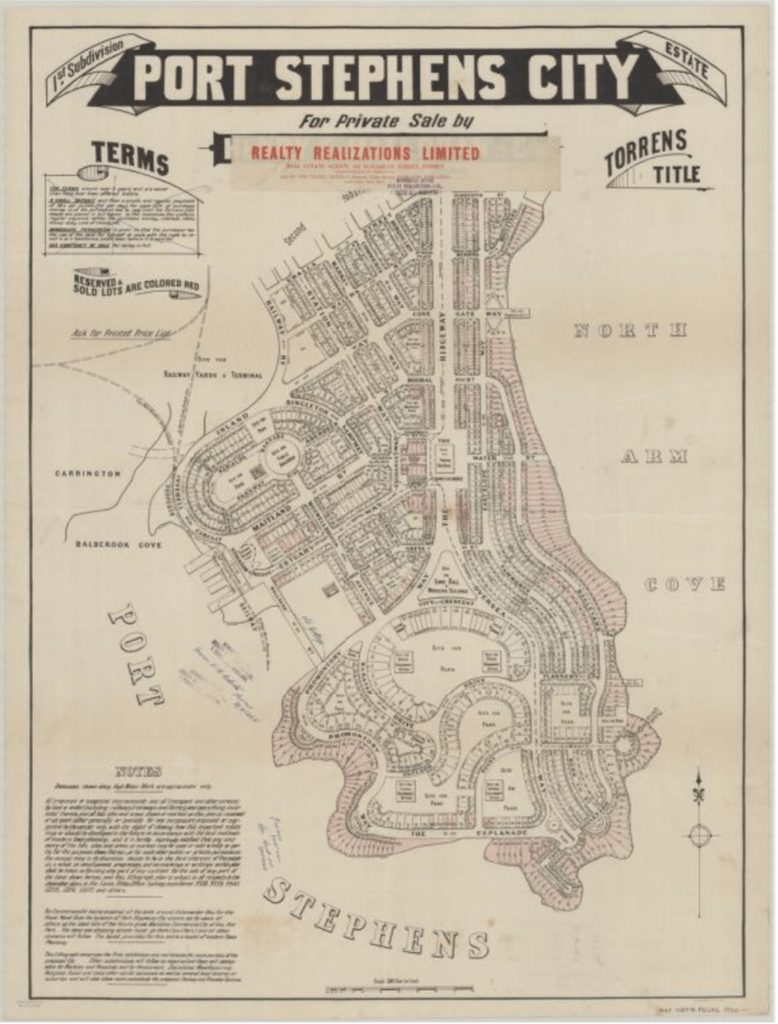
[National Library of Australia]
Second Subdivision plan:
A Second Subdivision, marketed by Henry F. Halloran & Company, covered the area to the north of the first subdivision, is illustrated below:
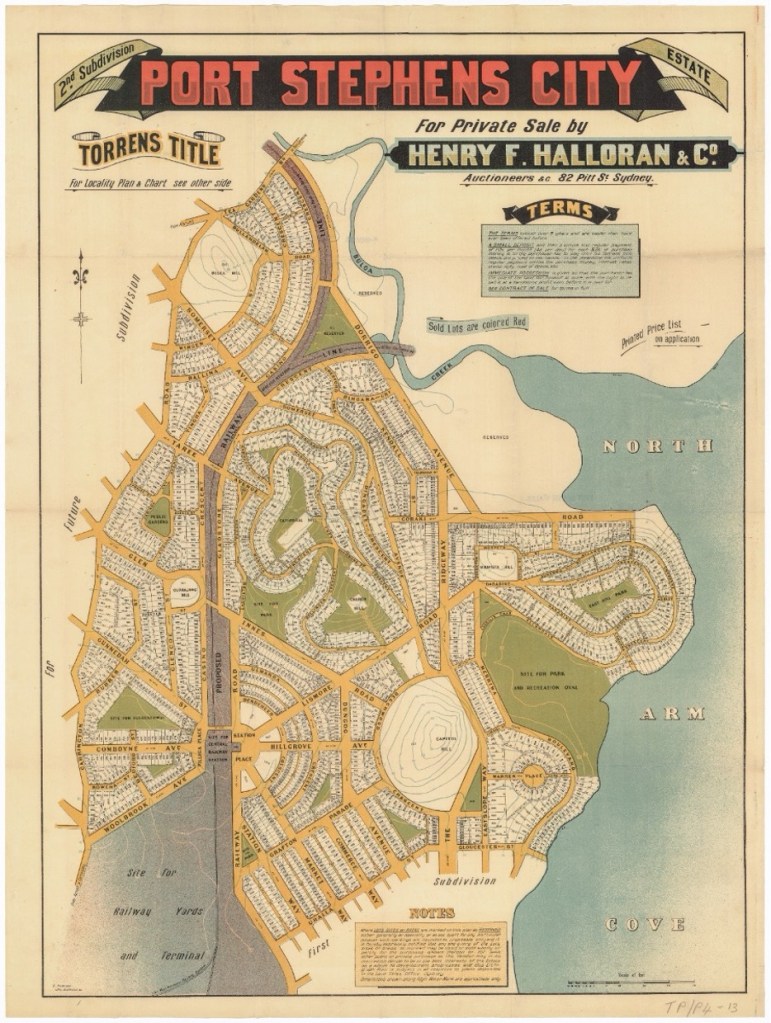
[NSW State Library]
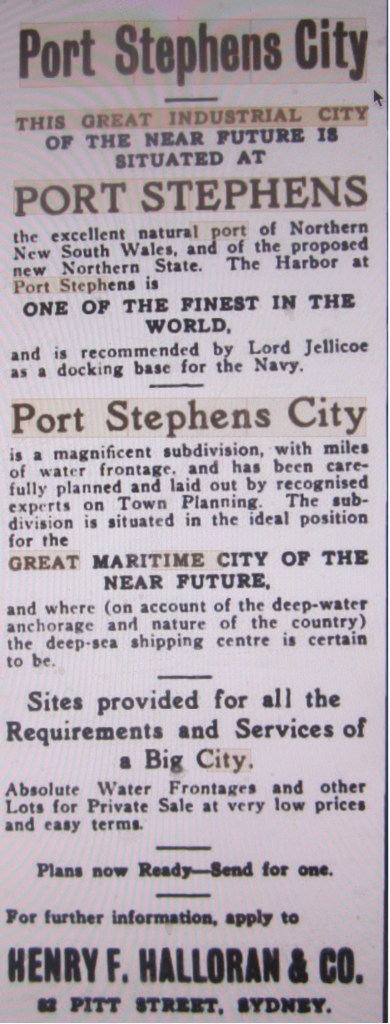
The Construction and Local Government Journal of 21 June 1920, page 10, advertised the ‘Port Stephens City’ as the great industrial city of the near future:
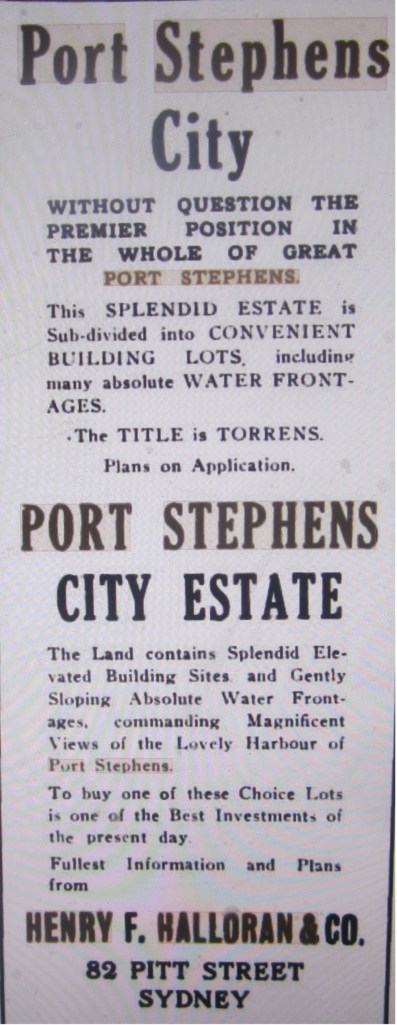
The following updated advertisement for the subdivision was published in the Construction and Local Government Journal of 22 August 1923, page 10:
By 1928. much land was still available in various subdivision sites. The Newcastle Sun of 14 September 1928, page 1, carried one of the last advertisements for this land sale:

9. The Pindimar City Estate – 1918
The largest proposed development on the northern shore of Port Stephens was the Pindimar City Estate at Port Stephens under the auspices of Pindimar Port Stephens Ltd. Marketing of the estate began in earnest in 1920. The planned city never eventuated, nor did the claimed profits promised to the land purchasers.
The estate plans:
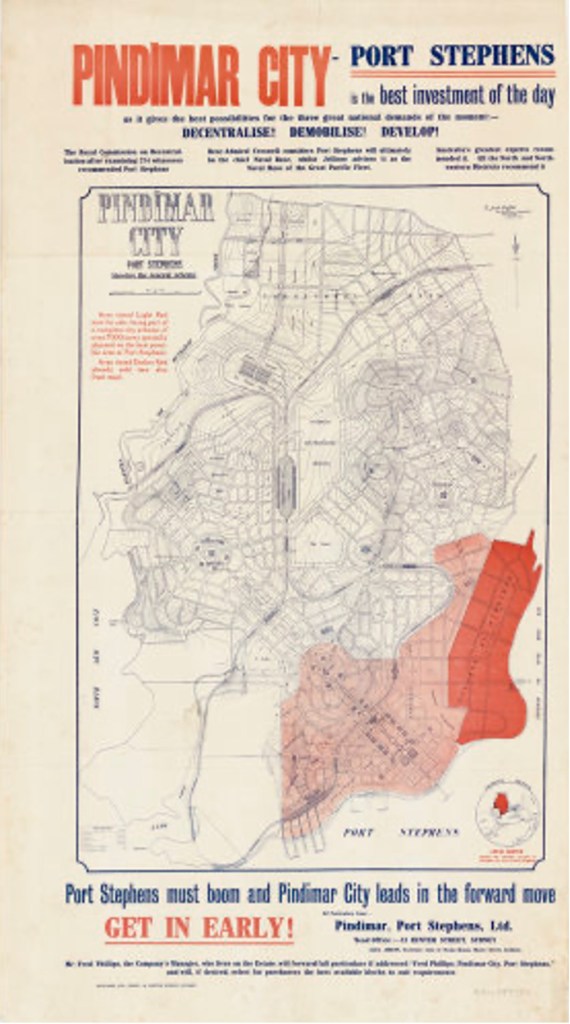
Complete plan of the proposed Pindimar City Subdivision [Newcastle City Library]
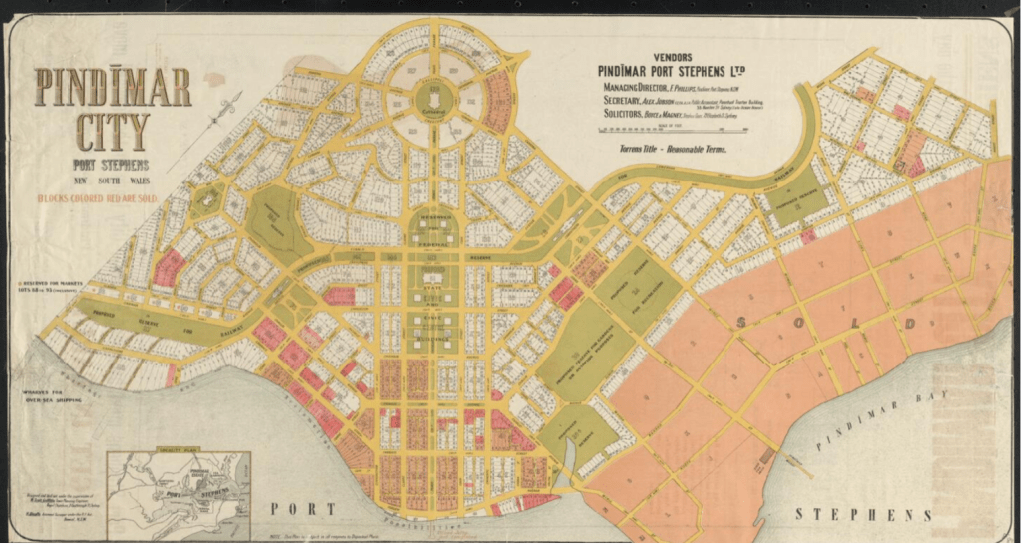
The first stage of the Pindimar City Subdivision promoted for sale [National Library of Australia]

Plan of Port Stephens showing position of the proposed Pindimar City, the Naval Base and the railway into Pindimar, 1928 [National Library of Australia]
The estate booklet:
The above plan of Pindimar City, was accompanied by the booklet: ‘The Port Stephens Book of Pleasure and Profit, Being the book of Pindimar the new City.’
A complete copy of the booklet can be viewed at the following link Pindimar City Estate.
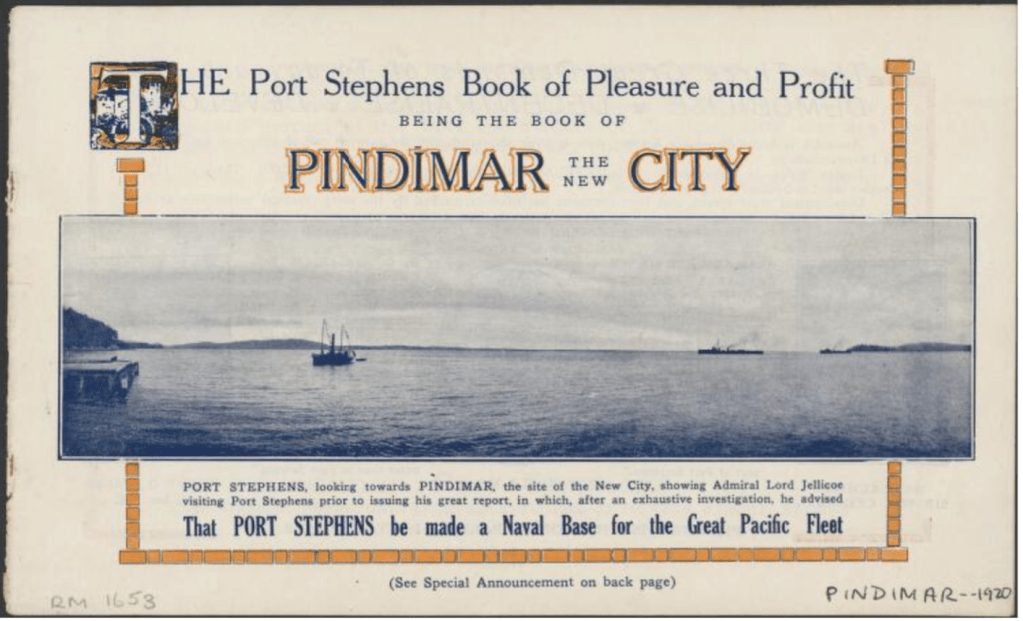
Maps and Booklet Published by Pindimar Port Stephens Limited. [State Archives and Records Authority of NSW]
The newspaper advertisement:
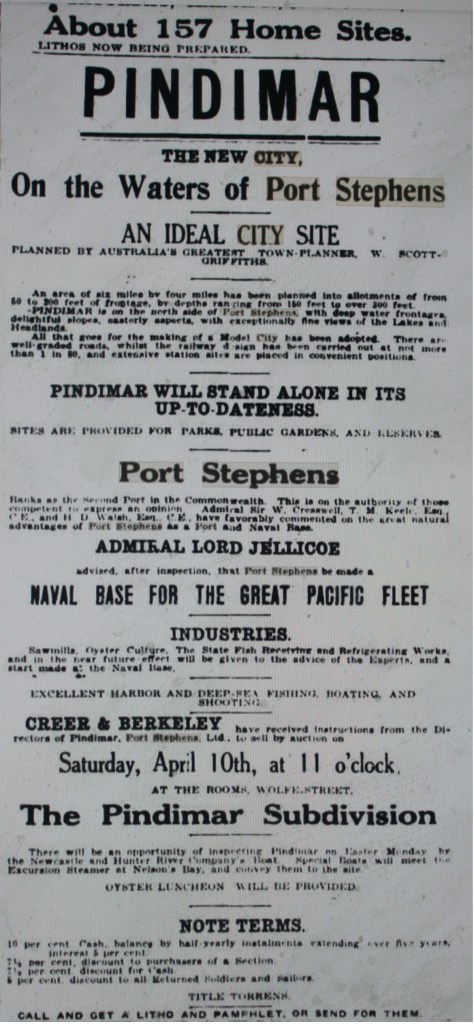
[Newcastle Sun, 6 March, 1920, page 4]
Proposed Road to Tanilba Bay to serve proposed Land Subdivisions – 1920
Henry F. Halloran had major land subdivision plans for the Tanilba Bay area, the primary ones being the Tanilba Bay subdivision and the Tanilba House Estate. To achieve his land sale ambitions he needed a good road from Nelson Bay Road into the subdivision areas. The Port Stephens Shire Council did not have the available funds. The remedy promoted by Henry F. Halloran to enable a road to be constructed was to lend the council the necessary funds to build the road. The council would repay Halloran from rates that they received from new landowners.
The following letter published in the Raymond Terrace Examiner and Lower Hunter and Port Stephens Advertiser of 6 August 1920, page 3, from Henry F. Halloran demonstrates the commercial enterprise that he applied to get a deal done:
‘Sir,—I did not intend to enter into a newspaper correspondence on this matter but as it is clear from the letters published in your paper, a lot of misconception exists as to what the offer is, and what it means, I feel that to make some further explanation so that everyone may be informed of the correct facts, and the matter decided impartially by the Council on its real merits. The offer if to advance the Council a sum up to £2000 for roadmaking and up to £500 for building a public jetty, £2500 in all, to be paid out of additional revenue derived by the Council in rates, subsidy charges, etc, after the construction of the said works, i.e. whatever revenue the Council receives this year, it will continue to receive each future year, and spend as it pleases without any abatement, but anything additional, i.e., any increase on account of-added values caused by giving access and developing the land served by the road, is to be used in-repaying the loan and interest,
If Mr. Halloran’s judgment is wrong, and there is no development or no increase in revenue from the land served by the new road then he loses his £2500, and interest. He takes all the risk, the Council takes absolutely none and does not expend on the work a single penny of the money of any of your correspondents, as at least one of them seems afraid of. The only money used to repay the loan will be the amount of the increase, and most of this will be the money which Mr. Halloran and his clients and his purchasers will pay in rates and the subsidy thereon, and this is admittedly fair, as they should be the persons to derive the most benefit from the work. If such is not fair Local Government, will someone say what is?
The revenue of the Council for other works (including the Nelson’s Bay Road,) will not be diminished by one 6d, and will be the same as if Mr. Halloran had not come on the scene. Nevertheless, although other ratepayers will not contribute they will for nothing, have the right to travel the road, and have what does not now exist, practicable access by road to the southern shore of Port Stephens by a near route, and at a most convenient place. On the one hand Mr. Halloran takes all the risk and no one else can possibly lose either directly or indirectly over the matter, while whether his development is either a success or a failure, all present ratepayers and the public will get a new road without any cost to them.
As Decentralization says in his letter “Once make it possible for the thousands from Newcastle, Maitland, and the surrounding districts to reach Port Stephens quickly, and at reasonable cost, and they will see for themselves the potentialities of the best port of the north, and the opening up of this district will soon become an established fact, and the demand for other roads to other points around this beautiful harbor will justify themselves in the increased population of the district and the consequent increased revenue derived by the Council.” This fits the proposed new road to Tanilba Bay exactly, as it will give the shortest, quickest and least costly access to a part of Port Stephens quite equal to any other.
If Mr. Halloran made a similar offer to have the Nelson’s Bay road constructed would your correspondents advocate its acceptance? And that reminds me that Mr. Halloran controls by far the largest land subdivision at Nelson’s Bay through which the Nelson’s Bay road runs for over half a mile, and which has more frontage to it than all the other subdivisions at Nelson’s Bay together, and he takes quite as great an interest in that very nccessary road as in the road to Tanilba Bay, and if Ratepayer, and Mr. Bryant, and Decentralization, and all others interested will combine, to make such an offer then Mr. Halloran’s share, according to the proportion of his interests, is available. What about it? The two roads have no particular relation to one another, but both are important.
Without detracting in any way from Nelson’s Bay, it must be borne in mind that it is not Port Stephens, but only one small corner of it, Nelson’s Bay has the most houses at present because land has been made available there, and one cannot but have admiration for it, and it is bound to go ahead, but there will be in the near future several other settlements round the shores of Port Stephens, and there is plenty of room for them all, and they will be just as important as Nelson’s Bay is now, and may or may not be more important. However, they should assist one an-other, and in doing so will assist themselves and the development of the whole of Port Stephens.
A comparison between both roads will show the present position as between the two, to be as follows:—Tanilba Bay road: (a) From Stockton to proposed jetty. 21¼ miles; (b) From Salt Ash turn off, 7½ miles, (Tanilba Bay 9¾ miles nearer to Stockton and Raymond Terrace:) (c) length of road remaining to be constructed 6 miles formation easy and cheap for whole length nearly all hard sand; (d) The money available; (e) Jetty to be built in a sheltered bay, safe in all weathers. 2. Nelson’s Bay road: (a) Length from Stockton to jetty 31 miles; (b) From Salt Ash turn off 17 miles; length of road remaining to be constructed about 11 miles, formation difficult and costly in parts, also long length of loose sand; (d) The money not available unless those interested will join to find it in the same way. (Mr. Halloran is willing to find his proportionate share which will be considerable;) (e) Jetty already built, but in an exposed position. Both places have splendid tourist and residential attractions. It must therefore be apparent that to block the construction of the Tanilba road will not assist the construction of the Nelson’s Bay road. The way to get most things is to keep on wanting them, and letting their necessity be known, and keep on letting it be known, and your correspondents cannot be blamed for taking this opportunity, to advocate the road they desire, but to block progress in one thing to gain another always has a boomerang effect, and hits back on the other instead of assisting it.
What Port Stephens is crying for is for something to be really done apart from talk, and now there is an opportunity to do something. HENRY F. HALLORAN. P.S.—I would like it noted that though in the above letter I speak as if I were the owner, I am really representing clients who are the owners, but have their full authority to write to above.’
The council did negotiate with the developer to have the road made.
10. Tanilba Bay Estate – 1918
The advertising promotes the Tanilba Bay estate as being about one hour’s drive by level road from Newcastle, via Stockton.
The Tanilba Bay Estate was surveyed in 1918. The whole estate area was brought for 2 pounds 10 shillings an acre. Within the estate the company spent 3,960 pounds on drainage and roads, and a further 2,500 pounds on a road from Salt Ash.
It was designed as a Garden City development, with rounded streets, and many facilities such as hospitals, theatres, churches and courthouse. Most of the streets were named with World War One themes.
The estate plan:
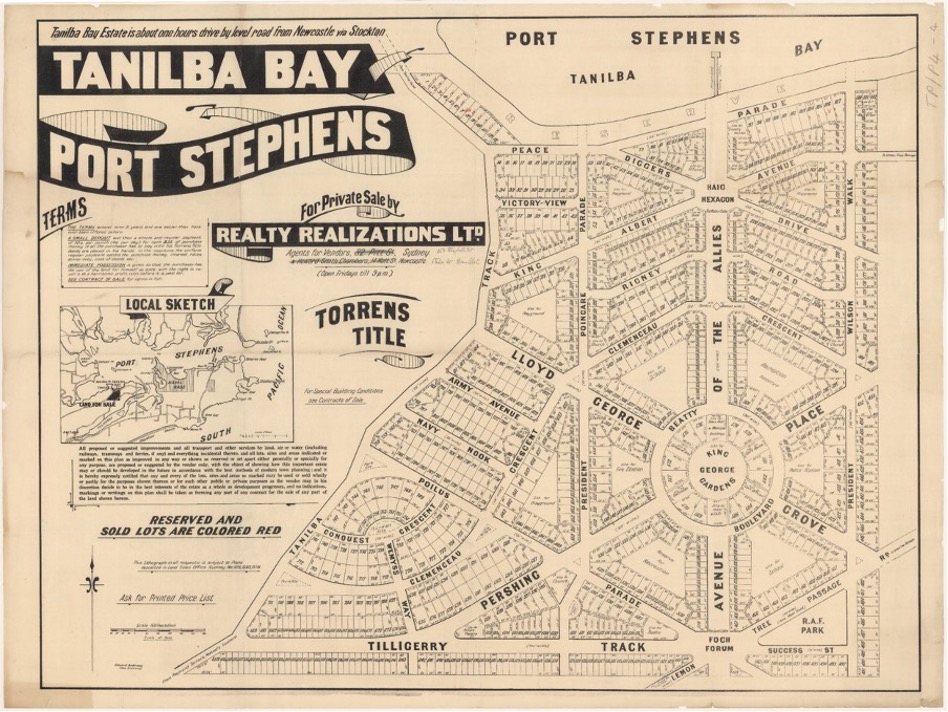
[State Library of New South Wales]
The land was still available for sale in the 1930’s as per the following newspaper advertisements:
The Newcastle Morning Herald and Miners’ Advocate of 5 January 1935, page 11, advertised:
‘POPULAR TANILBA. 5000 people visit it on New Year’s Day. The coming place. Why not have a Block of Land there on easy terms while the prices, are low. Plans available and car drive to inspect. REALTY REALIZATIONS LTD. 1 Tudor-st., first -door from Hunter-st. West. ‘Phone. Ham.665. 3947.’
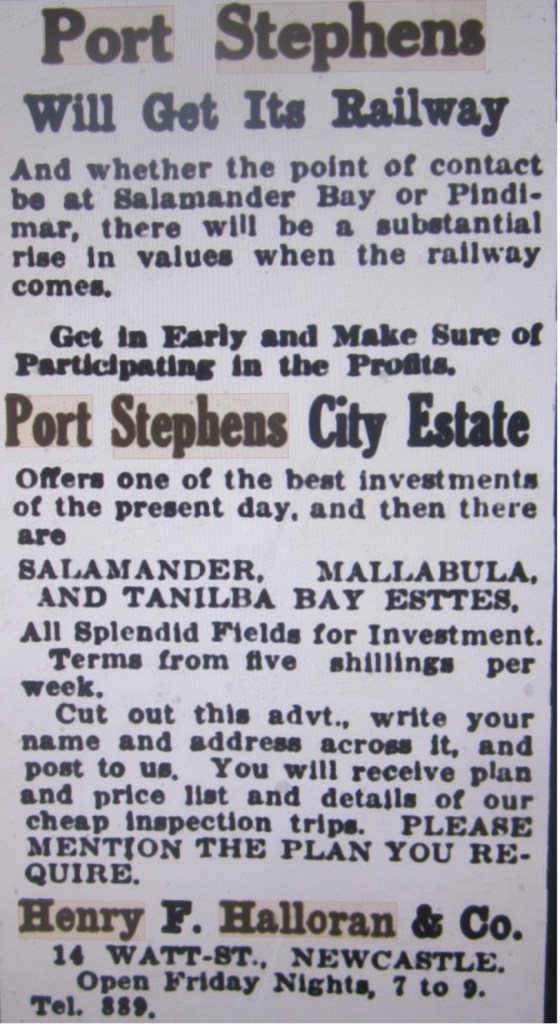
[The Newcastle Sun, 15 September 1928 and many other newspapers]
Land in the Tanilba Bay estate was still for sale in 1935, and the Newcastle Morning Herald and Miners’ Advocate of 5 January 1935, page 11, and other newspapers published the following advertisement:
‘POPULAR TANILBA. 5000 people visit it on New Year’s Day. The coming place. Why not have a Block of Land there on easy terms while the prices, are low. Plans available and car drive to inspect. REALTY REALIZATIONS LTD. 1 Tudor st., first door from Hunter-st. West.’
11. The Mallabula Estate, Tanilba Bay – 1919
The advertising promotes the Mallabula Estate as being about one hour’s drive by level road from Newcastle, via Stockton.
The Mallabulla Estate was surveyed in 1919, but subsequent sales were slow, partly due to the Great Depression in the 1930’s.
This was a Garden City type development incorporating rounded streets and abundant recreation spaces.
The estate plan:
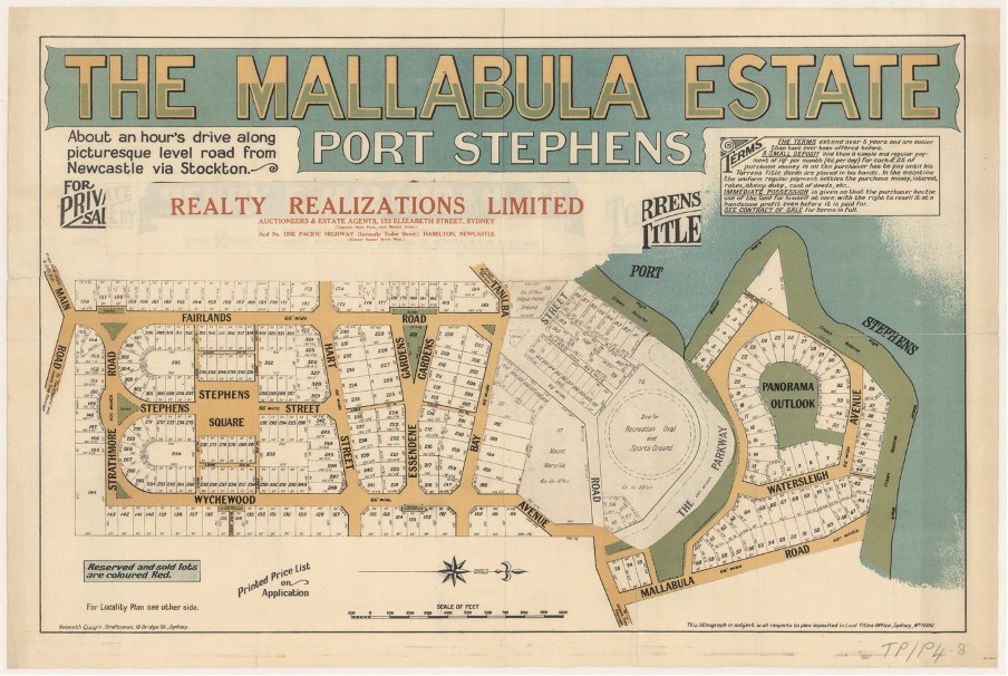
[NSW State Library].
The land was still being marketed in 1928 as per the newspaper advertisement below:
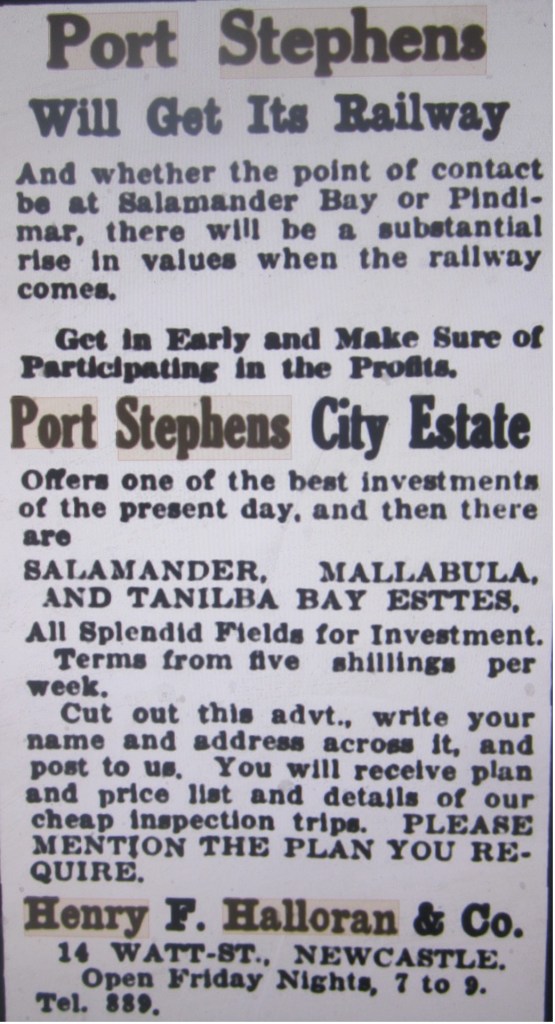
[The Newcastle Sun, 14 September 1928]
Land in the Mallabula Estate area was still available for sale in 1947. The Newcastle Morning Herald and Miners’ Advocate of 29 November 1947, page 9, advertised:
‘MALLABULA ESTATE, Port Stephens Choice Waterfrontage Lots. sandy beach, £100. Terms. Realty Realizations Ltd.. 1 Tudor-st.. Hamllton.’
The Newcastle Morning Herald and Miners’ Advocate of 11 May 1949, page 7, advertised:
‘MALLABULA ESTATE, PORT STEPHENS. Waterfrontages, £90, terms, good fishing, near Lemon Tree Passage, Apply Realty Realizations Ltd., I Tudor-st., Hamilton.’
12. Tanilba House Estate, Tanilba Bay – 1920
The advertising promotes the Tanilba House estate as being handy to Newcastle, via Stockton.
Henry F. Halloran purchased the land for this subdivision, including the historic ‘Tanilba House’ from Walter Clift. It was a smaller development than his Tanilba Bay Estate of 1918.
The estate plan:

[NSW State Library]
The land was still for sale in the 1950’s as per the following newspaper advertisements:
The Newcastle Morning Herald and Miners’ Advocate of 10 November 1950, page 11, advertised:
‘PORT STEPIIENS. TANILBA House Estate. Choice Waterfrontages from £130. Terms. Realty Realizations Ltd., 1 Tudor-st., Hamilton.’
The Newcastle Morning Herald and Miners’ Advocate 4 November 1953, page 11, carried the following revised advertisement:
‘TANILBA HOUSE ESTATE. Super absolute Waterfrontage Lots, from £180. Also other waterside lots, from £65. Terms. Ideal place for a weekender. Fishing, boating, swimming. Contact Realty Realizations Ltd., 1 Tudor-st., Hamilton.’
Advertisements for the estate were published until November 1952.
13. Waterview Estate, Tea Gardens – 1922
The advertising promotes the estate as being admirably adapted for sea-side homes for country people and close to surfing, boating, fishing and shooting.
The estate plans for the first subdivision:
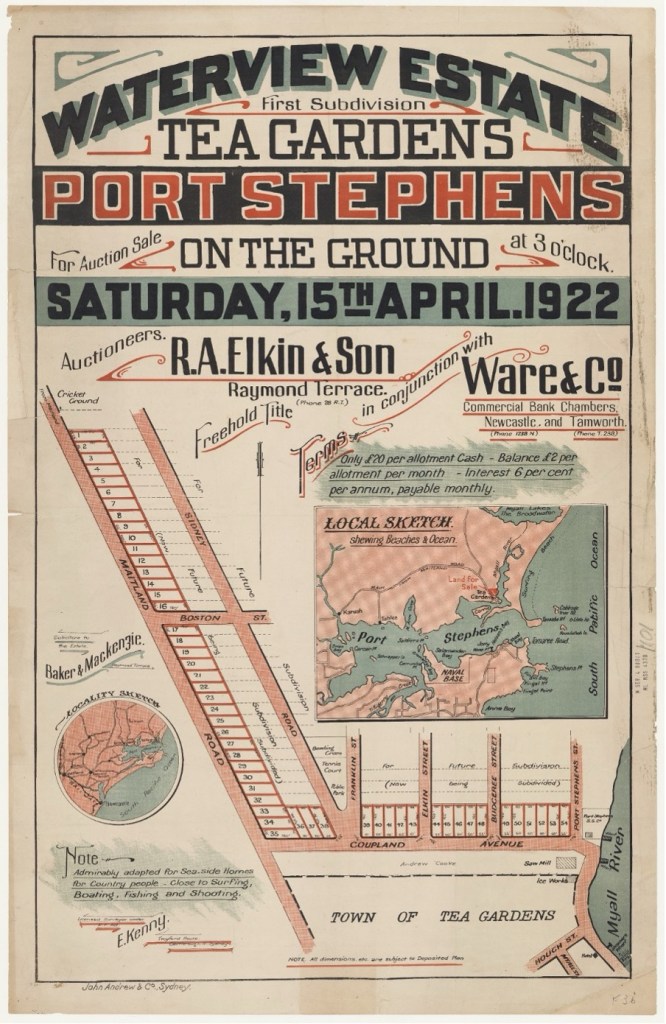
[NSW State Library]
The estate plans for the second subdivision:
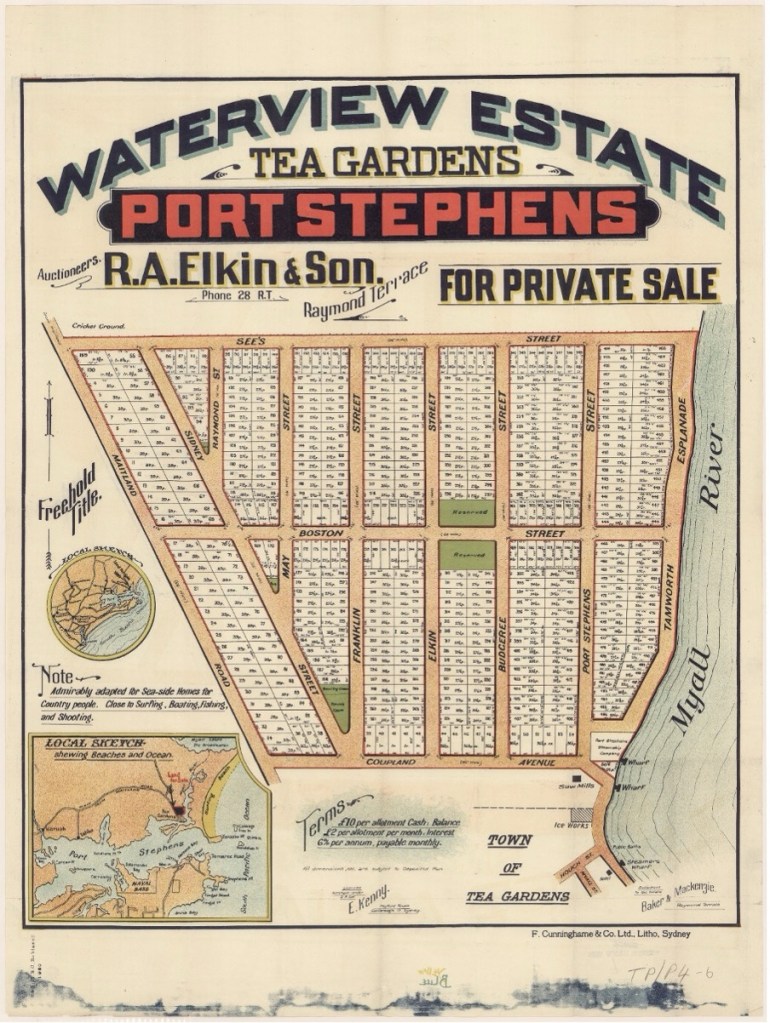
[NSW State Library]
The newspaper advertisement:
The Raymond Terrace Examiner and Lower Hunter and Port Stephens Advertiser of 24 March 1922, page 3, advertised:

The newspaper reports:
The Raymond Terrace Examiner and Lower Hunter and Port Stephens Advertiser of 31 March 1922, page 3, reported:
‘In these days when most people are in search of a sanatorium or a health giving sanctum to spend a recuperative holiday, there is no better location than around Port Stephens. Here the wide sheets of open water and close proximity to the sea and its beaches is the ideal resort. Close to Newcastle and Sydney a few hours run — the busy haunts of men can be vacated and in a few hours you are in a new haven, where peace, perfect peace reigns, and the relaxation from strenuousness to idle enjoyment is enjoyed to the full.
The Waterview Estate is for sale on Easter Saturday, and this land is ideally situated for seaside homes and weekend resorts. The plans are now out, and Messrs Elkin and Son are the auctioneers. The property is reached by a fairly good road now, and in a year’s time by a much better road, as improvements are being effected. There is no better thing offering at present, either as a spec. or a pleasure resort than this Estate. Each block will be sold on its merits, and those looking for a good growing investment should bear in mind the 15th April at Tea Gardens.’
The Raymond Terrace Examiner and Lower Hunter and Port Stephens Advertiser of 14 April 1922, page 3, reported:
‘Speculators and those in search of sea side residence sites are reminded that the subdivision sale of Waterview Estate, Tea Gardens, Port Stephens, will be offered by Messrs Elkin and Son, on behalf of the vendors, on Easter Saturday, on the ground. The blocks that will be offered on Saturday are choicely situated and are commanding sites for homes or the future business sites of Tea Gardens. It is wonderful to know of the amount of land that has changed hands in and round Port Stephens during the past two years; the purchase price runs into thousands.
Sites have been bought on both sides of the Port and those who believe that an active and early future is ahead of this great harbour, are now almost sufficient to demand its early opening. That is all that is required. Open up the Port and the land along and adjacent to its foreshores will at once climb into active demand at very high prices. The Government that is now in power may be induced to recognise the value of Port Stephens as a harbour way. It can’t be long delayed and the speculator who acquires land there now when prices are fair will, in a few years have a golden halo in his outlook. The Port is bound to come, and hence acquiring a block or more in the Waterview Estate should be one of the best things offering this Easter. The terms will deter none; they are easy; and a chat with the auctioneers will get over any difficulty. The sale will take place on Saturday afternoon, and on the following day the visitors will be taken for a run up the Lakes.’
The Newcastle Morning Herald and Miners’ Advocate of 28 April 1922, page 4, reported:
‘At Tea Gardens (Port Stephens), on Easter Saturday, R. A. Elkin and Son (Raymond Terrace) and Ware and Company (Tamworth) conducted a sale of the Waterview subdivision, situated, on the banks of the Myall River, Tea Gardens. This picturesque riverside township is becoming a popular pleasure resort since the road via Karuah has been improved, and is a favourite run for motorists. Mr. A. Elkin wielded the hammer, and buyers were present from Narrabri, Tamworth, Dungog, Raymond Terrace, Maitland, Cessnock, and other centres. Bidding was brisk, and quarter-acre lots sold from £30 to £105. The balance of the estate is to he sold privately.
This subdivision will afford an opportunity for the expansion of the town, where dwellings are difficult to obtain. A launch picnic was arranged by the auctioneers to give visitors an opportunity of seeing the beautiful Myall lakes, which was much appreciated. A local company with a capital of £10,000 is being formed to erect an up-to-date boarding-house at Tea Gardens, with tennis courts, swimming baths, motor launches and other accessories for visitors. The Port Stephens Shire Council has arranged for a loan of £2000 to improve the road to Tea Gardens, which will make it one of the best motor roads in the State, and also to construct a new punt at Karuah. With these improvements, and a fine steamer service via Salt Ash, this beautiful spot, adjacent to harbour, river, lake and sea, should become one of the most attractive holiday resorts in the State.’
The Dungog Chronicle of 23 June 1922, page 2, also reported on the Waterview Estate sale:
‘In another column the public are notified that Mr. R. A. Elkin is in town selling blocks on the beautiful Waterview estate, Tea Gardens. Portion of this estate, it will be remembered was auctioned a couple of months ago when every block submitted was sold, the competition being particularly keen. It was then announced that when further lots became available, they would be offered privately to the public. Dungogites who want a block of land at Port Stephens where a magnificent holiday, fishing, shooting, etc., can be spent should get in early and secure a block. Already a number have been sold to local residents.’
14. Karuah Estate – 1922
The Newcastle Sun of 1 September 1922, page 8, reported:
‘Karuah is likely to become in a short time one of the principal tourist resorts in New South Wales. At certain times fish bite freely off the wharf, while boats and launches may be hired to take parties round Port Stephens. Anybody in search of recreation could not do better than take a weekend run to Kuruah. A great drawback to Karuah’s progress in the past has been the locked up land surrounding it, but with the change taking place now rapid advancement is assured, and the town will go ahead by leaps and bounds. It is so conveniently situated for the populous centres of Newcastle and Maitland districts that the traffic to its many beauties and its fine fishing and oystery has been increasing. But the lack of suitable accommodation for casual visitors, and the fact that land has not been available for wee-end and holiday camps and bungalows have prevented settlement, though inquiries have been begun.
The new Karuah Estate subdivision of nearly 800 lots, now being prepared, comprise a beautiful area of partly level and partly undulating country, having a good frontage to the main road and about 2000 feet of frontage to the water in a particularly sheltered position, with perfect anchorage for boats and launches. The planning of this estate has been done, in the most thorough manner by one of the foremost town-planners, who has given more than ordinary thought and attention to making it as perfect as possible. All the features and ideas of modern scientific town-planning as are suitable to the estate and the locality have been introduced. A survey party, under Mr. Buckhorn, has been engaged on the estate during the past six months, and has just finished pegging the lay-out.
Along the whole of the waterfront a wide promenade has been provided. The new jetty to be constructed for the use of the purchasers will be in the centre. Slightly back from the water, but in full view, is the civic centre for all future public buildings, to which all important roads lead. Surrounding it is the business area. Many of the roads follow the contour of the rising land with graceful curves in such a manner that nearly all lots have a good view. There are many small parks, including a large recreation ground and sports oval on the level portion of the estate, and several fine outlooks on the higher points, notably the Golden Vision Park. The summit of a hill on the western side commands a splendid view of wide expanse and great variety.
A gang of men has been for some time preparing the roads, and the work will be advanced sufficiently by the spring for the estate to be made available for buyers about October. Buyers will be able to obtain timber at very low rates for building purposes from a sawmill which adjoins the estate. The Shire Council is becoming alive to the increasing importance of this district, and arrangements have been made for a loan of £3500 to be expended on roads, principally on the road from Karuah to Tea Gardens. A new power punt at Karuah ferry is to be installed.’
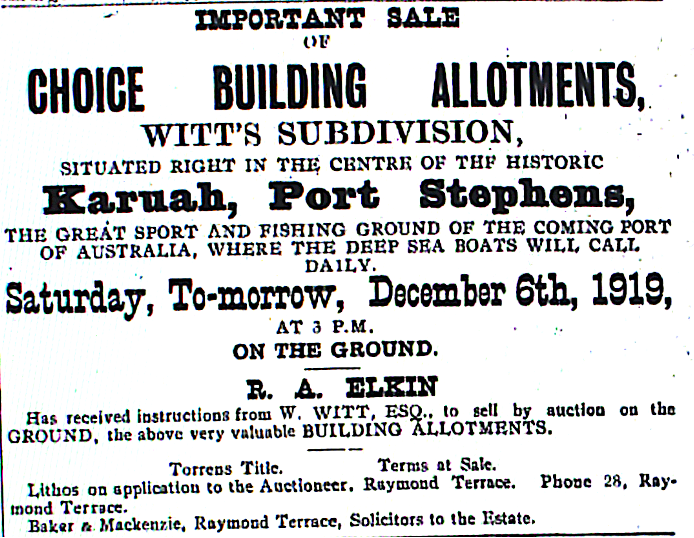
First advertisement for the sale of residential land in the Witt’s Subdivision at Karuah, published in the Raymond Terrace Examiner and Lower Hunter and Port Stephens Advertiser of 5 December 1919, page 3. The land was later featured in the Newcastle Sun article of 1 September 1922 that is featured above.
15. Tilligerry Estate – 1922
The advertising promotes the estate as the week-enders paradise.
The newspaper advertisements:
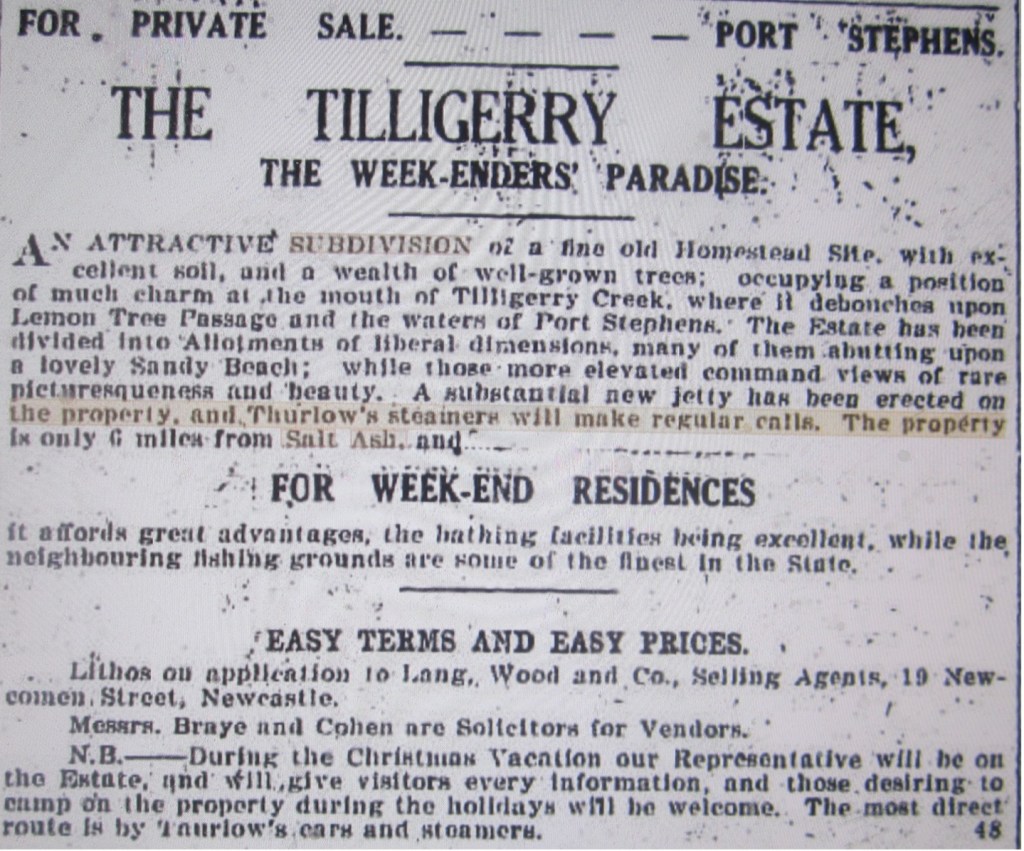
[The Maitland Daily Mercury, 20 December 1922]

[Newcastle Morning Herald and Miners’ Advocate, 20 December 1922]
16. Hawks Nest Estate – 1926
The estate plan:
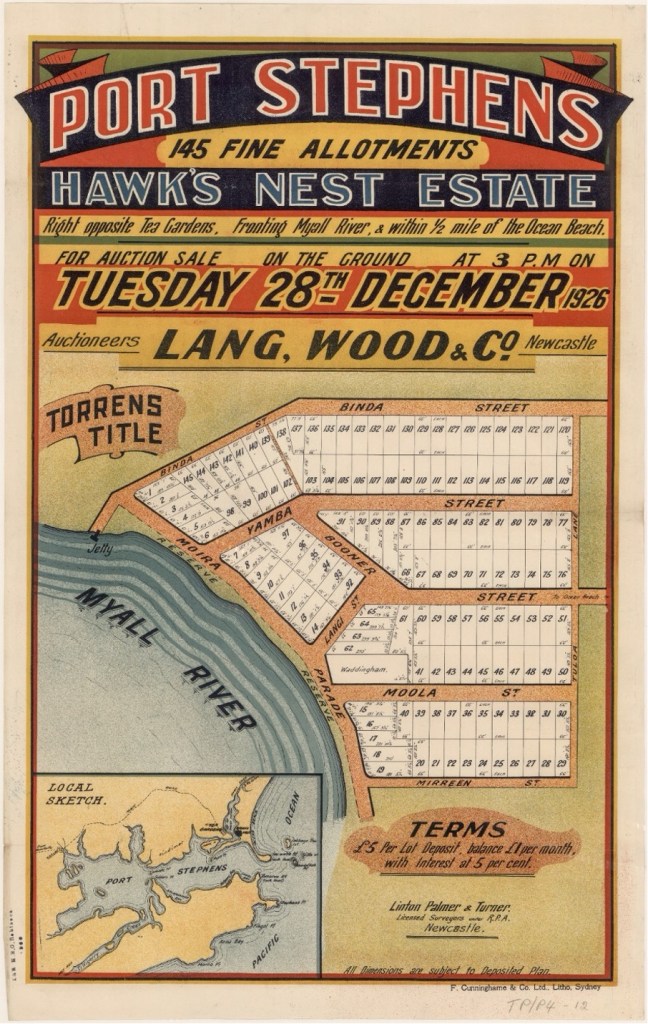
[NSW State Library]
The newspaper reports:
The Newcastle Morning Herald and Miners’ Advocate of 4 December 1926, page 6, reported:
‘A subdivision of 145 selected blocks of the Hawk’s Nest Estate, Port Stephens, will be sold by auction by Messrs. Lang, Wood and Co., on Tuesday, December 28, on the ground. The fine estate is situated opposite the township of Tea Gardens, and fronts the Myall River, close to its entrance to Port Stephens. It is in an area recognised as one of the finest fishing grounds in the State. Terms and particulars are advertised.’
The Newcastle Sun of 10 December 1926, page 6, reported:
‘The Hawk’s Nest Estate — one of the beauty spots of Port Stephens — will be offered at auction by Messrs, Lang, Wood and Co., on the ground, on Tuesday, December 28. The subdivision includes 146 selected blocks, and the estate is opposite the growing township of Tea Gardens, which, is approached by a good road and regular terry service, and fronts the well-known Myall River, near the entrance to Port Stephens. The estate has been subdivided into riverside allotments, which command good views, and are within a short distance of the ocean beach, which is renowned for fishing. Lithos. are now being prepared and will shortly be available from the auctioneers, Croasdill House, Thorn street, Newcastle.’
The Newcastle Sun of 17 December 1926, page 4, further reported:
‘The Hawk’s Nest estate— one of the beauty spots of Port Stephens — will be offered at auction by Messrs. Lang, Wood and Co., on the ground, on Tuesday, December 28. The subdivision includes 145 selected blooks, and the estate is opposite the growing township of Tea Gardens, which is approached by a good road and regular ferry service, and fronts the well-known Myall River, near the entrance to Port Stephens. The estate has been subdivided into riverside allotments, which command good views, and are within a short distance of the ocean beach, which is renowned for fishing.’
17. Thompson’s Estate, Tea Gardens – 1926
The advertising promotes the estate as right on fishing grounds, with good bathing, boating and beaches nearby.
The estate plan:
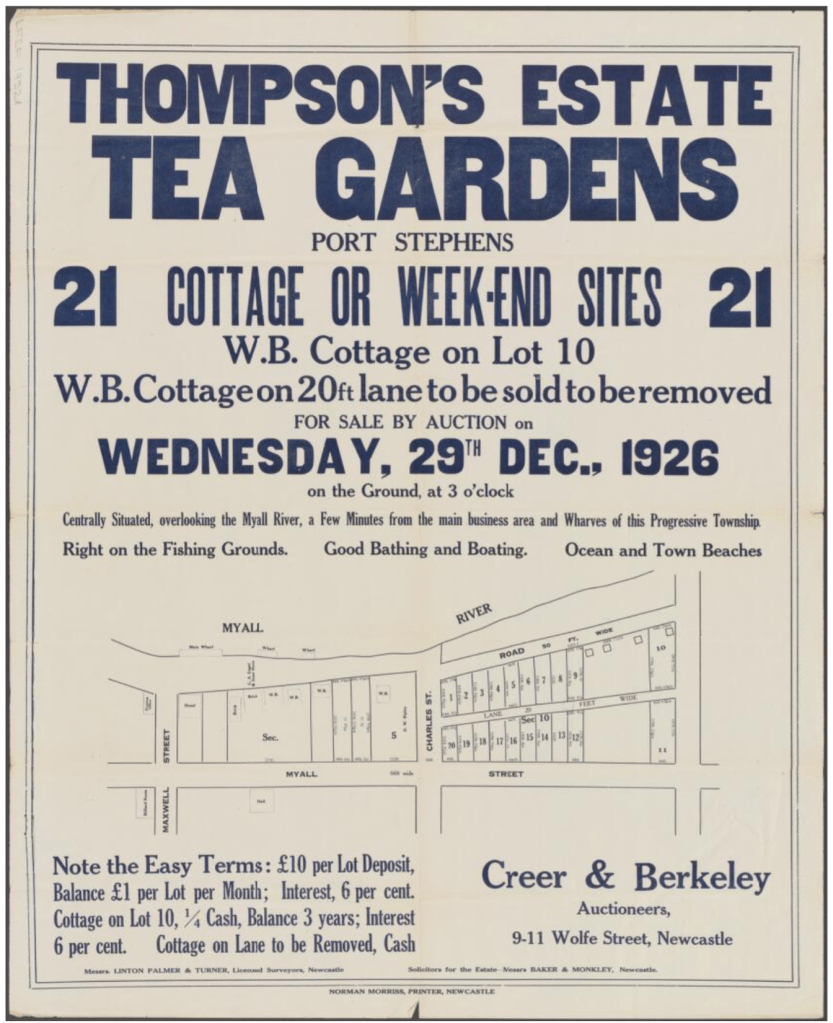
[National Library of Australia]
The newspaper reports:
The Dungog Chronicle of 27 July 1926, page 4, reported:
‘The surveyors are busy at work subdividing the estate of the late Mrs. Thompson, situated on the waterfront at the south-eastern end of Tea Gardens. This land should find ready sale as it embraces practically all the vacant land that is left on the waterfront in Tea Gardens.’
The Newcastle Sun of 10 December 1926, page 4, reported:
‘Messrs. Creer and Berkeley, auctioneers, wish to draw attention to a clearance sale of Thompson’s estate, at Tea Gardens, and Nelson’s Bay, Port Stephens, which will be held on Wednesday, December 23, on the ground at 12 o’clock at Nelson’s Bay and at 3 o’clock at Tea Gardens. The property to be submitted comprises three weatherboard cottages, with absolute water frontages, large depths, also two cottage or week-end sites. This is the only absolute water frontage property available in this charming and popular seaside resort, embracing glorious panoramic views of the harbor and foreshores.
There are gentle slopes, grassland, permanent water. This is a favorite spot for the tou-ist and week-ender, good fishing and boating, safe bathing. It is conveniently situated a few minutes from ferry, wharf, stores, and post office. Also for the same estate the auctioneers are offering 21 cottage or weekend sites and two four roomed weatherboard cottages, overlooking the Myall River, Tea Gardens, right in the business centre of the town, and almost opposite the main wharves right on the fishing grounds. There is good bathing, boating and fishing, and the property is near the ocean and town beaches. This is a town which has a great prospective value, being the terminus to the Upper Myall Lakes, with the oyster and timber industry right in its centre. Terms of sale are £10 per lot deposit, balance £1 per lot per month. Interest 6 per cent, for the land, and one-quarter cash, balance three years and interest 6 per cent, for the cottages.’
Second auction advertisement:
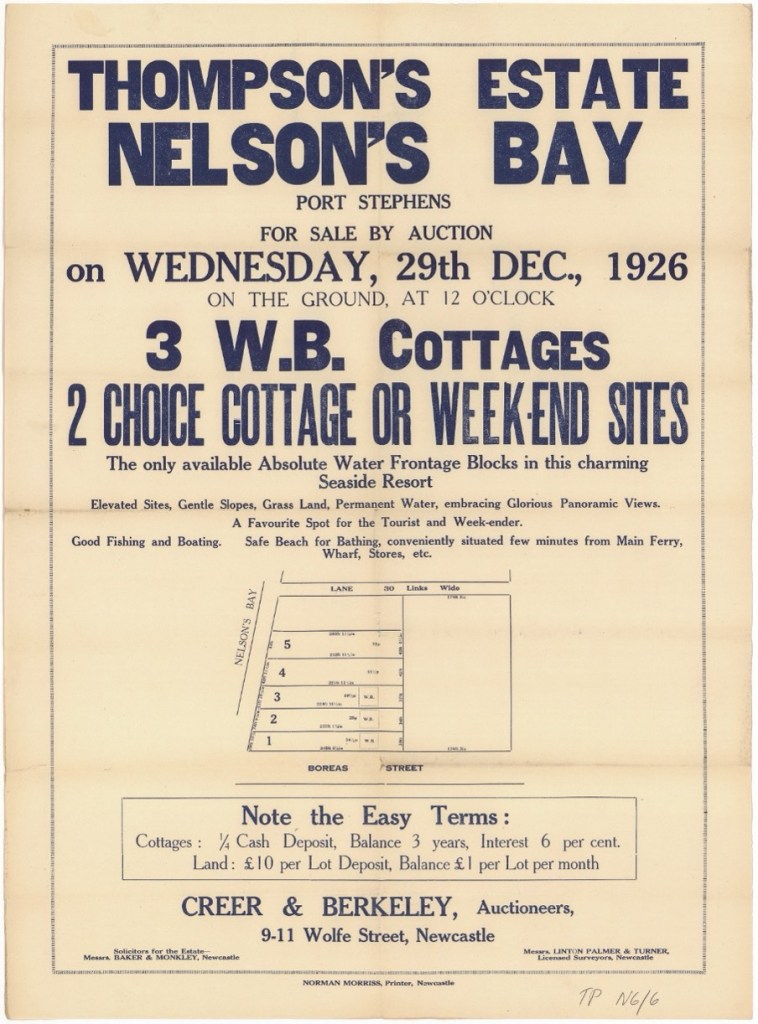
[NSW State Library]
The newspaper report:
The Newcastle Sun of 10 December 1926, page 4, reported:
‘Messrs. Creer and Berkeley, auctioneers, wish to draw attention to a clearance sale of Thompson’s estate, at Tea Gardens, and Nelson’s Bay, Port Stephens, which will be held on Wednesday, December 23, on the ground at 12 o’clock at Nelson’s Bay and at 3 o’clock at Tea Gardens. The property to be submitted comprises three weatherboard cottages, with absolute water frontages, large depths, also two cottage or weekend sites. This is the only absolute water frontage property available in this charming and popular seaside resort, embracing glorious panoramic views of the harbor and foreshores. There are gentle slopes, grassland, permanent water. This is a favourite spot for the tourist and week-ender, good fishing and boating, safe bathing.
It is conveniently situated a few minutes from ferry, wharf, stores, and post office. Also for the same estate the auctioneers are offering 21 cottage or week-end sites and two four-roomed weatherboard cottages, overlooking the Myall River, Tea Gardens, right in the business centre of the town, and almost opposite the main wharves right on the fishing grounds. There is good bathing, boating and fishing, and the property is near the ocean and town beaches. This is a town which has a great prospective value, being the terminus to the Upper Myall Lakes, with the oyster and timber industry right in its centre. Terms of sale are £10 per lot deposit, balance £1 per lot per month. Interest 6 per cent, for the land, and one-quarter cash, balance three years and interest 6 per cent, for the cottages.’
18. Nelson Bay Subdivision – 1927
The advertising promotes the estate as being near good fishing, boating and beaches.
The estate plan:
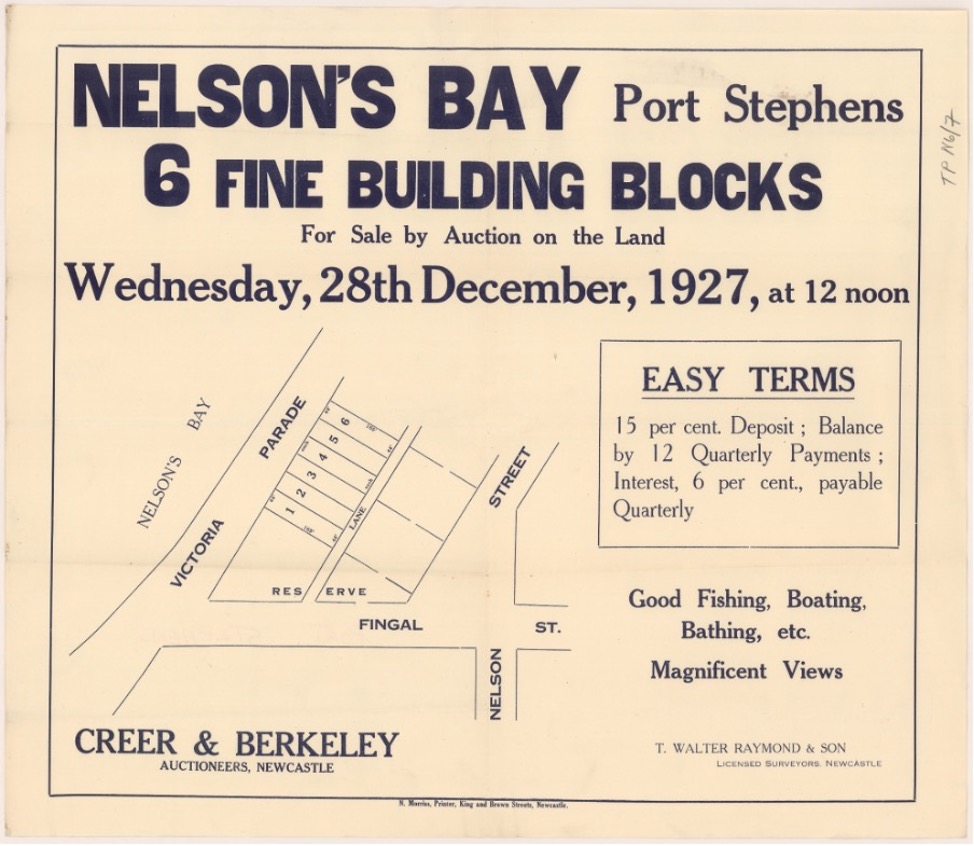
The newspaper reports:
The Maitland Daily Mercury of 13 December 1927, page 4, reported:
‘Six building blocks, in Victoria Parade, Nelson’s Bay (Port Ste-phens) will be offered at auction by Messrs. Creer and Berkeley, on the land, on Wednesday, Dec. 28, at noon.’
The Newcastle Sun of 16 December 1927, page 10, reported:
‘Auction Sales NELSON’S BAY PORT STEPHENS. 6 Fine Building Blocks In elevated position, commanding magnificent views, and having absolute frontage to Victoria Parade, the reservation along the foreshores. FOR SALE BY AUCTION, ON THE LAND, WEDNESDAY, DEC. 28, AT 12 NOON.’
19. White’s Estate, Nelson Bay – 1928
This estate was located adjacent to the land sold during December 1927, as shown above.
The estate plan:
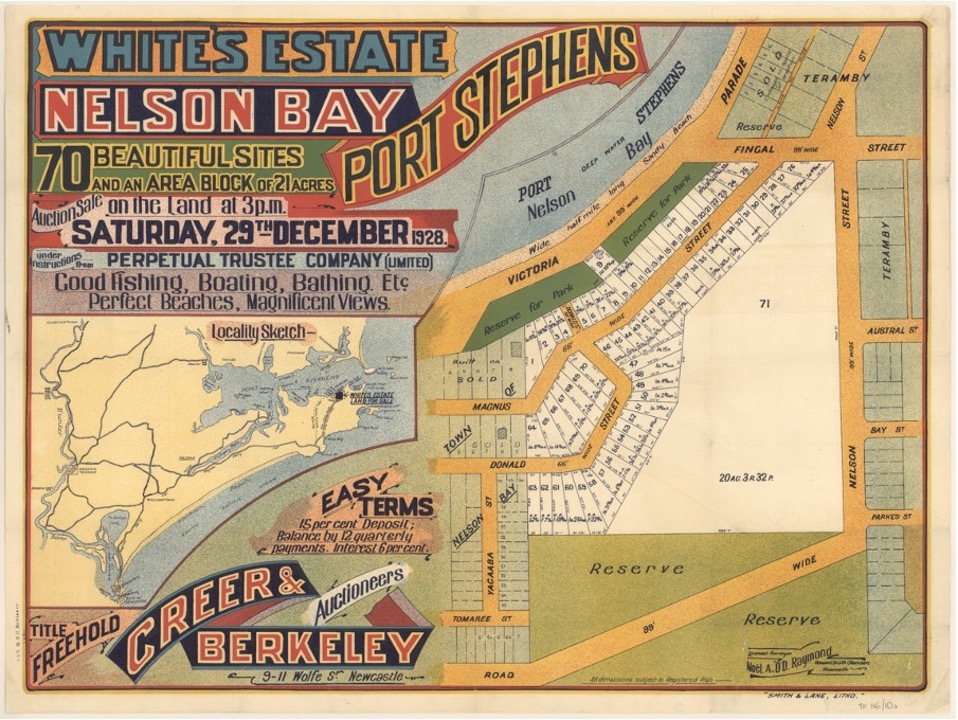
The newspaper reports:
The Raymond Terrace Examiner and Lower Hunter and Port Stephens Advertiser of 5 January 1928, page 3, reported on an early sale of land in the estate of Mrs. White:
‘The landsale held here recently when six lots in the estate of the late Mrs White, of Tahlee, realised good prices. The blocks are 44 x 165 and front Victoria Parade and the Bay. The location is about half way along the beach towards Fly Point. Bidding was fairly brisk and the blocks realised as follows: — Lot 1 42/6 per foot; Lot 2, 32/6; Lot 3 32/6; Lot 4 32/6; Lot 5 and 6, 30/-. The blocks were brought by non-residents.’
The Newcastle Sun of 28 December 1928, page 6, reported:
‘Port Stephens is an ideal holiday resort, as good fishing, in addition to boating and bathing, can be enjoyed. On December 29, White’s estate, which comprises 21 acres, subdivided into 70 sites, will be offered at auction by Creer and Berkeley. The road to Nelson’s Bay has been placed under the jurisdiction of the Main Roads Board, and already tenders have been called for the construction of this highway. Nelson’s Bay is right on the shores of Port Stephens, and has all the improvements necessary for the comfort of inhabitants. White’s estate has a frontage to the Reserve, adjacent to the beautiful sandy beach. There are regular car services from Newcastle and a launch service from Salt Ash.’
The following advertisement appeared on page 8 of the same newspaper:
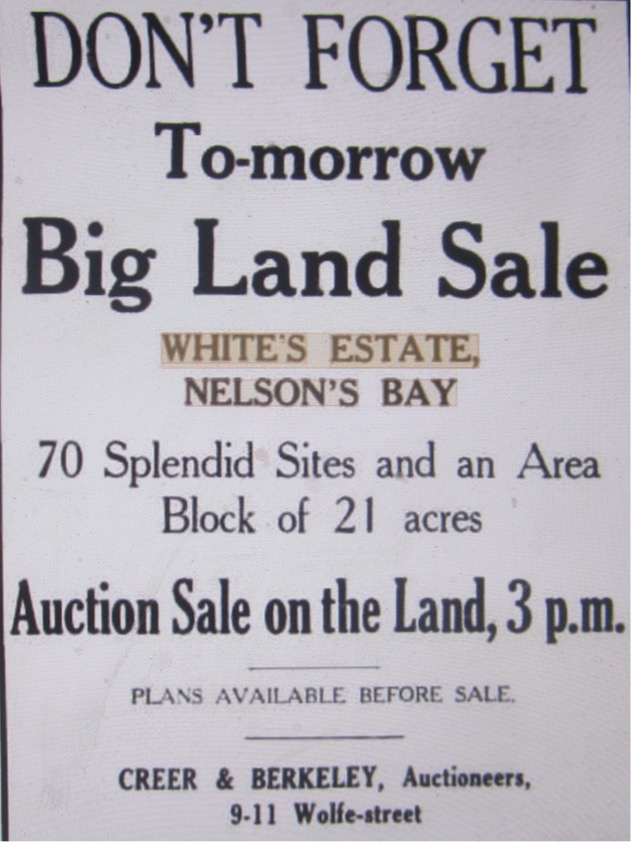
During 1949 a further 7 lots from White’s Estate were advertised for sale.
The estate plan for the 1949 sale:
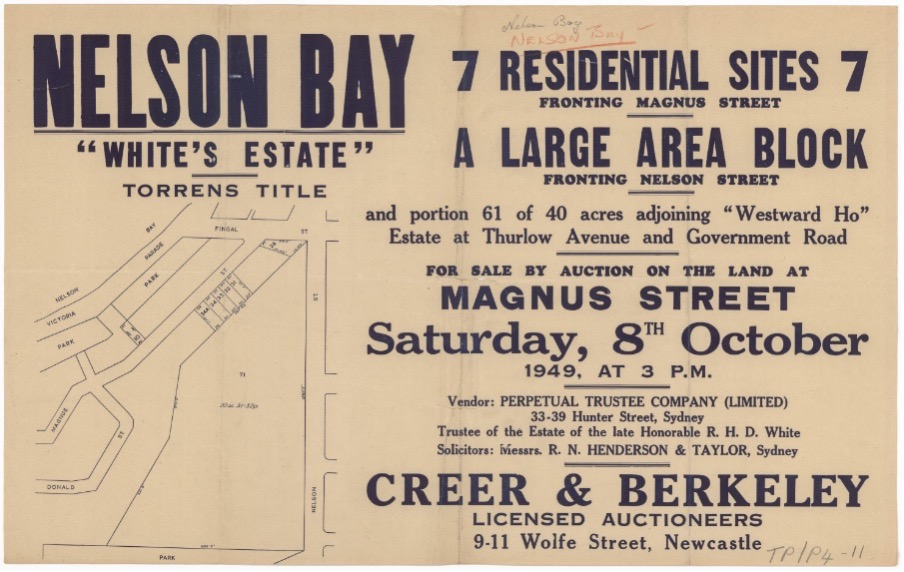
[NSW State Library]
The newspaper advertisement from 1949:
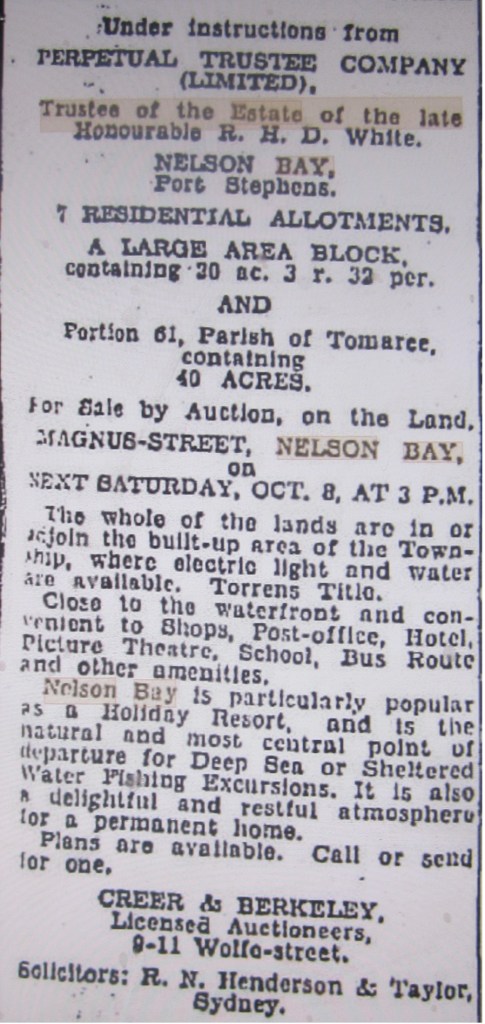
[Newcastle Morning Herald, 1 October 1949]
[Newcastle Morning Herald, 1 October 1949].
20. Salt Ash Subdivision – 1928
The advertising promotes the boat shed sites abutting on to Tilligerry Creek.
The estate plan:
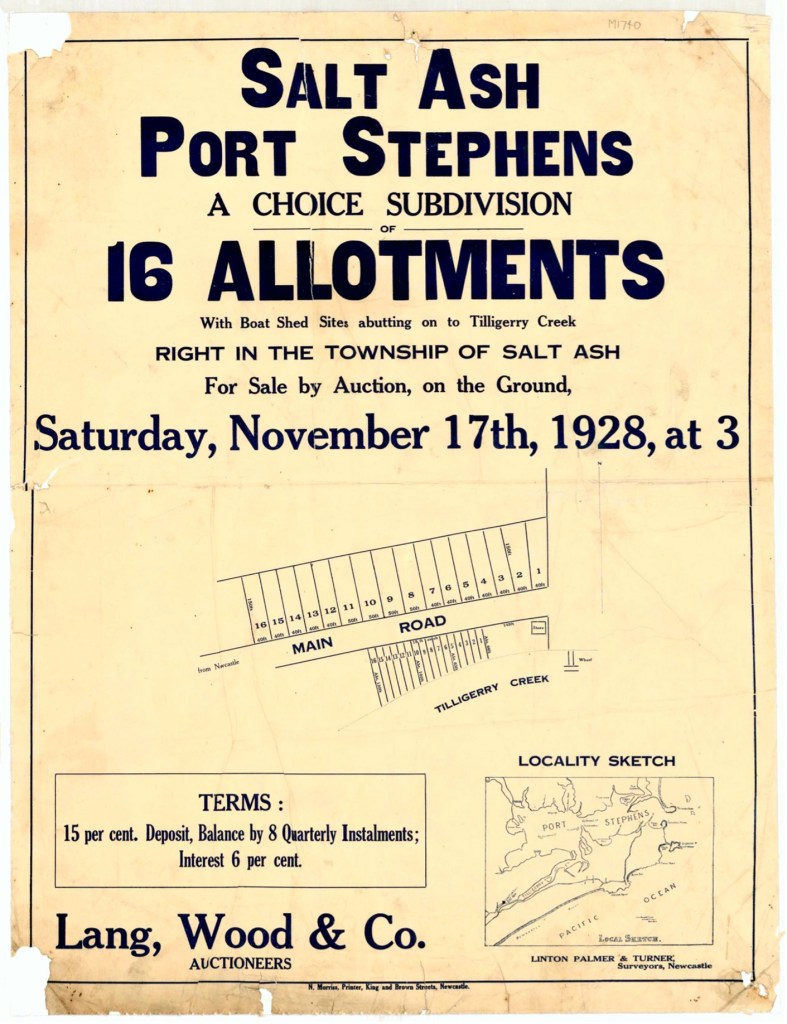
The newspaper advertisement:
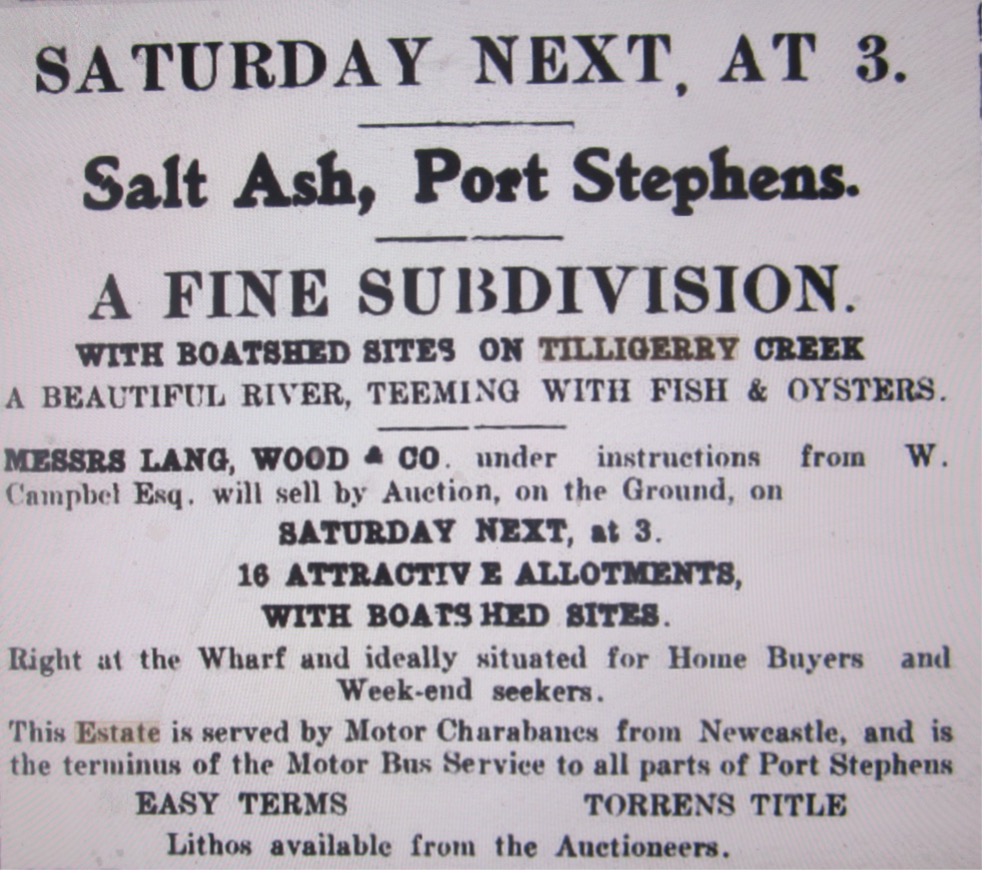
[The Gloucester Advocate, 13 November 1928]
21. Kooindah Estate, Lemon Tree Passage – 1828
The advertising states that ‘Kooindah’ means ‘sparkling waters’.
The newspaper advertisement:
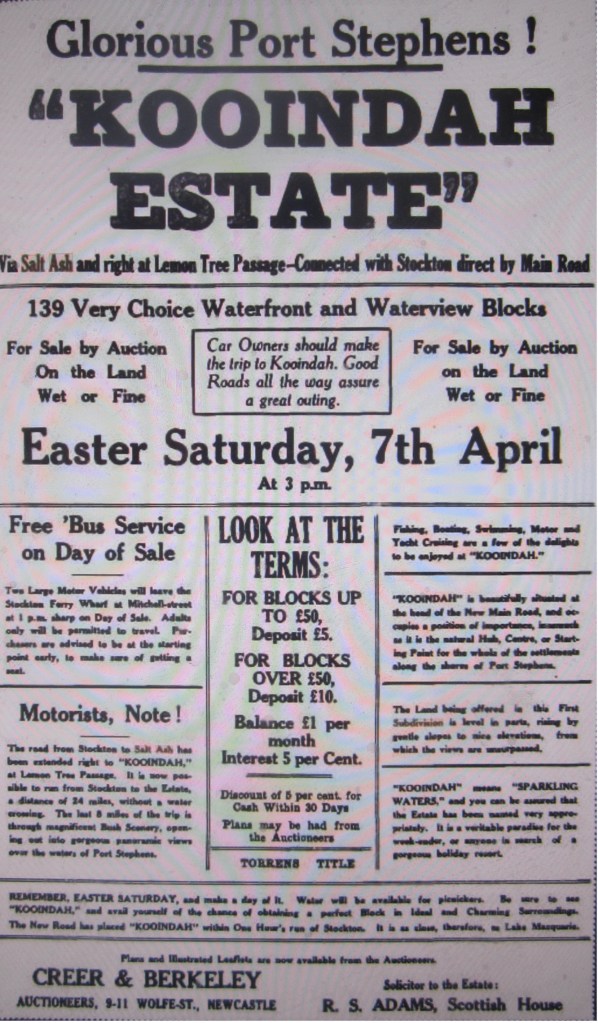
[The Newcastle Sun, 5 April 1928]
22. Anna Bay Estate – 1936
Henry F. Halloran brought the land for this estate during 1936 for 700 pounds, or 25shillings per lot.
The estate plan:
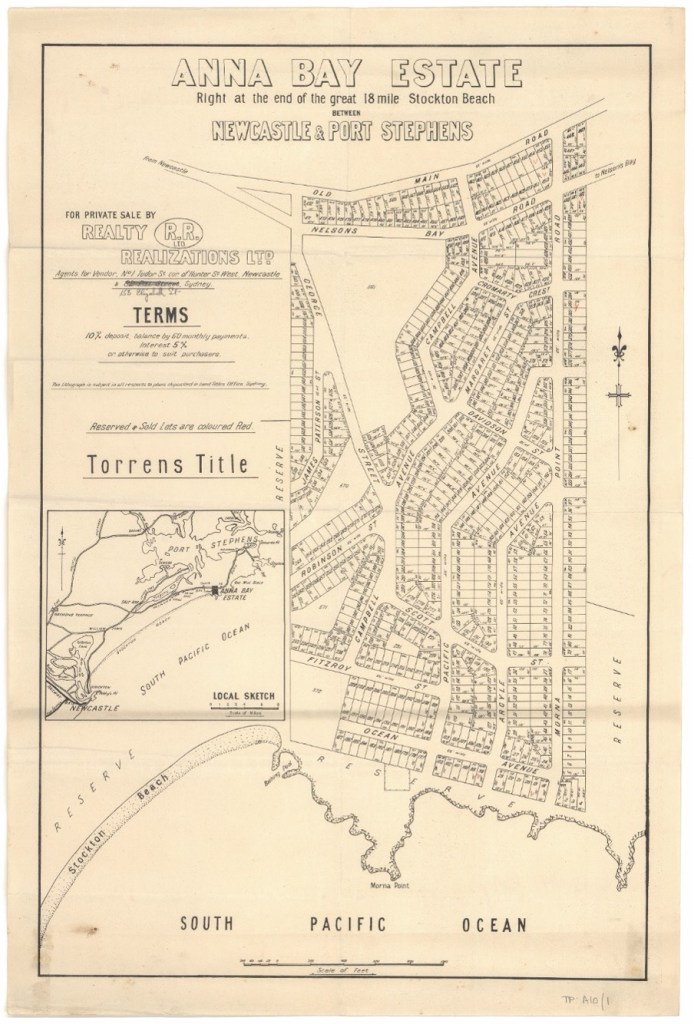
[NSW State Library]
The land was still available in 1953 as per the following newspaper advertisements:
The Newcastle Morning Herald and Miners’ Advocate of 14 March 1953, page 8, advertised:
‘ANNA BAY ESTATE. Excellent Cleared Lots, from £50. Terms. Buses pass the Estate to Newcastle Works. For Inspection, Realty Realizations Ltd., 1 Tudor-st., Hamilton.’
The Newcastle Morning Herald and Miners’ Advocate of 2 June 1954, page 12, advertised:
‘ANNA BAY ESTATE. Northern end Stockton Bench, choice Lots from £50. Terms. Cheap rates. For Inspection call at REALTY REALIZATIONS LTD., 1 Tudor st., Hamilton.’
The Newcastle Morning Herald and Miners’ Advocate of 2 August 1954, page 6, further advertised the subdivision and emphasised the job opportunities:
‘ANNA BAY EST. Beautiful Home Sites from £50 to £75. Terms. Why pay rent? Very good bus service to B.H.P. Be wise and secure a site now while prices are low. REALTY REALIZATIONS LTD., 1 Tudor-st.. Hamilton.’
Land values of the various Halloran Estates fell during the Depression Years and few sales were made during the previous ten years – 1938
in September 1938, Henry F. Halloran appeared before a Newcastle Land and Valuation Court, on behalf of a client, objecting to the valuation placed on lands in his various Port Stephens Subdivisions, for taxation purposes. He stated in his evidence that the value of the land in all his subdivisions had fallen considerably, and that he had made few land sales during the previous ten years.
The Newcastle Sun of 20 September 1938, page 7, reported his evidence
‘A practical stagnation of land sales with consequent fall in values in certain large foreshore subdivisions at Port Stephens was the basis of objections against valuations by the Valuer General heard today before Mr. Justice Roper at the Newcastle Land and Valuation Court.
Appearing as agent for Mrs. Queenie Tunnie, the Estate of the late Henry Charles Wilson, and Miss Eleanor Graham Dredge, a reduction of rates on Mallubala, Tanllba Bay, Tanilba House, Salamander and Tomaree estates at Port Stephens, were sought by Henry Ferdinand Halloran. Mr. E. J. Hook appeared for the Valuer-General. Halloran said that he had 50 years’ experience as an estate agent and valuator. His experience of coastal subdivisions was probably larger than any other estate agent in the State. The valuations on the estates were too high. His reason for objecting to the valuations was that, with rare exceptions, no movement in land matters had taken place in the Port Stephens district. On some of the estates concerned only water frontage lots had been sold. In support of his contention he said that on a large subdivision at Karuah, which had been on the market for about 10 years, only one lot had been sold.
Portion of the Tanilba Bay Estate he valued at £40 an acre. The whole area was bought in 1918 for £2 10s an acre. He valued portion of the lots at from £1 to £10 an acre. About £3960 had been spent in roads and drainage and another £2500 in making a road of access from Salt Ash. A subdivision of 600 lots, the Anna Bay Estate, was bought about two years ago for £700, about 25s a lot. In certain cases the valuations had been increased fourfold. Witness said that he considered the average value of lots of the Salamander Estate would now be about 10s a lot.
Mr. Hook: Were Mr. Wilson and Miss Dredge clients of yours? — Yes. And it was on your advice the Wilson Estate and Miss Dredge lodged the objections? — Yes. How do you account for the difference of the valuation of £8 a lot on Salamander Estate and your present estimate of 10s? — A few of the lots would be worth more.
He considered that Tanilba Bay subdivision, which was bought as one lot in 1918 for £700, was now worth only £510, even though it was now
subdivided and there were 40 acres of roads on it. Only two lots had been sold in 15 years.
Mr. Hook: As agent for Mrs. Tunnie, who owns the Tanilba Bay subdivision, do your operate on her bank account? — No. How would she recoup you for money paid on her behalf? — It would be adjusted in a general account. What does your price list show as the price of lot 33 on Tanilba House Estate? — We have no price list now. We have one about 10 years old. What does that show? — A thousand pounds.
In the last 10 years you have not attempted to sell Port Stephens land? — Not with any special effort. It would not be worth it. Halloran agreed that the road of access from Salt Ash had been reconstructed up to a point about eight miles from his land, but expressed a doubt whether it would be actually beneficial before a revival in land sales occurred there.
Replying to further questions by Mr. Hooke, Halloran said that, despite the fact that he had sold Lot 5 on Tanilba Bay Estate in May, 1936, for £120, its value in April 1937, was only £15. Lot 4 was sold for £120, but as an e-pert he did not think the land was worth so much as that. “People wanted it, and were prepared to pay for it,” he added.
George McBean, official valuer for Port Stephens Shire, said that in order to secure data on which to base his valuations in 1937, he obtained information about all land sales in the shire. He inspected the subdivisions under appeal, including the lots which had been sold. He had seen price lists of Halloran’s subdivisions at Tanilba House and Salamander. He knew of the sale of lots east of Nelson’s Bay, and that knowledge had assisted him in making his valuations.’
23. Bennet Beach Estate, Hawks Nest – 1947
The advertising states that the public phone and electricity had been promised by the council for 1948.
The estate plan:
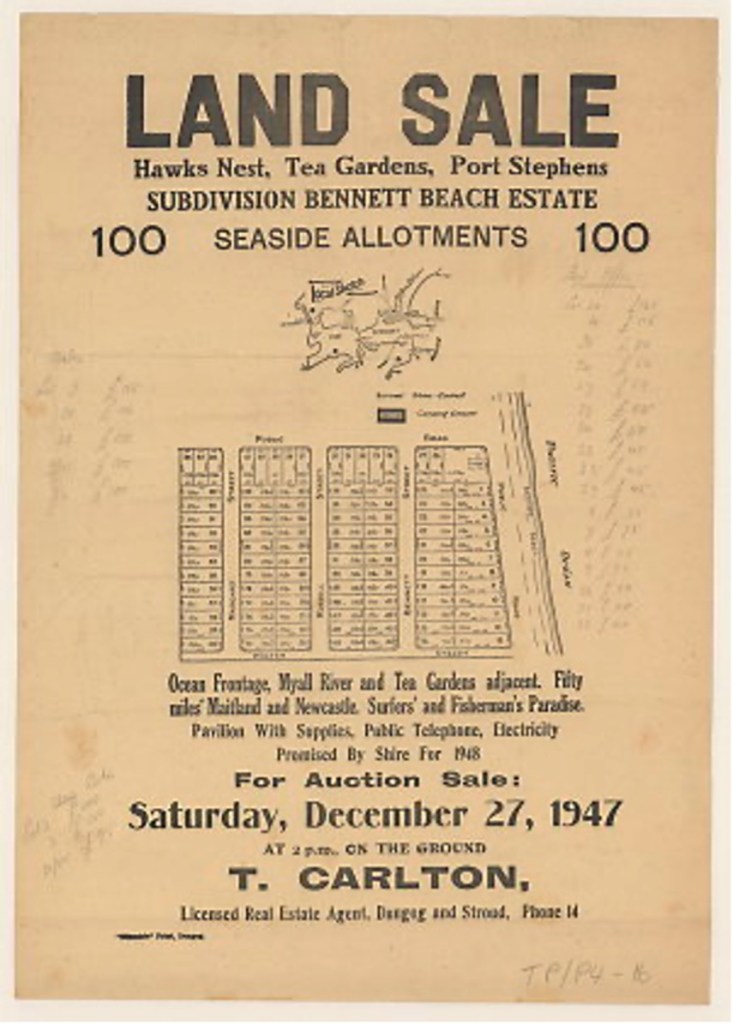
[State Library of New South Wales]
The newspaper advertisement:
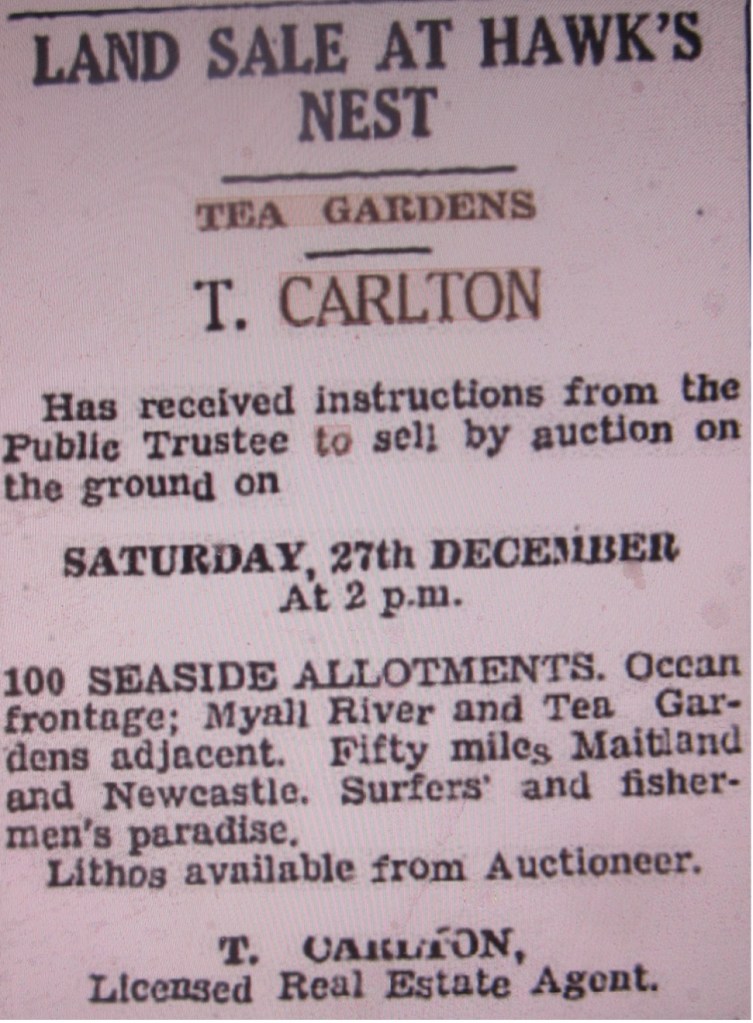
[Dungog Chronicle, 19 December 1947]
24. Marine Drive Estate, Tea Gardens – 1948
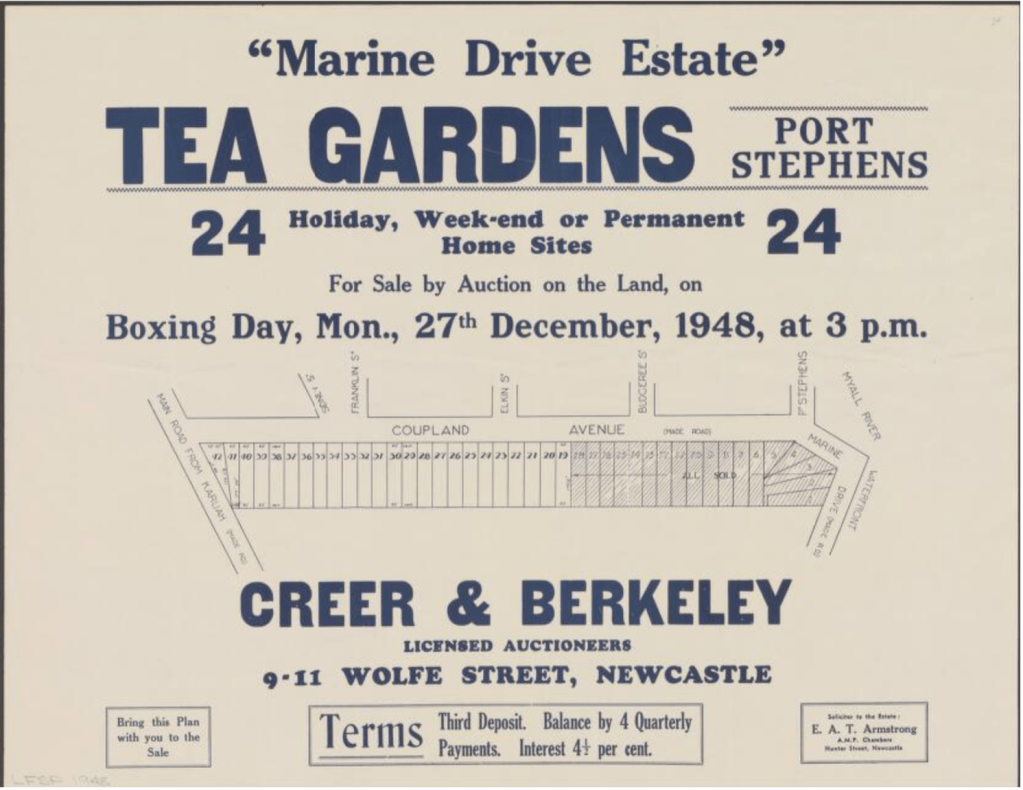
The estate plan:
[National Library of Australia]
The newspaper advertisements:
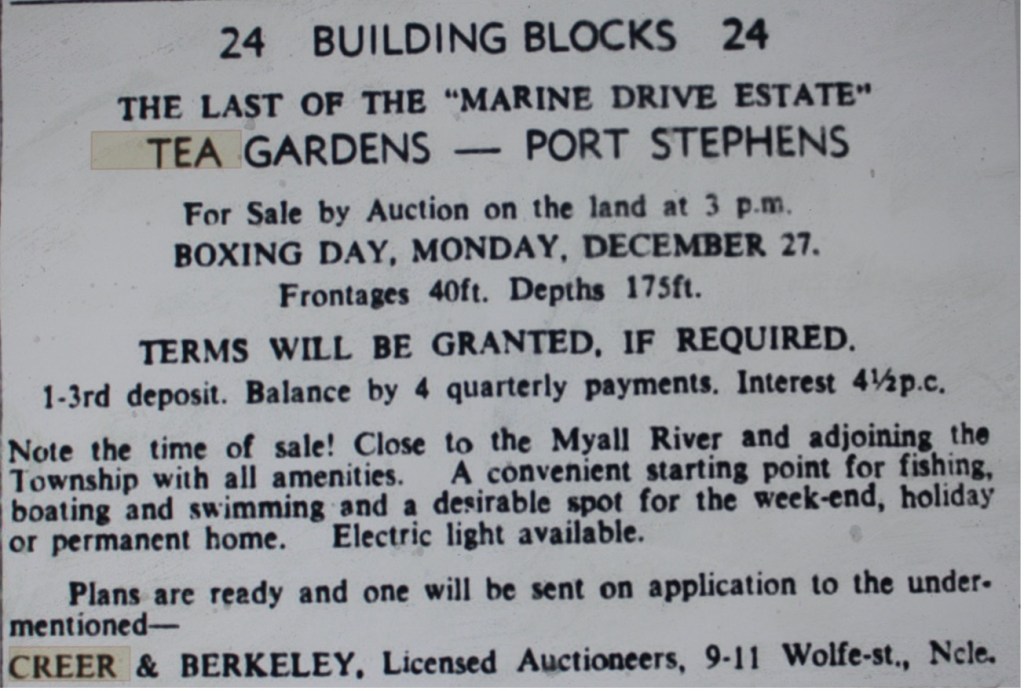
The Dungog Chronicle of 11 December 1948, page 2, reported:
‘On Monday, 27th December (Boxing Day), Messrs. Creer and Berkeley, Licensed Auctioneers, of Newcastle, will sell by auction 24 building blocks that comprise the last available blocks of the Marine Drive Estate. The sale will commence at 3 p.m.’
The Newcastle Morning Herald and Miners’ Advocate of 11 December 1948, page 10, carried the following advertisement for the land sale:
25. Tomaree Estate, Shoal Bay – 1950
The first estate plan promoted the area as the Vaucluse and Watsons Bay of Port Stephens:
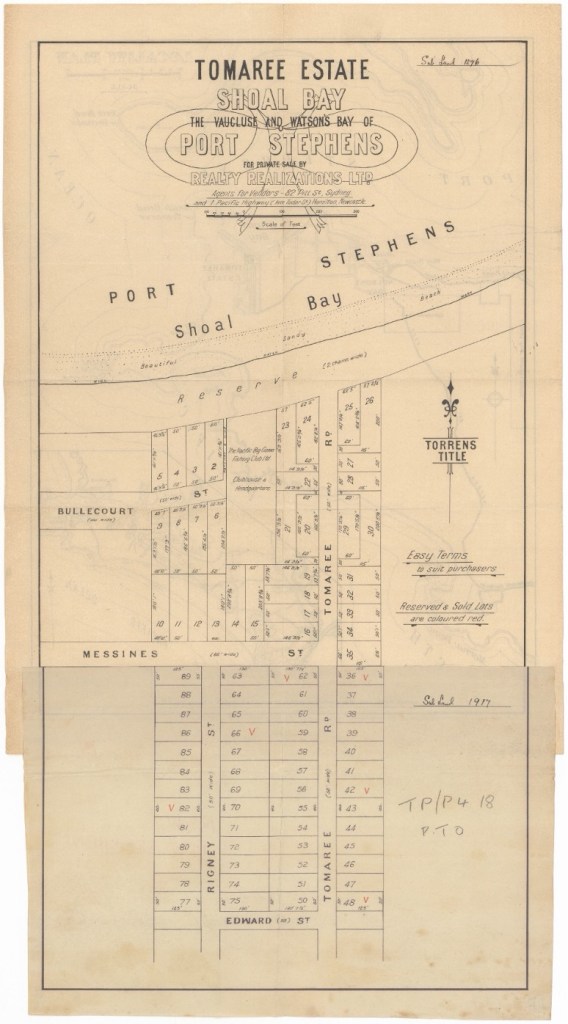
[State Library of New South Wales]
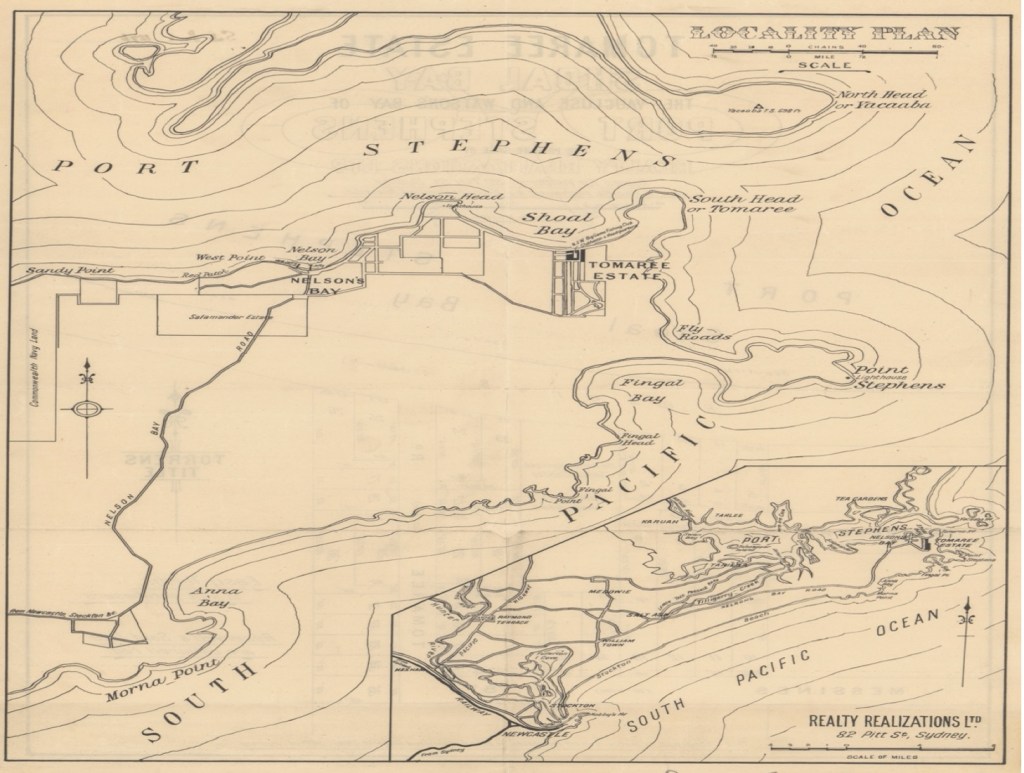
Location map of Tomaree Estate prepared by selling agent [State Library of New South Wales]
The newspaper advertisements:
The first advertisement for this subdivision appeared in the Newcastle Morning Herald and Miners’ Advocate of 16 November 1948, page 5:
‘Port Stephens, Tomaree Estate, New Subdivision between Shoal Bay and Box Beach, many lots to choose from. Only a few mins. to several beaches. Lots from £50. Terms. Realty Realizations Ltd., 1 Tudor st., Hamilton.’
The Newcastle Morning Herald and Miners’ Advocate of 11 December 1948, page 9, advertised:
‘PORT STEPHENS, TOMAREE ESTATE. SHOAL BAY, POPULAR RESORT, New Subdivision, Choice Lots from £50, handy to several beaches. Good soil, good fishing. Call at REALTY REALIZATIONS LTD., 1 Tudor-st., Hamilton.’
The estate plan for the second subdivision:

[NSW State Library]
The newspaper advertisements:
The land was still for sale in 1950, but the cost of the remaining land had increased. The Newcastle Morning Herald and Miners’ Advocate of 4 March 1950, page 8, advertised:
‘PORT STEPHENS. Shoal Bay, Tomaree Estate, new sub., good road, perfect Lots, from £65 to £100. Terms. Inspect weekend. Apply REALTY REALIZATIONS LTD., 1 Tudor-st., Hamilton.’
Unsold lots were still available in 1953. The Newcastle Morning Herald and Miners’ Advocate of 5 May 1954, page 13, reported:
‘PORT STEPHENS. TOMAREE Estate, Shoal Bay,, Anna Bay, Bldg. Lots, handy to Nelson Bay township. Plans sand prices, call at REALTY REALIZATIONS LTD., 1 Tudor-st., Hamilton. Phone MA1665.’
26. Dutchman’s Bay Estate, Nelson Bay – 1952
The advertising state that the estate lies next to the built-up township.
The estate plan, stage 1:
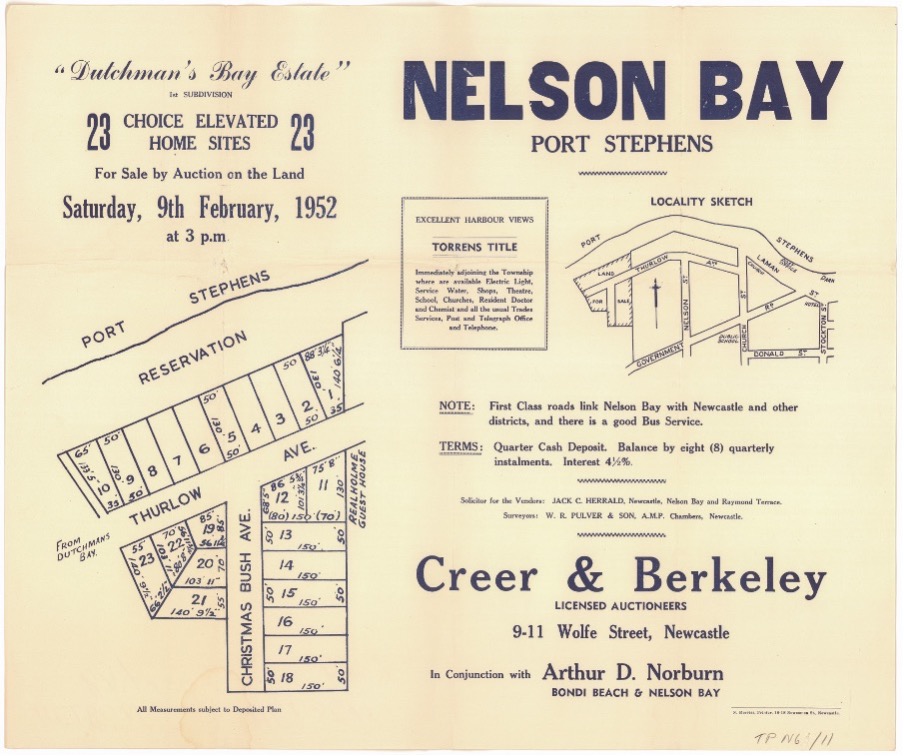
[NSW State Library]
The newspaper advertisement for stage 1:
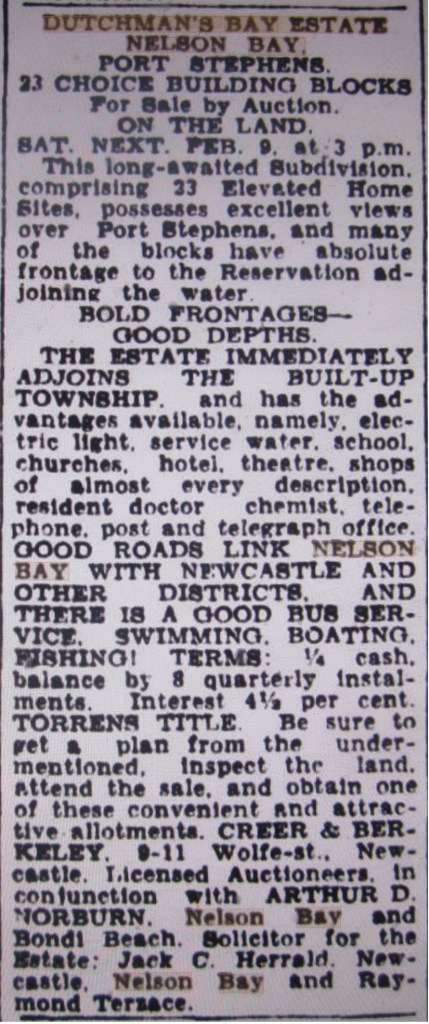
[Newcastle Morning Herald, 2 February 1952]
The estate plan, stage 2:

[NSW State Library]
The newspaper advertisement for stage 2:
The Sun of 9 January 1953, page 6, advertised:
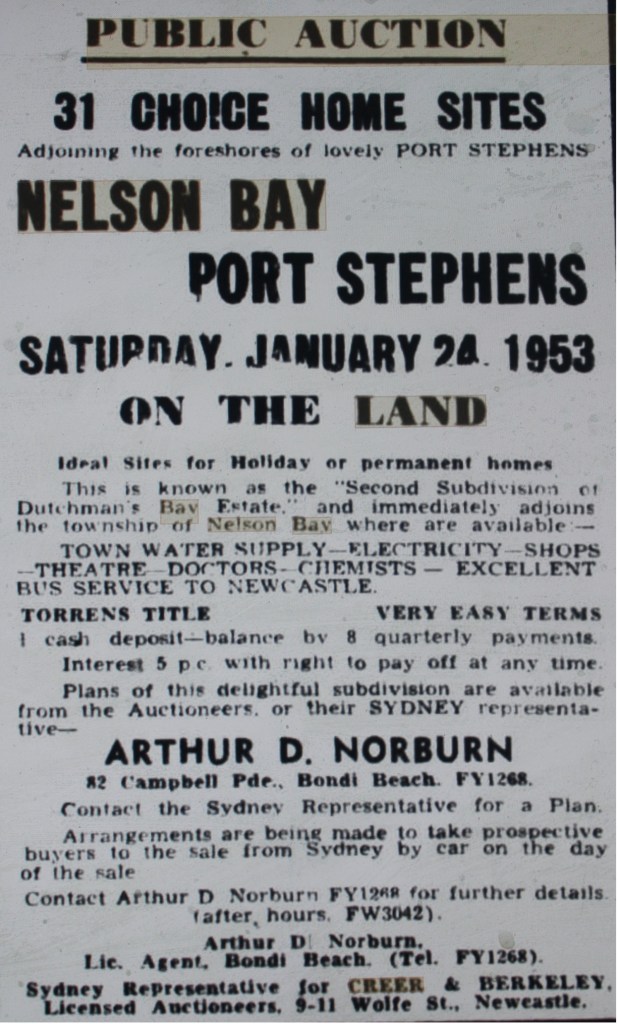
The newspaper report:
The Newcastle Morning Herald and Miners’ Advocate of 26 January 1953, page 2, advertised:
‘Sale Of Land At Nelson Bay Twenty-five building blocks were sold at Nelson Bay on Saturday at prices ranging from £130 to £420. The blocks, part of a subdivision of the Dutchman’s Bay Estate, were sold by Creer and Berkeley in conjunction with Arthur D. Norburn.’
POSTSCRIPT
Henry Ferdinand Halloran
Since his death in 1953, much has been written about this prominent business man and property developer. He played an important role in opening up for settlement many areas in New South Wales and the Australian Capital Territory.
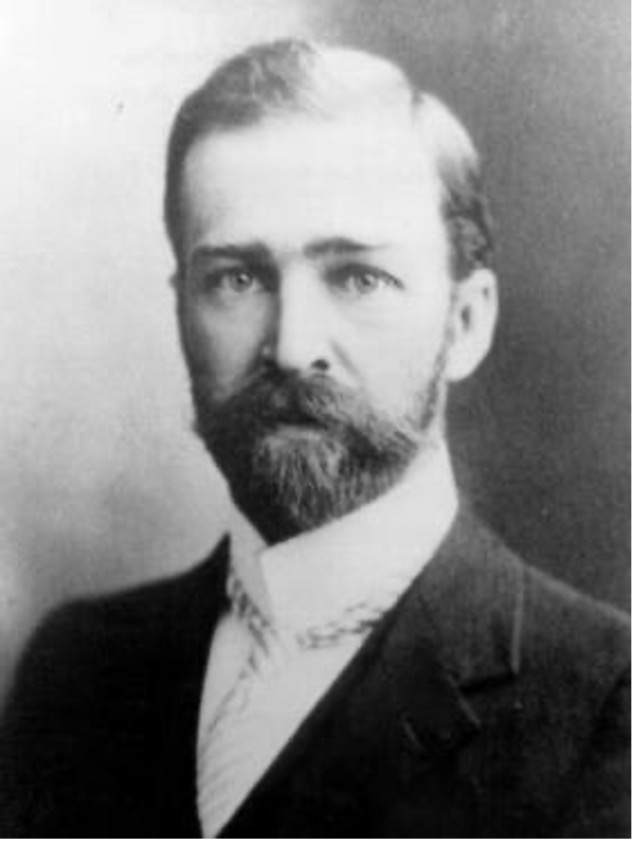
Henry Ferdinand Halloran
By 1886 he had established his company, Henry F. Halloran and Company. He was involved with many property developments in several Sydney suburbs, the Central Coast, Lithgow, Jervis Bay, Queanbeyan, Canberra, Lake Macquarie and Port Stephens.
By 1913, Henry Halloran had a prominent presence in the Port Stephens area and established Realty Realizations Limited at Raymond Terrace. He had land developments at Nelson Bay, Tanilba Bay, Shoal By, and North Arm Cove.
Much evidence of Halloran’s town design is still evident at Tanilba Bay where numerous stone features as gates, an archway, street temple, a pergola, wide boulevards and park facilities remain to be seen and enjoyed.
The Newcastle Morning Herald and Miners’ Advocate of 31 October 1953, page 5, published the following obituary to Henry Ferdinand Halloran:
‘Mr. Henry Ferdinand Halloran, managing director of Henry F. Halloran, conveyancing surveyors, who died in Sydney at the age of 84, had been in practice as a conveyancer since 1897. His interests were not confined to Sydney. He was also managing-director of Realty Realizations Ltd., Hamilton, and from there controlled the activities of the two organisations in the Northern district. His country home was at Ferodale, six miles out of Raymond Terrace, where he owned a farm. Usually, he spent his holidays there. He had made a close study of animal husbandry and had shown that the country in this part of the North was suitable for pasturing sheep.
Between this suburban settlement and Port Stephens, Mr. Halloran divided his time when away from the capital. Estates were acquired, subdivided and sold at Tanilba and Shoal Bay, where there has been considerable expansion. About Tanilba one night see the town-planner’s impression of a well-laid out town. Thirteen estates were subdivided in this area by Mr. Halloran, who, addressing a conference of Port Stephens Shire councillors 30 years ago, said he was convinced that, with or without the railway that had been spoken of to connect Morpeth with Port Stephens, there would be rapid development.
At Lake Macquarie, he had planned and subdivided 15 estates, and superintended much of the operations in the Newcastle district, with the firm’s representative (Mr. D. R. Roberts). Mr. Halloran assisted the research of the historical societies, and made available valuable data collected in the course of 50 years. The Halloran family’s link with the colony was unbroken from the days of Endeavour. Mr. Halloran’s grandfather was associated with Lieut. Caswell, believed to have been the first English naval man buried in the old cemetery behind Raymond Terrace.’
Researched and compiled by Kevin McGuinness
August 2023

 Port Stephens - a history exploration