
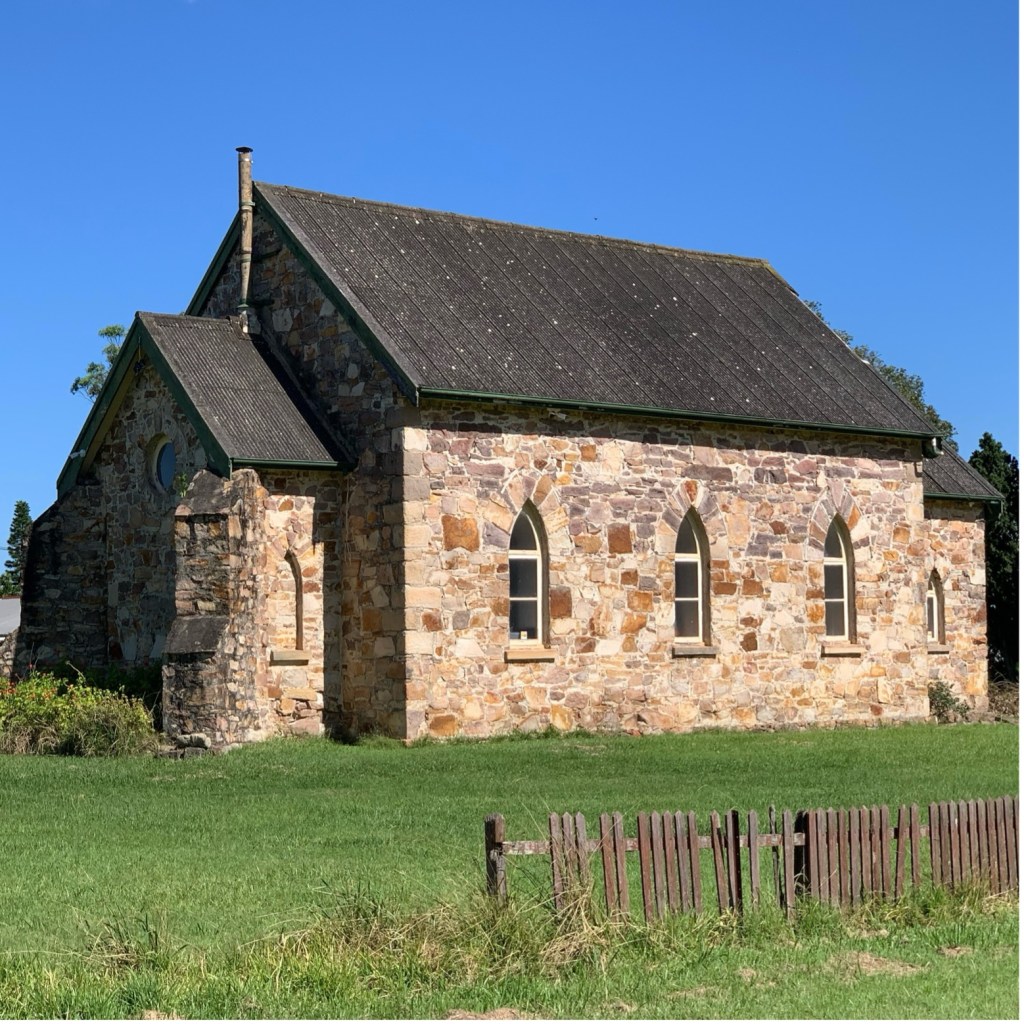
Introduction: A Church of Several Re-Incarnations
Carrington on the northern shore of Point Stephens was chosen in 1826 as the original site for the establishment of the Australian Agricultural Company (AAC).
In its early days, Carrington was a settlement of stone cottages, with a barracks for the convicts and the military whose presence was to keep order. Being on the bay, there would have been constant water traffic to and from Sydney.
Sir William Edward Parry was appointed Commissioner of the AAC from 1829 to 1934. His residence, Tahlee House, was erected at Carrington in 1830.
Under the auspices of Sir William Parry and aided by his wife, Lady Isabella Parry, religious services were conducted for the residents at Carrington and also at Stroud where the Company had operations. Sir William personally funded the building of a church at Stroud which was completed in 1833. It was later consecrated as the Church of St John the Evangelist.
The first stone church at Carrington was built by convict labour and officially opened on 17 December 1847, under licence from the Anglican Diocese of Newcastle. It was known as the Carrington Church as it was unable to be consecrated as the land on which it stood was still owned at that stage by the AAC.
After its opening in 1847, the Carrington Church had several re-incarnations:
- On 7 May 1851, it was consecrated as the Church of the Holy Spirit by the Anglian Bishop of Newcastle. This followed the transfer of the land titles for both the churches at Carrington and Stroud from the AAC to the Anglican Church of Australia (Church of England).
Due to the relocation of the headquarters of AAC to Stroud and the subsequent decline in the population at Carrington, the Church had closed by 1862 in favour of St John’s at Stroud as the main church for the AAC.
- 1888 – Re-dedication as St Andrew’s Church of England, Carrington following its restoration by the Hon. Robert Hoddle Driberg White, MLC.
- 1947 – return of services in March and the celebration of the Church’s Centenary in October. The Church was deconsecrated in 1949.
- 1962 to 1992 – leased out to the YHA for use as a Youth Hostel.
- 1994 to the present – sold to several private owners.
The following newspaper reports detail the history of the Carrington Church and its many lives.
A brief history of the Australian Agricultural Company (AAC)
The Daily Telegraph of 6 July 1889, page 10, provides a concise history of the history of the Australian Agricultural Company:
‘In 1824, when speculation was rife in London and money plentiful, many companies (now called syndicates) were formed, most of which came to grief. Amongst those still existing is the Australian Agricultural Company, formed principally to develop the agricultural resources of Australia and the adaptability of that continent for the rearing and improvement of stock. To enable the company to carry out much important undertakings in a new colony then only 88 years old, and the established field for reforming the criminals of the United Kingdom, the company had a grant of one million acres of ground given to them, with the privilege of employing 600 convicts as laborers.
The land selected by the company was bounded on the south by the harbor of Port Stephens and on the north by the Manning River. The first batch of the company’s establishment arrived in the colony in 1827, under charge of Mr. K. Dawson, and the first settlement was formed on the north side of the harbor of Port Stephens, at a spot called Carrabeen (a native name), about 12 miles within the heads of Port Stephens. …….
The bulk of the convicts assigned to the company were for a time located at Carrington, and the Government under General Darling granted the use of a small guard of soldiers under command of a captain. No measures were adopted for the safeguard of the convicts beyond a strict rule that any convict found outside of his barracks between the toll of the curfew bell of the evening and the roll call of the morning would be punished, and as the employment of the men was carried on with the hope held out of reward for good behaviour, very little trouble was experienced.
The company was managed by a colonial board of directors residing in Sydney, but as the management did not give satisfaction to the London directory a gentleman of position and influence was sent out to supersede the colonial board. This was Captain Sir William Edward Parry, R.N., the great North Pole navigator, who, with his family, took up their residence at Tahlee. Being a strict disciplinarian and a man of deep religions principles, the moral welfare of the community, which included many free men and their families, was studied, and in this Sir Edward was greatly assisted by Lady Parry. A church was erected and a clergyman appointed, and the Sabbath was scrupulously observed. The church was a wooden edifice and used for Protestants and others willing to attend the Church of England service but no interference was allowed with the services of other persuasions who had their own teachers.
Two surveyors, Messrs. Armstrong and Dangar, were employed to report upon the company’s property, and after thoroughly surveying the grant a map was made showing the quality of the soil in three distinctions—good, middling and indifferent. A very small proportion of this was fit for agriculture or stock-rearing, so through the influence of Sir Edward Parry the Government allowed an exchange to be made of 600,000 acres for two blocks west of the Dividing range which had not been taken up by squatters; about 260,000 acres on Liverpool Plains and about 350,000 acres on Peel’s River.
Besides this, Sir Edward procured the coalfield at Newcastle, which was then worked by convicts, and some 2000 acres of land. Although Sir Edward Parry was engaged at a high salary, with a retiring pension, the directors at home showed great judgment in securing his services, as he not only gave a character to their colonial servants, but so largely improved their colonial property. The land on the coast [at Port Stephens] was found unsuited to the company’s operations, so the head establishment was removed to Stroud, where Sir Edward Parry erected a church at his own expense as a memento of his connection with the company.
Sir Edward was succeeded by Colonel Dumaresq, who was A.D.C. to the Duke of Wellington at Waterloo. On his death at Port Stephens, Captain P. P. King, R.A., took charge of the establishment.’
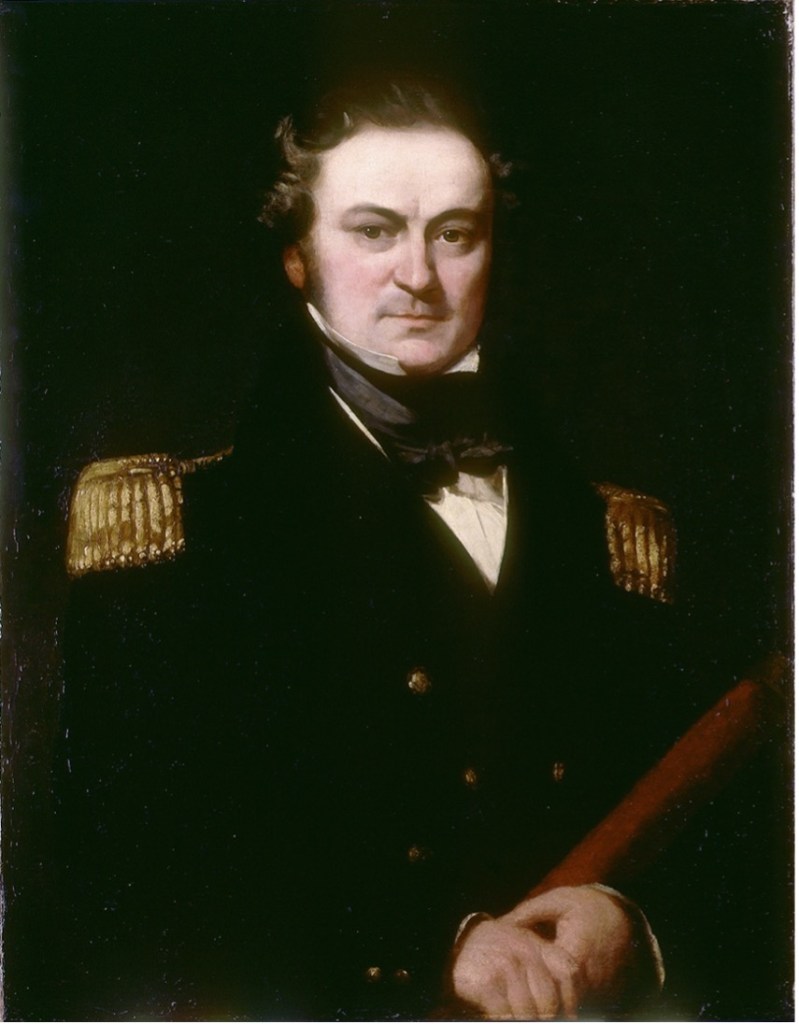
Captain Sir William Edward Parry
The Two Carringtons – Port Stephens and Newcastle
The Dungog Chronicle : Durham and Gloucester Advertiser of 5 March 1937, page 4, provides a history of the two Carringtons, which each having a strong connection to the Australian Agricultural Company:
‘There are two Carringtons in this northern heritage of the people. Carrington on the fringe of Port Stephens, derived its name from the first Chairman of the company, Lord Carrington; the later-named Carrington, which with a few weeks will celebrate its jubilee — was called after his grandson, a former Governor of New South Wales.
The Newcastle suburb of Carrington, which is important in that practically all the coal sent from Newcastle is shipped there by means of cranes, has most of the conveniences of modern life; the rural Carrington, at Port Stephens, remains almost as it was at the beginning of 1830, when Sir Edward Parry, fresh from his successful exploration mission to the Arctic, first set foot on its rock fringed harbour-line. The pioneers had the area surveyed and laid out, intending that it should be developed into a town. Streets were mapped and dedicated. According to the records of the shire, Carrington had some pretensions to being a township.
To reach it, a journey of four miles from the main highway is necessary; but at the journey’s end the traveller finds, not the town planned by the surveyors under Sir Edward Parry, but a placid grazing ground, with St. Andrew’s Church and Tahlee House the main features of the surroundings. In the small cemetery nestling in the valley lie the remains of many of the pioneers— among them those of one of Newcastle’s first pilots, Captain William Cromarty, grandfather of the late Mr. Magnus Cromarty, who represented Newcastle in the New South Wales Legislative Assembly at one time, and was a popular figure in the business life of the city.’
Construction of the Carrington Church at Port Stephens – 1847
Construction of the Carrington Church commenced in December 1846. The Raymond Terrace Examiner and Lower Hunter and Port Stephens Advertiser of 6 October 1932, page 1, published the following information:
‘The first stone of the Carrington Church was laid by Chaplain Philip G. King on the 17 December 1846, and the Church was opened under license from the Right Rev. William Grant Broughton, Lord Bishop of Australia, on the 17 December 1847, by the Rev. William Macquarie Cowper, M.A.
The building was erected at the expense of the Australian Agricultural Company, from the plan and under the superintendence of Mr. Thos. Laman. overseer of mechanics in the service of the Company. In the year 1847, the Diocese of Newcastle was founded and its first Bishop who had been consecrated on St. Peters’ Day, was on his way to Australia, when the Church was opened. The Rev. W. M. Cowper, the first chaplain of the A. A. Company, then resided at Stroud. He had arrived at Carrington in the year 1836, where he was welcomed by the Commissioner Colonel Dumaresq, who gave hospitality until his own cottage was ready for occupation. Later on, the chaplain moved to Stroud a more central position, where a substantial brick church had been built, in 1833 by Sir Edward Parry and the Company had erected a school and parsonage.
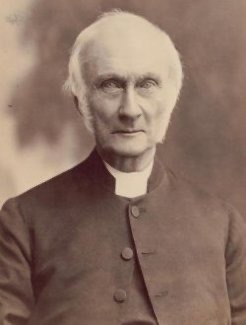
Rev William Macquarie Cowper
The chaplain’s ministry extended to beyond Gloucester on the one side and to Port Stephens on the other. The services at Carrington in the early days were held in a large wooden building which was also used as the carpenter’s shop. The Chaplain used to spend one month each year in a visitation to the other part of the Company’s estate on the western side of the Great Dividing Range. When the [Carrington] Church was built, the A. A. Company had laid out the land for a settlement, but the waterside township of Carrington failed to eventuate. Mr. Cowper’s chaplaincy terminated in 1856. He left then to take temporary charge of the newly opened Moore College at Liverpool, and afterwards became Dean of St. Andrews’ Cathedral, Sydney. The Reverend S. Simm succeeded to the chaplaincy and was made incumbent of Stroud. During his time, the Carrington Church was closed, and in 1862 a new Church having been built at Bulahdelah the furniture of the Carrington Church, was, with the consent of Bishop Tyrell, transferred to Bulahdelah, but as a loan to be returned if the Church at Carrington should ever be re-opened for worship.’
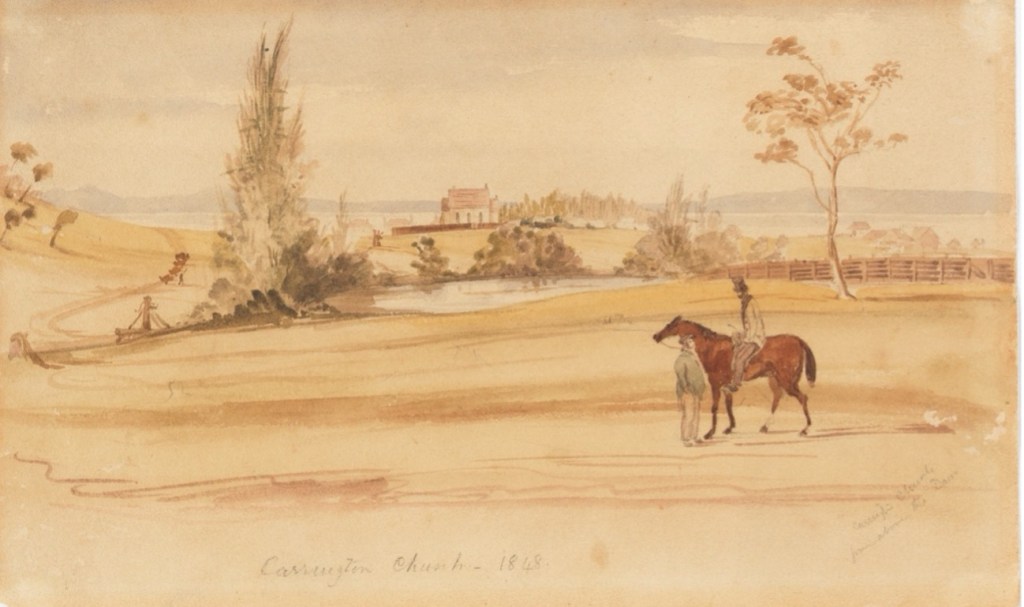
Painting of Carrington Church, from above the dam, 1848 [State Library of NSW]
Consecration as the Church of the Holy Spirit – 1851
On 7 May 1851, the Carrington Church was consecrated as the Church of the Holy Trinity. The Sydney Morning Herald of 13 May 1851, page 2, reported on the proceedings:
‘On Wednesday, the 7th instant, the Church of the Holy Trinity, at Carrington, was consecrated to the service of Almighty God by the Lord Bishop of Newcastle. His Lordship was attended by several of the clergy of the diocese. The Rev. C. P. N. Wilton, M.A., and the Rev. R. T. Bolton, M.A., acted as his Lordship’s chaplains. Archibald W. Blane, Esq., deputy-governor of the Australian Agricultural Company, as chancellor. The prayers were read by the Rev. W. M. Cowper, M.A., the Company’s chaplain; and the sermon preached by the bishop, from St. Matthew, xxi. 14. Owing to the smallness of the population at Carrington, the congregation was not very numerous. ….
On the following day, the Church of St. John the Evangelist, at Stroud, and the Burial Ground attached, were also consecrated by His Lordship. The clergy present were the Revs. C. P. N. Wilton, M.A., R. T. Bolton, M.A., C. Spencer, M.A., J. Rodwell, J. Blomfield, – Toms, W. M. Cowper, M.A. The deputy governor again acted as chancellor. The Rev. John Blomfield read the prayers; and the Rev. W. M. Cowper preached the sermon, taking for his text Deuteronomy, iv., 9. The congregation amounted to about 200, of whom forty remained to partake of the Holy Communion.
The Church was erected by Captain Sir Wm. Edward Parry, R.N., when Commissioner for the Company, principally at his own cost, and has been used for Divine Service since the year 1833 The consecration of both this and the former Church [Carrington] has necessarily been delayed till the present time, in consequence of the sites not having been granted by the Company to the Church. To this there were impediments, which have now happily been removed and the Company having in a liberal and handsome manner made them over by deed of gift, this desirable object has at length been attained, much to the satisfaction of the members of the Church of England in this district.’
Rededication as St Andrew’s Church of England, Carrington – 1888
Tahlee House was destroyed by fire in 1860. The Hon. Robert Hoddle Driberg White, a Sydney stockbroker, purchased Tahlee House in 1880 and built a new residence on the remains of the old. He also restored the Carrington Church in 1888. It was re-dedicated as St Andrew’s Church of England.

Hon. Robert Hoddle Driberg White, MLC
The Raymond Terrace Examiner and Lower Hunter and Port Stephens Advertiser of 6 October 1932, page 1, reported on the restoration of the church and its reopening in 1888:
‘The church was restored by the Hon. R. H. D. White, M.L.C., after he had purchased the Tahlee estate as a country residence for his family. Tahlee had been the home of the Company’s Commissioner in the early days, and it was here that both Mr. White’s father and his father-in-law had landed from the Old Country in the service of the A. A. Company. Mr. White was born at Stroud and represented that electorate in Parliament before becoming a member of the Upper House. He restored and made additions to Tahlee House and thoroughly restored and fenced in the Church, which is vested in the Trustees of Church Property for the Diocese.
The Church furniture was returned from Bullahdelah in 1888, the first year of the Rev. G. F. Rushforth’s incumbency of Stroud who resumed the services in the Church, now named St. Andrews’ Church, Carrington. The parish of Stroud then included the whole of the Myall with Church at Bulahdelah and Bungwahl; and the Gloucester district with several centres for services besides the Port Stephens district of Karuah and Carrington. Services in the extreme parts could only be held once in six weeks.
Mr. White, however tried to make the Church Sunday at Carrington a red-letter day for the people of Port Stephens. He arranged for a steamer to bring the people from Nelson’s Bay, Tea Gardens, and Hawke’s Nest. People also came by boats from Swan Bay and Karuah. The visitors landed at Tahlee wharf, walked to the Church, and on their return had light refreshments in the Tahlee grounds before sailing home. Whenever it was possible Mr. White used to bring visitors from Sydney in his yacht, the White Star, to Tahlee for the Church Sunday at Carrington, and this, with a wider outlook, together with the kind hospitality at Tahlee, made the periodical visits to Port Stephens of the Rector of Stroud a very pleasant part of his parochial work.
The late Bishop Stanton spent a Sunday at Tahlee and held a Confirmation in St. Andrew’s Church. He journeyed there from Newcastle in the White Star; then, after the Sunday, was taken by launch the whole length of the Myall Lakes to Narrani, thence by road to Stroud, preaching at Bungwhal and Bulladelah on the way. Other Bishops may have visited Carrington since then, but easier means of transport now prevail, with much less fatigue than in those days. The Very Rev. Dean of Sydney, also visited Tahlee during the incumbency of the Rev. Rushforth, the occasion being the marriage of Dr. Cullen, of the Sydney University, to the Dean’s granddaughter, the eldest daughter of the Hon. R. H. White, in St. Andrews’ Church. The Dean performed the ceremony and was assisted by the Rector of Stroud. On that day, after the marriage the Dean accompanied the Rector to Stroud, the scene of his ministry, many years before. Here he met and renewed associations with several grown up people who were boys and girls in his early days and preached at a week-night service in St. Johns’ Church.
There are very few people living near St. Andrews’ Church now, a church at Karuah serves the purposes of the larger settlement of the population which has developed in that district, but St. Andrews’ Church together with that at Karuah are ministered to by the Rector of Williamtown, whose parish evidently includes the large expanse of water known as Port Stephens.’
Another report on the Re-opening of the Church
The Maitland Mercury and Hunter River General Advertiser of 15 June 1889, page 3, contained a reflective style of reporting on the re-opening of the Carrington Church:
‘This little Church is pleasantly situated on a slight elevation in the rear of and at a short distance from the old village which gives it its name or designation. The church stands east and west, the entrance facing the west, and on the south side is bounded by the waters of Port Stephens. Looking in that direction, Tahlee, the residence of the Hon. R. H. D. White looms up in the distance, proudly perched on a high eminence, nearly surrounded by a thickly timbered mountainous country, with the majestic Mount Ereepah as a background, which rises to a considerable attitude from the site of the mansion. ………
It was built by the A. A. Company over forty years ago, but the precise date I have been unable to obtain, from plans furnished by the late Thomas Laman, of Stroud, who was at that time the Company’s architect. In length it is 54 feet by 25 feet in breadth outside the walls, which are of great thickness, as rubble buildings generally are. An open porch, with a small vestry on each side, forms the entrance, and with its chancel at the end, both of which are surmounted outside with a gilt cross, it forms a neat picture as it is. Of its architectural beauty little can be said, as it is as plain as plain can be, but in nowise offensively so ; and what is true of other things is true of this, “Beauty unadorned is adorned the most,” for in quiet unobtrusiveness its site and adaptation to the wants and requirements of the place is all that could be desired.
It is lighted by six long, narrow, pointed arch windows, three on each side, with a circular one high up in the chancel. Its interior is somewhat more attractive, at least so far as the roof is concerned, being open to the ridge, and is, I suppose to some extent, an example of the medieval style of church interiors. The beams that generally span the distance between the walls are cut away in the centre, the projecting ends are supported by brackets let into the walls, and by standards reaching to the ridge, and have a very pretty effect of chaste neatness and strength combined.
The church has not been used for public worship for over thirty-five years, and during that long period has been left entirely to take care of itself, which it has done fairly well, judging from the condition of preservation in which we now find it.
When the company’s settlement at Carrington, with Tahlee as the superintendent’s residence, was abandoned for fairer fields and pastures new ….. The company’s departure was the signal for a general exodus; the residents with a very few exceptions, left the place, and therefore everything about the place – gardens and houses and fencing and workshops – soon began to go to wreck and ruin. The remains of several cottages, scattered here and there in a most indiscriminatory fashion, show the proximity of dwelling-places was not an essential in those dark days, and, at the time, dreary place. So, at least, it strikes a stranger. “When the inhabitants left I understand the church was handed over to the tender mercy of the diocese of Newcastle. This I have only on hearsay, and yet there must be some truth in the statement, as when, in 1872 or thereabouts, the good people of Bulahdelah had built a church there, the whole of the fittings-pulpit, reading-desk, chairs, and pews were removed thence, with the understanding that should they at any time be required for their original place, they were to be returned without demur.
And thus have stood these bare walls of the church for the long period mentioned – no fence round them, no protection on the windows, and the door left open, it will not be wondered at that it was beginning to show the effect of this sad and saddening neglect. It then became a shelter for the occasional tramp …. With its open door it become an excellent pen for the sheep, and with its broken windows a delightful seclusion for the swallows to build their nests in. And once I have seen it used as a dancing saloon, the dancing kept up with the erratic music of a broken accordion, which instrument also dropped in an occasional note as an accompaniment to a comic song.
Such was the condition of the church when Mr. White, of Tahlee, to his credit be it said, took compassion on the neglected building, and, with a most generous consideration for the religious destitution of the people in the neighbourhood, set about having it thoroughly cleansed and renovated ; the cobwebs, swallows’ nests, and the accumulated dust of years swept away ; and to-day we see the place which had been given over to moles and bats in good repair and pleasing to look upon, a substantial paling fence surrounding it. The walls have been seen to, the windows glazed with coloured glass, which diffuses very effectively a “dim religious light.” The roof has been washed and varnished, the walls oil-painted, and all the woodwork shows the effects of the painter’s brush, and shows, also, that if cleanliness is not next to Godliness, it is not far from it.
The circular window over the chancel has been filled in with stained glass and has a very pleasing effect. The interior fittings have been returned from Bulahdelah, but I am sorry to say that Mr. White had some trouble over this matter, and was subjected to some little word banter, if not a kind of gentle abuse. Our friends there seem to have felt that possession was nine parts of the law and claimed the right to retain them on the plea of long having them, forgetting or ignoring the arrangement come to on their removal.
The broken railings in front of the chancel have been replaced with new ones, the floor covered with a pretty, bright carpet, and its walls hung with a deep crimson cloth, and the table covered with a similar material. A pulpit Bible and Prayer Book to match, in fine binding, have been provided, as also an abundant supply of hymn books, for the use of the congregation when assembled for worship.
The residents in the district are much indebted to Mr. White for the great boon of being enabled to worship their God and the God of their fathers in this church again, as all the expenses incurred have been defrayed exclusively by him.
The church was opened on the Sabbath, the 2nd of the month. Mr. White acted as verger and assistant organist. Mr. Younger, of St. Andrew’s Cathedral, presided at the instrument, which is a very superior one, and is also the gift of Mr. White, who, with his wonted skill and efficiency, discoursed sweet music in which the congregation heartily joined, sweet indeed it was as it fell on the ears and over the hearts of those who have not heard a sacred song or a hymn of praise in a church for years, and strangely sweet it must have been to those who could scarcely remember when, or if ever, they heard the solemn sounds before. The tunes, in addition to the chants, were those grand old ones – St. Ann, St. Michael, and the best of them all, the Old Hundred.
There was, considering the unfavourable state of the weather, the sparseness of the population, and the long distance some of the people had to come in boats or otherwise, a very fair congregation. Captain Dalton very kindly, with his smart little steamer, the Kingsley, brought a small crowd from Nelson’s Bay, and these, on their return to the vessel after service, were provided with some refreshments – a cup of tea, cake, &c., by Mrs. White at Tahlee. It was pleasing to notice in the audience Mr. White, senr., who, though well-nigh four score years of age, is still very active, as straight as a rush, and reads the smallest print without the aid of glasses, and whose voice was quite audible in the responses.
The Rev. G. F. Rushforth, of Stroud, officiated, and took for his text Ephesians, 4th chapter and 8th verse, and preached an excellent and simple sermon with much earnestness, at the conclusion of which the preacher paid a well-merited tribute of thanks to the generous donor, who had, with some trouble and considerable expense, enabled them to meet for public worship in such comfortable circumstances. Mr. Rushworth intimated that it was intended that there would be service in the church once in six weeks and expressed the hope that neither he nor the people would be disappointed in their expectations.’
Reflections on the Carrington Church – 1935
The Sydney Mail of 6 February 1935, page 40, provided an article on the history of the church, then called St. Andrew’s, and of the current condition of the church:
‘At Carrington, on the north-western shore of Port Stephens, not a great distance from Karuah, is an old rubble stone church which has an interesting history. ….
The church is in good condition within, and all the fittings are of cedar. There is some little weathering of the stonework, but the cement, made in the early methods from oyster shells, still binds the whole fabric solidly together. The building was probably erected by convicts, hundreds of whom were under the care of the A.A. Company; indeed, the employment and maintenance of from 600 to 1400 convicts was one of the conditions by which the great tract of over a million acres was held.
Little now remains of Carrington …. beyond the church with its old-time bell concreted outside the building, portions of the former Tahlee House — the residence of the various managers—and a couple of stone cottages. One of the cottages is tenanted by an old lady who was born on the estate more than 80 years ago. She is a descendant of the old Smith family which came out in 1830. The Smith family is stated to have been connections of Lord Carrington — a former Governor of New South Wales — whose surname was Smith and whose father was the first Lord Carrington. A church service is now held at Carrington once a month.’
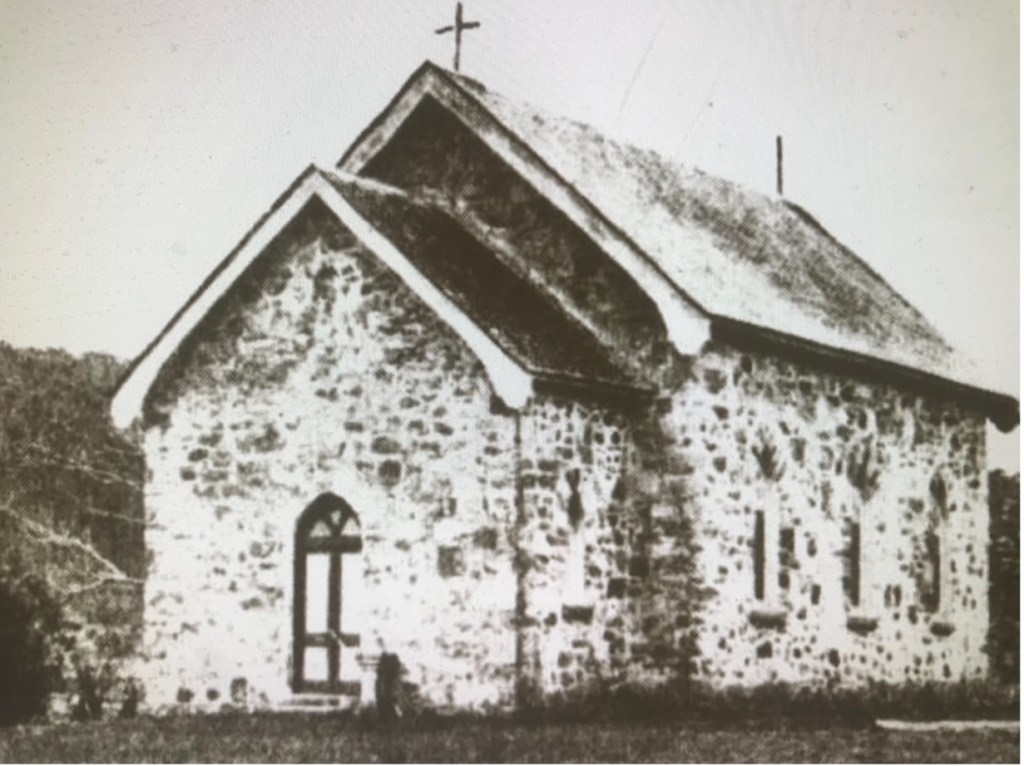
St Andrew’s Carrington, circa 1935
A reflection of the Carrington Church – 1937
The Newcastle Morning Herald and Miners’ Advocate of 22 February 1937, page 6, provides further insights into the history of the church:
‘The party of visitors from Newcastle to Port Stephens on Saturday took much interest in the small stone church at Carrington. The building is in an excellent state of preservation. The stone for the walls, which are about 2ft. thick. was hewn from the hills in the vicinity, while the lime used was made from shell gathered at Tahlee Point. The church stands in a roomy block of ground, and from the main entrance a commanding view of the waters of Port Stephens is obtained.
The roof, of shingle, and apparently renewed within comparatively recent years, covers a structure in which the main beams and other supports are of cedar. This timber formerly grew luxuriously in the surrounding scrub, although there is not now much of it to be seen. The small wooden crosses once to be seen at either end of the roof are there no longer, and only a small piece of the supports is extant. The belfry has also gone. This was originally erected near the front of the church. The bell was cracked when it fell, but it has now been re-erected on a dwarf stone pedestal near the entrance. Encircling the bell are the words: “Australian Agricultural Co., 1829.”
The late Sir William Cullen was married in this modest little church, his bride being the eldest daughter of Mr: R. H. D. White. M.L.C., the owner of Tahlee homestead nearby. The ceremony was performed by Dean Cowper. In the Tahlee House are enlarged autographed portraits of Lord and Lady Jersey, who, as guests of the White family, spent many a holiday there and joined reverently with the settlers in the services conducted in “St. Andrews’s Church, Carrington, Port Stephens,” as a worn and much-faded hymn-book describes it.’
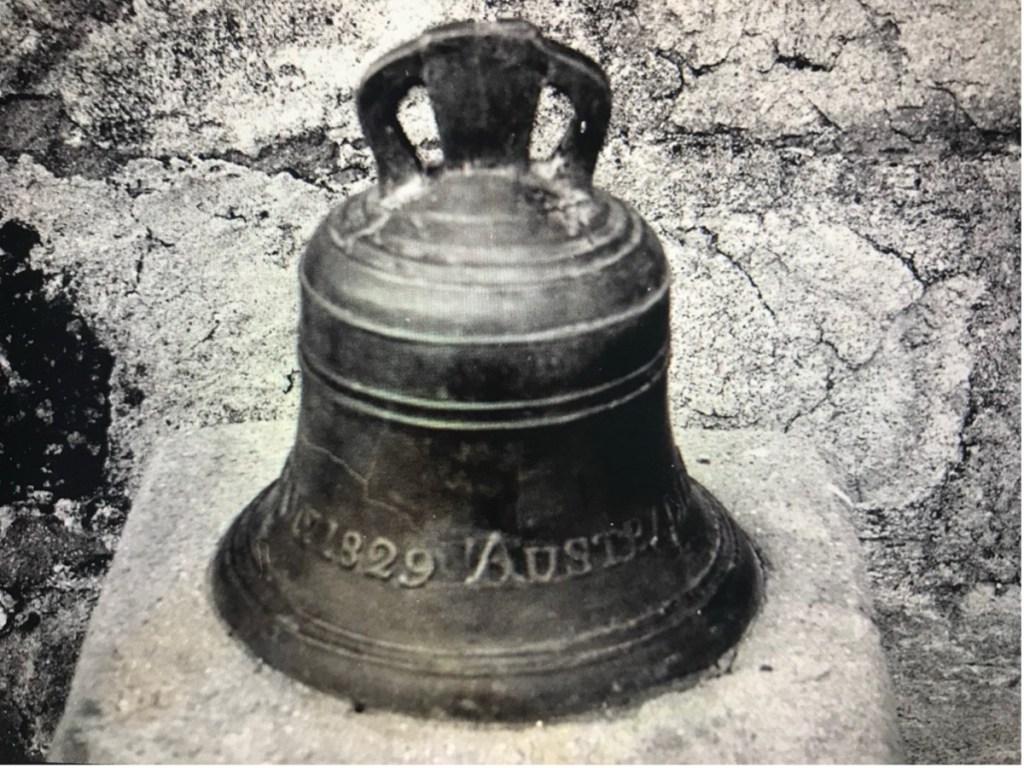
Australian Agricultural Company Bell at the Carrington Church. It was previously used to manage the daily routines of convicts, including as a warning of an escaped convict.
A Pioneer’s Prayer – 1937
The Newcastle Morning Herald and Miners’ Advocate of 6 March 1937, page 5, reported:
‘Then, as now, the people were wearied of conflict. That this was so shown by an examination of the old prayer books and other sacred literature to be seen in the small church at Carrington, a short distance from Tahlee Point. From the flyleaf of one of the old volumes was copied the following verse, written in a slight hand and embodying the sentiment of the populace today—
Oh, God of Love, oh, King of Peace!
Make wars throughout the world to cease!
The rule of sinful man restrain.
And peace, oh God, give peace again!
Remember, Lord! Thy works of old,
The wonders that our fathers told.
Remember not, our sin’s dark stain,
Give peace, oh God, give peace again.
Whom shall we trust but Thee, oh God.
Where rest, but on Thy faithful Word.
None ever called on Thee in vain,
Give peace, oh God, give peace again!
Where saints and angels dwell above,
All hearts are knit in holy love:
Oh, bind us in that heavenly chain—
Give peace, oh God, give peace again.’
Calls for the preservation of the Carrington Church – 1946
In November 1946, the Raymond Terrace Examiner and Lower Hunter and Port Stephens Advertiser, published two letters from concerned locals calling for action to be taken to preserve the Carrington Church. In response to the community interest in the old church, fundraising was undertaken during 1947 in aid of the various preservation works required.
The first letter was published on 14 November 1946:
‘Mr A. Lilley, of Swan Bay, comments as follows: I noticed in last week’s “Raymond Terrace Examiner” where the Nelsons Bay picnic is due at the old Carrington village near Tahlee, Port Stephens, on the 30th of this month. They picked an ideal spot. No doubt the people will be having a look through the old Church, but they will find that it wants a bit of ideal spot. The people who were here many years ago built this structure to last. There is no doubt it has been handed down to us by them and I think it is our place today to see that it is cared for and repaired and maintained through this generation. There is no doubt that Carrington will be built on again.
My suggestion to get funds for the church is to hold dances at different places around Port Stephens, as I think by doing this everybody would be throwing in their lot to support one of the first places, as a church where Divine service was first carried out at Port Stephens. I would like to see somebody support my views or suggest something so that we can get moving.’
The second letter written by Rev. Bernard Geary was published on 28 November 1946:
‘Having long recognised and appreciated the need to maintain and preserve our historical church buildings, I wish to support the remarks published in your paper, by Mr. A. Lilley in respect to the church at Carrington. The plan to preserve and repair the church at Carrington is not merely a question of sentiment. It is a question of what things we think important in human life and how we wish the culture of the new generation to develop. The people who made and loved Carrington did want Carrington to have a church, and it stands as a witness to their pioneering spirit and desire for a worthy place of worship.
The present neglect of the church is a challenge to us, to recreate the tradition afresh, and keep new this place of worship in the community. In this country we are in certain respects handicapped and in others assisted by our freedom from possessions of the past. In England nearly every village has its witness to ecclesiastical tradition in churches, which bear in their architectural structure reminiscences of every century from the 12th to 20th. The maintenance of the Carrington Church has a particular value for us in the Port Stephens area, because we are busy building up our own traditions. Organised pilgrimages, and the establishment of a local Historical Society, may be of some practical value, toward the desire to restore this and other historical buildings.’
Fundraising for preservation of the Church – 1947
The Raymond Terrace Examiner and Lower Hunter and Port Stephens Advertiser of 16 January 1947, page 3, reported:
‘A dance in aid of the repair fund to Carrington Church Port Stephens was held at Mr. Alf. Lilley’s on Saturday week was well attended. The cost of the repairs is estimated at £150 and it is hoped the public of Port Stephens and those of Stroud, Raymond Terrace, and other areas, will be liberal in their donations towards such worthy and worthwhile objective. Carrington Church is one of the oldest churches in Australia, and was built about 100 years ago, to meet the needs of a place of worship for free men and convicts of that period.
It would be a reflection of the people of today to allow such an historical building to fall into decay. Sir Edward Parry, of the A. A. Co. would probably be the founder of the Church. The Bible and Prayer Book presented by the Hon. R. H. D. White ex-M.L.A. for Gloucester, to the Church in 1889 are in the keeping of Mr. Alf. Lilley, of Swan Bay, and are in safe good order. Some of the old hymn books are in good condition and on the cover the price of 4d the then price of the book is printed. Any person desirous of assisting in the restoration of the old Church may send their donations to Mr. Alf. Lilley, Swan Bay, Karuah, or to the ‘Examiner’ Office, Raymond Terrace, when all donations will be published in a list. The sum of about £30 is at present in hand.’
The Raymond Terrace Examiner and Lower Hunter and Port Stephens Advertiser of 20 February 1947, page 4, further reported:
‘St. Andrew’s Church, Carrington, will, celebrate the 100th Anniversary of its opening and dedication on November 7th, 1947. ……. Unfortunately, the present roof is in bad condition. A tile roof is needed to preserve the building and its contents. The local residents are few in number. A fund for the renovation of this Church has been opened and an appeal is made to all readers of this article to help us to preserve this historic building. The Parochial Council, Clarencetown are acting as Treasurers of the Fund and your donations (no matter how small) can be sent, to the Rev. W. A. Hoare, Th. L., The Rectory, Clarencetown, or to Mr. A. Lilley, Swan Bay, Karuah. Send your donation now. “Procrastination is the thief of time.” If you leave it until later you may forget.’
Throughout 1947 and 1948, the newspaper published several lists of donations received for the restoration appeal.
Services resume at St Andrew’s Carrington – 1947
The Raymond Terrace Examiner and Lower Hunter and Port Stephens Advertiser of Thursday 27 March 1947, page 2, reported:
‘After a lapse of some considerable time, services are being commenced again in this 100 year-old church. The Rev. W. A. Hoare, who is Priest-in-charge of this area will hold evensong on Sunday next, March 30th, at 3 p.m. At this service we shall be glad to welcome any who are interested in the church. Arrangements are being made for a special service in connection with the Centenary which takes place in November of this year.’
Celebration of the Church’s Centenary – 1947
The Raymond Terrace Examiner and Lower Hunter and Port Stephens Advertiser of 23 October 1947, page 2, reported on the centenary celebration of St. Andrew’s Church:
‘The Centenary celebration of this old church was made on Saturday last, when in the presence of a church full of local and visiting residents, Dr. Batty, Bishop of Newcastle, presided over the ceremony and gave an interesting and appropriate address on the occasion. There were also present, Rev. W. A. Hoare (rector Clarencetown in whose parish the Church comes in), Ven. Archdeacon Woodd, Rev. Blakemore, of Stroud, Cr. C. T. Abbott, of Stroud Shire; Mr. C. W. Robards, Clarencetown and other visitors from Raymond Terrace and elsewhere.
Mr. Alf. Lilley, of Swan Bay, started a movement some months ago to direct attention to the church and the need for some funds to make repairs to the historic building. The appeal for funds has had some effect, but more is needed to carry out all the renovations required. It is a most substantially built church of rubble stone, erected by the convicts in 1847 under instructions from Sir Edward Parry, Superintendent of the A. A. Co. which made its headquarters at Tahlee, just nearby Carrington.
The wood fittings of the church, the pulpit and the pews, are of beautiful cedar, milled nearby in those early days, and add a wonderful effect to the interior of the church. The pews are about 18 inches to two feet wide, and the back thirty inches high. These and other cedar fittings all want repolishing, a new roof is required and then the old sacred edifice that heard the lamentations, sighs, tears and prayers of the early residents will be in a condition that most Christians would like to see it.
It stands on a flat, bordering on the shore of the Port, and nearby are residences of early days, and a giant fig tree, as old as the first settlement, and probably was there indigenous and raised its proud head amidst the glorious foliage of many other arboreal specimens of the early forest primeval. The flat land is very suggestive of a future week-end town in which the cares of daily life will find consolation and peace in a settlement laid out in a scientific and sanitary way to conform with future town planning.
His Lordship took as his text the 1st verse of Psalm 44 — “We have heard with our ears, O God, our fathers have told us: what Thou hast done in their time of old.” He drew attention to the fact of this year being the centenary of the diocese as well as the centenary of the church at Carrington. He spoke of the debt that they owed to pioneers and particularly to that great layman Sir Edward Parry, who had probably done more for the church than any other layman. They through Carrington church had a link with the Rev. William Macquarie Cowper, who became Dean of Sydney, and was the first chaplain appointed to the A. A. Co. When Rev. Cowper arrived at Port Stephens, he found that service was being held in a building that was being used during the week as the carpenter’s shop. It was through his influence and the help of Sir Edward Parry that this church was built. He referred to the fact that since they had had a pilgrimage to the tomb of Bishop Tyrell at Morpeth, he had found that it had become a place of pilgrimage for many. So too, might this little church, which through its link with the early pioneers, may become a place of pilgrimage for those who wished to pay homage in a small way to those pioneers.
He referred to the privileges that had been gained by the martyrs and the pioneers. In some cases by hardship, and inconvenience and even death. There was an obligation for them to see that the privileges of the Christian faith that they had gained were not lost. To-day was the festival of St. Luke, who was one of first missionaries. He referred to the need for restoration and though the roof was unsound, the building as a whole was free from defects. The centre was bound up in the history and the story of settlement. They all joined in thanksgiving to God for the years that had gone. The Rev. Hoare in a short address appealed for more funds to augment the amount in hand, which was insufficient to meet the cost of a complete repair. He also referred to the care that the church had received at the hands of Mrs. and the Misses Smith, who had cleaned it and looked after it.’
Restoration works to be undertaken – 1948
The Raymond Terrace Examiner and Lower Hunter and Port Stephens Advertiser of 22 April 1948, page 3, reported on the results of the fund-raising programme for the church restoration:
‘The fund for the repair of this historic church has now reached the sum of £120/13/6. The organisers of the fund, the Rev. W. A. Hoare and Mr. Alf. Lilley, are very grateful to all who have contributed towards the cost of repairing this church which has so many associations with the past. Negotiations are now proceeding to have the work put in hand but delays have been experienced in obtaining materials for the work. It is hoped that the work will be finished before the winter storms will further damage the building. When the work is completed, it is hoped that there will be a service of thanksgiving for the restoration of the church.’
The church did not remain operational for very long as it was deconsecrated in 1949.
Conversion of the Church into a Youth Hostel – 1965
News of the Area (NOTA) – a local paper circulating in the Hawks Nest and Tea Gardens areas, in the edition of 1 September 1986, page 13,reported on the years that the former church was utilised as a Youth Hostel, with the premises being leased from the Church of England:
‘A large crowd of well-wishers and members of the Youth Hostel Association of Australia gathered at Carrington on August 30, where Mr Norm Hopp, chairman of the Hunter Region of the Association introduced Mr. Milton Morris (MHR), who had opened the hostel on August 28, 1965. “It was one of the more pleasant duties as Minister for Transport,” Mr Morris said. “I had just come into government when Mr Mannix went out and at last I was going to a place, where there was no train, no buses and not many roads to complain about. ….. Preserving the heritage of a most important piece of Australian history without cost to the taxpayer was in his view the most important thing the YHA had done by adopting Carrington as a project.
Mr Andrew, state president of the NSW Youth Hostel Association noted that this happened to be the 150th birthday of the first church in Port Stephens. Convicts had toiled and crushed oyster shells to make the cement, which held the local stones together which formed the church walls. The church was used for services till 1949 when the church in Bulahdelah was built and the Carrington Church was “deconsecrated” and began to fall into ruin. When the YHA took it on from the Anglican Bishop of Newcastle the roof had gone and a tree had grown through it. There was no floor and no windows. About 100 volunteers had worked three years to reconstruct the historic church as a Youth Hostel and build a tea kitchen. Later an electric kitchen and dining room, hot showers and provided canoes.
Mrs Inez Ratcliffe, who was present, had been acting as warden for the first 15 years. Today about 4-5 travelling youth were using the hostel per day all year round. Youth hostels provided cheap accommodation for young people throughout the world and many lasting international friendships were formed by meeting people in these hostels. Mr Darcy Peacock, representing the Great Lakes Shire, said he was happy to be present at the occasion and have a building of such historic significance in the shire.’
The Carrington Youth Hostel celebrated its 21st anniversary at the site on 30 August 1986.
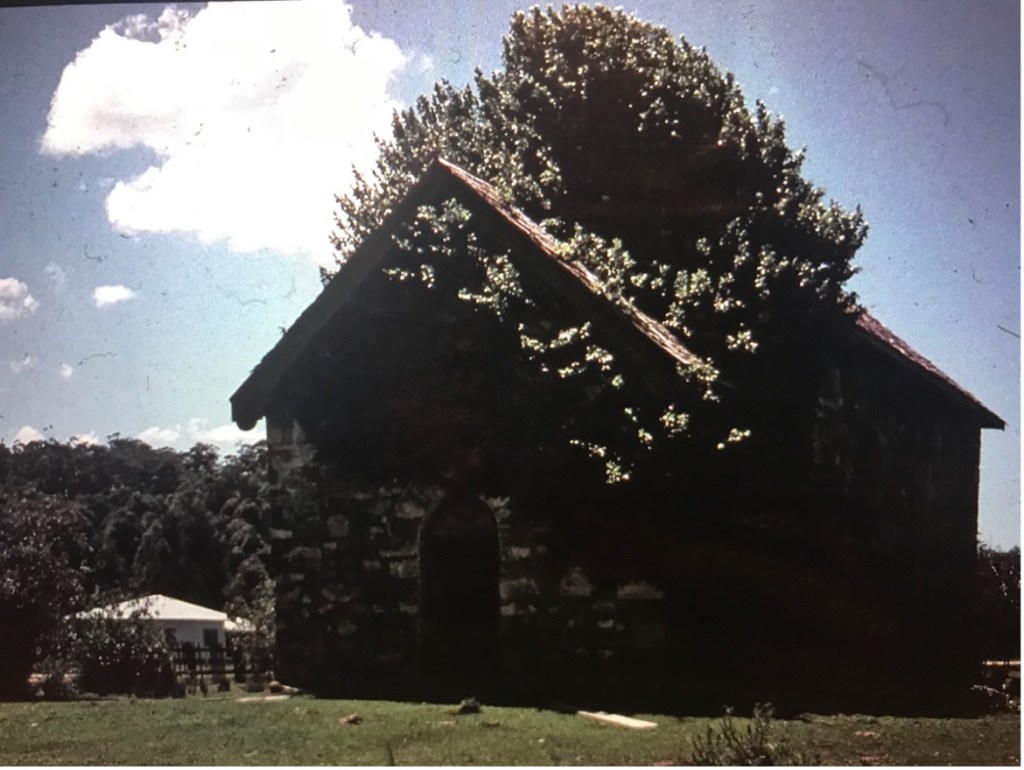
Tree growing through the church roof – circa 1960
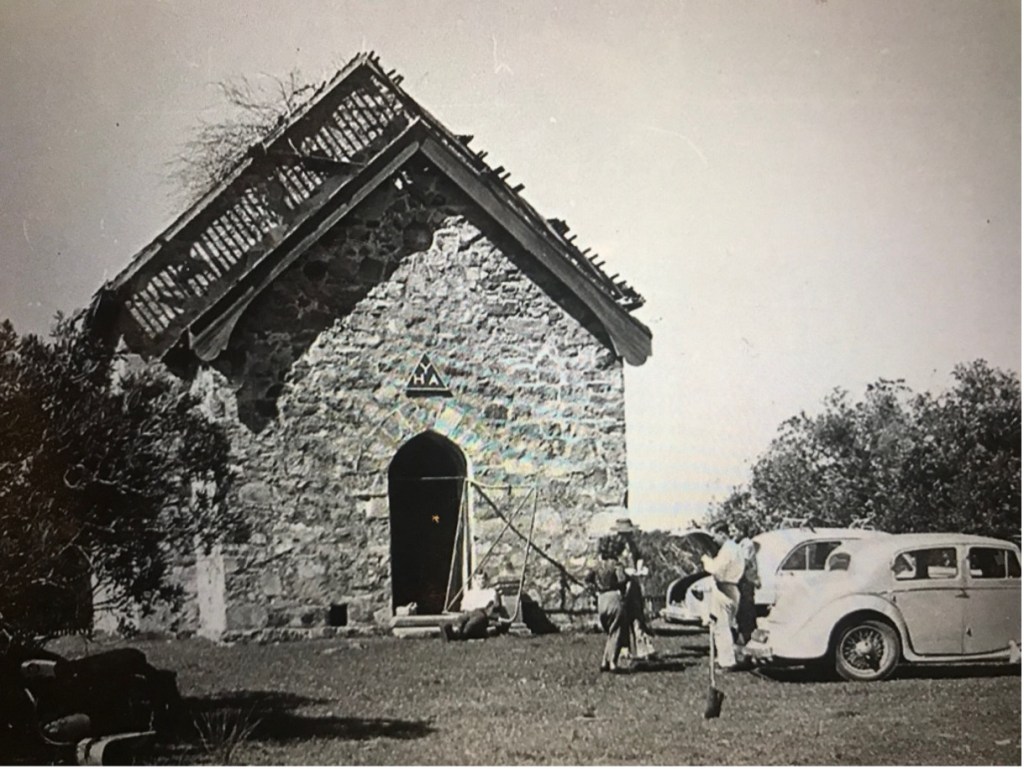
Conversion to a youth hostel, 1962
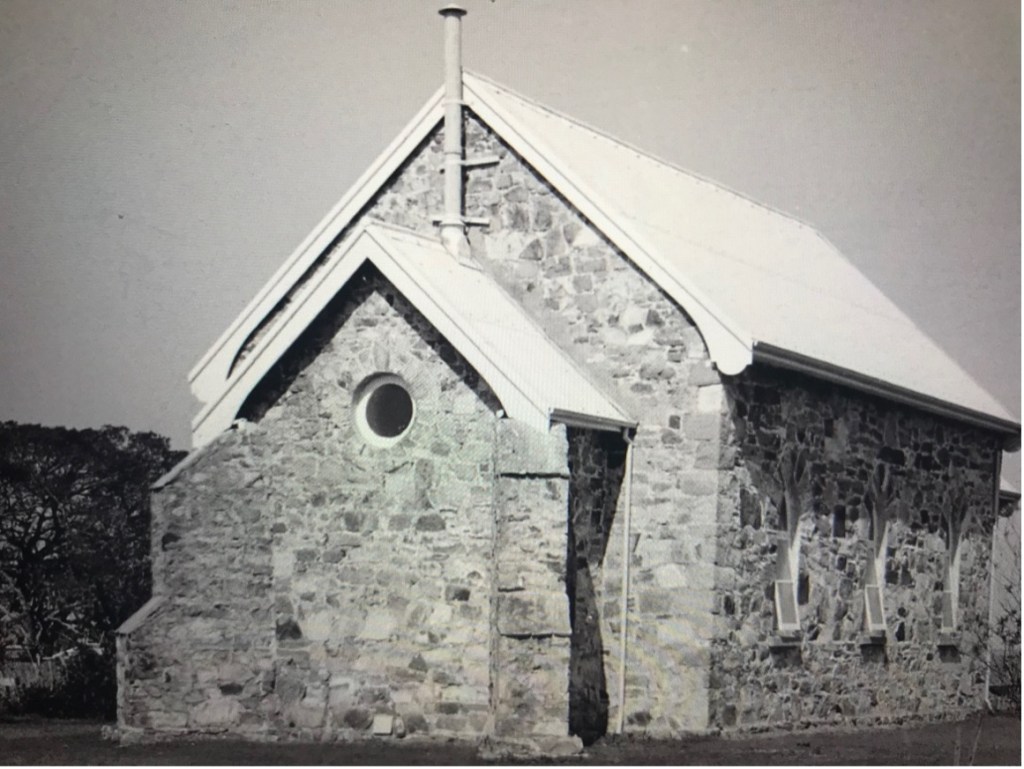
Carrington Youth Hostel in 1965 showing the new roof, windows and chimney for internal heating
Church site sold to private owners
The Youth Hostel closed in 1992. On expiration of the lease the property reverted back to the Anglican Church.
NOTA of 1 February 1992, page 6, reported that:
‘Carrington Youth Hostel had it’s busiest month since it’s inception. One hundred and eighty people stayed at the hostel, mainly from Australia with a fair smattering from overseas. The bad news for the hostel is that its owners have decided to close down the hostel at the end of this year. The hostel was officially opened on August 28, 1965 but as early as 1962 it was being used as a hostel. This closure will constitute a great loss to travelling Australians and overseas visitors, the closest hostel then being Girvan. It is planned that the old church will be used to house retired church elders.’
The church site was later sold to private owners.
It was again advertised for sale in February 2016 as follows:
‘One of the oldest standing churches in Australia is on the market, complete with a separate two-bedroom dwelling on 4047 square metres of land only metres from the pristine waters of Nelson Bay. Built in 1847, the heritage-listed church comes complete with a huge castle-like door and a church bell that was made in England in 1829 and was rung when local convicts escaped in the 1800s. Vendor of the property ….. said that she purchased it in 2000 and is only the third person to own it, with the Church of England being the first. ….. It was a YHA [Youth Hostel] for around 30 years. ……. The church itself has two toilets inside, while two external showers complement the external quarters that features two bedrooms and a huge kitchen with a separate lounge and dining area. …. “The church itself is incredibly strong. The sandstone walls are about 2.5 feet thick and some of the sandstone corners came all the way from England in ship hulls,” she exclaimed, adding that Carrington is steeped with history. …. “When it was run as a youth hostel they installed numerous internal walls to create multiple rooms. They have since been taken them out and it’s back in the original state now.”
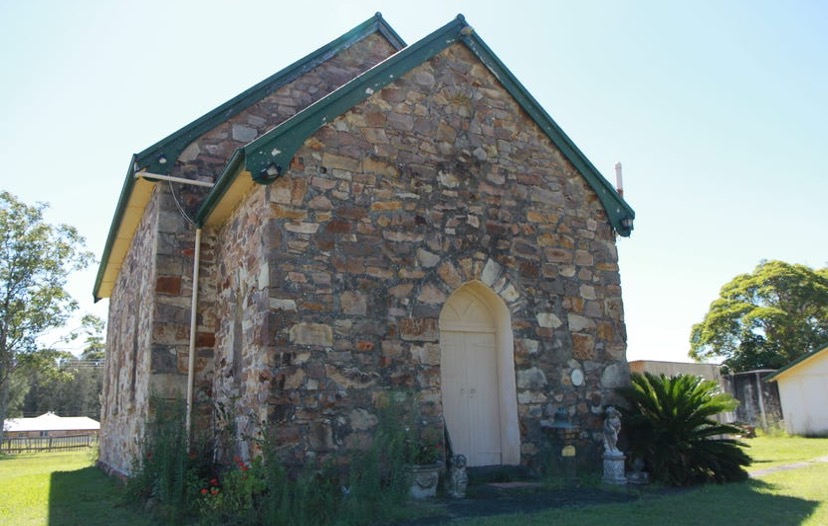
Carrington Church, 2016 – the Australian Agricultural Company is visible on the right pedestal near the front door. [Real Estate Advertisement].
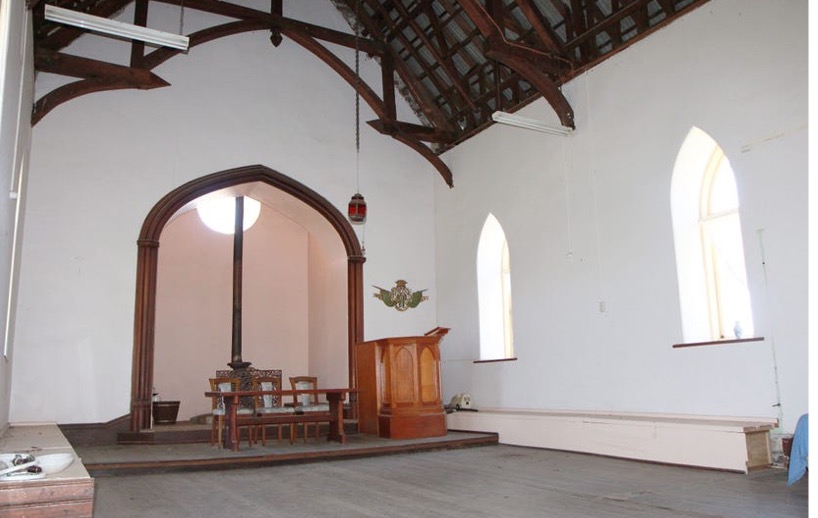
Interior of Church – 2016 [Real Estate Advertisement].
During a visit to the Church site in April 2022, it was noted that the AAC bell is no longer attached to the pedestal next to the front door.
Concluding Comments
Like many convict-built structures of the period, the Carrington Church was well designed and solidly constructed.
While many such structures have been lost over the years, those that survive tend to have been be adapted for modern purposes.
Hopefully the old Carrington Church will continue to be treasured as a heritage site.
The histories of several other churches in the Port Stephens region are published on this website and can be viewed at the following links:
St. Andrew’s Anglican Church at Tea Gardens
St. Michael’s Catholic Church at Nelson Bay
St. Saviour’s Anglican Church at Williamtown
History of the Methodist Church at Nelson Bay
Former Uniting Church at Williamtown
Early History of All Saints Church at Nelson Bay
Researched and compiled by Kevin McGuinness
April 2022

 Port Stephens - a history exploration