
Introduction
During 1913, with the possibility of a great war erupting in Europe, a local group of citizens became aware that Port Stephens was undefended.
It was realised that Port Stephens could be invaded by a foreign power because of its proximity to the Newcastle industrial area which was within easy military reach.
The citizens group was particularly concerned as they believed that Australia’s defence would be detrimentally affected if England (the Motherland) was required to participate in a war in Europe, and thus would be unable to defend Australia.
The citizens group formed the Port Stephens Defence League, as a means to lobby the Commonwealth Government to erect military defences at Port Stephens and at other undefended ports. The League believed that the defence of Australia should be upgraded by both building more warships and also by the use of aerial surveillance.
The aim of the Defence League was to awaken the people of Australia to a realisation of the danger of unpreparedness, if a war was to break out in Europe.
It was however only active during 1913 and had ceased to function prior to the commencement of World War One in July 1914.
Records of the history of the Port Stepehens Defence League are held in the National Library of Australia’s ‘Trove’ newspaper collection which is the source of this paper.
First Meeting of the Defence League held at Tea Gardens
The Raymond Terrace Examiner and Lower Hunter and Port Stephens Advertiser of 27 June 1913, page 3, reported:
‘A meeting of the Port Stephens Defence League was held at Tea Gardens on the 16th inst, when the President (Mr. K. J. Paton) delivered the following address: —
Gentlemen, — As members of the Port Stephens Defence League we have met tonight, not to delude you with some fairy tale, but to bring before you for your careful thought and consideration stern facts and realities that confront us as a people in an isolated continent practically undefended at some of the most vital places, to the safety of the Commonwealth, by any form of coastal defence.
In this land we have a heritage of splendid possibilities. We have erected institutions and brought into operation legislation that gives freedom, privileges, and advantages, unequalled among the nations of the world today. If there are any people in the world who ought to be imbued with the spirit of patriotism for the land they live in, that people ought to be the inhabitants of this great Commonwealth — with the freedom and opportunities it affords to all, and we ought to watch carefully dangers as they appear, that some calamity may not overtake us, and realise when too late that we have been living in a fool’s paradise, having left undone things we ought, with a little sacrifice, to have done to make our land as secure as possible against invasion by a foreign foe.
We are impressed with the belief that grave dangers threaten our land in the event of the mother country becoming involved in war with some powerful nation. We are an isolated dependency with 12,000 miles of practically unprotected coastline. Under present conditions we would fall an easy prey to a strong invading force, and the fact that we would be a rich prize to any nation with a teeming population— this land of ours, with its mineral wealth and fertile soil, enhanced by a good climate.
Are we as a people doing all we might do, all we ought to do, to place our coastal defences in a state of efficiency for any emergency that may arise, in view of the fact that other countries and nations are equipping themselves with feverish haste with all the latest and most effective appliances of modern warfare. True we have made a start with an army and navy, and good work was done by the Fisher Government during the last three years in connection with our defences, but we view with grave misgivings the almost equally balanced parties we have returned to the Federal Parliament, and the danger that may arise to the great Commonwealth if through party or individual ambitious this urgent matter of National Defence is allowed to lag.
Let us as citizens of the Commonwealth keep a watchful eye that no matter what party may be in power for the time being, the question of making our country moderately secure against invasion should ever be uppermost in our minds; for it matters not what shade of political opinion we may hold, it matters not with what form of religious belief we are imbued, a common danger threatens all— a common fate would befall us all — if ever this fair land was conquered by an alien race. In this great matter of national defence, we can all stand shoulder to shoulder in one common cause — the protection of our homes and all else that is dear to us.
In such a place as Port Stephens the danger of our defenceless state is daily staring us in the face. We have here one of the finest natural harbours in the Commonwealth, with sufficient depth and accommodation to shelter hundreds of the largest battleships afloat. This magnificent national asset is absolutely unprotected; and such a port as this in its unprotected condition is a positive menace, through the temptation it offers should the homeland [England] become involved in a war with any powerful nation having ships of war. It is undoubtedly such a port as this that an enemy would strike the first blow at. It is an open door to the very vitals of the Commonwealth.
From a base formed and held at Port Stephens the coal supply of Newcastle might easily be cut off, which means that all the steam coal worth mentioning in Australia would be boxed up, and such a base to work from would place an enemy within striking distance of our main railway line. A strong force could from such a base at Port Stephens strike a crushing blow in this way. This is a possibility which we are not exaggerating, and not an hour ought to be wasted or delayed in providing the very latest and most up-to-date equipment for coastal defence at this port and other ports of a similar kind in the Commonwealth. The longer this is left the greater our danger; for, as our resources are developed, our wealth as a nation increases, and we become a greater temptation—a richer prize to countries with teeming populations, looking for an outlet in which to place them. It has been well said by a great general who took part in a terrible war, that “war is hell.”
We tell you tonight that invasion of our land by a foreign enemy would result in a worse hell than your imagination can picture, and death would be far more preferable for our womankind and children than to be left to meet a victorious invading force, when we, their protectors, may have fallen in our country’s defence. We tell you the time has arrived in our history when we must be up and doing, and bring about ways and means for self-protection in the event of the homeland becoming involved in a life and death struggle that may necessitate her drawing all her naval forces to some place or places remote from the Australian coast.
The Port Stephens Defence League justifies its existence if for no other purpose than to try and awaken the people of our land to a sense of their danger and duty. We view with apprehension the startling progress in the invention of ships of war now being built under the highest possible pressure in the workshops of many of the great powers to supply the orders of their own Governments and the orders that are pouring in from other nations who have not yet got workshops and plant erected to build airships, the latest and undoubtedly the most deadly instruments of warfare ever invented.
So long as the supremacy of the sea was held by the nation of which we are a part, we felt secure; full of confidence that the splendid records of the past that Drake, Nelson, and many others we might mention have engraved on the pages of history— deeds of heroism as deep and enduring as the everlasting hills, would be repeated by the men of the British navy to-day should occasion arise. But the fact comforts us that we are face to face with a new and startling development in modern warfare — the airship, containing as it does tremendous possibilities, the limits of which no human being can foresee. It is confidently affirmed by many that the days of the water-borne battleship is numbered, and that the fate of nations in the near future will be decided in the air.
Such a start-ling development as the advent of the military airship [the German zeppelin] will undoubtedly revolutionise not only warfare, but all preconceived plans and methods of defence. We, therefore, do not offer any apology for the existence of our league; we ask can anything be done, and done speedily, to bring about a comprehensive scheme of coastal defence around our shores as is being done by Germany, France, and England at the present moment to prevent invasion.
We believe the Federal Government secured the advice of the best experts possible, and their scheme of coastal defence, as far as has been made public, we would assist to our utmost. But in view of recent developments in other lands, does it go far enough? And in view of recent political developments in Federal politics there may be a danger of this all-important matter lagging when parties are adjusting their differences, and other countries are putting forth their full energy to equip themselves in readiness for the coming Armageddon that seems inevitable.
It is not our purpose to say what in our opinion would be the best scheme for coastal defence; that is a matter which the naval and military experts of the Commonwealth will have to deal with. We can merely suggest for consideration the scheme as far as we are in possession of the facts, that a lesson may be taken from Germany, who seems to be leading in this new form of national defence. She is establishing military airship stations along her borders and along her coast, equipped with the very latest appliances and airships capable of a radius of 2000 miles, and carrying 20 dynamite bombs of half a ton each — enough to shatter to fragments the most powerful battleship attempting to enter her ports.
England and France are doing the same with all possible speed. Is it not passible for the Commonwealth to adopt such a scheme for our coastal defence, and to have all such stations linked up by wireless that would render the encroachment of a hostile fleet into our waters impossible without our knowledge. The possibility of holding a waterborne fleet of warships of sufficient size and power, considering our small population and the immense area of coast line to be protected, is a task so stupendous as to be well-nigh impossible for many long years to come; and we tell you that the feverish arming of the nations of the world is full of menace, and delay in this all-important matter of coastal defence may have the gravest consequences to us as a people.
If the vital points and centres along our coast were provided and supplied with sufficient military airships, invasion along our shores by a hostile fleet would be well-nigh impossible; and 100 of such air-ships could be built for the cost of a single modern battleship, and the time taken in building them has no comparison with the time occupied in building a Dreadnought. One of the military air ship workshops in Germany that has been turning out an airship every three months is now equipped with plants to turn out one every six weeks.
The Port Stephens Defence League believe that if defence leagues were established in the centres of population and the people were awakened to realise their danger and duty by such leagues as we purpose doing in the Port Stephens district, that money would be provided spontaneously sufficient to provide some comprehensive scheme embracing the very last word in coastal defence. What might we not accomplish by a little self-sacrifice, a little self-denial, that would inflict very little hardship on us. Suppose 2,000,000 of our four and a half million of people would contribute 2s per week for one year — a little over £5 each— in the twelve months we would have a fund of over £10,000,000 to be used in the defence of our country. It would be the best investment ever made in Australia — the best investment that ever any individual citizen of the Commonwealth has or ever can make. We insure our homes and our property against fire and other risks, and we sleep sounder in consequence; how much more is it necessary to insure not only our homes and our property, but our very existence— our lives and all we hold dear to us.
By a little self-denial the people of this wealthy land could insure themselves against invasion— could insure themselves against the horrors of war and bloodshed; insure themselves against the horrors of our wives and children falling a lawful prey into the hands of victorious invaders, whose colour may not be our colour, and whose standard of morality is not ours. We tell you our people must be awakened to a sense of their danger and duty. We must not be deluded into any false security. You know the story of Nero when Rome was burning, therefore let us be up and doing before the day of burning arrives and see to it that the defences of our country are placed in a state of preparedness for any emergency that may arise.
The officers of the league are: Messrs. E. J. Paton (president), H. Thurlow (Vice-president), L. Barry-Cotter (Secretary), T. Norman (Asst. Sec.), W. Dunstan (Treasurer), W. Rush, M. Blanch, J. Thurlow, and T. Laman, J,P., committee.’
First Meeting of the Defence League held at Nelson Bay
The Raymond Terrace Examiner and Lower Hunter and Port Stephens Advertiser of 18 July 1913, page 3 and of 25 July 1913, page 3, reported:
‘Rush’s Hall, Nelson’s Bay, was filled with an earnest and attentive audience, on the evening of the 10th inst., when the Port Stephens Defence League held its first public meeting there. The President ( Mr. E. J. Paton) occupied the chair. He simply opened the meeting by pointing out the importance of the movement and asked that the various speakers be accorded a patient hearing. In calling on the first speaker (Mr. W. C. Rush), the chairman said that he had already had the pleasure of hearing Mr. Rush on a public platform. He was a careful reasoner and a logical speaker, whom it was a pleasure to listen to.
Mr. Rush thanked the President for the very flattering way he alluded to him, but at the same time he felt a certain amount of nervousness on that account, in case they might be led to expect more from him than his knowledge of the subject would enable him to give them, for he wished to impress upon them that whatever distances, estimates, or calculations he may give have been submitted by experts. He said the chairman had informed them of the subject he was to speak on, and it was after careful perusal of the papers written by these experts that he, as a layman, had formed his own ideas of what would be the most suitable, form of defence to adopt in Australia.
If ever Great Britain is involved in war with any of the Great Powers, whichever one it may be, she would have enough to do on the other side of the world without troubling to send an adequate force as far as Australia; therefore, it is from Japan we may expect trouble when the time is opportune. In looking back to history war is found to be the same in principle as in the times of Ceaser, Napoleon, and others, only with this difference, that instead of spies and scouts being employed to enable a general to find out what the enemy behind the hill is doing, we have aeroplanes for reconnoitring purposes, and it is in that capacity vessels of the air will be of most tangible use, and the power that will have command of the air will have a great advantage over others.
According to late statistics an aeroplane can travel at the rate of a hundred miles an hour, and ascend to a height of approximately three miles, therefore their usefulness as a scout is invaluable, especially if bases are formed along the coast line and connected by wireless telegraphy, as an enemy could easily be located. But at the same time, when we consider that a modern battleship can throw a shell 20 miles, and a Lee Metford bullet can be effective about five miles, it would necessitate an up-to-date warship of the air, keeping a very high altitude, and being constantly on the move, and the object of their aim — namely, a Dreadnaught, being also on the move, would make the chance of a bomb falling on a vessel’s deck about as remote as drawing the winner in Tattersall’s Sweep. Of course, we have heard about an aeroplane sailing round Sydney and dropping artificial bombs in a most accurate manner, but we have never heard at what height they were, but he was satisfied that they were not at the height required to be out of the danger zone.
Therefore, for scouting purposes aeroplanes are invaluable, but as mediums of offence they have not reached sufficient perfectness to feel safe in doing without up-to-date battleships or submarines. Naturally our accessible harbours would be made secure from invasion by mines. If the Great Powers thought that warships of the air would have the terrible power of offence or defence, would they keep on spending millions in building Dreadnoughts. He thought not. He concluded by expressing the opinion that by only having at least four up-to-date battleships and a sufficient quantity of airships could we feel any sort of security from an invasion by an alien power.
Mr. Norman followed and spoke at considerable length on the necessity of being prepared. He was followed by Mr. S. P. Dunstan, who spoke as follows on “Sign of the Times” —He said he felt it his duty as a member of the Port Stephens Defence League to bring under their notice a very important subject, ”The signs of the times.” It was impossible to have universal peace, although several events have occurred to try and secure this.
The Peace Convention held at Hague is a great factor as regards universal peace. Mr. Carnegie, the great millionaire, has given 2½ millions to be invested and the interest used to try and secure a universal peace. Yet for all these, one nation is ready to pick at another with but slight provocation. If we pick up almost any paper we notice, in different parts of it “Signs of the Times.” Every nation shows these signs. In one place we see where a greater and more powerful Dreadnought is being built; again we see where some new invention in armour and explosives is being carried out; how some cruiser has heavier guns mounted than any other previously; how naval manoeuvres with aeroplanes and mono-planes are being carried out; again we look at what some of the nations are doing in respect to building vessels of war.
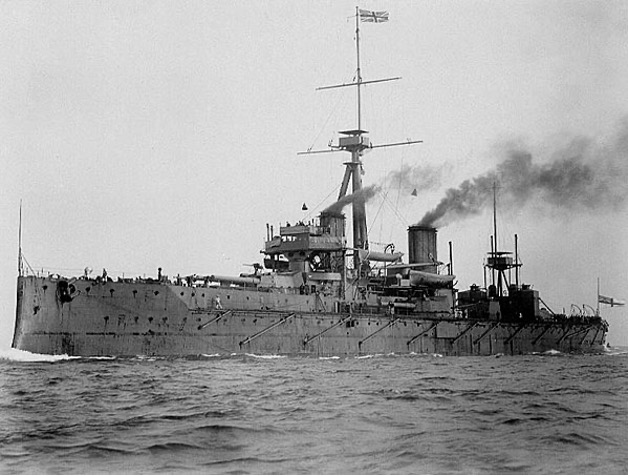
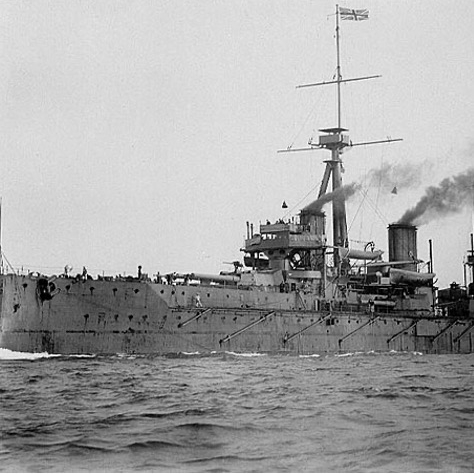
HMS Dreadnought, which gave its name to that class of warship
During 1912 the United Kingdom had had under construction 75 battleships, armoured cruisers of 1st, 2nd, and 3rd class cruisers, torpedo boat, torpedo boat destroyers and submarines. Germany had 86 and Japan 13 under construction. Again in 1912 England spent £45,000,000 on war equipment, Germany £22,000,000, and Japan £12,000,000. If we examine these figures, we must see at a glance that we are not far from a great war that will concern the whole of the world, and if any foreign nation should come to our shores, protected as we are, we will fall an easy prey.
Our paltry navy consists only of 13 vessels of war— 1 battleship (the Australia), 3 protected cruisers (the Sydney, Melbourne, and Brisbane), 2 cruisers (The Protector and Encounter), 2 gunboats, 3 torpedo boats, and a training ship. So, when we consider we are a fair prize for nations whose populations are yearly increasing by millions, and who are looking for places to place that population, we begin to think of our position, and we shiver. Let us then be up and doing. If our government is not in a position to place defences on our waters or on our lands, let us, like patriotic citizens who realise our dangerous position, come to their assistance. For the signs of a coming war are not wanting; they are everywhere, and woe to us if, we are caught unprepared.
The President apologised for the unavoidable absence in Sydney of Mr. L. Barry-Cotter, who had been called away on business. He had been listed to speak on “The Commercial Aspect of our Defence,” and his absence was very much regretted. Other officers of the League unavoidably absent were Mr. Hugh Thurlow (Vice-president) and Mr. Jeffrey Thurlow (committeeman). The chairman said his sentiments on the defenceless state of some of our leading deep-water ports were known to many, and those in the meeting who had read the
“Raymond Terrace Examiner” of the 27th ult, would have seen therein more fully just what his sentiments were than he had time to present to them that evening. The subject he had to deal with briefly was “The Aim and Object of the League. He said their aim was to awaken the people of the land to a realisation of the danger we are in if some comphensive scheme of coastal defence was not pushed ahead with all possible speed, particularly to have our deep-water ports place in a state of readiness to resist invasion in the event of Great Britain becoming involved in war, with any power having a fleet in the Pacific.
No student of events that have transpired during the last ten years and that are taking place today can feel otherwise, than that some of the nations of the world are resting uneasily and insecurely on the very verge of a volcanic upheaval that may suddenly involve them and shake their national existence to the very bedrock, and it filled him with concern to know how easily we may become involved in such a calamity. That a great crisis in the world’s history looms ominously and menacingly before us and is approaching with rapid progress the deepest thinkers in the world almost unanimously admit.
The aim and object of the League, therefore, was to awaken the people to a sense of their danger, and if necessary to sacrifice a little comfort and pleasure for the all-important matter of making them-selves as secure as possible against invasion. He believed it was possible even with our immense coastline and our small population to adopt some scheme of coastal defence that would make us moderately secure against invasion. He did not think, however, that it could be done by battleships other than as an auxiliary for many long years to come.
They were told that within twenty years we may have a fleet of battle ships sufficient to protect our shores. If we had to wait twenty years before we had a sufficient fleet of ships of war to protect our shores, and only then obtained at a cost that would spell financial ruin to the country, even should the population increase beyond anticipation in that time, and if they could not make themselves moderately secure against invasion long before that time, then he didn’t think they would need it if the events taking place in other countries are to be read aright.
He believed that as Australia was leading older countries in matters of social and legislative progress and reform, so might we strike out boldly and adopt the latest that science and invention has brought forth in the way of appliances for coastal defence such as airships, aeroplanes, and hydro-aeroplanes, submarines, and wireless telegraphy, such a scheme was possible and within the scope of our resources.
The President has received quite a number of congratulations upon the establishment of the League, the general opinion being that the movement will extend beyond Port Stephens and become a factor of great importance in the defence of the Commonwealth.
Second Meeting held at Tea Gardens
The Dungog Chronicle of 25 July 1913, page 10, reported:
‘A meeting of the Port Stephens Defence League was held at Tea Gardens recently, when the President (Mr E. J. Paton) said: — “We have met tonight to bring before you for your careful thought and consideration, stern facts and realities that confront us as a people in an isolated continent, practically undefended at some of the most vital places. If there are any people in the world who ought to be imbued with the spirit of patriotism for the land they live in, that people ought to be the inhabitants of this great Commonwealth, with the freedom and opportunity it affords to all, and we ought to watch carefully dangers as they appear, that some calamity may not overtake us.
Under present conditions we would fall an easy prey to a strong invading force. Are we, as a people, doing all we might do, all we ought to do, to place our coastal defences in a state of efficiency. True, we have made a start with an army and navy, and good work was done by the Fisher Government during the last three years in connection with our defences; but we view with grave misgivings the almost equally balanced parties we have returned to the Federal Parliament, and the danger that may arise to the great Commonwealth if, through party or individual ambitions, this urgent matter of national defence is allowed to lag.
“In such a place as Port Stephens the danger of our defenceless state is daily staring us in the face. We have here one of the finest natural harbors in the Commonwealth. It is undoubtedly such a port as this that an enemy would strike the first blow at. It is an open door to the very vitals of the Commonwealth. From a base formed and held at Port Stephens the coal supply of Newcastle might easily be cut off. A strong force could from such a base as Port Stephens strike a crushing blow in this way. “So long as the supremacy of the sea was held by the nation of which we are a part we felt secure. But the fact is we are face to face with a new and startling development in modern warfare — the airship, containing as it does, tremendous possibilities, the limit of which no human being can foresee.
We ask, can anything be done, and done speedily, to bring about a comprehensive scheme of coastal defence around our shores as is being done by Germany, France and England? “We can merely suggest for consideration the scheme as far as we are in possession of the facts, that a lesson may be taken from Germany, who seems to be leading in this new form of national defence. She is establishing military airship stations along her borders, and along her coast, equipped with the very latest appliances, and airships capable of a radius of 2000 miles, and carrying twenty dynamite bombs of half a ton each, enough to shatter to fragments the most powerful battleship attempting to enter her ports.
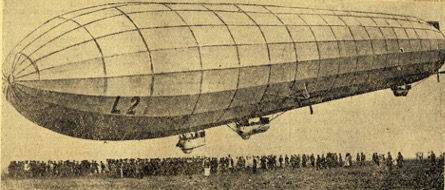
A German First World War One era Zeppelin that was used for military purposes, and referred to as an airship in this paper
England and France are doing the same, with all possible speed. It is not possible for the Commonwealth to adopt such a scheme for our coastal defence, and to have all such stations linked up by wireless? Suppose 2,000,000 of our four and a half million of people would contribute 29 per week for one year — a little over £5 each — in the twelve months we would have a fund of over £10,000,000 to be used in the defence of our country. It would be the best investment ever made in Australia. “Let us be up and doing before the days of burning arrive and see to it that the defences of our country are placed in a state of preparedness for any emergency that may arise.”
Second Meeting held at Nelson Bay
The Raymond Terrace Examiner and Lower Hunter and Port Stephens Advertiser of 22 August 1913, page 3, reported:
‘A meeting of the above was held at Nelson’s Bay on the 7th inst. The President (Mr. E. J. Paton) occupied the chair, and the following officers were also present: Messrs. Hugh Thurlew (Vice President), S. P. Dunstan (Treasurer), T. Laman, J P.; and W. C. Rush, J.P., (committeemen).
Among other important league business dealt with, the following platform was finally adopted: —
1. That the Port Stephens Defence League consist of a president, one or more vice-presidents, an honorary treasurer, and a committee consisting of five members.
2. The general business and management of the league to be conducted by the executive officers, five to form a quorum, including the president or a vice-president, or some other officer duly authorised to conduct the proceedings.
3. That annual membership fee of 2/6 will admit all eligible persons to membership in the league; that all native born or naturalised subjects of the British nation, other than criminals and insane persons, are eligible for membership in the league.
4. That membership fees, and all other moneys collected on behalf of the league, from any source whatever, will be lodged in a bank, and an account opened, to be operated on only by the hon. treasurer. All cheques to be countersigned by the president.
5. That expense incurred by the league in propaganda work, or in promoting the aim and interests of the league, to be paid out of the funds of the league.
6. That the aim and object of the league is to awaken the people of our land to a realisation of the danger of unpreparedness, in view of the feverish arming of the nations of the world, which is full of ominous significance, and to a sense of their duty to themselves and their children, even if it calls for a little self-sacrifice to accomplish.
7. That we support railway communication between the naval base at Salamander Bay and the Main Northern Railway line as surveyed and recommended by the Decentralisation Commission, thus providing facilities for transportation of troops and munitions of war and coal supplies to the naval base.
8. That we cooperate with other defence leagues that may be established elsewhere in the Commonwealth in this all-important matter of placing ourselves in readiness for any emergency that may arise.
9. That we receive contributions with a view to establish a fund to augment any Government grant for the defence of Port Stephens.
During the evening Mr. Donald Cromarty, of Anna Bay, was unanimously elected a Vice-President, of the league.’
Third Meeting Held at Nelson Bay
The Clarence and Richmond Examiner of 4 September 1913, page 2, reported:
‘At a recent meeting of the Port Stephens Defence League, held at Nelson’s Bay, the president, Mr. E. J. Paton, delivered a striking address on the need of protecting the coastline of Australia, and the neglect by the defence authorities of natural harbours, which had sufficient depth of water to shelter a fleet of battleships. After touching briefly on the feverish haste with which foreign nations were strengthening their war resources and increasing their armaments, and also the danger to Australia of England becoming embroiled with a European Power, Mr. Paton went on to point out the seriousness of allowing places such as Port Stephens to be unfortified.
They were a menace to the whole Commonwealth, particularly the latter port, which, besides possessing unlimited advantages from a maritime point of view, had an enormous strategic value. With a base formed and held there the coal supply of Australia could be controlled while a hostile force would have an excellent position from which to strike at the cities and principal towns. The military value of Port Stephens was unlimited. An invader, having once established a hold there, would have within his power one of the main arteries of the country. The harbour itself would shelter his fleet, and having formed a base, the fall of Sydney and Newcastle would be a matter of hours only.
The conclusion the speaker had been forced to was that the only method of defending adequately the coastline of Australia was to establish aerial defence stations on the coast, and link them up by means of wireless telegraphy, so that the approach of a hostile fleet would be impossible. If the vital points of Australia were supplied with military airships invasion would be practically out of the question, and a hundred airships of a suitable type could be constructed for less than the cost of one single modern cruiser.
If defence leagues were established in the centres of population, and the people awakened to the over-growing danger of invasion, enough money to carry out a comprehensive scheme of coastal defence would soon be obtained. Not an hour should be lost in providing the latest and most up-to-date equipment for Port Stephens and other ports of a similar nature. The longer this was left the greater became the danger, for as national wealth increased, we become a greater prize for countries which are undisguisedly seeking an outlet for their teeming population.’
Concluding Comments
Despite the logical arguments made by the League, none found favour with the Commonwealth Government.
The quick onslaught of World War One in 1914, and the Government’s war-time policy of sending troops and equipment to support Britain and other European allies, neutralised the advocacy of the Port Stephens Defence League.
It was not until the Second World War, when Australia faced the real threat of invasion from Japan, that Port Stephens was finally fortified at Mount Tomaree.
Researched and compiled by Kevin McGuinness
June 2024

 Port Stephens - a history exploration