
Introduction
In March 1952 a major military training exercise was held to the north of Port Stephens, at Broughton Island and on the adjacent mainland coastline.
Code-named Operation Boomerang, It was the biggest peacetime amphibious landing exercise in Australia since the Second World War.
The Newcastle Morning Herald and Miners’ Advocate of 6 March 1952, page 2, provided the following background to the planned military exercise:
‘The 15th Northern Rivers Lancers, whose annual 14-day camp will begin at Gan Gan [near Nelson Bay] on Saturday, will have the cooperation not only of the R.A.A.F., but of the Navy in its major exercise on March 20. The only thing is that the Navy does not know if will be cooperating. The exercise will be an assault landing at the Big Gibber, north of Port Stephens [just north of Myall Beach]. The Navy will have some craft in the immediate area about that date and the lancers have “written them into the exercise” to provide a background but they will not be playing an active part. The Army boys will simply make believe they are receiving Navy support.’
The resources of the National Library of Australia’s Trove newspapercollection have been utilised in preparing this paper.
Troops train for landing
The Newcastle Sun of 12 March 1952, page 5, reported:
‘Two hundred C.M.F. [Citizen Military Force] soldiers are under intensive training in the Port Stephens area in preparation for March 20 when the biggest amphibious landing exercise in Australia sice thw war will be carried out.
The landing will be made on the coast at Big Gibber, several miles north of Port Stephens, after R.A.A.F. aircraft and Army amphibious vehicles have pounded the beachhead with high explosives and machine-gun fire. Royal Australian Navy ships may also take part. An Army spokesman said today that men from the 15th Northern Rivers Lancers and 16th Co. R.A.A. S.C., including many former national service trainees, had been preparing for the exercise since March 8. He described the landing as a “culminating exercise” and said that about 20 amphibious tanks and trucks plus other army equipment would be used.
Outlining the “attack” plan, he said that the force would cross from Broughton Island, some miles to sea, to the beachhead after it had been softened up. “We will put to sea at 3 a.m., the landing area will be bombed by the R.A.A.F. at 5 a.m. and the landing will be made at 5.30 a.m. The force will then push forward across sandhills and marshy land to a hill several miles inland which would represent an ‘enemy’ military objective.” As the landing was a raid only, a planned withdrawal would be made to the coast later.’
High Ranking Officers to attend exercises
The Newcastle Morning Herald and Miners’ Advocate of 14 March 1952, page 5, reported:
‘A C.M.F. private said last night that “so much top brass” was coming to Newcastle that “a man would wear his arm out slinging salutes.”
The “top brass” to whom he referred are high-ranking Army officers. At least seven, with the rank of lieutenant-colonel or above, have visited Newcastle this week or will do so at the weekend. Others are likely to arrive later.
Their major attraction is the annual 14-day camp of the 15th Northern Rivers Lancers and 16 Company, R.A.A. S.C., two Newcastle C.M.F. units which are the only amphibious units in the Commonwealth. The camp is giving officers an opportunity to see the units in operation. Sixteen Company is carrying out exercises in the Nelson’s Bay area and the lancers on the Mvall Lakes. When they combine for a large-scale amphibious landing at the Big Gibber, north of Port Stephens, on March 20, important Australian and oversea military observers are expected to join the influx.’
Troops storm beachhead in mock attack
The Newcastle Sun of 20 March 1952, page 3, reported:
‘A beach front north of Port Stephens was swept with gunfire at sunrise today as Citizen Military Force units dashed ashore in an amphibious landing and supporting aircraft pounded inshore targets in a softening-up process.
This was “Operation Boomerang,” described by Service authorities as Australia’s biggest post-war combined air force and army amphibious manoeuvre. It involved “invasion” of an area near Myall Lakes by “hostile” amphibious units. Boomerang began with this lightning, commando-type beach landing by amphibians from the 15th Northern Rivers Lancers and the 16th R.A.A.S.C., both Newcastle C.M.F. units, at Big Gibber, north of Port Stephens. Then infantry advanced through three and a half miles of dense scrubland to Tickerabit, on Myall Lakes, heavily supported by ground fire an air support. When the objective was attained, a strategic withdrawal was made to the coast, and the attackers, called “Spearforce,” returned to home territory.
Before the exercise began there was some excitement when a duck broke down last night and almost crashed on rocks at Broughton Island in heavy seas. Another duck near-by raced to the rescue and hauled the disabled unit to safety just as the crew prepared to jump clear.
First phase of the exercise came when the amphibious units, with small craft from the Water Transportation Branch of the Royal Australian Engineers, Sydney, made a feint run yesterday to Broughton Island, and spent the night there. Last night troops, mainly C.M.F. members, but including a number of National Service trainees who had recently finished training, worked until a late hour getting the vehicles ready for today’s operations. At 3.30 a.m. in pitch darkness the armada, totalling 20 vehicles, two work boats and an assault landing craft carrying a total of 300 men, raced north of Broughton Island.
At sunrise the amphibious units swerved in towards the beachhead with howitzers and machine-guns firing, while overhead R.A.A.F. Mustang and Vampire fighters, with Lincoln heavy bomber support, pounded the target area. Immediately the vehicles reached the 3000-yard-long beachhead they took up defensive positions. Tanks went to the northern sector to give artillery support for the 110 men who comprised the raiding party on Tickerabit. These men landed on the southern end and pushed quickly towards their objective in an infantry advance. Then the signal came, “Mission Accomplished.”
More than 70 representatives of the Armed Forces, including one officer from England, watched the exercise. They included Brigadier D. Macarthur Onslow. C.B.E., D.S.O., E.D., Commanding Officer of the 1st Armored Brigade, Lieut-Colonel S. Pearson, Director of Armor, who came from Melbourne, Lieut-Commander Carl Wikeman. R.A.N.V.R., Colonel Kellway of the Royal Artillery, Major O. C. Matthews, of Army Headquarters, Melbourne, 10 officers from the 1st Armored Brigade and several air liaison officers.
Brigadier Macarthur-Onslow said he was most impressed with the exercise. “It is obvious that much ground has to be covered before the men will reach the high standards required in modern warfare, but they were certainly most impressive today. I was particularly pleased about the way National Servicemen took their place in the fabric of the C.M.F.”
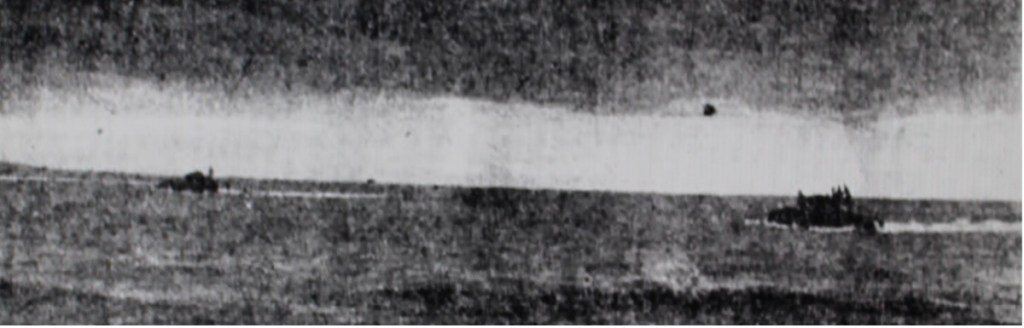
Tanks and “ducks” just before making their landing [Newcastle Sun, 20 March 1952]
Evaluation of the Invasion
The Daily Telegraph of 21 March 1952, page 5, reported:
‘Radio failures and breakdown of supply lines spoiled yesterday’s amphibious “invasion” of the coast north of Port Stephens.
The landing, “Operation Boomerang,” was “less than a 50 per cent, success,” a senior officer said. The landing was the biggest peacetime amphibious operation in Australia. A party of visiting senior officers, including the Commander of the First Armored Brigade (Brigadier Denzil MacArthur-Onslow), experts from Army Headquarters, Melbourne, and a British Army Colonel, landed with the troops. All the senior officers left before the operation was completed.
Troops in the landing were members of the 15th Northern Rivers Lancers and the 16th General Transport Company of the Royal Australian Army Service Corps, all based at Newcastle. They landed in 17-tons amphibious tanks and 12-tons amphibious personnel carriers.
The unit’s orders were to raid an “enemy” held hill on the shore of Lake Myall, four miles inland, and withdraw. The Commanding Officer (Lieutenant-Colonel J. A. James) decided to occupy Broughton Island, three miles offshore, in daylight as a feint to deceive the “enemy.” This move, a test for C.M.F. men and National Service trainees in the tanks and personnel carriers, was successful, despite drenching’s and some sea sickness.
Yesterday afternoon an airdrop of food and ammunition by R.A.A.F. Dakotas ended embarrassment caused when pressmen and visiting officers joined the unit on the island, apparently prematurely, on Tuesday night. The air drop also meant full rations for troops whose last rations had been soaked during the crossing. Early today they drove into the surf, and, without lights, moved in single file to a rendezvous nine miles to the north. As dawn broke four Lincoln bombers from Amberley, Queensland, laced the beach with bombs. A few minutes later the amphibians turned left and began the 3000 yards run to the beach, firing their 75 mm. howitzers and 5 machine-guns. They stopped firing to allow, four Mustang aircraft to dive-bomb and strafe the beach.
Communication difficulties caused some confusion on the beach, but officers quickly sorted the tanks from the infantry carriers. Infantrymen moved into the scrub toward their objective, four miles away, accompanied by a radio equipped officer to control fire from the tanks’ guns. In the next three hours four walkie-talkie operators established communication only long enough to allow one tank to fire a few ranging shells on the hill. This robbed the infantry of all tank support in their “attack.”
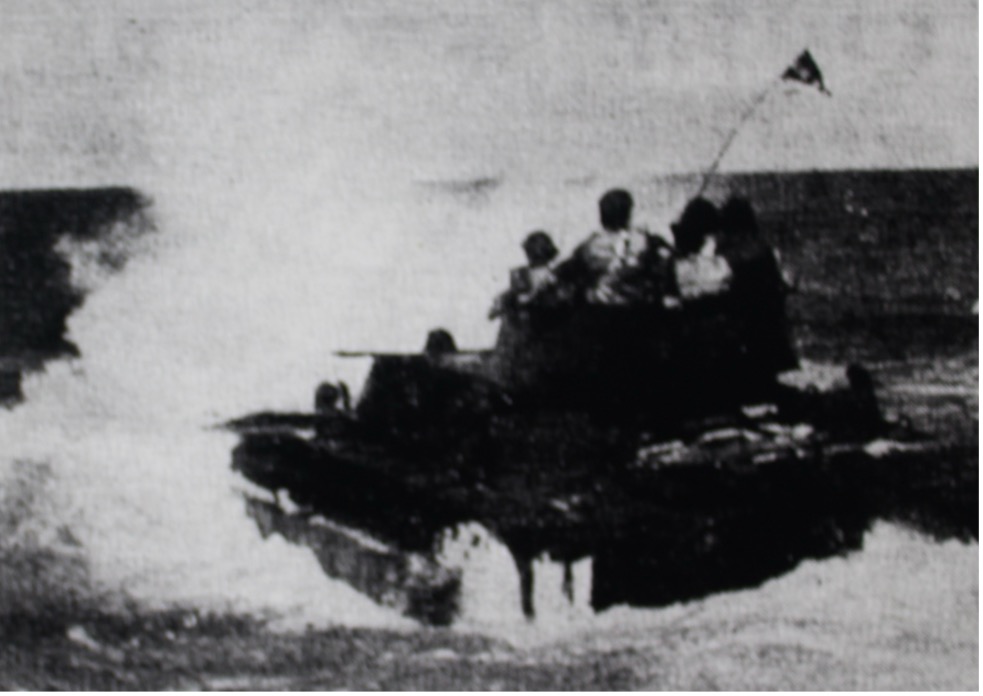
An amphibious tank of the 15th Northern River Lancers, Citizens Military Forces, entering the surf at Dark Point, north of Port Stephens [Daily Telegraph, 21 March 1952]
Rescue required during the exercise
The Newcastle Morning Herald and Miners’ Advocate of 21 March 1952, page 2, reported:
‘A dramatic night on Broughton Island was a prelude to Australia’s biggest amphibious assault landing exercise at the Big Gibber rocks, north of Port Stephens, yesterday.
An amphibious “duck” broke down off the island and had to be rescued, and a small workboat, carrying observers to the exercises, was unable to find its way in the darkness in the island’s north bay. The “duck” broke down a few hundred yards from a bombora. Its commander signalled with ‘Very’ lights for assistance. Another ”duck” moved out from the beach to rescue it, but a towline was attached from a third “duck,” which was also approaching the island. As they neared the shore, the towline snapped and a fresh line had to be attached. The unserviceable “duck” was beached. The workboat, rocking in a heavy swell, stood offshore till it received guidance from other vessels. Some of the 20 officers aboard, including a doctor, were seasick.
The exercise, “Operation Boomerang,” climaxed the annual 14-day camp of two Newcastle C.M.F. amphibious units, the 15th Northern Rivers Lancers and 16 Company, R.A.A.S.C. A Sydney C.M.F. small ship unit, 1 Water Transportation Training Squadron, and R.A.A.F. elements cooperated. When the exercise began on Wednesday afternoon, the amphibious units, known as “Spear Force,” moved from Dark Point on the mainland to Broughton Island. Soon after they reached the island, R.A.A.F. Dakotas flew over to drop rations, ammunitions and supplies by parachute.
In the late afternoon and night, a landing barge and two workboats from the transportation squadron and two “ducks” from district units, carried about 70 Navy, Army and Air Force observers to the island to watch the exercise.
The landing barge also carried a mobile kitchen in which hot meals were prepared for the troops. The men, including a small number of National Servicemen from the first group to complete basic training, slept on the beach, under amphibious tanks or on the grass slopes. Mail received late in the night was delivered to them when breakfast was served at 2.30 a.m. yesterday. Reveille was at 2 a.m.
At 3.30, the fighting tanks, with five, personnel carriers, moved off from the island, heading. north in a calm, moonlit sea to the Big Gibber. The convoy was led by one of the workboats. It was to have been headed by the transportation squadron’s Fairmile cruiser, but the Fairmile severely damaged its propeller shaft in exercises at Nelson’s Bay on Tuesday and had to be taken to Sydney for repairs.
As “Spear Force” reached its forming up point, 3000 yards offshore from the Big Gibber, at 5.30 a.m., R.A.A.F. Lincolns flew over, bombing the beachhead. They were followed by Mustangs from Williamtown, which strafed and rocketed the area in a softening-up attack. While the straffing continued, the amphibious craft, moving in for the landing, opened fire. with 75mm. Howitzers and Browning machine guns. The aircraft then smoke bombed the scrub near the beachhead and continued their rocket runs while the landing was carried out. The actual landing was at 6.17.
Immediately they hit the beach, 16 Company troopers acting as infantry. streamed from personnel carriers and began their advance through thick scrub and marshland. The fighting tanks moved north into the sandhills to provide fire cover. The objective was Tickerabit Point, 31/2 miles from the beachhead, on the Myall Lake. When the infantry “fought” its way to the point and “captured” it, the exercise ended.
The Commander of 1 Armoured Brigade (Brigadier D. Macarthur Onslow), who was one of the principal observers, said he was most impressed by the exercise, but that much ground still had to be covered before the high standard required in modern warfare was reached. “I was particularly pleased with the way National Servicemen took their place,” he said. The Commanding Officer of the lancers (Lieut. Colonel J. A. James), who commanded the exercise, said he was gratified with the water movement. Observers had expressed surprise that it could be done in the light available and with the number of vehicles used. ……
The amphibians’ camp will end at Gan Gan on Sunday, A sports afternoon will be held tomorrow, when the camp will be open to visitors.’
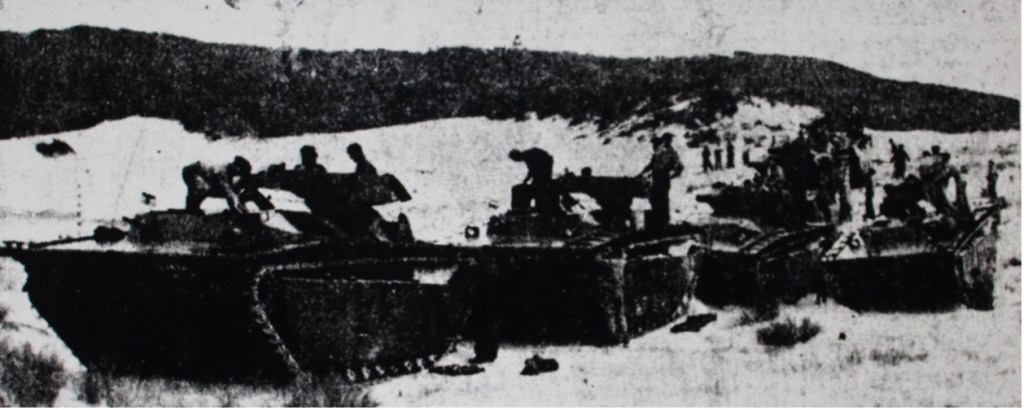
Amphibious tanks assemble on sand dunes to provide concentrated fire after the landing [Newcastle Morning Herald and Miners’ Advocate, 21 March 1952]
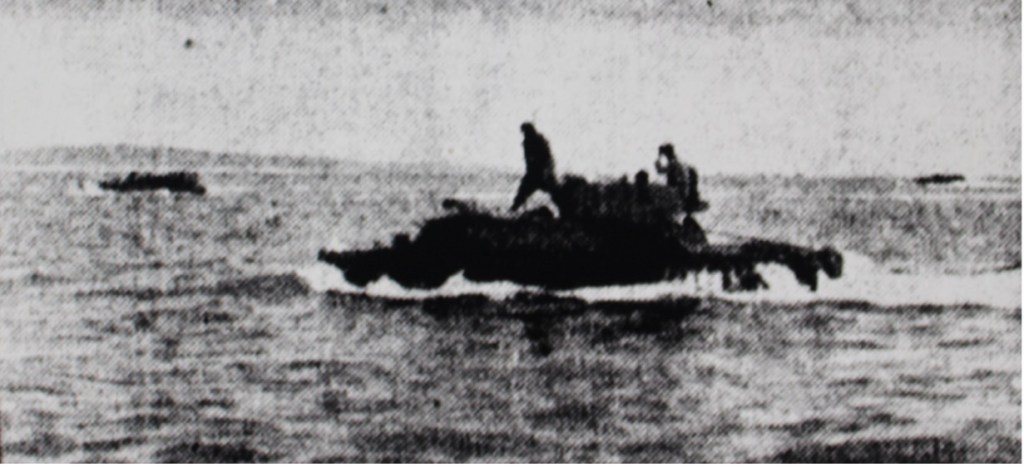
A tank heads towards the beach for the landing [Newcastle Morning Herald and Miners’ Advocate, 21 March 1952]
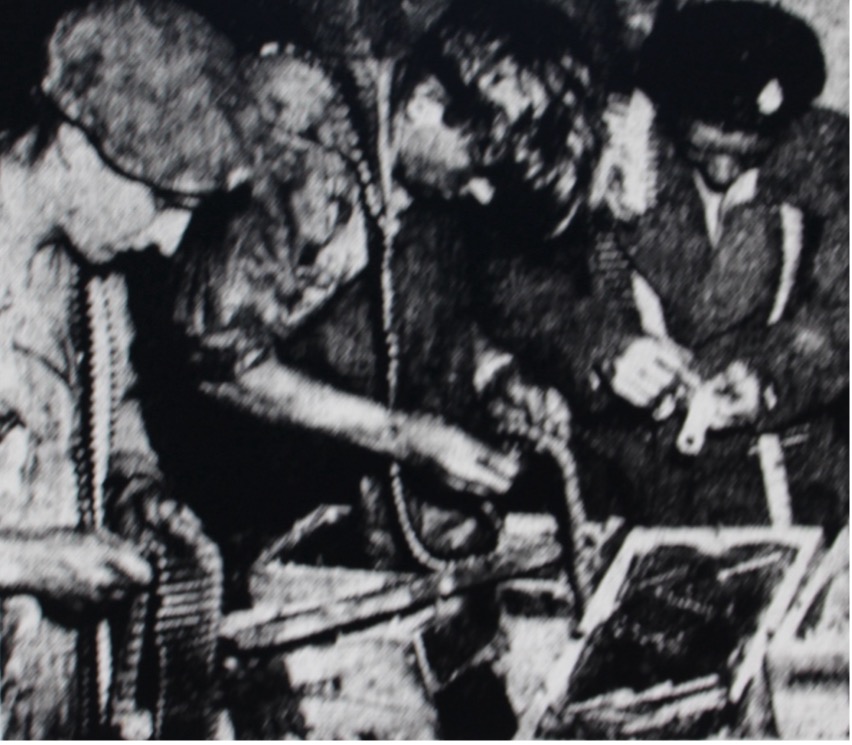
Waiting for the landing, Corporal N. Julian, Corporal H. Stewart and Cadet G. Fleming, prepare ammunition belts [Newcastle Morning Herald and Miners’ Advocate, 21 March 1952]
Concluding Comments
The waters inside and outside of Port Stephens have been the scene of military training such as that set out in this paper.
During the Second World War, the area was used to train both Australian and overseas troops in amphibious warfare. See HMAS Assault and JOOTS 1942/43 at this link on the website.
In 1938, a major peace time military exercise was conducted at Fingal Bay and along the Anna Bay coastline. Details are found at Military Exercises at Fingal Bay – October 1938. on the website.
Researched and compiled by Kevin McGuinness
June 2024

 Port Stephens - a history exploration