
Introduction
The Great Depression was the worst economic downturn to date in the industrialised world, lasting from 1929 to late 1930’s.
On 24 October 1929, one week after the election of the Federal Labor Government of James Scullin in Australia, the United States stock market crashed triggering a series of events that quickly led to the Great Depression.
Uncertainty as to the correct economic measures to be taken at both Federal and State levels, hindered Australia’s efforts to escape the prolonged downturn. This led to major financial distress on both the business and personal levels.
Despite the attempts by the Federal government to manage the crisis, it was the recovery of our major trading partners, especially Great Britain and public works funded by state and local governments that brought about the slow recovery.
Mobilizing the economy for the Second World War finally ended the Depression. Workers joined the armed forces or went to work in defence jobs.
The Port Stephens region did not escape the economic effects of the Great Depression.
This paper examines what happened throughout the area, particularly around Nelson Bay and its immediate surrounds. A considerable number of unemployed miners and others camped for the duration of the Depression in the Fly Point area of Nelson Bay.
However, it was not all bad news for the region. Despite harsh economic conditions, the Port Stephens area benefitted from many infrastructure programs particularly roads. These were made possible by special government grant funding and the considerable skilled labour force that had temporarily relocated to the Nelson Bay area.
The plight of the unemployed in the Nelson Bay area was not easy, especially in relation the food relief program and the arrangements for the payment of the dole.
These matters came to the notice of the Trade Union movement and through its advocacy, improved government procedures were implemented to aid the plight of the unemployed
Lobby groups use high unemployment to push various causes – 1928/29
With the large number of unemployed in the Port Stephens region, community leaders were quick to spring into action to persuade the NSW Government to fund particular projects as a means to solve the regional unemployment problem.
The Sydney Morning Herald of 17 May 1928, page 14, reported on the view of Tea Gardens residents concerning the unemployment issue, and proposals to on of roads and a railway to ease the problem:
‘Port Stephens’ residents are incensed at the proposal of the Government to spend money on non-productive work for the unemployed when the money could be utilised in constructing a railway and roads to open up Port Stephens. It is pointed out that if the works were started, they would absorb practically the whole of the unemployed from the coal-fields district. The homes of these men are only a few miles away.’
In a similar fashion the Maitland Daily Mercury of 11 February 1929, page 4, reported:
‘Mr. W. F. O’Hearn, M.L.A., stated today that he had asked the Minister of Works and Railways, Mr. E. A. Butteanshaw, to carry out his promise and submit the Port Stephens railway proposal to the Standing Committee on Public Works this session. If the work was sanctioned it would be the means of providing work and absorb hundreds of the unemployed right near their own homes.’
Unemployment relief grants received by Port Stephens Shire Council 1930 – 1933
in the earlier years of the Depression, prior to the introduction of the NSW Government work-for-the-dole scheme in 1933, various federal and state government grant schemes operated, often for short periods, aimed at relieving aspects of the economic harm caused to individuals.
The three assistance schemes that were of relevance to unemployed residents in Port Stephens were the dole, food relief vouchers, and relief grants allocated to the Port Stephens Shire Council.
Four relief grants were received by the Port Stephens Shire Council over the period 1930 to 1933:
(1) The Dungog Chronicle of 21 January 1930, page 6, reported on the first unemployment grant that the Council received from the NSW State Government:
‘The President … reported that he had received word of £250 for the unemployed grant. As no time permitted to meet the Council, he and the late president and the Engineer had conferred and agreed to spend the money on the New Line Road; 75 per cent, had to be expended in labour, and this was about the only road where this condition could be complied with. He hoped this would be satisfactory to the Council. The Council endorsed the action.’
(2) The same paper of 15 August 1930, page 2, reported on the second, and much larger grant received by the Port Stephens Shire Council to aid infrastructure development and employment:
‘Hon. Walter Bennett, M.L.A., has been informed by the Minister for Local Government that a grant has been made to Port Stephens Shire Council, amount £2,000 [for] formation and gravelling on Karuah-Tea Gardens road, Martin’s Creek and Dunn’s Creek road.’
The same paper of 19 September 1930, page 6, reported on further aspects of the grant and its implementation:
‘The Local Government Office forwarded conditions of employment to be followed regarding the £2,000 grant for unemployed. The number of men was left in the hands of the council. Work would be paid on an hourly basis on a £4/2/0 week rate for 48 hours. The number of hours to be worked to be 35 per week, and no day longer than 8¾ hours. An employee providing his own horse, dray and harness to receive 5/- per day extra, or part of a day. Termination of employment may be made at any time subject to payment of any wages due up to the time of such termination. The President stated the money was being spent on the Karuah, and Dunns’ Creek and Martin’s Creek roads.’
(3) The Raymond Terrace Examiner and Lower Hunter and Port Stephens Advertiser of 15 January 1931, page 4, reported on a third unemployment relief grant received by the Council:
‘Department of Local Government [informed] Council that the sum of £250 had been granted for unemployment relief. The work to be done to the Department’s approval and a list of proposed work to be submitted. Local unemployed to be engaged. Award rates and conditions to be observed. 80 per cent to be expended in wages.’
The same paper of 12 February 1931, page 4, carried further details on how the grant money would be spent:
‘An inspection was made with the President of several roads deemed most suitable for the work to be done under the conditions laid down under the grant, and it was decided to spend £150 on the Swan Bay Road, £50 on the Dunns Creek Road, and £50 on the Martins Creek road. The work to be done is as follows : — Swan Bay road, formation of one mile and gravelling where necessary; Dunns Creek road and Martins Creek road formations on both roads of short lengths where the roads have been washed out.’
(4) The same paper of 11 August 1932, page 4, reported:
‘The Commonwealth Employment Council advised [Port Stephens Shire Council] that the sum of £600 had been granted for unemployment, the Council to add £300. Agreed to [by council].’
Problems in receiving food relief in the Nelson Bay area – 1931
The Raymond Terrace Examiner and Lower Hunter and Port Stephens Advertiser of 12 February 1931, page 4, reported on problems experienced in the Nelson Bay area, in accessing food relief:
‘It has been brought under the notice of the Hon. W. Bennett, M.L.A., member for Gloucester, that the unemployed at Nelson’s Bay are placed at a great disadvantage in securing their dole, inasmuch as they are compelled to journey to Tea Gardens to obtain an order from the constable resident there, which entails considerable expense. Mr. Bennett has brought the matter under the notice of the Chief Secretary and has suggested that the constable of Tea Gardens might visit Nelson’s Bay once a week in order to issue food relief coupons. Mr. Gosling has promised to look into the matter.’
The Dungog Chronicle of 20 March 1931, page 4, reported on the Minister’s response on food relief, which appeared to lead to an improvement over the previous arrangement:
‘In reply to your representations urging that arrangements be made with a view of the issue of food relief at Nelson’s Bay so that applicants need not travel to Tea Gardens, I desire to intimate that reports obtained show that the Constable at the latter place visits Nelson’s Bay once each week, but the difficulty in this case is that as weather conditions must be studied, a specified day for his visit cannot be fixed as it would be exceedingly dangerous for the small Police Launch to cross the harbour in rough weather. The matter, however, is being left in the hands of the Constable at Tea Gardens to make the best arrangements possible in the circumstances.’
Unemployed persons move to Port Stephens area – 1931
As the economic effects of the Depression took hold, many people found it necessary to move from cities and large towns to less populated areas to find cheaper housing and perhaps new employment opportunities that were not available in larger centres of population.
The Nelson Bay area was one district to attract unemployed persons, particularly those previously employed in mining around the Newcastle, Maitland and Cessnock districts.
The Dungog Chronicle of 3 March 1931, page 3, reported on the trend to seek economic relief away from major population centres:
‘Many people who are compelled to accept the dole find that it is impossible to live on it if they remain in the cities. They move out and camp in the bush or on Port Stephens. They can thus augment their menu with rabbits, fish, etc.; and can buy at very low prices fruit and vegetables from nearby farmers. ……
It is very common around Port Stephens to find camps of half a dozen young men who pool their dole coupons and live together. Their resources are so slender that they cannot afford good clothes, drink or tobacco and they are leading a healthy life by the water until the economic tide turns.’
Tragic accident occurred when collecting food relief – 1931
Further evidence of the problems encountered with the procedures pertaining to obtaining food relief was reported in the Newcastle Sun of 15 June 1931, page 1:
‘Arthur Wilson, aged 35, a Greta miner, was drowned, when a small punt in which he, two other men, a woman and a baby were rowing from Tea Gardens to Windy Whoppa [Winda Woppa], suddenly overturned and sank in 15 feet of water, near Windy Whoppa this morning. …….
Wilson and the other members of the party were coalfields miners staying temporarily at Windy-Whoppa, a timber-milling settlement across the river from Tea Gardens. With the woman and child the three men set out this morning for Tea Gardens to collect food relief. A strong westerly wind was blowing as they begun the return journey, and with little freeboard, the little punt made a difficult crossing. When the punt was about 50 yards off the shore waves began to splash over the side, and realising that the boat was in danger of being swamped, one of the men jumped overboard into 15 feet of water. Shortly afterwards the little craft suddenly capsized, and the two remaining men, the woman and the baby were thrown into the water. Wilson, who, it is understood, was unable to swim, was seen on the surface for a few moments, and then he sank from sight.’
Reduction in salary Port Stephens Shire Council Officers – 1931
In the early Depression years, much pressure was placed on the Council by ratepayers to reduce costs. While the Council was legally unable to reduce the wages of its maintenance workers, the Shire’s Clerk and Engineer, voluntarily reduced their wages, as reported in the Raymond Terrace Examiner and Lower Hunter and Port Stephens Advertiser of 8 October 1931, page 4:
‘Cr. Ralston said he was pleased to know that the Clerk and Engineer had voluntarily reduced their salaries. He was pleased to know that the bad times had been helped by them in that way. They were deserving of their thanks and he moved to that effect. Cr. Meredith seconded and said the reductions had been operating he understood for the past six months.’
Further relief grant unavailable as conditions in the city so acute – 1931
The Raymond Terrace Examiner and Lower Hunter and Port Stephens Advertiser of 17 December 1931, page 4, reported:
‘Cr. Meredith said an application from Nelsons Bay had been made for relief, by grant, for about 40 diggers there. Was there any chance of getting any money for relief? The engineer said Mr. Bennet had informed him that Mr. Baddeley had told him that the conditions in the city were so acute that none was available for the country districts.’
Protest by Port Stephens Shire Ratepayers Association – 1932
While the Council clerk and engineer had previously reduced their wages, the Port Stephens Ratepayers Association called for further cost reductions and protested that the council rates should be reduced because many ratepayers could not afford to pay them.
The Dungog Chronicle of 15 January 1932, page 4, reported:
‘A deputation from the Port Stephens Shire Ratepayers’ Association protested to the Port Stephens Shire Council against an increase of ¼d. in the £1 on last year’s rate. The new rate is 2¼d. and last year’s was 2d. Speakers on the deputation were Messrs. Boag, H. Hodges, J. F. Considine, J. D. Richardson, F. Mate and W. L. Priddle. The council considered the position as the deputation had put it, and, after a statement by the Engineer that the machinery sinking fund would not stand another draw on it as the draw this year on that fund may be heavy, council could see no way of reducing the rates beyond starving the roads, and this was considered bad practice, as a considerably larger rate would be necessary next year to maintain the roads. They would get less subsidy from the Main Roads Board. The new rate of 2¼d was unanimously adopted.’
The Ratepayers Association maintained their pressure on council to reduce costs, as reported in the Maitland Daily Mercury of 17 March 1932, page 2:
‘Mr. J. W. Boag, secretary of the Ratepayers’ Association, said he was asked by the association to submit the following resolution to the shire council: “That the Port Stephens Shire Council be requested to consider the idea of rationing [limit hours of employment] the salaried officers and maintenance men and if there is no authority for this to seek such power from the Minister for Local Government.” This letter provoked much discussion, it was thought by some of the councillors that the letter should not be received, as they had discussed the matter at the recent deputation. The president, supported by Cr. Ralston, thought that they should receive the letter.
The president thought some rationing could be done. If allowed, it might be a relief to ratepayers who had to accept much less for their product. The men in fairness should be cut down. Cr. Meredith said the association insinuated that they were wasting money in employing too many men. The engineer said they were necessary. The engineer said that many councils had made application for rationing to the Conciliation Board. But they were told that they could not do it. … Cr. Clode said that there was no need to ration if they had the power to dismiss the men as they chose. Cr. Pearse said that rationing was not allowed. The matter had been threshed out at the last Shires’ Association conference, and they had not got any satisfaction. Cr. Meredith said they had told their engineer and clerk to cut down the expenses. The remarks at the Ratepayers’ Association, as reported, were most objectionable.
Cr. Russell: The request was threshed out at the deputation, and they bring it here again. Cr. Ralston said that he would move that Cr. Pearse be instructed to bring the matter up at the next meeting of the Shires’ Association executive, with a view to getting permission to ration. The president, in seconding, said that the ratepayers could not pay their rates, and the men should share some of the depression. Cr. Russell: We have to tell them whether it is possible or impossible— it is impossible. Cr. Meredith said that to dispense with any more would mean loss of efficiency in the work. They had dispensed with all the men that they could spare. The association should be informed that the council had already reduced the men to bedrock. He moved to that effect. Cr. Pearse seconded, and the motion was carried. Cr. Pearse was also instructed to bring the matter before the next shires’ executive meeting, with a view to obtaining some alteration of the award.’
Three hundred unemployed in Port Stephens Shire Council area – 1932
The Raymond Terrace Examiner and Lower Hunter and Port Stephens Advertiser of 7 July 1932, page 4, reported:
‘With regard to the Unemployed Grant work …… Cr. Pearse said all unemployed had to register with the Shire Engineer. The Engineer said he had 170 applications and thought there were about 300 unemployed altogether in the Shire.’
Relief work available on Bulahdelah to Tea Gardens road construction – 1932
The Dungog Chronicle of 22 July 1932, page 4, reported:
‘A number of men left for Tea Gardens to work on the Bulahdelah-Tea Gardens road, which is being constructed from the unemployment relief fund under the control of the [Stroud] Shire Council. Some 25 men from here have been employed and left by lorry to commence last Monday. This will be a benefit to this district as some of the men have been out of work for a long period.’
The same paper of 2 September 1932, page 4, reported on the success of the construction project, and the benefits it brought to the unemployed persons so engaged:
‘Work on the above road finished on Friday last. Three miles of grading was carried out, and about two and a half miles of forming was achieved. The section completed is regarded as about the worst section of the road, and the general comment is “It is a pity that there was not sufficient money available from the unemployed relief committee to have put the road right through to Bullahdelah.” ……..
Considering that the workmen were changed every week, and were drawn from the large army of unemployed, the work carried out is a credit alike to the Stroud Shire, its Engineer, and the unemployed who were engaged on the work. The work carried out is the lie direct to those who would say that the unemployed do not want work.’

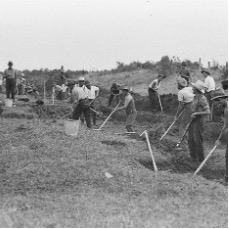
A gang of men on relief work during the Depression – a common throughout the Port Stephens district.
Loans available to farmers to give relief to the unemployed – 1932
The Maitland Daily Mercury of 10 September 1932, page 10, reported on loans for relief that was available to farmers:
‘The Department of Lands wrote regarding the proposed loans for the relief of unemployment. There loans would be made available to farmers for purposes of rabbit netting and destruction, ring-barking, suckering, clearing for cultivation, falling, etc. Council was asked to assist by receiving applications for grants, in recommending the fitness of applicants, and in supervising in other ways. ….. Council agreed to help.’
Port Stephens Unemployed Association raises issues:
The Newcastle Morning Herald and Miners’ Advocate of 26 October 1932, page 3, highlighted various issues faced by the unemployed camped at Nelson Bay. In particular, a requirement that rations could only be obtained once in any town and the unemployed were forced to travel seeking work or handouts at towns along the way:
‘Port Stephens Unemployed Association held the usual meeting in Nelson’s Bay Park. Various contentious matters were dealt with, chief of which were the food relief questionnaire, and the instructions issued by the food relief officer, telling single men to get on the track. The following resolutions were carried:- the unemployed of Nelson’s Bay view with disfavour the personal nature of various questions asked us in the food relief questionnaire, and also the method adopted for the collection of these forms, and instruct the Secretary to write to the Chief Secretary, explaining the method of collection, i.e., by a public store-keeper, and ask him to have this remedied, and also the questions amended.” “That we, the single men resident in and around Nelson’s Bay, refuse to go on the track, and reaffirm our decision to attend for food relief when again due, as we contend that we are bona fide residents of Nelson’s Bay, and by having insufficient footwear, &c., it is not possible for us to go on the track.”‘ This resolution was adopted after an interview with the relief officer, who was requested to show his authority for the track instructions, which he declined to do.’
The same newspaper of 9 November 1932, page 11, further reported:
‘Port Stephens Unemployed Association at its last meeting, expressed strong disapproval of the new dole regulations. These are that all men whose wives receive child endowment are reduced a scale in food relief. A man, wife, and two children, receive 5/ per week endowment, are reduced to C scale from D scale, with the other scales pro rata. Also that men living at Anna Bay must travel to Raymond Terrace, a distance of about 28 miles there and back, to draw their food relief. Another general reduction in food relief prices of an average of 22 per cent. was put into effect, and the general opinion was expressed that the present Government was trying all the new regulations out at Port Stephens first, as was done with the food relief questionnaire, prior to putting them in operation elsewhere.
A matter causing hardship on local unemployed is the difficulty of being unable to obtain the goods enumerated on the dole coupon, as many of these are not stocked by the storekeepers, and it was said that they supply other goods at higher prices. This applies particularly to meat, where, owing to the Government price allowed being 4d a lb, and the butcher charging 7d, 8d, or 9d, per lb, the men on food relief are receiving less than 50 per cent. of the amount due. Resolutions were carried with regard to these matters, and also thanking speakers from Newcastle United Front Committee who attended. The Chief Secretary is to be urged to put more humane regulations in to effect in this district.’
Carpenters Union and the Trades Hall council take up complaints raised by the Port Stephens Unemployed Association – 1932
The issues raised by the Port Stephens Unemployed Association were viewed as significant and the case was taken up by the Carpenters’ Union at Newcastle. The Newcastle Sun of 14 November 1932, page 7, reported:
‘Recent developments in connection with the dole at Port Stephens were the subject of a great deal of discussion at the last meeting of the Carpenters’ Union. It was complained that in the cases of married men whose wives received endowment the scale had been reduced. Objection to the men having to travel from Anna Bay to Raymond Terrace for relief was also taken. It was claimed that a reduction of 22 per cent. in the scale of relief had been made operative, at Port Stephens, and the opinion was expressed that new dole regulation and reductions were being tried out in that centre before being applied elsewhere. The meeting decided to instruct the secretary (Mr. Hall) to write to the Chief Secretary (Mr. Chaffey), protesting against any reductions in relief being brought about by new regulations, as it was felt that the unemployed were suffering sufficiently under the past regulations.’
The same newspaper of 18 November 1932, page 8, provided an additional report on the issue:
‘Following the claims made by the Carpenters’ Union delegate from Port Stephens (Mr. Hughes) to the Trades Hall Council last night, that genuine hardship had been imposed on the unemployed in that district by the present system of food relief, the executive of the Trades Hall is to gather data for submission to the local members, who will be asked to bring up the matter in Parliament. Mr. Hughes, speaking at last night’s meeting, declared that the storekeepers could not supply goods at the Government prices, owing to the added costs of freight and other expenses. He said that the unemployed were suffering considerable hardship as a result of the anomalous position created by the regulations. The unemployed were slowly starving, he declared, and he had seen children dressed in clothes made out of bags. In many cases, families were living in bark huts, and were subsisting partly on fish given to them by the fishermen. The amount of food relief obtainable was altogether inadequate.’
Government responds to concerns of the Nelson Bay unemployed – 1932
The Newcastle Morning Herald and Miners’ Advocate of 17 December 1932, page 4, reported on the Government’s response to the Nelson Bay food relief issues:
‘The Under-secretary to the Chief Secretary’s Department (Mr. E. B. Harkness), replying to representations by Mr. G. Booth, M.L.A., in relation to complaints received from the unemployed at Nelson’s Bay, concerning the issue of unemployed food relief in that district, states that the prices recently arranged by a departmental inspector do not impose any hardship on local suppliers, particularly from the point of view of transport cost, steamer and road haulage being available. The letter proceeds—”With regard to the supply of fresh milk, the price of 3d per pint has remained unaltered since July 1932, and it is understood that there is practically no desire on the part of recipients to avail themselves of this item, the value being used for the substitution of other articles of food. Separate bread coupons are issued, allowing all recipients the option of nominating one of the two local bakers. The charging of a higher rate for alternate items will probably be overcome under the terms of new arrangements which it is hoped will be put into force in the near future. Should the Issuing Officer at Nelson’s Bay be satisfied as to bona fides of any applicant residing at Anna Bay, he may issue him with unemployed food relief, although Anna Bay is within the Raymond Terrace police patrol.” ‘
It was not until April 1933 that the Nelson Bay unemployed received a resolution of their problem concerning the purchase of food. The Cessnock Eagle and South Maitland Recorder of 11 April 1933, page 6, reported:
‘In reply to his representations regarding the prices charged by store-keepers at Port Stephens to recipients of food relief, Mr. J. M. Baddeley, M.L.A., has now received a communication from the Director of Government Relief (Mr. A. T. Treble) advising that approval has now been given to allow recipients an unrestricted choice of suppliers.’
Unemployed men at Nelson Bay assist fishermen in distress – 1932
The Newcastle Morning Herald and Miners’ Advocate of 19 December 1932, page 6, reported on the assistance provided by unemployed men at Nelson Bay, to four fishermen who had fought challenging sea conditions:
‘Fears of the safety of the four men who set out from Newcastle early on Friday were allayed on Saturday when the men returned to their homes at Wickham and Carrington. After thrilling experiences while driven before the gale on Friday, the party were able to run into Nelson’s Bay just as the oil supply gave out. ………. . Arriving at Nelson’s Bay, they were assisted by a number of unemployed men in the vicinity. Fires were made and the four men dried their clothes, which were drenched by the rain squalls and breaking seas. J. Noale, a young fisherman, noticing the fires, went across the bay in his launch, and towed the men’s craft back with him. The men were given food by residents, and after a night’s rest left by omnibus for home. The boat was left at Nelson’s Bay. It is their intention to return for it today, provided weather conditions are suitable.’
Trades Hall Council again supports the unemployed at Nelson Bay – 1933
The interest of the Trade Union movement in the circumstances of the Nelson Bay unemployed continued into 1933. The Newcastle Sun of 3 January 1933, page 6, reported:
‘Declaring that unnecessary hardship had been placed on the recipients of food relief by a new regulation at Nelson’s Bay, the secretary of the Trades Hall Council (Mr. Bass) said to-day that the Chief Secretary (Mr. Chaffey) would be asked to have it withdrawn. Mr. Bass said that the regulation, to which his attention had been drawn, was to the effect that in future issues all those who were not actual residents of Nelson’s Bay would be required to apply at Raymond Terrace, a distance of 22 miles! “This is quite unnecessary, and the Trades Hall Council intends to take up the case for the unemployed with Mr. Chaffey immediately,” said Mr. Bass.’
The same newspaper of 5 January 1933, page 6, reported:
‘Declaring that the dole restrictions being imposed in the Nelson’s Bay district were most significant, the secretary of the Trades Hall Council (Mr. Bass) said today that he was quite satisfied that it was the prelude to the complete abolition of the dole.
“The Acting-Premier (Mr. Bruxner) has confirmed the statement of Sir Samuel Walder that the Government is formulating plans to abolish the dole,” said Mr. Bass. “In the light of this statement, recent developments at Nelson’s Bay are most significant. “Following the complaint made that food relief recipients not actually residents of Nelson’s Bay, would have to travel 22 miles each way to Raymond Terrace for relief in future. I have now been informed that single men at Nelson’s Bay have been notified that there will be no further relief for them at all. “How these men are going to live, I don’t know,” said Mr. Bass. “It is worth noting that, in the past, all the drastic dole restrictions have been tried out first in the Nelson’s Bay district. The Government introduced the questionnaire in that district before it appeared in Newcastle, and what is happening there now is only a prelude to what will follow in Newcastle and other centres in the State very shortly.” Referring to the regulation providing for recipients to travel to Raymond Terrace, Mr. Bass said that many would have to walk, as few unemployed were fortunate enough to possess bicycles. The chances of a lift along the road, too, were remote.’
Minister for Labor and Industry visits coalfields and Nelson Bay – 1933
The Cessnock Eagle and South Maitland Recorder of 3 February 1933, page 6, reported:
‘The Minister for Labour and Industry (Mr. J. M. Dunningham) visited the South Maitland Coalfields on Wednesday and was met by a number of deputations. …..
After the Mayor (Ald. Shakespeare) had welcomed the Minister and expressed pleasure at his visit, Mr. J. M. Baddeley introduced the deputations, and said he hoped that after Mr. Dunningham had heard the representations that were to be put before him he would endeavour to do something for the unemployed of Cessnock, now numbering between 3500 and 4000. ……
Mr. Chris Thompson brought under the notice of the Minister the hardships imposed on miners, who, owing to unemployment, had gone to the Port Stephens district. They were having difficulty in getting the dole, and had been told that they would have to return to Cessnock. The Minister said that he would take the matter up with the Chief Secretary’s Department.’
Support for the unemployed men at Nelson Bay remains firm – 1933
The Cessnock Eagle and South Maitland Recorder of 31 March 1933, page 5, reported on the on-going plight of the unemployed Cessnock miners camping at Nelson Bay:
‘Recently the Cessnock Municipal Council wrote to Mr. Hawkins (Minister for Food Relief), protesting against the treatment meted out to coalfields unemployed who were camped at Port Stephens. These men only receive a week’s dole each fortnight, the restricted allowance being due to a report by the food relief officer at Port Stephens in which he stated that some of these campers earn money by catching and selling fish.
At its meeting on Tuesday night the council received a reply from Mr. Hawkins in which he declined to grant the request that the full scale of relief be granted to these men. “These men at Port Stephens are being treated like dogs,” said the Mayor. ”They are being harassed and told that to get the full dole they must go back to Cessnock.” Ald. Brown said it was hard liner that an unemployed man had the dole cut down on him just because he augmented his food supply by catching a few fish. ‘These men could have stayed in Cessnock, but would have probably been put out of their houses because they could not pay rent. Instead of helping men who endeavour to get out and fend for themselves as these men have done, the Government deliberately set itself out to penalise them,” said Ald. Brown.
On the motion of Ald. Horne, the council decided to bring the matter before the Chief Secretary with a request that each man should receive the full amount of the dole.’
The Labor Daily of 6 April 1933, page 7, provided an update on the continuing hardship of the unemployed Nelson Bay miners:
‘Do the police actually possess discretionary power in the issue of unemployment food relief or are they influenced by instructions from the Chief Secretary’s Department?
This question arises out of a deputation which Mr. J. M. Baddeley. M.L.A., and the Mayor of Cessnock, Ald. Shakespeare, headed to Government departments yesterday. The deputation conferred with the Under-Secretary of the Chief Secretary’s Department, Mr. Harkness, in connection with food relief at Cessnock and Port Stephens. It was pointed out that the police had taken definite action against the single men at Port Stephens and that food relief was issued fortnightly instead of weekly. The unemployed had also suffered reductions in their dole rations.
Mr. Harkness referred the matter to the Police Commissioner, Mr. Childs. The Police Commissioner said that the matter was entirely in the hands of the police, and that they could use their own discretion throughout the State. The deputation explained that the constable at the Tea Gardens, Port Stephens, was acting under instructions from the Chief Secretary’s’ Department, and had stated that he was informed to issue food relief fortnightly instead of weekly. The Commissioner said the police officer could give food relief weekly if he cared. This matter, the deputation stated, would be taken up by the unemployed at Port Stephens.’
The final government response on the food relief issue was reported in the Cessnock Eagle and South Maitland Recorder of 28 April 1933, page 5, and highlighted a hard-lined official attitude:
‘In reply to his representations in relation to the question of the issue of food relief to unemployed men who are camped at Nelson’s Bay, Mr. J. M. Baddeley, M.L.A., has now received a communication from the Chief Secretary’s Department, stating that the matter has received the fullest consideration and the Department cannot see its way to vary the existing arrangements.’
The Newcastle Morning Herald and Miners’ Advocate of 15 March 1933, page 7, reported on the disappointment of the Port Stephens Shire Council to the decision of the government on the food relief issue:
‘A communication was received from the Chief Secretary’s Department, in reply to representations over the issue of unemployed food relief to single men camped on the foreshores of Port Stephens, intimating that some of the men in question were earning money fishing in crews. In all circumstances it was considered that the action of the local police in issuing a weekly ration every fortnight did not impose any hardship. Ald. Brown considered it an injustice for the men’s rations to be curtailed in that manner. The dole was small enough. They should not be penalised for trying to supplement their food relief.
The Mayor said he had interviewed the police officer in charge, and he had told them these men were earning money. The ruling did not affect the other people. Ald. Brown: How would the officer know what these men were earning. The Mayor: He has his dole “pimps.” Ald. Brown: The average man did not apply for the dole unless he was entitled to it. There were a large number of Cessnock people there, and he did not think they would apply for the dole under false pretences. …… it was decided to inform the Minister that Council disapproved of the action depriving those men of the weekly dole.’
Proposal to train unemployed boys at Port Stephens – 1933
Apart from the massive problem of adult unemployment, there was also a problem with thousands of youth in the Newcastle region who had little chance of learning a trade.
The Newcastle Morning Herald and Miners’ Advocate of 14 February 1933, page 4, reported:
‘The Minister for Labour and Industry (Mr. J. M. Dunningham) announced last night that the Directors of the Pindimar Estate, Port Stephens, had made available 100 acres, and a building containing 20 rooms, for the training and housing of unemployed boys in the Newcastle district, for farm work. The building and land will be placed on lease with the Newcastle Citizens’ League, who will arrange for its control, management, and use and for the selection of boys in rotation for training at this centre. “Arrangements have been made,” said Mr. Dunningham, “for the cooperation of the State Labour Exchanges in the placing of boys after they have passed through their training at this centre, and an ap-peal will be made to the farmers of the northern districts to assist in placing these boys in employment.” …….
In order that the work may be proceeded with as soon as possible, the Minister is arranging for the application by the League for an advance to be submitted for the favourable consideration of the Unemployment Relief Council.’
No future newspaper reports were published on this matter which indicates that the proposal failed to proceed. A further scheme to help the unemployed youth was advocated in 1935, and is covered later in this paper.
Stand-off between the unemployed miners and the Police concerning food relief continued – 1933
The Newcastle Morning Herald and Miners’ Advocate of 20 July 1933, page 6, reported:
‘In reply to representations by Mr. G. Booth, M.L.A., in relation to a communication from Cardiff branch of the Unemployed Workers’ Movement, Newcastle-street, Cardiff, concerning the issue of food relief at Nelson’s Bay, he has been informed by the Chief Secretary’s Department that the Commissioner of Police has furnished a report which states that work was available at Pindimar, and the unemployed at Nelson’s Bay were so informed, but only two men made application for employment, and they did not apply until some two or three weeks after being informed, with the result that the work was not then available. There are camping facilities at Nelson’s Bay, but the unemployed elect to camp at various sites ranging in distance up to seven and eight miles from the police station, and the matter of the distance they have to travel in order to obtain food relief appears to be one that could be remedied by the men them-selves.’
The unemployed men’s response to the Police allegations came quickly, as reported in the same newspaper of 28 July 1933, page 12, in a letter to the editor:
‘Sir, – I wish to deny a report which appeared in the “Newcastle Morning Herald” of July 20, dealing with Nelson’s Bay relief. In regard to the work at Pindimar, the policeman in charge of the distribution of food relief told the single-men that there was work for them over at Pindimar. When asked where, he said at the fish canning works. This canning factory only works when the fish are available, which is about three months of the year, and it pays 1/- an hour wages. Some of the Nelson’s Bay unemployed and Hawk’s Nest single men presented themselves at the factory for the jobs, and, when interviewed, the Manager told them that he had no work for them, and had not told the constable that he wanted any men. Furthermore, he had not enough work for the hands that were there. The unemployed made application for the reported jobs within three days, not three weeks, as stated in the report of the Commissioner of Police.
As to the men camping seven or eight miles from the police station, the station is at Tea Gardens, five miles from Nelson’s Bay, across the water. Some time ago, the police notified the men who were camped at Anna Bay, three miles from Nelson’s Bay, that they would have to go to Raymond Terrace (34 miles) for their relief, as they were out of the Tea Gardens police district.
Now, about the camping places. Unemployed who have made comfortable little camps on Crown land, on what is known as Fly Point, were notified by an officer of the Lands Department, that they would have to buy or get off. Furthermore, although there is a Labour Agent here, he cannot register anyone until told to do so by the policeman, so it is apparent that camping and campers are not wanted if they are to draw the dole. Whoever compiled the report for the Commissioner should have stated these facts. Any inquiries which may he made will prove my statements to be correct, and would uncover many anomalies in the issuing of relief in this centre. ‘R.E.D.’ Nelson’s Bay.’
Work-for-the-Dole Scheme – 1933
The Sydney Morning Herald of Friday 19 May 1933, page 15, reported on the proceedings of the Conference of Shires Association, wherein acceptance was given to the Government’s new work-for-the-dole scheme:
‘The conference of the Shires Association decided yesterday on general acceptance of the Government work-for-the-dole scheme.
The decision was reached as the result of a report of a special sub-committee, which, favoured adoption of the scheme, subject to certain conditions, on the grounds that its application, under the supervision of councils, would save a loss to the State of millions of pounds a year; would provide an asset which would benefit the areas where the scheme was introduced; would be an earnest of the desire of all councils to co-operate with the Government in the task of rehabilitating the State finances; and would provide thousands of workers with a welcome, if limited purchasing power. The assurance of a day’s or two days’ work would enable numerous men who today were struggling on small farms to remain on their holdings. The value of the scheme to those people, the committee stated, was inestimable.’
The Maitland Daily Mercury of 13 July 1933, page 12, reported that the Port Stephens Shire Council accepted the new relief proposal:
‘The Department of Labour and Industry advised the conditions under which work for the dole would be carried out. The president said it would be a good thing if they could give the work to those on the dole, but could they work out the scheme with any good to the council. Councillor Lantry thought they might be able to work with it. Cr. Russell said if they could work it efficiently, they should give it a trial. The engineer said that it must apply over the whole of the shire. They then gave work orders in lieu of the dole. The engineer said that work could be done at Karuah, Nelson’s Bay, on the Medowie-road and other places. Cr. Lantry said the men up his way had no time for the dole, they wanted to work. He could show them where they could do some up his way. Cr. Tranter also supported the motion. The motion was carried.’
Commencement of the Work- for-the-Dole Scheme in the Port Stephens Shire – 1933
The Maitland Daily Mercury of 11 August 1933, page 6, reported:
‘Mr. Arthur Howarth, M.L.A., has been notified by the Minister for Labour and Industry, Hon. J. M. Dunningham, M.L.A., that he has approved of the Emergency Relief Scheme being introduced in the Port Stephens Shire for a period of three months to provide employment for those men at present receiving food relief in the shire. This is subject to the council’s acceptance.’
The same newspaper of Monday 14 August 1933, page 6, reported further:
‘Mr. Monkley, reported the number as 200 who were on food relief. The council had applied for £1200. The engineer, Mr. Payton, said he would be ready in a week’s time with the dole work. …….
Application had been made for grant to enable work to be done for food relief, embracing the whole of the shire, and the following roads and works were specified to come under the scheme;— Hinton streets; Swan Reach road (raising length subject to flood); Dunn’s Creek-road; Tomago-road; Duckhole-road; Mt. Hall-road; Ferrodale Estate roads; Karuah streets and Muston’s dam; Swan Bay-road; Nelson’s Bay Urban Area, improvements to streets and several reserves.’
The Raymond Terrace Examiner and Lower Hunter and Port Stephens Advertiser of 7 September 1933, page 1, reported on the commencement of the Emergency Relief Scheme within the shire:
‘This scheme has been put into operation and for the first week 166 men were given employment. At Nelson’s Bay the work was started on the 21st inst and over the rest of the Shire work started on the 28th. As far as I have been around the jobs, everything is going along smoothly and the work has been very satisfactory. Nelson’s Bay: Of the 112 men reported by the police in receipt of food relief only 65 turned up for work. The main works being carried out are, filling and levelling recreation reserves and camping area on foreshores, levelling cricket ground reserve building sanitary conveniences on camping area, and building sanitary steaming shed. Dunns Creek Road: — 7 men engaged forming and gravelling road. Swan Reach and Hinton: — 16 men, preparing for raising road at foot of Mount Kanwary, at present only stone being quarried to ensure traffic being kept on in case of wet weather. In Hinton drains and water tables being cleaned out. Council’s lorry being used. Karuah : 22 men, widening and strengthening Muston’s dam and forming and gravelling road to post office. Ferodale: Three men forming road. Swan Bay Road: — 9 men, forming and gravelling; Council’s lorry being used. Duckhole Road: 11 men, forming and metalling, Council’s lorry being used. Tomago Road:— Destruction of noxious weeds, 4 men at present working on the Highway. Medowie: 11 men, forming road. Anna Bay Deviation: — 4 men, potholing with metal from the roadside. Lemontree Passage Road: 13 men, blind-ing road with gravel; two lorries hired on piece work being used. The engineer said culverts at Karuah and the road to the punt and the post office would be part of the relief work.’
A month later, the same newspaper of 12 October, 1933, page 3, reported on the scheme:
‘This work is progressing satisfactorily, practically all the work being done is of a permanent or lasting nature. As the three months trial period will be drawing to a close next month, more definite figures will be available and will be submitted showing what this scheme is costing the Council. The average number of men employed each week is about 165.’
The Maitland Daily Mercury of 14 November 1933, page 2, reported:
‘A report on the emergency relief scheme has been prepared by Mr. T. Payten, shire engineer, who anticipates that at Christmas time there will be hundreds of men camped at Nelson’s Bay. “If they think they can get work,” states the engineer, “they will remain and, become a heavy charge on the relief work. To date there has been expended £936, all on by-roads. A balance of £681 is available for expenditure up to December, 31. Of this, £350 has been allocated for work not yet done, while £331 is available for carrying on the scheme. The average weekly wages paid under the scheme amount to £58 to the Nelson’s Bay area and £92 to the balance of the shire. The subsidy obtained from the Government is as follows: Nelson’s Bay area £17, balance of shire £96. The cost to the council for the trial period of three months was £246. A considerable amount of work has been done that could not have been carried out in the usual course of the council’s work. A large proportion of the work is of a permanent character.” Nelson’s Bay Urban Area Committee has indicated its readiness to continue with the scheme until Christmas Eve.’
A detailed listing of projects undertaken by Port Stephens Shire Council utilising the Relief Funds is set out in the Appendix.
Aforestation Scheme for Unemployed Youth – 1935
The Newcastle Morning Herald and Miners’ Advocate of 29 March 1935, page 9, reported on a proposed Afforestation Scheme for Unemployed Youth:
‘A Sketch map [was] prepared by Mr. W. Hind, Surveyor and Draughtsman for the Hunter District Water and Sewerage Board, to illustrate the plan of afforestation put forward by Newcastle Young Citizens’ Association for the assistance of unemployed youths. The scheme provides for the planting of pine forests on Crown land in the areas shown on the map with shading, comprising 27,850 acres, between Newcastle and Port Stephens. The estimated carrying capacity is 7,000,000 trees.’
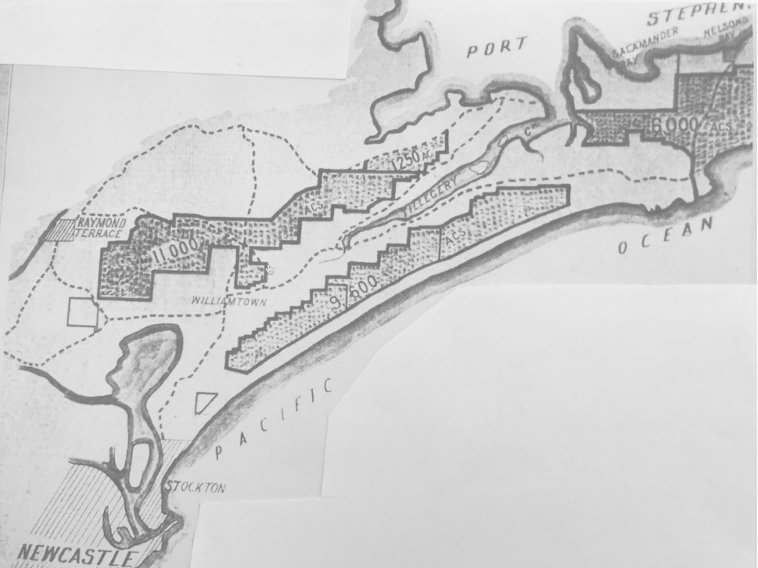
Sketch map of proposed Afforestation Scheme, with areas of forestation highlighted.
The same newspaper of Wednesday 17 April 1935, page 8, reported on the findings of an examination of the suitability of the proposed Afforestation Scheme:
‘The scheme of the Newcastle Young Citizens’ Association for utilising large tracts of Crown land, between Newcastle and Port Stephens, for establishing pine forests, will be given great impetus, as a result of an inspection yesterday by an expert. He said that the land was eminently suitable for the plantation of pines. The Young Citizens’ Association will approach the Government now with confidence, and urge that not only would the afforestation scheme absorb unemployed youths, but would be a great national asset.’
The same newspaper of 11 September 1935, page 5, report edon the visit to the proposed forest area by the Minister for Forests, in which he expressed a discouraging view of the prospects of the scheme:
‘A discouraging view of the prospects of the Port Stephens areas for reafforestation was expressed by the Minister for Forests (Mr. Vincent) after his inspections yesterday.
The president of the Young Citizens’ Association (Rev. G. Nesbitt) expressed keen disappointment that the Minister could not see his way clear to adopt the proposed scheme as a means of providing for workless youths. “I have been president of the Young Citizens’ Association for four years,” said Mr. Nesbltt, “and we have had several schemes. It seems to me that the whole thing is hopeless.” “I would not give it up,” advised the Minister (Mr. Vincent), “because after all is said and done, although you cannot see anything big, undoubtedly the efforts are exercising a good influence.” After Inspecting the various sites which it was proposed to clear and plant with hardwood and wattle, Mr. Vincent told members of the deputation which accompanied him by car that he was not impressed with the majority. “Frankly, I am not hopeful,” he declared, “but I will have experiments made. A few acres will be ring-barked and the effect watched.”
Mr. Vincent said he was sure Rev. Mr. Nesbitt would agree that if the soil was not suitable it would only be wasting money to start an afforestation scheme near Port Stephens when there were more suitable areas farther north. The Department, he added, was fully aware of the position, and was doing its utmost to right the unemployed situation. At present there were about 2300 boys working in forests, and a number of these had been taken from the Newcastle district. “I think Newcastle will rapidly absorb its youth,” he remarked.’
Council considers possible end of relief scheme – 1935
The Raymond Terrace Examiner and Lower Hunter and Port Stephens Advertiser of 7 November 1935, page 4, reported on the anguish felt by the Council for the unemployed persons who would be financially affected by the relief scheme having to end before Christmas:
‘The cancellation of unemployed relief was left with the President and Engineer, as the engineer reported that the grants had run out. Cr. Parish said it was not their fault. Cr. Markey: Can’t we cut out a portion of it. Cr. Russell : No. That’s the hard part of it. Cr. Markey: Can it be carried on by cutting out any of the work. The Engineer: But we can’t finance it.
Cr. Tranter said as far as he could understand it, the Government was not giving any more Unemployment Relief. He thought from the Premiers’ speech he was going to give full time employment. Trying to read what he means, he did not know if he will. It was hard to to cut it out. Cr. Markey: It’s a great pity coming on to Christmas time too. What will it cost us to the end of the year.
The engineer said there was only one more meeting before Christmas. Cr. Tranter: We might see if we can’t get some of them to make better use of it. Cr. Markey: How much to carry on to the end of the year. The Engineer: It is costing about £136/15/ a fortnight. We have overspent our allocations now.’
Port Stephens Shire Council successful in its submission to obtain relief funds for 1936 and 1937
In response to the State Government curtailing much of the Emergency Relief Work scheme, to have the scheme continue in the Port Stephens area the council was required to make a submission justifying the necessity of the work proposed. The Raymond Terrace Examiner and Lower Hunter and Port Stephens Advertiser of 19 March 1936, page 4, reported:
‘The Shires Association advised that the Minister had stated that where unemployment warranted it relief work would not be cut out. ….
With regard to unemployed relief work Council decided that the clerk wait on Mr. Bellemore and explain the position with a request for continuing Emergency Relief Work.’
The same paper of 9 April 1936, page 4, reported that estimates and specification of works were submitted to the Department with a view to starting the work again.
The Maitland Daily Mercury of 1 May 1936, page 6, reported:
‘Mr. A. Howarth, M.L.A., is in receipt of the following letter from Mr. Dunningham: “With regard to the personal representations made by you on behalf of the Port Stephens Shire Council for the re-introduction of the emergency relief work scheme I have to advise that as the proposed works submitted by the council to be carried out under the scheme have now been approved as relief works, arrangements will be made for the re-introduction of the scheme to provide employment for the local unemployed.” ‘
The Raymond Terrace Examiner and Lower Hunter and Port Stephens Advertiser of 11 February 1937, page 4, reported on the continuing requirement of the Council to again actively seek further relief funds for 1937, which it did successfully:
‘Cr. Clode, on a reference to relief work thought the Government should keep its promise re emergency work. It was doing so in other areas. He thought they had been misled. He asked the engineer to see that the most important works were done at once. If some Councils could get the 10 per cent, why cant we? The suggestion was agreed to. …..
A programme with estimates and specifications [for Emergency Relief Work] was submitted to the Department for further works to be carried out which has been approved.’
Port Stephens Council advocates for unemployed persons at Raymond Terrace – 1937
In 1937, the Port Stephens Shire Council amalgamated with the Raymond Terrace Municipal Council to form the present-day Port Stephens Shire Council. Accordingly, they commenced the advocacy of the needs of the unemployed persons resident at Raymond Terrace.
The Raymond Terrace Examiner and Lower Hunter and Port Stephens Advertiser of 14 October 1937, page 4, reported:
‘At the Council meeting, last week, of the Port Stephens Shire, the Dept. of Labour and Industry, in reply to Council’s letter urging that employment be provided for the unemployed residents of Raymond Terrace, on rationed relief works being carried out at Nelson’s Bay stated that the emergency relief work scheme in Raymond Terrace Municipality was discontinued on the 31st December 1935, and as men from that centre had not been engaged upon relief work with in the last six months, such men excepting in the case of returned soldiers or sailors would not be eligible for inclusion in the work at Nelsons Bay.
The question of the provision of suitable work upon which the Raymond Terrace men could be employed would be a matter for consideration, by the Dept. of Works and Local Government to which Council’s request had been referred. The Clerk said he had represented the position of the men to the Department. Cr. Russell moved that a further application be made. It was not fair to the men at all. Cr. Clode seconded, and suggested that the letter be sent through Mr. Bennett to support the request. Cr. Markey supported the motion, which was agreed to.’
The same newspaper of 11 November 1937, page 4, further reported:
‘Cr. Markey asked if there was any chance of work for the unemployed at Raymond Terrace or elsewhere before Christmas. Could anything be done. The engineer said he would arrange the work as soon as he could at Raymond Terrace and Nelsons Bay. Cr. Markey hoped something would be done.’
The Council later received additional financial assistance to assist the unemployed as the following report in the Raymond Terrace Examiner and Lower Hunter and Port Stephens Advertiser of 9 December 1937, page 4, indicates:
‘The Dept. of Local Government stated that if work on the Sports Ground at Raymond Terrace or the baths at Nelson’s Bay was let by contract, 90 per cent of the labour must be obtained through the nearest branch of the labour exchange.
The documents in connection with these were forwarded for the signature and seal of the Council. The Dept. also intimated its approval of the plan and specifications of the sports ground, and baths. Australian timber to be used in the buildings. …. The unemployed whose names have been on the electoral roll for 18 months and whose registrations are at least 6 months old will be employed.’
EPILOGUE
By the end of 1937, Australia was recovering from the worst effects of the Great Depression. There were still unemployed people in the Port Stephens area during 1938 and later years, but the problem was not of a critical nature as was the case in earlier years.
During 1938, for the first time since 1931, the Port Stephens Shire Council did not participate in any special relief programmes for the unemployed. Mobilizing the economy for the Second World War finally ended the Depression in Australia in 1939.
Much credit should be given to the Councillors of the Port Stephens Council, and also to the Shire Clerk and Shire Engineer, who, through their untiring work, resulted in hundreds of unemployed men receiving some paid employment. Most of the burden fell on the Shire Engineer, who had the responsibility of identifying meaningful jobs that could be undertaken by labourers, generally without the use of machinery, and also of maintaining supervision of the projects that were spread over the large Shire Council area.
Immediately following the wind-down of the unemployment problem in Port Stephens caused by the Great Depression, a new influx of unemployed persons descended on Nelson Bay and surrounding areas in 1938, in the form of striking miners from Cessnock and surrounding districts. A new tent city was to form again, but this is another story.
Researched and compiled by Kevin McGuinness
July 2022
APPENDIX :
Infrastructure projects undertaken by Port Stephens Shire Council under the NSW Government Unemployment Relief scheme 1932 – 1937
Overview
The following monthly reports of the Port Stephens Shire Council, of infrastructure and maintenance programs undertaken under the Unemployed Relief [Work-for-the Dole] Scheme were published in various issues of the Raymond Terrace Examiner and Lower Hunter and Port Stephens Advertiser.
The working life of the labourers employed under the Employment Relief Scheme involved heavy manual labour, sometime under harsh weather conditions. Workers were expected to organise their own travel to work sites, which generally involved walking. The Department of Labour and Industry informed Port Stephens Shire Council in 1934, that where relief work was more than three miles away from the workers place of residence, transport should be provided. Generally, workers would camp at a work site while employed.
The monthly reports published by the Port Stephens Shire Council of work completed are set out below. Reports were not published every month, as the scheme was subject to periodic operation. The amount of work undertaken by unemployed persons and the locations, varied each month.
September 1932
Nelsons Bay’ Park Area: The filling of this area was completed. On completion 52 married men had been given three day’s work each and 35-single men one day each.
Martins Creek Road: This road work was completed, and 70 married men and Returned Soldiers had been given one week’s work as well as several single men who provided horses and drays.
April 1934
Karuah: Removing and re-erecting fence and levelling area on foreshore park area, and building stone retaining wall at high water mark. Karuah road was generally repaired with gravel and pot holes filled.
Ferodale and Medowie Roads: Forming and draining.
Tomago Road and Highway: Destruction of noxious weeds.
Woodville, Seaham and Paterson Roads: Attention to road drainage.
Rosebank quarry: Quarrying gravel for use in that area.
Dunns Creek Road: Attention to drainage.
Lemon Tree Passage: Quarrying blinding for use on Lemon Tree Road and Nelson’s Bay road.
Nelsons Bay Urban Area: Clearing and grubbing cemetery area; deviating and forming road to Little Beach and Inner light; and getting stone for reclamation of foreshores.
June 1934
Karuah: The principal work done here was gravelling streets in village and on the main public road. Timber was obtained for the renewal of all the old culverts along the main roads.
Medowie: Further road forming and building culverts.
Ferodale: Further road forming.
State Highway: Attention to road shoulders.
New Line Road: Repairs to road with gravel.
Seaham Road: Forming and gravelling.
Hinton Road: Attention to drains and water tables.
Dunns Creek and Martins Creek roads: Attention to drains and water tables.
Lemon Tree Passage: Obtaining and loading gravel for Nelsons Bay Road.
Anna Bay: Same as above.
Nelsons Bay: The clearing of the cemetery area was completed and the new road to Little Beach: cleared and formed in parts.
July 1934
Nelsons Bay Urban Area: Most of the work was done on the main road during the month on account of the wet weather.
Lemon Tree Passage and Anna Bay: — Quarrying gravel as reported above.
Pacific Highway: Repairing shoulders.
Medowie: Further forming and preparing timber for culverts.
Ferodale: Forming road and draining.
Duckhole road: Forming road and draining.
Eagleton to 6 Mile: Repairing and opening up old road.
Karuah: Forming road into Aboriginal settlement. Raising and gravelling on main Karuah road, building one new culvert and preparing the timber for others.
August 1934
Nelsons Bay: Satisfactory work was still being done here, although hampered by wet weather. Metal was quarried and used in main road. Road to Shoal Bay was being formed and parts metalled. Fittings were made for the sanitary steaming plant, including washing bench and trough, steaming bench, and water tank.
Lemon Tree Passage and Anna Bay: Raising and spreading gravel.
Karuah : Raising gravel for Karuah road. Building culverts and preparing timber for further new culverts. Four new culverts were been completed. Completion of forming road to Aboriginal reserve.
Eagleton to 6 Mile: Forming and draining road.
Duckhole Road: New Line road draining.
Seaham road: draining and gravelling.
Hinton Road: draining.
Dunns Creek road: forming and gravelling.
Martin’s Creek road: forming and gravelling.
September 1934
Karuah: Quarrying gravel and repairs to Karuah road. Obtaining timber for culverts at creek crossings at Johnson and Young’s and building embankments for the former. Medowie: Road forming.
Ferodale: Forming on Grahamstown road.
Lemon tree Passage: Quarrying gravel and repairs to rain damage.
Anna Bay: Quarrying stone for crushing.
Tomago road: Blinding material recently spread.
Six Mile Road, Martins Creek, Dunn’s Creek Roads: Forming and draining. Rosebank quarry: Quarrying and loading gravel for Wallalong road.
Nelsons Bay: Forming and metalling road to Shoal Bay; repairs to main road and preparing timber for reclamation on foreshore. Owing to wet weather these are the only jobs that could be done.
October 1934
Nelsons Bay: Work was progressing satisfactorily, the fine weather enabling some of the streets in the village to be formed and gravelled. Further work was done on the Shoal Bay road. A start was made with the reclamation of the road at the eastern end of the foreshore at Fly Point. Some of the men usually working at Nelsons Bay have now been drafted to assist at the Anna Bay crushing plant.
November 1934
Wallalong Road: Work was progressing as quickly as possible, 380 cubic yards of gravel were spread and 60 chains of road completed.
Karuah: Good progress is being made at Fletchers deviation and the filling of the embankments to culvert, and the timber for culvert is being prepared. At Johnsons Creek the embankments are well forward and the erection of the culvert had been started.
Medowie Road: The hill at Mr. James place was being formed and metalled. Ferodale: Further work on Grahamstown road and reforming the Swamp road. Lemon Tree Passage and Anna Bay: Quarrying metal for the main road.
Nelsons Bay: Forming and gravelling loads in village and reclaiming road on foreshores to Fly Point.
Dunns Creek: Forming and gravelling.
Martin’s Creek: Forming and draining. Arrangements have now been made for the cartage of metal from Municipal Metal Quarry at Martins Creek to the top end of the road.
February 1935
Nelsons Bay: Continuation of forming and metalling streets; completion of reclaiming foreshores and shelter shed.
Anna Bay: Obtaining metal and erecting bins.
Lemon Tree Passage: Clearing, grubbing and levelling park area.
Medowie: forming and metalling road.
Ferodale: forming roads.
Karuah: Completion of culvert and repairing at Woodville.
March 1935
Nelsons Bay: Work has been wholly the gravelling of streets, all the principal ones having been completed.
Anna Bay: Crushing metal and building bins.
Lemon Tree Quarry: Quarrying and loading metal.
Medowie: Forming and metalling road; about 40 chains of the metal road had been completed.
Ferodale Road: Forming road.
Karuah: Building embankment for culvert and deviation at Fletcher’s and embankment at Young’s. Wallalong: raising and spreading gravel.
Dunns Creek: Forming and gravelling road.
July 1935
Nelsons Bay Urban Area: Good progress was being made in scenic road from Nelsons Bay to Little Beach.
Medowie Road: Continuation of metalling and blinding same.
Lemon Tree Quarry: 317 cubic yards gravel quarried and loaded.
Anna Bay Quarry: 220 cubic yards metal quarried, crushed and loaded.
Rosebank Quarry: 478 cubic yards gravel quarried and loaded.
Hinton Flood Banks: Good progress being made.
Karuah Road: Completion of culvert to road and widening ferry approach. 198 cubic yards of filling, 254 c. yards metal, and 30 cubic yards spalls used.
Ferodale: 6 chains road formed.
Swan Bay Road: 15 chains road formed.
Dunns Creek Road: 4 chains road formed and 2 log pipes put in.
August 1935
Nelsons Bay: Work was processing satisfactorily with the construction of the scenic road at Fly Point. Repairs were also done to the wharf and shed on same.
Anna Bay quarry: Quarrying and crushing 524 cubic yards of stone.
Lemon Tree Quarry: Quarrying and loading 297 cubic yard gravel.
Medowie Road: Continuation of metal road. Over one mile of road had been constructed.
Karuah: General repairs of road and sheeting of load al Fletcher’s deviation also widening of stone approach to ferry. 245 cubic yards of gravel and 61 cubic yards of filling were quarried and hauled.
Dunns Creek Road: Continuation of widening of cutting at White Hill.
Martins Creek Road: Loading metal at quarry.
Ferodale: 5¼ chains of road, formed and drained.
Tomago Road: Patching road with metal.
Duckhole and Mount Hall Road: Quarry metal to be carted to these roads.
September 1935
Nelsons Bay Urban area: Formation of scenic road from Fly Point to Little Beach ; earth work now nearly complete; gravelling road for length of 6½ chains.
Anna Bay Quarry: Quarrying and loading 336 cubic yards of gravel.
Medowie: Quarrying, breaking and spreading 384 cubic yards of metal. Length of road now completed over 1½ miles.
Ferodale: Clearing and grubbing road.
Karuah: At Fletcher’s deviation, 360 cubic yards of filling, 279 cubic yards of metal spread on the road. Stoning approach banks to culvert. At Karuah ferry widening and cementing approach and building new steps for boat wharf.
Tomago: Spreading metal from roadside.
Stroud Road: Quarrying and breaking metal for Mount Hall and Duckhole roads. Dunns Creek Road: 5 chains of forming on White Hill.
Martins Creek Road: Loading and spreading metal.
Hinton Banks: Good progress being made.
October 1935
Nelsons Bay: Further forming and gravelling 15 chains of the scenic road; splitting 750 slabs for the reclamation of foreshore; and casing one pile at wharf in reinforced concrete.
Anna Bay Quarry: 156 cubic yards of metal quarried and crushed and delivering and setting up new crusher.
Lemon Tree Quarry: 248 cubic yards of metal quarried and loaded and filling road at foreshores.
Karuah: Completion of Fletchers deviation road with a further 398 cubic yards of metal and 1600 feet of fencing.
Tanilba Road: 50 cubic yards metal spread.
Tomago Road: Spreading metal.
Medowie Road: Forming and metalling road; 355 cubic yards metal quarried broken and spread.
Ferodale: 4 chain of road formed and drained.
Richarson’s Quarry: Quarrying stone for Mount Hall and Duckhole roads; about 200 cubic yards ready for spreading.
Hinton Levee Banks: Good progress being made.
Dunns Creek Road: Forming and draining road.
June 1936
New arrangement for Emergency Relief Work: During the month an officer from the Dept. of Labour and industry paid a visit [to Council] to start the work again under the new system and prepare the roster. The men were divided into 7 gangs with centres at Raymond Terrace, Karuah, Medowie, Anna Bay, Dunns Creek, Nelsons Bay and Hinton. Work was started and jobs started were as follows: —
Raymond Terrace: Quarry and spreading gravel on Duckhole Road.
Karuah: Quarrying gravel and the general repair of Karuah road.
Medowie: Forming road from Medowie hall towards Ferodale, for 43 chains.
Anna Bay: Quarrying and crushing 95 cubic yards of metal which were spread on road repairing same from the quarry to the Deviation.
Dunns Creek: General run through road repairing drainage.
Nelsons Bay: Repairs to roads with gravel and splitting timber for retaining wall. Hinton: Building levee banks.
July 1936
Nelsons Bay: Repairs to roads with gravel. Building foreshore retaining wall.
Anna Bay Quarry: Quarrying and crushing metal.
Medowie: Quarrying and breaking metal and the repair of the new road.
Stockton Road: Destruction of briars.
August 1936
Nelsons Bay: Repairs to roads with gravel; building foreshore retaining wall, and repairs to wharf.
Anna Bay Quarry: Crushing stone and repairing Nelson Bay road, particularly along deviation.
Medowie: Repairs to new road, quarrying metal, 720 feet of road formed.
Karuah: Forming new deviation near Youngs and start made metalling same. Stripping and opening up new quarry.
Duckhole: Completion of forming 10 chains length and start made metalling same. Dunns Creek Road: Repairs to drainage and forming.
Hinton: Building levee banks.
September 1936
Nelsons Bay: 3 chains retaining wall, 4 chains road gravelled, 2 chains widened with gravel 10 chains cleared.
Anna Bay: Quarrying and loading 270 cubic yards of gravel.
Medowie: Quarrying metal for Lavis lane; forming Ferodale road. Repairs Medowie road and building one new culvert.
Karuah: Opening up new quarry, quarrying metal, filling deviation and preparing timber for culverts.
Duckhole Road: Forming road and gravelling.
Hinton: Completing north flood bank.
Dunns Creek: Forming road and gravelling 4 chains.
October 1936
Nelsons Bay: Gravelling 3½ chains of main road; building 1½ chain of retaining wall, and splitting 75 slabs.
Anna Bay: Quarrying and spreading 192 cubic yards blinding.
Medowie: Building 9ft. span culvert. 40 cubic yards metal quarried and napped, 14 cubic yards gravel, 56 cubic yards filling and 7 chains of road cleared, grubbed and formed.
November 1936
Nelsons Bay: Completion of retaining wall on foreshore and filling back of same. Widening 13 chain of gravel road; clearing 30 chain of scenic road on Shoal Bay foreshore; 140 feet of kerbing and guttering; clearing undergrowth on about 4 acres of new camping reserve and splitting 25 posts and 102 rails for fencing of same.
December 1936
Nelsons Bay: 300 feet of kerb and guttering; moving and re-erecting fence round new camping area and splitting 35 posts and 100 rails; also moving and re-erecting stables. Completing retaining wall on foreshore.
Karuah: New culvert of 14 ft. span at 12 m. and spreading 120 cubic yards of metal.
Limeburners—Clarencetown road: putting in 6 concrete pipe culverts and repairs to road.
Anna Bay Quarry: Crushing and spreading 132 cubic yards metal, and blinding road.
Medowie Road: Building one new culvert, 68 cubic yards filling, 84 cubic yards gravel and forming road.
Hinton: Building levee banks at Mt. Pleasant.
Raymond Terrace: Assisting quarrying gravel at Rosebank.
March 1937
Nelsons Bay Urban Area: Concrete kerb and guttering, 380 feet; 6 slab vehicle entrances. Concrete box drain, 42 ft. long.
Medowie: New bridge over Ferodale drain, 36 ft. long; new bridge in Lavis’ Lane 16 ft. long, 2 chains forming, 84 cubic yards metal.
Salt Ash: 320 cubic yards of filling, widening road.
Karuah: Quarrying and spreading 165 cubic yards metal.
Swan Bay Road: 10 chains clearing, 25 chains forming.
Hinton: Building Mt. Pleasant banks.
May 1937
Nelsons Bay: Work was progressing here satisfactorily under the new scheme. 225 feet of kerb and guttering and 256 feet of concrete footpath were laid.
Swan Bay: Completion of grubbing forming and sanding 85 chains at the foreshore end of road.
Medowie: 2 timber culverts built, one pipe culvert put in, and 350 cubic yards filling at Salt Ash.
Hinton: Building Mt. Pleasant flood banks.
Raymond Terrace: men assisted in quarrying gravel.
June 1937
Nelson Bay: Kerbing, guttering and footpaths being carried out with concrete at Nelsons Bay.
Swan Bay: Karuah men engaged on Swan Bay Road, clearing, forming and draining road, also three culverts built.
Salt Ash: Medowie men widening road and building shoulders on Salt Ash Deviation-road.
Hinton: Mt. Pleasant levee banks now completed.
Raymond Terrace: Men raising gravel at Richardson’s quarry.
July 1937
Nelsons Bay: All men are employed on Lands Dept. Subdivision.
Swan Bay Road: 20 chains of road formed and about 60 chains of road to Mr. Davis’ property cleared and formed with the assistance of local residents.
Medowie: Widening road and boxing to Salt Ash and filling new deviation at Williamtown.
Raymond Terrace: Men employed on Highway work.
Karuah: Repairs to Karuah road.

 Port Stephens - a history exploration