

Introduction
The first ferry service between Nelson Bay and Tea Gardens, operated by the Thurlow and Boyce families commenced in 1904. They operated three launches – Reliance, Kingfisher and the Replica – to carry passengers and suppliesfrom the southern to the northern shores of Port Stephens. With the expansion of the routes to Salt Ash and Soldiers Point, they also catered for the early tourist trade in the area.
The related stories of ‘SS Reliance’, ‘Lakes Travel Route’ and ‘A Journey from Port Stephens up the Myall Lakes to Forster’ are found at these links on the website.
The business was taken over by the Engel family in 1927. Services closed in the years of the second World War as the vessels were commandeered by the Commonwealth Government.
After the War, in February 1946 Messrs. Cohen and Hughes commenced the first regular passenger ferry service between Nelson Bay and Tea Gardens, in association with an improved linked bus service from Stockton provided by Fogg’s Bus Service.
The new ferry service was established to serve the needs of local residents and of the emerging tourism market to the Port Stephens area from Newcastle and Sydney.
Four months later in June 1946, Messrs. Cohen and Hughes sold their new ferry operation to the Korsman Brothers, who were large operators in the marine and boat building industry based at Tea Gardens.
The resources of the National Library of Australia ‘Trove’ collection were used in preparing this paper, which covers the period 1946-1954.
First announcement of the New Bus and Ferry Service – 1946
The Newcastle Morning Herald and Miners’ Advocate of 14 February 1946, page 4, made the first announcement of a new passenger ferry and bus service between Newcastle, Nelson Bay and Tea Gardens which was to commence operations shortly:
‘A new bus and ferry service will begin on Monday between Newcastle and Tea Gardens. The bus will connect with a ferry at Nelson’s Bay. The service will operate twice daily. The bus will depart from the Railway Garage [Newcastle] at 9 a.m. and 4 p.m., and ferries will leave Tea Gardens on the return journey at 7 a.m. and 3.45 p.m. The fare for the return trip will be 10/. On Sundays and public holidays there will be an excursion rate of 7/6. The [bus] service will be conducted by Fogg’s Motor Service Pty. Ltd.’
It is noted that the service between Newcastle and Stockton was by way of the vehicular Stockton Ferry across the Hunter River.
The Dungog Chronicle of 1 March 1946, page 3, further reported:
‘A Nelson’s Bay-Tea Gardens ferry service has started operating morning and afternoon and connecting with Foggs’ motor ‘bus at Nelson’s bay for Newcastle. The fares are 7/6 single and 10/- return, covering the through journey. This combination service gives Tea Gardens the best timetable and the lowest fares which have ever been in operation and should result in a very great increase in tourist traffic and general prosperity in Tea Gardens.
In the past and, in fact, until Foggs’ motor buses started operating between Newcastle and Nelson’s Bay, the former timetable from both Tea Gardens and Nelson’s Bay operated to Newcastle in the morning, returning in the evening, and whilst thus catering for the local people, made no provision whatever for tourists and others from Newcastle desirous of spending a day at Port Stephens without the necessity of staying overnight.
The present Foggs’ timetable from Newcastle to Port Stephens in the morning, returning in the evening, in addition to the former timetable in the opposite direction, has resulted in a very great benefit and general well-being to the district served, and it may now be said that since the advent of the ferry, similar benefits will become available to Tea Gardens.
The new ferry service also provides the all-important and long-felt necessity of giving visitors, both to Tea Gardens and Nelson’s Bay, an opportunity of a pleasant harbour trip, viewing, as it does, the inner shipping, the great oyster industry for which the port is famous, the timber and sawmilling activities, and the magnificent scenery of Port Stephens harbour; without this ferry a visit is incomplete and conveys little know ledge of the Port’s potential possibilities as a tourist centre.
It is understood that investigations are at present being made in connection with a proposed tourist trip from Nelson’s Bay to Myall Lakes, but owing to the difficulty of procuring a fast, shallow-draught vessel such a service is not likely to operate before next summer. These wonderful lakes some twenty miles in extent are unfortunately at present more or less out of reach of visitors. The time is past for considering the interests of any one place, locality, or individual. Such a policy of local jealousies is destructive to progress and not in the best public interest. Only by a combination of all interests and all beauty spots can Port Stephens, as a tourist centre, be presented at its true value and when such a policy is fully appreciated, realised, and acted upon then the possibility of future progress will become almost unlimited.’
Ferry to Make Special Trip from Tea Gardens to Nelson Bay – 1946
The Dungog Chronicle of 19 April 1946, page 3, reported:
‘Nelson’s Bay ex-service men R.S.L. are giving their first annual ball in the Church of England Hall next Tuesday. ….. It is anticipated that the ball will be a great success, and it is said that the Tea Gardens ferry will make a special trip.’
New Ferry Acquired – 1946
The Dungog Chronicle of 10 May 1946, page 3, reported:
‘The Tea Gardens-Nelson’s Bay ferries have acquired an additional launch of thirty feet in length and ten feet beam, powered with a Victor marine engine. The launch, which was brought to Newcastle on the deck of a coastal steamer, continued its journey to Port Stephens under its own power, and it is understood experienced a rough and hazardous voyage on the 25th April.’
Improvement to Hawks Nest Wharf required to cater for ferry patrons – 1946
The Dungog Chronicle of 10 May 1946, page 3, reported:
‘Steps should be taken to improve conditions at Hawk’s Nest wharf. Repairs are required and steps are needed. At low tide one needs a carpenter’s ladder to get ashore or on to a boat. If steps were provided many people would pull into the wharf and go ashore to picnic or walk to the beach. The land approach to the wharf is almost as bad as that from the water. A road should be built to it so that vehicles could land passengers and goods. …..
Now that the ferry service is operating twice daily between Tea Gardens and Nelsons’ Bay, it is imperative that provision be made for traffic by that service to Hawk’s Nest. The proprietor, Mr. Cohen, deserves every encouragement and assistance in his enterprise because is to the mutual advantage of all.’
Ferry Sold to New Operator – 1946
The Dungog Chronicle of 7 June 1946, page 3, reported:
‘It is understood that Messrs. Cohen and Hughes have sold the Tea Gardens-Nelsons’ Bay Ferries, started by them some four months ago, to Messrs Korsman Bros., of Tea Gardens. Whatever the future of this enterprise may be, the credit must be given to the late owners who, in conjunction with Foggs’ Bus Service to Nelson’s Bay, effectually removed a long existing barrier between Tea Gardens and Nelson’s Bay, the crossing of the harbour.
It is said that immediate improvements to the service are to be made, including Fogg’s buses meeting the ferry at the wharf and thus saving passengers carrying luggage to the bus, the building of a jetty at Holbert Town [near Tea Gardens] is under consideration, and Pindimar interests contemplate a connecting jetty between the shore and the old shark depot wharf. These undertakings would give a full service to the areas at present isolated.
In reviewing the business record of the new owners, Messrs. Korsman Bros., it must be remembered that this firm possess considerable experience in the operation of small craft and have indeed conducted over a period of many years passenger, mail and cargo services throughout Port Stephens; also some years ago, had they been able to obtain a road license, they would have operated an additional road service to Tea Gardens at reduced rates with a resultant benefit to the township.
The plant now available for use in the ferry service comprises the ‘Yoothapuna,’ a well-known and proved passenger craft, 60 passengers, to be reconditioned and fitted with new engines; the present ferry boat ‘Yacaaba,’ 46 passengers, and the ‘Toomaree,’ a suitable craft for special trips. These vessels having a total carrying capacity of well over a hundred passengers, can handle with ease all traffic at peak periods.
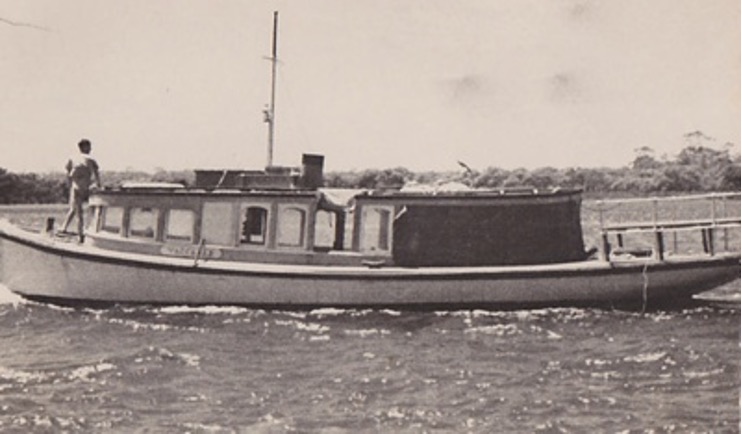
‘Yacaaba’ ferry at Port Stephens owned by Alf Korsman and skippered by George ‘Horsehead’ Lambourne [Tomaree Museum Association]
It may now be said that the Tea Gardens-Nelson’s Bay ferry service is firmly established, that there is no danger of it ceasing operations, that the service has brought about a great reduction of fares for through passengers to Newcastle, and gives the best timetable which has ever operated. Other manifest advantages are that visitors can now reach Tea Gardens and return to Newcastle in the one day and visitors to both Tea Gardens and Nelson’s Bay can avail themselves of a delightful harbour excursion morning and afternoon, thus greatly enhancing the popularity of these seaside resorts.
Tea Gardens is indeed fortunate: five months ago, its interests were to a great extent strangled and it suffered a degree of isolation, now its transport problem appears to be solved and is in the hands of capable firms in Messrs. Korsman Bros, and Foggs Bus Services. Indeed a wonderful transformation from stagnation to prosperity, and resultant repercussions in connection with future local enterprise may be confidently looked for.’

George ‘Horsehead’ Lambourne, skipper of the ferry ‘Yoothapuna’
Ferry arrives safely in bad weather – 1947
The Dungog Chronicle of 7 January 1947, page 3, reported:
‘The recent heavy storm along the coast caused some damage to buildings at Nelson Bay and stripped many Christmas bushes of their flower. The small trawler Viking was caught at sea and experienced an anxious time whilst the weight of wind continued. ….
The Tea Gardens-Nelson Bay ferry boat (skipper Lambourne) arrived safely ten minutes late owing to reduced speed to save damage to deck gear. This ferry has yet to be stopped and judging from the weather it has already negotiated, things will be moving around if it does ever tie up.’
Ferry improves prosperity at Tea Gardens – 1947
The Dungog Chronicle of 7 January 1947, page 3, reported:
‘Tea Gardens is not entirely out of the picture regarding progress in and around Port Stephens, although as compared to other localities such as Nelson Bay, Soldiers’ Point, and Lemon Tree Passage, it has not made an equal advance; however, since the advent of the ferry service, more than trebling the former means of communication, and at greatly reduced rates, a definite improvement is manifested.
Recent land and property sales at satisfactory prices indicate that all interest is not lost in this charming waterside resort. Hawk’s Nest especially is in good demand, and this is almost entirely owing to the ferry connection. There is to be a new cafe at the Tea Gardens baths and the local business establishments are to be congratulated upon their enterprise in making deliveries of provisions to customers throughout the town. In this particular respect Tea Gardens is ahead of any other settlement around the port.
The prospects of a vehicular ferry between Nelson Bay and Tea Gardens is being investigated and enquiries are being made as to the suitability of steel landing barges of the larger type, many of which are becoming available, for such a purpose. This would cut out a sixty mile and somewhat uninteresting drive for motorists wishing to incorporate a visit to the two places in their tour of the North Coast.
A telephone service is to be installed at Tamboi [at the head of Myall Lakes], which will assist the fishing industry and a fish depot it is said will be established at Tea Gardens. There is divided opinion among the fishermen as to whether this will prove a benefit or otherwise. Government enterprise in such matters has not a reassuring record, as instanced by the Pindimar fish depot, where thousands of pounds were squandered to no good effect.
We hear a lot of Greater Newcastle. Why not a Greater Tea Gardens? Here lies an opportunity for the Stroud Shire Council to do something really worthwhile and establish the very best seaside resort upon the North Coast, one with which no other resort could compete, with its incomparable beauty, scope and variety, offering sea and river fishing, placid river waters or the curl of the ocean breaker. All this and more could be done by the building of a drawbridge at Hawk’s Nest, little more than many bridges one sees along the roads.’
Complaints about the with bus service in holiday time – 1950
The Newcastle Morning Herald and Miners’ Advocate of 4 January 1950, page 2, published the following letter from an unhappy passenger who had been on board a bus from Soldiers Point to Stockton and then the Stockton ferry to Newcastle:
‘Travelling conditions on Fogg’s buses to Nelson’s Bay and Soldiers’ Point, on Christmas Day and Boxing Day left a lot to be desired. Seats could not be booked before travel, but everyone was seated, I was informed at the Railway Garage office [at Newcastle]. A seat—yes, if one cared to balance on the luggage packed in the aisle. Thirty miles is too long to stand. The unnecessary emptying-out of the 4.45 bus from Soldiers’ Point on Boxing Day, at the junction with the main road, and subsequent disposal of its passengers among two already filled buses from Nelson’s Bay, showed a disregard for passengers.
Then, to have to alight at Stockton, after expecting to be set down at the [Newcastle] Railway Station, and to toil up a wearisome lot of steps with a toddler and two suitcases, was the last straw. There was no bus shortage, as the bus was left at the side of the road; no crew shortage, as the crew travelled back as passengers to Newcastle; and evidently the company suffers no shortage of petrol, as it ran extra tours outside the district. Fogg’s are doing a fine job by providing regular services at reasonable rates, thus bringing fine resorts within the reach of the people, but the people and their families are entitled to sit in comfort, on such a long journey, and not be herded in and out of buses like cattle at the whim of a bus crew. Cheeseparing tactics such as these earn nothing but ceinture.’
Nelson Bay and Soldiers Point Buses Unable to Terminate at Stockton – 1952
The Newcastle Morning Herald and Miners’ Advocate of 3 December 1952, page 2, reported:
‘A suggestion that private buses operating between Newcastle, Nelson’s Bay and Soldier’s Point should terminate at Stockton would not be implemented, officials of the Department of Motor Transport said yesterday. A conference between Fogg’s Motors Pty. Ltd., owners of the buses, and the Department of Motor Transport, yesterday decided to continue terminating the buses at Newcastle, but to make a slight increase in some fares to offset delay in crossing the harbour.
Some weeks ago, Foggs Motors Pty. Ltd. applied to the department for permission to terminate Nelson’s Bay and Soldiers’ Point buses at Stockton. The reason given was that periodical delays in crossing the harbour in the vehicular ferry increased running costs-particularly on Sundays when drivers were paid double time.’
Nelson Bay Wharf in poor condition for ferry patrons – 1954
The Raymond Terrace Examiner and Lower Hunter and Port Stephens Advertiser of 11 November 1954, page 2, reported:
‘The Naval Wharf at Nelson Bay has reached a dangerous condition, principally in regard to the planking, reported the Building Inspector (Mr. A. A. Conroy) to the last meeting of the Port Stephens Shire Council, held on Tuesday. “When recently counted there were 18 broken planks, and as a great potential danger to life and limb is evident, I wish to draw the Council’s attention to the position,” the report continued.
Mr. Conroy said that the wharf is used by practically every tourist who visits the district, and many amateur and professional fishermen. In addition, the wharf is used by the Tea Gardens ferries, and a great number of local visiting launches and assorted watercraft. Although Council does not own or control the wharf it is vitally urgent that some authority should affect repairs.’
Concluding Comments
Ferry services on the Nelson Bay to Tea Gardens route have continued up to the present day with various operators and timetables.
The ‘The Original Tea Garden’s Ferry’ company currently operates a daily service between Nelson Bay and Tea Gardens with the two historic timber ferries, MV Tea Gardens and MV Jesse.
Researched and compiled by Kevin McGuinness
July 2024
POSTSCRIPT
On 7 May 2025 , ‘The Original Tea Gardens Ferry’ was honoured to announce that the MV Tea Gardens has officially been added to the ‘Australian Register of Historic Vessels (ARHV)’.
The ferry has had a coloured history. She was built in 1944 for the RAAF Marines Division to transport munitions to Catalina flying boats during the Second World War.
After the war, she spent several decades in active ferry service in the Hawkesbury River Tourist Service to Pittwater, Palm Beach and Bobbin Head. She came to Port Stephens in 1990’s, where as the MV Tea Gardens , she currently plies the ferry route from Nelson Bay to Tea Gardens.
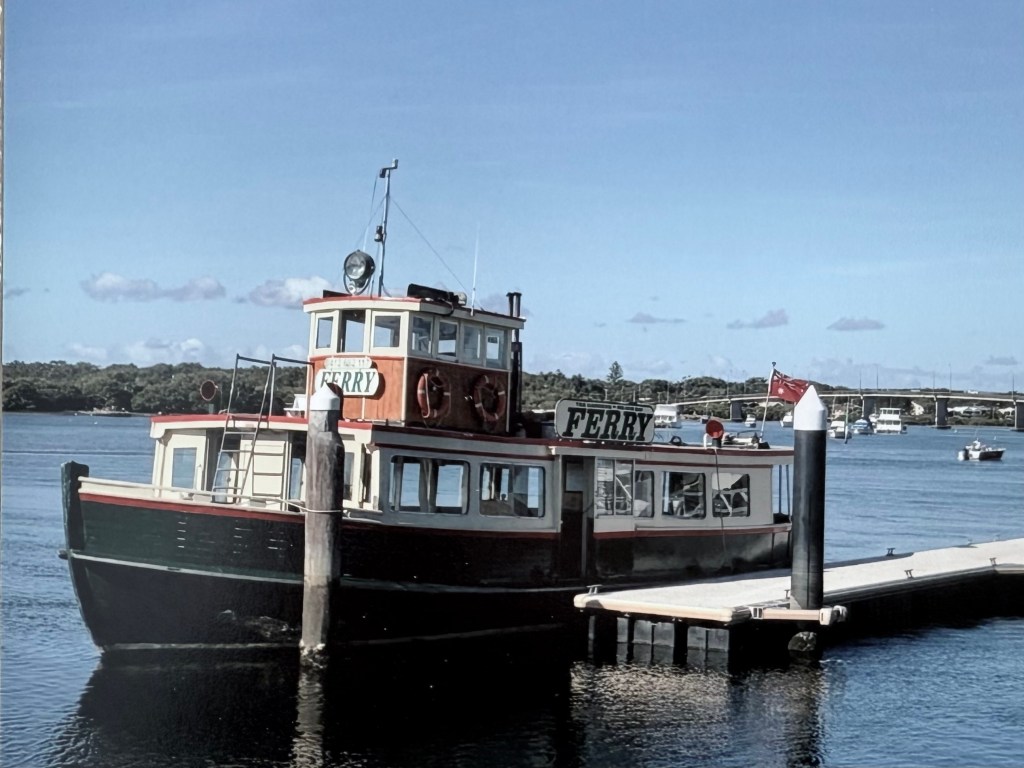
MV Tea Gardens at Tea Gardens Wharf (Author Photo – May 2021)

 Port Stephens - a history exploration