

Introduction
Following the NSW Royal Commission into Decentralisation of 1911, there was much interest from community groups and parliamentarians for the opening-up and development of Port Stephens and its hinterland. It was envisaged as an overseas port to serve the shipping needs of north and north-western areas of New South Wales.
After the First World War (1914-18), calls for the development of Port Stephens had intensified to such an extent that land speculators had turned their attention to the largely unoccupied lands on the northern shore of Port Stephens around Pindimar and North Arm Cove. As a result, vast areas of land that had held little value quickly rose in value. Waterfront land was specially sought.
The largest proposed development on the northern shore of Port Stephens was Pindimar City under the auspices of Pindimar Port Stephens Ltd. Marketing of the estate began in earnest in 1920.
The plans for the proposed city were designed and laid out under the supervision of W. Scott Griffiths, Town Planning Engineer, and H. Sheaffe, a licensed surveyor.
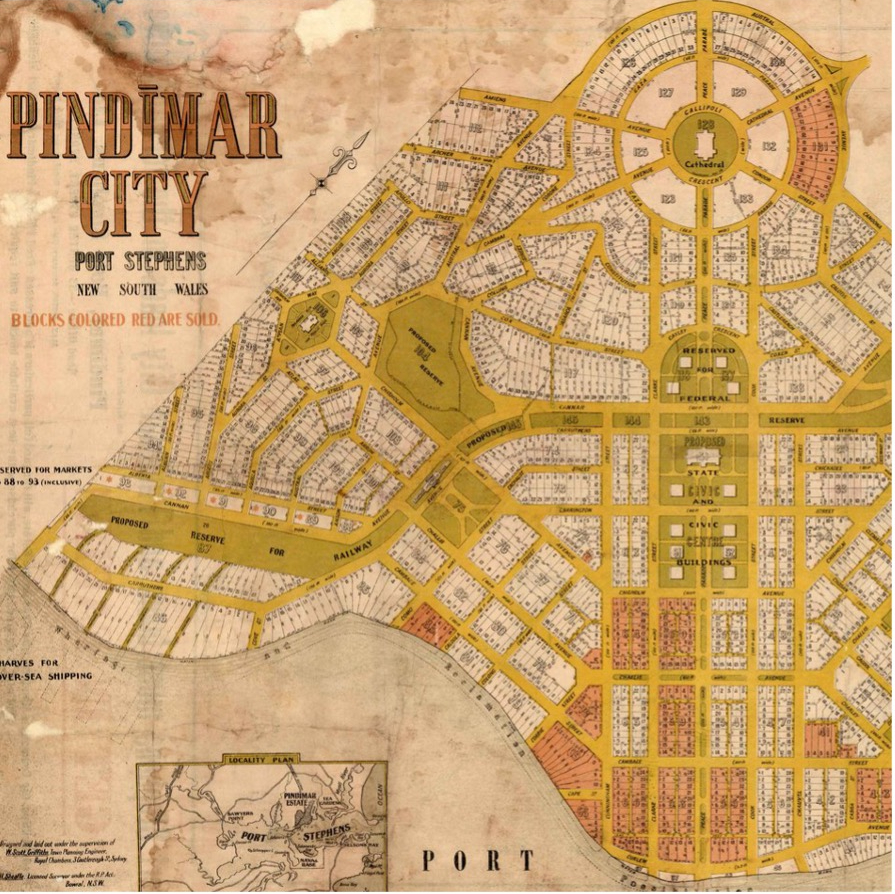
Pindimar City Map, Port Stephens, New South Wales (c 1919) [University of Newcastle]
If developed, Pindimar would become the third largest city in New South Wales. At this time, the only development at Pindimar was the Fish Processing Factory, that had been established by the NSW Government in 1917.
Many blocks of land at Pindimar were sold, but the development never eventuated. Pindimar City was reliant on the construction of a railway line from the Main Northern Line to Pindimar, and the development of various wharf facilities for commercial use, by government authorities.
The developer also failed to obtain guarantees from government authorities to construct the necessary supporting infrastructure. Marketing of the Pindimar City estate continued until 1926, but buyers were only left with their Torrens Title land, and no surrounding city, with parks, grand road avenues, commercial precincts, and railway station.
Coincidentally, two other large adjacent land developments were being marketed, viz, Port Stephens City by Henry F. Halloran Company and Bundabah Estate by Bundabah Estate Limited. Their stories are found at these links on the website.
This paper gives the history of the proposed Pindimar City development.
Advantages of Port Stephens – 1920
At the time of the first promotion of the Pindimar City development, the Construction and Local Government Journal of 1 March 1920, page 11, published a lengthy report on the advantages of Port Stephens as an overseas port and the merits of the new Pindimar City development:
‘Today Sydney is overcrowded. It holds 810,000 out of the State’s population of 1,920,000. There are 15,000 houses short in Sydney’s metropolitan area, with soldier’s and their brides back in hundreds, whilst the new Minister for Housing (Hon. Chas. Oakes, M.L.A.), is having plans prepared for 20,000 homes. The chief point in the great problem of the housing of the people, is to spread our cities and in this respect, the Minister should bear in mind the great necessity for Decentralising the crowding population of Sydney, which city today, holds nearly one half the population of the State. Development must spread and every possible place for profitable construction should be considered by the Government. Of such places, Port Stephens has been earmarked by the most practical authorities as the place for earliest attention.
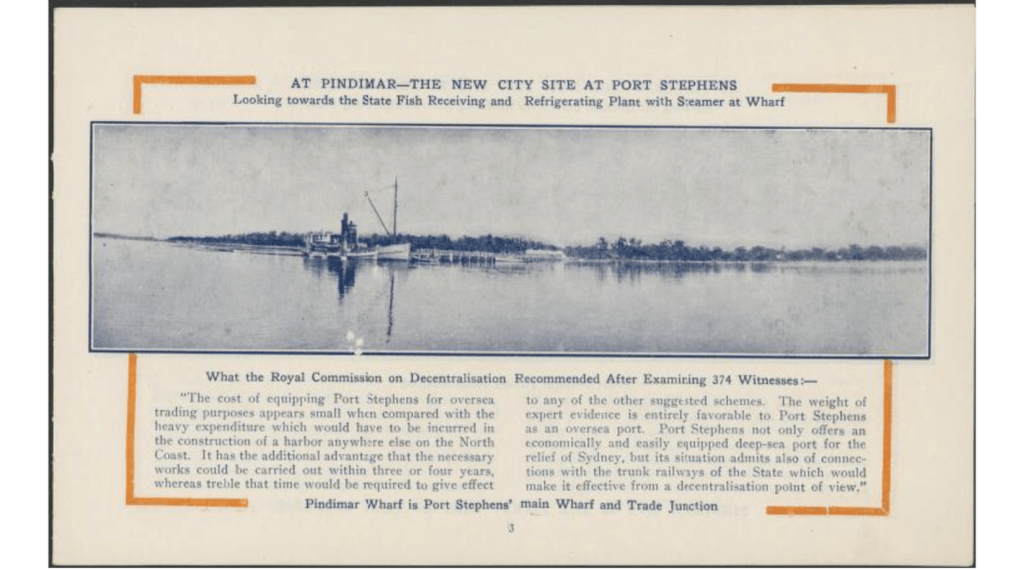
The Royal Commission on Decentralisation after examining 374 witnesses recommended the place mentioned as follows :— “The cost of equipping Port Stephens for oversea trading purposes appears small when compared with the heavy expenditure which would have to be incurred in the construction of a harbor anywhere else on the North Coast. It has the additional advantage that the necessary works could be carried out within three or four years, whereas treble that time would be required to give effect to any of the other suggested schemes. The weight of expert evidence is entirely favourable to Port Stephens as an oversea port. Port Stephens not only offers an economically and easily equipped deep-sea port for the relief of Sydney, but its situation admits also of connections with the trunk railways of the State which would make it effective from a decentralisation point of view. By means of suitable railway connections, Port Stephens could be made the port of export for the whole of the North Coast, the northern, north-western, and a considerable portion of the western districts — as area comprising 125,000 square miles.”
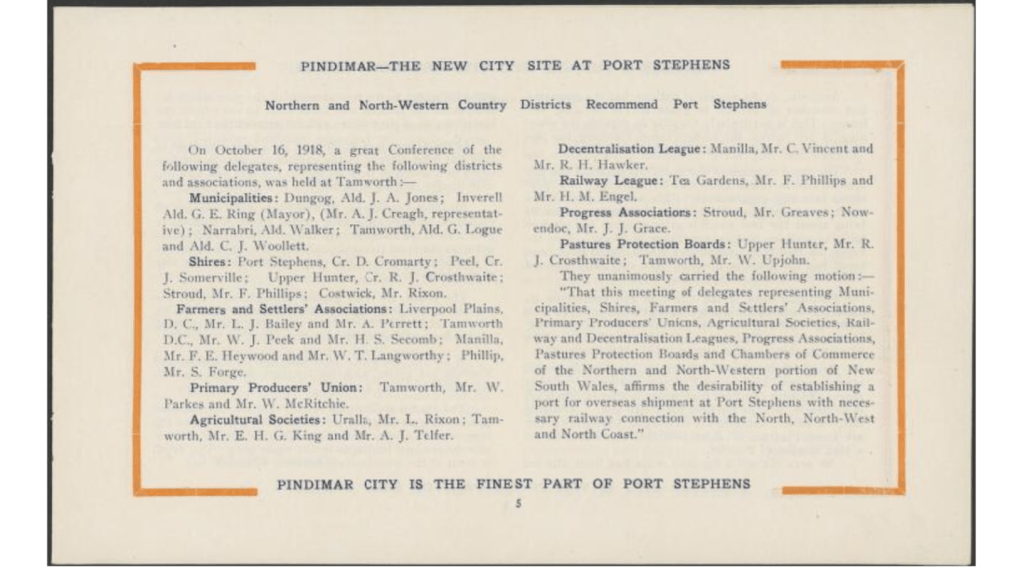
The leading harbor experts of the Commonwealth also expressed decided opinions on the matter. …. On October 16, 1918, a great Conference …. was held at Tamworth. … They unanimously carried the following motion: — “That this meeting of delegates representing Municipalities, Shires, Farmers and Settlers’ Associations, Primary Producers’ Unions, Agricultural Societies, Railway, and Decentralisation Leagues, Progress Associations, Pastures Protection Boards and Chambers of Commerce of the Northern and North-Western portion of New South Wales, affirms the desirability of establishing a port for overseas shipment at Port Stephens with necessary railway connection with the North, North-West and North Coast.”
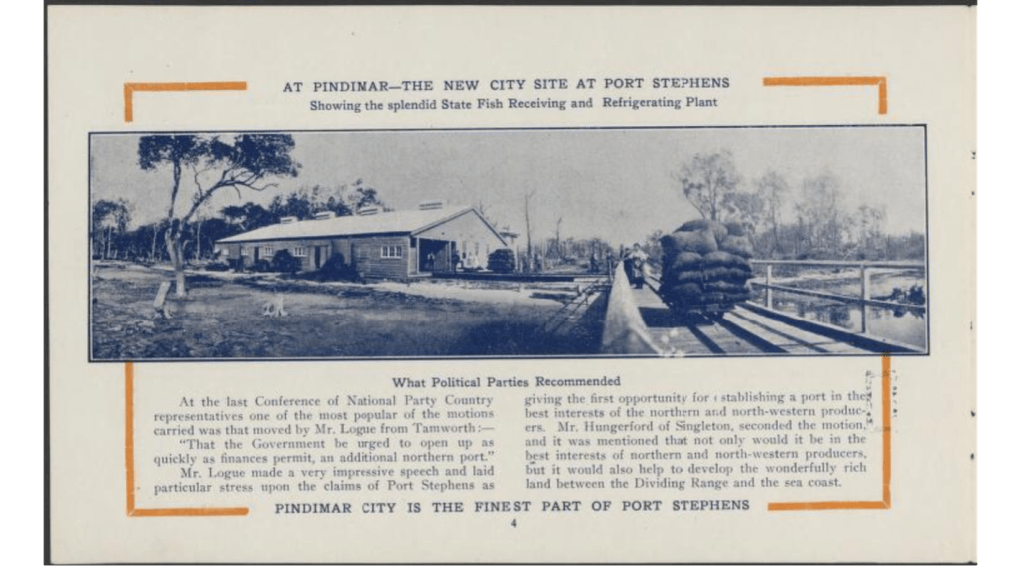
At the last Conference of National Party Country representatives (practically one of the most representative of country interests, that had ever been held in Sydney), one of the most popular of the motions carried was that moved by Mr. Logue from Tamworth : — “That the Government be urged to open up as quickly as finances permit, an additional northern port.” Mr. Logue made a very impressive speech and laid particular stress upon the claims of Port Stephens as giving the first opportunity for establishing a port in the best interests or the northern and north-western producers; Mr. Hungerford of Singleton, seconded the motion, and it was mentioned that not only would it be in the best interests of northern and north-western producers, but it would also help to develop the wonderfully rich land between the Dividing Range and the sea coast. The motion was carried.
The Backbone of Repatriation is Decentralisation, and Port Stephens, according to the leading authorities offers best opportunities for the placing of War Service Homes for Soldiers and Dependents. War Service Homes should be placed where there are excellent possibilities for profitable living being made, as at Pindimar, Port Stephens, where the fishing and the oystering and other openings afford opportunities for a healthy and prosperous outdoor life, just the ideal living after the strenuous and arduous existence of the five years of war.
Port Stephens must now begin to move, and there is no doubt that early Government action will be taken regarding bringing into being the long-promised railway line to the port. The necessity of the railway line, apart from its distribution of country products, and other port business; has been emphasised by the Great Drought, the chief lesson to the Government being the urgency of a cross-country railway line from New England to the Northern Coast, for the lack of which, North and North-western stock owners have been put to ruinous expense. Such a railway, as proposed to Port Stephens, has been loudly called for, in fact, despite the present heavy cost of transport, thousands of large-stock have been sent to the always-grassed areas around Pindimar, as the Port Stephens District is always free of drought, and is, undoubtedly, highly valuable as a drought-refuge for the State’s Northern and North-western stock.
Two Government schemes for a railway to Port Stephens, have been proposed, linking up the Port with the North Coast Railway, and in both schemes the lines pass through the Pindimar City Area, one line only having to cover a distance of 34 miles, at a cost of but £260,000. Port Stephens is far-famed as a natural self-replenishing larder for the north and north-west. It has a brilliantly prosperous future ahead of it, and nothing can hinder the development of a district so abundantly, blessed by nature, so rich and varied in its resources. Its scenic charms have been described as of a Wonderland of Scenic Glory; and from Pindimar, on the North Shore, are such to be best noted.
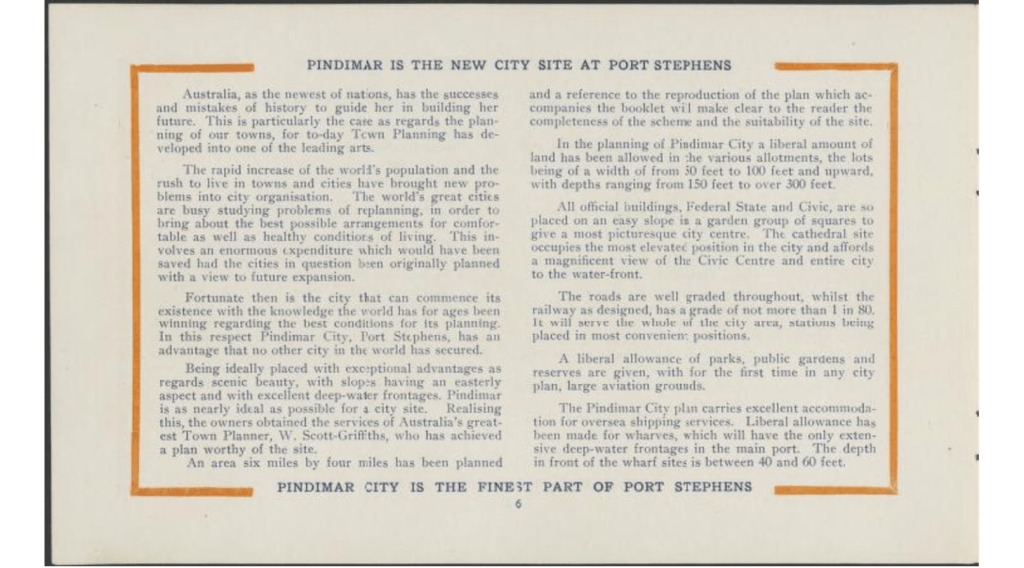
Pindimar is the best part of Port Stephens, which was why the State Government picked upon it to carry the State Fish Receiving and Refrigerating Plant, which gives another reason why the Railway is certain to be early commenced, as it will be found necessary for quickest country distribution of the State Fishing interests at Pindimar, as well as for the best development of oyster and other industries. In view of all the wonderful possibilities ahead of Pindimar as the picked portion in the Port, the owners of Pindimar City Site, are placing it before the public. Pindimar has the finest pier in the whole of the Port, and is now the main shipping wharf in the port, and used as the trade junction. It has the ideal position for the site of the future city, hence, the owners commissioned Mr. W. Scott-Griffiths, Australia’s greatest Town-Planning Engineer, to lay out a model city. This work is now completed, ….. has been described as a design without an equal as a city plan.
It is a clever plan, so arranged that as it develops each sub-division will become part of a harmonious whole. There is the greatest prospective value in being associated with a city that will certainly be famous, as a cleverly planned area that will win considerable praise from the world’s town planning experts. The Town Planning Engineer had the whole of the successes of history to guide him, with a site almost unequalled for glory of out-look, the view from the Estate presenting a magnificent panorama through the distant commanding Port entrance heads, and taking in a wonderful stretch of water-way.
The city is smartly divided into Commercial, Residential and other Sections, each being cleverly placed to save time and give every convenience and comfort. Pindimar, being on the north is on the right side of Port Stephens, easily linked with the main northern lands, and able to deal as a port with the products 310,000 square miles. Pindimar has the pick of the deep-water of Port Stephens, portions having 60 to 90 feet deep water close to shore. Pindimar’s fresh water supply is excellent. The State Fish Depot Authorities on the Estate using great quantities from a well, excellent water being so obtainable almost everywhere in Section 1 Area. The lots are of liberal size, with frontages ranging from 60 to 150 feet, with depths ranging from 150 to over 300 feet, and there is a very liberal allowance of Reserved Areas for Parks, Playgrounds, Racecourses, Aviation Areas and Botanical and other gardens.
Pindimar City is the principal section of a well-planned area of over 7000 acres, and its value will be well understood when it is pointed out that the first Pindimar Subdivision sold right out. Pindimar Wharf is central. River and lake cargo from and to Sydney and Newcastle by a regular service run by the Newcastle and Hunter River Steamship Co., Ltd. being landed there; a passenger service calling twice daily to and from Newcastle with mails.’
Marketing of Pindimar City – 1920
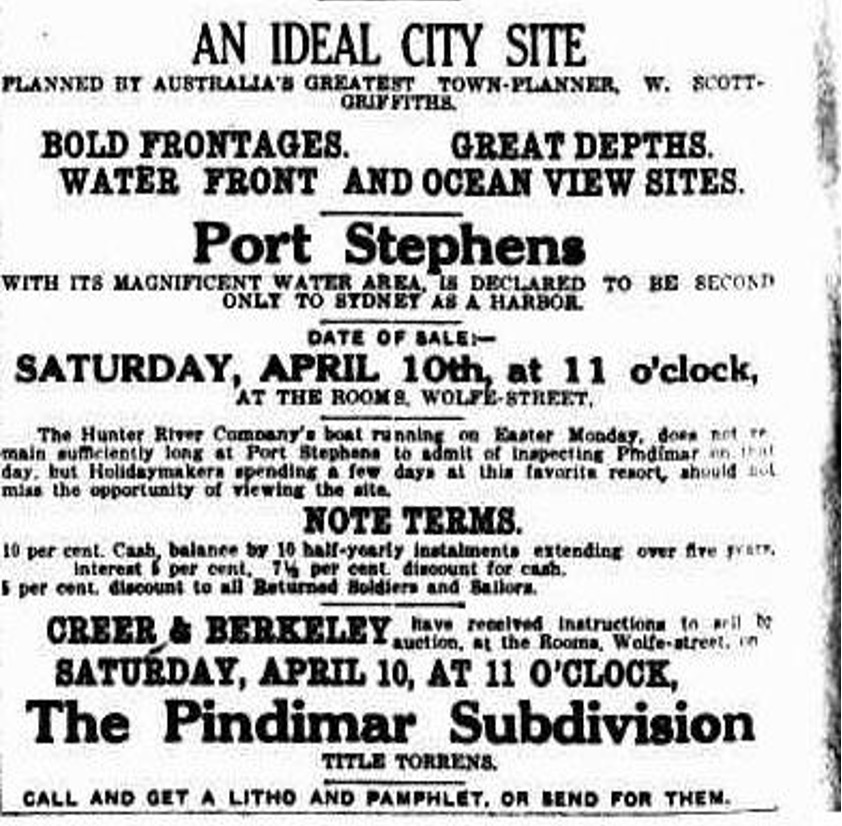
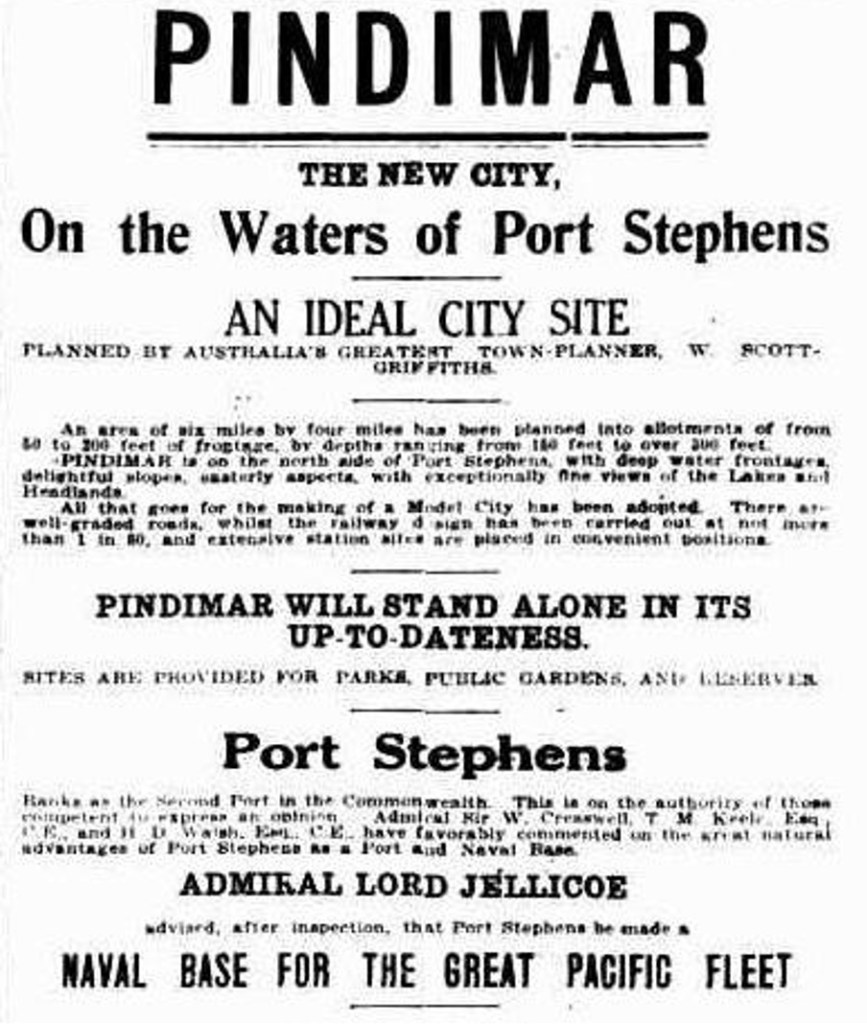
The Pindimar City estate was extensively marketed with the publication of a six-page booklet, and in newspaper advertisements. Many newspapers also published reports favourable to the city development.
The following two advertisements from the Newcastle Sun in March 1920, are typical of those published:
The six-page booklet held by the State Archives and Records Authority of NSW, published by the Pindimar Port Stephens Limited is displayed below:
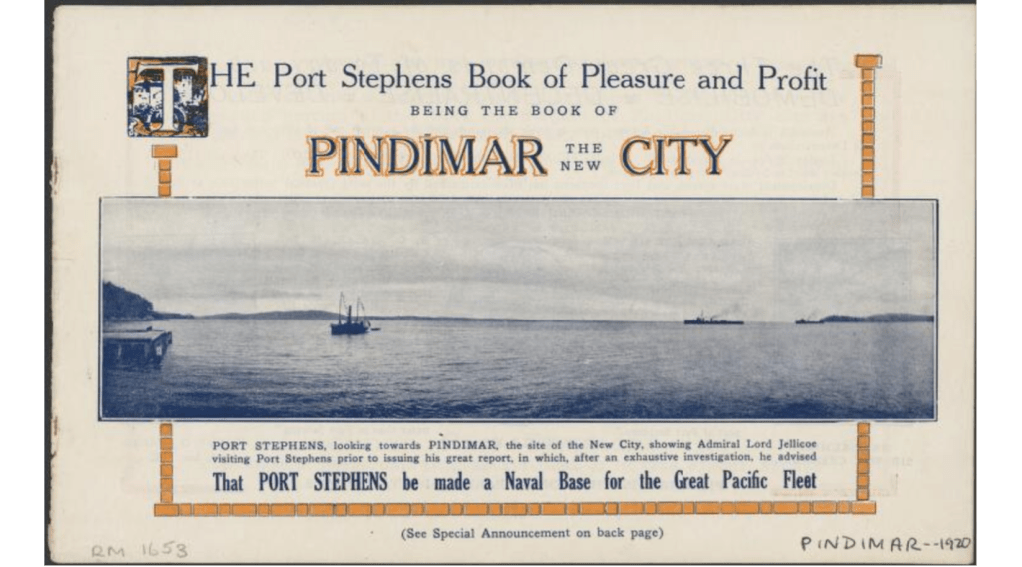
Page 1

Page 2
Page 3
Page 4
Page 5
Page 6
Details of the Pindimar Estate – 1920
The Newcastle Sun of 15 March 1920, page 4, carried further details of the Pindimar Estate:
‘The Pindimar town plan prepared by Mr. W. Scott Griffiths covers an area of six miles by four. Liberal allowance has been made in the various allotments for the subdivision sale to be conducted by Messrs. Creer and Berkeley on April 17. The widths vary from 50 feet to 100 feet, and depths range from 150 feet to over 300 feet. The reservation for official buildings in the centre of the city is on an easy slope in a garden group of squares, while the site for a cathedral is elevated, affording a magnificent view of the entire city area to the water front. A special feature of the layout is the naming of the streets. There are three subdivision areas, Dalley, Monash and Anderson, and in nearly all cases the street names commence with the same initial letter as the suburb in which they are placed. The city area is divided into commercial, residential and other sections, so placed as to give the utmost saving of time and the fullest conveniences. It is on the north side of Port Stephens, and may easily be linked with the main northern and north-western lands, and the adjacent water is from 60 to 90 feet deep.’
New City Site at Port Stephens – 1920
The Construction and Local Government Journal of 15 March 1920, page 12, published eight photographs of the Pindimar Estate site, which provide a perspective of the area proposed for the city development. The photos illustrate issues referred to in publicity used by the developer.
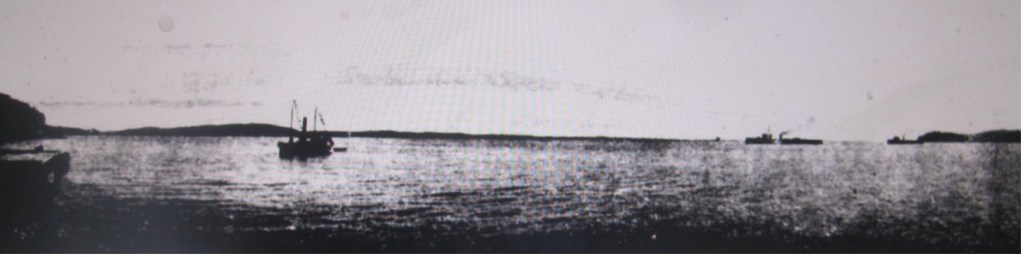
Admiral Lord Jellicoe visiting Port Stephens, which he advised should be made the Naval Base for the Great Pacific Fleet.
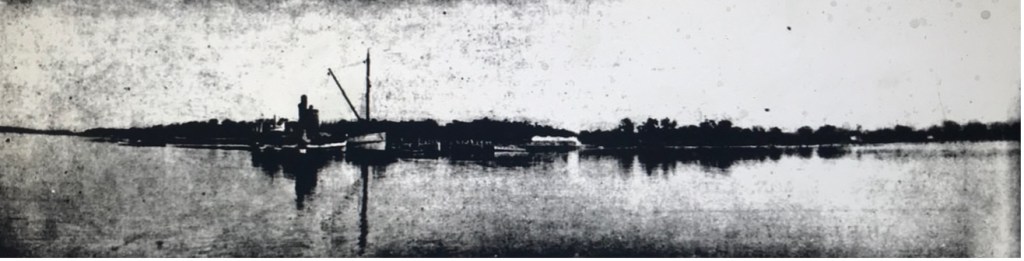
Looking towards the State Fish Receiving and Refrigerating Plant with Steamer at Wharf.
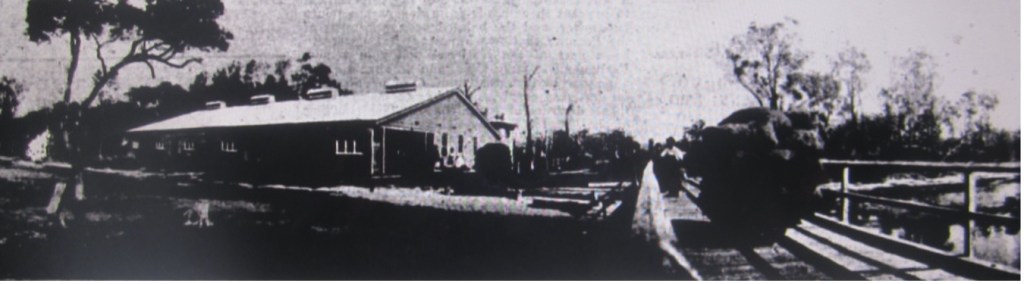
Showing the splendid State Fish Receiving and Refrigerating Plant.
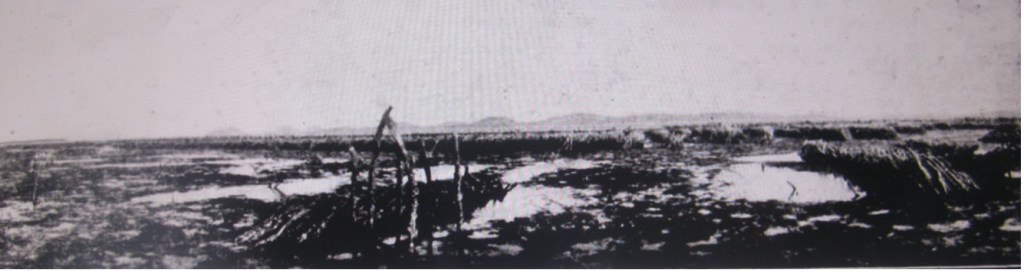
Showing one highly improved Oyster Bed where over 150,000 oyster-sticks are placed for catching the oyster spat.
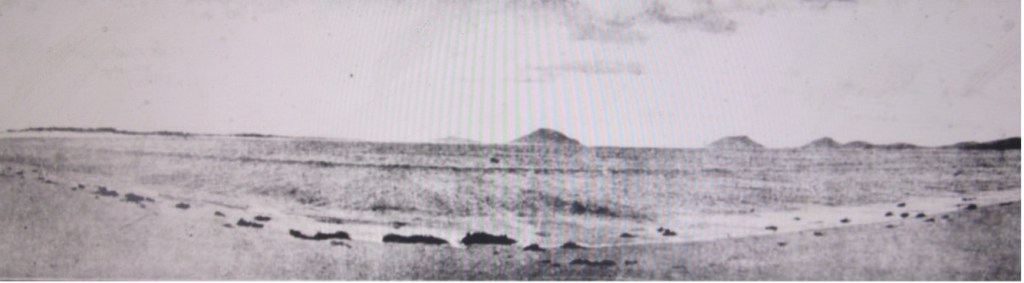
Looking from Pindimar Easterly to the Entrance Heads and their magnificent scenic effect.
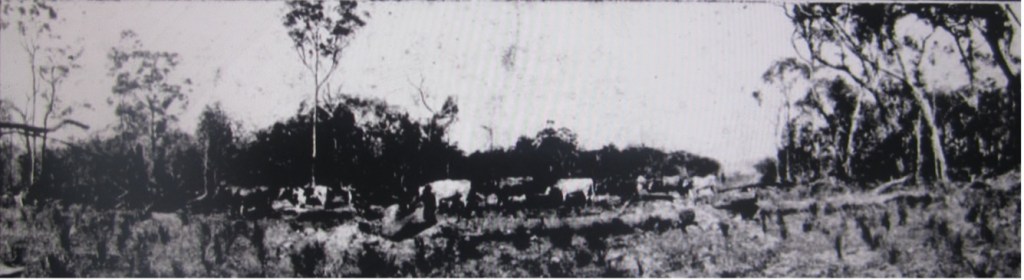
Making the streets and roads in the newly planned city, looking towards the Entrance Heads of Port Stephens.
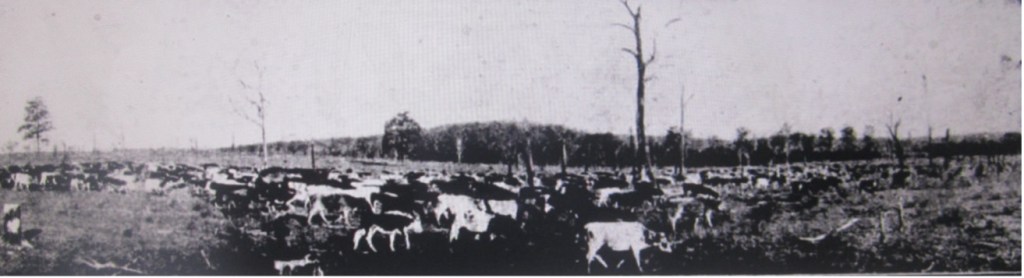
Showing Pindimar as the Stock Nursery of the State; the starving stock arriving during drought time.
Pindimar – Site with a Future – 1921
The proposed new city at Pindimar received regular promotion in newspaper reports. The following report in the Newcastle Sun of 19 March 1921, page 4, illustrates the type of positive reviews of the Pindimar City estate:
‘The Pindimar City plan has been designed by a clever town planning engineer, who had the whole of the successes of history to guide him, and with a site almost unequalled for glory of outlook. The view from the estate presents a magnificent panorama through the distant commanding Port Entrance Heads, and takes in a wonderful stretch of water-way. It is the first city plan in Australia to include facilities for aviation possibilities in future commerce. A fine road is being made along Peace-avenue, to link up Pindimar City site with existing railway systems, whilst a fine accommodation house has been planned for visitors.
The city is smartly divided into commercial, residential, and other sections, each being cleverly placed to save time, and give every convenience and comfort. The site is ready for immediate occupation, and the soil is good, a portion of it being suitable for market gardening. The pastureland is excellent, feeding thousands of head of cattle from dry districts during the drought seasons, thus saving valuable stock besides being profitable. The fishing is unexcelled. Pindimar, being on the north, is on the right side of Port Stephens, is easily linked with the main northern and north-western lands. It is the port fashioned by nature to be the outlet for the production of 125,000 square miles of the richest portions of New South Wales.
Pindimar has the pick of the deep water of Port Stephens, portions having 60 to 90 feet deep water close to shore, and a fresh water supply is excellent. The State fish depot authorities on the estate obtain great quantities from a well. Excellent water may be procured at all times from wells in the level country. The city is the principal section of a well-planned area of over 7000 acres. Its value will be well understood when it is pointed out that the first Pindimar subdivision sold right out. The wharf is central, river and lake cargo from and to Sydney and Newcastle by a regular service run by the Newcastle and Hunter River Steamship Co., Ltd., being landed thereat. There is also the excellent “Port Stephens’ Passenger Service,” running from and to Newcastle, calling twice daily with mails and passengers. An excellent accommodation house for visitors is proposed to be built from plans by H. E. Budden. O.B.E., F.R.I.B.A., of Budden and Green-well, Sydney.’
Council Concerns – 1922
The first concerns by Stroud Shire Council about the progress of the infrastructure development associated with the estate was reported in the Dungog Chronicle of 11 August 1922, page 5:
‘In connection with the bonds given by the Port Stephens Development, Ltd., regarding the carrying out of certain roadwork on the streets within Port Stephens City subdivision, I [the shire Clerk] have to inform you that one bond expires on 17/11/23 and the other on 12/1/24. The bonds provide that the required work shall be carried out on the written request of the council. As there is now only about 15 and 17 months respectively to run before the expiry of the bonds, does the council intend to make a request on the company to have the work specified, carried out.’
The decision of the council was not reported.
Land and Valuation
The Daily Telegraph of 18 June 1924, page 4, reported on the following Court action taken by Pindimar Port Stephens Ltd:
‘Pindimar Port Stephens, Ltd., appealed against the valuation by the Stroud Shire for the year 1924 of several portions of land, aggregating about 5874 acres, situated at Pindimar. The Shire Council’s valuation was £11,748, and the appellants’ £7342. The Court determined the unimproved capital value at £10,748. In the appeal by the Port Stephens Development, Ltd., against the Shire Council’s valuation of £13,471 in respect of the company’s Port Stephens City Sub-division, parish Coweamhah, the appellants valued the land at £2070 u.c.v. [unimproved capital value]. The Court fixed the valuation at £13,471.’
Death of the Pindimar City Architect – 1929
The Sydney Morning Herald of 22 March 1929, page 14, published the following obituary on the death of the Pindimar City estate town planner, Walter Scott Griffiths:
‘Mr. Walter Scott Griffiths, South Australian Government town planner and chairman of the Central Town Planning Advisory Board, died in Adelaide on March 12. He was formerly a well-known architect in this State, and for some time was deputy-president of the Kuring-gai Shire.
Before becoming town planner in South Australia be practised in New South Wales. He designed a number of important works, including Pindimar City at Port Stephens. Springfield township, near Hobart, and the beautification scheme for Bondi Beach now being carried out. He was also placed first in collaboration with two others in the minority report of the Federal capital design competition. This design was subsequently purchased by the Commonwealth Government, and the sewerage and drainage scheme form part of the present capital. He was a member of the Institute of Surveyors of South Australia, of the English Town Planning Association, and of the World’s Town Planners’ Institute.’
Researched and compiled by Kevin McGuinness
November 2022

 Port Stephens - a history exploration