
Introduction
The promotion and marketing of the large Pindimar City estate development on the northern side of Port Stephens began in 1920.
Coincident with this, a smaller section of adjacent land was also marketed for sale by Port Stephens Bundabah Estate Limited, on the eastern shore of North Arm Cove. It was to be known as the Bundabah Estate.
Across the cove at North Arm, a large development estate entitled the Port Stephens City was also being marketed for sale at this time.
These three estates were being marketed to land speculators.
The Bundabah Estate Limited, was registered in 1920 with a capital of £10,000 in £1 shares. Its purpose was to acquire land and buildings at Port Stephens and on-sell smaller land holdings. The directors were: R. F. J. Wood, J. R. Fulton, and E. J. West.
Two issues concerning the estate deserve notice. Firstly, the decision in a legal case brought by the estate developers against the Stroud Shire Council set a precedent for other local government authorities, and secondly, the estate was established before a public access road was dedicated.
Council ruling on road specifications for the Bundabah Estate challenged – 1920
As the Bundabah Estate was adjacent to the Pindimar City development, which featured several wide avenues in areas leading to the waterfront, the Stroud Shire Council argued that the road specifications for Bundabah should match those of Pindimar. The council assumed that the Bundabah town area would eventually form part of the adjacent Pindimar City area.
The Dungog Chronicle of 10 December 1920, page 5, reported:
‘W. H. Foster, Surveyor, West Maitland, forwarding a rough plan of proposed subdivision of portion of Bundabah Estate, North Arm, Port Stephens [to Stroud Shire Council], and asking what formation of the roads is required before drawing up his specifications and submitting plan for approval. — The Clerk was instructed to reply that Council requires the same work done on the roads within this subdivision as is required on the roads within Pindimar City subdivision, namely, clearing thirty-three feet wide, and culverts to be constructed where necessary.’
The Dungog Chronicle of 11 March 1921, page 3, further reported:
‘Mr Wood [a director of the development company] interviewed council with regard to requirements as to width of streets in the Bundabah Estate subdivision, Pindimar. The President urged that one, if not two, of the main streets in the area should be made 100 foot wide. Cr Franklin opposed the suggestion pointing out that Balmain and similar busy city harbor side towns do not require such a width. Cr Abbott agreed with the President. Cr Gorton was of the same opinion as Cr Franklin. After considerable discussion it was decided that the main street be 100 feet wide. The Engineer was instructed to inspect the subdivision.’
This decision of the council, led to a subsequent legal challenge to the 100-foot-wide road requirement.’
The Dungog Chronicle of 12 April 1921, page 4, reported on two pieces of correspondence received by Stroud Shire Council:
‘W. H. Foster, Surveyor, Maitland, regarding proposed Bundabah Estate subdivision, also from R. W. Thompson and Son, Solicitors, West Maitland, regarding the same matter, asking if the Council still insists upon its requisition to have, one of the streets in the subdivision made at least 100 feet wide, and if so to forward a notice of appeal form under Ordinance 32. — The following resolution was then passed, “That this council insists upon one hundred feet street being made in the subdivision.” ‘
The Raymond Terrace Examiner and Lower Hunter and Port Stephens Advertiser of 5 August 1921, page 3 (and other newspapers) reported on the results of the court action taken by the development company against the council:
‘At the Maitland District Court last week the Port Stephens Bundabah Estate, Ltd., was the plaintiff in an action brought against the Stroud Shire Council, under section 341 of the Local Government Act of 1919, by way of appeal, as provided by the Act. The decision appealed against was that of the Council requiring Bundabah road in the subdivision of the Bundabah Estate, Port Stephens, to be 100ft in width and not approving of the plan of subdivision of the area lodged under the Local Government Act, 1919, owing to the road being shown as 66 feet wide thereon.
Mr. N. E. Weekes appeared for the plaintiff company, and Mr. W. J. Enright, on behalf of Mr. Jas. R. Carlton for the Stroud Shire Council. The estate is situated on the shores of Port Stephens. The only matter in dispute was whether the road should be 100 feet wide or 66 feet.
His Honor: I take it the important point whether, in 100 years hence, this may be a big town, and whether it is necessary that they should have a wider street.
Mr. Weekes submitted that the council had no power to insist upon a street 100 feet wide. There was no provision in the Act giving council power to ask for a road above the standard width. And as far as main roads are concerned, there could be no dispute that the council had no power to make a road a main road.
His Honor: The council has no power to proclaim a main road.
Dealing with the width of roads, Mr. Weekes said that section 392 provided that council should take into consideration, inter alia, (a) the situation and planning of the road in relation to public convenience present and perspective, inter communication with neighbouring localities within or without the area, and (b) the classification of the road. Section 236 dealt with the classification of roads, and he claimed that the council had no power to proclaim a main road. His Honor said admittedly council had no power to proclaim a main road.
Continuing, Mr. Waller stated that section 229, stated that, subject to the Act, every new public road should be classified before it was opened to or beyond the standard width for its class, but no section gave the council any power to proclaim a road beyond the standard 66 feet for secondary, or residential roads. A main road must be not less than 80 feet. His Honor said that as it was admittedly not a main road, there was no classification requiring more than 66 feet.
Mr. Enright: Will your Honor, hold that Council has no power to refuse approval if a street is less than 66 feet wide.
His Honor: I cannot see anything else. A finding was accordingly given in plaintiff’s favour with costs on the second scale.’
The Stroud Shire Council eventually approved the subdivision plan, as reported by the Dungog Chronicle of 20 September 1921, page 4:
‘Correspondence was received [by Stroud Shire Council] from R. W. Thompson and Son, Solicitors, West Maitland, asking for the return of the plan, endorsed with Council’s approval, of the Bundabah Estate, and threatening legal proceedings for recovery if not returned. It was decided to endorse the plan and return it, although the Council stated that they do not approve, but that approval was forced upon them by the Court.’
The decision in the court case set a precedent for a later dispute between Stroud Shire Council and another party in 1938. The Northern Champion of 19 November 1938, page 4, reported:
‘(Correspondence Stroud Shire Council from) from Butterworth and Cowan, solicitors, Taroo, seeking approval to plan of subdivision submitted to council at previous meetings on behalf of the estate of the late Charles Thompson, at Forster. In regard to council’s ruling that the road through the subdivision should be l½ chains in width, the applicants pointed out that the council had no power to compel that the road should be more than one chain wide. This was the finding of the court in the case of Port Stephens-Bundabah Estate Ltd. v Stroud Shire Council (1921), the facts of which case were almost identical with the present one. Approval in that case was made subject to a road being increased from 66 feet to 100 feet, and the court held that the council had no power to insist on a road in a subdivision being more than 66 foot wide.
The clerk said that although the Main Roads Board had insisted upon a road 150 links wide, council had no power to do so. The contention in the letter before council was right. The road through the block was not a surveyed road according to the Lands Department. If council wanted the road widened later on it would have to effect a resumption. The application was granted.’
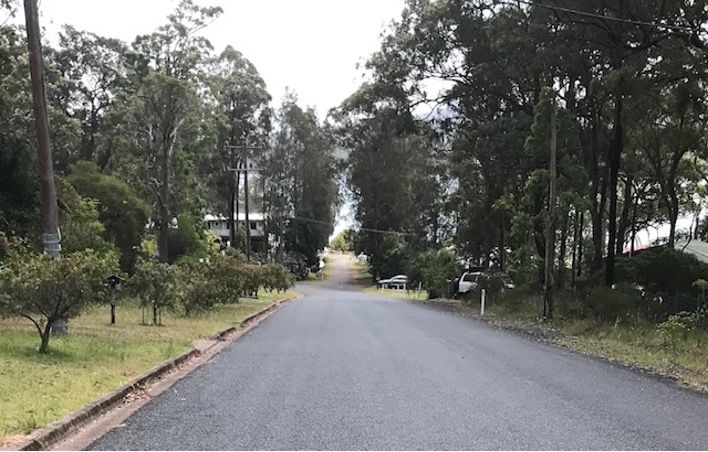
Bundabah Road looking towards the waterfront, which was subject to the court action [Google photo, 2008]
Problem with the Access Road – 1924
By 1924, the need to provide a public road to the Bundabah Estate was raised. Considerable action was taken over the next three years to finalise a solution to the access problem.
The Dungog Chronicle of 15 January 1924, page 4, reported:
‘(Stroud Shire Council received) letter from managing director (of Bundabah Estate) regarding public road, asking what council proposes to do as to roads to estate, as rates are charged them by council. The president said that the Australian Agricultural Company left a road through the estate. The Engineer thought that the road was not necessary at the present, there being only three houses.’
The Dungog Chronicle of 12 June 1925, page 4, reported on the Stroud Shire Council engineers’ action with the access road matter:
‘On receipt of additional information from Mr. Wood (of the development company), subsequent to last meeting, I visited Pindimar and the site of the road. Mr. Phillips gave me a plan I had not seen before as there was not one in this office. This plan of Merewether’s subdivision shows the blocks into which the area was originally divided, and the roads of access left thereto. I then saw Messrs. Wood and Sharpe in company with Cr. Franklin. Mr. Sharpe strongly insists on his absolute right to enclose and prevent the use of the track through his land, which Mr. Wood erroneously refers to as ‘our road,’ meaning residents and visitors of Bundabah.
Mr. Wood stated that he thinks it is the council’s duty to provide Bundabah subdivision with a road of access, now that the track has been blocked. Mr. Phillips informed me that he has given the residents of Bundabah the right to use the road he has constructed from Tea Gardens road to Pindimar City, the whole of which lies on the private lands of that estate, for light traffic, but this road is now inaccessible from Bundabah. The road shown on the subdivision plan as giving access to Bundabah is heavily timbered and local residents inform me it would be impassable even if cleared, as the country is rough and broken.
The Registrar-General informed the clerk some time ago that the plan of the subdivision has not been registered, therefore the subject road is not a public road. The position is that the purchasers of Bundabah did not pay sufficient attention to the access to their property by land, at time of purchase, and as they have been allowed apparently unrestricted use of Pindimar lands, have not had any reason to worry about same in the interim. The ways in which council could meet the wishes of Bundabah would be as follows: — Have the surveyed road gazetted as a public road, clear it and construct, etc., where necessary on the five-mile length, or re locate the road, resume the land and then clear and construct the road. Either alternative would involve an expenditure of over £500.’
The Dungog Chronicle of 17 August 1926, page 6, provided a further update action taken by the Stroud shire Council engineer to solve the road access problem:
‘Regarding request to open road from Bundabah Estate to main road: I inspected this road which is about 3 miles long from main road to Sharps’s corner, and although the surveyed road is practical it would be a big expense to even clear a track and provide the necessary culverts. I interviewed Mr. Phillips of Pindimar Estate, and whose private road the Bundabah people use at present, and he stated that he had no objection to his road being used, provided the gates were kept closed, etc., and that he had informed the Bundabah people to that effect, but naturally would like to see the surveyed road opened at some future date.’
By 1927 a solution to the access road problem, was evolving. The Dungog Chronicle of 24 May 1927, page 6, reported:
‘Telegram from R. F. G. Wood, Bundabah, stating that the Bundabah residents and estate are in favour of the proposal for the Council to take over the road from Pindimar Port Stephens Ltd., which leads to Bundabah and Pindimar from the Karuah-Tea Gardens road. The Council thereupon decided to accept the proposal.
The proposal is to take over the road from Karuah-Tea Gardens road for a distance of 6 miles as far as Pindimar Post Office with branch to Bundabah, leaving a short distance between the Post Office and the wharf still vested in the Company to enable them as owners of the foreshore to hold the lease from the Government of the wharf which was erected by the Company. This portion of the road to be attended to by the Company.
It is also proposed that the gates at present on the road to be taken over be allowed to remain and be registered as public gates, and that should it be found necessary to order the removal of any of these gates at any time the Council will have the road fenced on both sides, and likewise also should it be found necessary to fence for any other imperative reason.’
Although a final solution to the road access problem had been negotiated, the Stroud Shire Council, was left with a financial burden to fix the proposed new public road. The Dungog Chronicle of 24 July 1928, page 4, reported:
‘R. J. F. Wood. Port Stephens-Bundabah Estate asked ….. for the road link to be completed to Bundabah. Cr. Kesteven said Council made an egregious error in accepting that road. The grades were 1 in 5 in places, and they could have gone a little further and got a good road. Council had simply been hoodwinked. The road climbs to the highest point on the Pindimar Estate before it goes down again. On the motion of Crs. O’Brien and Turner, it was decided that the “missing link” be surveyed and dedicated.’
Holiday Camp – 1933
With the road access problem rectified the developers of the Bundabah Estate established a holiday camp on part of the site. The Maitland Daily Mercury 24 January 1933, page 7, reported:
‘A place that has come into prominence during the recent holidays is Bundabah, on the northern side of Port Stephens, says, the N.R.M.A. There is a splendid camp on Bundabah Estate which fronts a protected bay oft Port Stephens. The turn-off from Pacific Highway is at a point 11½ miles north of Raymond Terrace. This road loads to Tea Gardens via Karuah, the turn-off to Bundabah being about 11 miles east of the latter place. The last few miles of road down to the camp is unmade and likely to be difficult after heavy rain. Otherwise, the going is good right from Sydney. Splendid catches of schnapper and other fish have been reported from this place during the last few weeks, and as camping facilities are good. Bundabah is likely to become even more popular before the end of the summer.’
Five years later the holiday camp was promoted again in the Maitland Daily Mercury of 8 December 1938, page 7:
Bundabah Camp area at Bundabah, on North Arm of Port Stephens, under control of Bundabah Estate, Ltd. Located six miles from Tea Gardens road (turn off 11 miles east of Karuah). Fishing, tank water, wood, sanitation, store, boat calls twice weekly. Fishing, swimming, boating, tennis. Camp fee: 1/ night, 3/ week. Caretaker: N. B. Phillips, on area (Pindimar P.O., via Raymond Terrace).’
Windup of Port Stephens Bundabah Estate Limited – 1965
Notices placed in the Government Gazette of the State of New South Wales, of 17 December 1965 and 1 July 1966, reported that the company had been placed in Liquidation and wound-up.
Researched and compiled by Kevin McGuinness
November 2022

 Port Stephens - a history exploration