

Introduction
Following the NSW Royal Commission into Decentralisation of 1911, there was much interest in the economic development of the Port Stephens area and its hinterland. It was envisaged as an overseas port to serve the shipping needs of north and north-western areas of New South Wales.
After the First World War (1914-18), calls for the development of Port Stephens intensified to such an extent that land speculators turned their attention to the largely unoccupied lands on the northern shore of Port Stephens around Pindimar and North Arm.
Buoyed by the possibility of a Naval Base being established across the harbour at Salamander Bay, and the belief that a railway would be constructed to connect with the main northern railway line, vast areas of land on the northern shore quickly rose in value. Waterfront land was specially sought.
Around this time, there was also much agitation for the creation of a new Northern State in NSW, with Port Stephens as its harbour. This further fuelled land speculation for financial gain.
This paper sets out the history of the Port Stephens City land development at North Arm, on the northern shore of Port Stephens.
Coincidentally, two other large adjacent land developments were being marketed, viz Pindimar City by Pindimar Port Stephens Limited, and Bundabah Estate by Port Stephens Bundabah Estate Limited. Their stories are found at these links on the website.
As neither the Naval Base, the railway extension or the creation of a new Northern State ever eventuated, land speciation was a contentious issue at the time. Even today, much of the mooted land estate at North Arm remains without services such as roads, electricity, water or sewerage, and so houses cannot be currently built there.
North Arm Site Originally planned by Walter Burley Griffin – 1918
The land development estate at North Arm was initially owned and marketed in 1918 by Land Limited.
The company engaged the well-known American architect, Walter Burley Griffin, to design the land subdivision for the Port Stephens City site. Griffin was the designer of Canberra as the Federal capital. Also his work included the design for the suburb of Castlecrag in Sydney.
Griffin’s design for the Port Stephens City was similar in concept to his Canberra city plan, as it featured many recreational reserves particularly along the shoreline, long wide boulevardes, and provision for government and private land areas. His plan incorporated the landscape of the area.

Port Stephens City estate, at North Arm, as designed by Walter Burley Griffin, 1918 [National Library of Australia]
Announcement of the Port Stephens City Development at North Arm – 1920
Land Limited went into liquidation in 1919. The estate was then purchased by Henry Ferdinand Halloran and marketed from 1920 through to the 1930’s.
The following announcement was made in the Newcastle Morning Herald and Miners’ Advocate of 27 March 1920, page 8:
‘Messrs. Henry F. Halloran & Co., of Sydney, announce that they have land to sell at Port Stephens, comprising three miles of water frontages. Liberal terms are offered’.
Henry Halloran was a surveyor, conveyancer and valuer by profession. He was also a well-known developer of land in the Newcastle, Lake Macquarie and Port Stephens areas. His modus operandi was to buy large estates of undeveloped land and then call on local councils to fund and build roads and service facilities on the estates.
He amended the original Walter Burley Griffin plan by replacing many of the waterfront water reserves with private allotments and later expanded the original estate area by adding a northern extension.
His marketing strategy was to emphasise the large profits that would be made in the future when economic development took place in the surrounding areas.
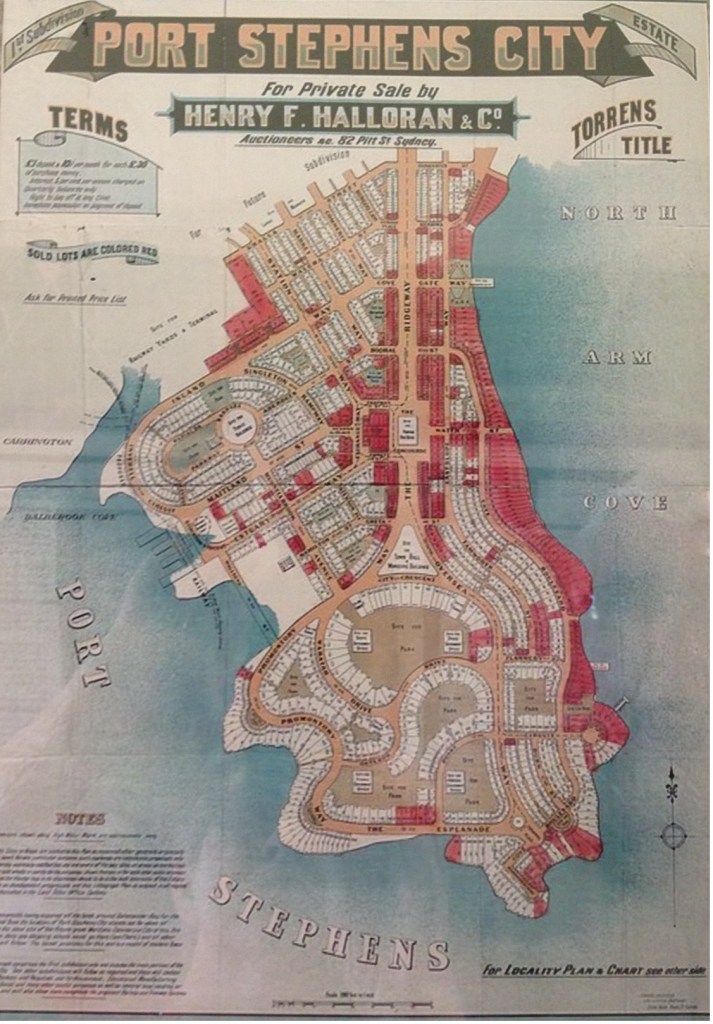
Plan of the amended Port Stephens City development of Henry F. Halloran and Company, which replaced the shoreline recreation areas with private allotments formerly featured in the original Walter Burley Griffin plan [National Library of Australia]

Alternative plan of the first subdivision of the Port Stephens City development by marketed by Realty Realisations Ltd, a real estate division of Henry F. Halloran and Company [National Library of Australia]
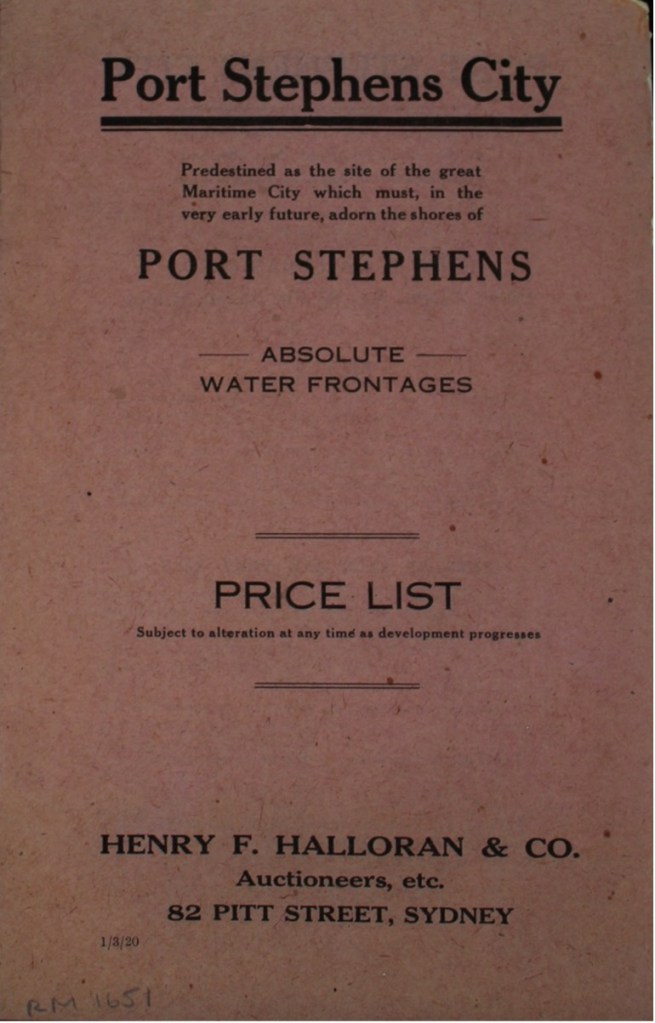
Cover of the price list for the Port Stephens City, ‘predestined as the site of the great Maritime City which must, in the very early future, adorn the shores of Port Stephens’ [National Library of Australia]
Port Stephens Land Speculators – 1920
The Daily Observer of 12 May 1920, page 2, reported:
‘It is being suggested by some newspapers that the Northerners who are working for a New State with the object of making the people in the area independent of the selfish interests in a distant city are merely succeeding in helping land speculators to dispose of building sites at Port Stephens. How this can be sinisterly connected with a big movement to create a Greater North is difficult to see; but evidently the fact is being used to throw discredit on the bona fides of the New State movement.
Port Stephens is after all only one aspect of the whole Northern developmental problem; undoubtedly it is of vital interest to some sections of New Staters who believe Nature has provided the North with a natural harbor which will one day enormously add to the prestige of the New State. For the present it does not constitute even the smallest part of the general Northern aspiration, and if it were opened tomorrow would not solve the greater problem of properly developing an area nearly as large as Victoria.
The fact that speculators have rushed in to secure the best building sites at Port Stephens, and are now, in expectation of the arrival of a New State within the next few years, busily trying to dispose of their land at a substantial profit, in no way affects the broad issue of establishing self-government in the North. This paper has already drawn attention to the land speculation going on at Port Stephens and has used it as another instance of the utter neglect of Northern interests by Sydney Governments.’
Halloran Seeks Council Assistance to Build a Road to North Arm – 1920
The Dungog Chronicle of 14 May 1920, page 3, reported on a letter received by the Stroud Shire Council from Mr. Halloran:
‘A letter from Mr Halloran relative to a proposal to open a road from Karuah to the Tea Gardens via Tahlee, Carrington, and the new town on North Arm has been referred to me [Shire Engineer]. I have not made an inspection, but from inquiries I believe the road is quite practicable and on the map, it looks a good proposition and well worth preliminary inquiries. The time must come when a main road must be made to connect with the north shore of Port Stephens with the main road system so that if this road is adopted instead of the present road from Karuah to Tea Gardens there is every chance of it being adopted as a main road and so receive Government aid.
The present road does not serve any settlement, and the land will never be more than cattle runs, whereas the proposed road will serve the towns which are being established on Port Stephens, besides having scenic attractions which the inland road does not possess. I therefore recommend that Mr Halloran be invited to submit further particulars and that an inspection be arranged for.’
The Dungog Chronicle of 11 June 1920, page 6, further reported on the road inspection undertaken by the Stroud Shire Council engineer:
‘In accordance with your instructions [the Council] I made an inspection of the above road with Mr Halloran on May 29th. The length of road to be improved is approximately five miles and the whole length is on sound country with an abundance of material at hand, so I am of the opinion that the proposed expenditure of £1000 will make an excellent road for motor traffic and will be quite sufficient for some years with a reasonable amount of maintenance. I have made an estimate which is necessarily only an approximate one, as no measurements have been taken, but I think it provides for all necessary work.
It is proposed to finance these improvements by a loan of £1000 from Mr Halloran at 6 per cent interest, such loan and interest to be payable from the revenue to be obtained from land held by Mr. Halloran. This leaves all revenue from other land on the route free for maintenance after construction. It is part of the undertaking that Mr. Halloran constructs a bridge and causeway over Bellbrook Creek, and constructs an equally good road to connect with the present road to Tea Gardens near Bulga Creek. This road will become an alternative route to Tea Gardens, and although it will be a little longer it will be a better road than the present one.’
Description of Port Stephens City – 1920
The Northern Star of 7 June 1920, page 2, published observations about the site of the Port Stephens City, as it was being prepared for sale:
‘At the mouth of the Myall River is the township of Tea Gardens. To further explore the port a launch run to Karuah takes one round the northern side of this beautiful harbor. Now one comes to the peninsular ….the site of the Port Stephens City. This is an important enterprise, controlled by a large development company, which is also taking advantage of Mr. Halloran’s special knowledge, and when the passing visitor looks over this estate, with its wide streets, now being cleared of timber, its beautiful gradually sloping foreshores, its deep water frontage, its beautiful bay on the east side—North Ann Cove— with a surface of water a mile in width and over three miles in length, he cannot help picturing this place a hive of industry, a city of beautiful buildings and pleasing parks, for with the usual long sightedness for which this planner of towns is noted.
Mr. Halloran has laid out Port Stephens City with a liberal supply of parks and reserves, and has reserved the most prominent points for municipal, Government and other public buildings. No mud flats mar the slopes of this estate, this future city—no expensive reclamation, no long jetties—nature has endowed the estate with all that was necessary for a shipping city, and it only remained for the right man to come along and develop nature in a natural way to make a city both beautiful and eminently useful, economical and convenient.’
Port Stephens City leads to protests against land alienation – 1920
The Daily Observer of 14 June 1920, page 2, reported:
‘Inverell New State League has set a lead which should be followed by all other Leagues. Mr. T. A. Warner considered that Leagues should make strong representations to the Government and ask that they should see that no more land about Port Stephens was alienated. Whether Port Stephens was to be included in the New State area or not, the alienation of land, at Port Stephens was inimical to Northern interests. He moved that a strong protest be lodged. Mr. McIlveen considered the matter a most important one and he thought every League should take the protest up. The idea was most unwise. He seconded the motion.
Mr. Wilson said that in Challis House [Martin Place, Sydney] there was a map prominently displayed which set out the city plan of Port Stephens. The place had been elaborately designed and there was a syndicate selling lands at Port Stephens at present. Such should not be allowed. The meeting was agreed on the point and a strong protest will accordingly be lodged. The mayor suggested they should ask the shires and municipalities to join in the protest. Port Stephens was a harbor that could be made as fine as any in Australia, and it was in the interests of the whole of Australia that no further alienation should be allowed.’
Funding of the New Road to North Arm and Tea Gardens Settled – 1920
The Dungog Chronicle of 10 December 1920, page 5, reported:
‘The usual monthly meeting of the Stroud Shire Council was held on Monday, December 6th, ……. [and] the matter of the proposed scheme for the reconstruction of the road from Karuah to Tea Gardens was dealt with. F. Phillips, representing Pindimar, Port Stephens, Ltd., and Mr Engel, representing the Tea Gardens Progress Association, were present, and the whole scheme received full consideration. Mr Halloran, representing Port Stephens Development, Ltd., sent an apology for his absence, but stated that his Company is prepared to advance a sum of £1000, of which half is to be expended on the first section of the road nearest to Karuah and the other half on the road from the Tea Gardens Road to Port Stephens City, via Tahlee.
This proposal of Mr Halloran’s was not, however, acceptable to the council, nor to the two delegates present, who both favoured the scheme as put forward by the council, viz., that £3000 be raised by loan to cover the three sections of the road, £1000 to be allotted to each section, and that such loan be obtained as follows: — £1000 from Halloran and Co., £1000 from Pindimar Port Stephens, Ltd., and £1000 from the people of Tea Gardens. A resolution of the council was accordingly passed adopting this proposal, and deciding to levy a local loan rate of 2d in the £ on the unimproved capital value of all land south of the Karuah-Tea Gardens road, and within a three mile radius north of the road, commencing at the Karuah River and running easterly to within three miles of the Myall River, then including all land between the west bank of the Myall River and a three mile radius westward thereof extending for a distance of six miles northerly, such rate to be for the purpose of repaying the loan of £3000 and interest, if any. The Clerk was then instructed to write to Mr Halloran and inform him of the council’s decision, also to write to Mr J. Mackay and ask if he will advance a loan of £1000 on behalf of the Tea Gardens.’
Advertisements for Port Stephens City
The following four advertisements for Port Stephens City emphasised the future financial reward awaiting speculative purchasers after the expected economic developments occurred in the area.
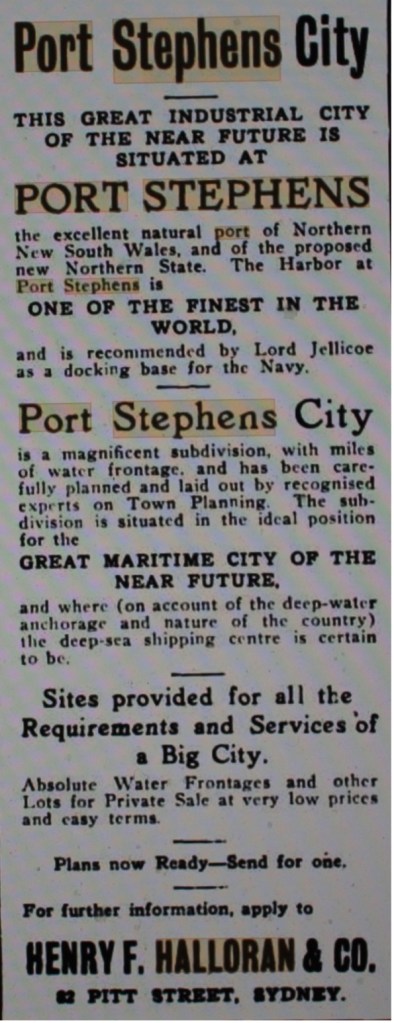
[Construction and Local Government Journal, 31 May 1920]

[Construction and Local Government Journal, 8 August 1923]

[The Newcastle Sun, 17 August 1928]
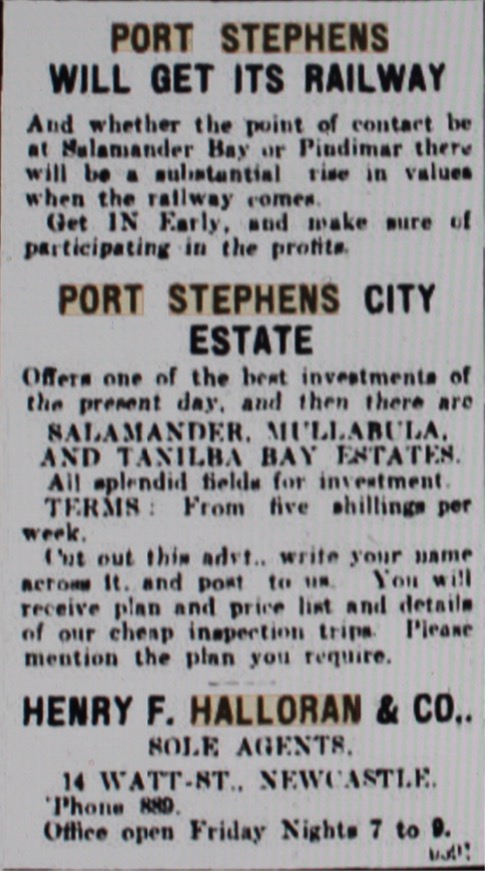
[Newcastle Morning Herald and Miner’s Advocate, 5 September 1928]
Concluding Comments
Those who brought land at North Arm never realised the great financial reward that they had expected. Neither the Naval Base nor the railway ever eventuated.
In 1924, the NSW Parliamentary Standing Committee on Public Works declared that Port Stephens was not going to be developed as a port, as it would be untenable being in such close proximity to Newcastle.
Although the North Arm Cove area was still being advertised in 1928, the above factors put paid to the Port Stephens City development.
In 1960’s, the Great Lakes Council deemed the subdivision ‘Non-Urban’. This meant, both then and now, that permanent dwellings could not be built on the majority of undeveloped sites which today still remain without services such as roads, electricity, water and sewerage.
Over the subsequent years, landowners have lobbied the authorities to have the area rezoned for housing purposes. The chief stumbling point remains as to who will pay for all the infrastructure required for residential development.
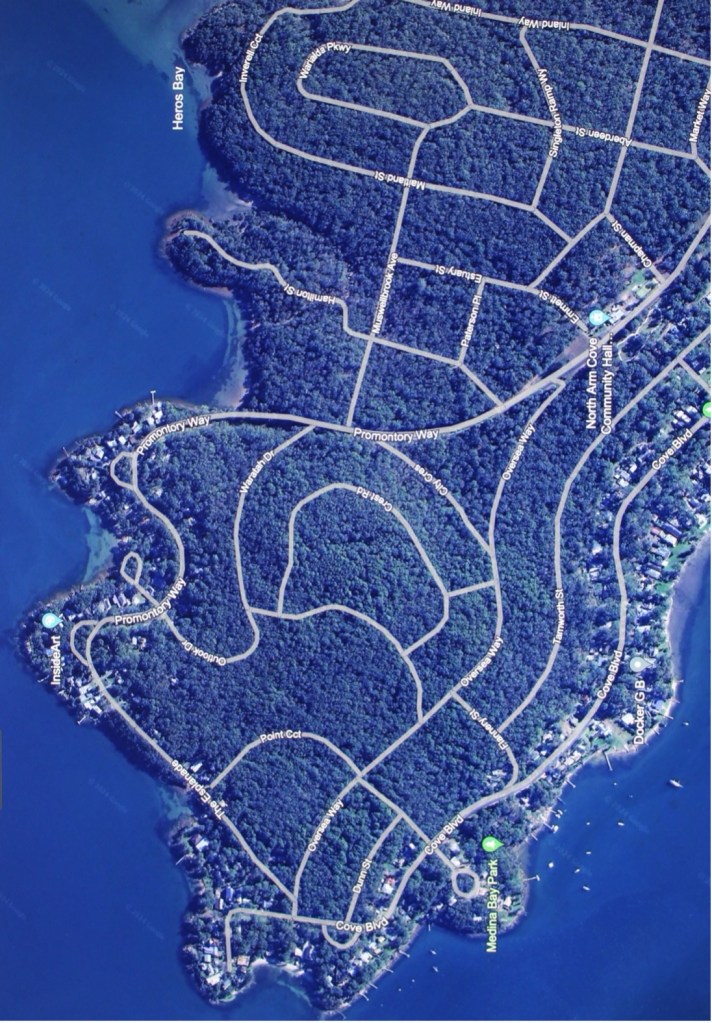
Google Maps still displays the named roads of the Halloran subdivision plan for the North Arm area. Most of the roads displayed have not been developed. [2024].
Researched and compiled by Kevin McGuinness
August 2024

 Port Stephens - a history exploration