
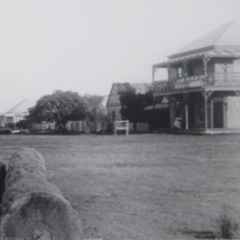
Introduction
Following changes to the NSW Local Government Act in 1919, provision was made for the formation of Urban Area Committees, in areas of sufficient population density such as towns, to assist local councils in the planning and delivery of services.
Ratepayers thereof could petition the local council for the proclamation of an ‘Urban Area’. Nominations could then be taken to serve on an Urban Area Committee.
The Tea Gardens Urban Area Committee was one such body formed in 1930. Other committees were also formed at Nelson Bay and Forster.
For almost thirteen years, the Tea Gardens Urban Area Committee served its local area well, but it experienced several difficulties with which it had to deal.
This paper sets out the history of the Tea Gardens Urban Area Committee using the resources of the National Library of Australia’s Trove newspaper collection.
Regulations Governing Urban Areas
The Dungog Chronicle of 9 August 1921, page 3, reported on the regulations concerning the declaration of Urban Areas:
‘A certain area is taken and proclaimed an Urban Area. The Urban Area is governed by a committee of three, which has power to levy an additional rate to be spent within the area. This additional rate is collected by the Shire Council and handed to the Urban Area Committee less a small percentage to cover cost of collection. The Shire Council has power to delegate to the Urban Area Committee certain of the works and services it carries out, and at the same time to hand over to the Committee funds for carrying out the delegated services or works.
The point which is apt to be overlooked by advocates of the Urban Area proposal is that the Shire Council is not bound to hand over to the Urban Area Committee all the works or services which the Committee may ask to be allowed to undertake. Also, that the Shire Council still levies the general rate within the Urban Area and spend the proceeds of such rate either within or outside the boundaries of the Area. It might happen that it would increase its burden of taxation and be even worse off than it is under present conditions.
However, it is unlikely that such would ever be the case, since councillors would not be so blind as to what is fair play and what is not. Their seat in the council would be jeopardised thereby and also their Local Government reputation, which the majority prize very, highly.
The benefits that an Urban Area Committee could bring upon its area should outweigh other considerations. An extract from “Sydney Morning Herald” regarding which the danger referred to above, is as follows: — One of the interesting innovations of the new [Local Government] Act is the creation of Urban Area Committees. The scheme is that a village in a Shire may elect three members to form a small Committee to act as a minor Council. This Committee may request the Shire to levy a special rate in the village, and the amount is
then put in the bank for the Committee to spend. The stumbling-block in the way of success is the danger of the Shire Council and the Committee quarrelling between themselves as to their rights and powers. For example, such a committee controls the town of Coolamon. It recently waited upon the Shire to point out that the special rate of 2d, levied at the request of the Committee, will not go far enough. The request was that the Shire Council should make a contribution out of its funds. The Council refused the request, and one of the Councillors made a remark that is extremely significant as to the prospects of the success of these Committees. He said, “We appear to be setting up a Council within a Council, and dual control is no good to any-body.”
Application made for at Tea Gardens Urban Area Committee – 1930
The Newcastle Morning Herald and Miners’ Advocate of 14 January 1930, page 4, reported:
‘The “Government Gazette” notifies the receipt of an application under section 548 of the Local Government Act, 1919, by Stroud Shire Council for the establishment of an urban committee in respect of Tea Gardens Urban Area, within Stroud Shire. Any number (not less than 100) of electors enrolled in respect of the urban area may within one month from the date of the notice, petition the Minister to hold a public inquiry, and to order the taking of a poll on the question whether an urban committee shall be established.’
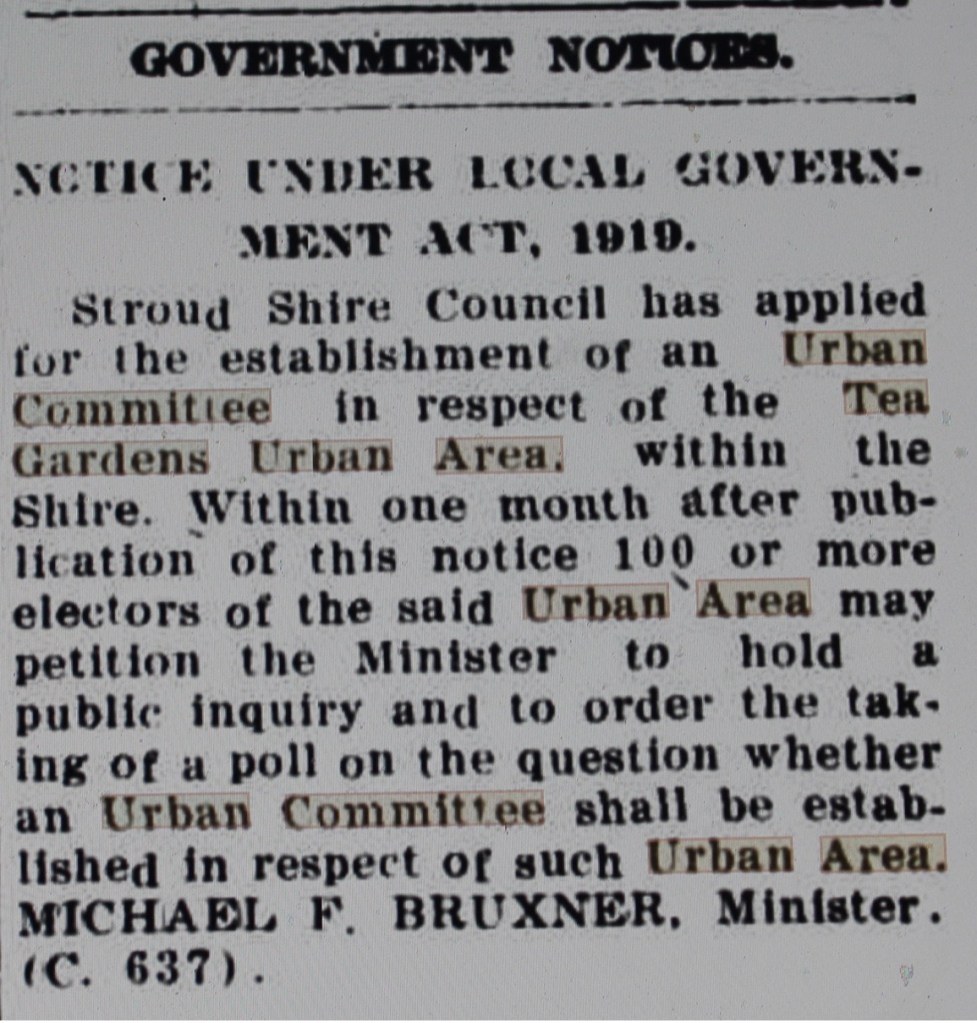
Notice for establishment of the Tea Gardens Urban Area Committee [Dungog Chronicle, 17 January 1930]
Works Proposed for Future Urban Area Committee – 1930
With the thought of a new Tea Gardens Urban Area Committee before the minds of local residents, a range of works were proposed that would need the urgent attention of the new committee. Such matters included urgent repairs to the wharf, drainage, and street lighting.
Nominations called for the Urban Area Committee – 1930
The Dungog Chronicle of 25 July 1930, page 4, reported:
‘Nominations closed on Thursday last in connection with Committee-men for the proposed Urban Area for Tea Gardens. The amazing feature of the whole business is nobody appears to have been aware of the fact. Those interested in the matter have genuine cause for protest and complaint. Who is to blame? That is of little concern provided a suitable opportunity is afforded to those interested in the matter. But as things stand a number will no doubt be dis-franchised through no fault of their own.
It was not until Monday night that a few nomination forms were available through Cr. Harris. The usual advertisement has not appeared in a newspaper circulating in this district. We were informed that the matter was published in a late edition of the Newcastle paper which is not circulated in this district. A vain and an expensive method of trying to meet the technical requirements of the act with which to cover up the lackadaisical methods so strikingly adopted in this matter. This paper made enquiries from Cr. Harris, who rang the shire for information, and to our mind the information that the Department of Local Government did not afford the shire clerk sufficient time wherein to complete the requirements of the gazettal notice, is entirely unsatisfactory. But there would have been nothing unusual in the Department of Local Government inserting a fresh notice in the gazette.
The electors of the Urban Area should be the first consideration. As matters stand the public have not been afforded sufficient time in which to arrange candidates and nominations. Since the above has been in type we have received a notice from the Shire Clerk which appears in our advertising columns, attention is drawn to it. The date for the receipt of nominations has been altered and the election will not be carried out by means of postal voting but by personal voting at a booth at Tea Gardens.’
Nominations for the First Urban Committee Received – 1930
The Dungog Chronicle of 8 August 1930, page 4, reported:
‘Messrs. T. E. Pyman, R. Zeininger and George Davies were the only nominees for the Tea Gardens Urban Area. The election was set down for the 16th instant, and they will assume their honour as from this date. The three gentlemen may be regarded as highly suitable for the office under the provisions of the local government act.
It is considered that the committee elect will bring seasoned judgment into the work that will come before them. There are still many local requirements outstanding that will call for their seasoned judgment that should reflect credit upon the Urban Area and those who are responsible for their nominations. The Stroud Shire has shown earnestness in carrying out many belated works which will prove a relief to the work of the committeemen. The time is ripe for this new body making an effort of securing a portion of the unemployed funds for the employment of some of the many unemployed in this centre.’
First Committee take Oath of Allegiance – 1930
The Dungog Chronicle of 5 September 1930, page 4, rported:
‘Mr. Adcock, Clerk of the Stroud Shire, paid an official visit to Tea Gardens last week in connection with the oath of allegiance, and the appointment of officers of the committee. Mr. T. E. Pyman, was appointed chairman, and Mr. George Davies Secretary. We wish the Urban Committee a happy experience in their new role, and as this committee forms a new page in the history of local government in Tea Gardens we feel that the gentlemen who form the committee shall introduce into that history a wealth of wisdom.’
Mr. T. E. Pyman subsequently resigned as secretary of the Tea Gardens Progress Association as he thought this necessary in light of his new chairmanship role with the Urban Area Committee.
Advice sought from Committee regarding proposed swimming baths – 1930
The Dungog Chronicle of 19 September 1930, page 4, reported:
‘The baths came before the Stroud Shire [Council] at its meeting on Friday last, when the Engineer reported regarding cost. Now that the Urban Area Committee is functioning it was resolved to refer the matter to this body for consideration as to whether the proposal meets with local requirements. It is desirable that this question is not unduly delayed as summer will be decreed any week, and the need of the baths will be in great demand. If the surf beach at Hawkes Nest was accessible by means of a ferry service, there would not be the same insistent demand for the baths. The Urban Area Committee will be fully competent to say whether the proposed expenditure will be justified, or make a concrete suggestion for satisfactory repairs on an economic basis that will be justified in accordance with income from the Urban Area.’
Histories of the Tea Gardens – Hawks Nest Ferry and the Tea Gardens Baths are found at the respective links on the website.
With regard to the Ferry, the committee voted £25 of its funds towards the cost of constructing the landing approaches.
Urban Area Committee raises various Issues with Stroud Shire Council – 1931
The Dungog Chronicle of 17 April 1931, page 3, reported:
‘Tea Gardens Urban Committee wrote [to Council] regarding straying stock and asked if the Committee could appoint an impounding officer. A request was also made for a report on the drainage of Tea Gardens, and further that the Engineer advise regarding the intersection of Witt and Maxwell-streets. Extra sanitary accommodation was needed in the camping area. On the motion of Cr. Harris, it was decided that the committee recommend to Council some person as impounding officer. The other matters mentioned in the letter were referred to the Engineer. The Tea Gardens Urban Committee objected to the application for a permissive occupancy by Arthur Sheather who desired to build a slip and wharf opposite lot 7, section 4, on the grounds that he was a minor. — It was decided to inform the Department that there was an objection.’
Town drainage receives attention from the Urban Area Committee – 1931
The Dungog Chronicle of 15 May 1931, page 4, reported:
‘The Shire Engineer, Mr. Stone, at the invitation of the Tea Gardens Urban Committee visited town last week in connection with a proposed scheme which will drain certain areas of the township which are subject to the effects of heavy rain, particularly during the winter months. It is understood that the Engineer can overcome the chief trouble and is preparing plans accordingly. The residents affected have patiently borne grave inconvenience and discomfiture over many years and will have good reasons for appreciating the efforts made by those concerned on their behalf. This scheme in itself mere than justifies the creation of an Urban Area which has the power to spend its own funds. Other important works could be undertaken if outstanding rates were paid, and relief, in this way, could be given to local unemployed. The committee propose spending a sum of money in gravelling certain spots.’
The Dungog Chronicle of 21 August 1931, page 4, further reported:
‘The Urban Committee have called for tenders in connection with the town drainage. Tenders close this week. The shire engineer has charge of this work on behalf of the Committee. This drainage will confer considerable relief, during wet periods, to an important centre of the town.’
Urban Area Improvements – 1931
The Dungog Chronicle of 24 December 1931, page 4, reported:
‘The Tea Gardens Urban Committee are having quite an amount of local work carried out in the area. It has had the two-fold object of providing work for a number of local unemployed, and attention to many objectionable town features. The many users of Holbert Town road will appreciate the maintenance that is being carried out.
The disappearance of the miniature lagoon which has existed between Messrs. Pyman and McRae’s properties for so many years, has been an eye-sore and a reflection upon civic pride for too long and the committee are to be congratulated upon giving this eye-sore attention. The creation of the Urban Committee is proving a boon and a blessing to ratepayers and residents alike. Their work has not entailed extra taxation.’
First Statement of Accounts for the Urban Area Committee – 1932
The Dungog Chronicle of 13 May 1932, page 4, reported:
‘Mr. Thomas E. Pyman, Hon. Sec. of the Tea Gardens Urban Area Committee has received the statement of accounts for the year 1931, returned from the Department of Local Government and endorsed as being in order. Sundry creditors for goods and services amounted to £18/10/11. The balance at 1/1/1931 was 3/11 and the surplus from Revenue account £27/5/2 — total £46.
The credit balance at the bank was £34/8/6; stores and materials £6/10/11— total £46. The revenue account was as follows: —Rent, etc., 2/9, stamps, etc. £1/13/8, telephone 4/-, bank charges and exchange 12/9, workers’ compensation £1/4/-, sundries 3/-, camping reserve expenses £12/19/-, roads, streets and culverts, construction £82/11/7, maintenance £98/5/3, balance £27/5/2 — total £225/5/2.
By votes from Council for general purposes £218/13/8, camping reserve £6/11/6— total £225/5/2. The committee, of which Mr. George Davies is President, had a successful year. There is plenty of work yet to be done and the committee has the whole of the countryside behind it.’
Disorder at an Urban Committee Meeting concerning the camping area – 1933
The Dungog Chronicle of 20 January 1933, page 3, reported:
‘George Davies, Tea Gardens, forwarded a statement of what took place at the meeting of the Tea Gardens Urban Area Committee, which meeting, he, as Chairman, was forced to close through disorder. Before proceeding with general business, Secretary Pyman read an ordinance which referred to Committeeman Engel remaining in the room whilst business in connection with the camping area was being dealt with. At this stage there was no motion moved regarding the camping area, in fact no business was transacted other than that mentioned in my statement.
Mr. Engel asked the Secretary did he infer that he would have to leave the room. The Secretary replied: You heard what I read and if you have any brains you know what do to. Considerable cross firing followed between them and I called for order. Secretary Pyman insisted he was going to have his say and would take certain steps, to know why the Council allowed the committee to spend money on private property. At this stage owing to the disorder, I was compelled to close the meeting, and on waiting the required period for things to quieten down, there being no improvement, I abandoned the idea of continuing by re-opening the meeting.
Regarding my resignation, I regret being compelled to take this course as well as putting the Council to the trouble and expense of an election to fill the vacancy. I would have liked to have seen my term through for the sake of those who voted me into the position. However, I realise that under the circumstances existing, the committee had no hope of carrying on. I wish to accept and convey to the Councillors and staff my appreciation of the prompt and courteous manner in which they have dealt with any inquiries I have made in connection with the Urban Area Committee.
Mr. Les. Engel, a member of the Urban Area Committee, to whom the Clerk had written regarding the matter, and forwarded a copy of a letter sent to Council by Mr. T. E. Pyman, Secretary of the Urban Area Committee, wrote as follows:— In reply I have to report, it is true that I am a member of the firm of G. A. Engel and Sons, Ltd. The action of Mr. Pyman, Secretary Urban Area, in reading the ordinances on consanguinity did not convey to me that I was disqualified from being present at the meeting because no business was being dealt with in which I had a pecuniary interest. I regard the whole of his letter as being irrelevant.
The firm of G. A. Engel and Sons, Ltd., give the Council the use of a certain portion of land as a camping area. No charge is made for it. Apart from this, neither myself nor the firm have relationship with the Urban Area. The procedure of the meeting complained of was: — (1) The appointment of officers; (2) Confirmation of minutes; (3) Correspondence read and dealt with; (4) Accounts passed for payment; (5) General business.
At this stage, Mr. Pyman said: — “In connection with the camping area, there is an ordinance I am going to read” After having done so, I asked Mr. Pyman “Do you infer that I have to leave the room.” He replied: “If you have any brains, you know what to do.” In answer to this I told him I had as much brains as he had. The Chairman called “order.” Mr. Pyman insisted upon having more to say, and among other things said he would report the matter and demand an inquiry through the Department of Local Government as to why the Council allowed the Urban Area to spend money on private property, viz., the camping area.
In view of the disorder the Chairman suspended the meeting. It will be understood that there was no motion before the meeting even if I were disqualified under the ordinances. I am not aware that the firm of G. A. Engel and Sons, Ltd., have repudiated the conditions governing the camping area. Mr. Pyman has never to my knowledge brought this alleged repudiation before the Urban Area or taken the matter up with the firm. Mr. Pyman’s reference to the chairman is not consistent because after Mr. Davies was elected chairman, Mr. Pyman remarked that he had never sat with a better chairman. If I may say so, Mr. Davies is in no way influenced because he is a member of the staff of G. A. Engel and Sons, Ltd, and Mr. Pyman’s remarks, are in my opinion an insult to the Chairman’s undoubted integrity. I appreciate the action of the Council in forwarding me the communication.
The Clerk stated that following Mr. Davies’ resignation, he had taken the necessary steps to have the vacancy filled. In answer to Cr. Harris, the Clerk said he did not think that Mr. Engel had created any breach of the ordinance. The camping area did not belong to the Urban Committee, it was given to the Council. This Council had not committed any irregularity in spending money on it. The case of Forster was similar. The Urban Committee there collected the camping fees and spent the money on the area. In answer to another question, the Clerk said the land was not vested in the Council.
Cr. Harris said that it appeared from the correspondence that Mr. Pyman was contemplating further action. The Clerk said he was going to suggest copies of the correspondence be sent to the Department for an opinion. Cr. Harris thought copies of the correspondence could also be sent on to Mr. Pyman. The Clerk said Council was given the use of the land free of charge. It was just an act of grace to allow the public, through the Council, the use of the area for camping. The Council gave the Urban Committee the right to collect fees and spend the money on the area, for example, to provide sanitary conveniences. There had been no repudiation by Engel and Sons.
Cr. Kesteven said the question was whether Mr. Pyman had exceeded his duty as secretary in his conduct at the meeting; if so his attention should be drawn to the matter. It might spoil the committee. Cr. Harris: That is why Mr. Davies resigned. Clerk: He has exceeded his duties, but probably he was unaware of it.
Cr. Kesteven thought Mr. Pyman should use polite language in any case. He thought Council should make sure its position was sound and if so, then they could rap him over the knuckles. Council then decided to put the matter before the Local Government Association’s solicitor. Cr. Harris said the meetings were held at Mr. Pyman’s home, and Mr. Engel would not attend because of the disadvantage in which he was placed.
The Clerk asked what about dis-banding the committee altogether and letting Council carry on. Cr. Kesteven. mentioned a general election. Cr. Harris thought that would not be fair. Anyhow, there was a hallwhere meetings were generally held, and the Urban Committee could meet there. The Clerk said that the Committee could decide where its meetings are to be held. After further discussion it was decided, in addition to getting the Local Government Association’s solicitor’s opinion, to send copies of the letters to Mr. Pyman, and ask him for a reply, and it was left to the President, Cr. Harris and the Clerk to take any action necessary.’
The Dungog Chronicle of 17 February 1933, page 6, reported on the response from the solicitor to the Shires’ Association, that had been sought by the Stroud Council:
‘A. R. Bluett, Solicitor to the Shires’ Association, wrote as follows: — I have yours of 27th inst. concerning the alleged disqualification of an Urban Area Committeeman. I am not informed as to the arrangement between Council and the company concerning the use of the land referred to. Apparently, the ownership of the land is retained by the company and the Council merely has a permit to use it. That being so, when any proposal affecting the land is before the Urban Committee, a member of the firm would be disqualified if what is proposed to be done by the committee would be such that he could be held to have any pecuniary interest in it. For example, if the committee proposed to level off the land so as to make it more valuable to him as owner, or to fence it or place on it any improvements which would be of benefit to him when the Council’s permit was cancelled or expired, then he would have a pecuniary interest in what the committee is doing. He would not, however, have a pecuniary interest in the payment of fees by campers and the ordinary management of the ground as a camping reserve.
There was, however, no necessity for the secretary of the committee to do anything more than draw Mr. Engel’s attention to the ordinance and it was then for Mr. Engel to decide whether he was disqualified or not. If Mr. Engel thought he was not and was prepared to run the risk of some person taking action against him under Ordinance 1 Clause 32(a), it was quite competent for him to do so.
In connection with this matter, I would suggest that you give consideration to the question whether the arrangement between the Council and the company for the use of this ground is sufficient to allow the Council to treat it as a reserve provided by the Council under section 348. The above matters were considered and dealt with by Council in “Camera.”
Two Vacancies on the Urban Area Committee to the Advertised – 1933
The Dungog Chronicle of 24 January 1933, page 2, reported:
‘Recently, Mr. G. J. Davies, Chairman of Tea Gardens Urban Area Committee resigned his position as a member of the committee. Stroud Shire Clerk (Mr. H. H. Adcock) has how received the resignation of the Secretary, Mr. T. E. Pyman. In order to fill the two vacancies, an extraordinary election will be held by postal ballot on Saturday, February 25. Nomination day has been fixed for Friday 3rd of February.’
The Dungog Chronicle of 18 May 1934, page 6, further reported:
‘Tea Gardens Urban Area (P. Ward, Secretary), reported that numerous complaints had been received in reference to the connecting road leading to the cemetery being undermined by persons obtaining sand for cementing and concreting. It was desired to know whether the road is Government land or otherwise. The Committee desired a suitable warning notice if legal.
It was also pointed out that there was no particular garbage dump within the urban area and one was urgently desired. At present garbage was dumped anywhere. The President moved that the committee be informed of the regulations governing each issue raised, and that the matter be dealt with on the next, visit of the Engineer. The motion was seconded by Cr. Bowen and carried.
Tea Gardens Urban Committee informed Council that it views the probable heavy costs of providing the necessary material to protect the foreshores of the township and cannot commit itself in connection with any loan covering same. The committee would like the Council to furnish an approximate estimate of the necessary expenditure and the rates of interest chargeable on any loan. The Clerk said that the only way to do the work would be to get a loan and deduct the repayments from the Urban Area Committee’s annual grants. It was moved by the President that the writers be informed of the financial matters referred to.’
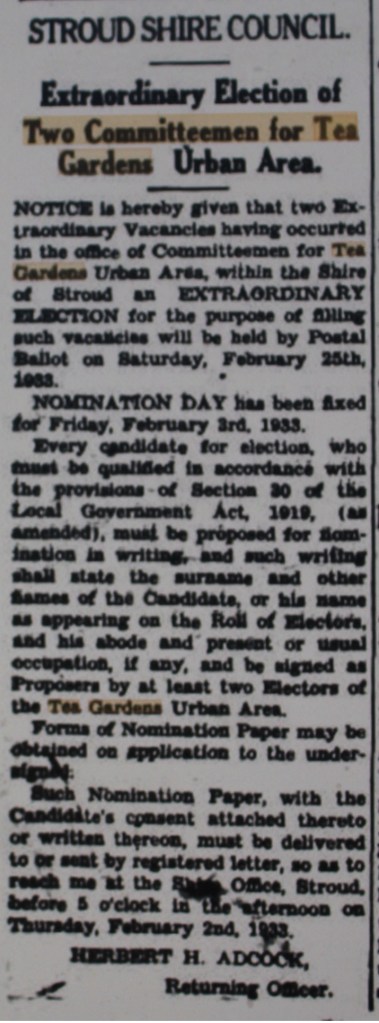
Notice for the election of two new Urban Area Committee members [Dungog Chronicle, 24 January 1933]
Two New Members elected to the Urban Area Committee – 1933
The Dungog Chronicle of 17 February 1933, page 2, reported:
‘Messrs. Percy Ward and Tom. Croese have been elected to the Urban Area Committee at Tea Gardens vice Messrs. G. Davies and T. E. Pyman, resigned. Both gentlemen are well known in Dungog and surrounding districts and are keen on advancing the interests of Tea Gardens from the tourist point of view, as well as in every other way. The third member of the committee is Mr. Les. Engel who likewise carries the esteem and regard of the whole district.’
Committee Meetings – 1934
The Dungog Chronicle of 11 May 1934, page 4, reported on the May meeting:
‘The usual monthly meeting was held on Friday, 4th May. The secretary was instructed to write to the Shire Council to see if a garbage dump could be established in Tea Gardens. At present any old place does and a proper dump would be an asset. He also had to write to see who owns the road leading from the main road to the cemetery. At present persons are taking sand and undermining the road. Regarding the loan for repairing the river embankment, the secretary has to make further inquiries re interest, etc.’
The Dungog Chronicle of 15 June 1934, page 4, reported on the various correspondence items dealt with at the June meeting:
‘The usual monthly meeting of the above was held in the Australia hall on Thursday, 7th June. Owing to the absence of the President (Mr. E. Motum), through sickness Mr. H. M. Engel, Vice-President, was chairman. Others present were Messrs. R. E. Zeininger, H. Thurlow, V. Edmonds and A. W. Vaisey (hon, secretary). Correspondence was received from the Stroud Shire stating that the matter of the river bank at Tea Gardens and the pump at the beach were referred to the Urban Area Committee.
From the Urban Area Committee, stating that Witt-Street between the school and Maxwell-Street could not be attended to at present owing to lack of funds, and that the pump at the beach was attended to. The secretary was instructed to write to the Fisheries Department and have the Oyster Reserve gazetted as such. The Urban Area regarding Witt-Street again, also drawing attention to Ogden Street between Myall and Witt Streets. To the Stroud Shire asking attention be given to the Karuah road and also that a fence and gate be erected at Karuah Punt for driving cattle on to the punt and ask Port Stephens Shire to do the same on the other side of the river. To the Pastures Protection Board, Gloucester, asking that an officer be appointed at Tea Gardens to issue stock travelling permits.’
Committee applied to have membership expanded to five – 1935
The Dungog Chronicle of 1 March 1935, page 4, reported:
‘The election of committeemen for Tea Gardens Urban Area is fixed for 23rd March by postal vote. Last December no one nominated, and the Stroud Shire Council requested the Minister for Local Government to hold an election, which is now set down for the 23rd March. When there were no nominations received in December, and it looked as if the Urban’ Area Committee would be abandoned, Mr. T. E. Pyman requested Mr. C. E. Bennett, M.L.A., to wait on the Minister for Local Government and ask that the committee be re-constituted to consist of five instead of three members.
Both Mr. Bennett’s and the Minister’s replies are given in another column [see section below]. The Urban Area Committee has been active now for a number of years and they have done good work. The first committee consisted of Messrs. T. E. Pyman (president), Geo. Davies (secretary), and R. E. Zeininger. They were elected unopposed and held office for about 12 months. Then another election was held and Mr. L. F. Engel was elected in place of Mr. R. E. Zeininger. The committee then was Messrs. Geo.Davies (president), T. E. Pyman (secretary) and L. F. Engel. After a time both Mr. Davies and Mr. Pyman resigned, and their seats were filled by Messrs. T. Croese and P. Ward, who were elected unopposed. The committee then was Messrs. L. F. Engel (president); P. Ward (secretary), and T. Croese. Mr. T. Croese left the district shortly afterwards and resigned, and his position was filled by Mr. Hugh Thurlow (unopposed).
Last September Mr. P. Ward resigned and Mr. Hugh Thurlow acted as secretary. Permission was obtained to carry on without an election pending the general election in December. For the forthcoming election there are eight nominations, viz., Messrs. William Edward Burrows, Hugh Thomas Aden Cook, George Davies, Leslie Frederick Engel, Ernest William Motum, Tom Perrin, Thomas Edward Pyman and Russell Edwin Zeininger. Three are to be elected. So far there have been no election speeches, each relying on the good name they have with the electors.’
The Dungog Chronicle of 1 March 1935, page 4, further reported on the above issues:
‘In connection with the above matter Mr. T. E. Pyman has been advised as follows by Mr. C. E. Bennett, M.L.A., under date 11th February: — “In reply to your communication of the 8th instant, relative to the Tea Gardens Urban Committee, I desire to state that I am this day making representations to the Minister for Local Government, on your behalf, suggesting that the committee, be re-constituted to consist of five instead of three members. “Immediately I am in receipt of his reply I will communicate with you further.”
Mr. Bennett has since received the following communication from the Hon. E. S. Spooner, Minister for Local Government: — “With reference to your personal representations I have to inform you that at the ordinary elections held in December last, no nominations were received in respect of the Tea Gardens Urban Committee within the Stroud Shire, and, in pursuance of the Council’s application in the matter, 1 authorised the Council, under Section 549 (6A.) of the Act, to hold, a further election forthwith. “Since the machinery has now been put in motion towards the holding of a fresh election, this action will now have to proceed.
“So far as a proposal for the increased representation of the Urban Committee is concerned, I have to invite attention to the provisions of Section 549 (4) of the Local Government Act, 1919, which provides that the number of committeemen constituting an urban committee shall be three or such other number as the Governor may determine from time to time. I consider, however, that it will be time enough to deal with any such proposal when the existing vacancies in the Committee have been filled and I would suggest that the matter be allowed to remain in abeyance in the meantime.”
New Urban Area Committee members elected – 1935
The Dungog Chronicle of 29 March 1935, page 4, reported:
‘An election for three committeemen for Tea Gardens Urban Area was held by postal vote, closing last Saturday. The result of the ballot was as follows: — Geo. Davies 75; E. W. Motum 74; R. E. Zeininger 71; L. F. Engel 71; T. E. Pyman 41; T. Perrin 41; Aden Cook 39; W. Burrows 35. Informal 18. Messrs. Zeininger and Engel came a tie and Mr. Zeninger won the draw for the position. The new committeemen are Messrs. Davies, Motum and Zeininger. Mr. Davies has been on the committee before and held the position of secretary and president. Mr. Motum, who will make his first appearance on the committee, has held the position of president of the Progress Association for a number of years. Mr. Zeininger was on the first committee but held no office’
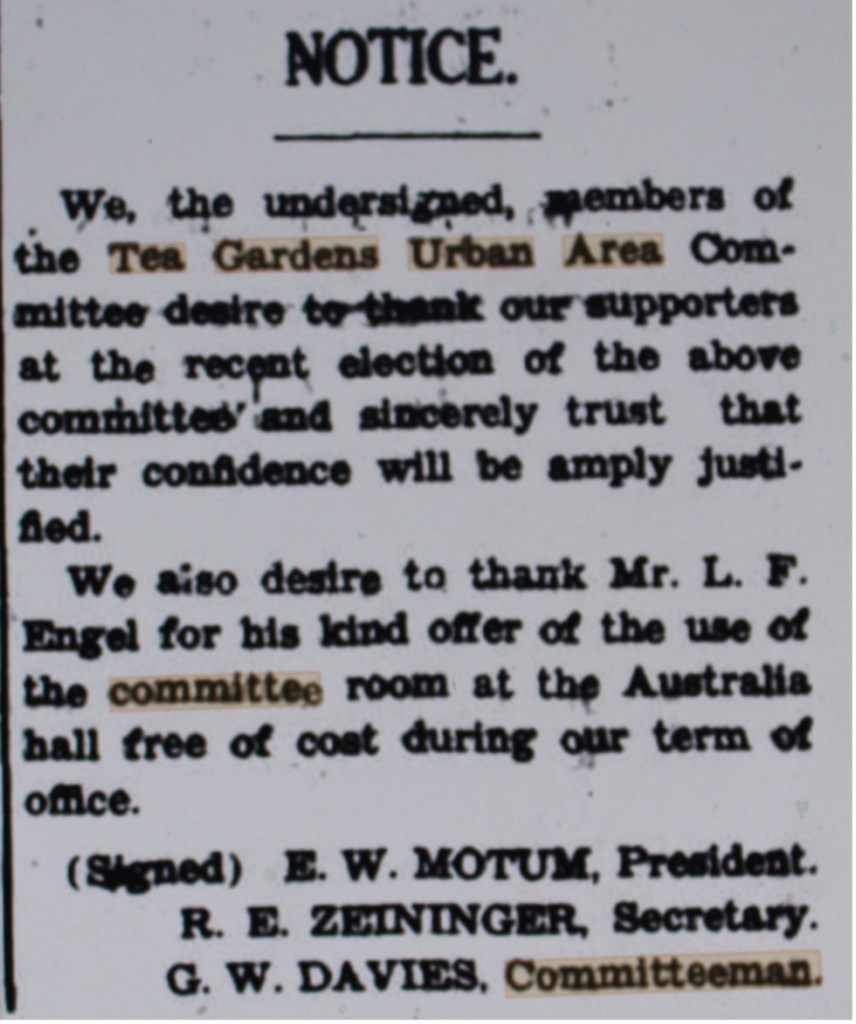
Notice placed by the new Urban Committee members [Dungog Chronicle, 12 April 1935]
Committee Member resigns – 1936
The Dungog Chronicle of 21 February 1936, page 6, reported:
‘The Shire Clerk, Mr. H. H, Adcock, reported as follows: Assistant Engineer — Nominations for candidates to fill the position of Committeeman to Tea Gardens Urban Area rendered vacant by the resignation of Mr. Zeininger, closed on Thursday, 6th inst., at 5 p.m. No nomination was received by me until the next day, when that of Mr. W. E. Burrows was received. As it was too late, I cannot hold an election or even declare Mr. Burrows elected, but would suggest that, under the provisions of Section 549 (6a) of the Act, application be made for appointment by the Governor of Mr. Burrows to the position.’
Proposal for a camping fee by Urban Area Committee criticised – 1936
The Newcastle Morning Herald and Miners’ Advocate of 7 August 1936, page 22, published the following letter to its editor from Mr Hugh Thurlow:
‘Some residents of Tea Gardens, having gone to considerable trouble and expense in making preparations to cater for visiting motorists during the coming summer season, view with grave concern the stated intention of the local urban area committee to inflict a surcharge of, it is said, 2/6, upon all tents pitched upon private property within the area. Whilst the urban area committee control, at some public expense, a camping ground situated in the back area of the township, which is little used, presumably because visitors prefer other sites upon or near the water frontage, it appears unjust that private enterprise responsible for making available a more attractive camp should be penalised by such a surcharge as suggested, which would practically double the camping fees upon private property, and, consequently, place owners at a distinct disadvantage.
It is said by officers of the urban area committee that an object of such surcharge is to, in part, defray the expense of improvements and buildings, shelters, shop, etc., now under construction at the ocean beach. Providence Bay, which are estimated to cost about £2000, and whilst such additional tourist attractions are to be highly commended, it should not be financed by making Tea Gardens less attractive through the imposition of practically a double camping fee upon ground other than the urban committee’s own camp site.
The future progress of this district is largely dependent upon the united effort of residents to develop its great potential tourist attractions, and this is not to be achieved by dividing public interest and making one section hostile to the other. In short, the urban area committee’s effort at progress appears to suggest making the ocean beach more attractive by making Tea Gardens less attractive. I must admit feeling rather puzzled myself at our urban committee’s policy, and feel somewhat like the Frenchman who, when commenting upon the queer ways of the English, remarked: He first squeezes a lemon in his whisky to make it bitter, then puts in sugar to make it sweet, adds boiling water to make it hot, blows it to make it cold, drinks it, and remarks, “Very nice.”‘ From what one hears, I am afraid that local property owners will not make the Englishman’s remark, either about our local committee. or the proposed surcharge against campers.’
New Camping Pavilion at Hawks Nest funded by the Urban Area Committee – 1936
The Dungog Chronicle of 11 August 1936, page 2, reported:
‘The Stroud Shire is doing much to develop its tourist resorts ….. At Tea Gardens work has commenced on the new camping ground developmental scheme on the Hawk’s Nest reserve. A contract for the erection of the pavilion has been let to Mr. H. J. Thwaites. A modern luxury pavilion will provide accommodation for all the necessities of the campers, such as plunge baths for ladies and gentlemen, public wash houses and showers, modern hot and cold water system, shop and general provision store, lounge and reading room, small cabaret and dance floor, sun room, laundry and open fireplaces, mechanical water supply and electric lighting system.
Work is now in hand on the site levelling and grassing and tree planting. The scheme was designed by the Shire Engineer, Mr. F. G. D. Stone, A.R.I.B.A. It is being financed by the Tea Gardens Urban Committee and on completion will introduce a new era in camping life.’
Further information on the Hawks Nest Camping Pavilion is found at this link on the website.
Urban Area Committee deals with multiple issues – 1936
The following two monthly reports show how the Urban Area Committee was operating as a scaled-down version of a local government council.
The Dungog Chronicle of 18 September 1936, page 6, reported:
‘[Correspondence] from Tea Gardens Urban Committee, asking that the whole of the Urban Area be included in the scavenging area [area of garbage collection]. The latter did not now include Limekilns, Hawks Nest, Winda Woppa or that part north of Motum’s property. Cr. Zeininger stated that the contractor would have to travel an extra 2 miles to Limekilns. It was essential however that Hawks Nest be included in the area. He moved that the Engineer be instructed to prepare a draft of the proposed scavenging area. From the same Committee advising that A. Ward was putting down rails and that E. Korsman had commenced erecting a shed or garage without permits. It was asked that the Committee be advised of all permits granted for the area.— The [Council] Clerk stated that he had a communication from Ward on the matter and he would comply with the request of the letter. Korsman’s matter is to be further investigated.’
The Dungog Chronicle of 6 November 1936, page 4, also reported:
‘The usual monthly meeting of the Urban Committee was held on Thursday, 29th Oct. Present: E. W. Motum (chairman), W. Burrows, and V. Edmonds, secretary. Correspondence was received from: Stroud Shire, forwarding straying stock notices. From same advising that the council declined Mr. H. Thurlow’s offer of £2/12/ per annum in lieu of paying 2/6 for each tent. Same asking had the Urban Committee any objections to L. G. Holbert being granted a street trading license. Same advising that Mr. F. G. D. Stone has been appointed Director of the pavilion being erected at Hawk’s Nest.
Same forwarding a permit for Mr. C. Moore to collect fees for erecting tents. Same asking for any objections to a permissive occupancy for W. Ward. From C. E. Bennett, M.L.A., acknowledging letter regarding the absence of the telegraph messenger during afternoons stating the matter is receiving attention. H. C. G. Thurlow offering to pay £2/12/ per annum in lieu of 2/6 per tent. H. C. G. Thurlow declining to pay the 2/6 fee for tent erections. W. J. Phillips asking to have a lane near his house cleared. W. J. Phillips seeking support in having the sanitary depot removed to another site.
It was decided that the Secretary write the Shire Council and ask them to reconsider Mr. H. Thurlow’s offer of £2/12/ in lieu of 2/6 per tent, and also stating that the committee had no objections to Mr. W. Ward being granted a p.o. Mr. L. G. Holbert’s request for a street license was recommended to be granted for a stand in front of the Australia Hall. Mr. W. J. Phillips is to be informed that the committee were in favour of clearing the lane as requested, but there were no funds available at present.
The Secretary was instructed to write the Shire Council re the sanitary depot, asking could a new site be made at the rear of the cemetery. Mr. Blanch is to be given 7 days to remove rubbish placed by him in Myall Street. Messrs. deLore and Moriceau to be notified that they must not use the baths wharf for their punt as it was damaging the baths. The following accounts were passed for payment: A. E. Davies, wages, £4/6/2; Stroud Shire, sanitary fees, £1/14/8; G. A. Zeininger and Sons, building and erecting tank £9/2/3. The Stroud Shire is to be asked to bank rates collected from the Tea Gardens Urban Area as they are collected.’
Urban Area Committee concerned about financial liabilities – 1937
The Dungog Chronicle of 22 January 1937, page 4, reported:
‘Tea Gardens Urban Committee again asked [Stroud Council] that rates collected in Urban area be banked to the credit of the Committee. Funds were needed for the baths and the Hawks Nest reserve.
The Clerk: I will look into the matter and see what money is available. Cr. Zeininger: They feel a little uneasy regarding their liabilities. They have the pavilion and other necessary works. They have to maintain the existing baths and a mast on the wharf has to be renewed. Direction notices also have to be erected. From same advising that a Cessnock man had refused to pay a tent erection fee at Hawks Nest. The defaulter was prepared to take the matter to court and his case was being watched by several who had paid their fees. The Committee considered it would be necessary to prosecute. Cr. Zeininger moved that the offender be notified that if the amount owing be not paid within 14 days, proceedings for the recovery of same would be instituted. — Seconded by Cr. Wilmen and carried.’
Vacancy on the Urban Area Committee – 1937
The Dungog Chronicle of 19 March 1937, page 4, reported:
‘At the meeting of Stroud Shire Council on Friday last a communication was received from the Department of Works and Local Government re extraordinary vacancy on the Tea Gardens Urban Committee, on account of the absence of G. Davies from four consecutive meetings of the committee. It was asked if the absence in each case was without leave. …..
The Secretary of the Committee had not notified Council of the state of things and the matter had reached such a stage that Mr. Davies’ seat had become vacant on 22/10/36, he having absented himself from four consecutive meetings. The Clerk said he had written to the Secretary of the Committee for information. As the time for holding an election had elapsed, it remained for the department to fix a date, or appoint someone to the position. …
The Clerk: I do not know whether the Committee should remain in existence or be dissolved. Cr. Zeininger: I think that the dissolution of the Committee would be a retrograde step because for one thing it would throw more responsibility on the Councillor for the area and the Urban Committee being three persons could distribute its influence a little wider than one individual. Also, I favour an election for the position of committeeman. I do not know what the cost would be. Cr. Turner: I too, would favour an election because it gives the public an opportunity of selecting their representative. On the motion of Crs. Zeininger and Higgins it was resolved to advise the Local Government Department that Council favours an election rather than appointment by the Governor. Also, that the Minister be asked, under the seal of the Council to fix a date for the election.’
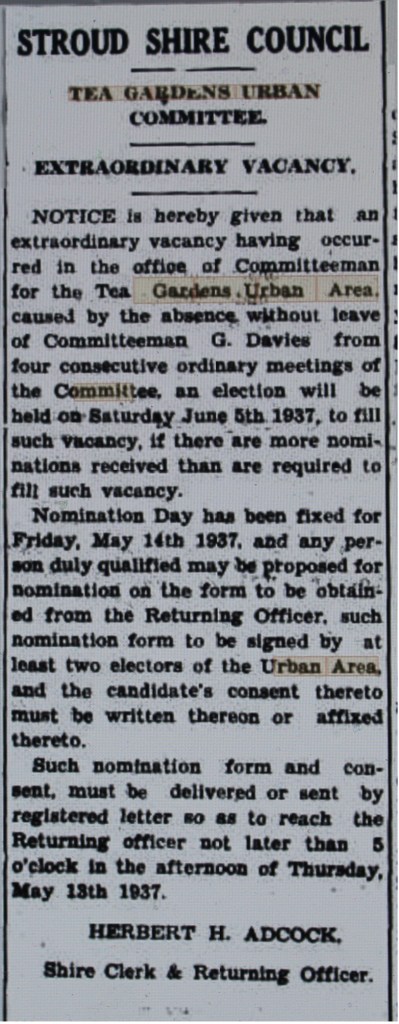
Notice of vacancy on the Urban Area committee [Dungog Chronicle, 30 April 1937]
Loan to be raised to fund swimming baths – 1937
The Dungog Chronicle of 15 October 1937, page 6, reported:
‘[Correspondence ] from Tea Gardens Urban Committee agreeing to the Council raising a loan of £750 towards the cost of construction of baths at Tea Gardens, and also agreeing to make the repayments of principal and interest of £34/13/ each half year; also desiring the Council to make a rate levy of 2d in the £ in the Urban Area for general improvements.’
Urban Area Committee advocates for dredging of waterway – 1938
The Dungog Chronicle of 3 June 1938, page 4, reported:
‘On Friday Mr. G. Carleton, Officer in-Charge of the Public Works Department, Newcastle, visited Tea Ga-dens and was met by Mr. C. E. Bennett, M.L.A., Cr. R. E. Zeininger (Stroud Shire), Messrs. E. A. Motum (Urban Committee) and A. Motum.
The object of the visit was to deal with dredging problems. The requirements of the Urban Area Committee and the Progress Association were placed before the visiting officer, and an inspection of the river and the foreshores was made. The need for placing the dredged sand on the eastern end of the town on the southern side of the road was emphasised. The problem of placing a stone wall or a pole wall along the foreshore, behind which dredged sand would be placed, was also considered.
The river is in a bad state and the worst spots were pointed out. The baths were also under review and the advisability of having concrete piles was discussed. Improvement to the river approach to Hawks Nest wharf was urged. These and various other matters were fully dealt with and it seems as if the needs of the locality will be met in a reasonable way.’
Monthly meeting of the Urban Area Committee – 1938
The wide variety of issued dealt with by the Urban Area Committee is illustrated by the following report published in the Dungog Chronicle of 4 March 1938, page 4:
‘The usual monthly meeting of the Tea Gardens Urban Committee was held on Thursday, 24th February. Mr. C. B. Foster (deputy chairman) was in the chair and others present were Messrs W. J. Ringland, E. W. Engel and the Secretary.
Correspondence was received from Sir Earle Page stating that the matter of having a permanent cable laid to Hawks Nest was receiving attention and that the name of Mr. A. A. Engel to have his telephone connected to the trunk line during the absence of the postmistress, was sent on to the postal department. From C. E. Bennett, M.L.A., regarding the dredge. This was dealt with at the special meeting on the 14th Feb. From M. Richards, Bulahdelah, seeking information regarding the Urban Area. — The secretary was instructed to supply the required information.
From Stroud Shire stating that (1) W. J. Phillips made application to sell his sanitary contract to Mr. H. R. Brown. As Mr. Brown had not supplied the necessary papers no action was taken. (2) Council granting permission to issue permits for cattle to graze on the streets during the daytime. Applications are to be invited for the position of pound keeper and impounding officer at a remuneration to be arranged. (3) Advising that scale of charges for wharf dues were approved of by the Council and were sent to be embodied in the ordinance. (4) Enclosing a plan and extracts from Mr. Hugh Thurlows’ letter regarding tent erections. — The committee approved of the scheme, but desired that the fee be 7/6 per tent and reviewed annually. The collector for tent erection fees reported that two persons refused to pay the fee. The names to be forwarded to the Shire Council for action to be taken. …..
G. A. Engel & Sons advised that they were unable to be present at the meeting but were prepared to allow the Committee to drain Charles Street swamps through their property and that they would do the drains through their property themselves. This matter to be referred to the Engineer. The Tourist Development League is to be asked to co-operate in producing a booklet advertising Tea Gardens and that the committee was prepared to pay £10 towards same. Works to be attended to are: — New planks to be placed in the Government wharf; a fender on the wharf to be attended to; pruning a tree in front of the Port Stephens hotel; cleaning the lavatories on the camping ground; repairing a lavatory at the pavilion.’
The Dungog Chronicle of 16 December 1938, page 6, provided information on the activities of the Urban Area Committee during that month:
‘The Tea Gardens Urban Committee advised that it did not approve of the area offered by Mrs. Brown as a pound site, it being considered the paddock was too close to the buildings.
The committee also wrote recommending that Mr. J. W. Cooper be appointed to the positions of tent erection fees collector and of wharfinger. — The recommendation was adopted on the motion of Crs. Turner and Wilmen.’
Tenth Anniversary of the Urban Area Committee – 1940
The Dungog Chronicle of 6 September 1940, page 4, reported:
‘It was on August 25, 1930, that the Shire Clerk (Mr. H. H. Adcock) met the first Urban Committee at the old Court House and instructed them in their duties. The first Committee comprised Messrs. T. E. Pyman (chairman), Geo. Davies (secretary), and R. E. Zeininger. Messrs. L. F. Engel, P. Ward, T. Croese, H. Thurlow, W. Burrows, C. B. Foster and E. W. Engel have been members of the Committee. When the Committee was in its early stages, funds were scarce, and no great amount of work could be done.
Later the Committee asked for a levy of 2d in the £ on the area. The pavilion has been built and also the baths. The present Committee also find funds scarce, as all the rates, including the extra levy, are absorbed by the Shire to make repayments on the pavilion and the baths. Urgent works on streets or gutters have to stand over until the pavilion and baths are paid for. Although the rates of the Urban Area are paying off these buildings, the Urban Committee had no say in the management of them.
Several months ago the Committee asked the Shire to take over the pavilion, and allow the Committee to have their rates to spend in Tea Gardens. The reply they received was that it would be discussed later. What will the position of the Committee be when it becomes of age?
Financial concerns of the Urban Area Committee – 1941
The Dungog Chronicle of 7 February 1941, page 4, reported:
‘The usual monthly meeting of the Urban Committee was held on Thursday last. Mr. V. Edmonds was in the chair, and others present were Messrs. D. M. Maslen, E. W. Motum, E. W. Engel, and the secretary. A letter from Mr. S. McGrath asking that the blackberries be removed from the property next to his was referred to the Shire Council, asking them to take action to have the blackberries removed. It was decided to clear the weeds off the streets. A man is to be put on for a day to do the job.
Exception was taken to the Shire Council doing work in the Tea Gardens Urban Area. The Council is to be asked to allot the money to the Urban Committee and let them do the necessary work. Arrangements are being made for a wharfinger to collect the dues on the public wharf.’
The Dungog Chronicle of 21 February 1941, page 4, also reported:
‘Tea Gardens Urban Committee wrote [to Stroud Shire Council] enquiring why certain expenditure at Tea Gardens had been entrusted to Cr. Zeininger. Cr. Zeininger said that the money had not actually been expended. Personally, he would prefer that such expenditure be done through the Urban Committee. Otherwise the Committee had no funds to work with, and their existence would not be justified. On the other hand, the Urban Committee could be very useful.
In this case the money was voted through him simply because he had asked for it. It arose from a remark somewhat insulting to Council made in a semi-public place recently. Cr. Flannery moved and Cr. Zeininger seconded that in future all similar expenditure be made through the Urban Committee. Cr. Flannery said that actually it was unfair to a Councillor to place the responsibility upon him. The motion was carried.
Tea Gardens Urban Committee forwarded a complaint from a local resident regarding blackberry growth. Cr. Zeininger said there were also other complaints. It was decided to send notice to owners of properties complained of. Cr. Zeininger moved that the Urban Committee be asked to advise Council as to where blackberry existed. — This was seconded by Cr. Miles and carried.’
Activities of the Urban Area Committee – 1941
The Dungog Chronicle of 17 October 1941, page 3, reported on correspondence relating to the many varied activities of the committee:
‘[Correspondence] from Tea Gardens Urban Committee, asking Council to give consideration to the addition of four street lights in Tea Gardens. The positions suggested for the new lights were corner of Charles Street and Marine Drive, corner of Maxwell Street and Witt Street, corner of Witt Street extended and Engel Street, and in Jacob Street opposite Mr. D. M. Maslen’s residence. The letter said that ratepayers stated that they are charged for street lighting on their rates and receive no benefit. ……
The engineer said that new lights would cost between £20 and £30 each, depending on the site, and it would cost somewhere about £6 or £ 8 per annum to maintain them. Cr. Flannery said that if the Council was going to serve everyone with a light, he did not think the street lighting fund could bear the cost. The matter was left in the hands of the acting engineer for investigation.
From Tea Gardens Urban Committee, asking for a further allocation of £25 to the Committee to carry out urgent work, as the previous amount of £15 had been expended. — Cr. Zeininger said that the chairman of the Committee had explained that the primary need for the vote was for sufficient money to pay the secretary. However, this would not be due until the end of the year. The road along the waterfront at Hawks Nest was in acute need of repair, and the Committee wanted the rest of the money for this. It was an urgent matter to have this road put into reasonable order, as the tourist facilities at Hawks Nest would suffer if it were neglected. ….. Cr. Zeininger moved that £15 be voted to the Urban Committee to be expended on the Hawks Nest road as directed by the engineer. Cr. Wilmen seconded the motion, which was carried. Cr. Flannery said that he was opposed to the expenditure of the money and would vote against the motion.’
The Dungog Chronicle of 21 February 1941, page 4, also reported:
‘The Clerk, Mr. H. H. Adcock, in his report, stated that nominations had been invited for candidates for election to fill a vacancy on Tea Gardens Urban Area, but no nomination was received. As Mr. D. W. Ripley had previously consented to accept appointment, he would suggest that Mr. Ripley’s name be re-submitted for appointment should he be still agreeable. The recommendation was adopted.’
Urban Committee labelled unnecessary – 1941
The Northern Champion of 12 November 1941, page 2, reported:
‘The Tea Gardens, correspondent of the “Dungog Chronicle,” writing in the issue of that paper last Friday with regard to the forthcoming elections, states: “The members of the present Urban Committee are not standing again, as they consider that the shire spends the money for them and that an Urban Committee is not necessary.” Evidently there must be the same feeling at Forster, as it was learned at the weekend that the three present Urban Committeemen at that centre, namely, Messrs. C. A. Blows, W. Cutcher and W. Poppenhagen, had declined to be again nominated for the position.
At Tea Gardens there are five committeemen, but up to the present Forster has only had three. However, by a recent proclamation, the number has been increased to five, and it is fully expected that sufficient nominations will be made to all the positions.’
Urban Committee starved of funds – 1942
The Dungog Chronicle of 25 August 1942, page 3, reported on the difficulty of encouraging persons to serve on the Tea Gardens Urban Committee due to perceived lack of funding:
‘….. Mr. Fitzgerald then referred to the position of the Tea Gardens Urban Committee and asked whether the Council was in a position to nominate persons for appointment to the Committee. The Minister was asking him for a reply. He had intended asking the Minister to let it stand over until he (Mr. Fitzgerald) got to Tea Gardens. However, if the Council could nominate suitable persons for appointment he would submit their names, or if on the other hand the Council thought it would be as well to let the committee be abolished, he would recommend accordingly.
Cr. Zeininger said that lie had tried to get people to consent to nomination, but nobody would take it up. The feeling generally was that in the past money had been so close that the Council had not given the committee sufficient funds to spend in the Urban Area. Mr. Fitzgerald said that in his opinion the powers given to the committee were not sufficient to justify its existence. They were dependent on the council for funds. On Cr. Zeininger’s suggestion it was decided to leave the matter in abeyance for another month.
Disbandment of the Urban Area Committee Recommended – 1943
The Raymond Terrace Examiner and Lower Hunter and Port Stephens Advertiser of 2 December 1943, page 3, reported:
‘At the Stroud Shire meeting the Shire Clerk said he had received information from the Chairman of the Tea Gardens Urban Committee that only two meetings were called since the formation of the Committee, namely for January 24th and February 26th, 1943, which means that the Committee is not now functioning. Your direction as to what advice should be forwarded to the Department will he appreciated. The Council decided to recommend the disbandment of the Urban Committee.’
Financial matters of the Committee to be transferred to Council – 1945
The Dungog Chronicle of 20 March 1945, page 1, reported:
‘[Correspondence] from the Department of Local Government [to the Council] that the Tea Gardens Urban Committee’s statements of accounts for the year ended 31/12/45 have been examined and appear to be in order. As the Tea Gardens Urban Committee is not functioning the assets and liabilities of the Committee should be transferred to the Council’s accounts and administered by the Council.’
Urban Area Committee could be established again if required – 1946
The Dungog Chronicle of 19 March 1946, page 4, reported:
‘[Correspondence] from the Department of Local Government expressing the Department’s opinion that the proper procedure to be adopted at this stage is for the Tea Gardens Urban Committee to be abolished and if by the time the next general elections are due, there is any demand for the re-establishment of the committee, this matter could receive further consideration. Cr. Zeininger moved that it is the considered opinion of Council that the matter of the abolition of the committee should remain in abeyance until after next election. Seconded by Cr. Gibbons and carried.’
Concluding Comments
The Tea Gardens Urban Area Committee, which functioned well up until the early 1940’s, seemed to be a victim of its own success.
As it took on additional responsibilities, its operational model became more complex and financially expensive and it essentially became a second local council authority. While the Stroud Shire Council held the power to delegate tasks and financial resources to the committee, its future was not vialble.
The Dungog Chronicle of 25 February 1947, page 4, reported on the demise of the Tea Gardens Urban Area committee:
‘[Correspondence] from Department of Local Government [to Stroud Shire Council], advising that the Tea Gardens Urban Committee had been abolished by proclamation.’
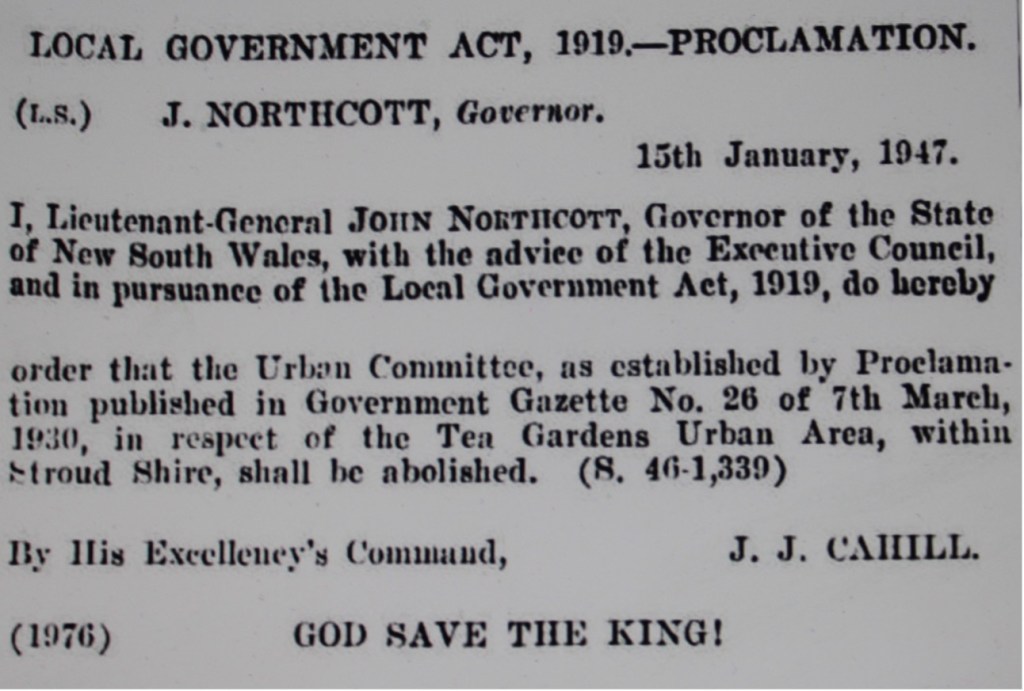
Notice of the abolishment of the Tea Gardens Urban Area Committee [Government Gazette of 24 January 1947]
Information on the Nelson Bay Urban Area Committee is found at this link on the website.
A history of the formation of the Port Stephens Shire Council is also published at this link on the website.
Researched and compiled by Kevin McGuinness
July 2024

 Port Stephens - a history exploration