
Introduction
On 20 November 1894, the NSW Government appointed a Royal Commission on Fisheries. The Terms of Reference were to inquire into and report upon the best means of developing the marine fisheries of NSW, and to examine the better regulation of the fishing industry by the Government.
At the time the Royal Commission was appointed, the majority of commercial fishing and oyster cultivation was confined to the rivers and harbours of NSW.
As part of its enquiries, two Royal Commissioners visited Nelson Bay in April 1895 and took evidence from eight witnesses involved in the local fishing industry.
This paper summarises the evidence provided by fishermen and oyster growers at Nelson Bay. From this, it was gleaned that local fishermen struggled to earn a reasonable income due partly to the problems of marketing their catches in Sydney markets. With oyster cultivation, advanced hatching and maturing procedures had not been adopted at Port Stephens at that stage.
Prior to the establishment of the Royal Commission, a public meeting was held at Nelson Bay to discuss the deficiencies of the Fisheries Act, which needed amendment to reflect the current needs of the industry.
The Australian Star of 24 April 1893, page 5, reported:
‘Messrs. E. W. O’Sullivan, M.L.A., and R. A. Price arrived here [at Nelson Bay] on Saturday, and in the evening delivered addresses on the fisheries industries at the Sea Breeze Hotel.
Mr. O’Sullivan dealt with the subject at great length and pointed out several defects in the Fisheries Act. Mr. Price also spoke on the question, and there were several defects pointed out by the fishermen and others present. Messrs. O’Sullivan and Price also spoke on the political position of the country, and a vote of thanks was accorded them by the large assemblage present on the motion of Messrs. E. Dent and Thompson. Mr. James Johnson occupied the chair, and also accorded a vote of thanks.’
Appointment of the Royal Commission on Fisheries – 1894
The Illawarra Mercury of 22 November 1894, page 2, reported:
‘The Commission appointing Messrs. Frank Farnell, J. H. Carruthers (Minister for Lands), and Lindsay G. Thompson, to inquire into the fishing industry was approved by the Executive yesterday. Mr. Frank Farnell, who has been appointed chairman, says the Commission will start work next week. A thorough and exhaustive inquiry will be made into the fishing industry, and not a single phase of the question will be left untouched. Visits of inspection will be paid to the different fishing grounds. Remedial measures and amending legislation to regulate the fisheries will be considered, and the question of market accommodation and distribution of fish will be inquired into. The question of fish acclimatisation will be dealt with, and attention will also be devoted to fisheries in inland waters. The terms of the commission direct “full inquiry as to the best means of developing the marine and other fisheries of the colony, and as to the better regulation of the industry by law.” Full power is given to call for persons and papers, and to make such experiments as may be deemed necessary. Mr. Walker D. White has been appointed secretary and shorthand writer to the commission.’
A previous Royal Commission had been appointed in 1876 to examine oyster cultivation but did not specifically examine the Port Stephens area, where considerable oysters were cultivated for the Sydney markets. The Commission reported in 1877, together with a draft legislative Bill, for the consideration of the Government. Unfortunately, no further action was taken in implementing the recommendations of the Commission or on the draft Bill.
Fisheries Commission visits Nelson Bay – 1895
On 6 and 8 April 1895, Frank Farnell, M.P. and Lindsay G. Thompson, two Royal Commissioners, took evidence at the Sea Breeze Hotel at Nelson Bay.

Frank Farnell, M.L.A., President [The Sydney Mail and New South Wales Advertiser, 26 October 1895]
The Daily Telegraph of 8 April 1895, page 4, reported on the Nelson Bay proceedings:
‘The Fisheries Commission arrived at Nelson’s Bay by the steamer ‘Gosford’ today and took the evidence of fishermen and oystermen on the condition and prospects of their calling. The commission will continue their duties on Monday.’
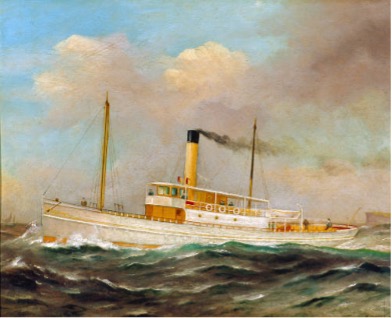
ss Gosford [Australian National Maritime Museum]
Summary of Evidence Taken at Nelson Bay – 1895
Eight witnesses with extensive experience in fishing and oyster cultivation gave evidence to the Royal Commission over the two days it sat at Nelson Bay.
Each witness was asked a similar range of questions concerning their commercial experiences as well as their knowledge of the fish that inhabit the surrounding ocean waters.
A summary of the main issues raised by each witness concerning fishing and oyster cultivation in the Port Stephens region, is set out below:
- Samuel Lilley – Fisherman at Port Stephens
– Has resided at Port Stephens for fifteen years.
– There are sixty fisherman in Port Stephens and whose catches are mainly mature bream.
– Port Stephens is a breeding ground for fish.
– Fishermen protect young fish.
– There are some closed waters [to netting fish] in Port Stephens, viz: Telligerry Creek, Swan Bay, and Karuah River.
– A fishing inspector should not receive any proceeds of a fine issued.
– Catches are sent to Newcastle by steamer in baskets, at two shillings per basket for good fish and 1 shilling for common fish, and then to Sydney by rail for the markets at Woolloomooloo and Redfern. Mullet and blackfish are common fish.
– The agents in Sydney pay the freight from Port Stephens to Sydney and then the agent deducts the difference from the proceeds of the sale.
– Returns received from the Sydney markets are not satisfactory. A fair price would be one half of the price the public pay for the fish.
– Provided the following example of his experience with the Sydney markets: Say there are four men in a boat, they have a haul, and catch eight baskets in one haul; they send that fish in four different lots, each fisherman being a separate consignor of two baskets. We have found that one man would get a good price for the fish, the next man would obtain a fair price, the next would just clear himself, and the next two baskets would be condemned altogether. At first, we thought it might be that our fish were crushed or damaged in some way, but judging from our repeated experience we can only come to one conclusion and that we have been robbed right and left.
– It is possible that the agents are in collusion with the fishmongers, so that the prices realised may be only known to themselves, and that they send us such returns as they think fit. On the whole, within the last four months, no fisherman in Port Stephens has had one pound given back to him from the Sydney markets. The only profit they have had is through the little business they have been doing with the Newcastle Ice Company, which has been started lately for the purchase of fish. They gave us 12 shillings for sand whiting, 8 shillings for garfish, 8 shillings for bream or flathead, and 6 shillings for mullet of blackfish, and this pays us well.
– The Woolloomooloo Market is not centrally situated and their system of displaying fish is not good. The fish should not be thrown on the ground, as they are liable to be trodden on, and this creates a prejudice against the use of fish in the public mind.
– We send fish into the country from Newcastle, and they receive profits from these sales.
– Fishermen should be allowed to have a raised table at the markets where they could market their own fish. There should also be auxiliary markets elsewhere.
– The Railway Commissioners should place a refrigerated car on the northern line for the conveyance of fish.
– It would be an advantage if the Port Stephens fishermen could sell live fish at a market.
– Aliens should be naturalised before being granted a fishing licence.
– There are plenty of crayfish [lobster] at Port Stephens and there is no difficulty in catching using hoop nets, landing and sending them to market. There is a class of Italian fishermen who catch crayfish by means of galvanised wire pots at Broughton Island, which is undesirable. Port Stephens fishermen previously used Broughton Island as their principal crayfish ground, but now the Italians have taken complete control of the island. They have all the principal places taken up by their pots. There are a great number there during the crayfish season and they have about 800 or 900 pots. Crayfishing at Port Stephens should be regulated to prevent improper interference with their breeding season. Fishermen only receive a few pence per dozen crayfish. In Sydney the public pay 1 shilling to one shilling six pence for a crayfish. Fishermen should receive at least 6 pence per crayfish.
– Would favour an experiment in fish trawling by the Government. [see Addendum in this paper for further information].
– Have done smoking and curing of fish in Port Stephens with Rosewood but it did not pay. Nine and a half dozen large mullet was sent to the Redfern market and 4 shillings 8 pence was paid for them. Would need a price of 3 pence for each smoked fish for it to pay.
– Oysters are generally found in deep water beds in the Karuah River and are obtained by dredging.
– A person can make a living by obtaining 1,000 yards of Crown Land for oyster cultivation provided the necessary spat for layings can be obtained.
– Spat should be given free, so long as the grower pays for the mature oyster. A leasing system with a royalty would be best.
– A good many oysters go away from Port Stephens belonging to one or two leases, but they are not high quality. The receive fifteen shillings, down to one shilling per bag.
– It takes nine months on the good beds in the Karuah River and about three years in the foreshores for an oyster to reach the marketable stage. Artificial culture is not carried on as they are simply dependent on the natural beds and the foreshores for the supply.
– Oyster stealing from private land has occurred.
- Edward Holbert – Fisherman at Corrie Island in the Myall River
– Fisherman in Port Stephens for nine years
– There is a good supply of fish at Port Stephens, but not as thick as they were nine years ago. He and his brother and one other man catch eighteen to twenty baskets per week.as when, but they were when dispatched. Or it could be the agents falsely claiming baskets not full so they can pocket the difference.
– We do not get one-third of what consumers pay, and many times we get account sales bringing us in debt. I have received 2 shilling for one lot of fish sold by one man and 6 shillings for a similar lot of fish, got in the same haul, sold by another man.
– Fish should be displayed on tables at the markets and fishermen should be allowed to sell their own fish at the markets.
– Accounts of sales made do not break down costs such as freight, and there is no way of knowing if the recent reduction in rail freight prices have been allocated correctly. For twenty-seven baskets of fish sold in Sydney, I got nearly nine pounds, and the charges came to six pounds.
– A rail truck with a cool chamber would prevent fish spoiling while in transit to Sydney.
– It is believed that an agent could falsely condemn fish. I have consigned six baskets of fish, some in my name and some in another man’s name, and I have had something for my fish, but the fish sent in the man’s name were condemned, and I have to pay the charges for them, and yet the fish came out of the one haul. It is possible for fish mongers to be in collusion with agents.
– The Fisheries Act requires revision as it is very hard on a man. A fisherman’s tools of trade should not be taken from him for a first offence.
– Disease has affected my brother’s oyster lease opposite Corrie Island of 200 yards for two years.
– Have done a little fish smoking or curing and used swamp oak. This would pay better than sending fresh fish in the summer.
– It would be an advantage to be able to take live fish to the market.
– Prawn fisheries are extensive in the Myall Lakes. They are not sent to the Sydney market. They sort them and make them into what they call “chow,” and sell them to the Chinese from whom they receive about 6 pence per pound weight.
- Charles Anderson – Fisherman, Tilligerry Creek, Port Stephens
– Fisherman of eleven year’s experience working with two other men.
– The current provision in the Fisheries Act providing for the seizure of nets and tools of trade for fishing in closed waters should be replaced.
– Tilligerry Creek and Pipeclay Creek are closed waters [for netting] as it is a place for breeding fish.
– We send the fish by horse and cart from Salt Ash Wharf, Tilligerry Creek, to Stockton, thence to Newcastle, where we sell them. We act as our own agents.
– Not happy with prices realised at the Sydney markets. The middleman should be cut out.
– Have caught crayfish in Anna Bay. They used to be more plentiful and have been over fished.
– A new Fisheries Commission needs to be formed and fishermen given more say in it s administration. Members of the Board should visit the region periodically.
– The fisherman’s license fee of five shillings a year is plenty, and the periodical boat license fee should be done away with registration being made permanrnt.
- Peter Johnson – Fisherman, Tilligerry Creek, Port Stephens
– Fishermen at Port Stephens for ten years working with two other men.
– Sends twelve baskets on average of fish per week to Sydney market by steamer to Newcastle and train to Sydney.
– Not happy with financial returns as sometimes get into debt for my weeks work. The middleman should be removed.
– Believes the fishmongers and agents act in collusion. Often send baskets of whiting to market that we know are fetching good prices and we get mullet price back.
– I had an oyster-saloon in [Hunter Street] Sydney.
– Fish should not be put out on the floor at the Sydney market. I have seen people trample on them and steal thme off the heap.
– Should be more than one sale at the Woolloomooloo Market each day. That would allow the consignments by the steamers from the north to be disposed of without the risk of their being kept till next morning and going bad.
– Cannot gut fish before sending to market as we do not have the time to do so. Steamers come into the wharf at Nelson Bay and leave very quickly.
– People have had to wait over a month to have a Court matter dealt with as sessions on these rivers is only held once a month and fishermen are deprived of their nets during this period.
– Boats should not be licensed as if a replacement has to be used, they are up for an additional fee.
– Engaged for ten years with oyster industry at Port Stephens and hold 300 yards at Lemon Tree Passage and Tilligerry Creek. Oysters previously in better condition.
– The greatest cause of the deterioration of oysters is the licensing system. Under that scheme the majority of beds in the Colony were destroyed by over-dredging. New chums to the work tore the bottoms of the beds up altogether. They stripped the grounds and did not give beds sufficient time to recoup. The worm disease also did damage by getting into the shell. If the bottom was thickly covered with some kind of multch, so as to keep the mud underneath, this would nit happen. I have no license to allow me to collect spat lay it down.
– Turtles are not often captured. There are not enough to induce people to fish them alone. When sent to market they fetch about two pounds.
– We send oysters to Sydney and they are sold by auction. Get about 10 shillings a bag. I sent three bags a fortnight ago and got about sixteen shillings for the lot. My oysters brought ten shillings per bag in the open market, but all the return I got was five shillings 4 pence per bag.
– The rent for foreshore leases is too much. Oysters are stolen from Crown lands and sold by non-lessees.
– To become marketable, an oyster takes eighteen months on some beds and two or three years in other places.
– Had to forfeit several oyster leases as they were subject to disease and no return for labour was received, but the oyster rent was still payable. A system of payment on results would be better.
– Oysters are improving at Port Stephens. Fresh water was destroying some oyster locations.
– Fisheries Commissioners had not paid any official visits to Port Stephens. There should be at least one practical fisherman on the Commission, and they should visit to see local conditions and local boards should be established.
– The upper areas of Port Stephens should be left open [to netting] in winter.
– Supports the present style of baskets for carrying fish to market and oppose boxes. Baskets should be locked.
– Greeks and Italians are here crayfishing and one or two net-fishing. They should be naturalised before being licensed.
– Better if government charges for every bag of oysters taken from a lease instead of charging rent for the lease. Two shillings and six pence would be a fair rate to charge per bag.
- Walter Glover – Fisherman, Nelson Bay, Port Stephens
– A fisherman in Port Stephens for thirty-two years and employs two men.
– Catch an average of four or five baskets per week.
– Claims sometimes fish arrive at market in poor condition. Have had bills stating half had been sold and the other half condemned, and yet the half that was condemned came out of the same catch.
– Fish are sent to an agent who takes the market dues and commission and sends me what is left. We have been nearly five weeks clearing eighteen shillings. Not happy with system. Should get rid of the auctioneers and middleman.
– Have had fish stolen in transit but do not know where. A fortnight ago, we sent a half basket of whiting and got paid for a half basket of garfish.
– At the market, the fish are tipped on the floor, and everybody walks over then. I have been at the Woolloomooloo Market and seen fish stolen every morning.
– Better for fishermen if there was more than one sale a day. Branch markets should be established.
– Better to send fish to Redfern Market as there is less handling and less to pay.
– It costs two shillings per basket to send fish to Newcastle by steamer. Then one shilling by rail to Sydney. A cool rail car should be provided, and fish could be sent to the interior.
– Could send gutted fish to the market if market would take them and they would keep longer.
– If we received half of what the consumer pays it would be good. At present the middlemen take too much.
– Should be able to sell your own fish to the general public. Two years ago, I was offered thirty shillings per dozen for schnapper on the wharf in Sydney, but I could not accept the offer, because I had to put them through the market.
– There are two well-boats [fish are transported alive in water tanks] working here but they lose the fish, which are generally schnapper. They go from here to Port
Macquarie and take fish to Sydney.
– There should be two or three sales at the markets a day.
– The fishing license is too expensive. A metal one would be better than a paper one.
– For a first offence against the Fisheries Act, a fishermen’s nets should not be taken away. A fine is preferable. Proceedings against fishermen is taken at Tea Gardens and they are deprived of their living until the case is heard.
– Inspectors should not be paid a part of the fine.
– Some areas closed to netting during the summer should be opened in winter as fish would carry better.
– Members of the Fisheries Commission have not visited Nelson Bay and it is not satisfactory. They should make themselves acquainted with local conditions. Fishermen should have representation on the Commission and local boards should be established
– There are plenty of prawns but no one fishes for them in Port Stephens as it is too far from market. In the Myall Lakes some fish for prawns; then dry them and sell them to the Chinese fishermen.
– Crayfish are not as plentiful as before. Used to be plenty on Cabbage Tree Island, but last year could not get any. Three years ago, you could get them around the lighthouse at the entrance, but not now. Can only catch some at night. European fishermen engage in the capture. When we cannot do net fishing, we go after crayfish. We start in June and the crayfish are pretty thick in July and August. Not necessary to have a closed season for crayfish.
– European [Greek] fishermen are not at Broughton Island this year as the Italians are there. They fish exclusively for crayfish. Last year they had three hundred pots. There is no chance for any other man to go fishing there while they are there. They should be naturalised before being given a fishing license.
– I have caught schnapper all-round the island and then salt them and sell them to the Chinese fishermen.
– The oysters are not as good as they have been. The place has never been the same since it was leased out. Twenty-two years ago, there were twenty boats working up the river, and two men in a boat. I was working there; we were turning out four, five and six bags every day. Since the leasing system the river has never been the same. When the leases were first worked all the mangroves in the river were covered with oysters. They took those oysters off and threw them into deep water on to the deep beds, and in so doing covered the good oysters there. Those foreshore oysters will not live in the deep water; they are accustomed to being uncovered at certain times of the day.
– Oyster leases should be ended, and every man should be allowed to get what oysters they want and to pay a royalty on each bag of oysters. Under the present lease system Crown lands are stripped of oysters by persons who hold no license.
– Oysters take about nine months to mature from the spat stage.
– There are a few sea turtles in Port Stephens. The hawkbill turtle is good for market. Not many sent away.
- Thomas Bagnall –Fisherman, Nelson Bay, Port Stephens
– Licensed fisherman for fourteen years and fishing in Port Stephens for twelve years with two sons.
– Nets should not be confiscated for first offence against the Fisheries Act.
– Inspectors should not be given any part of a fine.
– Send fish frst to Newcastle by steamer and by train to Sydney. Rail freight should be lower than a shilling. We often do not get 3 pence for a basket in Sydney and are often in debt to the agents. On my recent consignment, I am in debt one pound, 11 shillings and nine pence for a consignment of twelve baskets.
– We do not get one-third of the amount the public pay for fish.
– Fish are better dealt with at Hudson’s market [at Redfern] than at Woolloomooloo as there raised tables at Redfern.
– Good idea to have fishermen’s name displayed with fish for the public to see.
– Fishermen should be able to sell fish directly to the public.
– Should also be an afternoon sale at Woolloomooloo.
– Full baskets do not always arrive at market. Sometimes do not get baskets and boxes back again.
– No need to gut fish before market. Sometimes there would not be time to do that as there is a need to catch the steamer.
– Need a refrigerated car on the train from Newcastle to Sydney
– Oyster leases should be ended, and anyone be allowed to get a bag full and sell, but instead pay a royalty on the every bag.
– Most oysters that go to market are taken from Crown land. The leases do not produce half that goes from here.
– Have caught a few crayfish, and there less than previous years. Should be some time when none allowed to be obtained.
– Four Italians were fishing at Broughton Island the year before last. They had about three hundred to four hundred pots [traps] last year.
– Have caught some turtles. Worth five pounds at Woolloomooloo market.
– Should be a reduction in the fishing license and the boat license.
– Fisheries Commissioners have never visited Port Stephens. There should be someone with practical experience on the Commission
– Local fish canning would be better than sending fish away.
– Aliens should be naturalised before giving them a license.
- Henry Laman – Honorary Acting Inspector of Fisheries, Port Stephens.
– Acting Inspector of Fisheries from November 1889 to July 1893 and retrenched , and reappointed in August 1893. When first appointed, I received a salary of 50 pounds per annum, but since August 1893 have received no salary. Also I am the Preventative Officer for Customs.
– Fishery Commissioners have not visited Port Stephens.
– Eighty fishing licenses are presently issued including crayfish men.
– In 1894, about 5000 baskets of fish sent away from Port Stephens to markets.
– Fishermen often complain about the Fisheries Act and also of the way it is administered.
– Prawn nets are not used in the port but in the Myall Lakes.
– Fishermen could be allowed to use whatever net they want so long as they empty them in a certain depth of water and do not send undersize fish to market.
– Fishing nets should not be confiscated for a first offence of the Fisheries Act, and instead a fine be issued.
– A metal license should be issued.
– Oyster beds leased have been prolific of late. I do not know how many bags are harvested as there is no requirement for an inspector to be informed. Possible for oysters to be stolen from Crown lands. Would support leasing smaller areas to persons, say 500 yards. There are 29 oyster leases in the Myall River held by about six persons. Leases are in fair condition.
– Leases will not improve as lessees leave it to nature and depend largely on oysters they get from Crown lands to replenish their beds. The worm has affected the oysters. Some leases have been abandoned because of the low market price and also to a lesser extent by the worm. If after three years, a lease is unproductive a lessee should not be charged for the full three-year period or alternatively have a fee system based on results.
– New Zealand oysters were laid down but later died due to the different water.
– The best oyster beds were at Corrie Island several years ago, but leases held above Middle Island are the best.
– Some oysters in the Karuah River die to flooding, washing away of river bottom and over-dredging. Continual stirring and working the oyster-beds will help to eradicate the worm.
– If platforms were built, to be one-third above low-water mark, and the oysters placed on them, it would help them grow. Could be called a practical oyster culture, but it has not been attempted here. Oysters develop rapidly in the port, but none has established means of oyster culture including capture of spat. Left up to nature.
– Crayfish have been overworked. European fishermen may be responsible. The Italians have made an appearance in the last two years with crayfish. Should have a closed season for crayfish.
– Italian and Greeks camp on Broughton Island and have between three or four hundred pots. The Italians hold licenses. May not be naturalised. Half a dozen Italians will use between three hundred and four hundred traps.
– Two well-boats are in the Port occasionally. They go as far as the Solitaries and take their catches to Sydney and Newcastle.
– Smoking and curing of fish are not done as it us uneconomical and there are no smoke-rooms available.
– Occasionally a fisherman will miss a steamer with their catch, such as when bad weather happens, and the catch is wasted.
– Prawn fisheries are extensive in Myall lakes. They are sent in a dried state to Newcastle and sold to the Chinese.
– Given the large area of Myall Lakes of over 4000 acres, it is hard for the inspector to cover the area.
– Turtles are sometimes caught in nets accidently in the upper waters. Some grow to an immense size and weigh about two tons. No good for oil. Some of the fishermen got one on the beach and they cut its liver out, and boiled it trying to get oil, but they got none. Some oil was discharged when the turtle was dried out by the sun on the beach. Some industry may be possible in oils generally: porpoise oil, shark oil, and turtle oil. Hawkbill turtles are edible and weigh two cwt. and are sent to Sydney.
- Henry Thompson – Oyster Lessee, Nelson Bay.
– Has lived at Nelson Bay for five years and held four oyster leases for ten years that cover 1000 yards.
– Troubled by the worm a great deal. Has surrendered oyster leases because of the worm disease; 1000 yards in the Karuah and 700 in the Tilligerry Creek. It is not only the worm that is a problem.
– Oysters in Karuah River now absent due to over dredging.
– An oyster lease needs to be at least 1,000 or 2,000 yards to be viable.
– Every winter we shift the oysters from the high rocks and lay them out on the flat, and when they develop, we send them to market. I put them below half tide in order that they may fatten. They are not allowed to stay there long enough to develop the disease.
– Instead of leasing fees, persons should pay according to results.
– Has sent about eight or ten bags of oysters to Sydney each week and cleared 10 shillings per bag. Only received 5 shillings 4 pence per bag five weeks ago.
– New Zealand oysters did not thrive. They may have been old when I received them.
– No Fisheries Commissioners have visited. An experienced man should come here. The fishermen blame them for current problems. A local Board should be established.
– There should be a two-month closure season for crayfish. The Italians are fishing for crayfish at Broughton Island. The have three hundred traps for one boat. They should pay for every crayfish they take. Aliens should be naturalised before receiving a license.
– About two years ago, before the Italians went to the Island, there were twenty or twenty-five boats that went there and now there are none. Under the present system the Government only gets 2 pounds for per boat, whereas previously it received 50 pounds. One half of the aliens at Broughton Island are not licensed.
Royal Commission Report Submitted to Parliament – 1895
Following the finalisation of the gathering of evidence, the report of the Royal Commission on Fisheries was presented to the Government in June 1895.
Many of the issues raised by the Port Stephens fishermen and oystermen appear to have been addressed in the Commission’s recommendations. The Evening News of 20 June 1895, page 6, reported:
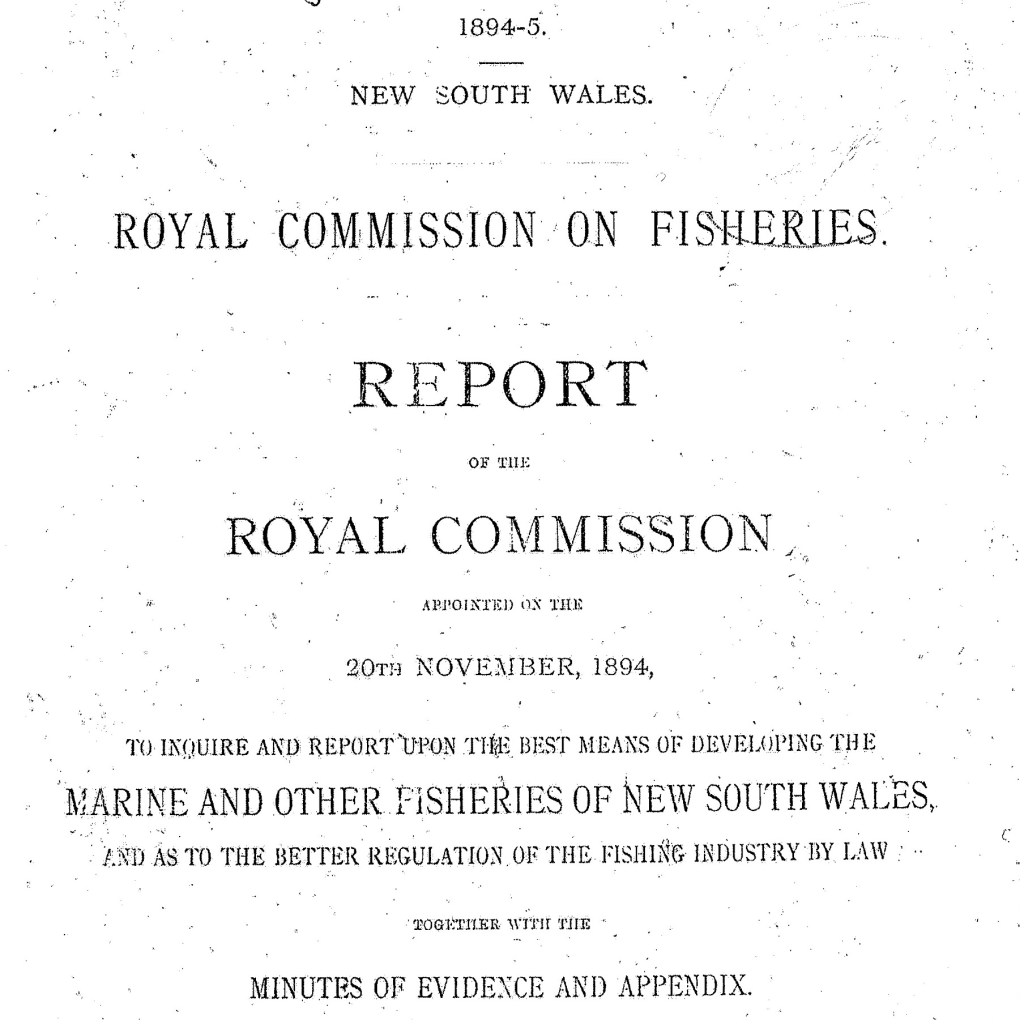
‘The Colonial Secretary has presented to Parliament a report of the Royal Commission appointed in November 1894, “to inquire and report upon the best means of developing the marine and other fisheries of New South Wales, and as to the better regulation of the fishing industry by law.” The report is a very lengthy one, and with the evidence and appendices makes up quite a large blue book.

Front Cover of the Report of the Royal Commission on Fisheries
The inquiry held by the commissioners is shown to have been a most exhaustive one, and the following is an abstract of some of the principal suggestions made, namely:
1. The immediate passing into law of a bill (drafted by the commission) to regulate the fisheries and oyster fisheries of the colony.
2. A systematic exploration of our seacoast by a properly equipped trawling vessel, to determine the capabilities of the deep sea fisheries [See addendum of this paper for further information.]
3. Transmission of live fish to market by means of well-boats.
4. Employment of small launches, driven by oil engines, to facilitate inspectorial supervision of the fisheries.
5. Examination of the fisheries at Lord Howe Island and Elizabeth Reef.
6. Inquiry into the crayfish fisheries.
7. Inquiry into the inland water fisheries.
8. Establishment of fish hatcheries.
9. Improved methods of fish transit.
10. Adoption of refrigerating cars for transit of fish by rail.
11. Packing of fish in locked boxes instead of in baskets.
12. Improvements in construction of cases for fish transit.
13. Improvements in market accommodation.
14. Reduction in market dues.
15. Abolition of the middleman, and authority for fishermen to vend their own fish.
16. Erection of a central fish market near Darling Harbor Railway Station, with urban and suburban auxiliary markets.
17. Substitution of fish carts for the hawker’s basket and barrow system.
18. Gutting fish, and improvements in accommodation for fish in fishing boats.
19. Uniform charge by railway for fish carriage irrespective of distance.
20. Employment of fishtanks in connection with the well-boat system.
21. Development of the herring fishery.
22. Institution of experiments for eradicating the worm disease in oysters.
The members of the commission — Messrs. Frank Farnell, M.P. (president), R. H. D. White, M.L.C., and L. G. Thompson — hope to make a supplementary report, dealing more particularly with the inland fisheries, Lord Howe Island fisheries, and a few other subjects, which they have not yet had an opportunity of fully investigating.’
Supplementary Report of the Royal Commission – 1896
A supplementary report of the Royal Commission on Fisheries issued in 1896 emphasised the need for the exploration of deep-sea fisheries where it was believed that trawling could take place
The Sydney Morning Herald of 8 June 1896, page 3, reported:
‘The supplementary report of the Royal Commission on Fisheries has now been issued. Referring first to the deep-sea fisheries, the commissioners say their inquiry has not been as comprehensive as they wished it to be, as the Government had not supplied them with the appliances necessary for an effective investigation, namely, a completely equipped trawling vessel. Had such appliances been afforded them, they feel confident they would have been able to make an important recommendation in the matter [Further information on the trawling investigation is set out in the Addendum of this paper].
The cost of a steam trawler and a well-boat would have been about £5400 and would have enabled much light to have been thrown on the possibilities of the offing fisheries. The evidence already taken goes to show that our marine fishing grounds are of immense extent, covering the entire length of the seaboard but, so far, this vast source of wealth has been almost totally ignored. The commissioners record their emphatic opinion that the Government should lose no further time in providing the means for the institution of a trawl survey to test the suitability of some of the known places on the coast on which it is believed trawling could be successfully undertaken.
It is also believed that this course would lead to the discovery of deep-sea deposits of oysters. The report also insists on the value of the well-boat in connection with the conveyance of live fish to market. As the result of the non-employment of well boats the loss of fish the most perishable of our articles of food— has been enormous. Tons and tons of this valuable food are lost to the community annually owing to the lack of proper means of conveying it to the metropolitan and inland markets. ……
The commissioners conclude by some remarks on market accommodation, and the need for fisheries legislation. They repeat that the fish market, to be of use generally to the community, should occupy a more central site. The Darling Harbour railway terminus, to which access is available by water, rail, and road, would form a far more convenient site for the central fish market than Woolloomooloo, and if auxiliary markets were established in each of the most important suburbs, and the whole system properly supervised and placed under the control of the Government, something more approaching perfection in our mode of fish distribution would, in the opinion of the commission, be the outcome. Such a system would benefit both the fishermen and the consumer, and our inland towns would also share the advantages to be gained by a more ready means of sending consignments of fish into the interior.
The report says it is a matter of extreme regret that it has not yet been found practicable to introduce into Parliament a bill to regulate the fisheries of the colony, and a hope is expressed that it will be passed at the very earliest opportunity during this session.’
Concluding Comments
Eight years elapsed before the legislation of the NSW Fisheries Act of 1902 was passed. This provided for regulation of the fisheries and oyster fisheries of NSW.
It had addressed many of the issues raised by fishermen and oyster men who gave evidence to the Royal Commission at Nelson Bay in 1895.
The Northern Star of 4 March 1903, page 5 provided the following summary of the new ‘Fisheries Act 1902’:
‘The provisions of the Fisheries Act, 1902 came into force on Friday, it being the 60th day after the measure was assented to by the Governor. There are several new provisions in the new Act which will affect those who indulge in line and net fishing, whether for pleasure or as a means of livelihood, and also picnic parties and others who are fond of oysters, and who have up to the present been allowed to carry them away from the waters.
Every person fishing for sale, or using a boat for the same purpose, must be provided with a license, the cost of which is 5s for the year, and every person who sells oysters, whether wholesale or by retail, must take out a license, the fee for which is 20s for the year.
This provision will be far-reaching, as all oyster lessees, keepers of oyster shops, hotelkeepers, restaurants, and persons selling oysters in bottles, will require licenses. ….
Fishing-nets must not be landed on shore in such a manner as to prevent undersized fish from escaping into the water, and it will be unlawful for fish to be left on the shore. The use of wire traps or cages, with wings attached, so as to impede the free passage of fish in inland waters is prohibited.
It is now an offence for any person to take any fish under the weights prescribed in the Act, and Inspectors of Fisheries are directed by the Act to seize all undersized fish, and persons who are found with such fish in their boats, or on their premises, or in their possession, will be liable to a penalty of £2. ….
Foreshore leases for oyster culture may be maintained at a yearly rental of £1 for every 100 yards, the smallest area being 500 yards, and other lands may be put up for leasing by auction or tender. It is imperative that all oyster leases shall be cultivated by having suitable material laid down for the attachment of spat. Regulations shall be issued defining approved methods of cultivation.
Leased areas must not be so stripped of oysters, or otherwise mismanaged as to threaten their partial or total destruction as oyster-bearing areas, and leases so worked will be liable to cancellation. Provision has been made to suspend for three years the taking of oysters that are not fit for consumption as food.
No oysters may be taken away from unleased Crown lands or public oyster reserves, but the public may consume as many as they like on the waters or foreshores. This provision will apply to a number of people who have been in the habit of opening oysters on the rocks and removing them in bottles.
In waters that are at present closed to net-fishing, no prawn-nets can be used, as prawns are now defined as fish.’
A supplementary Royal Commission report (1896) also recommended that a trawling expedition be undertaken to explore the commercial viability of fishing the vast ocean along the NSW coast.
The Addendum below summaries the findings a trawling expedition undertaken in 1898.
Following the results of the 1898 trawling expedition, together with a 1907 Commonwealth Government investigation, the way was paved for the NSW Government to establish a government operated trawling industry in 1917.
To commercially process the fish caught in the ocean waters along the NSW coast, several fish processing factories were established.
One of these factories was opened at Pindimar, Port Stephens on 15 November 1917. The history of the Pindimar Fish Processing Factory is found at this link on the website. Unfortunately, the fish trawling industry soon failed, resulting in the Pindimar facility closing in 1920.
Addendum
Fish Trawling Expedition Visits Port Stephens – 1898
One of the aims of the Royal Commission on Fisheries was to explore and promote the possibilities of initiating a fish trawling industry to harvest the vast amounts of fish in the ocean along the NSW coast.
Up to this stage commercial fishing and oyster cultivation was confined to the rivers and harbours of NSW. Acting on the findings and recommendations of the Royal Commission two expeditions were taken on board the government steamer ‘Thetis’ along the NSW coast to identify the quantities and types of fish available in ocean waters, for commercial processing.
The Daily Telegraph of 3 March 1898, page 6, reported on the second fact-finding expedition undertaken, which was to proceed as far north as Port Stephens, with Mr. Frank Farnell, M.P., on board, who had previously taken evidence on the fishing industry at Nelson Bay during 1896:
“I could not wish for better success than we have had today.” When a remark like that fell from Mr. Frank Farnell, M.P., on board the steamer ‘Thetis’, at Newcastle tonight, it may safely be assumed that affairs are going pretty well with the trawling expedition over which he is exercising supervision. The Thetis entered the port at 5.20 p.m. this afternoon and was the centre of a great deal of attraction as she came to a berth alongside the Queen’s Wharf.
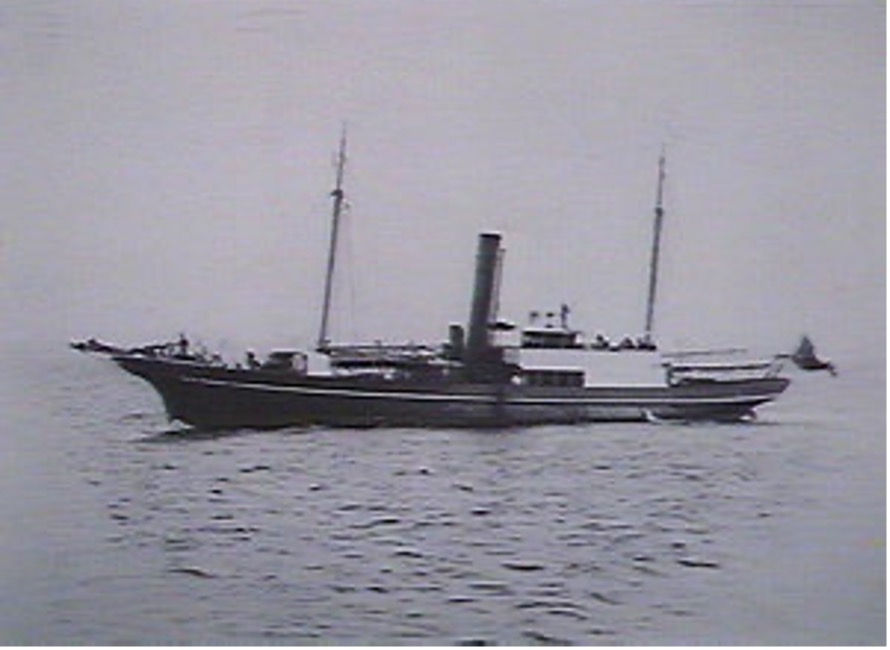
Thetis [State Library NSW]
Trophies of the expedition were visible on her deck in the shape of a giant stinging ray, and an 8ft. shark, and in other directions were to be seen evidence of the success which had attended the day’s operations. All had not, however, gone well with the steamer from the time of her leaving Sydney, as very inauspicious weather was met with during the first four days of the expedition, and yesterday was the first occasion on which suitable conditions for trawling prevailed. Captain Hildebrand mentioned that generally the sea had been altogether too rough for the kind of work on which they were engaged. …..
Yesterday, however, the wind changed round to south, the sea became smooth, and everything went well. “We left Sydney,” said Mr. Farnell, while describing the expedition to a “Daily Telegraph” reporter on Friday afternoon, and determined upon trawling at a point off Cape Three Points, near where operations were left off on the previous occasion. The net was lowered at 7 p.m., in 41 fathoms, and raised at 9 p.m. in 51 fathoms, and the course steered during the two hours was a northerly one. An accident happened, owing to the net becoming fast and getting slightly torn, and a portion of the gangway carrying away. The haul was a moderate one — 415 fish of 12 different species being obtained, seven of them being edible and the major portion of the catch marketable. The hour being late, Broken Bay was then made, and the necessary repairs were affected on Saturday.
We put off again on Sunday morning, and at 7.15 we put the trawl down, raising it two hours and a half later off Bungaree Norah, the depth having varied from 25 fathoms to 32 fathoms. The result was nil owing to the net having become twisted, an accident likely to happen at any time. Still going north, the next throw out was made at 10.20 a.m. in 32 fathoms, and at noon the trawl was raised in 45 fathoms. Not many fish were captured, and they were of seven different species. Bird Island was the scene of the next cast, which took place at 3 o’clock in 72 fathoms, and dragging was continued till 6 p.m., still to the north, the depth having increased to 90 fathoms. Another accident to the net reduced the catch to small proportions.
On Sunday night the Thetis steamed up to Seal Rocks, and at 6 a.m. on Monday operations were commenced between Broughton Island and the Rocks at depths of 32 and 45 fathoms. Two and three-quarter hours’ work realised a small haul of 12 different species, including John Dory, a basket of whiting and a rare variety in the tobacco pipe fish. Another experiment was made off Broughton Island the same day, but the net got caught, and the sea became too rough, and shelter was sought in Nelson’s Bay, the conclusion being come to that it was dangerous to continue operations in that weather.
On Tuesday we went off Port Stephens again at 10.15 a.m. and dropped the new net about four miles out in 32 fathoms, raising it again at 12.30 p.m. in 58 fathoms. The net being new it evidently did not touch the bottom, and no fish were caught. On the same day we lowered her again off Morna Point, still going south, and raised her in half an hour, having got fast again, but at a depth which was not ascertained. Owing to the roughness of the sea, a return was then made to Port Stephens, where a little damage which had been done was repaired, and the Thetis remained at anchor till this morning.
Another start having been made, we lowered the trawl in Newcastle Bight, south of Morna Point, at 8.15 a.m., in 28 fathoms, and raised it again at 10 a.m., in 12 fathoms, the result being about three-quarters of a ton of fish, roughly estimated to number 3000. Six baskets full of edible varieties were made up, all of which were marketable. They consisted, of whiting, John Dory, flounder, red bream, schnapper, skate, red mullet, gurnard, flathead, nannagai, and a rare specimen called the saury, a splendid food fish. Not the least interesting trophy was a giant stinging ray, which weighed 160lb., and which Mr. Waite secured for the Museum. The ray specially predominated in the haul.
Still further south another cast was made at 10.30 a.m. in 42 fathoms, and at 1.15 p.m. over a ton of fish was hauled up out of 26 fathoms, there being fully 500 single specimens. Six baskets full of edible kinds were obtained, the only species not hitherto met with being known as the old wife, a fish at one time often met with in the harbor waters: crayfish, and zancrus. Another giant ray, 250lb. in weight, was also caught, but as it was tailless and therefore useless as a specimen, it was thrown overboard.
At 2 p.m. the trawl was again lowered in 20 fathoms. The southerly course was continued, and at 3.45 it was raised in 16 fathoms, not far off Nobby’s. This was the shallowest ground experimented on during the day, and it was purposely selected to enable us to ascertain the fish to be obtained at that depth. The result was very gratifying, for we got half a ton of fish, roughly estimated to number over 400, and comprising splendid specimens of soles, bandom sole, of which there were dozens, flounders, flathead, red bream, John Dory, another sauryet, a different species to the former, one nannagai, whiting, silver bream, gurnard, fortescue toads, batray, stinging ray, porcupine, squid, stargazers, sawfish, an 8ft. shark, and prawns. The capture of the shark bears out my prediction that it is in shallow water we will meet with them, if at all.
Well satisfied with our day’s work, we then came into Newcastle.” Mr. Farnell was of opinion that, the Newcastle Bight was about the best ground they had struck, being quite equal to that between Broken Bay and Sydney, while the quality of the fish was superior to that obtained further south. He regarded it as extraordinary that trawling could be carried on for a whole day in unknown waters without a single obstacle or obstruction being met with. In no part of the world could a better result be achieved. In that particular there was, he added, a portion between Bird Island and Newcastle which had not yet been exploited, and that would be done during the next couple of days, and the Thetis would probably return to Newcastle on Friday afternoon, preparatory to leaving for the Manning the same evening. ….
Another discovery was the existence in coastal waters of several small specimens of witches, a species of sole which brings the highest prices on the London market. Captain Neilson was of the opinion that the discovery indicated the existence of large specimens in the deeper waters.
On the whole, both Mr. Farnell and Captain Neilson express unbounded satisfaction with the result of their expedition. On being also interviewed, Mr. E. R. Waite, F.L.S., of the Sydney Museum, said that many of the lower forms of life had been secured in splendid hauls. Not having submitted the specimens obtained to microscopic examination, he could not then speak with any degree of certainty, but he regarded it is quite possible they may have secured many kinds new to science which had hitherto only been found in single numbers, and they would, therefore, he enabled to add considerably to the scientific literature on the subject.
Among the curiosities secured might specially be mentioned the large and beautiful specimen of the tobacco pipe fish and the saury, both little known to fishermen up north. The small net, kept on the surface of the water, brought up rich material in the shape of small animal life, crustacia, copspods, and other minute creatures known to be the food of certain fishes. It was reasonable to suppose that these would be found right along the coast. Several charitable institutions of the town benefitted by the arrival of the Thetis, as Mr. Farnell kindly distributed large quantities of fish amongst, them. The balance of the catch was forwarded to Sydney tonight.’
Researched and compiled by Kevin McGuinness
July 2024

 Port Stephens - a history exploration