
Introduction
During the 1930’s, plans for the establishment of paper mills and associated forestry plantations were floated in various areas of Australia, including Port Stephens.
This paper sets out the history of several proposals for the Port Stephens region. However, none of these progressed to fruition.
Company purchases land at Port Stephens for a Reafforestation Scheme – 1931
The Dungog Chronicle of 10 July 1931, page 4, reported on a company that proposed to establish a plantation to grow pine trees for the manufacture of paper and artificial silk:
‘We understand that a company has purchased approx. 4,000 acres from Mr J. K. Mackay, owner of “Durness” Station, Tea Gardens. The land has a frontage of about eight miles to the Myall River, from Shark’s Hole to Devil’s Elbow.
It is proposed to establish a reafforestation scheme to grow pine trees for the manufacture of paper and artificial silk. As far as we can glean, three varieties of pine are to be grown. We are reliably informed that a satisfactory price was secured by the owner, particularly as this section of the station was not valuable from a pastoral viewpoint.
One condition of the sale, so we are informed, was that only local workmen were to be employed by the new company. It is a condition that does credit to the vendor, and we feel certain will prove an advantage to the proposed new industry. Local workmen may be depended upon to give a good account of themselves. The surveyors are at present engaged carrying out initial preparations, and it would appear that time will not be unduly delayed in making a start, and the many local unemployed, we hope, will shortly experience a period of prosperity.’
Mr. J. K. Mackay was a prominent New South Wales pastoralist with land holdings in various states. Further information on the ‘Durness’ Station is set out in a Postscript to this paper.
The proposed forestry operations did not proceed despite the ambitious plans.
Company proposes establishment of a paper mill at Port Stephens – 1931
The Nambucca and Bellinger News of 21 August 1931, page 5, reported:
‘According to a statement published in the August issue of the ‘Newspaper News’ (Sydney), there is every likelihood of Port Stephens being the centre of the paper manufacturing industry in New South Wales. A company has been formed and capital is now being sought to establish the enterprise.
An ambitious project, says “Newspaper News,” seeking £2,000,000 capital, and called Imperial Paper and Paper Producers, Ltd. (N.S.W.), with a brown paper mill at Port Newry, north of Mackay (Q.), and a white paper mill at Port Stephens (N.S.W.), and employing the German “Orstrand” process of bleaching various fibrous materials from grasses, straw, bagasse (the fibrous residue of sugar cane after sugar content is extracted) and waste materials, is announced. Associated with the process is the “Hydroiloid” process of paper making.

Advertisement for The Imperial Pulp and Paper Making Company [The Catholic Advocate, 22 January 1931]
Most active agent in the promotion of this enterprise is Mr. George L. Adams, a Sydney industrial chemist, who claims to have experimented with almost every useful Australian material for paper pulp. At present three engineers, two from England and one from an Australian firm, are making technical investigations in Australia, and another English finance representative is touring Queensland to check up on the potentialities that have been represented by Mr. Adams.
Interviewed, Mr. Adams said that the Orstrand process, which was owned by Dr. Scherbak, of Germany, involved a 25 per cent, saving in transport costs of pulp. The syndicate, of which he was one, had arranged with Dr. Scherbak to send Dr. Karl Grieb, chemist, from Stuttgart to Australia on a five years’ agreement in charge of the whole bleaching process. Dr. Scherbak had at the time insisted that British nationals or Australians be sent to Germany to receive full technical training in the work. All technical men for the paper production would be brought from overseas.
“The enterprise is to be based not on any hazardous experimentation,” said Mr. Adams. “We shall follow, in the footsteps of European, British, and American technicians over ground that has been proved in regard to fibrous materials and with a process that has been established as the most economical, and already proven in manufacture.”
“What part of your production will newsprint be?” “Newsprint,” said Mr. Adams in reply, “must bulk largest in our production, because it is in greatest demand of all papers. Our next white job would be bank papers, which are also in fair demand. There is not sufficient demand here for the higher-grade papers to justify manufacture. In regard to newsprint there is a great need of local manufacture, because of the great stocks that have to be kept in store and afloat to feed the presses of Australia and New Zealand. The continuous supply in Australia of local newsprint will mean the freeing of large amounts of newspaper capital which now must lie idle in stocks. It should be the task of the newsprint supplier to carry all the stocks necessary, but that is impossible under present conditions of importation.”
Australia, with her own manufacture, would be in the unique position of being the only country in the world not compelled to import her raw stuffs for paper. A great deal of the paper produced will be manufactured under what is known as the “Hydroiloid paper making process.” The result of the application of the “Hydroiloid process” promises a variety of new papers of remarkable quality. “Newspaper News” has tested one claim made for the paper made by the Hydroiloid process. A sheet was soaked in water for five minutes and the water squeezed out of it by wringing with the hands. Immediately afterwards the paper was written on with a sharp pen and ordinary writing ink, but the writing did not smudge.
In discussing this paper, a writer in the “Brisbane Daily Mail” says: One of these sheets, which, by the way, was made from cast-off mail bags, was put under one of the severest tests it is possible to put any class of paper. Nitric acid in its strongest commercial form was poured straight from the bottle and allowed to gather in a pool on the surface of the paper. It was al-owed to run into a crease of the paper where it had been folded perhaps hundreds of times, a very close watch was kept for several minutes, but with the exception that the powerful acid had stained the paper slightly it had absolutely no effect. Several hours afterwards the sheet of paper was again inspected; but the acid had not acted upon the paper. Such a test is almost beyond understanding, when it is pointed out that the nitric acid used in the test is diluted considerably for the purpose of engraving by acid process the hard zinc plates used for photographic block purposes. When the acid was poured over several thicknesses of ordinary newsprint, the paper literally crumpled and disappeared.’
Tour of inspection – 1931
The Dungog Chronicle of 9 October 1931, page 4, reported:
‘The tour of inspection made recently by engineers engaged by the Imperial Pulp and Paper Products, Ltd., of Port Stephens district, directs attention to the natural advantages that the port possesses, not only as a paper pulping centre but as an excellent location for the establishment of a model township such as it is hoped will result from the decision of the company to build its big white paper mill there.
Port Stephens has been referred to as the economic key to decentralisation and the new state, and, whether one favours the establishment of new states or not, it must be agreed that as a terminal and potential capital for any new state it has many advantages. The. harbour from a navigation point of view is regarded by many as the finest on the New South Wales coast, with even greater advantages than Sydney Harbour. Certainly, it is the finest in New South Wales north of Sydney.
Furthermore, its hinterland has been richly endowed by nature with tracts of fertile land and heavily timbered country of good quality, whilst rich coal deposits of Newcastle and district which extend to the port are world famous. As a potential source of power these deposits have much to offer.
The Imperial Pulp and Paper Products Ltd., have done well in starting their enterprise by the selection of Port Stephens in New South Wales and Port Newry in Queensland ….. as centres for their manufacturing operations. Quite apart from the coal deposits at the door of Newcastle, records prove that the deposits of coal in Port Stephens extend to the Barrington River are sufficient to meet requirements for ages while mineral deposits are said to abound in profusion. The potentialities of this district have, not been seriously realised, and if the depression hits Port Stephens particularly hard there is no doubt that enterprise will be forced to seek out and exploit the economic factors of this world wonder port, and its hinterland both near and far.
Evidence of this port’s capacity, in the absence of harbour dredging, is that the s.s. “Asama Maru” drawing 27 feet, last week found no trouble whatever in making entrance. Captain George Manson late of Tea Gardens, piloted the “Asama Maru’” and it will be remembered that during the Public Works Committee inquiry regarding the proposed railway from Morpeth to Pindimar (Port Stephens) the versatile Captain gave valuable technical evidence concerning the potentialities of Port Stephens as an overseas port. The evidence tendered the parliamentary works committee about two years ago did not see the light-of-day due to the fate of the Nationalists. The evidence on this occasion was unanswerable and clearly demonstrated the salient facts which support and prove the economic advantage in the opening up and development of this port. But what stronger evidence could there be than the 1911 report of the Royal Commissioners, which strongly recommended Port Stephens in a scheme of decentralisation in railway transit? The shelving of this report is one of the many blots upon party politics and the incidence of vested interests. Given a chance Port Stephens will become a jewel in the economic crown of Australia.’
Industry representative visits Newcastle – 1931
The Maitland Daily Mercury of 29 December 1931, page 6, reported:
‘With a view of ascertaining what facilities exist at Newcastle and Port Stephens for the possible establishment of the pulping industry in that district, Mr. F. E. Adams, of the Imperial Chemical Pulping Co., paid a visit to Newcastle yesterday, and conferred with the representatives of several public bodies.’
Salamander Bay proposed as the site of the new paper mill – 1932
The Newcastle Morning Herald and Miners’ Advocate of 28 January 1932, page 6, reported:
‘Mr. George L. Adams, Director of the Imperial Pulp and Paper Producers, Ltd., accompanied by Messrs. A. L. Lewis, Chief Engineer, Captain H. Sullivan, Harbour and Marine Advisor, F. R. Hope, Surveyor, and John R. P. Adams, publicity officer of the company, passed through Newcastle by car yesterday, on their way to Port Stephens. The object of the visit is to make a preliminary survey of the land to be acquired for the purpose of erecting the extensive mills for the manufacture of paper and select the site for workmen’s cottages, to house the large number of employees that will be engaged, and their families.’
The Newcastle Morning Herald and Miners’ Advocate of 1 February 1932, page 4, further reported:
‘Last week Mr. George L. Adams, Director of the Imperial Pulp and Paper Products, Ltd., accompanied by the Chief Engineer, the Harbour and Marine Advisor, the Surveyor, and the Publicity Officer of the company, visited Port Stephens for the purpose of making the preliminary survey of the land and waterfront of the site that it is proposed to acquire for the erecting of the large paper-making mills at Port Stephens.
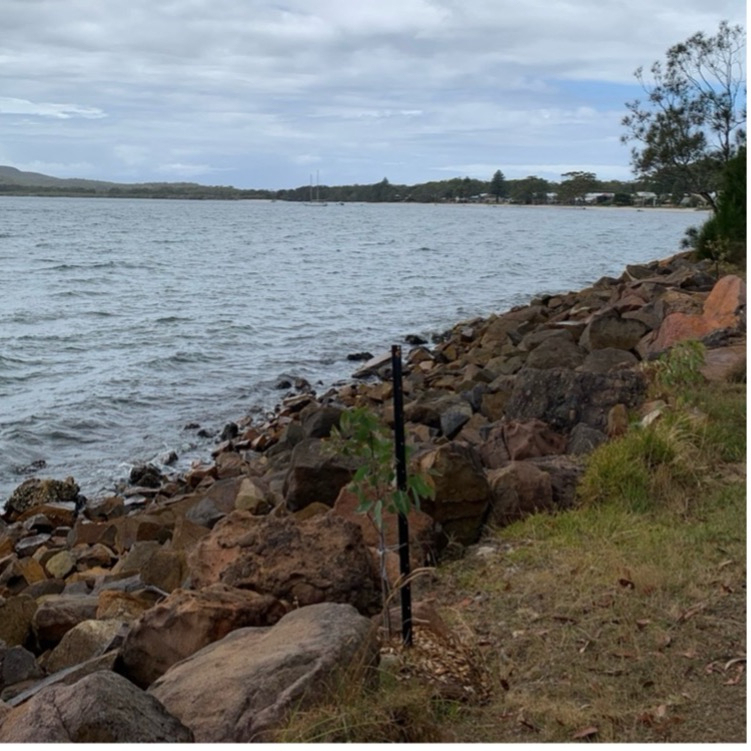
The land is situated at Salamander Blay, on the southern side of the harbour, where it was the intention at one time to have the naval base for the Commonwealth Government. The land is considered most suitable for the purpose, since not only has a great amount of work been done in building a long retaining wall, but the sites for the mill and the modern village settlement are suitable. The depth of water is also such that when the jetties are built the largest vessels trading on the Australian coast can be berthed.
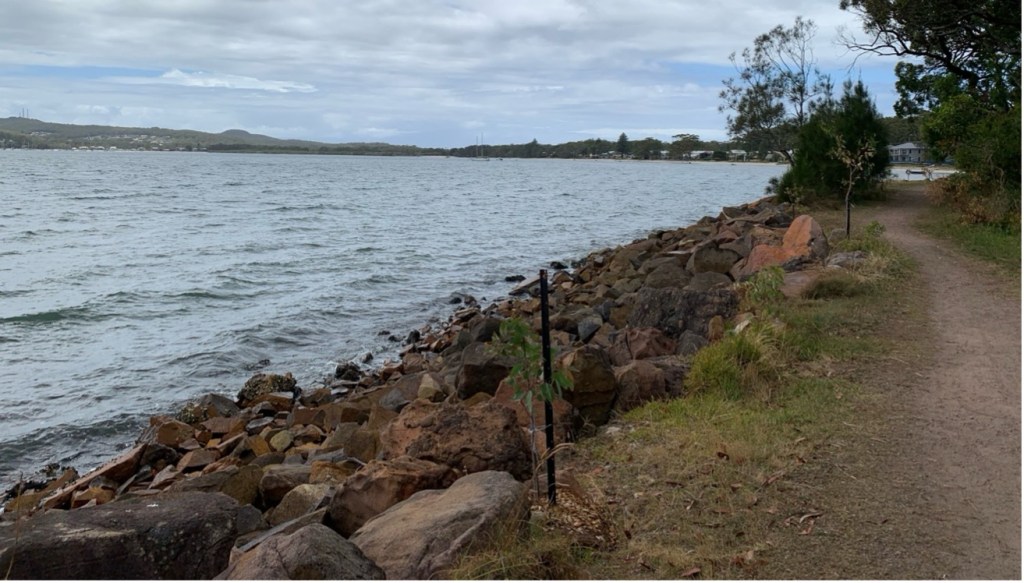
Site of the proposed paper mill at Salamander Bay near the and the rock retaining wall. [Author photo]
In a statement last night, Mr. Adams said that Thursday was spent in taking soundings and fixing the sites for the jetties, and on Friday the land was gone over, and sites selected for the mill. The erecting of the executive residential site and the large number of workmen’s cottages for the 100 employees that would be engaged in the manufacture of paper of all trades, in addition to the roads, were suggested, and the line of sewerage pipes to carry off the 2,400,000 gallons of wastewater to Point Morna, at Anna Bay, were roughly mapped out.
The experts engaged were satisfied that Salamander Bay was an ideal position for conducting an industry of this magnitude, and that, when completed, it would be the centre of a large settlement, that would be of benefit not only to the direct employees of the company, but to thousands of other people. On the way back to Sydney from Port Stephens, the party was entertained at lunch at Mayfield, by Messrs. Elkin and Haugh. Mr. Elkin, in welcoming Mr. Adams and his experts, stated that they were pleased to know there was a probability of such a large industry being established in the district. since it would assist in absorbing some of the unemployed. In discussing the proposition, both Messrs. Elkin and Haugh were able to give valuable information, since they had spent practically a lifetime in the district.’
Electoral promise to establish a paper mill at Port Stephens – 1932
The Newcastle Morning Herald and Miners’ Advocate of 1 June 1932, page 6, reported:
‘Speaking at Marrickville [in Sydney] last night, Mr. H. A. Donald, who is contesting that constituency in the interests of the United Australia Party [UAP], declared that immediately the Lang party was defeated a company with a capital of £3,000,000 would begin the manufacture of paper at Port Stephens. He said that the company would spend £1,200,000 the moment it was assured that the Stevens Government would be returned to office, and it would provide work for 1000 men. The company would build a village of 300 homes for its employees. Not only would this work relieve unemployment, but it would be another step towards decentralisation.’
The New South Wales state election was held on 1 June 1932 and the Lang Government lost office. It was a large victory for the UAP/Country Party of Bertram Stevens. Despite the change of government, the promised company investment at Port Stephens did not eventuate.
Court claim to recover wages from paper mill company – 1933
The Newcastle Morning Herald and Miners’ Advocate of 30 March 1933, page 7, reported:
‘A settlement was reached today on terms filed in the Court, but not to be disclosed, in the case in the Supreme Court, before Mr. Justice Stephen, and a jury, in which Alan Sidney Terry Elkin sued G. B. Waller, W. Bennet, and R. A. Elkin, seeking to recover £144/4/2 alleged to be due for wages from May 9 to July 18, 1932. Plaintiff had alleged that it was agreed between himself and the defendants that he should receive £750 per annum salary for his employment in the capacity of secretary and clerk in the establishment of mills by a proposed company for the manufacture of paper pulp at Port Stephens.
The defendants pleaded that they were never indebted, denied having promised as alleged, and denied any breach of agreement. Mr. F. A. Dwyer, instructed by J. R. Thomas, appeared for the plaintiff, and Mr. H. W. Moffitt, instructed by Messrs. Thomas Rose, and Dawes. Sydney agents for Mr. A. S. Borthwick, of Dungog, for the defendants.’
Renewed proposal for a paper production plant at Port Stephens – 1936
The Daily Telegraph of 30 April 1936, page 22, reported:
‘Documents were lodged in Canberra yesterday for the registration of British Australian Pulp and Paper Company, Limited, with a nominal capital of £5 million. This is the third company to announce the projected manufacture of paper pulp. …….
Objects are to erect pulp mills and manufacture paper pulp from the Kurukuru grasses of Papua and the Mandated Territory of New Guinea both for export and for use in Australia, and to manufacture fine writings and printings in Australia. ….. The company will operate as a holding concern, and its operations will be carried out by subsidiary companies. …. Lands required for production and pulping have been secured from the Administration of Papua, and include 45,000 acres at Colllngwood Bay in the North Eastern Division. These are sufficient for establishing at least three units of plant, producing an output or 60,000 tons of pulp per annum. …..
The company has also secured 690 acres of land at Port Stephens, New South Wales, for a site for the establishment of mills for the manufacture of fine writings and printings, and proposes to manufacture this class of paper for the Australian market.’
The Wingham Chronicle and Manning River Observer of 31 July 1936, page 5, also reported:
‘The construction of factories at Port Stephens for the manufacture of fine writing and printing paper, and at Collingwood Bay, Papua, for the making of paper pulp, will be begun as soon as plans and estimates can be completed, Mr. W. J. Fullerton, a Director of the British-Australian Pulp and Paper Co., Ltd., announced on Monday. The Port Stephens plant, he said, would have an output of 15,000 tons, and the output from Papua would be 5,000 to 20,000 tons of pulp a year.
On Monday, at the Hotel Australia, the Chairman of Directors (Mr. P. R. Higgins) entertained interested businessmen when Mr. Johnston Tait, mill engineer, who has been preparing plans of the proposed work, was bidden farewell on the eve of his departure for London. Mr. Higgins said that the plans would be completed in approximately six weeks, and that Mr. Tait, in England, would complete the layout of the field work and the specifications of tramways and wharfage in Papua. In approximately six weeks one of the English Directors would leave for Australia to arrange contracts for the construction of plant and the development of plantations on which the grass required for the manufacture of pulp would he cultivated.’
The proposed paper manufacturing operations at Port Stephens were never realised. The British Australian Pulp and Paper Company Limited was voluntarily wound up in May 1946.
Concluding Comments
Prior to the Second World War, there were many proposals for the development of the economic potential of Port Stephens, the majority of which never eventuated.
In particular, the timber industry was in decline around the time the various paper manufacturing proposals were being contemplated, as much of the accessible timber had been removed and processed.
The History of Timber Industry at Port Stephens is found at this link on the website.
POSTSCRIPT
Description of ‘Durness Station’ on the Myall River
The Dungog Chronicle of 13 January 1933, page 4, published the following pictorial description of the ‘Durness’ Station on the Myall River, that was written by Ruby Doyle, where a reafforestation scheme to grow pine trees for the manufacture of paper and artificial silk was proposed in 1931:
‘Two hours’ run by car from Dungog brings one to Tea Gardens on the banks of the Myall River. Along the river’s bank lies ‘Durness’, owned by Mr. J. K. Mackay, of ‘Cangon,’ Dungog. Mr. and Mrs. McLeod, of bonny Scotland are in charge and will give you a right royal welcome when you arrive, hungry and thirsty, after a long but delightful drive through picturesque bush country.
Standing at the very edge of the river, the house surrounded by its garden and orchard, forms the centre of a charming picture. A rutty road, shadowed by huge trees, leads right up to the garden, where bougainvillea clambers high in purple splendour against a background of mellowed brick walls. Overhead, flung against a sky, fragile as blue glass, clouds hover like enormous birds, their shadows passing softly over the earth where’ sunlight skills itself so generously over paddock and curving hill.
From the bush surrounding the house, comes the wistful note of some hidden bird, and the thread of that perfect music rises, falls, and rises again to linger for ever in the memory. Broad-bosomed, quiet-voiced, as some sweet woman who loves and knows herself loved in return, the river lies dreaming under the clouds and summer skies, and the trees standing along her banks, lean to her, for ever chanting their gentle wind-songs. Through their dark branches, dawn comes stealing, magic with silver and rose and palest, tenderest green, delicately iridescent as a butterfly, and as short lived. Then each green leaf breaks into small whisperings, and those, withered and brown, hurl themselves upon the face of the slumberous river waking to another day.
Gulls are glimpsed, snow-white against flat mud banks, shags skim lightly across the water, a solitary pelican stands half hidden in his leaf-screened corner, for all the world like a solitary, sad old Politician long forgotten by his party. Huddled close to the water’s edge is the boatshed with its wharf from which the young folk who come here to make high holiday, dive deep into, the green water whipped by a sea breeze.’ And away there to the side of the house stands the orchard in all its glory. Loquats peep over the fence and noisily clap wide leaves, one upon another, when, the wind runs past them to tease the glossy heads of orange and lemon, pomelo and mandarin trees, standing demurely in kirtles of green, spicing the air with their scent, tempting one with their ripe fruit hanging golden under the leaves.
There are red-gold persimmons and crimson plums, bananas butter-yellow, and striped with green, topped off with pale alabaster blossoms beloved by the bees. Luscious rock melons hide close to the ground and bold brave grape vines swing up towards; the sky and the sunlight, hiding their purple treasure behind a smother of leaf and tendril. Passion vines fling themselves impetuously from pillar to post, from tree to tree; peach trees link arms with the pears and gaily pelt each other with soft painted petals, pink and white and pearl, their ribbon-like leaves curling along swaying branches which dip towards the moist brown sand.
Beyond the house is the bush with its magnificent trees towering heavenwards or marching like soldiers up low rugged hills leaning against the sky. Here, as nowhere else, bird and flower and shy wild creature are at home — gay hued parrots swooping through the brilliant sunshine, prick eared wallabies hiding close to lichen patterned rocks, little creeping things, insects on rainbow wings, bee and butterfly and noisy cicada. Tawny hares, white-tailed rabbits, who, at sunset, will sit ringed about some ancient tree root, considering the ways of man.
In delicate and scattered beauty, bluebells and dandelions push upwards through quivering bronze-green grasses and the hardy sarsaparilla flings her purple shawl over tree and shrub and fallen log. Everywhere there is shimmering’ slumberous beauty, the whispering sigh of leaves and the thousand-million small voices that make up the mighty voice of our Australian bush. Vine, tree, flower, golden and purple fruits, shy tight buds unfurling themselves to the wind and the sun and the silver rains that run, over the hills, shrouding their heads in. mist. Gum tree, and box, and shaggy headed ironbarks, stand shoulder to shoulder, framing the setting sun, which, like an immense copper bowl, holding all the fragrance of this old earth, rests for a moment on the top of some dark hill and then vanishes from sight.
Evening stillness, the bark of a friendly dog, and the gentle mooing of cows, wandering out towards the hills tells us that the long rich summer day has drawn to an end. Stars, like pearls sewn on velvet, shine overhead. Night falls. Tomorrow another dawn will steal palely gold over the horizon to waken the now silent house to life again, to kiss the gentle river and the murmurous trees.’
Researched and compiled by Kevin McGuinness
July 2024

 Port Stephens - a history exploration