
Introduction
In December 1880, a research party from the Australian Museum arrived at Port Stephens to study marine fauna and flora in the waters of New South Wales north of Port Jackson.
The expedition was under the direction of Mr. W. A. Haswell, curator of the Queensland Museum. The crew included a taxidermist, marine engineer and an illustrator.
The SS Prince of Wales was chartered by the Museum for the six-day expedition which included the return journey from Sydney to Port Stephens.
The Sydney Mail and New South Wales Advertiser of 15 January 1881, page 88, gave a summary of the findings of the expedition:
‘The first day was spent in dredging inside harbour, in depths of 5 to 15 fathoms. On the second a run was made out to sea and several hauls of the dredge effected in depths between 20 and 60 fathoms with but poor results. The afternoon of the same day was occupied in dredging in shallow water inside Port Stephens. The third day was also occupied in dredging in the interior of the harbour, as a strong N. E. wind rendered work outside impossible.
On the fourth day a trip was made to the Seal Rocks and a fine seal captured; on the way back some very interesting hauls of the dredge were obtained in 20 to 35 fathoms, off Broughton Islands, bringing up a great variety of living forms, especially of sponges and polyzoa. On the way back to Port Stephens two porpoises were captured with the harpoon. The following day was spent in dredging off Port Stephens, mainly opposite Broughton Island, with good results.
Among the specimens obtained are undoubtedly many new to science, the best results having been obtained among the Ophiuridæ, the Polyzoa, the Crustacea edriophthalmata, corals, and the sponges; but the most important outcome of the excursion when the material has been worked out will, doubtless, lie in the direction of the determination of the northern range of the Port Jackson fauna. The specimens obtained number about 1000, and a further report will be made after the examination of the specimens.’
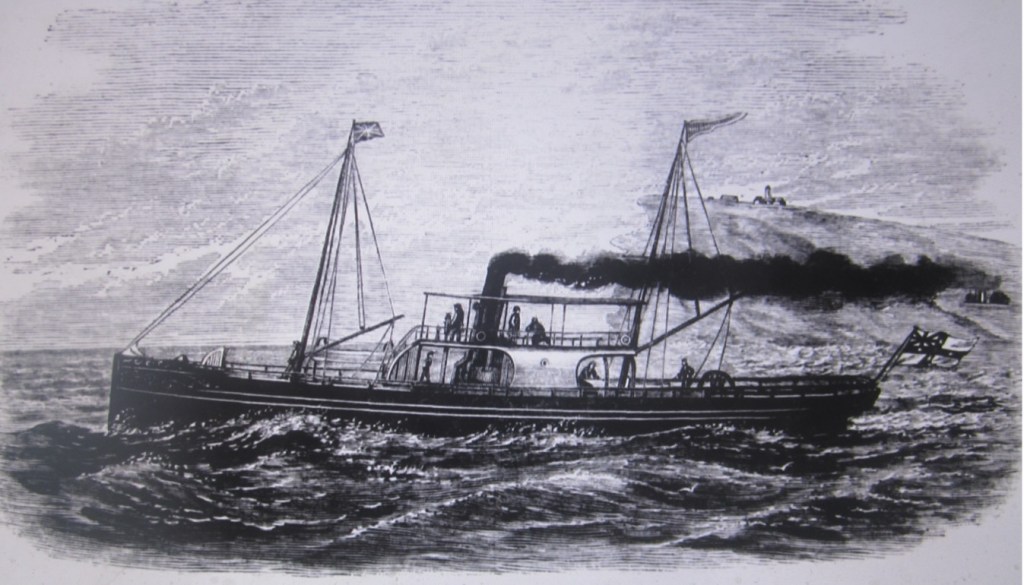
SS Prince of Wales which was chartered by the Museum Dredging Expedition [Australian Town and Country Journal, 30 August 1879]
Part One: A Diary of the Expedition
The Australian Town and Country Journal issues of 5 February 1881, pages 24 and 31, and 12 February, page 23, published a full report on the expedition, written by a correspondent, entitled “Viador” (meaning wayfarer; traveller). “Viador” identified himself as the illustrator for the expedition.
The report, as reproduced in the sections below, is very informative and descriptive of the operations undertaken during the visit to Port Stephens and beyond to collect local species of fauns and flora.
Researchers Visit the Fish Processing Facility at Nelson Bay
Soon after arriving in Port Stephens, on the first day of the expedition, the research party visited the recently completed fish processing facility at Nelson Bay, built by the New South Wales Fish Company:
‘Skirting the southern shore we passed the inner or harbour light and signal station, the pretty and substantial buildings connected therewith being perched on a steep well-wooded little bluff; a telegraph station is established here, but until the Sydney Fish Supply Company selected this spot for their fishing grounds, the operator’s principal employment was to transmit weather reports to the head office, and yarn with his fellow sufferer at the outer light.
A few fishermen’s huts, scattered along the shores of Nelson’s Bay, next came in view. Arriving off the Company’s newly erected works, situated at the far end of this sandy bight, we ran alongside the long jetty. Mr. Huntly, the manager (the same gentleman who in a similar capacity contributed largely towards making the Coffee Palace [in Sydney] the success it is) was standing on the end of the wharf when we made fast.
On learning the nature of our business, Mr. Huntly welcomed us heartily, kindly proffering us every assistance that lay in his power. After breakfast we went ashore to inspect the works, the engine room with the machinery for the production of dry cold air, or ice, as might be required, coming first; a well within the building furnishes an ample supply of excellent cold fresh water in every way adapted for the purpose required; we then passed round to the right hand side of the main building and entered through a pair of solid and think double doors, a spacious apartment floored with a thick layer of cement, the walls and roof were lined with sawdust, closely packed, and between tongued and grooved pine linings, the roof was traversed by cold air pipes, capable of lowering the temperature as far as it was desirable for the operatives to work in; two small double framed windows admitted sufficient light to enable them to clean, open, and sort the fish.
Passing through two more similar doors, we found ourselves in the cold storage chambers; on every side, above and below, 18in of the same non-conducting material, sawdust, of which over 80 tons had been brought from Sydney for the purpose, divided the seasons, and a double quantity of cold air pipes overhead were expected to be capable of reducing the temperature many degrees below zero. Here the stock was to be kept, and when wanted the supplies would be run out into the cleaning-room, there packed carefully in the company’s cases and safes, placed on the trolly, and run down the tram to the vessel, which will discharge her consignment at the branch cold store-house in Sydney, where less powerful machinery will conserve it for any reasonable length of time. It is proposed from there to send supplies to the up-country towns. At the rear, but attached to the main building, is a large iron shed for drying, salting, and smoking fish, the firing arrangements for the six furnaces being very convenient.’
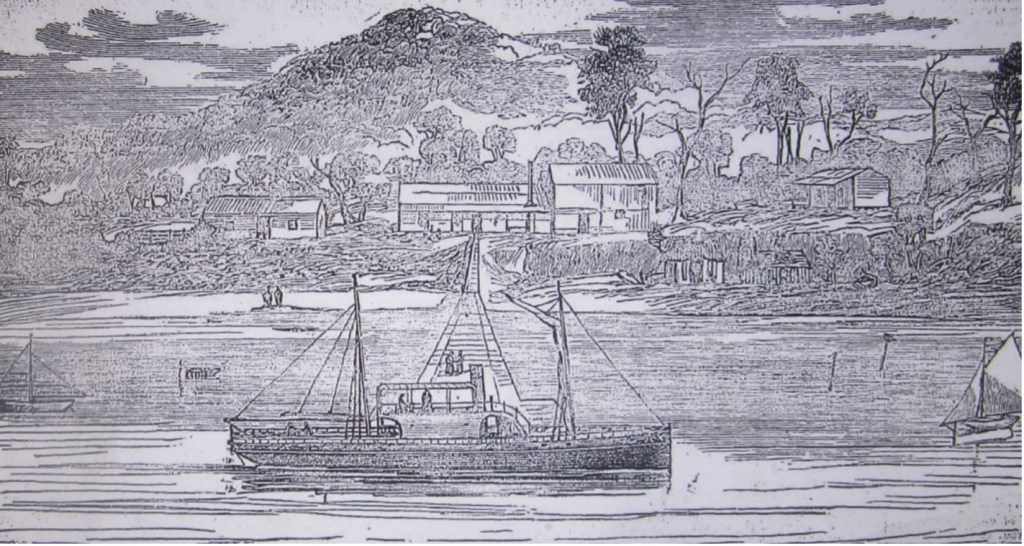
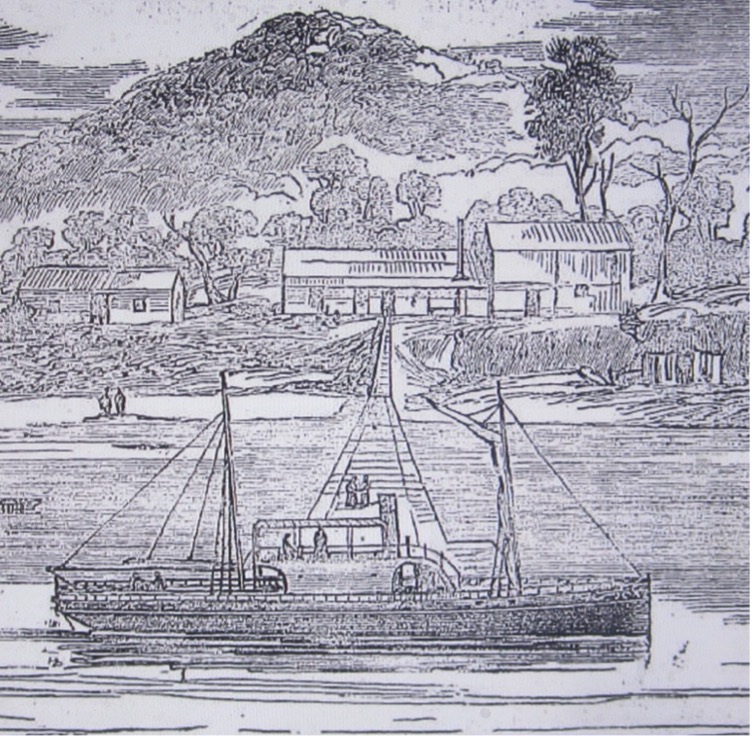
Facilities comprising accommodation and a factory of the New South Wales Fish Company at Nelson Bay as illustrated by an Australian Museum expedition member. The steamer ‘Prince of Wales’ is shown in the forefront adjacent to the new wharf. [Australian Town and Country Journal, 5 February 1881].
Further information on the fish processing facility is found at this link on the website
Daily Summaries
The report, as cited above, continues and summarises the daily activities, as follows [with the daily headings added]:
Day One
‘Our first cast [with the dredge] was made on the tail of an extensive sandbank, lying opposite the works [Nelson Bay Fish Processing Works], but on hauling the dredge to the surface it was found to contain only dead and broken shells, and gravelly silt; a few spider crabs, were, however, obtained in the manilla tangles (bunches of untwisted rope fastened to the bottom of the net). The following cast was hardly more successful, but on shifting closer in, within half a cable’s length of the rocky shore, we found in from eight to ten fathoms a much more promising bottom, and several successive hauls procured as a fine lot of sponges and several varieties of crabs and starfish. Live shells were, however, very scarce.
After a midday dinner we steamed further up the harbour, scaring large flocks of black swans and pelicans from the mud flats and sandy beaches on which they were feeding, by Snider bullets, but long ranges and bad shots reduced the execution to nil. Selecting a suitable spot, a party, myself among them, landed to attack the oysters; here the execution was something awful, cold steel wielded by veterans at close quarters quite turning the tide of war. After satisfying our thirst for oysters, leaving the others to imprison a few bagsful of the survivors, I went for a short stroll, but discovered nothing of interest but an old black’s camp and traces of warregals, which are very numerous in this district.
Returning on board with spolia belli, we proceeded further up the inlet. While we had been on shore two or three more casts had been made with varied success, and a few of the spirit and chromic acid jars were filled with the results. After it had been thoroughly overhauled a portion of the silty residunm was put in a canvas bag for closer scrutiny and microscopic examination on our return.
A couple of miles further and the Prince hove-to off a well wooded little islet [Middle Island] rather larger, but not so high, as Garden Island, where our guide assured us we could get a lot of eggs of the nankeen crane, and possibly a goat or a rabbit or so, so the skiff which had been towing astern was brought alongside. Mr. Haswell, Morton, Cook, Lewis, the pilot, and the skipper, who was provided with a double-barrelled muzzle loader, and myself, armed to the tooth with a No. 1 saloon rifle in my hand, and an antiquated, but in other respects very good Terry rifle slung over my shoulder, embarked for the shore. On landing, and thrusting our way through the dense undergrowth, we startled large numbers of nankeen cranes from their nests and the treetops in which they had been sitting.
These birds hovering and wheeling overhead were easily shot, and the popgun had scored two, when the barrel being rather foul, one of the pills stopped halfway, and although I fired another shot to induce it to move on, it refused to budge an inch, and my sport in that direction was over. The others in the meantime had not been idle. Several trees had been climbed, but only three or four eggs had been obtained. They were about the size of a bantam’s egg, and of a pale sea-green tint. The skipper had bagged what a couple of ounces of No. 1 had left of a crane. These were not the only game started, myriads of mosquitoes making it pretty sultry for all hands, and ultimately gaining the day by causing us to beat a retreat before we would otherwise have done so, not before, however, the captain’s lively fusilade had sent many to their happy hunting-grounds.
One more too-inquisitive crane fell a victim to the blunderbuss. He was gazing pensively down the barrel, speculating, I suppose, whether there was a worm in it, when somehow or other it went off, and the victim of misplaced confidence, with a few score or so of Australian nightingales, were numbered with the slain.
Returning on board the boat we put her round, and ran down the harbour to the Company’s jetty, where we intended to moor for the night. On our way back the pelicans were again saluted with the usual success. One, however, came rather close to see what the row was about, but before I could ram a cartridge into and cap that wretehed nondescript affair, a Terry rifle, he had sheered off.
After tea Mr. Morton [taxidermist] and myself took a stroll along the beach to the inner lighthouse, and from whence we had some telegraphic messages to send. After a rather fatiguing climb up the sandy track we reached the summit of the hill; the view of the surrounding scenery, lit up by the rising moon, was very pretty, and well repaid us for our exertions. After sending our messages, Mr. Glover, the lighthouse keeper, showed us over the premises and light room; everything was painfully clean, bright, and orderly, in fact it would have been impossible to have collected sufficient dirt to rear a solitary specimen of the bug tribe on from the whole of the buildings.
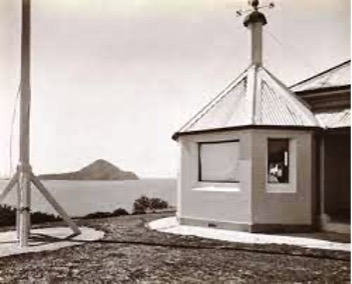
Early view of the Inner Lighthouse, Port Stephens, with the lamp room at the right of the photo
On our return to the steamer, we called in at the cottage in which Mr. Huntly and Mr. Wolle, the custom house officer, were living. The latter gentleman handed Morton, as a donation for the museum, a very curious artificial bait and hook used by a tribe of Nova Scotia Indians for catching fish. It was constructed of a piece of hardwood, shaped like an eel, with a long sharp piece of bone attached in such a manner as to form the point; there was no barb.
Day Two
On the following day it was resolved to go outside and obtain a few hauls in deep water four or five miles off the coast; Mr. Waterhouse and a couple of others to stay on shore and go shooting; I remained also to sketch the works. The sportsmen after decimating a little jay and murdering in cold blood a butcher bird that had not yet arrived at days of discretion, succumbed to the heat of the weather and taking up selections on the balcony of an empty cottage, snoozed comfortably until the return of the vessel. I found my work not the most pleasant, sitting on the end of the jetty all day under a burning sun.
They had met with pretty fair success aboard the steamer, but the labour of hauling up a heavy dredge by hand (there being no winch) from a depth of 60 fathoms enabled them to have but a few hauls.
Day Three
The following day, Thursday, was devoted to further operations within the harbour; several sea urchins, a few live shells, one or two little fish, and a few bagsful of singularly uninteresting looking black mud, were the principal takings of the dredges, one of which in trying conclusions with a large ghibber, was considerably worsted, and knocked into one of those manifold shapes technically supposed to resemble a cooked hat.
In the early morning with the rising tide we ran up the Myall, a shallow creek connecting the large fresh-water lakes to the northward with the harbour. Steaming about a couple of miles, we arrived at a coal wharf where the dredge that was employed deepening the channel loaded her fuel. A party of us having landed on the opposite shore of the river, Mr. Huntly caused some fishermen living there to try a cast of the seine, and a fine haul of large mullet, whiting, black bream, and blackfish were in a very short time transferred from their native element to the head-sheets of our boat. The finer specimens were put into the spirit-cask, for the Museum collection of Australia food fishes, and the bulk of the remainder were turned over to the commissariat department.
That evening it was resolved that the following day should be devoted to a visit to the Seal Rocks, two barren little islets lying within a league from the coast, about 25 miles to the northward, in the hope of scouring a complete series of the large hairy seal, Arctocopbalus sp., which, it was reported, frequented these isolated rocks during the breeding season in considerable numbers.
Day Four
Early the next morning, with Messrs. Huntly and Lewis (who had about the same time last year paid the place a visit) aboard, we made a start. On getting fairly clear of the bold headlands of Port Stephens, we found the sea smooth and a light north-easter blowing, a favourable combination of circumstances which gave us every hope of success. Passing inside the Broughtons, a group of bold rocky islets, sparsely clothed with stunted sombre-tinted vegetation, lying just off the entrance to the harbour; and steaming rapidly up the coast we were soon abreast of Long Island, on which not a tree of the size of a gooseberry bush was to be seen, the only prominent object that met the eye on its wide expanse of undulating grassy surface, girdled by beetling cliffs an sand beaches of pearly whiteness, being a small hut erected near a permanent spring of good water by a prospecting party engaged there some time ago in boring for coal.
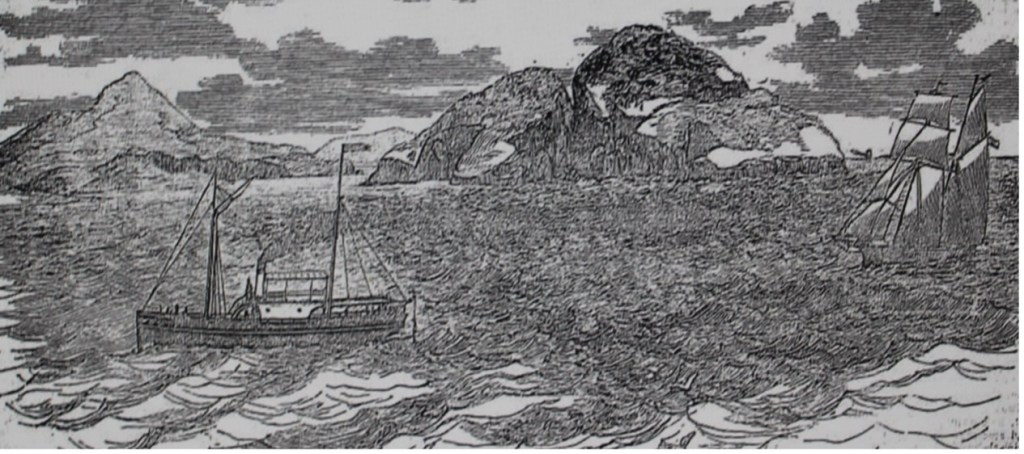
Illustration of the Prince of Wales near Broughton Island [Australian Town and Country Journal, 5 February 1881]
Shortly after, while “seeking the seclusion that a cabin grants, “I was startled by a hurried rush of trampling footsteps overhead, and loud cries of “Stop her,” “I’ve got him,” “Stoady,” “Clap on here,” &c. My first idea was “man overboard,” but on gaining the deck in the twinkling of a duck’s tail, I saw at once the state of affairs; Lewis had harpooned a large porpoise, and five or six men had all their work cut out to hang on to him; dashing rapidly to and fro and at times leaping clear out of the water in his frantic efforts to escape, the sea pig bent and twisted the light iron of our little patent harpoon until it resembled a Brobdinagian cork-screw; had it been one of the old pattern it would probably have drawn.
As his struggles grew weaker, and exhaustion from loss of blood rendered his ultimate fate a certainty, his comrades attacked him on every side, but the smooth slippery skin and perpetual motion of their unfortunate countryman effectually resisted their little attentions, compelling them to satisfy their cannibalistic cravings with copious libations of sanguinary sea-water. After much manoeuvring and repeated failures we managed at last to pass a running bowling round his tail and hauled him aboard; our prize proved to be a fine specimen of Dolphinus sp., a variety not represented in the museum collection; from the tip of his pointed snout to the end of his powerful flukes he measured about 8ft, and his beautifully close lines accounted readily for the wonderful rapidity and ease with which those fish cleave the water.
Unfortunately for us, as the morning sun rose higher in the heavens, the breeze freshened, and by the time we arrived at our destination a nasty cross sea was fast getting up. It was determined, however, to make an attempt to land, so the Prince was hove to about a cable’s length to leeward of the principal islet, which was only 80 or 90 yards long and about 40 wide, and her cockleshell of a dingy (the only boat with us) was lowered. Watching our chance Morton and I, armed respectively with a Snider carbine that had known better days, and the Terry, jumped into her, and Lewis taking the spoons “pulled for the shore.”
Seals of both sexes and all ages, from the pretty little sleek dark skinned calves tumbling over each other in play, or suckled by their mothers, sedate old dames clothed in puritanical dandy grey russet costumes, to huge shaggy maned patriarchal bulls, basking sleepily in the sunlight, or discussing in solemn conclave the Eastern question, fish supply, or some other equally engrossing topic, were thickly scattered over the surface of the rock. On getting within a few boat’s length of the shore we held a council of war; closer inspection certainly did not remove the difficulty or diminish the danger of landing; a swift tidal current was sweeping round the island, causing a nasty jobble, and giving Lewis all he could do to prevent the dingy from being stove or swept away to leeward; great numbers of adult seals were swimming on every side of and diving under us, now and again leaping entirely out of the water, and threatening at times to swamp our little nutshell; the young ones did not appear to have been as yet initiated in the natatory art, as we did not see one disporting itself in its natural element.
Save an occasional roar of defiance from some old warrior, as he shuffled clumsily, though with considerable speed, over the hard and uneven surface, or raised himself on the ends of his flippers to take stock of the intruders on his domain, the lords of the soil (if such an expression can be admitted where there is none), took no notice of our approach, beyond gazing at us with a steady inquisitive stare; but a change comes o’er the spirit of their dreams.
Selecting a couple of hoary old ruffians who were contesting fiercely on a small, elevated plateau, for the smiles of some captivating young cow, we fired almost simultaneously, the dull thud of the bullets and the sudden cessation of hostilities on the part of the combatants telling unmistakably that they had found the billets for which they had been intended. The recipient of the Snider bullet scrambled hastily down the slippery rocks towards us, but before he could reach the water the Terry spoke again. Pausing an instant on the edge of the rock, he uttered a short sharp cry of mingled pain and rage, and then plunged into the sea, leaving on the crest of a breaking wave a swirl of blood-stained foam as he sank to his last resting-place.
In the meantime, the gentleman who had stopped my ball had come to the conclusion that he was in the way, and was making tracks for the other end of the island as fast as he was able, when some messengers which we sent after him prevailed on him to bring to, and lay himself out to be measured for his bone-box. The ball having been thus opened, the vessel commenced, at a comparatively long range, a rapid but ineffectual fusillade, from all sorts of firearms. I shall never forget the scene of tumult and uproar that ensued. Scores of old bulls kept up an incessant roaring, growling, and bellowing as they floundered aimlessly over the island, a continuous stream entering and emerging from the sea, the bleating of innumerable small calves, deserted by their frightened mothers, many of whom had taken to the water, mingled with the sharp, ringing reports of our rifles, creating a strange medley of sounds, more easily imagined than described. Many of the wounded struggled down into the sea, dyeing the surf crimson with their life-blood and the rapid current swept them away to the southward.
Morton’s Snider, after the first two or three shots, had been hors de combat refusing pertinaciously to eject the empty shell of its cartridge and the jerky motion of the dingy caused me to miss as often as I hit; our friends aboard the Prince were evidently out of practice, as with the exception of a few very fair shots at us their shooting was decidedly below par, and more noise than slaughter was to be credited to their score. I afterwards ascertained, however, that the rifle was a kind of shooting iron not exactly in their line, that the skipper was a dead shot at the sun with his favourite sextant, and that the engineer could do some pretty tall firing with a long-handled shovel.
Seven or eight dead or dying monsters were now lying on the bloodstained battlefield, so we decided to make an attempt to land; Lewis, however, discovered that he was unprovided with a weapon less clumsy than a paddle, and not liking the threatening gestures and fierce demeanour of the bulls, some of whom were maddened with rage and pain, and fearing that they would take to him while securing the dingy, prevailed on us to return to the Prince for his favourable waddy.
Pulling back to the island we came across a dying seal, and by the help of a gaff hook attached to one end of the fisherman’s endgel managed to secure him. While engaged in hauling him aboard the steamer, rather a laborious undertaking as he was an adult male weighing nearly half a ton, we lost some time and were drifted by the strong tide over a mile to leeward. On getting back to the rock we found that during our absence the wind and sea had increased to such an extent that it would have been madness to attempt to land. A heavy ground swell was now breaking angrily on every side of the rocky islet, and the treacherous drawback rendered it dangerous for us to take our little cockershell too close, so I confined myself to shooting at those in the water, in the hope of the party aboard the Prince being able to pick up or harpoon some of the desperately wounded ones before they sank, but although I expended some 50 rounds of ball cartridge, the roughness of the sea rendered our exertions and further slaughter futile.
On re-embarking, before we left the rocks, Mr. Haswell decided, weather and circumstances permitting us to entertain any hopes of success, to return the following morning and secure our victims. We then piped all hands to dinner, and getting the canvas on her, shaped our return course. With wind and tide in our favour we wore not long in making the Broughton, outside of which Mr. Haswell wished to try a few hauls of the dredge A cast of the lead showed 25 fathoms, so the dredge was lowered to the bottom; the engines were stopped as the strong breeze gave the vessel quite sufficient way for dragging the scraper.
As soon as the vessel’s way was checked, lines were over the side, and although she drifted too fast for the sinkers to remain on the bottom for more than a few seconds at a time, a dozen or so fine schnapper were soon kicking on the deck, the skipper scoring the highest with eight or nine. Every now and then the word would be passed “in lines and haul up the dredge,” and then the stout hawser attached to the bottom tickler having been hitched into a snatch block, fastened at the end of a temporary derrick overhanging the little vessel’s taff rail, was manned by all hands, and with a stamp and go the mystery bag would be quickly hauled to the surface and swung in-board.
The first two hauls were very successful, some very fine and remarkable Polyzoa’s of the most beautifully varied forms and tints being obtained; among the prizes were several brilliant little scarlet crabs with legs and claws tipped with bright cobalt blue; live shells were, however, as elsewhere we had tried, very scarce. Many interesting zoophytes and rare sponges were among the contents of the net, and a few curious spider crabs were found on overhauling the manilla tangles.
After this our luck gave out entirely, the rocky bottom destroying two of our dredges before we returned to the port. On our way back Morton was vary busily employed in skinning the seal and porpoises, for Lewis had struck another shortly before entering the harbour. This fellow was rather smaller than the one we had captured in the morning and gave us loss trouble to secure. When we let go the mua-hook at our usual berth just off the Fish Company’s works, Mr. Waterhouse, whose dread of ”mal de mer” [sea sickness] had alone prevented him from accompanying us, and his friend, came alongside with a boat load of fine oysters, which they had collected during our absence.
Shortly after the Manly, a steamer little larger than the Prince, bound for the Bellinger, ran in and dropped anchor between us and a topsail schooner, that had put back for shelter, fearing a north-easterly gale. The skipper of the former in whom I recognised an old shipmate, came aboard after tea and brought the latest papers from town.
Day five
At dawn the following day the easterly having given place to a strong southerly, which for them was a fair wind, both vessels weighed and left us again the solo representative of the shipping interest in the harbour. As the morning advanced it became very evident, much to our disappointment, that we would be compelled to relinquish any idea of being able to land on the rocks and secure the seals that had been shot the day before, so after bestowing our blessings on that much abused personage the clerk of the weather, we decided to devote the last day at our disposal to trying a few more hauls over the ground where we had been so successful the day previous. A regular chapter of accidents, however, ensued, and we added but little of any importance to our collection.
First our only set of tangles was carried away, and then one of the nets was torn to rags, and finally the rocky bottom completely destroyed our last two dredges, compelling us to return to port earlier than usual, and almost empty handed. After breakfast on Sunday we made everything snug for our return to Sydney, and after bidding Mr. Huntly goodbye we tore the emblem of hope for the last time from its fond embrace of Port Stephens mud, and steaming rapidly down the harbour we shortly cleared the heads, and the scene of our pleasant little excursion was left far astern.
About 10 o’clock we were just off the Nobby’s, and the approach of an imaginary buster was made the excuse for running into Newcastle, and spending Sunday in the coal city. A flowing tide and full head of steam swept us up the harbour in fine style, and we made fast outside one of the Government tugs, used for towing the silt barges out to sea, which was moored alongside the wharf.
After making ourselves presentable, Messrs. Haswell, Morton and myself went ashore and took a walk of inspection round the howling wilderness and which is designated by those unfamiliar with its intricate labyrinths of odoriferous back slums, and old building materials, &c., and its monumental mountains of cinders and ashes, broken bottles, rags, bones, and empty kerosene tins, the second city of the colony.
We had an early dinner at one of the leading hotels, where we met an acquaintance of Morton’s, Mr. Cates, one of the members of the London Comedy Company, then playing to scanty and unsympathetic audiences in that city of sin and sorrow. After dinner that gentleman gave us an opportunity of inspecting the theatre, the dirtiest and most disreputable old barracks in the colonies; in fact the little bark shanty devoted to the muses at Temora could score many points over its more pretentious rival.
Day Six
About midnight, all hands being aboard, we got underweigh, and we made a fine passage to Sydney, entering the heads just after sunrise. Cowper’s wharf, in Woolloomooloo Bay, was selected as the most suitable place for disembarking our impedimenta, which were soon transferred to a couple of vans and sent on to the Museum, and the last event of our little trip was brought to a close by piping all hands to splice the main brace at Punch’s bar, and drink success to our next excursion, when or where ever it might be.’
Concluding Comments
The 1881 Report of the Trustees of the Australian Museum stated that most of the specimens were obtained within Port Stephens itself. Specimens were also obtained on two days outside the heads of and included a large proportion of new species distinct from those of Port Jackson.
The total number of species procured was estimated at 700.
The Port Stephens region has been the destination for numerous research expeditions.
Researchers from the Australian Museum travelled to the Port Stephens region to collect aboriginal artifacts in areas such as the Morna Point coastline in 1928.
Researchers from Sydney University made visits to the Myall Lakes area in 1934 and 1935 to study the geology and vegetation. Details of the Scientific Surveys of the Myall Lakes -1934/35 are found at this link on the website.
ADDENDUM: BRIEF HISTORY OF THE SS PRINCE OF WALES
Construction of the Prince of Wales Steamship
The Australian Town and Country Journal of 30 August 1879, page 25, reported:
‘Up to within the last few years, it was the rule and not the exception for orders for steamers requisite for harbour requirements to be sent to the old country, but we are glad to say that now, with all the first-class appliances we possess, Sydney shipbuilders can build steamers, and engineers can construct engines, quite equal to anything that is imported from the old country, and in proof of which, we this week give an illustration of the Prince of Wales, one of the fastest steamers and handsomest specimens of naval architecture now in Sydney harbour.
This favourite vessel, as a steam tender and tug stands unrivalled in the port, and her owner, Captain Waterhouse, enjoys the patronage of most of the leading shipping firms in Sydney, and is eagerly sought after by excursionists who take a day’s outing to the beautiful crannies and nooks of Middle Harbour.
Recently the Prince of Wales received a thorough overhaul, and on her trial trip, notwithstanding a strong head wind, and bunting in profusion flying, the smart craft did the measured mile in 5min 10sec, and that with the boilers priming. In proof of the high opinion which the Press has for this steamer, it may be mentioned that the fourth estate selected her as the Press boat for the great race for the championship of the world between Trickett and Laycock yesterday, and the superiority of speed and comfort of the Prince of Wales was particularly noticeable by those who had the pleasure of being aboard.
The Prince was built by Mr. W. Dunn, of Blues Bay, North Shore, and was launched in December, 1877. Her length is 100ft overall, and, when loaded, has an 8ft draught. The engines are by Chapman and Co., and are compound surface condensing, with cylinders of 12¾in and 22½in respectively. She is fitted up with cabins fore and aft, having sleeping accommodation for 42 persons, in addition to a ladies saloon, and is licensed by the Marine Board to carry 360 passengers. The Prince of Wales is specially adapted for excursion parties, being fitted up with seat accommodation in every part, and her great beam gives every opportunity for people to move about comfortably.
In addition to her deck accommodation, she has a capacious bridge from which the steering is done, and last, though not least, her towing powers are considerable, having towed against wind and sea some of the largest ships that ever came into Sydney Harbour. The Prince of Wales has been running since June 1878, in constant work, and up to her recent overhaul has not cost Captain Waterhouse penny for repairs, and now she can, to use a racing phrase, run “rings” round anything her size in the harbour, and is a formidable rival to the well-known Manly steamer Fairlight.
Messrs. Chapman and Co., ought to feel proud at having turned out such excellent work as the engines of the Prince of Wales, which are acknowledged to be of a very superior description, and already have gained for the manufacturers the highest professional encomiums. Mr. Dunn, the builder of the Prince of Wales, who has been established as a shipbuilder for the last 20 years, has turned out, at least, 100 vessels; but he prides himself, and justly so, on the ” Prince,” which takes the palm. At the present time the commander of the Prince of Wales is T. Clayton, with H. Clayton as engineer, and both strive their utmost to increase the popularity of what is the pride of the port.’
Prince of Wales Sinks
The Daily Telegraph of 17 July 1886, page 3, reported:
‘A collision, resulting in the sinking of one of the finest steamers belonging to this port and the loss of two lives, took place yesterday morning on the coast in the vicinity of Botany Bay. The steamer Prince of Wales, owned by Mr. William Waterhouse, the well-known steamboat proprietor, was outside the Heads on the lookout, for any vessel that might require her services, when a ship, which proved to be the Peterborough from London, hove in sight. As is usual the Prince of Wales went within hailing distance of the ship, and having made arrangements with the master, Captain Murchie, to tow her into port, proceeded forward with a view of getting a towline on board.
The weather was pretty fine at the time, and the vessel being close handy no difficulty was experienced in throwing the heaving line on board. The line was made fast to the tow line and being secured by the crew of the ship, the order “haul in” was given. Just at this moment the wheel-chain of the Prince of Wales by some means or other became jammed, and she, becoming unmanageable, shot across the ship’s bow and was run down. The Prince of Wales was struck with great violence on the port side, in the vicinity of the gangway, and sustained such damage that she sank almost immediately, the engineer, (John Farr) and the fireman, known as “Tom,” being drowned, and the others on board, viz., Captain A. McKay, the master, M. Walsh, a deckhand, and W. Bland, a passenger, having a narrow escape from meeting with a similar fate.
Walsh and Bland, who were on deck, managed with difficulty to scramble on board the ship. The captain was less fortunate. He was thrown overboard and was rescued by the ship’s boat in an exhausted condition, having been nearly half an hour in the water.
The first news of the occurrence was received in town soon after 11 o’clock in the forenoon, and was to the following effect:— “Steamer Prince of Wales run down by ship Peterborough. Fireman and engineer drowned.” Later on, the Secretary of the Marine Board received a telegram from Captain Creer, of the pilot steamer Captain Cook, stating that the Prince of Wales had been lost. No particulars of the occurrence were given, and although many were the surmises it was not until after 1 o’clock that anything authentic came to hand. At about the hour indicated the steamer Kate, having on board the captain and others of the ill-fated vessel, steamed into Circular Quay.
The Kate was outside the Heads and she came up just after the unfortunate accident took place, and having towed the ship’s boat with Captain McKay back to the Peterborough took her in tow and brought her safely into port. The Peterborough had on board upwards of 100 passengers, who feel extremely sorrow that their voyage should have terminated so unfortunately. ……. The matter has been reported to the Marine Board, and an inquiry will probably be held on Monday next.’
Researched and compiled by Kevin McGuinness
June 2024

 Port Stephens - a history exploration