
Introduction
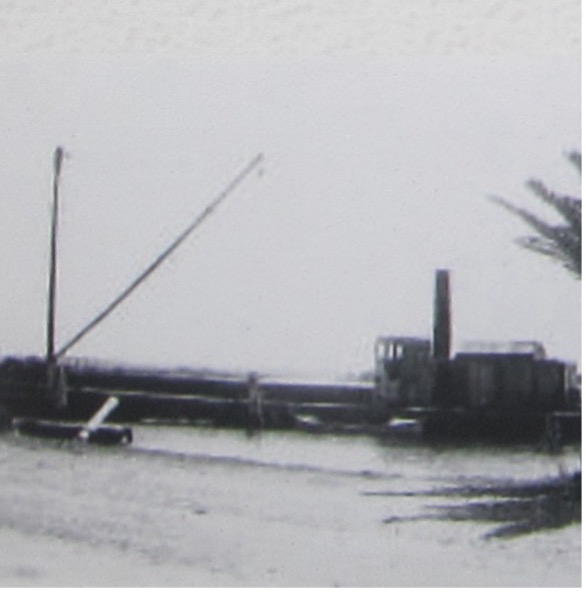
The lluka was a 128-ton iron paddle steamer that was built in 1879 at Blues Point, Sydney. She was originally owned by Joseph Grafton Ross of Sydney.
The paddle steamer was purchased by the Colonial Sugar Company in 1880 and then transported sugar for the company. She was 110ft. long, with an 18ft. 3in. beam, and 7ft. 2in. draught.
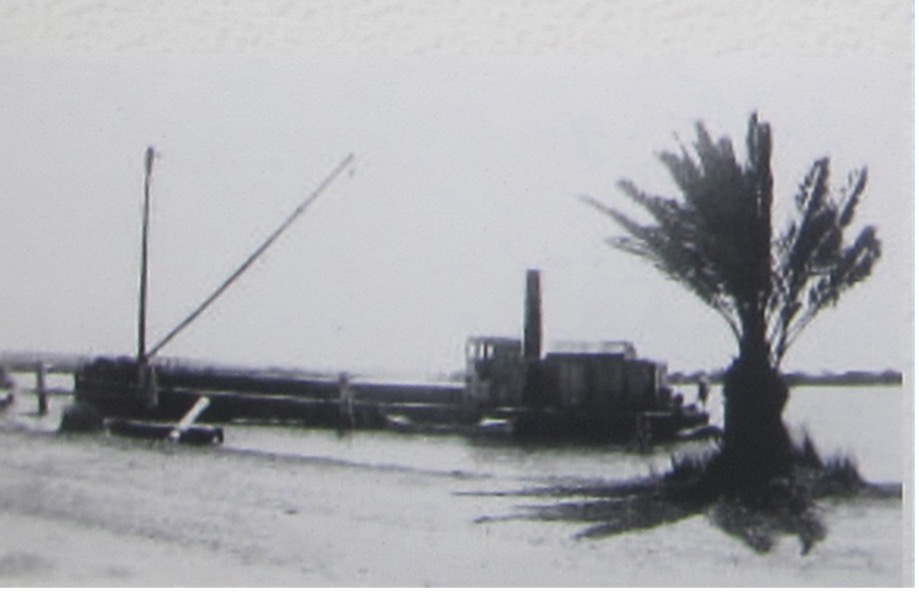
In 1924, Iluka was refitted as a steam powered drogher to carry timber after being purchased by Mills and Rigby, timber merchants of Newcastle.
Over her 67 years of service, the steamboat had a chequered history. She was sometimes referred to as the ‘ill-fated Iluka‘. Within months of her launch, she was involved in a collision with another boat. This misadventure was followed over the years by additional accidents and sinkings.
This paper looks at the operational life of the Illuka, whose hulk remains at Port Stephens, opposite Tea Gardens wharf.
Iluka in a collision at Clarence Heads – 1879
The Clarence and Richmond Examiner and New England Advertiser of 30 August 1879, page 4, reported:
‘A collision occurred on Monday evening last between the steamers lluka and Lillie, resulting in the sinking of the latter boat. From what we have heard it appears the Lillie steam launch, in charge of C. Charleston, was proceeding to lluka, and when off Freeburn Island and near the black buoy, about 6 p.m., met the steamer Fiona, which had entered some time previously, after towing up the Colonial Sugar Company’s new boat the Iluka.
The latter boat was following, having been cast off by the Fiona after steam had been got up. The Lillie was passed by the Fiona all right, but came into collision with the lluka, which struck her on the starboard bow, and she quickly sank. Charleston, with some difficulty, got on to the sponson of the lluka, but was severely crushed by the sinking launch, which heeled over against the other boat, jamming him against her side.
Captain Curphey, of the Fiona, hearing the collision, at once stopped the Fiona and lowered a boat, which was quickly on the spot. The injured man was taken on to Harwood Island and came on to Grafton to his home the following day, and he has since been confined to his bed from the injuries received.
The lluka is a new iron tugboat, owned by the Colonial Sugar Company, and had only arrived in the river an hour or two previously. The Lillie was a small wooden steam launch, the property of Mr. T. Bawden, M.L. A., and was we believe insured. Mr Hutchinson was sent down by the owner to endeavour to find the sunken boat and report upon the best means of raising her. We understand he returned to town, having been unable to find the spot or any trace of the launch.
Iluka in a collision at Darling Harbour – 1918
The Daily Examiner, of 27 June 1918, page 6, reported:
‘A collision occurred in Darling Harbor between the Macleay River S.S. Company’s steamer Kinchela and the Colonial Sugar Refining’ Company’s lighter Iluka. The Kinchela was proceeding from the Bathurst Street wharf to Careening Cove, and the lighter was being towed from Pyrmont to Darling Harbor by the tug Jessie. They impact was severe, the lighter being cut down to the water line. A quantity of sugar on board the lighter was damaged by water. The Kinchela was slightly damaged.’
The Sydney Morning Herald of 14 August 1918, page 9, reported on the subsequent Marine Board of Inquiry:
‘Walter John Glover, master of the steamer Jessie, was proceeded against at the Central Police Court yesterday by Captain Sangster, on behalf of the Superintendent of Navigation. It was alleged that on June 25 the defendant unlawfully failed to obey article 23 of the regulations in the navigable waters of Port Jackson. Mr. Kidston appeared for the Crown Law Department; Mr Broomfield, K. C. (instructed by Messrs. Minter, Simpson, and Co.), for the defendant, who pleaded not guilty to two charges.
It was stated that the defendant, who had the lighter Iluka in tow, with about 60 tons of sugar, in Johnstone’s Bay, caused a collision with the steamer Kinchela, by which the Iluka was damaged. Defendant said that he went full speed astern when he heard the blasts from the Kinchela.
Mr Kidston said he did not press for a heavy penalty. Mr Clarke, S. M., Imposed a one of £5, with £1 costs, in default two months’ imprisonment with hard labour. The second charge was withdrawn.’
Iluka refitted as a drogher to carry timber – 1924
The Newcastle Sun of 15 December 1924, page 2, reported:
‘A fine engineering feat has been carried out by Hosking and Lawrence, of Sydney. Mills and Rigby, timber merchants, of Newcastle, urgently needed a large steam lighter to trade at Port Stephens, to carry long poles, and to carry 100 tons, and to draw very little water. The firm purchased the old Sugar Company’s hulk, Iluka, formerly a paddle steamer, and invited Hosking and Lawrence to convert it into a steam propeller job. It meant cutting out the stern and electric welding a new boss into the existing post; also to carry a false keel three feet aft, to hold the rudder pintles.
The hulk was taken to Alexander’s slip at the Glebe, when the hull was thoroughly overhauled, 18 plates renewed, and the work at the after end commenced. Having no stern frame, great care had to be taken to strengthen the frames and keep the stern fair. The plates and rudder were removed, and a cast steel bow welded in. Patterns were made, and a cast steel shoe made, and firmly connected to the keel.
A start was then made to erect engines and boilers, seating, building in steel bunkers, water-tight bulkheads, steering-house, casing and crew’s cabin. The engines and boilers and auxiliary machinery were installed, and crew’s quarters fitted out. A special feature was installing a large mast and derrick with the necessary winches, to load two lengths of poles when required. The hatch was 74 feet long.
When completed, the vessel left for Port Stephens under her own steam, unsupported, with a cargo of coal, and averaging eight knots an hour. There is only one other vessel in the Commonwealth on which a similar job was carried out: that was the s.s. Holden, of the N.C.S.W. Co. The work on the hull and fitting was carried out under the personal supervision of Mr. W. J. Hosking, member of the Institute of Engineers and Shipbuilders, and the engines and machinery and propeller under the supervision of the late Mr. Charles Lawrance, late superintendent of Mort’s Dock.’
Iluka goes aground at Port Stephens – 1926
The Daily Commercial News and Shipping List of 28 December 1926, page 4, reported:
‘The steam drogher Iluka, which struck a submerged pole in Boolambayte Creek on December 11, and went aground in 12 feet of water, is expected to be refloated, and will be placed on Messrs. Allen Taylor and Company’s slip, Port Stephens, for repairs.’
Iluka at Tea Gardens
Iluka sinks at Port Stephens – 1928
The Daily Telegraph of 7 January 1928, page 23, reported:
‘The steamer drogher Iluka, which sank in Port Stephens on Christmas Eve, with a number of turpentine piles on board, was raised yesterday.’
Iluka breaks away from moorings at Port Stephens – 1928
The Dungog Chronicle of 22 June 1928, page 4, reported:
‘The ill-fated s.s. Iluka set the ball rolling by breaking away from her moorings taking a couple of piles with her and landing on the sand spit opposite the Government wharf, where she remained all day Thursday, but floated off on the big tide on Thursday night and was brought to a safe anchorage at the northern point of Slip Island none the worse for her buffeting about.’
Iluka sinks in Myall River at Bulahdelah – 1930
The Raymond Terrace Examiner and Lower Hunter and Port Stephens Advertiser of 9 January 1930, page 3, reported:
‘The lighter Iluka, with 200 tons of timber aboard that had been loaded at Bulahdelah sank on its way down the Myall River to Port Stephens. The cargo sank with the Iluka. Half of the cargo was to have been shipped to Melbourne and the other half to New Zealand. The timber was cut near the head of the Myall and hauled to the river by bullock teams. The timber was the property of Mr. A. C. Brown, Ltd.’
Court proceedings against owner of Iluka – 1930
The Newcastle Sun of 24 October 1930, page 8, reported:
‘By consent an order giving the Department of Navigation authority to remove the drogher Iluka from where it lies sunk at Bulahdelah, impeding navigation in the Myall River, was made by Mr. Stevenson, S.M., at Newcastle Summons Court today. The case was one in which the Shipping Inspector of the Newcastle Department of Navigation (Captain Gerrard) proceeded against Myall River Timber Company, Ltd., now in liquidation, on a charge of having failed to remove the vessel within 10 days of receiving notice to that effect.’
Bullock teams used to salvage the Iluka – 1931
The Newcastle Sun of 20 July 1931, page 5, reported:
‘Bullock teams in preference to horses are to be used by the Public Works Department men, who commenced today the work of removing the drogher, Iluka, which is blocking the fairway in front of the timber wharf, at Bulahdelah.
The Iluka sank there some months ago, and instructions were recently issued to have it removed. The time allowed for the work was a fortnight, but it is hoped to do it in a shorter period. Works Department officials explained today that the object was to drag the drogher out of the deep water, pump the water out of the vessel so that it may be refloated, and repair it.
Bullock teams will be used along the riverbank to drag the vessel into shallow water. Two teams will be used in conjunction. The bullocks are regarded as preferable to horses for a steady pull, horses being too prone to work in spurts and thus snap their harnessing gear. Divers have examined the sunken vessel, and an inspection has been made by the engineer-in-charge of Public Works (Mr. Ross), who visited Bulahdelah last week. Nine or 10 men will be engaged on the work, all of them experienced in this particular type of work. A great deal of interest is being manifested in the work by those in the vicinity.’
The Newcastle Morning Herald and Miners’ Advocate of 7 August 1931, page 8, further reported:
‘Much work has been done on the raising of the drogher, the Iluka, which was submerged in four and a half to five fathoms of water and was a menace to navigation. ….. The task has been in the hands of the Public Works Department, with the aid of a punt and bullock teams, which, together, have brought the vessel to within several feet of the shore. The work has been very disheartening, in that unexpected and additional work had to be done, which proved detrimental to the desire for speed.
Several large pumps are now at work, pumping out water, but little headway is being made owing, it is thought, to countless small leaks. The divers are having a busy time in their search for such leaks. The Iluka has been moved from the river centre, and this enables local shipping to be carried out without hindrance. Along the foreshores is a mass of wire ropes, pulleys, and other gear.’
Iluka refloated – 1931
The Newcastle Morning Herald and Miners’ Advocate of 12 August 1931, page 6, reported:
‘The drogher Iluka, which sank at the moorings, Bulahdelah, about 18 months ago, was raised to the surface by the Public Works Department, after much preparatory work was carried out, with the aid of ropes and blocks, with a team of oxen. The work, which extended over several weeks, proved very disappointing. The hull was placed on the shallow reaches of the Myall River, and it was seen that it had a series of holes, varying in size. The divers were unable to find the holes, owing to a layer of cement having been spread over the whole of the inner bottom. So that the hull could be safely removed to a safe position, it was found necessary almost to lift it, and at the same time use the large pumps to keep out the water. Then many patches were used to cover the leakages.
The boat has an approximate weight of 200 tons and is unique as a derelict at Bulahdelah. Several prior attempts to raise it were made by means of the Spanish windlass, using two punts on which to support their machinery, but these methods proved of little value. The hull has been a menace to navigation for many months. The hull was formerly used for freighting piles and poles of great lengths.’
Hulk of the Iluka purchased by G. A. Engel and Sons, Limited – 1932
The Dungog Chronicle of 12 February 1932, page 4, reported:
‘Whilst loading poles at Bulahdelah wharf, the steam drogher “Iluka,” originally owned, we understand, by the C.S.R. Co., and employed on the Clarence River, sank where she remained for about two years a menace to navigation.
Many unsuccessful attempts were made by the owners (Myall Trading Co., in liquidation) to raise, and it was decided to abandon her. Tenders were subsequently called by the Department of Navigation for the raising of the vessel and delivery at Tea Gardens. It is understood that there was at least one tender, about £450 was submitted to the Department, but the navigation authorities evidently considered that the work could be carried out more economically by themselves. While we are not in possession of facts it is estimated that the Department, entailed an expenditure of about £900 in raising and placing on the riverbank at Bulahdelah.
About ten men were engaged in the work of salvage, covering a number of weeks, when Departmental Officers were convinced that the cost of placing the “Iluka” in good order and condition would not be justified and the sale of the wreck was determined upon when Messrs. G. A. Engel and Sons, Ltd., of Tea Gardens purchased the outfit for the nominal sum of £7. Before making the purchase, this firm satisfied themselves that they could, for a reasonable sum, restore the drogher for useful work.
In the process of reclaiming the craft a centrifugal pump was employed, and within forty-eight hours the historic ‘Iluka’ was on Engel’s slipway at Tea Gardens. On further examination this company is quite satisfied that they have made no mistake in securing what will in the course of a few weeks prove a very useful and profitable drogher. Four local workmen are engaged upon effecting necessary repairs. This enterprising firm have recently installed an oxy-welding plant at their slipway, which enables them to effect the major portion of necessary work. The putting of new plates in a steel vessel will make local history. If rumours are true, the owners have already had tempting offers for the purchase of the ‘Iluka’.
Iluka repaired – 1932
The Dungog Chronicle of 8 July 1932, page 4, reported:
‘A start has been made with replating of the ‘Iluka’ on Engel and Sons’ slip at Tea Gardens.’
The Dungog Chronicle of 14 October 1932, page 4, also reported:
‘The drogher, ‘Iluka,’ a recent purchase of Messrs. G. A. Engel and Sons, of Tea Gardens, and which has had extensive repairs on Engels’ slip, is now nearing completion, and will be ready for launching in a few days. The repairs comprise practically a new bottom, new bilge plates and parts of sides, an extensive overhaul to her machinery, also a new mast and derrick. The whole of the work has been done locally by their own plant and labour.’
The Dungog Chronicle of 25 November 1932, page 4, further reported:
‘The steamer ‘Iluka,’ which has been on Engel and Sons slip for some time having considerable repairs done to her, was launched last week and will shortly be in commission as a drogher on the Myall River. Her place on the slip was taken by the ‘Coweambah,’ which is in dock for her annual overhaul.’
Iluka returns to transporting timber – 1933
The Dungog Chronicle of 31 March 1933, page 4, reported:
‘There is evidence of a deal of activity in the timber industry lately. Lorries are bringing in sawn timber and poles, and the waterfront is stacked well up the banks. The “Iluka” is engaged in transporting loads to Port Stephens.’
Iluka replaces the ‘Boambee’ in transporting timber – 1934
The Newcastle Sun of 30 April 1934, page 8, reported:
‘Accompanied by the ‘Coweambah’ the drogher Iluka arrived in port [Newcastle] this morning from Port Stephens. The vessel will take the place of the Boambee, which foundered in the Williams River this month. The Iluka was formerly well known as a coastal trader between Newcastle and Port Stephens.’
Iluka delivers timber to Salt Ash sawmill – 1935
The Dungog Chronicle of 19 July 1935, page 4, reported:
‘The Salt Ash sawmill, which has been idle for a considerable time, has resumed work and has made employment for the droghers, as practically all logs required have to be brought by water transport. The “Iluka” delivered 90 logs to the mill last week.’
War time restrictions increase the Iluka’s transport of timber
The Dungog Chronicle of 2 July 1943, page 3, reported:
‘Engel’s slipway is again the scene of boat repairing operations. The ‘Iluka’ is at present undergoing repairs in order to cope with the timber trade of the district. This activity has been brought about by using the waterways in lieu of lorries and trucks in order to save tyres and petrol. The timber will be conveyed from Port Stephens to Newcastle by boat which will come into service between those two places. It is understood the service will also cater for all kinds of freight and thus relieve the strain imposed upon the lorries from Newcastle to Tea Gardens.’
The Dungog Chronicle of 7 January 1944, page 3, further reported:
‘There has been much activity in the timber trade in Port Stephens for some considerable time, but particularly during the past week or so. Allen Taylor and Co. were busy loading a coastal boat. The ‘Iluka’ and ‘Myall River’ took big consignments from Bulahdelah to the Duckhole, Pindimar, to put on board an ocean-going ship. Members of the Wharf Labourers’ Union have been working long hours, and irrespective of the day or night.
The authorities who keep an eye on petrol and rubber have put all the timber lorries off the run from Bulahdelah to Newcastle, and now the timber has to come down the Myall River from Bulahdelah per the ‘Myall River’ and ‘Iluka,’ to the ocean-going boats anchored at Pindimar. Mr. W. J. Ringland, Superintendent for Allen Taylor and Co., has been a very busy man; too busy to take his annual holidays.’
Final resting place of the Iluka opposite Tea Gardens Wharf – 1946
The Dungog Chronicle of 20 December 1946, page 3, reported:
‘The recent storm dealt severely with the Port Stephens district. Telephone communication was cut by falling trees. The old warrior, s.s. Iluka, was blown from her mooring at Tea Gardens and washed up on the opposite bank of the Myall River. It may be her graveyard.’
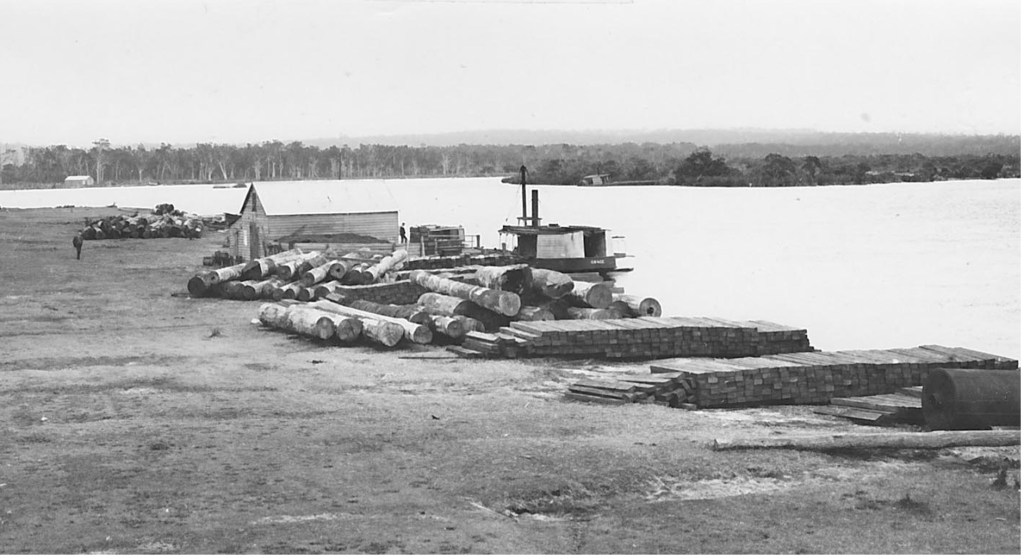
Timber stacked at Tea Gardens, with the Iluka lying abandoned on the opposite shore (near top centre of photo)
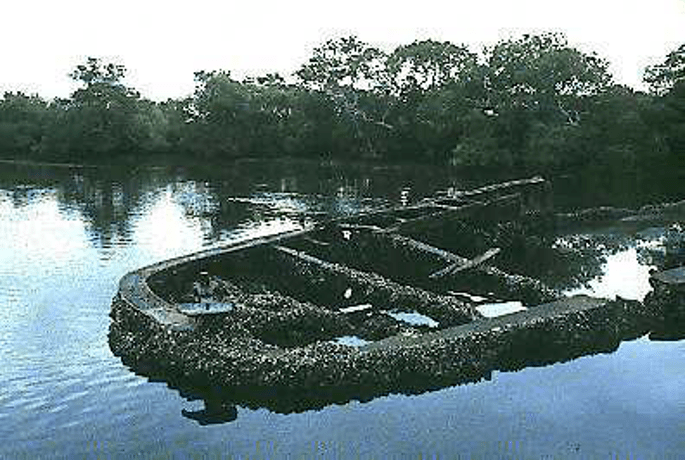
Hulk of the Iluka, opposite Tea Gardens, Port Stephens [The Maritime Archaeology of Myall Lakes / Tea Gardens: Area Conservation Plan. Heritage Office, June 1999]
Concluding Comments
The hulk of the Iluka lies today across the waters from the wharf at Tea Gardens.
The Newcastle Morning Herald and Miners’ Advocate, 2 June 1951, page 5, summed up the last days of the Iluka, thus:
‘Opposite Tea Gardens village, on the Hawk’s Nest side of the river, is the hulk of the 128-ton Iluka. She was built in 1879 as a hulk to hold sugar cane for the Colonial Sugar Company. Years later, she was converted into a steamboat for the Myall timber trade. Mr. Perrin helped convert her. To the men on the river, Iluka was always ‘a freak.’ She was 110ft. long, with an 18ft. 3in. beam, and 7ft. 2in. draught. Her machinery was right at the stern. “About three years ago, after all that time, she was considered unsafe,” Mr. Ripley said. “The cost was too great to bring her up to requirements, so she was stripped.”
Information on other boat hulks on Port Stephens is published on this website and can be found at the following links:
Hulk of the ‘Salamander’ Drogher at Port Stephens
Hulk of the ‘Terara’ Drogher at Port Stephens
Hulk of the ‘Brighton Ferry’ at Port Stephens
Researched and compiled by Kevin McGuinness
June 2024

 Port Stephens - a history exploration