
Introduction
Boat building in Port Stephens commenced in 1831, when the Australian Agricultural Company, then based at Carrington, launched its small steam boat, the ‘Karuah‘. It had a speed of about 4 knots and was designed to operate within the port.
From the late 1860’s to the 1930’s, boat building was one of the three major industries at Port Stephens, along with fishing and the timber trade.
This paper examines the history of boat building at Port Stephens which was centred on Tea Gardens and the lower stretches of the Myall River where most of the activity took place.
Boat repair and associated engineering works were also undertaken from the 1920’s and thereafter, mainly in the Nelson Bay area, but these are not covered in depth in this paper.
The main sources used are primarily from the National Library of Australia’s Trove newspaprer collection.
For other papers dealing with boat building at Port Stephens see also the following links on the website:
Historic Photos of Boat Building at Port Stephens
The Slipways at Tea Gardens – Port Stephens
First steam boat built at Port Stephens – 1831
The Newcastle Morning Herald and Miners’ Advocate of 29 April 1939, page 22, reported:
‘Sir Edward Parry, when Commissioner for the Australian Agricultural Company, did everything he could to encourage industry. The building of boats was one. In his “Early Days of Port Stephens” —a daily record of his work—there is the following entry: ”November 30, 1831, was a great day at Carrington (on the shores of Port Stephens). It saw the launching of the first steamer built on the port, and marked an important epoch in the company’s history ….. Our little steamer, named Karuah, got under way for the first time, and paddled about the harbour. I cannot yet say much for her success; but everything is stiff and new. We hope to be able to improve her. I do not think she went above three knots.” There is the following entry next day: “The Karuah again plied about, and is much improved by an alteration in her paddle-boards and by working the engine more. I think she went about four knots to-day.”
A view of boat building in Port Stephens – 1868
The Sydney Morning Herald of 26 June 1868, page 5, reported:
‘We have great pleasure in giving publicity to the following letters, which refer to the articles now appearing in our columns upon the manufacturing industry of the colony. …..
A correspondent who signs himself “J. D.,” writes :— “In looking over your journal of today I find that your correspondent of the manufacturing industries of this colony has passed over Port Stephens in a too summary way, giving only one shipwright credit for building there. The facilities we have here for shipbuilding are nowhere to be surpassed in the colony. We have timber in all varieties: blackbutt, blue and flooded gum, ironbark, tea-tree, and others more particular to the district, all of which are adapted to the shipbuilding trade. We have three yards in work, from which there have been launched in two years, four vessels—the Alpha, Britannia, Caledonia, and Galatea, and two on the blocks about to be launched, the one by Mr. T. Kinnaird, and the other from the yard of Mr. T. Buckman.
Mr. Piper has also built three vessels, the Edith, Messenger, and Myall. There has also been built on the river a number of punts, during the last two years, from thirty to forty tons, for the conveyance of timber to the vessels at the Tea Gardens. Being one of the builders of the Alpha I feel extremely obliged to your correspondent for the praise bestowed but I feel it my duty to make known the other shipbuilding firms on the Myall River, Port Stephens.”
Launch of the first steamer at Port Stephens – 1870
The Maitland Mercury and Hunter River General Advertiser of 7 July 1870, page 3, reported:
‘On Saturday last our little township [Tea Gardens] was enlivened by the launch of the first steamer built on this river. At two p.m. a large number of persons congregated on the premises of Messrs Donaldson, Kinnaird, and Donaldson, to witness so memorable an event. A little after 2pm, the preparations for the launch being complete, the blocks were removed, and the Barbelle, swan like, glided into her native element amidst the plaudits of the lookers on. The duty of giving her appellation was performed by Mr Philip Snape, J.P.
The Barbelle is a strongly built little steamer, will stand any amount of knocking about, and her construction altogether reflects the highest credit on her energetic proprietors, Messrs Donaldson and Co. She is intended for the river trade, and makes the fourth contribution to our colonial marine by those enterprising and plucky gentlemen within no great length of time, thus plainly manifesting the steady progress that is being made by this community.
In this district, besides the Messrs Donaldson, Kinnaird, and Donaldson’s establishment, there are other places where several most useful specimens of maritime architecture have from time to time been constructed, the capabilities of those vessels as they now plough the water to and from Port Stephens could very favourably be commented upon did time and space admit of so doing.’
Construction at Tea Gardens – 1905
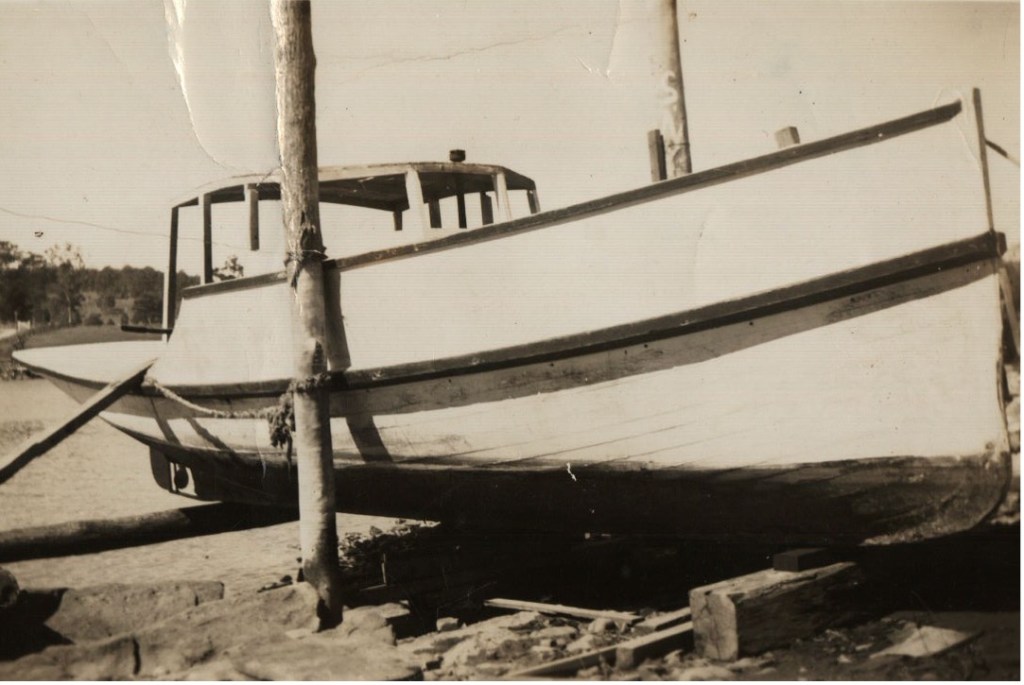
‘Unity’, built by Bert Moutom & Courtney Smith for Geroge Neil – Tea Gardens 1905
Benefit ball conducted at Tea Gardens for builder of the ‘Reliance‘ – 1909
The Dungog Chronicle of 23 July 1909, page 3, reported:
‘A very successful, benefit ball in aid of Mr G. Radcliffe, boat builder, who is totally blind, was held in the School of Arts here on Friday, 9th inst. It seemed as though the fates were determined it should rain, but at the last minute fortune smiled, the sun shone, and the result was a beautiful afternoon and night. A great crowd turned out, and a very enjoyable night was spent.
The music was supplied by Mr D. Thompson, the well-known blind player, on the piano (thus bringing it in the blind playing for the blind), ably assisted by Mr A. Johnson on the violin. Two songs during the course of the evening by Capt. D. Williams, were much appreciated. After accounts were settled and all lists in, it was found that the sum of £28 odd remained to be tendered to Mr Radcliffe. Mr Radcliffe, who is a man a little past the prime of life, is, or was, a first class tradesman, having built, the well-known passenger boat s.s. ‘Reliance.’
Keel of new launch laid down – 1912
The Raymond Terrace Examiner and Lower Hunter and Port Stephens Advertiser of 12 July 1912, page 3, reported:
‘Messrs. H. Thurlow and Co. have laid down the keel of a new launch, which it is proposed will run froth Salt Ash to Bungwahl, the through trip in a day, leaving Salt Ash in the morning in lieu of the afternoon as at present. The boat will be of 80 h.p., 75ft. overhaul, and is designed to run 12 knots or over per hour. The keel is 80ft. long, and a beautiful specimen of an ironbark stick it is — as straight as an air line. Another new oil boat starts shortly in the trade between Port Stephens and Bulahdelah, Mr. McLeod, formerly of the Riverview Hotel of the latter place, having had a new boat built, which is now almost ready for running.’
Accident while launching boat – 1913
The Gloucester Advocate of 23 July 1913, page 2, reported:
‘An accident happened to Mr. George Davis of Tea Gardens, while launching a punt from the slip with a wire rope. The rope took a turn and in trying to free it caught his hand and pulled the thumb off; but we are pleased to say he is about again.’
New motorboat – 1913
The Sydney Morning Herald of 23 September 1913, page 10, reported:
‘There was launched here on Saturday from J. Gronfor’s yard, to the order of Flanagan and Smith, a new motorboat, 70ft x 14ft x 7ft, and fitted with twin-screws, propelled by two 40 B.H.P. semi-diesel Nat engines.
This is the largest Semi-Diesel marine installation in New South Wales to date. The vessel, which is a fine model, is intended entirely for passengers, and will engage in the excursion and tourist trade between Newcastle, Lake Macquarie, and the Hawkesbury River.
The vessel may possibly be seen in Sydney during the summer. The launching was very successful, the vessel being christened the Crescent I. by Mrs. Flanagan, wife of one of the owners.’
Launch of the ss Coweambah – 1919
The Dungog Chronicle of 25 March 1919, page 3, reported:
‘On Monday, March 17 th, the launching of the new steam ship, Coweambah, belonging to Mr G. A. Engel and Sons, Ltd., took place. The event has been looked forward to with considerable interest by the public writes our correspondent. The vessel was designed expressly for the Myall Lakes and Port Stephens trade and is intended to take the place of the s.s. Nepean as soon as she can be fitted out. The launching was timed for 10.30 and long before that hour a large number of people began to assemble on the island [Witt Island] where the vessel was built. There were visitors from all parts of Port Stephens and Myall Lakes, and it was estimated that 300 persons were present.
A short speech was made by Mr H. M. Engel. manager of the firm, setting forth the reasons for the building of the vessel and what was going to be done with it. He expressed regret at the departure from this world of the late G. A. Engel, who was the founder of the large business now carried on by the family. Success to the Coweambah was drunk and the christening ceremony was performed by Miss Violet Engel just as the vessel began to glide down the ways to the beautiful high water which was waiting to receive her.
The name is purely aboriginal and is also the name of the parish in which the vessel was built. After the launching refreshments were handed round and some good stirring speeches were made. Mr Saddler referred in glowing, terms to the sterling qualities of those engaged in the enterprise of building such a fine vessel. He hoped it was the beginning of a shipbuilding era in Port Stephens. A presentation was then made to Mr Charles Burrows, who deigned and carried out the building of the vessel. The presentation consisted of an inscribed gold medal. In making the presentation Mr H. M. Engel eulogised the recipient, who responded expressing his thanks. Various other toasts were drunk.’
Further information on the ss Coweambah is found at this link on the website.
Construction of a passenger and mail boat at Tea Gardens – 1919
The Raymond Terrace Examiner and Lower Hunter and Port Stephens Advertiser of 18 July 1919, page 3, reported:
‘Mr. Gromfries is starting to build a new mail and passenger boat, which will be twice the size of the one now running and will be much faster.’
Launch of a palatial yacht – 1923
The Newcastle Sun of 7 April 1923, page 1, reported:
‘What is undoubtedly the largest and most palatial yacht north of Sydney, was launched at Gronfors and Priestly’s yards, Tea Gardens, Port Stephens, on Good Friday. The “Seagull’ is her name, and she was built to the order of Dentist H. E. Koll, of Newcastle, to the design of Mr. Gronfors. She is 37 feet 6 inches in length, and has a beam of 9 feet, and is driven by a 20-h.p. Kelvin engine. Everything in the nature of up-to-date yacht equipment is to be found in this new craft.
An outstanding feature is the steering apparatus, which enables the skipper to choose his course from both the cabin and deck, with the maximum of comfort. Built of Australian beach, the hull is built on beautiful lines. The keel is of white box-wood, while the topsides are of Pacific maple. All timber was supplied in Newcastle by Andrew Cook, Ltd.
The yacht contains two cabins (which are of polished woods), storerooms, kitchen and all conveniences. After spending vacation on the Myall Lakes, the ‘Seagull’ will sail for Toronto, where she will be stationed. Accompanying Mr. and Mrs. Koll at Tea Gardens were Mr. and Mrs. Moore, Dr. Robinson, Dentist Daisley (Newcastle), Mr. Dodd (Sydney), and Mr. Gronfors.’
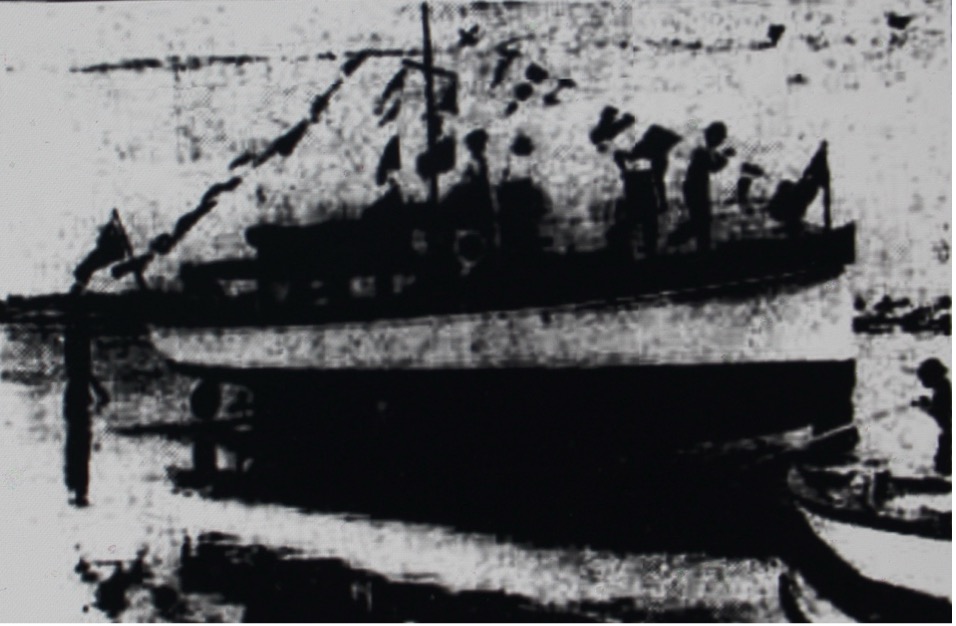
Seagull on launch day [Newcastle Sun, 7 April 1923]
Fishing boat constructed – 1930
The Dungog Chronicle of 4 July 1930, page 4, reported:
‘Mr. J. Gronfors, of Tea Gardens, has just completed a new type of fishing boat for Motum Bros, of Tea Gardens. The boat is 24ft. long with a 7ft. beam and is machined by a Chapman 4 h.p. engine. This boat is out of the ordinary, the raised deck provides accommodation for the crew. The special features of the raised deck and the great curve in the kiel line will tend to make the boat more sea-worthy. The greatest care and attention was paid by the builder, in using oversized materials, and the slight additional cost incurred, in this matter is more than justified because the durability and life of the craft has been doubled thereby.’
Reflections on the boat building industry at Port Stephens – 1935
The Newcastle Morning Herald and Miners’ Advocate of 27 April 1935, page 14, reported:
‘The President of the Stroud Shire (Cr. W. F. Harris) conducted many tourists over the foreshores of Port Stephens, the Tea Gardens, Hawke’s Nest, Myall and Pindimar during the Easter holidays. ….. Visitors were given some of the early history of the shipbuilding and timber industry.
At one time there was much done in connection with boat building. Among the vessels built at Port Stephens is the Maud Weston designed and completed at the Branch mill by Mr. Robert Davies in 1900. It was a steamer of 140 tons, and for years was a familiar ship in the Port Stephens, Newcastle and Sydney trade as one of the fleet of “60-milers.” The steamer was overwhelmed and lost in a south-easterly gale off the coast between Sydney and Newcastle.
The late Mr. Charles Burrows also built many craft on the Port Stephens waters. Included in these were the steamer Kate Thompson, which was used as a floating store by the Flanagan family, who 40 years ago were storekeepers at Tea Gardens. The steamer was built at Tea Gardens, on the river bank, at the intersection of what are today Jacob and Myall Streets. He also built the steamer Victoria and the drogher Stanley 35 years ago. The latter steamer is still doing service as a lighter, and is owned by Messrs. Phillips Bros., of Pindimar. Included in his building list is the steamer Coweambah, owned by Messrs. G. A. Engel and Sons Ltd., and trading between Port Hunter and Port Stephens.
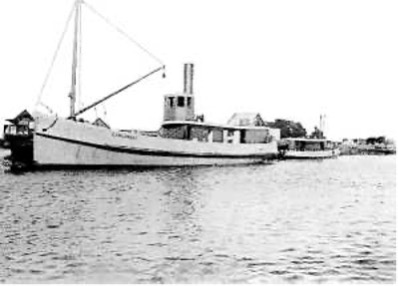
ss Coweambah
The Maggie L. Weston was built at Tea Gardens and launched nearly half a century ago on the bank adjacent to where the Riverview establishment now stands. On the same spot the drogher Chance was also built; but a few years later, it was rebuilt for Mr. John Witt, an early hotelkeeper at Tea Gardens.
Mr. Robert Davies built many other craft besides the Maud Weston, the Bullahdelah River being mainly the scene of his activities. Among those constructed by him was the drogher Federal, which, after doing 35 years’ service in the timber trade, now lies on the Slip Island, in front of Tea Gardens.
The late Mr. Stewart Smith, of Hawks Nest, built several boats there. One of them was the river steamer Bulahdelah which traded between that township and Nelson Bay for years. Mr. James Kinnaird also built a number of ships on Port Stephens waters upwards of 60 years ago. These included the ketch Pearl and the brig Silvery Wave. Both were built at a place known as Grovers, on the Myall Lakes, a mile below the home of Mr. A. J. Cutler, who was for many years identified with Newcastle in various public capacities. He also built two vessels for the coastal trade at Bulahdelah. One of them was the top-sail schooner Alpha; another the ketch Clyne. The crooks and timber for these vessels were cut from the bush where now stands the township of Bulahadelah.
Another shipbuilder who took an active part in the construction of vessels at Port Stephens was Mr. William Piper, who built the ketch Messenger in Piper’s Creek, four miles above Tea Gardens. This, according to Mr. Harris’s records, was upwards of 70 years ago. He also achieved something of note by building the Myall—a three masted steamer—and the steamers Cynthia and Australia. These traded between Newcastle and Sydney from the different ports along the coast.
The Myall has been converted into a drogher, and is one of the fleet of Messrs. Allen Taylor and Co. Ltd., in Sydney Harbour. Messrs. Croll and Wright are others who took an active part in shipbuilding, The best known of the boats built by them was the Caledonian for Mr. Duncan Macrae. It was built at Macrae’s mills on the Myall Lakes, in or about 1874. Messrs. Croll, Wright and Rodgers went into the sawmilling industry at Bungwahl after leaving Macrae’s Mills, were they had carried on successfully for a considerable time. They eventually dissolved the partnership, Mr. Croll remained at Bungwahl, and Mr. Wright went to Tuncurry, where his descendants are carrying on in the shipbuilding and timber business. Mr. Rodgers went to Camden Haven and continued the same line of business until his death. These three are regarded by Cr. Harris as worthy pioneers of the shipbuilding industry. They designed vessels large and small, and before the partnership was actually dissolved, they built many droghers at Bungwhal.’
Lease of wharf at Nelson Bay for boat building – 1935
The Newcastle Morning Herald and Miners’ Advocate of 23 November 1935, page 20, reported:
‘The Clerk of the Port Stephens Shire (Mr. C. L. Monkley) recently addressed a letter to the Under-Secretary for Lands stating that Mr. Light, of Sydney, had applied for a special lease for boat-building structure at Nelson’s Bay, and indicated, that the Council had decided not to raise any objection to the granting of the lease, subject to the observance of certain conditions. One of these was that Mr. Light would have to lease and recondition the wharf. The District Surveyor thought it better for the Government to take the wharf over provided the council was prepared to take control again at the expiration of the lease of 21 years. He thought some statement to that effect should be made by the Council. The Vice-president of the Council (Cr. G. J. Russell) moved in the matter, and the lease will be granted, with a provision that council take over control of the wharf at the end of 21 years. Mr. Light will be starting on the work early in the New Year.’
Minister for Works invited to Nelson Bay to discuss shipbuilding – 1941
The Dungog Chronicle of 1 August 1941, page 3, reported:
‘An invitation is to be extended to the Minister for Works to visit Tea Gardens to discuss the possibility of Shipbuilding there. This was decided upon at the meeting of the Progress Association; presided over by Cr. R. E. Zeininger. Port Stephens has every facility for shipbuilding and could be utilised to advantage for that purpose.’
Navy orders filled at Tea Gardens – 1943
During the Second World War, boat building and repair increased in pace due to Navy requirements. The Dungog Chronicle of 8 January 1943, page 3, reported:
‘Tea Gardens has changed under war conditions. There is hardly one eligible young man left in the town. All are in a war service of one kind or another. The ‘Coweambah’ and the ‘Yalinbah’ have gone too. Skipper Bill Ripley is now captain of a big boat running to Hobart and to Cairns, etc. Eric Engel is boat building to fulfill orders for the Navy. Previously the men mentioned had charge of the ‘Coweambah’ and the ‘Yalinbah’ respectively.’
Ship builder visits Tea Gardens – 1943
The Dungog Chronicle of 9 April 1943, page 3, reported:
‘A visitor came along last weekend to Tea Gardens, whose trade is that of a shipwright, the object of his visitation being to give the place a look over, and see if an opportunity existed to establish a home for himself and family; and in his spare time to supplement his meagre pension from the last war by building boats. He mentioned that he had been engaged in building barges for the U.S.A. in Sydney, but the strenuous work there was too great a tax upon his health.
This question brings to mind that Cr. R. E. Zeininger, President of the Stroud Shire, was formerly enthusiastic about the economic advantages to Tea Gardens if a ship-building yard was established here. Unfortunately, the proposal did not take shape, and it is in the realm of dreamland. There is hardly enough local capital to form a company, quite apart from the manpower available. But does this not hit back at the procurators of State, and the policy of decentralisation? Of course it does. Besides draining overcrowded centres, it would be economic to build wooden ships in localities where the timber exists. It is understood that Mr. Phillips is constructing barges at Pipe Clay Creek. If Mr. Zeininger’s vision of a shipbuilding yard at Tea Gardens is impracticable, for one reason or another, the idea of building barges is in the region of possibility. The President of the Shire has this in mind, no doubt. Could not the Shire itself undertake a project of this nature which seems to hold possibilities of remuneration, and if our imagination is not astray the Shire could do with a little extra revenue. The President’s fertile brain will, we are sure, examine the proposal from every angle.’
Boat nearing completion at Tea Gardens – 1943
The Dungog Chronicle of 23 July 1943, page 3, reported:
It is understood that Mr. Hugh Thurlow is completing a boat for service in this district and hopes to have it completed before Xmas. Hughie has always displayed vision regarding the requirements of the Port Stephens district, and we are sure that the running of the boat will be more than justified. It is rather a pity that, such a boat has been absent from the port for so long.’
Two fishing trawlers launched – 1944
The Dungog Chronicle of 25 August 1944, page 3, reported:
‘During the last week two seine net trawlers were launched, one at Tea Gardens, built by Mr. G. Hampton and Sons, and one at Nelson’s Bay by Messrs. Thompson and Hill. Each of these builders previously built a similar craft now in service with the Navy, and each has now laid down a third keel. Also it is understood that Mr. I. Lund and Mr. V. Whitney, are about to lay a keel. All these enterprising people are fishermen and build and man their own craft. Therefore, when their requirements are supplied, the building will lapse.
Reviewing the shipbuilding industry of former years, which was quite considerable, undoubtedly the actual pioneer was the late Mr. Charles Burrows, who in his time constructed and launched many seagoing craft for the coastal trade, including the ‘Victoria’ and the ‘Coweambah’, the latter to the order of G. A. Engel and Sons, and for many years a constant trader between Port Stephens and Newcastle.
Mr. Burrows also built almost all the local river craft engaged in the timber trade. There is at present a lot of wishful thinking about reestablishing the local shipbuilding industry. Local business people and land owners, whom it would benefit, fully realize the potential possibilities now that the small craft has proved its ability to fish grounds unsuitable for larger vessels. But unfortunately, this wishful thinking is as far as they have ventured. The actual doing has been left to the silent workers who don’t talk but get on with the job.
Port Stephens is undoubtedly a most suitable locality for establishing the shipbuilding industry for wooden vessels. At Bulahdelah, Myall Lakes, and Tea Gardens there are timber mills. There is an unlimited supply of ti-tree and other knees, bends and crooks, most of which are at present shipped elsewhere, and the local export of select hardwoods is one of the greatest upon the north coast of New South Wales. ……. In conclusion, let us thank these good fishermen who are at present building these good fishing boats.’
Fishing boat completed – 1946
The Dungog Chronicle of 3 May 1946, page 3, reported:
‘Mr. Cambell, of Nelson’ Bay, has just completed an exceptionally well-constructed seagoing fishing vessel, and it is expected that an early launching will eventuate. This makes the fourth trawler completed at Nelson Bay within the last twelve months, the former being built by Mr S. Thompson, for a Sydney owner, one — Mr. James Hill, for his own use; one — Mr. John Lund, for his own use; one — Mr. Catsicas also recently rebuilt his own fishing craft. The engines of these vessels are of the Diesel type, and have been lifted aboard and placed upon their beds by G. A. Engel & Sons, at Tea Gardens. There is yet another trawler in the locality, at Sandy Point, almost ready for launching.’
Two trawlers nearing completion – 1947
The Dungog Chronicle of 14 March 1947, page 1, reported:
‘Two new trawlers, both [built by] Mr. William Asquith and Mr. Frederick Asquith, are nearing the completion.’
Review of boat building at Tea Gardens – 1948
The Dungog Chronicle of 24 April 1948, page 3, reported:
‘It is not generally known that Tea Gardens turns out some of the finest pleasure craft that can be produced, carrying the trademark: “A. Adolphson & Sons, Boatbuilders, Tea Gardens.” This factory is in the centre of the town and one can always see two or three launches under construction, from 16 to 25 footers, fitted with 3 to 12 h.p. engines, open boats, raised deck and cabin class, workmanship and finish to compare with the best that is afloat.
Owing to the shortages of material it has been hard to carry on this class of work, so Mr. Adolphson is to be congratulated for the progress he has made, and it must be with pride that looks at the Tea Gardens waterfront with its numerous watercraft, and see 75 per cent. his plant’s production. His boats can be seen on Sydney harbour, the Hawkesbury River, Lake Macquarie and the Hunter River.
There is a saying that “chickens come home to roost.” Port Stephens has had its boat builders for 50 years. Some 48 years ago the late Bob Davies built the ill-fated Maude Weston, 140 tons gross, lost off Terrigal in a south-east gale. Fortunately all hands were saved. She was built at The Branch [at Gloucester and is not covered further in this paper] and held her own with the best 60-milers in those days.
The Maggie L. Weston was built where Bob Shook’s store and flats now stand opposite the Tea Gardens baths. The drogher ‘Chance’ was also built here. The late Charlie Burrows also built the steamer “Kate Thompson” where Mr. Ward’s place stands at intersection of Jacob and Myall Streets. She traded for years as a store boat on Port Stephens waters. He also had other vessels of note—’Victoria,’ ‘Stanley,’ in addition to several other small craft, the ‘Coweambah,’ which for years traded on New South Wales coast, and during the last war gave great service on the Queensland and New Guinea coast. She finally was lost when disabled in tow of the M.V. Moa Moa, who had to seek shelter in Trial Bay owing to a south-east gale which was raging at the time. The master of the Moa Moa found it necessary to change the tow line, and in doing so the ‘Coweambah’ broke adrift and rolled over in the surf at the entrance of the Macleay River. One life was lost. A coincidence was that her last trip from northern waters before taken for war work was from this river.
The late Stewart Smith, hotelkeeper at Hawks Nest, built several vessels there. One, the well-known “Bulahdelah,” traded in these waters for many years. The late Jim Kinnard built well-known ships, among them the ketch “Pearl,” the brig “Silvery Wave,” the top-sail schooner “Alpha,” and ketch “Clyne.” Among other builders was William Piper, whose most-noted vessels were the ketch “Messenger,” the 3-masted steamer “Myall,” the “Cynthia” and “Australia.”
Croll and Wright also built in Port Stephens waters. “Caledonian” was built at McRae’s mill, where the home of the late Mr. Cutler stands today. Where Blackstone’s store stands opposite Tea Gardens Hotel, “Chips” Gonfres built several fine vessels. These last few years numbers of trawlers have been built in these waters by fishermen—Hamptons, La-mans, Campbells, Thompsons, Hydes, and Asquith. Time marches on, today Adolph-sons are the established boat builders at Tea Gardens.’
The Dungog Chronicle of 15 May 1948, page 3, further reported:
‘Adolphson and Sons launched a new fishing boat this week for Mr. T. Asquith. Tom, who has been fishing all his life and had many boats, says this is the smartest packet he ever had.’
The Dungog Chronicle of 10 July 1948, page 3, also reported:
‘Adolphson and Sons have finished another new boat. It has been delivered to Mr. Farley at Karuah. Three more are under construction for other owners.’
The Dungog Chronicle of 17 September 1949, page 3, further reported:
‘Mr. Herb Sanderson’s cruiser “Merua” will leave for Middle Harbour, Sydney, as soon as the weather fines. She has been in these waters [at Tea Gardens] for many months. Built by Adolphson and Sons, she is powered by a 10-12 Simplex marine engine.’
The Dungog Chronicle of 25 September 1948, page 3, again reported:
‘A. Adolphson & Sons have another raised deck half-cabin cruiser ready to launch for Mr. Burke, of Tamworth. She is powered with a 10-12 Simplex engine and is to be stationed at Soldiers’ Point.’
The Dungog Chronicle of 4 December 1948, page 5, finally reported:
‘A. Adolphson and Sons have just completed a new boat for the Convalescent Home at Tomaree Head. Also two launches which will be shipped to Woy Woy, and have another launch on the stocks for Soldiers Point.’
Further reflections on Port Stephens boat building – 1948
The Raymond Terrace Examiner and Lower Hunter and Port Stephens Advertiser of 2 September 1948, page 2, reported:
‘Mr. Sam Thompson is still boatbuilding keeping the industry going at Nelson Bay which by the way, was early started by the late Walter Laman and other old residents of 60 years ago. Some useful craft have been turned off the slips at Port Stephen and a few have seen war service.
Mr. Thompson and his son Arch, had a nice designed trawler just off the ways at the beginning of the war, and was commandeered by the Australian Navy. Arch enlisted and went in charge of her, and was officer-in-charge during the war and was all round the Islands doing scout work, particularly at Finchhafen [town in Papua New Guinea]. He did creditable work and was promoted during the war. He returned to Nelson Bay with his boat, and his colours aloft. The timber for this boat was mainly obtained at Raymond Terrace, and the builders made a fine job of her. Mr. Thompson has another on the ways, and this goes into family use too.’
Boat building remains an active pastime – 1949
The Dungog Chronicle of 7 May 1949, page 3, reported:
‘Mr. Don Maslin, who launched a good cruiser some time back, is now building a boat to row around her. These are not the only boats Don has built. Some years back he built a 16ft. sailing skiff. He also sailed her and held his own among the best of her time. Mr. Bert Motum has just launched a smart rowing boat, and Bob Schuck has ordered the timber to build another boat before he goes out of business. Bill Blanch puts rowing boats together in his back yard, so anybody that feels like an argument about styles and construction of boats won’t go astray by having a holiday at Tea Gardens.’
New Boat build commenced – 1950
The Dungog Chronicle of 29 July 1950, page 3, reported:
‘A. Adolphson & Sons have started to build a 22ft. launch for Mr. Percy Turnbull. It will be fitted with a 10-12 marine motor, have accommodation suitable for making a home to live in, and will be the most up-to-date launch made in Adolphson’s factory. It’s Mr. Turnbull’s motive to use her in Port Stephen’s waters and he does not believe the fascination of the Myall Lakes will ever leave him.’
Boat builder closes business – 1951
The Dungog Chronicle of 16 June 1951, page 3, reported:
‘Adolphson and sons, boat builders, have closed their factory at Tea Gardens. Mr. Adolphson is now employed by the Stockton Ferry Company at Stockton where he intends to live as soon as the transfer of the new home there is completed.’
Fishing cruiser completed – 1952
The Dungog Chronicle of 29 November 1952, page 6, reported:
‘Mr. Don Maslen launched his new cruiser last week at Tea Gardens. It is fitted out with a Petters Deisel marine engine and will be engaged in the oyster industry and prawning up the Myall River.’
Concluding Comments
By the early 1950’s, most boat building in Port Stephens had ceased, with tourism rapidly becoming an increasingly important industry for the area.
On the Tea Gardens waterfront, there is an active reminder of the boat building and repair industry. The Tea Gardens slipway is still operational and is regularly utilised in servicing boats. The slipway originally formed part of the Birdwood Mill at Hawks Nest and was moved to the present site in 1954 after the mill ceased operations. The slipway has been operating as a community facility since 1980 and is the last one in the area.
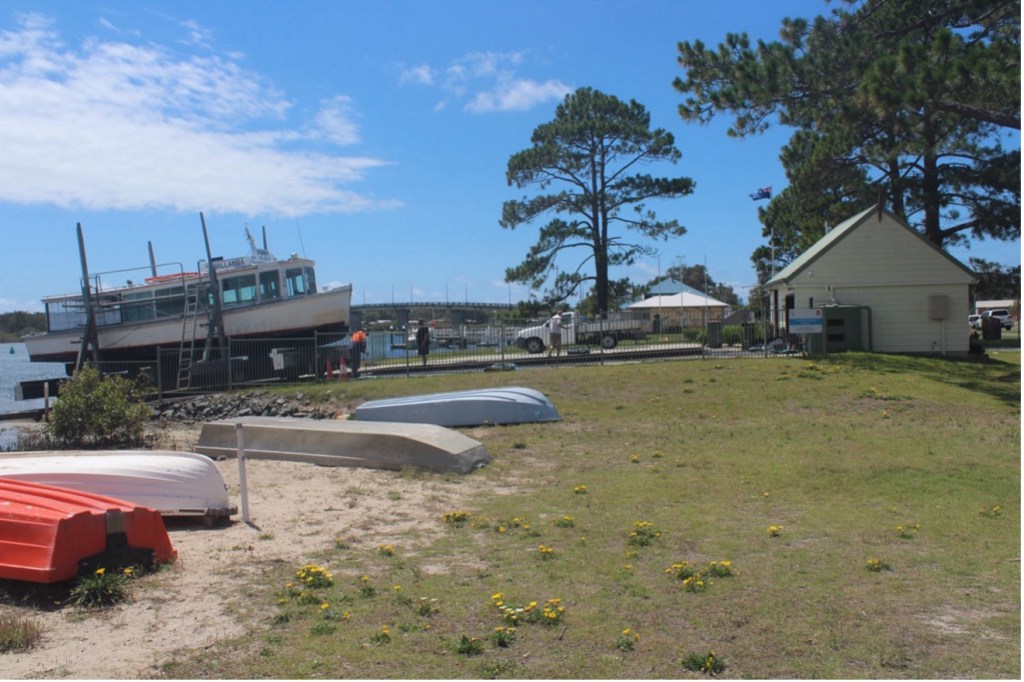
Tea Gardens slipway with the ferry m.v. Wallamba undergoing maintenance [Author photo – December 2023]
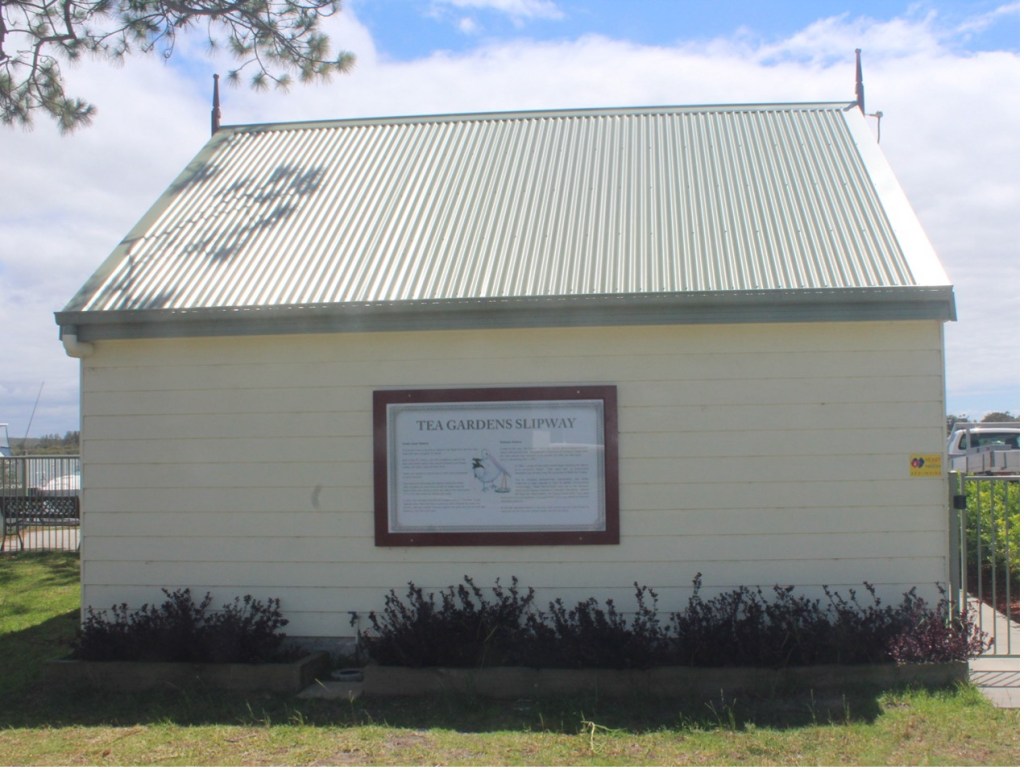
Building at rear of the Tea Gardens slipway with signage that outlines a history of the slipway [Author photo]
The signage on the rear of Tea Gardens slipway outlines its history. It reads:
‘A piece of the past, Tea Gardens community slipway has a long and involved history with the local area. Originally part of Birdwood Mill located in Hawks Nest, the mill’s slipway was relocated to its present site after the mill closed due to a devastating fire in 1954.
In 1980, a group of local boat owners began operating the slipway as a community facility. Eight years later, an incorporated association was formed under the jurisdiction of NSW Fair Trading. Due to changing environmental requirements, this facility underwent a major upgrade in 2021 to address environmental shortcomings.’
Researched and compiled by Kevin McGuinness
January 2024

 Port Stephens - a history exploration