
Introduction
In Australian maritime history, there have been four cargo ships designated ‘Port Stephens’.
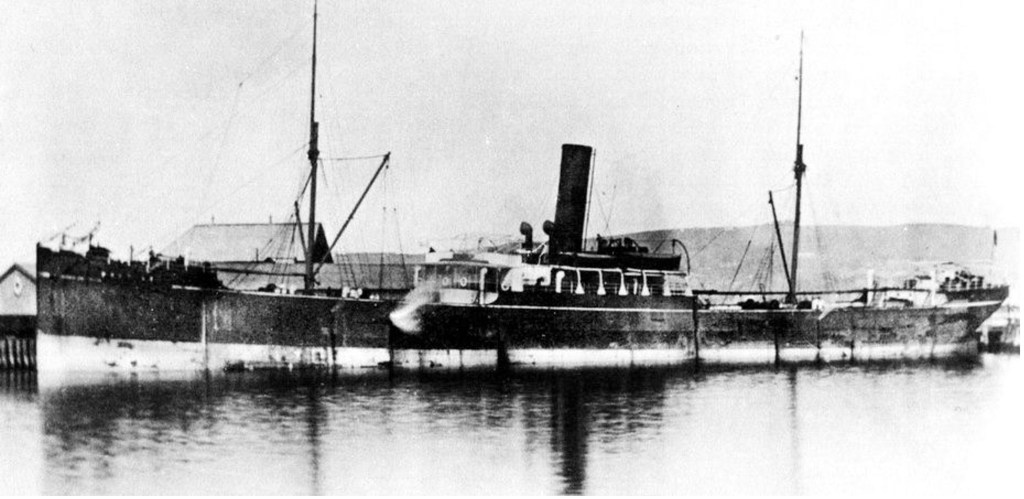
The first ship, ss Port Stephens, arrived in 1894 and was one of the newest ships of the Anglo-Australian Line owned by W Mellum & Co. It traded between various ports in Australia to international dstinations such as England, United States and New Zealand.
The second ship, ss Port Stephens, built in 1911 at the Stockton shipbuilding yards for the Port Steamship Steamship Company, traded between Sydney, Newcastle and Port Stephens.
The third ship, named ss Port Stephens in 1916, was acquired by the Commonwealth & Dominion Line from its previous owner, Corry & Co in 1914, where it saw service as the Star of Australia. It traded in Australian and international ports.
The fourth ship, renamed Port Stephens, was chartered by the Commonwealth & Dominion Line from the Silver Line in 1955.
This paper is the stories of the four ships.
Ship One : SS Port Stephens
Arrival of the ‘Port Stephens‘ – 1894
The Daily Telegraph of 12 October 1894, page 6, reported:
‘The steamer Port Stephens, which arrived yesterday from Barry Dock via ports, is one of the newest of the Anglo-Australasian line, owned by Messrs. W. Mellum and Co., and like most of their boats is an excellent type of the modern cargo carrier. She was built by Messrs. Thompson and Sons, Sunderland, and engineered by J. Dickinson, of Sunderland.
The Port Stephens is a steel vessel, schooner-rigged and classed 109 A1 at Lloyds. Her dimensions are: Length, 345ft.; beam, 44ft. 1in.; and depth, 18ft. 2in., giving a net register of 2278 tons, and a gross measurement of 3554 tons. The engines are on the triple expansion principle, and the vessel’s equipment in other respects is on the most modern scale. Captain R. Whitehead has command.
The Port Stephens took a cargo of coke to Port Pirie, and she has come on here with a consignment of steel rails for the Government. The steamer left Barry on August 4, and had a fine weather trip to the line, the north-east trades being moderate. The Equator was crossed on August 20 in long. 8deg. 47min. W., and the Cape of Good Hope rounded on September 1.
For the next three days the steamer had to cope with a fresh south-east to north-east gale and high sea. The easting was made between the parallels of 44 and 45 south, unsettled weather, squally, with heavy hail and snow, being experienced. Port Pirie was reached on the 26th ult., and the steamer, after discharging 2480 tons of coke, left for Sydney at 6 a.m. on the 6th inst. Fresh south-west and west breezes and hazy weather prevailed until reaching the Promontory, and then moderate weather to port. The Heads were reached at 4.30 p.m. yesterday, and the steamer proceeded to moorings in Johnstone’s Bay.’
Cargo steamship ss Port Stephens
‘Port Stephens‘ conveys first cargo to England – 1895
The Evening News of 29 January 1895, page 4, reported:
‘The sheep by the steamer Port Stephens were sold [in London] at an average of 6¼d per pound, equal to £2 per carcass.’
The Newcastle Morning Herald and Miners’ Advocate of 20 May 1895, page 4 reported on the return voyage of the Port Stephens from England to Sydney:
‘The Anglo-Australasian Company’s steamer Port Stephens reached the [Sydney] harbour on Saturday from London via ports. She has on board part of original cargo, to discharge which she was accommodated with a berth at the cargo wharf. Captain Whitehead is in command, and the vessel is consigned inwards to Messrs. J. and A. Brown, and outwards to Messrs. Gibbs, Bright and Co., who are the local agents for this line. Throughout the voyage an average of 11 knots per hour as maintained.
A departure was taken from London on the 8th March. After leaving the dock she brought up at Gravesend to receive 25 tons of dynamite, and upon resuming experienced fine weather until she encountered the south-east trade, which proved very strong. Crossing the equator on the 24th March in 9deg west this vessel was attended by vigorous trades until the Cape station was signalled on the 6th April. Whilst in accomplishing her easting she met with exceedingly heavy weather, which lasted for several days. This, however, turned out to be the final rough experience of the passage, and the vessel, which bears her customary clean appearance, arrived in Adelaide last Thursday week, and called at Melbourne and Sydney.’
‘Port Stephens‘ Continues Regular International Cargo Journeys – 1895
After arrival back in Australia after its first return trip to England, the Port Stephens made regular trips from various ports in Australia to international ports including England, America and New Zealand. The vessel carried such cargoes as coal, coke, sheep and general cargo. The Port Stephens proved to be a reliable ship until trouble struck in 1906 while on a trip from New Zealand to Newcastle.
‘Port Stephens‘ collides with a ketch at Port Pirie – 1899
The Newcastle Morning Herald and Miners’ Advocate of 12 April 1899, page 4, reported:
‘The Harbourmaster at Port Pirie has held an inquiry into the collision at Port Pirie of the steamer Port Stephens, with the ketch Napperby. The evidence was considered to point to the fact that the ketch was in the wrong, and after hearing the opinion of Captain Inglis the Wardens decided that further action was necessary.’
‘Port Stephens‘ overdue – 1906
‘The Harbourmaster of 15 October 1906, page 7, reported:
‘Grave anxiety is being manifested in shipping circles here for the safety of the large steamer Port Stephens, which left Oamaru, New Zealand, for Newcastle direct on Tuesday, 2nd inst. The steamer was under charter to the Union Steam Ship Company to load coal, and under ordinary conditions should have reached port about Monday last, so that she is now nearly a week overdue. No tidings of the vessel have as yet been reported, but masters trading across the Tasman Sea have been advised to keep a look-out for her.’
‘Port Stephens‘ Abandoned at Sea – 1906
The Daily Commercial News and Shipping List of 16 October 1906, page 4, reported:
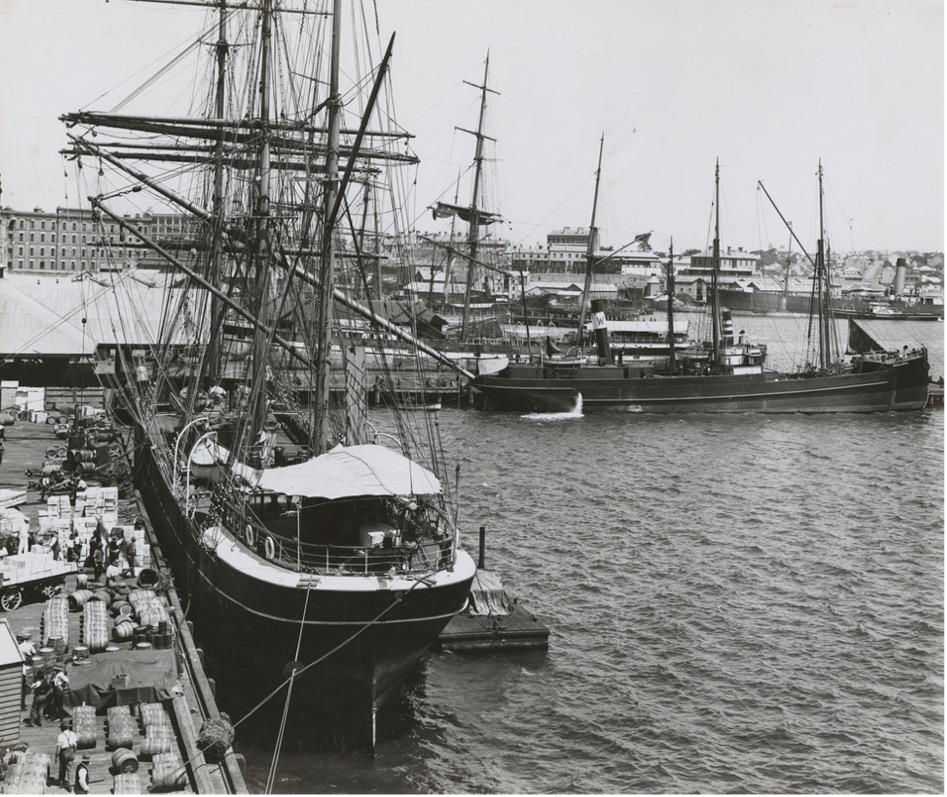
‘A cable was yesterday received from Dunedin [New Zealand] stating that the barque Ravenscourt, which left Newcastle on the 20th September for Callao, had called off Port Chalmers Heads and landed the crew of the steamer Port Stephens. The latter had lost her propeller and was driven to 50deg. south, when she was abandoned.
Captain Jolly, of the Port Stephens, says he left Dunedin on September 27, and Oamaru on October 1. On October 3 he met with bad weather, and the tail shaft broke. They were then in latitude 45deg 50min. They drifted very fast, being quite helpless, and had reached latitude 49deg 20min five days later, when the barque Ravenscourt, which had been driven out of her course, hove in sight. She took the steamer’s company aboard, numbering 33.
The Port Stephens, which had been running for the Union S.S. Company of N.Z., was to have been handed over on her return to Newcastle, and after coaling there was to have proceeded to Port Pirie to load ore prior to being placed on the berth at Sydney to load wool for the London sales.
The Port Stephens is a steel screw steamer, of 3554 tons gross, built by J. L. Thompson and Sons, at Sunderland, in 1894, and is classed 100 Al at Lloyds. She is owned by the Anglo-Australasian S.N. Company, Limited (W. Milburn and Co., managers).’
Reason the ‘Port Stephens‘ was abandoned – 1906
The Daily Telegraph of 17 October 1906, page 9, reported:
‘Mr. Warren, the chief, engineer of the Port Stephens, gives the following account of the vessels experiences: “We left Dunedin on September 27, with a part cargo of Newcastle coal for Oamaru. We left there in ballast on the return journey to Newcastle on Monday, October 1. Everything went well down the coast. We made good head-about 100 miles out from Foveaux Strait, and second day from Oamaru. We had covered about 100 miles out from Foveaux Strait and were then running on a direct course to Newcastle. That was on the Wednesday, and on the morning of that day, about 7 o’clock, the tail shaft broke off in the stern tube.
The ship was severely shaken, and the engines ran on at a fearful pace. A hurried examination showed that, the shaft, had been cleanly broken about 6ft, from the propeller boss. I at once ordered the shaft to be drawn in so as to find where the break was. The stern tube was cut away, the shaft, disconnected, and the tall end of the shaft drawn in for examination. A shaft we had on board was got out and put in readiness; but we found that the very rough state of the weather and the severe pitching and rolling of the vessel would absolutely preclude any thing being done in the way of replacing the old one.
“Seeing that it was altogether impracticable to put in the spare shaft we turned our attention to the broken one, with a view to repairing it. No time was lost, and all hands were put at work on the broken shaft. We worked at it night and day. We had to operate in a very awkward and narrow part of the ship and that fact, and the pitching of the vessel, severely handicapped us. Our intention was to cut the stern tube away and key the broken shaft together.
The second, third and fourth engineers and myself, worked at it night and day, as did the firemen, divided into six hour watches. “The work of repair was dangerous indeed, but we managed to get the inside portion of the shaft drawn in leaving a small piece about 6ft, long supporting the propeller. There was a strong wind blowing from the north, and a strong current running from the same direction. We commenced to drift almost due south, the ship pitching and rolling heavily the whole time, and continued to drift till the following Monday, October 8. During that time the engineers and firemen continued night and day at the shaft.
Up to Monday we had drifted about 119 miles, and if we had drifted in the same direction for another two days, and at the same rate, we would have been right among the ice-bergs. A keen lookout was maintained during the five days we had been drifting, and we were flying flags of distress by day and burning lights by night.
“At about 3.30 on the morning of the 8th, the first mate sighted a ship just on the horizon. We at once sent up rockets and burnt flare-lights to attract her attention. This we were successful in doing, and she immediately put on, all sail and bore down on us. She proved to be the Ravenscourt, and our joy at her having come to our assistance was great, for we were in a sore plight. There seemed nothing else for us but to drift on till we came to the ice. We were then away down beyond the Snares, about 150 miles south of New Zealand, and it was bitterly cold.
“The Ravenscourt came to within three miles of us and there hove-to. Captain Jolly immediately put out with a boat’s crew and pulled off to the Ravenscourt. He intimated to Captain Jenkins, of the Ravenscourt, our helpless condition, and arrangements were then and there made between the two captains to have our crew taken off to the Ravenscourt, and landed at the nearest port. The Ravenscourt herself was bound from Newcastle to Callao and, owing to adverse and strong currents, was some hundreds of miles out of her course.
“After a consultation on the Ravenscourt, Captain Jolly returned on board, and the crew mustered and asked whether it was advisable to stand by or to leave the ship. The members of the crew were unanimously in favour of leaving the ship, as she was in a helpless state and it would be suicidal to do otherwise. Accordingly we gathered together as much of our personal effects as possible and parted company with the Port Stephens, which we regarded as a doomed ship. Naturally we had to leave behind a good deal of personal property, and in this respect some are heavy losers.”
Mr Warren went on to say that in the attempt to repair the damaged shaft the engineering staff and others were much fatigued. He spoke in high terms of the kindness of Captain Jenkins and his officers and men. The second engineer corroborated the account of his chief, but the captain declined to speak.’
Ravenscourt (at left) in Sydney Harbour [State Library of South Australia]
Search for the abandoned ‘Port Stephens‘ – 1906
The Clarence and Richmond Examiner of 20 October 1906, page 9, reported:
‘The Union Company’s steamer Rakanoa, which left Dunedin on Tuesday night, for Newcastle, will make a search for the Port Stephens, and will spend some days in the locality in which the abandoned vessel was last seen. She will then call at the Bluff and report the result. The Rakanoa carries an extra crew and a special supply of coal. It is possible that the Port Stephens has been picked up by the Hinemoa, which left a week ago on a visit to the Aucklands and other islands.
The circumstances surrounding the abandonment of the steamer have been inquired into by a Court of Marine Inquiry. The court decided that the master, Captain Jolly, was guilty of a great error of judgment in abandoning the ship. The court held that the master should have known that the chances were against the steamer drifting further south, and blamed him for not sufficiently encouraging the men to stand by the ship, also for the lack of provisions. The court expressed regret that the other officers, except the engineer, did not show a desire to stick to the ship. The tug Champion will leave Sydney tonight in search of the drifting steamer.’
The Daily Telegraph of 13 November 1906, page 4, further reported:
‘The tug Champion has put into Lyttleton, after a tempestuous experience in search of the Port Stephens. The tug went as far as 46deg. 44 min. south, and 176 deg. 49min. east, being a zigzag course throughout the cruise. She did not sight any vessel the whole time she was out, and the search has been abandoned. The tug has left for Newcastle.’

Tug ‘Champion’ at a wharf in Newcastle Harbour [Newcastle Library]
Captain’s Account – 1906
The Newcastle Morning Herald and Miners’ Advocate of 26 October 1906, page 4, reported:
‘Captain E. A. Jolly, master of the abandoned steamer Port Stephens, arrived at Sydney from New Zealand on Wednesday. Soon after his arrival, he interviewed Messrs. Gibbs, Bright, and Co., the agents for the owners of the missing vessel, and will, it is understood, shortly proceed home.
In his account of the abandonment of the Port Stephens, Captain Jolly told the Marine Court of Inquiry held at Dunedin last week that he was unaware of the shortage of provisions until after the breakdown. There was sufficient for two weeks, or a double voyage to Newcastle, and there was no cargo on board. At 7.5 a.m. on the 3rd inst. the longitude was 164.40 east. He consulted the chief engineer, but there was too much sea to lash the propeller. The broken end of the shaft was drawn in. The break, he thought, was 5ft from the sternpost. As to his duty as master, he could do nothing under the circumstances. He could not have used sails, for they would have helped to drive the steamer more to the south. She lay broadside on and rolled heavily. Sails would not have brought her head to the wind. He thought of a sea-anchor, and discussed the matter with the chief officer, but he had tried a sea-anchor before and found it useless.
He set the crew to work to clear the forehold, so as to get in water to lower the ship’s head. That was started on the 7th last. When the weather moderated on Saturday night witness put a 4½in hawser round the propeller, but it carried away in 20 minutes. He set sails on Saturday night. The wind was then from the south-west but dropped during the night. During the whole of the time work was being carried on by the engineering staff. The ship was making a little water by the stern tube until they plugged it, otherwise the ship was tight.
The engineer said that if it was a scarf break, he could probably repair it, but not if it was a clean break. It turned out to be a break right across, will no angle in it. It was Sunday before they sighted the broken part of the shaft. The engineer then said that if the propeller was lashed as securely as it could be he could not dovetail the break. There was too much play on it. On the morning of the 8th inst, said Captain Jolly, they saw two sailing vessels, and the Ravenscourt saw their signals. He went aboard and discussed the situation with Captain Jenkins, who was willing to take the crew and land them at the nearest port.
On returning to the Port Stephens, he mustered all hands. His own opinion was that they ought to leave the ship, but when he mustered all hands, he made no distinction between men and officers. He told them the barque was willing to take those who wished to leave and said that any who wanted to leave it preference to standing by the vessel were to cross the deck. All crossed except the chief engineer and the carpenter. Captain Jolly explained the danger, saying they were out of the track of sailing ships. It was then that the crew walked over.
His own opinion was that it was proper to abandon the steamer. In two weeks, they would have been out of provisions. With a south-west wind they might have drifted on to the Snares, and with a northerly wind they might drift on to the Aucklands. If there had been any men left to work the ship he would have stuck to her, but at the same time he thought it would be a foolhardy thing it do. That the abandonment of the vessel was justified is proved by the fact that the steamer has not yet been picked up.’
Dissatisfaction with Marine Court Finding – 1906
The Newcastle Morning Herald and Miners’ Advocate of 31 October 1906, page 4, reported:
‘The Shipmasters’ Association of New Zealand, at its annual meeting, placed on record its unqualified dissatisfaction with the finding of the Court in the recent nautical inquiry regarding the abandonment of the steamer Port Stephens. It was considered that the case should be reopened without delay and more evidence called.’
The Newcastle Morning Herald and Miners’ Advocate of 23 March 1907, page 4, further reported:
‘The abandonment of the steamer Port Stephens south of New Zealand last October is referred to in a letter from Captain Jolly, who was master of the vessel at the time. At the Court of Inquiry held at Dunedin. Captain Jolly was censured for abandoning the vessel. The Wellington Shipmasters’ Association disagreed with the finding of the court and expressed the opinion that Captain Jolly had acted properly.
In his letter Captain Jolly says: “I have delayed writing until I could tell you what attitude the owners and underwriters were going to take, which I only managed to have settled yesterday. I am pleased to tell you that the latter quite agree with my actions, as they considered I had no option to do otherwise. As for the owners, they have promised me the first vacancy that occurs.”
‘Port Stephens‘ never found – 1907
The Sydney Morning Herald of 16 September 1907, page 8, reported:
‘The Port Stephens represents the only case of recent years of a steamer being left to her a fate in Australian waters. This vessel, after breaking down in the Southern Ocean, was abandoned, and though comprehensive search was made, was never heard of again.’
Ship Two: SS Port Stephens
‘Port Stephens‘ undergoes speed trials – 1911
The Newcastle Morning Herald and Miners’ Advocate of 27 July 1911, page 5, reported:
‘The new steamer Port Stephens, built at the shipbuilding yards of Messrs. M. A. and H. Callen, Stockton, for the Port Stephens Steamship Company, Limited, was given her speed trials yesterday. She is a staunchly built wooden vessel with a length of 92ft, a 21ft beam, and a draught of 7ft 5in, on an estimated loaded capacity of 140 tons. She is fitted with a compound surface-condensing engine with 11-inch and 22-inch cylinders, and a 16-inch stroke, and has a single boiler with two furnaces.
The engines and machinery were supplied by Messrs. Ross and Duncan, of Glasgow. She is a handy craft of compact design, and should prove a serviceable timber carrier, for which trade she is intended to run between Newcastle and Port Stephens. Prior to running the trials the vessel was taken round the harbour, having on board Messrs. T. Griffiths, Mayor of Stockton; T. M. O’Neill, president of the Newcastle Chamber of Commerce; Messrs. McMillan (shipwright-surveyor) and Dalling (engineer-surveyor) Navigation Department, and the directors, several shareholders in the company, and a number of ladies.
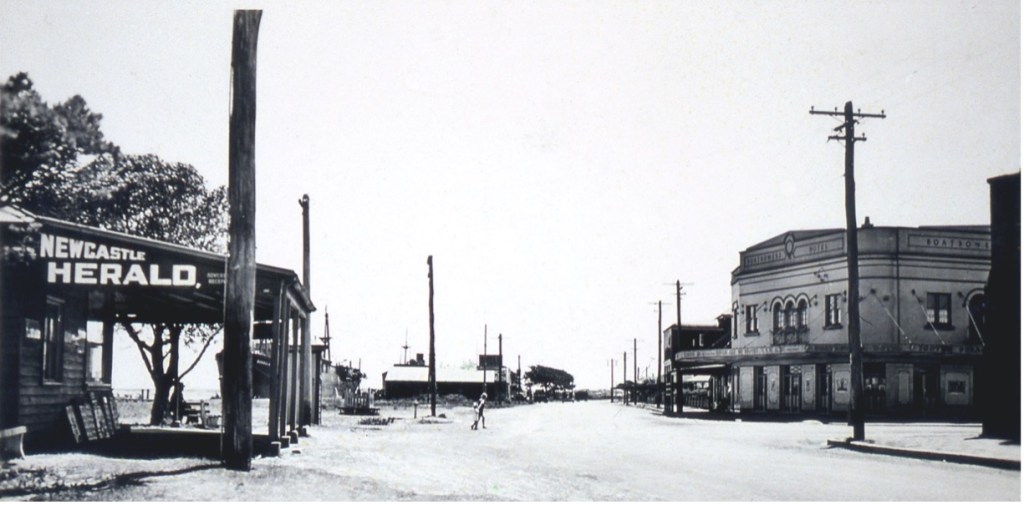
The vessel ran two trials over the measured mile from No. 15 crane to the end of the Dyke, and on each occasion covered the distance in six minutes, being at the rate of ten miles an hour. After the trials the vessel proceeded to Stockton New Township, where the directors entertained the guests at the Boat-rowers’ Hotel. The Mayor of Stockton proposed the toast of “The Company and Officers,” which was supported by Mr. O’Neill, and responded to by Messrs. C. Martin (chairman of directors) and Arthur Callen (secretary). The toast of “The Builders” was proposed by Mr. A. W. Paton, supported by Messrs. McMillan and Dalling, and responded to by Mr. M. Callen.’
Boat Rowers Hotel, Stockton, early 1900’s [University of Newcastle, Living Histories]
‘Port Stephens‘ wrecked – 1911
The Maitland Daily Mercury of 6 November 1911, page 5, reported:
‘Another marine disaster occurred on the coast early yesterday morning, when the coastal steamer Port Stephens went aground on the beach about two miles north of Norah Head. She now lies on the bench in an apparently hopeless position. The crew all escaped.
The Port Stephens left Sydney at about midnight on Saturday for Newcastle, having on board a quantity of chaff. Captain Peter Peterson was master of the vessel, and everything went well until about 4 o’clock yesterday morning when shortly after passing Norah Head, she struck the rocks, and going right over them landed high and dry on the bench. Mr. Alfred Green, chief engineer, early in the morning, after leaving the wreck, went over to Wyee, and came in from there by train to Newcastle. He said after he had finished his watch he went below and turned in. At about 3.50 a.m. he was awakened by a terrific bump, which was quickly followed by another. He knew then that the vessel had struck something, and he went with all haste to the engine room.
On reaching there he received an order from the captain to put the engines astern, which he did. But that had no effect, and very soon afterwards the vessel was hard and fast. He remained in engine room for a while and then went on deck. There was no panic, the crew were all calm and kept their heads. It was a bright moonlight morning, wind was fresh, and there was a bit of a sea running. While on deck he saw several sharks about. When the vessel struck, he thought she was near Terrigal, but on going on deck he saw she was about half way between Norah Head and Bird Island.
The mate, Mr. J. Rattery, had the watch when leaving Sydney, but he understood that the captain was in charge at the time of the accident. He was afraid there was no hope of saving the vessel, which, was lying on the beach broadside, to the seas. The crew remained on board, and after having breakfast, left their ship dry-shod, the tide being then low.
The Port Stephens was a new vessel, having been built at Stockton in June last. She had a length, of about 100 feet and a beam of 22 feet. She had been regularly engaged in the trade between Port Stephens and Sydney and carried a crew of nine hands. She was a staunchly built wooden vessel and was valued at about £3000. She was insured.’
The Newcastle Morning Herald and Miners’ Advocate of 6 November 1911, page 4, also reported:
‘Another marine disaster occurred on the coast early yesterday morning, when the coasting steamer Port Stephens went aground on the beach about two miles north of Norah Head. She now lies on the beach in an apparently hopeless position. The crew all escaped. The Port Stephens left Sydney at about midnight on Saturday for Newcastle, having on board a quantity of chaff. Captain Peter Peterson was master of the vessel, and everything went well until about four o’clock yesterday morning.
Nothing can yet be said as to the cause of the mishap, which occurred on a bright moonlight morning when there was not a very rough sea. The vessel came along the coast, and all went well until shortly after passing Norah Head, when she struck the rocks, and going right over them, landed high and dry on the beach. The first intimation of the mishap was contained in a telegram from the principal lighthouse-keeper at Norah Head to Captain Cumming, Deputy Superintendent of Navigation.
It stated, “Steamer Port Stephens went ashore two miles north of the lighthouse at 4 am.; if tug sent immediately ship may be saved.” Captain Cumming, at once communicated the contents of the message to Mr. H. Callen, of the Port Stephens Steamship Company, owners of the vessel. He then issued instructions for the pilot steamer Ajax to get ready to proceed to the scene. As the message from Norah Head did not state if the crew had been saved, Captain Cumming wired for further information, and received the reply, “Crew saved, engineer leaving Wyee for Newcastle.” In view of that message the Ajax, which was just going out of the harbour, was recalled, as there would be no need for her services. Mr. Callen arranged with Messrs. J. Fenwick and Company to send a tug to the locality of the grounding, and the Victoria was despatched at noon.’
Salvage Plans – 1911
The Newcastle Morning Herald and Miners’ Advocate of 7 November 1911, page 4, reported:
‘The steamer Port Stephens, which went on the beach near Norah Head on Sunday morning, was in practically the same position yesterday. Mr. A. Green, the engineer, returned to Newcastle last night. He stated that the steamer as sound, and the only water in her hold got through her hatches. Captain Cuthbert, the underwriters’ representative, is understood to have hopes of refloating the vessel, and telegraphed to Sydney for salvage gear to be sent up. He proposes to lay a couple of anchors out and kedge the vessel to the water, where, if she floats, she will be anchored until she is able to steam out or be towed. The exact value placed on the steamer was £3800, and she was insured for £2000.’
Initial Salvage Attempts Fail – 1911
The Daily Commercial News and Shipping List of 14 November 1911, page 15, further reported:
‘The steamer Port Stephens, which went ashore between Norah Head and Bird Island, is still in the same position. The owners think that the vessel may be kedged off the sand and refloated. They have, however, decided to leave her in the hands of the underwriters, and the gear has been taken from Sydney to try and refloat her. The vessel is said to have suffered considerably by her bumping on the sand, and there are a few holes in her sides. She has also been severely strained and will have to be patched up considerably before attempts are made to refloat her.
She is high and dry, but at high tide the water breaks just underneath her stern. The steamer is valued at £3800 and is insured for £2000. The Department of Navigation has received a message stating that the stern of the Port Stephens was in the water, and that, with the assistance of a tug, the vessel might be floated off. The department advised the owners to this effect.’
The Evening News of 16 November 1911, page 7, reported:
‘The steamer Gosford, with salvage appliances on board arrived at 5 o’clock this morning off the scene of the wreck of the steamer Port Stephens, on the beach between Norah Head and Bird Island, which occurred on November 5. The salvage operations will be under the supervision of Captain Grainger, of Grainger and Hay of Sydney. The steamer is in a good position, and the prospects of re-floating her are considered bright. After the Port Stephens has been kedged out, an attempt, with the assistance of the Gosford, will be made to tow her off.’
The Newcastle Morning Herald and Miners’ Advocate of 23 November 1911, page 4, finally reported:
‘A message was received in Newcastle yesterday, that the steamer Port Stephens stranded on the beach near Norah Head is a total wreck. The message added that the salvage party had returned to Sydney. Apparently the rather rough weather of the past couple of days has done further damage to the vessel.’
Court of Marine Inquiry – 1911
The Clarence and Richmond Examiner of 25 November 1911, page 9, reported:
‘Judge Fitzhardinge, with Captains Carpenter and Dakin, held an inquiry as to the stranding of the steamer Port Stephens near North Head.
The Judge, in delivering the finding, said to put the vessel where she struck the course must have been altered. The captain must have been either actually or mentally asleep at the time. The Court found the stranding due to the default of the master, Captain Petersen, who was called upon to show cause why his certificate should not be cancelled or suspended.’
Salvage of Wreck by New Owners – 1912
The Daily Commercial News and Shipping List of 27 February 1912, page 18, reported:
‘The hull of the steamer Port Stephens, which was wrecked near Bird Island some months ago, was towed into Port Jackson last Sunday by Messrs. J. and A. Brown’s tug Irresistible, and anchored in Berry’s Bay. Messrs. Einersen Bros., who purchased the wreck (after it was abandoned by the underwriters) for £500, succeeded some weeks ago in saving the engines and boiler, and now the hull, which was full of sand and well up on the beach.’
‘Port Stephens‘ repaired and sold to a Rockhampton Company – 1912
The Evening News of 31 May 1912, page 3, reported:
‘The [Port Stephens] wreck was sold to Messrs. Einersen Brothers, of Sydney, and subsequently salved—a fine performance in view of the almost impossible position of the vessel. The vessel was towed to Sydney to be repaired. She has now been sold through Messrs. McIlraith, McEachern and Company to a Queensland firm for work in the coastal trade of the northern State. The Port Stephens will leave Sydney in about three weeks.’
The Sydney Morning Herald of 2 July 1912, page 10, further reported:
‘On Saturday afternoon the steamer Port Stephens in her second trial trip in Sydney harbour, when she attained a speed of nine knots The Port Stephens, of 118 tons gross, has been sold by Messrs. Einersen Bros. to McIllwraith, McEachern and Co. Proprietary, Ltd., who intend using her as a tender at Rockhampton.
Last November, it will be recollected, the Port Stephens was wrecked off Norah Head (between Sydney and Newcastle). Messrs. Einersen Bros., of Pitt-street, then bought the hull as it lay, and in three months’ time the vessel was placed on the slip at North Sydney ready for resuscitation. A feature of the work of bringing the boat to Sydney was in connection with the engine boiler which had to be hauled by bullock teams over to the railway, a distance of about 10 miles.’
‘Port Stephens‘ destroyed by fire at Rockhampton – 1913
The Daily Standard of 24 September 1913, page 4, reported:
‘A telegram was this morning received by the Marine Board from the harbourmaster, at Rockhampton as follows:—”Port Stephens destroyed by fire yesterday afternoon at Broadmount. No lives lost.”
The Port Stephens was a wooden steamship with a registered capacity of 118 tons gross and 55 net. Her registered dimensions were: Length, 95ft; breadth, 22ft; depth, 6.9 feet. Her port of registry was Newcastle, and the year of registering 1911. The vessel was built at Stockton, N.S.W., in 1911. In February 1912, she was wrecked and recovered. Walter Reid and Co., Ltd., are the owners.’
The Daily Standard of 25 September 1913, page 6, also reported:
‘Further particulars have been received in connection with the fire which occurred late on Tuesday afternoon, and which resulted in the total destruction at Broadmount of Messrs. Walter Reid and Co.’s steamer-lighter, Port Stephens, and about 2000 cases of oil. The Port Stephens with the lighters Martha Reid, Janet Edith, and Pioneer was engaged in lightering cases of kerosene; benzine, and naphtha from the steamer Torsdale, which arrived in Keppel Bay, and anchored in Broadmount basin about 200 yards, from the wharf, on Sunday, with 32,000 cases of oil from New York.
She was unloading to the lighters in order to reduce her draught sufficiently to enable her to come up the river to the town wharfs to discharge her freight. The Port Stephens was made fast opposite the after hutch of the Torsdale, and by 3 o’clock, had loaded 2,000 cases of oil. Smoke was then observed by one of the gang of six wharf labourers who were working in the hold. An examination showed that the oil was on fire.
The flames spread rapidly, and Captain C. Lawson, in command of the Port Stephens, realising that there was no chance of getting them under, decided to abandon the ship. The crew, consisting of an engineer, two firemen, and two deck hands, together with Captain Lawson and the wharf labourers, thereupon boarded the Torsdale and cast the Port Stephens adrift, there being imminent risk of an explosion.
Under the influence of a northerly wind, the Port Stephens drifted with the floodtide and took ground on a sandbank near Rocky Point. The flames by this time had enveloped the vessel, and she was soon burnt to the water’s edge, when the boilers exploded. The crew of the Port Stephens were brought to Rockhampton at an early hour this morning.
The loss to Messrs. Walter Reid and Co. is serious, as the Port Stephens was a particularly handy craft with a fair carrying capacity. She was purchased by the firm in Sydney about two years and shortly after she had been built. She was about 100ft long, with engines about 35h.p., while her net registered tonnage was about 140 tons. She was capable of a speed of 10 knots an hour. The vessel was insured with the Queensland Insurance Co. for £2000. The steam tender Dolphin, which has been out of commission for some time, was placed under steam again last night, and left this morning for the scene of the disaster.’
Marine Board of Inquiry – 1913
The Capricornian of 11 October 1913, page 25, reported:
‘The Marine Board this afternoon considered the report of the Shipping Inspector of Rockhampton, Captain S. Wilkinson, regarding the circumstances in connection with the total loss by fire of the Port Stephens, at Broadmount, on the 23rd of September.
The Inspector said that he was of opinion that the fire did not originate nor was it caused in any way by the fires in the Port Stephens furnace. Any leakage of kerosene that might have taken place could not possibly have found its way into the stokehold or the engine-room bilges owing to the strong bulkhead dividing the stokehold and the engine-room from the main hold. He was of opinion that no blame could be attached to the master or his crew for the loss of the ship, and he found that every effort was made by them to save the vessel.
The origin of the fire he was unable to unravel, but it might have originated from some person or persons smoking on the steamer Torsdale. The Port Stephens was lying alongside under the lee of that ship and sparks unnoticed might have been wafted down to the hold and thereby ignited. The Marine Board concurred with the Inspector’s report.’
Ship Three: SS Port Stephens
With the formation of the Comminwealth & Dominion Line in 1914, the company a cargo ship from Corry & Co which is remaned SS Port Stephens in 1916. It has previously been in service in Australian and international trade as the Star of Australia.
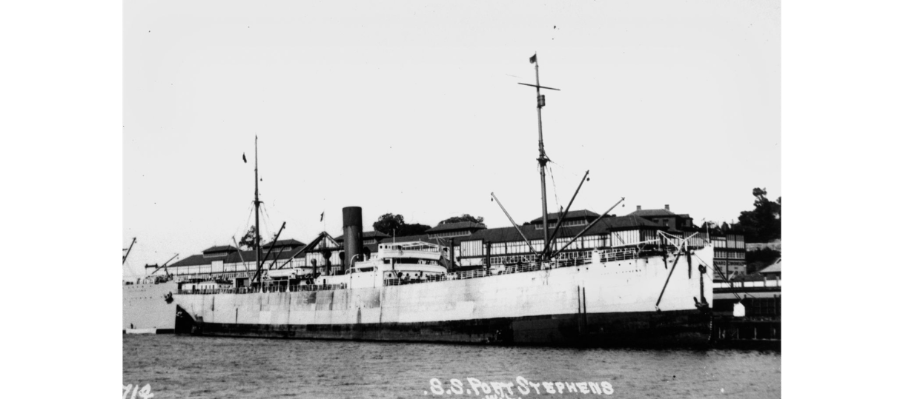
SS Port Stephens [State Library of Queensland]
The Sydney Morning Herald of 25 March 1924, page 10, provided a summary of the operational life of the SS Port Stephens prior to its sale to a foreign buyer in 1924:
‘The steamer Port Stephens, of 6179 tons gross register, belonging to the Commonwealth and Dominion Line, Ltd., is reported to have been sold to foreign buyers. The vessel visited Australia in December last, and prior to that had been in the Australian trade for nearly 25 years. Having deadweight carrying capacity of about 10,300 tons, the Port Stephens, formerly known as the Star of Australia, was built at Port Glasgow in 1899.
A wonderful tow was accomplished in 1921 by the Port Stephens, when she picked up the steamer Yoshmoo and towed her 2000 miles across the Atlantic Ocean to Queenstown, Ireland. The vessel was subsequently awarded £13,200 as salvage.’
Ship Four: ‘Port Stephens‘
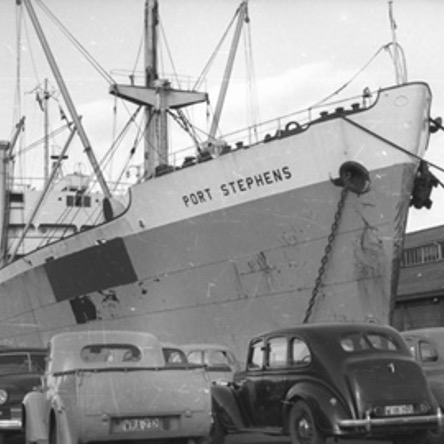
A fourth ship carrying the name of ‘Port Stephens‘, was chartered by the Commonwealth & Dominion Line from the Silver Line in 1955. It was previously the Silveroak and renamed.
This ship was sold to the Ben Line in 1956.
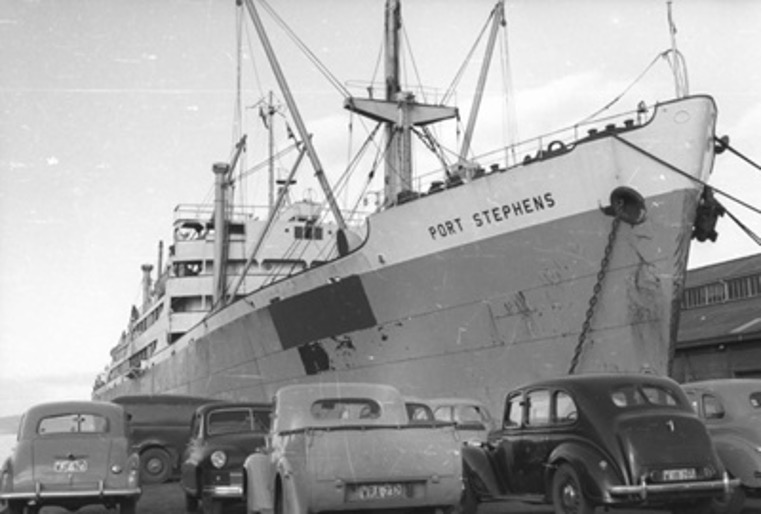
‘Port Stephens’ cargo ship at North Elizabeth Street Pier, Tasmania, circa 1955 [Maritime Museum Tasmania]
Concluding Comments
The stories of the first two cargo steamships demonstrate the dangers faced by the crews of such steam vessels.
The following links found on this website outline the stories of marine disasters in the Port Stephens region:
A History of 110 Shipwrecks at Port Stephens – 1800 to 1950;
Morna Point – A Graveyard of Shipwrecks;
Captain Thomas Kehoe – Three Shipwrecks at Port Stephens;
Wreck of SS Macleay Near Port Stephens – October 1911;
Foundering of SS Oakland off Cabbage Tree Island – 1903;
Wreck of SS Uralla Near Birubi Beach, Port Stephens – 1928;
Wreck of the Cora Lynn off Port Stephens.
Researched and compiled by Kevin McGuinness
June 2024

 Port Stephens - a history exploration