
Introduction
Prior to the Second World War, Tea Gardens was an active centre where many boats and small ships were built.
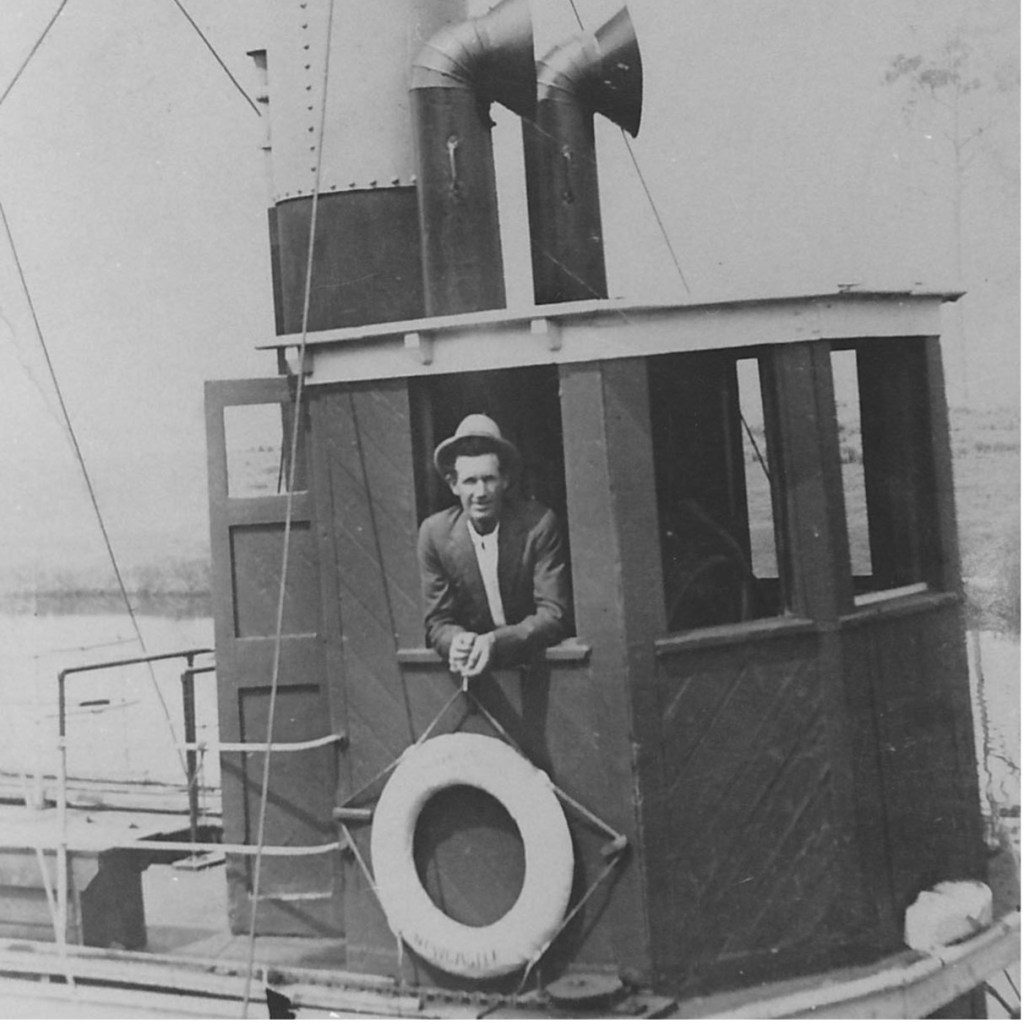
One of these small ships was the ss Coweambah built by the local firm of G. A. Engel and Sons, Limited. The Coweambah was a well-built vessel that regularly traded between Port Stephens and Newcastle carrying heavy cargo such as timber, as well as passengers. It was a much-respected vessel and was known locally as the ‘Cowie’.
It was destined to help the nation during the Second Word War when it was requisitioned by the Commonwealth Government for military duties. It served the nation well but was wrecked while on its return to Australia under tow after its military service was ended.
This paper is the story of the many activities undertaken by the Coweambah in its twenty six years of service in peace time and in war.
Launch of the Coweambah at Tea Gardens – 1919
The Dungog Chronicle of 25 March 1919, page 3, reported:
‘On Monday, March 17th, the launching of the new steamship, Coweambah, belonging to G. A. Engel and Sons, Ltd., took place. The event has been looked forward to with considerable interest by the public writes our correspondent. The vessel was designed expressly for the Myall Lakes and Port Stephens trade and is intended to take the place of the s.s. Nepean as soon as she can be fitted out. The launching was timed for 10.30 and long before that hour a large number of people began to assemble on the island Witts Island] where the vessel was built.
There were visitors from all parts of Port Stephens and Myall Lakes, and it was estimated that 300 persons were present. A short speech was made by Mr H. M. Engel. manager of the firm, setting forth the reasons for the building of the vessel and what was going to be done with it. He expressed regret at the departure from this world of the late G. A. Engel, who was the founder of the large business now carried on by the family. Success to the Coweambah was drunk and the christening ceremony was performed by Miss Violet Engel just as the vessel began to glide down the ways to the beautiful high water which was waiting to receive her.
The name is purely aboriginal and is also the name of the parish in which the vessel was built. After the launching refreshments were handed round and some good stirring speeches were made. Mr Saddler referred in glowing terms to the sterling qualities of those engaged in the enterprise of building such a fine vessel. He hoped it was the beginning of a shipbuilding era in Port Stephens. A presentation was then made to Mr Charles Burrows, who designed and carried out the building of the vessel. The presentation consisted of an inscribed gold medal. In making the presentation Mr H. M. Engel eulogised the recipient, who responded expressing his thanks. Various other toasts were drunk.’
After the launch of the Coweambah, final construction and fitting out was undertaken.
Coweambah arrives at Newcastle on a trial trip – 1919
The Newcastle Morning Herald and Miners’ Advocate of 18 December 1919, page 4
‘The new steamer Coweambah, which arrived at Newcastle from Port Stephens on her trial trip, was built by Mr. P. Burrows at Port Stephens, for Engel and Sons, Limited. Captain Forbes is the master. She is 85ft in length, and 20ft in beam, and has a speed of eight knots. The Coweambah which will carry timber for the firms of Messrs. A. Cook, Limited, and A. Smith, will leave today for Port Stephens with general cargo.’

ss Coweambah
Coweambah burnt at Tea Gardens Wharf – 1923
Initial reports of a fire on board the Coweambah overstated the amount of damage caused to the vessel. The Newcastle Sun of 30 June 1923, page 5, reported:
‘Burnt to the water line while lying at her owner’s wharf at Tea Gardens, Port Stephens, the coastal steamer Coweambah is now a total wreck. The vessel was loaded with piles and girders, which were to be transhipped to the schooner Louis Theriault, at Pindimar. The Coweambah was built for the owners, Messrs. G. A. Engel and Sons. Ltd., six years ago [actually four years]. The vessel was insured with the United Insurance Co., Ltd.’
The Dungog Chronicle of 3 July 1923, page 4, further reported:
‘Fire occurred at Tea Gardens on June 26th about 10.30p.m., by which considerable damage was done to the cargo steamship Coweambah. Thomas Wogork who was sleeping on the boat was awakened by the noise of the burning timber and the heavy smoke. The Coweambah was tied up at Engel’s wharf at the time, and is owned by Messrs. G. A. Engel and Sons, Ltd. It is a wooden steamer of 75 tons register.
Wogork, fireman, had a look round about 9.10 p.m. and all was well. The ashes and cinders were raked from the boiler into the stokehold on arrival of the steamer a few hours previously. Wogork thinks there might have been a cinder left alight. There appears to be little doubt about the fire originating in the bulkhead on the starboard side of the stokehold. The damage done is estimated at about £1000, and the total ship was insured for £4000. The cargo was not damaged. After an investigation of the case, the district coroner, Mr. F. J. Callow, J.P. dispensed with an enquiry.’
The Sydney Morning Herald of 18 July 1923, page 15, finally reported:
‘After survey, it has been ascertained that the damage to the wooden steamer Coweambah, which was damaged by fire in Port Stephens on June 20, is not so great as was first supposed. The vessel was stated to have been burnt to the water-line, but she has proved less than a 30 per cent loss to underwriters. It is stated that repairs to the vessel will cost in the vicinity of £600.’
The Coweambah was only out of service for a short period as it was listed in shipping reports as having arrived in Newcastle from Port Stephens on 17 August 1923.
Coweambah undertakes a fishing trip – 1926
In addition to cargo duties, the Coweambah provided recreational cruises. The Dungog Chronicle of 14 May 1926, page 2, reported:
‘Schnapper fishing is in full swing off Port Stephens. The Coweambah went out recently and secured 150 schnapper as well as 100 other fish. It is proposed to go out again on May 30 if sufficient fishermen can be secured. Twenty (at 10/- each) are required to make it a payable proposition for this big boat to go out to the grounds. There are many residents of Dungog and district who are keen on deepsea fishing, and this is an excellent opportunity for them to secure a cheap and enjoyable outing. The Tea Gardens Progress Association is behind the movement, with a view to popularising that locality, and would like to have as many Dungogites as possible join in. Those who intend to make the trip can leave their names at this office. The Coweambah will leave Tea Gardens at 3 a.m. and return in time to allow Dungogites to reach home at 6 p.m.’
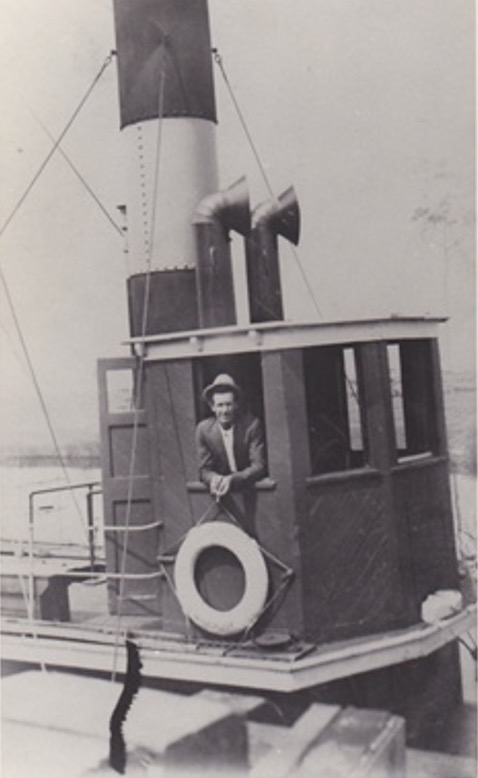
Coweambah with skipper, George Davies
Mystery explosion alarms Newcastle residents – 1928
The Newcastle Sun of 27 April 1928, page 5, reported:
‘When, this morning, shortly after 11 o’clock, a terrific explosion split its startling echoes through all the streets of the city, and penetrated into every warehouse, office and shop, everybody was agog, ‘What was It?’ ….. Immediately rumours ….. ‘They might have been testing the ship’s rockets,’ one said. They were. Mr. Dumbrell, shipwright surveyor of the Navigation Department, had been inspecting the coaster Coweambah. Mr. Dumbrell. caused all the commotion in the city merely by testing the ship’s rockets. These are fired from a cannon as a distress signal, and they are subject to a half-yearly overhaul…. The cannon is only about eight inches long, but it can make a big noise.’
Coweambah Carries Timber – 1928
The Dungog Chronicle of 26 October 1928, page 3, reported:
‘The auxiliary schooner Margaret W. is at present in Port Stephens loading timber for New Zealand. Included in the shipment is a large amount of sawn timber, about 50,000 feet of which the “Coweambah”‘ brought from Newcastle. The timber is being shipped by Mr. Gus. Brown, the well-known timber merchant.’
‘Coweambah’ assists in recovery of damaged aeroplane – 1930
The Manning River Times and Advocate for the Northern Coast Districts of NSW of 25 June 1930, page 1, reported:
‘The fate of Mr. J. A. Kerr’s Avro Avian, “Air-Ferries,” [aerial transport service] which crashed after landing on the beach [near Hawks Nest] at 4.45 p.m. on the 10th instant (high tide) was not so fortunate as Mr. Bardsley’s “Miss Cronulla,” which landed safely at low water on King’s Birthday. …..
Messrs. J. Keith and H. Williams, of Adamstown who were line fishing on the beach witnessed the untoward landing which resulted in an unfortunate accident, about three quarters of a mile north from Bennett’s Cottage at the beach. Messrs. Keith and Williams subsequently accompanied Pilot Kerr and his companion, much to their intense gratitude to Hawkes Nest wharf, where the unhappy fliers procured a pulling boat from Mr. W. Smith to reach Tea Gardens.
The ‘plane “Air Ferries,” was returning from Taree, where they left at 3.15 p.m. and passed over Port Stephens in the direction of North Head when the ‘plane suddenly turned towards Hawks Nest beach, where the pilot determined to land. ….. On landing, the wheels of the plane ran into a large washout on the beach, which caused the ‘plane to nosedive, damaging the wings and propeller blades, and buckling stays of the petrol tank, besides sanding the engine.
Again Tea Gardens folk volunteered the following morning to give whatever assistance they could to the luckless airmen, and a party of ten residents, together with Constable Benson, went to the scene of the accident. The horse “Motum” was found to be a friend in need, as he has been for many years. The wingless plane was drawn by the horse to a point near Hawks Nest wharf, where the damaged plane was prepared for shipment per s.s. Coweambah for Newcastle and transhipment to Sydney. A party of eight carried the wings of the plane a distance of about four miles.’
Coweambah forms part of coordinated transport services – 1930
The Coweamnbah formed part of the integrated river passenger and cargo transport services provided by G. A. Engel & Sons, Ltd. The following advertisement provides an example of the various integrated transport services.
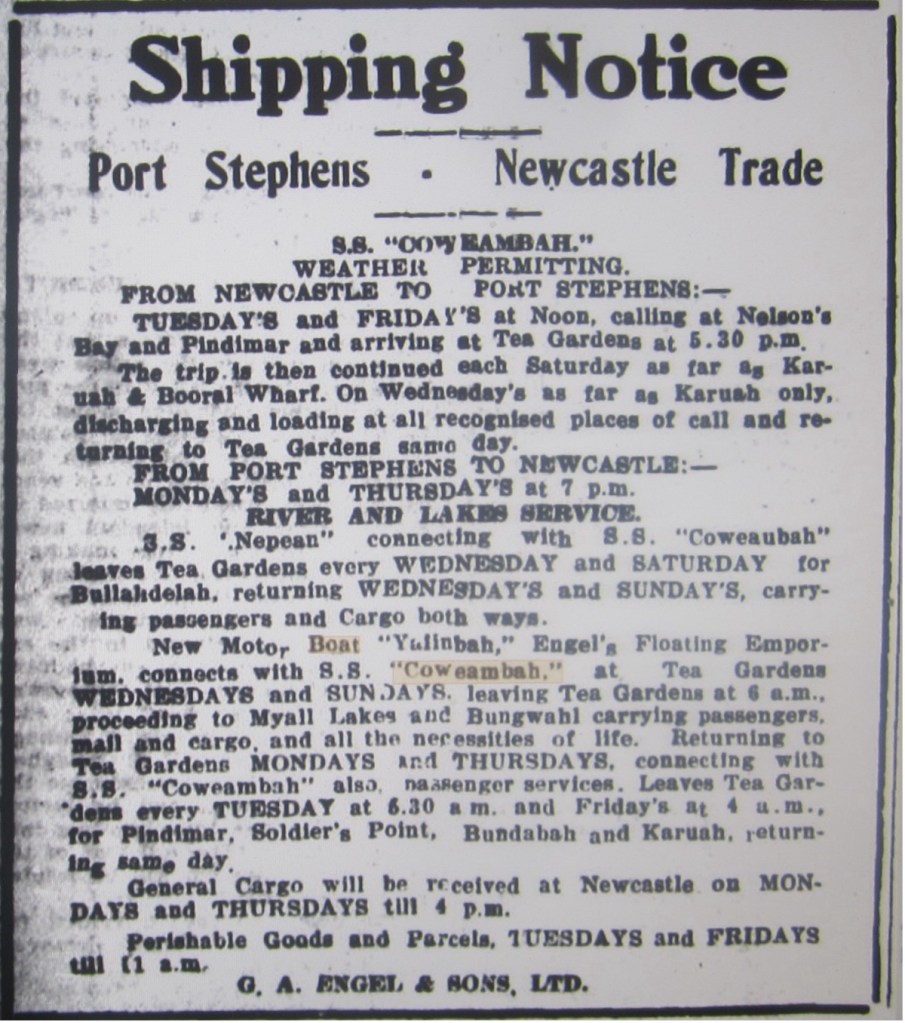
Advertisement for integrated transport services utilising the Coweambah [Dungog Chronicle, 25 April 1930]
Coweambah tackles a huge storm between Port Stephens and Newcastle – 1931
The Newcastle Morning Herald and Miners’ Advocate of 7 July 1931, page 6, reported:
‘Battling through the terrific rainstorm in which nothing could be seen past the bow of the vessel, and against high seas and a strong south-east gale, the Coweambah, one of the smallest vessels on the New South Wales coast, arrived at Newcastle from Port Stephens yesterday afternoon, after a voyage of seven hours. This is the second time the Coweambah has made the voyage when interstate steamers 50 times her tonnage have preferred to remain at Sydney rather than venture forth on the voyage to Newcastle, although the wind would have been almost behind them.
When the Coweambah set out from Port Stephens, between 9.30 and 10 a.m., yesterday, a westerly wind was blowing about 30 miles an hour. Anticipating having the shore as a protection from the wind, it was not thought that the voyage would prove difficult. When the heads were cleared, however, it was found that the sea had a southerly roll, and that the velocity of the wind was increasing. When the vessel was half-way to Newcastle, the sea rose, although the wind was still blowing from the west. On nearing Newcastle, the wind died down suddenly, and the atmosphere was comparatively calm for about 20 minutes. The sea was still high, however.
About 3.40 p.m., when the vessel was within three miles of Newcastle, the wind changed to the south-east, freshened immediately, and soon reached a speed of about 40 miles an hour. Then the real trouble began, for the wind was mainly against the vessel, and threatened to blow it close to the shore. The vessel had kept well out for the sake of safety, but it was realised that it was a case of making Newcastle or going ashore. And many vessels have gone ashore on that stretch of coast never to sail the seas again.
Progress was slow but sure, and the little vessel battled on into the gale for more than an hour before the last three miles were covered. The first glimpses of the shore for hours were gained shortly before the wind changed, so it is not difficult to realise that the vessel was quite close to Newcastle before the Nobbys light was seen flashing its welcome message through the rain. Two big waves broke on the bar as the Coweambah was approaching it. Fortune favoured the vessel, and it crossed the bar in a lull in the storm. It was hoped that the voyage would be completed about 2.30 p.m., but the vessel did not arrive until 4.45 p.m.
Two passengers on board found the roughness of the trip distressing. “The Coweambah behaved splendidly,” said a member of the crew last night. “We shipped a fair amount of water, but no damage was done.” He added that the vessel was only half-loaded and said that progress would have been more rapid if about 15 tons of extra cargo had been on board. The boat, he declared, “rode the waves like a bird.” A steamer of only 75 tons gross, the Coweambah was built at Tea Gardens 10 years ago, and is owned by Ingall and Sons, Tea Gardens.
The boiler in the vessel was salvaged from the Seagull, which was wrecked about half-way between Newcastle and Port Stephens within 100 yards of the Uralla. The original boiler in the Coweambah was replaced by the boiler from the Seagull. The Coweambah has traded between Newcastle and Port Stephens for three years and makes two trips each way each week. In the three years the vessel has not once turned back to the port whence it set forth. It has missed about three trips owing to unfavourable weather. One of these was the night the Uralla was wrecked. Earlier in the night on which the Pappinbarra was wrecked the sturdy Coweambah, with a south-east gale behind it, completed the voyage from Newcastle to Tea Gardens in four hours. On several occasions, in rough weather, the Coweambah has taken eight or nine hours for the trip.’
The Dungog Chronicle of 7 September 1926, page 5, had previously reported on the boiler subsequently installed in the Coweambah:
‘The wrecked Seagull [that was wrecked in 1926 south of Morna Point, with the loss of all life] has been purchased by Engel Bros., Tea Gardens, and workmen have been busy in the breakers at Anna Bay getting everything of any value out of her. The boiler and machinery have been recovered, so it looks as if the enterprising brothers have secured a rare bargain for £25. Good luck has favoured the salvagers, as modorate weather has prevailed ever since the steamer was beached.’
Shell Grit Industry – 1932
The Dungog Chronicle of 26 February 1932, page 4, reported:
‘The demand for shell grit has increased so much that another company has begun operations at Port Stephens. This grit is shipped to Newcastle per G. A. Engel and Sons steamer, ‘Coweambah,’ and during the last few weeks she has carried upwards of 2,000 bags.’
Coweambah assists disabled launch – 1932
The Dungog Chronicle of 4 March 1932, page 4, reported:
‘The well-known lobster boat “Meaolis,” owned by Spero Spathis, fisherman of Port Stephens, broke her crankcase whilst on a trip to Newcastle last week. She was taken in tow by the coasting steamer ‘Coweambah’ to Newcastle, where repairs have been effected.’
Coweambah lands salvage gear on Fingal Island – 1932
The Dungog Chronicle of 24 March 1932, page 4, reported:
‘An attempt will be made on the full moon tides to refloat the ketch ‘Edris,’ which went ashore whilst loading a cargo of shell grit at Narrowgut beach (at Fingal Island). A quantity of salvage gear has been landed at the wreck by the ‘Coweambah,’ and the work will be in charge of Mr. Lyons, of the Lyons Trading Company, who are the owners of the vessel.’
Coweambah transports fishing party – 1933
The Dungog Chronicle of 20 January 1933, page 4, reported:
‘A party consisting of Mr. Ted. White and family and Constable Coppin and wife, made the trip to the ‘Gibber’ [north of Hawks Nest] on Saturday last, the result being a splendid catch of fish. Making the trip by ‘Coweambah’ whilst on her way to Bulahdelah, the party spent the night on the beach and caught the same boat home 24 hours later on the return trip.’
Coweambah carries timber to Newcastle four times weekly – 1933
The Dungog Chronicle of 1 September 1933, page 4, reported:
‘An indication of the increase in the output of timber from Port Stephens can be gauged by the fact of the coaster ‘Coweambah’ doing four trips to Newcastle last week with timber cargoes. The bulk of the timber was for New Zealand ports, principally Napier, and will be reloaded in Newcastle by Union line boats bound for that port.’
New Year’s Day Excursion to Tea Gardens – 1933
The Coweambah was frequently used for travel excursions to special events as illustrated in the following advertisement.
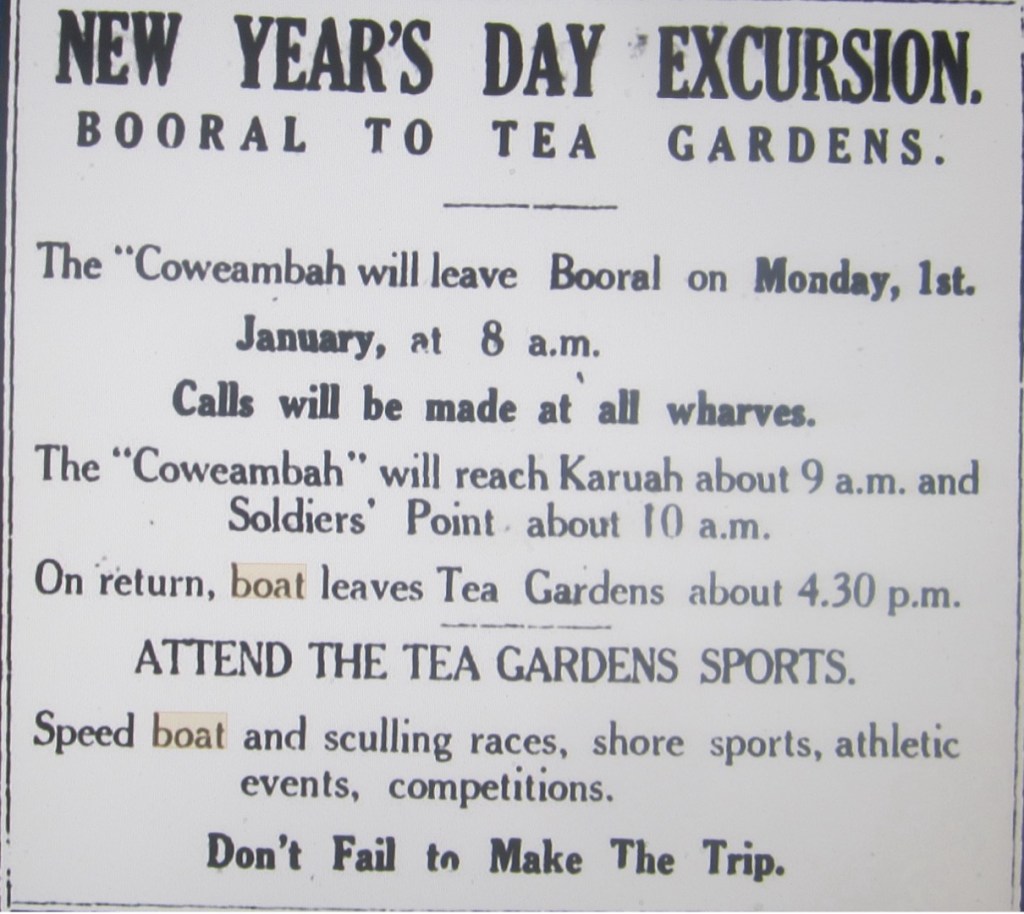
Advertisement for Excursion [Dungog Chronicle, 15 December 1933]
Coweanbah transports Sea Scouts to Newcastle – 1933
The Dungog Chronicle of 22 December 1933, page 4, reported:
‘A party of the Tea Gardens Sea Scouts made the trip to Newcastle on Monday last under the guidance of Mr. Hugh Thurlow. The trip was made per s.s. ‘Coweambah,’ a free trip being offered by the proprietors of that boat.’
Coweambah transports new speed boat – 1934
The Dungog Chronicle of 9 March 1934, page 4, reported:
‘Mr. Reg. Burrows is the possessor of a fine new speed boat, which arrived by the ‘Coweambah’ last trip. The speed boat is named the ‘Whizz Bang,’ but at the time of going to press not very much is known about her.’
Coweambah tackles huge storm – 1934
The Newcastle Sun of 31 May 1934, page 15, reported:
‘The “sixty-miler,” Coweambah, left Port Stephens at approximately 11 am. yesterday, and was sighted off Morna Point by the lookout at Nobbys at 4 pm. The vessel was almost in sight of the Newcastle breakwater when the wind sprang up. Heavily laden with timber, the boat made heavy weather, and did not cross the bar until 7.8 pm.’
Coweambah transports spectators to Tanilba Regatta – 1935
The Dungog Chronicle of 11 January 1935, page 4, reported:
‘It has been definitely decided that Tanilba Regatta which was held on New Year’s Day …… will be an annual event henceforth. This news will be welcomed by those who wish to spend a pleasant holiday on the first day of the year. All tastes were catered for at Tanilba. There were races for sailing boats and for speed boats, there were sculling races, foot races and horse events. There was a woodchop and a standing log chop. All these events were crammed into one day and were carried out successfully. …… The ‘Coweambah’ brought many hundreds down the Karuah River, whilst the ‘Yalinbah’ conveyed a huge crowd from Tea Gardens.’
Coweambah transports spectators to Mungo Brush Regatta – 1935
The Dungog Chronicle of 10 January 1936, page 4, reported:
‘The Port Stephens Regatta Club held their 28th Annual Regatta at Mungo Brush on Thursday, 26th, and Friday 27th December. The weather was fine and launches came from all round the lakes carrying their human cargo. The s.s. ‘Coweambah’ ran an excursion from Bulahdelah on both days, while the ‘Yalinbah’, ‘Yoothapuna’ and ‘Unity’ ran from Tea Gardens.’
The Coweambah provided transport for spectators to many Mungo Brush Regattas.
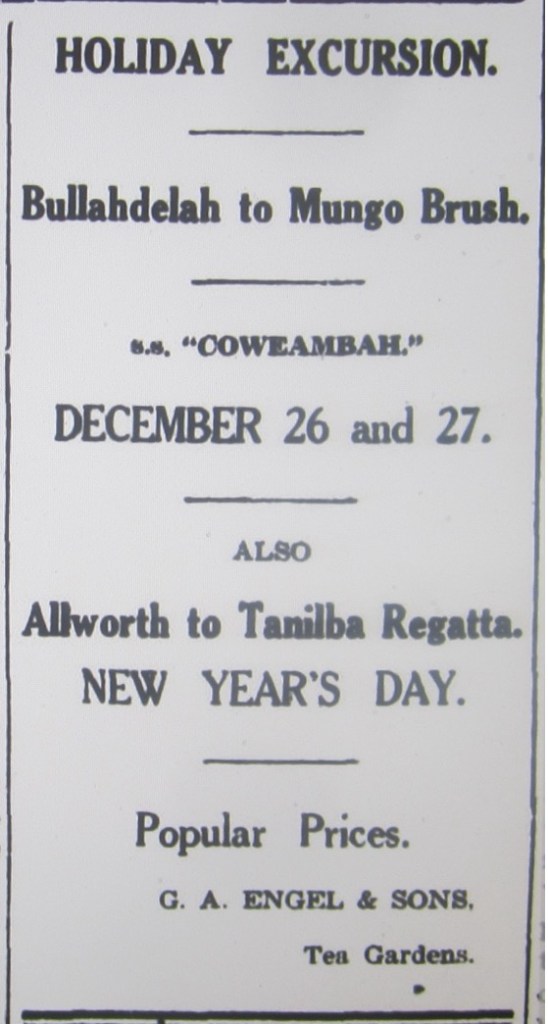
Advertisement for transport to the Mungo Brush Regetta on the Coweambah [Dungog Chronicle, 14 December 1934]
Coweambah runs aground – 1936
The Dungog Chronicle of 5 June 1936, page 4, reported:
The s.s. Coweambah went aground on a mud flat in the Karuah River last Thursday week. As no word was received of the Coweambah and she was overdue, Mr. H. M. Engel got Mr. Aden Cook to take him in the speed boat ‘Brun’” to look for her on Saturday. After finding the Coweambah the ‘Bruno’ had a mishap. The ‘Anambah’ went to the assistance of the former vessel on Sunday and was successful in getting her into deep water.’
Coweambah assists motor launch – 1938
The Dungog Chronicle of 10 June 1938, page 4, reported:
‘While fishing off Little Island last Sunday, a motor launch broke down, and only having a sand bag for an anchor, had drifted dangerously close to the Rock. Seeing the occupants waving and the launch in its dangerous position, the Coweambah went to the rescue, and after great difficulty, managed to get a line aboard and towed the launch to safety.’
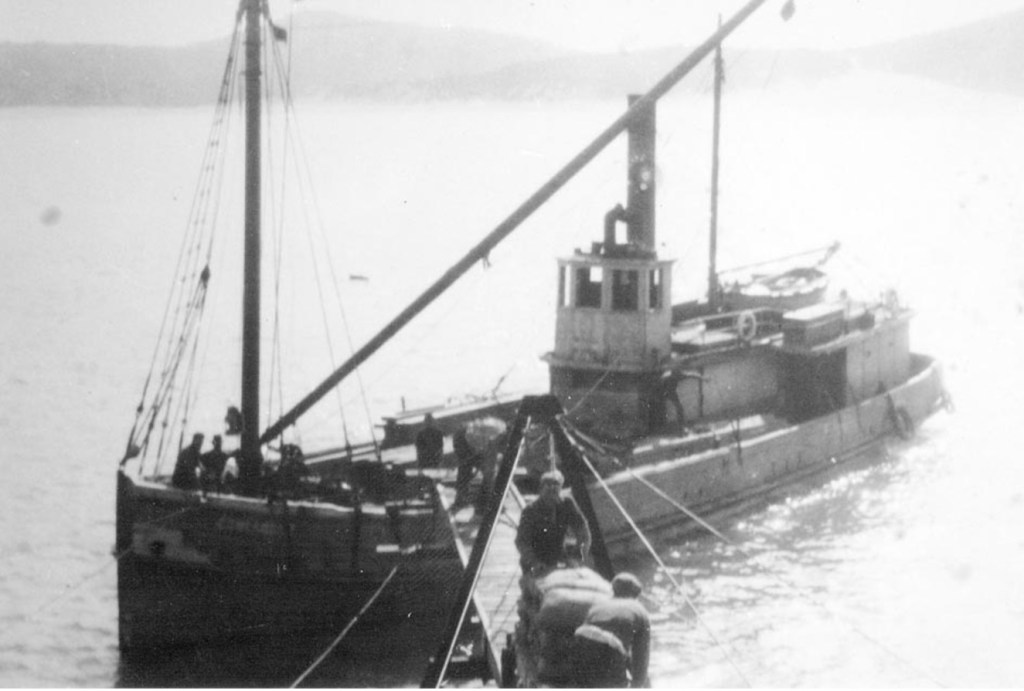
Shell grit being loaded onto the Coweambah at Fingal Island – circa 1936
Coweambah to undertake fishing trip – 1940
The Newcastle Sun of 23 February 1940, page 7, reported:
‘The Macquarie Fishing Club has obtained a full complement of 30 members for its outing to the Broughton Island fishing grounds on Sunday. The bus will leave West Wallsend at 11 o’clock on Saturday night for Nelson Bay where the party will board the ‘Coweambah’, which has been engaged for the trip. Members have decided to pool the fish caught, after allowing for one selection to be made from individual catches.’
Coweambah requisitioned for military service – 1942
In 1942, the Coweambah was requisitioned by the Commonwealth Government for use by the United States Army Small Ships Section, for military transport duties. It was used in Queensland and New Guinea waters to transport supplies to military bases.
Tea Gardens Affected by Commandeering of the Coweambah – 1942
The loss of the Coweambah was a significant detriment to the continued economic prosperity of the Tea Gardens area, as it robbed the area of a water freight service, particularly to service the timber trade. The Dungog Chronicle of 22 December 1942, page 1, reported:
‘Quite a number of people associated with the Government have been around Tea Gardens recently, and this has made up for the loss of man-power and other losses sustained by the loosing of the Coweambah, Yalinbah, etc.’
The Dungog Chronicle of 13 August 1943, page 3, reported:
‘A number of visitors came for the weekend with a view of schnapper fishing, but found it impossible to obtain a boat of sufficient proportions for this attractive purpose. Gone are the days of the old Coweambah when large numbers could go to sea and land this delicacy of the breakfast table.’
Proposed New Transport Service to serve the Tea Gardens Area – 1943
The Dungog Chronicle of 18 June 1943, page 3, reported:
‘We understand that preparations are being made to run a boat service between Newcastle and Tea Gardens in order to satisfactorily cope with the timber trade from the district to Newcastle. The Iluka is to undergo repairs to work the waterways of this district. The idea is to conserve petrol, tyres, etc., instead of lorries travelling the road to Newcastle.
The new order will be to deliver the timber at certain points from respective forests and then collect it with the Iluka. The idea has much to commend itself in achieving a good objective. It is understood preparations will take about two months. No doubt business people will avail themselves of the opportunity of water freight in view of the overtaxed lorry services since the Coweambah went off the run. some time ago. The ‘Cowe’ has been in’ service up Townsville way since leaving here.’
Coweambah wrecked while returning under tow from military service – 1945
The wreck of the Coweambah at the mouth of the Macleay River, received much newspaper coverage, some of which is set out below.
The Macleay Chronicle of 13 June 1945, page 2, reported:
‘The small steamer Coweambah, 76 tons, was wrecked on the beach north of the New Entrance [to Macleay River] on Monday morning. The Moa Moa, a 550 ton ship, sheltering in Trial Bay, made an attempt to tow the Coweambah to safety, but the terrific seas made the effort unsuccessful. The Police and Kempsey Ambulance were standing by at 9.30 a.m. on Monday, and at 11 a.m. the ship broke up and six of the crew were washed ashore.
One member of the crew, George Michalitsis, is missing. The rescued men were Ian Graham Cripps 23 (Sydney), Arthur G. Salt 57 (New Zealand), James W. Gadd 19 (Hurstville), Keith W. Roals 21 (Newcastle), Eric M. Trower 19 (Queensland),’ James Ford 32 (Marrickyille). Some of the men suffered injuries to hands and feet, and all suffered severely from shock and immersion.
They were admitted to the Macleay District Hospital for treatment. Kempsey Ambulance Officer had a full supply of first aid requirements, spare blankets, cigarettes, etc., and crossed the river with the Pilot officials, Sergt Turner, Const. Thompson, and some sailors from a North Coast boat lying at Jerseyville. The survivors were particularly grateful for the excellent Ambulance service. At Kempsey the local Red Cross provided a new outfit for the men, with smokes and other comforts in addition.’
The Daily Examiner of 13 June 1945, page 2, also reported:
‘The survivors of the Coweambah, which was wrecked off South-West Rocks, at the entrance to the Macleay River, are now in the Macleay District Hospital.
Today they gave a graphic description of the sinking of the ship. Ian Graham Cripps, 23, of Canterbury, said they were only half a mile from the shore, with both anchors out, in a 60-mile an hour gale. The vessel could not keep its bow up. A huge wave rolled over the ship almost washing the men overboard. They hung on and a second wave smashed the boom and one of the lifeboats. The men grabbed some of their possessions and made for the other lifeboat. Another wave smashed it against the side of the boat as it was being lowered. “We tossed away our belongings,” he said, “and jumped into the sea and hoped for the best. It was a case of every man for himself.” ‘Cripps said that in the 20 minutes that it took to reach the shore the ship was smashed to pieces.
With heavy seas pounding the Coweambah. the vessel is in danger of becoming a total wreck. Special salvage equipment is being rushed from Sydney today to attempt salvage operations. A powerful tug also, left Sydney to aid in the work. Heavy seas and a gale force wind are hampering those engaged in searching for the missing members of the crew. Because of the terrific seas pounding the coast the sailings of all ships between Newcastle and Sydney have been cancelled.’
The Newcastle Morning Herald and Miners’ Advocate 14 June 1945, page 2, further reported:
A vivid story of the Coweambah’s battle for life when wave after wave was driving her towards the rocks in Trial Bay was told by one of the survivors, Keith W. Roals of Merewether-street, Mereweher. “She started to drag her anchors at 3 a.m. on Monday,” he said. “We let the chain out to its full extent. Still the anchor was dragging. With the engines working at full speed, we tried to head the ship into the sea. Without a rudder that was impossible. “A wave hit her. She trembled, listed, righted herself again; then another sea struck her broadside-on and broke over the decks. “It was a hopeless fight,” Roals said; “Black smoke and fumes were coming from the stokehold. One of the firemen, Jim Gadd, had been washed from the deck and was astride an upturned lifeboat in the sea. It was then the men left her.”
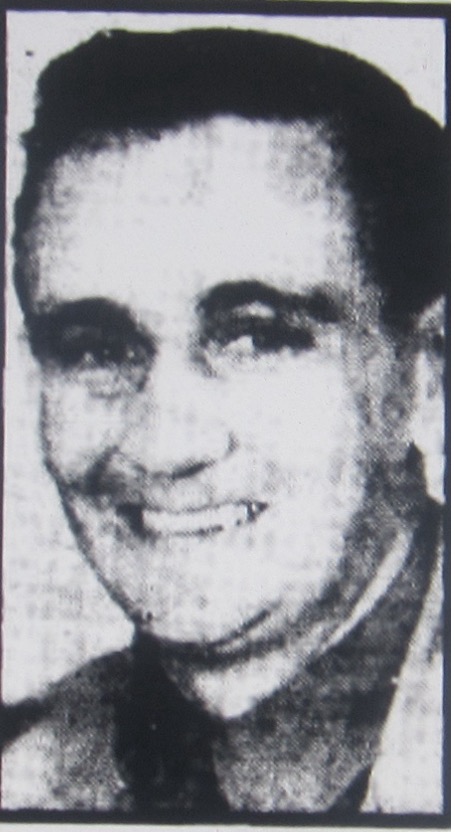
Keith Roals [Newcastle Morning Herald, 14 June 1945]
In tow of a larger vessel, the Coweambah ran into heavy weather off the coast. Four days were occupied in travelling 200 miles. The ship lost her rudder, her steam pumps and lighting were thrown out of action. Of the crew, of eight, including the captain, the cook became very sea sick and was unable to do his work. The men were without food, except what they could scrounge from the galley. On Sunday it was decided to allow the Coweambah to shelter in Trial Bay. The towline was dropped at the mouth of the bay. The wind took the vessel into a suitable anchorage. On Sunday night the Coweambah’s captain took a small boat to the stern in an attempt to fix the rudder. Later, he was rowed to the towing ship, but the seas ‘made’ and he could not get back.
With the pumps out of action, the Coweamnbah’s crew had to pump the bilges out by hand. It was a tiring, exhausting job. Roals was in his bunk at 3 a.m. on Monday, when a sea crashed on to the ship and washed him out of it. He crawled back again, but a few minutes later another wave tossed him out and the ship listed. Roals went on deck. He saw his mate, Jim Gadd, washed overboard. With him went the ship’s lifeboat. Some moments later he saw Gadd astride the boat. One by one the men, with lifebelts fitted, went over the side. The shore was a little over 800 yards off, but the cross currents caused immense dumpers which caught the men, swirled them below water, then shot them to the surface, to suck them back again almost before they could draw breath.
They were in the water about 30 minutes. The lifeboat was ashore before them. It was right side up, driven well on to the sand. The only members of the crew not on the beach were the captain and the cook. The Chief Engineer, A. Salt, who had been in the islands for some years, placed his savings, £600, in a gladstone bag, and threw it into the sea in the hope it would be washed ashore. “If I do not get out of it, send the bag to my wife,” Salt said to his mates. Salt, who has but one arm; was fastened into a lifebelt. His mates gave him a round life-buoy for further support before he plunged into the sea. Roals was naked when he landed. He praised the kindness of the Kempsey people and members of the Red Cross who assisted the men. Roals, who is 21, has a brother, Terry, also a merchant seaman. Terry’s ship was torpedoed off the Australian coast. He was one of 11 from a crew of 40 who were saved.’
Concluding Comments
Although the Coweambah was wrecked many years ago it is still recognised as having been a popular and important ship in Port Stephens.
As the product of an active shipbuilding industry in the Port Stephens , it frequently features in marine histories of the area.
Researched and compiled by Kevin McGuinness
January 2024

 Port Stephens - a history exploration