

Introduction
Daphne Marie Rooke was a prized South African novelist who resided in Port Stephens for several periods of time, after marrying an Australian, Irvin ”Bertie” Rooke.
Daphne was born in South Africa and published numerous prize-winning novels about life there. The University of Natal recognised her writing in the 1980’s and awarded her a honorary doctorate in 1997.
While living at Port Stephens, Daphne Rooke wrote a novel, Apples in the Hold, in which the action was largely centred on Nelson’s Bay. The book was published in 1952 under the pseudonym of Robert Pointon.
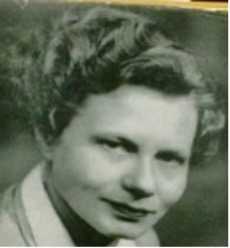
Daphne Marie Rooke
Publicity for the novel Apples in the Hold
The Newcastle Morning Herald and Miners’ Advocate of 27 May 1948, page 2, carried the following report on Daphne Rooke:
‘Mrs. Daphne Rooke, of Nelson’s Bay, who won the 1946 South African Prize Novel competition with “The Sea Hath Bounds,” has nearly completed a novel whose action is centred at Nelson’s Bay. The book will be called “Apples in the Hold.” Mrs. Rooke, who came to Australia in 1947 from South Africa will complete the book in about two months and hopes to have it published in Australia. Another novel, “Drew’s Pride,” which she completed at Nelson’s Bay last year, has been accepted by a South African publishing company. It deals with life on Natal canefields.
The novel on Nelson’s Bay starts in Sydney and the story then moves to Nelson’s Bay, where it deals mainly with the life of professional fishermen. Mrs. Rooke lives “in a little house in the bush near Halifax Park” with her eight-year-old daughter. Her husband, Mr. I. Rooke, works in Sydney and returns to Nelson’s Bay at weekends. Mrs. Rooke said yesterday that she and Mr. Rooke built the house themselves and are still building it. “It started off as a garage, but we are actually at the important stage where we are about to install a fireplace,” she said.’

Daphne Rooke at Port Stephens, 3 April 1952 [State Library of NSW]
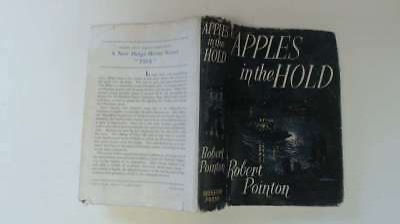
Dust Cover of the book ‘Apples in the Hold’ in which the action was largely cantered on Nelson Bay, Port Stephens (published under the pseudonym of Robert Pointon)
A Review of Daphne Rooke’s Work
Dirk Den Hartog, literature and cultural history lecturer, reviewed some of Daphne Rooke’s novels. He wrote:
‘Rooke’s first novel, The Sea Hath Bounds (1946, later published as A Grove of Fever Trees, 1950), was first published in the year that she and her Australian husband emigrated to Australia, where she continued to write primarily about South Africa. Her first international success was achieved with her second novel, Mittee (1951), set in the Transvaal prior to, and during the Anglo-Boer War. After this Rooke published a novel with an Australian setting, Apples in the Hold (1952), under the pseudonym Robert Pointon, but returned to South African settings for a string of successful novels: Ratoons (1953), Wizards’ Country (1957), A Lover for Estelle (1961), The Greyling (1962, banned in South Africa), Diamond Jo (1965), and Margaretha se la Porte (1974).
Although she has used Australia and New Zealand as settings for her children’s fiction (The Australian Twins, 1955, The New Zealand Twins, 1957, and the adult/juvenile Boy on a Mountain, 1969), she says she always wanted to write about South Africa. The South African Twins (1953, also published as Twins in South Africa, 1955) extends her children’s fiction to South Africa. Another locality Rooke has explored in her fiction is India, in the ‘poetic fantasy’ Beti (1959).’
The Daphne Rooke Collection – University of Cape Town Libraries
The Daphne Rooke Collection was donated to the University of Cape Town Libraries in 1990 by Dr Ian Glenn, Head of the Department of English at the University. It consists of some 209 items, mainly of Daphne’s published writings including Apples in the Hold.
Dr Glenn acquired the collection from Daphne Rooke in 1988.
The website for this collection contains the following information:
Biographical Note
‘Daphne Rooke was born in Boksburg in 1914. Her talent for writing was recognised and encouraged by her mother, Marie Knevitt, a journalist and writer of short stories. Her first novel, `A Grove of Fever Trees’, was co-winner of an Afrikaanse Pers literary competition in 1950. Her novels were particularly popular in the USA in the 1950’s and early 1960’s. According to Dr Ian Glenn, she was the South African writer with the widest international exposure and the greatest commercial success at that time. Her books were published by serious publishers and received appreciative notices in leading critical reviews of the time in the USA and Britain.
She used indigenous material, and dealt with major historical issues of the day. In spite of these factors, or perhaps because of them, her books were not well received in South Africa. One of her novels, `The Greyling’, was banned in South Africa in 1962. Dr Glenn describes some of the early South African reviews of her books as “uncomprehending”, and believes that some of her work “deserves recognition and rethinking”.
She married Irvin Rooke, an Australian, and eventually settled in Australia. She also travelled extensively in Africa, Australia, New Zealand and India, and some of her stories have been set in these places. She has a daughter, Rosemary, and two grandchildren, living in England.’
The Collection
‘The Daphne Rooke Collection was donated to the University of Cape Town Libraries in 1990 by Dr Ian Glenn, Head of the Department of English at the University. The collection consists of approximately 209 items, mainly Mrs Rooke’s published writings. These include novels, short stories and children’s stories. There are typescripts of several published and unpublished works, galley proofs, workings copies. Included with the working copies are corrections suggested by the publisher, and correspondence in this connection.
Also in the collection are some incomplete manuscripts, background material and rough notes. Apart from Daphne Rooke’s own writings, the collection includes reviews, journal articles and two short stories by her mother, Marie Knevitt. Because of renewed interest in South Africa in the work of Daphne Rooke, Dr Ian Glenn was able to receive funding from the Centre for African Studies at UCT, and from the HSRC, to visit the writer in Australia in 1988, and acquire the collection from her.
During his visit Dr Glenn tape-recorded an interview with Daphne Rooke. These tapes and an edited transcript of the interview form part of the collection
Further Background from Wilkipedia
‘Daphne Marie Rooke (nee Pizzey) (6 March 1914 – 21 January 2009) was a South African author of works such as “Mittee”, “Ratoons” and “Wizards’ Country”. She also wrote travel articles and books for children set in India, Australia, New Zealand, and South Africa.
Daphne Rooke was born in Boksburg, Transvaal; the youngest of six children born to an Afrikaaner mother. Daphne’s grandfather was Dietlof Siegfried Maré, founder of Pietersburg, who had 23 children by two wives. One of Daphne’s uncles was writer Leon Maré.
Daphne’s mother was Maria Magdalena Maré, born in 1878, who was known as “Mittee”. She married an Englishman, Edward Knevitteor Knevitt in 1899. During the Anglo-Boer war, tensions between Afrikaans and English ran high, and the couple and their four children (Daphne’s three half-brothers and a half-sister) were forced to leave Pietersburg because of Knevitt’s English citizenship. The Marés and Knevitts apparently had little contact after this time.
After the death of Edward Knevitt, Daphne’s mother remarried another Englishman, Robert Pizzey, in 1911, and had two further daughters: Rosemary born in 1912 and Daphne born in 1914. Robert Pizzey fought and died in the First World War. As a child, Daphne had recurring heart and growth problems. Primarily for the sake of Daphne’s health, the family left the Highveld and moved near to Durban Natal. Daphne’s mother was a teacher and a journalist, and also a short-story writer. She published a collection of short stories The Children of the Veld, under the pseudonym “Mare Knevitt”.
This inspired Daphne to try her hand at writing. She became a journalist and author. In 1946, she was co-winner of the Afrikaanse Pers literary prize, for a work that was eventually published as her first novel, under the title “A Grove of Fever Trees”. In the meantime (1937) she had married an Australian named Irvin (“Bertie”) Rooke, whom she had met while doing organisational work for the Transport Workers Union. To reconnect with Bertie’s Australian family, they left for Australia in 1946. They returned to Natal in 1953 but disturbed by the police state mentality in South Africa, moved back to Australia in 1965. In the 1980s her work was “rediscovered” by the University of Natal, which awarded her an honorary doctorate in 1997. She remained in Australia until Bertie’s death in 1989 when she moved to Cambridge, England, where she lived for the rest of her life.’
Concluding Comments
Despite her literary fame in South Africa, Daphne Rooke has remained virtually unknown in the Port Stephens area where she resided for several years in Bent Street at Fingal Bay.
The Newcastle Sun of 30 June 1953, page 8, reported on Daphne Rooke appearing as a guest speaker at the Newcastle Red Cross Musicale:
‘Extra chairs had to be put in the Lady Mayoress’s reception room yesterday to accommodate the crowd which attended a musicale given by Newcastle City Red Cross. Guest speaker was authoress Mrs. Daphne Rooke of Nelson Bay, who spoke on South Africa, where she formerly lived. She was accompanied by Mrs. L. Jorgensen of Nelson’s Bay.’
Daphne died on 21 January 2009 at Cambridge, England, aged 94 years.
Researched and compiled by Kevin McGuinness
September 2021

 Port Stephens - a history exploration