
Introduction
The Raymond Terrace and Dungog District Council was formed in 1843, marking the beginning of local government administration in the Port Stephens region. Following the dissolution of this council, the Raymond Terrace Municipal Council was formed in July 1884, primarily covering the immediate Raymond Terrace town area. Dungog, which formed part of the previous District Council area was proclaimed a municipality in May 1893. The Port Stephens Shire Council was formed in 1906 and covered the Telligherry and Tomaree peninsulas.
In 1937, the Port Stephens Shire Council amalgamated with the Raymond Terrace Municipal Council to form the present-day Port Stephens Council.
This paper focuses on the development of local government in the southern areas of Port Stephens with its local government administrative centre at Raymond Terrace.
The Mid-Coast Council which covers the northern side of Port Stephens and has its administrative centre at Forster is not covered in this history.
A Brief History of Local Government In New South Wales
During the first 50 years of settlement, most services were provided by the State Government. The growth of the colony over the ensuing years meant that the system of government at the time was becoming unsuitable.
In 1840, the Government drafted a scheme to introduce municipal institutions. The mechanism was such that upon receipt of at least 150 petitions out of a population of 1,000, the Magistrates in Petty Sessions would convene a meeting to determine whether there was sufficient support for incorporation of the local area. If community support existed, the Governor would incorporate the region and create a council
The first local councils in New South Wales were incorporated in 1842, with 29 District Councils established under the provisions of the ‘Act for the Government of New South Wales and Van Diemen’s Land’. The Raymond Terrace and Dungog District Council was one of the new councils formed. From mid 1843 individual councils, administered by a government-appointed warden, were established in many Police Districts. These new Councils were empowered with the authority to levy general rates and charges for the purpose of constructing and maintaining roads, bridges and other infrastructure. Councils were also granted the power to enact by-laws for ‘the eradication of nuisances’ and to employ officers to enforce local order.
The first local government scheme proved ineffective. Public opposition to the levying of rates. together with other issues, led to the local governments in NSW being deemed a failure.
Local government was again attempted with the passing of the ‘Municipalities Act, 1858′, whereby local councils gained wider responsibilities. They included the provision of roads, bridges, ferries, wharves, cemeteries, water supply, sewerage, public hospitals, gardens and libraries.
The ‘Municipalities Act, 1867′ provided for the subdivision of municipalities into boroughs and districts, each with designated area and population qualifications. The Municipalities Act consolidated all previous Acts and Amending Acts without altering their main features. The Raymond Terrace Municipal Council was one of the local government areas formed under this latest legislation.
With the ‘Local Government (Shires) Act, 1905 ‘and ‘Local Government Extension Act, 1906′ local government finally gained a compulsory, state-wide system of incorporation. By 1908, 134 shires were created, joining the 190 previously incorporated municipalities. The Port Stephens Shire Council was one of the new Shires formed under this legislation in 1906.
The ‘Local Government Act, 1919‘ extended local government powers and functions again. Minor legislative changes to the Act thereafter have resulted in the last major review, being that of the ‘Local Government Act, 1993′. Local government entities now include shires, municipalities and cities, with powers of shires and municipalities identical. Although the Local Government Act 1993 has been the subject of numerous amendments, the core features of the regime implemented in 1993 have been largely untouched.
Raymond Terrace and Dungog District Council – 1843
The area covered by the Raymond Terrace and Dungog District Council covered a far larger area than that covered by the present-day council region. It is hard to imagine how a council consisting of seven councillors could be expected to provide effective administration over such a wide area, which lacked interconnecting roads and communication options covering the large area.
The Colonial Observer of 6 September 1843, page 5, published the following details about the initial members of the council, and the area covered by the Raymond Terrace and Dungog District Council”
‘The following are the boundaries of the respective district, with the names of the gentlemen nominated in the charters, to fill the offices hereafter named respectively, viz.:-
Raymond Terrace and Dungog,— Warden. — Kenneth Snodgrass, Esq., Councillors. — William Russell, Thomas Cook, Vincent Dowling, Archibald Windeyer, Alexander Fitz Crawford, and George Mosman, Esquires.
The boundaries of this district as prescribed by the charter, are as follow : — Embracing the county of Gloucester, (exclusive of the Australian Agricultural Company’s land) and a north-eastern portion of the county of Durham; bounded on the north from Farquhar’s Inlet by the River Manning to the north eastern angle of the Australian Agricultural Company’s Land; thence by the eastern boundary, lines of the said Australian Agricultural Company’s Land to the Myall Lake Broadwater, and by the Broadwater and Myall River to Port Stephens; thence by Port Stephens and the Rouchel River to the Village Reserve at Booral; thence by a line west to the south west corner of the Australian Agricultural Company’s Land; and thence by a line north forming the western boundary of the said Australian Agricultural Company’s Land to the River Manning; thence again by the River Manning, and by the Barnard River to its source; on the west by the range dividing the Manning and Hunter River waters, and the range dividing the Allyn and William River Waters to the southern boundary of John Verge’s grant; thence by a line bearing east to William River, and by this River to its confluence with the Hunter; and by the Hunter to the western point of Mrs. McLean’s Grant; on the south from thence by the River Hunter (exclusive of the Island therein), and the sea shore to Port Stephens; and from hence by the sea shore which forms the eastern boundary to Farquhar’s Inlet aforesaid.’
The Weekly Register of Politics, Facts and General Literature of 22 June 1844, page 649, illustrates that the Raymond Terrace and Dungog District Council began to provide input into the NSW Legislative Council to influence the policies of the day:
‘Mr. Windeyer presented a petition from residents in the district of Raymond Terrace and Dungog, praying that the Council would take steps to procure the repeal of the Act of Parliament at present regulating the disposal of Crown Lands, and that the management of the Crown Lands be in future vested in the Council, and also the disposal of all funds derived therefrom.’
From time to time, notices would be published calling for nominations to fill vacant councillor positions. The first such notice was published in the Maitland Mercury and Hunter River General of 29 April 1846, page 1:
‘Notice is hereby given, that in pursuance of the eighth clause of the charter establishing District Councils in New South Wales, a meeting of the electors of the district of Raymond Terrace and Dungog will be held at the Court House, Raymond Terrace, on Tuesday, the fifth day of May next, at twelve o’clock, noon, for the purpose of nominating two duly qualified persons as members of the said Council, in the room of William Russell and Thomas Cook, Esquires, who retire pursuant to the ninth clause of the same charter.
Should the number of candidates exceed two, and a poll be demanded, the polling will commence at the Court House, Raymond Terrace, at nine o’clock in the morning of Friday, the eighth day of May next, and terminate at four o’clock in the afternoon of the same day. K. Snodgrass, Warden.’
Unsuccessful attempt to form the Raymond Terrace Municipal Council – 1871
The ‘Municipalities Act, 1858,’ allowed any district to be constituted as a municipality by a petition of only 50 or more householders. This was contingent on no counter-petition being signed that received a greater number of signatures than the initial petition in the ensuing three months.
In 1871 there were calls for the formation of the Raymond Terrace Municipal Council, but it did not eventuate. In response to the provisions of the Act, a petition consisting of 134 persons who owned or leased land in the district was prepared in September 1871 and submitted to the NSW Government, calling for the establishment of the Council. The petition also included the recommended boundaries of the proposed municipality. Just over one month later a counter petition, signed by 222 persons, objected to the formation of a Council. It appears that the need to pay council rates, was a deal breaker.
Details of the two petitions are set out below.
(1) Petition for Establishment of the Raymond Terrace Council [signed by 134 persons]
The New South Wales Government Gazette of 4 September 1871, page 1975, published details of a petition calling for the establishment of a Council:
‘His Excellency the Governor, with the advice of the Executive Council, directs the publication, in accordance with the Municipalities Act of 1867, of the substance and prayer of a Petition addressed to His Excellency, and signed by one hundred and thirty-four persons, praying that their locality therein described may be erected into a Municipality, under the name of the “Municipal District of Raymond Terrace.”
The Petitioners state that they are desirous of being incorporated. That they are all persons who would be liable to be assessed for Municipal taxes. That the population of the proposed Municipality exceeds 500.
They suggest the following as the boundaries of the Municipality, viz.: —
Commencing on the east side of the Hunter River, at the north-west corner of T. Walker’s 820 acres ; thence easterly by the north boundary of that land and its continuation to the south-east corner of the Raymond Terrace Pasturage Reserve ; thence northerly by the east boundary of that reserve and its continuation, through R. Windeyer’s 750 acres, to the south boundary of R. Windeyer’s 800 acres ; thence westerly to the south-west corner of that land; thence northerly by the west boundary of that land and of Abercrombie’s 915 acres to the north-west corner of that land thence westerly by the north boundary of J. King’s 1,920 acres and Gill’s 640 acres to the Williams River, and crossing that River to north-east boundary of J. Keen’s 96 acres, and by the north boundaries of that land and J. Keen’s 207 acres, Ralston’s 134 acres, and Clymont’s 2,000 acres, to the point of intersection of the Raymond Terrace Police boundary ; thence south by that boundary through said 2,000 acres, and by west boundary of W. Hickey’s 600 acres, and crossing the Hunter River to north-west corner of Moran’s 2,483 acres, and by west boundary of that land and continuation southerly, to a point west of the north boundary of Greenway’s 800 acres ; and thence easterly by a line to the north-west corner of said 800 acres, and by its northern boundary to the Hunter River, and crossing that river, to the point of commencement.
And the Petitioners pray, that the locality as now described may be constituted a Municipality, under the name of the ‘Municipal District of Raymond Terrace.’
A list of petitioners is set out in Appendix 1.
(2) Petition Against Establishment of the Raymond Terrace Council [signed by 222 persons]
Many of the persons who signed the Petition for incorporation later signed the Counter-petition, claiming they did not understand the financial consequences to them when a Council is established.
The New South Wales Government Gazette of 29 November 1871, page 2731, published details of a petition against establishment of a Council:
‘His Excellency the Governor, with the advice of the Executive Council, directs the publication, in accordance with the Municipalities Act of 1867, of the substance and prayer of a Petition addressed to His Excellency, and signed by two hundred and twenty-two persons against the incorporation of the proposed Municipality of Raymond Terrace—such Petition being in opposition to a Petition the substance and prayer of which were published in the Supplementary Government Gazette of the 4th September last and otherwise as required by law. ….
The Petitioners state that if incorporated they would be liable to be rated for Municipal taxes. That in their opinion the circumstances and condition of the district are such, that instead of the incorporation of at least that portion of it in which they are concerned being likely to benefit the same, it would be highly injurious, more especially in this time of much distress when numbers of inhabitants have left or contemplate leaving the district.
That the area proposed to be incorporated has not within it materials sufficient to work such an important and comprehensive law with economy and advantage.
That many of the persons who signed the Petition for incorporation have signed the Counter-petition.
That they feel that the movement for incorporation should have been initiated at a public meeting when the whole matter could have been fully considered.
And the Petitioners pray that your Excellency will give this, their Counter-petition, the weight given to Counter-petitions containing an excess of signatures to original petitions under the Act aforesaid; and refuse to grant the prayer of the original Petition for incorporation.’
A list of petitioners is set out in Appendix 2.
Successful petition to form the Raymond Terrace Municipal Council – 1884
Thirteen years after the unsuccessful attempt to form a Council, a petition signed by 65 persons was presented to the NSW Government in March 1884, requesting the formation of the Raymond Terrace Municipality. It was successful in initiating legislative action, as it was not challenged by a counter-petition. The petition also included the recommended boundaries of the proposed municipality. Further details of the petition, including the names of the persons who signed it, are set out in Appendix 3.
The New South Wales Government Gazette of 20 March, page 1927 published details of the petition calling for the establishment of a Council:
‘His Excellency the Governor, with the advice of the Executive Council, directs the publication, in accordance with the Municipalities Act of 1867, of the substance and prayer of a Petition addressed to His Excellency, and signed by sixty-five persons, praying that their locality therein described, may be erected into a Municipality, under the name of the “Municipal District of Raymond Terrace.” ….
The Petitioners state that they are persons who, upon incorporation, would be liable to be assessed for municipal rates in respect of property or household residence. They state that the population of the proposed Municipality is at least five hundred, and that the area thereof is 360 acres.
That the following are the boundaries proposed, viz.:— County of Gloucester, parish of Elden : Commencing on the left bank of the River Hunter, near its junction with the Williams River, at a point where the south boundary line of what is now known as the Roslyn Estate, of one hundred and fifty acres, terminates on said river Bank ; thence bearing easterly along said boundary, crossing Stroud Road, 50 chains to the north-east corner of one hundred acres, shown on parish map as A. Bennett’s ; thence bearing south along the east boundary of that one, hundred acres and that of the Raymond Terrace village reserve 60 chains to the north boundary of the Kinross Estate ; thence bearing west by that boundary 82 chains to its termination on the left bank of the Hunter River ; thence northerly by the waters of that river 70 chains to the said measurements, a little more or less, to the point of commencement.
And the Petitioners pray that Your Excellency may be pleased to proclaim the same district as a Municipal District, by virtue and in terms of the Municipalities Act of 1867, under the name of the Municipal District of Raymond Terrace.’
A list of petitioners is set out in Appendix 3.
Formation of Raymond Terrace Municipal Council – 1884
Raymond Terrace Municipal Council was proclaimed on July 7, 1884.
Comments about the Raymond Terrace town at the time the Council was formed are useful to note and were set out in an article published in the Sydney Mail and New South Wales Advertiser of 19 July 1884, page 142:
‘Raymond Terrace has by proclamation in the Gazette been constituted a municipal corporation. This newly incorporated town is fast becoming one of importance. Within the last few years land within its precincts has greatly advanced in value. At an auction sale of back allotments, a week or two since land was for the first time sold by the foot. The price obtained was £1 to £1 15s. per foot, or an average of near £400 per acre. It is thought that, if this may be taken as an index to the value of first-class business sites in the town, the rise in the price of land here will compare very favourably with the advance that has taken place in Sydney and suburbs. Raymond Terrace and its locality suffer from bad roads. The Premier while on a pleasure trip to the country residence of Mr. R. H. D. White, M.L.A., had occasion to pass over them, acknowledged that they were very bad, and promised to entertain favourably any application that might be made for means to put them in thorough repair. This seems the best way to get at the Government— give them a little experience of our wants. It is suggested that the good shaking that Mr. Stuart has received on the said roads in question will do his health good.’
The first election for aldermen to serve on the municipal council of Raymond Terrace took place on 9 September 1884.
The Sydney Mail and New South Wales Advertiser of 27 September 1884, page 622, reported on the results of the election in the following manner:
‘The first election of aldermen for the new municipality of Raymond Terrace, and which took place last Monday week, resulted in the return of Messrs. J. S. Hart, R. Mayor, J. Richardson, D. Morgan, J. Delaney, and L. Bishop as aldermen, and Messrs. T. Adams, jun., and D. Hunter as auditors. The total number of votes polled were 112, whilst the possible number is 120. On Tuesday at noon the official declaration was made by the Returning officer, Mr. C. R. Middleton. The aldermen elect returned thanks for the honour conferred and promised to work for the advancement of the borough. At a subsequent meeting Mr. J. S. Hart was unanimously elected first Mayor of the municipality. Monday week was declared a public holiday, and on the whole the election went off very quietly.’
Trouble in the Raymond Terrace Municipal Council – 1886.
After two years of council operation, financial trouble arose as the Council got into debt. The Sydney Morning Herald of 17 September 1886, page 8, reported:
‘A state of affairs has come about in municipal matters here which is perhaps unique in municipal annals. The council has been in existence two years, during which period it has been utilising a credit of £1000 allowed by the bank on the personal security of the six aldermen originally elected. At a meeting of the council last night, a letter was read from the manager of the bank, stating that it would be necessary for fresh arrangements to be made before any increase of the overdraft above £6I2 should be permitted to the council. The reason for this was given in a copy of a letter enclosed, which the bank received from two of the sureties, who declined to continue their responsibility, in consequence, they said, of the manner in which the funds of the council are being dealt with by a majority of its members individually and collectively.
Three of the other aldermen at once refused to continue their liability any further, and a motion was carried that all work be suspended, and everyone in the employ of the council be discharged until the overdraft be paid off. The meeting was a most disorderly one, and at one time it was thought that violence would ensue, when Alderman Adam challenged Alderman Richardson to “come outside and he would take a round out of him.” Several discreditable scenes took place until two of the Aldermen retired from the meeting, after which the proceedings were carried out with perfect order and decorum.’
Raymond Terrace Municipal Council Area and its Mayor – 1887
The Australian Town and Country Journal of 13 August 1887, page 27, provided a timely summary of the council while it was in its third year of operation:
‘Mr John Richardson, the energetic Mayor of Raymond Terrace, was born in the city of Dublin in 1838, and arrived in New South Wales with his parents in 1841. He went to school up to the age of 14 years, after which he was variously employed as apprentice, assistant, and later on manager in a store. In 1871 he began business as storekeeper in Raymond Terrace. He has been very successful and is now in a very large way of business. In 1880 Mr. Richardson was appointed returning-officer for the electoral district of Gloucester, and later on a magistrate of the territory and a member of the Licensing Bench. He was returned as one of the aldermen at the first municipal election, and subsequently re-elected on the expiration of his term of office, and unanimously elected Mayor at the last annual election.
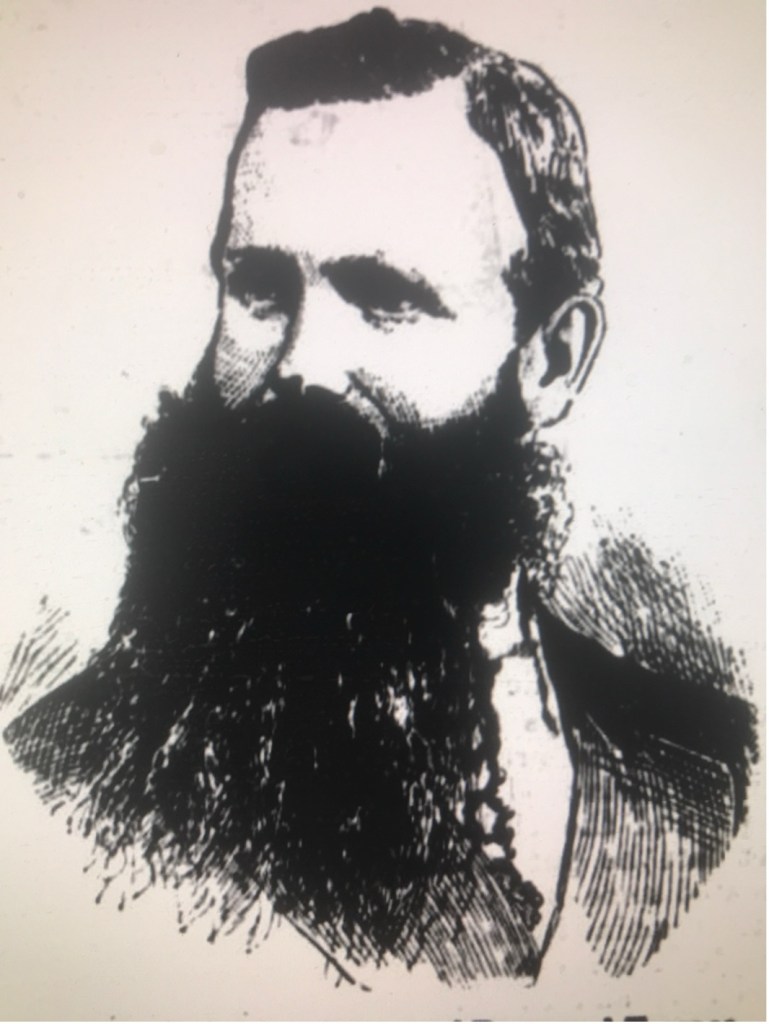
John Richardson, Mayor of Raymond Terrace Municipal Council
The municipal district of Raymond Terrace, comprising an area of about 390 acres, ranks among the youngest municipalities in the colony, having been proclaimed on July 7, 1884. The first valuation of rateable property, and the levying of a rate of 1s in the pound, provided the council with an income from rates of £241 17s per year. At the last valuation, in the early part of 1886, this amount stood at £281 17s 3d, or an average increase of £20 per year. The total revenue up to January 31, 1887, from all sources amounted to £1140 10s 8d. The total expenditure to the same date on municipal works, &c, was £1670 9s 10d. The municipality possesses within its boundaries eight and a-half miles of streets, the principal of which are one chain and a half wide; and of these about, two miles of streets have been improved, or are in the process of improvement. In 1884 the number of houses or other buildings in the municipality was 154. This increased in 1886 to 171; and the number of electors on the roll rose from 142 to 199 during the same period.’
Formation of Port Stephens Shire Council – 1906
The Port Stephens Shire Council was formed in 1906 under the provisions of the ‘Local Government (Shires) Act, 1905′.
The Newcastle Morning Herald and Miners’ Advocate of 25 June 1906, page 7, reported on the recruitment of the first Town Clerk:
‘At a special meeting of the Port Stephens Shire Council, held at Raymond Terrace on Friday, presided over by Mr. John Richardson, Mr. A. L. Adam was unanimously elected temporary shire clerk, upon the motion of Mr. J. Boag, of Seaham, seconded by Mr. R. Swan, of Hinton. There were seven applicants.’
The Maitland Weekly Mercury of 21 July 1906, page 10, reported on some of the early administrative matters that were being implemented by the Port Stephens Shire Council:
‘The fortnightly meeting of the above shire was held in the courthouse, Raymond Terrace on Thursday afternoon last. There were present — Messrs. J. Richardson (chairman), J. Dalton, B. Swan, S. Holmes, J. W. Boag, and Council Clerk (Mr. A. L. Adam). There was a considerable amount of departmental correspondence, but the only one for consideration was requesting the council to reconsider its recommendation that Hinton be the chief polling place, at the same time pointing out that Raymond Terrace was more suitable.
After discussion it was decided to adhere to the original recommendation, on the motion of Councillors Swan and Boag. The matter of collecting the rolls is being proceeded with under the supervision of Sergeant Crawley and is well advanced. The Chairman reported that he had procured the necessary books, and also that the sum of £20 had been placed to his credit in the local bank by the department. It was decided to exhibit lists of electors at the various Post Offices within the shire, and also at the Courthouses in Paterson, Clarence Town, and Raymond Terrace. The fixing of office hours was left to the chairman and Council Clerk.’
The Maitland Daily Mercury of 31 July 1906, page 2, reported on further council administrative matters:
‘The usual fortnightly meeting of the Temporary Shire Council was held in the Court House, Raymond Terrace, on Thursday afternoon, July 26. There were present — Councillors G. Richardson (chair), Dalton, Swan, Holmes, and Council Clerk (Mr. A. L. Adam). Correspondence was received from the Department of Public Works in connection with the arrangements for the forthcoming election, and the collecting of the various lists, also notifying the council that the Minister had approved of Hinton being the principal polling place.’
First Election of Councillors for the Port Stephens Shire Council – 1906
The Australian Town and Country Journal of 28 November 1906, page 54, reported on the results of the first Council elections:
‘The first elections of councillors took place on November 24, in the 134 shires created in N.S.W. under the new system of local government. Although the number may afterwards be increased to nine, each shire council is at first to consist of six members—two each from three ridings. Many of the returns to hand up to November 27 were not complete, but as far as they have been received they are given below:—PORT STEPHENS.-A Riding: S. McQueen, J. B. Meredith. B Riding: H. G. Ralston, J. J. Moy. C Riding: R. Swan, J. Stuart.’
Details of the election of the first Shire President was reported in the Daily Telegraph of 7 December 1906, page 5:
‘Councillor Swan was elected president of the Shire of Port Stephens. The voting was even between Councillors Swan and Meredith, and lots were drawn in favour of Councillor Swan. The meeting decided to confer with the Wallarobba, Bolwarra, and Kurri Kurri Shires in regard to the appointment of a joint shire engineer.’
The reporting of early administrative matters was continued in the Manning River Times and Advocate for the Northern Coast Districts of New South Wales of 12 January 1907, page 6:
‘The Port Stephens Shire Council met on Thursday, last week. Mr. A. L. Adam was appointed clerk, at a salary of £3 per week. Raymond Terrace was made the headquarters. Mr. Baldock, of the Stroud Roads Office, has been appointed engineer for the Port Stephens and the Wallarobba Shire, at a salary of £475 per year.’
Port Stephens Councillors and Staff – 1907
The Australian Town and Country Journal of 29 May 1907, page 29, published a photo of the first Port Stephens Shire Council councillors and staff:
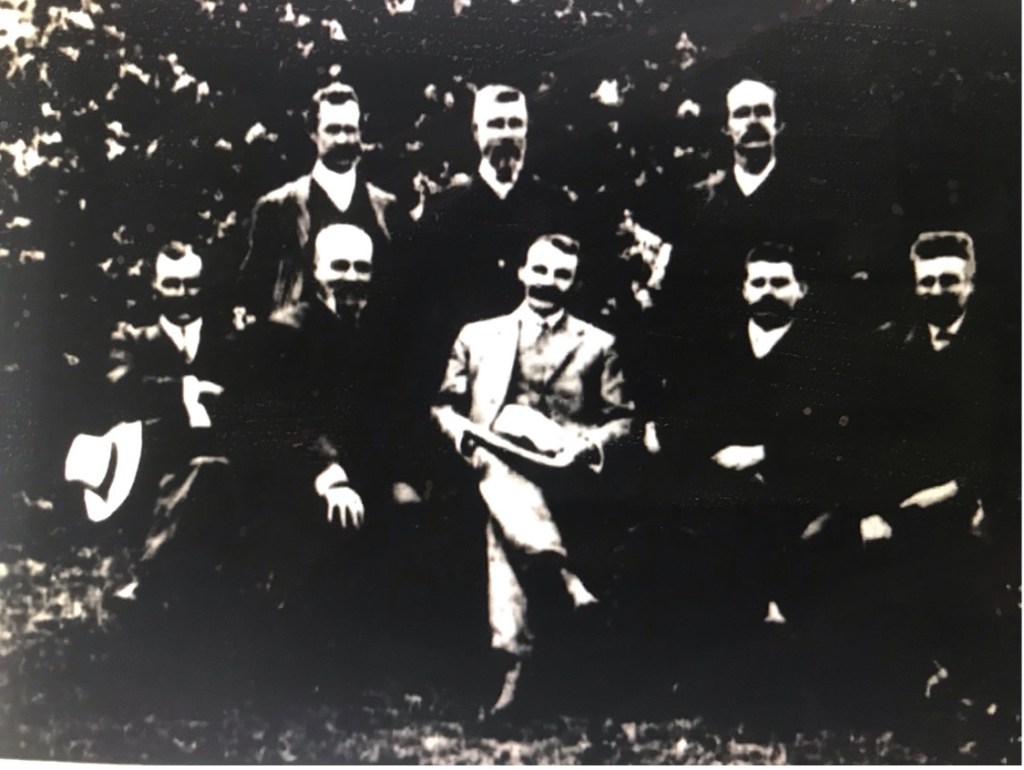
Left to Right—Back row: Messrs. H. M. Baldock (Shire Engineer), A. L. Adams (Shire Clerk), and R. W. Swan. Front row: Messrs. J. J. Moy, J. Stuart, Dr. J. Meredith, Messrs. S. McQueen, and H. G. Ralston.
Greater Maitland Amalgamation Scheme – 1933
In 1933 there was a proposal to amalgamate certain portions of the Port Stephens Council into a new greater Maitland council area. The proposal received no support from the Port Stephens Council and the proposal eventually lapsed.
The Raymond Terrace Examiner and Lower Hunter and Port Stephens Advertiser of 8 June 1933, page 4, reported:
‘Cr. Tranter asked what attitude the Council took up with regard to Greater Maitland. He would object to any part going in with a greater Maitland scheme. When the proposed amalgamation of East and West Maitland, Bolwarra, Morpeth, Tarro and Port Stephens was discussed it was turned down. Was the Council still of the same opinion? The President said no part of Port Stephens Shire desired to be in any greater Maitland scheme. Personally he thought no farm areas should be included in municipal areas. It was C riding the greater Maitland wanted. Cr Tranter should attend the conference and oppose it. He moved that as a motion which Cr. Clode seconded. Cr. Tranter said the Port Stephens Shire had been able to live within its means. Their pass book was better than most and their roads compared more than favourably with adjoining shires The President said they should inform the Greater Maitland scheme that they did not want it, because it would not benefit the Shire. Cr. Tranter— There is no harm in East Maitland and Morpeth amalgamating with West Maitland, but it was no good to take in outside areas. Cr. Russell: It we go into Maitland we will have to take the Valuer-General’s valuations. Are they agreeable to that. It should be enough. Cr. Tranter: I will oppose it and I want to know our objections. Cr. Russell: The farm lands will have to pay; the towns wont. Cr. Tranter: They want to gain some thing at the farmer’s expense. Cr. Lantry: Some of the farms at East Maitland are in the municipality and the rates are extortionate. Cr. Russell: This question came up at the Shire’s conference and it was agreed that the matter should be left to the area. The motion to oppose the scheme was carried.’
Raymond Terrace Municipal Council Jubilee Celebrations – 1934
The celebration of the jubilee of the Raymond Terrace Municipal Council was a big event in the town, with hundreds of residents participating in many varied activities. The celebrations culminated on Saturday, 22 September 1934.
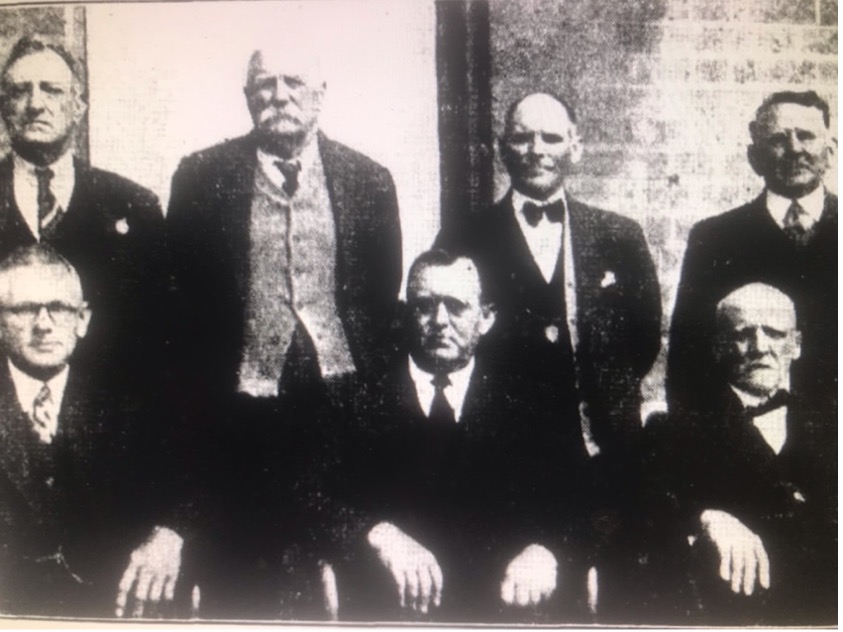
Members of Raymond Terrace Municipal Council for the jubilee year (left to right)— Standing: Ald. E. Windeyer. H. Sutton, E. Holwell, E. L. Markey. Seated: Ald. R. A. Hain, J. M. Feeney (Mayor), C. H. Boots.
The Raymond Terrace Examiner and Lower Hunter and Port Stephens Advertiser of 27 September 1934, page 4, provided a the following report and photographs of the varied activities on the Jubilee Day, September 22:
‘Early on Saturday, people began to pour into Raymond Terrace, and by 11.30 am. the hour when the procession was to assemble, the streets were well lined with an eager and interested crowd. Exhibits for the procession also came along in goodly numbers, and by 12 a.m. the procession headed by the two red men on white horses got away to time from the place of assembly in Sturgeon street, and moved into William street, then to the Highway; along to Kangaroo street, to Port Stephens street, to Burke street, then into King street, and up to the Park on the hill. The order of the procession was: Two redmen — Messrs. Major Windeyer and O. Passfield, painted features with red to correspond with their coats and riding stylish grey hacks.
Then came the Light Horsemen under Colonel Hop James, and they looked spick and business like in their military outfits. They added a touch of scenes familiar 18 to 20 years ago. Then two ladies — Miss Calman and Miss George mounted. Then came the standard bearers Messrs. Sintel and Kane. Then a car containing the Mayor and Aldermen of Raymond Terrace filled in their allotted space; then the Town Clerk looking the part, in shining silken belltopper, giving a tone to that part of the procession, very reminiscent of the period 50 years ago. Then followed the ex-Mayors of the town, Mr. Jas. Hanlon, Mr. R. A. Elkin. The old residents of the town occupied the next position. Then came the Newcastle Garrison Artillery Band of 26 performers, in artillery uniform and out for the occasion in best band parade dress.
Then the exhibits of the procession, came in due array. The Boy Scouts and Cubs float “Australia’s Rising Sons” was a lorry decorated in three shades of gold, the heavier colour on the bottom a fading into light gold upwards, of artificial flower decorations, on a back ground of lighter hue. It was a work of art, and the designers and executors achieved their ambition in gaining first prize and also were awarded a special prize donated by Mr. A. J. Windeyer, of Kinross. The public were appreciative of this exhibit and as it moved along it received its due measure of approbation. The second float “The H. A. C. B. S,” [Hibernian Australasian Catholic Benefit Society] was also a magnificent exhibit and much work of skill and taste was shown in its preparation. A silver star shone on the front; where “Faith” (Miss M. O’Grady) in white attire seated in a reverent attitude of prayer on a dais forward, whilst several members in regalia, were seated, or stood in the lorry. Two little girls, one in the costume of 1884 and one in that of today represented the era of 50 years. The dressings were green and gold, and uniformly placed. The words “H. A. C. B. S” were also conspicuously displayed, and the emblem of the order in artful execution. They were awarded second prize and were entitled to it.
Then came the G. U. O. O. F. [Grand United Order of Odd Fellows] float with two bridal sets, one 50 years ago and the other of today, with the brethren following in regalia. The Rowing Club’s float came next with a skiff and two oarsmen depicting the means of rowing 50 years ago. The sides of the lorry were draped with calico and carried along each side the names of the various champions from the time of the earliest championship race. Green, Hicky, Laycock, Trickett, Rush, Hanlon, Beach, Kemp, Searl, Stansbury, Towns, Paddon and Pearce were recalled. The Golf Club’s float was a conspicuous item, and the Aboriginal Band from Karuah gave a historical tone in both appearance and deed.
The best decorated motor car the next in order, and this exhibit was accorded the prize. It was driven by Mr. Bert Cross. “Modern Industries” also filled an interesting place and was followed by T. S. Elkin and Co.’s float carrying the main products of the Lower Hunter, and a giant broom of millet, which conspicuously denoted the important place of broom millet, among the products of the river. This was an instructive and emblematic float, and a happy thought of the firms. Mr. Alf Lilley and his crew put on the float— ‘Port Stephens Products’— fish and oysters, transported by bullock wagon 50 years ago. The theme was a fisherman with a copious whisker, bare footed handling a fishing net, and now and then engaged in picking a fish from the meshes, whilst the crew rowed the boat in the garb of the industry.
Oysters also had their proper representation. This float was a good effort to represent the industry and was favourably commented on. It deserves a special prize. The Raymond Terrace Dairy Co.’s float showed the manufactured goods of the factory; butter, cheese, milk and dried milk etc. An excellent float was that of the B. H. P. The various articles of manufacture were deftly placed to show to advantage and caught the eye readily. Enumerated were garbed, netting and fencing wires; various fertilisers in the different stages of manufacture; steel plates, etc.
Another neatly arranged float was that of “Newcastle Abattoirs”. The goods were craftily displayed on a pyramidal shelved stand, and was unique in it’s appearance and generally gave a good illustration of the various articles produced at the abattoirs. This was a welcomed addition to the procession. The float of the Newcastle City Council served both an instructive and ornamental setting in electrical goods. All household utilities in electrical goods were deftly arranged and made an interesting exhibit. H. Berry and Co. emblemised their saw-mill craft, by displaying a lorry load of logs. It was the modern transport and to the older members of the community, the days were not forgotten when the plodding oxen hauled under various obdurations not seen in print, the load of logs to the mill.
The prize for the most comical turnout was won by Messrs. Ray and Merv. Slade, in the ”’Waybacks”. They were in ram-shackle turnout their horse “Starlight” well ribbed up with I884— 1934 painted on his sides, in a pair of shafts that described many curves. Harness was old and patched, and the ”old man” with his whiskers’ patched pants of many cloths and hues; whilst the “old woman” in her dress of ancient and much weatherworn appearance of mantle and skirt and bedraggled hat and hair presented a burlesque that was supported with action true to type. The crowd expressed its approval as it passed on its way. W. Graves gave a good representation of the “result of the drought”, and the conception was illustrated by battered lantern, billy, old axe, dishes, bag coverings rope reins, poor horse and cart in desperate state.
Mr. H. Randall scored a special for his “50 Year, Racing and Drink — the Result”. This theme provided a boy leading a pet foal and carrying a chaff bag swag, with a bottle in hip pocket, trousers patched in many parts, all shades. His wife followed with a duck under her arm, leading a kangaroo dog, and the baby carrying a bottle, with billy and mug, all in rags and tatters. They gained a prize for best couple and got their share of applause for a good representative burlesque. “The Gold. Diggers of 1884” in Ivan and Noel Pepper gave a character sketch with a goat in a billy cart with camp appurtenances in old picks, shovels, lantern, bags etc. and they wore the garb of the job. They were an amusing exhibit and got a special prize. “The Early Bush Worker” was won by Mr. E. Foley, of Allworth. He was a true type in all detail. Mr. Geo. Greaves’ character sketch of ‘The Bushranger” was a good effort and scored a win. Mr. Jack Oakley won with his representation of “Early Stockman” and gave a typical display in the garb and mien of the time. Archie Davis characterised the ‘Aboriginal’ with his spear, nulla, boomerang etc. and was given a prize.
The procession was a fine individual as well is a collective effort and illustrated the active imagination of those who fashioned the various settings. It was the best display of its kind ever seen in the town and accounted superior to many that have been put on in larger centres. The various character sketches were analysed during the day, and all accounted good. It was indeed a fine effort, and the committee achieved a triumph in its success. Messrs. E. L. Markey, J. D. Richardson, A. Osborn, J. Vero, E. Windeyer were the principal workers. The sports were actively carried out during the afternoon and some keen competition marked various efforts.’
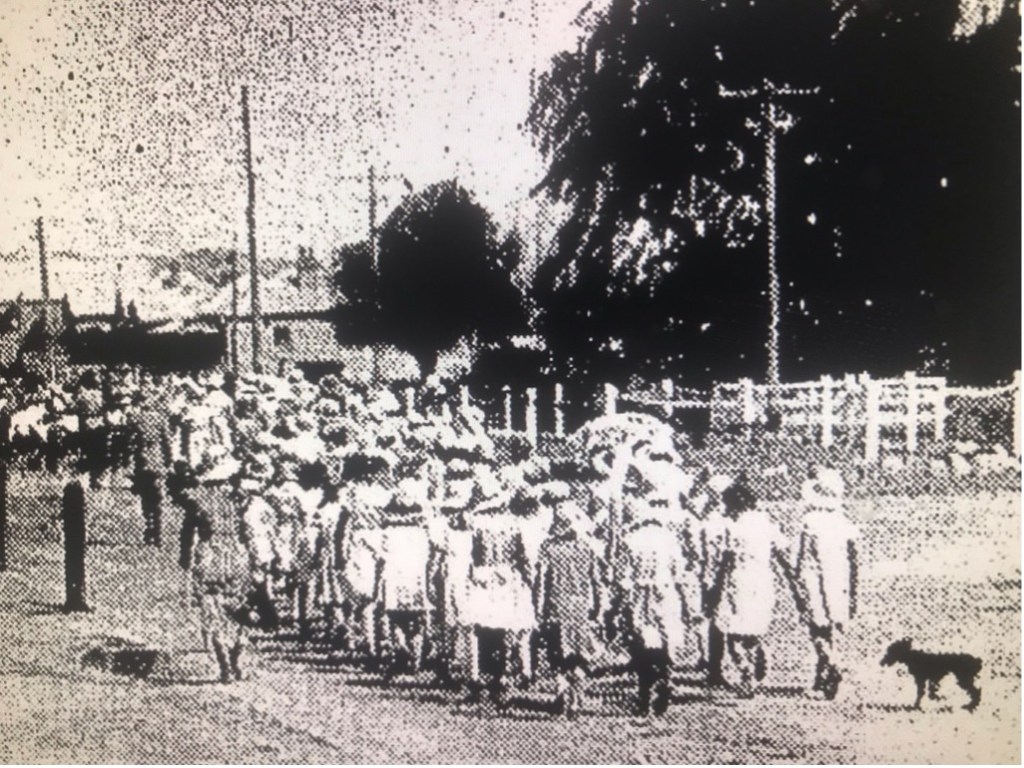
Children’s Jubilee Procession Passing Along Adam Place, Raymond Terrace.
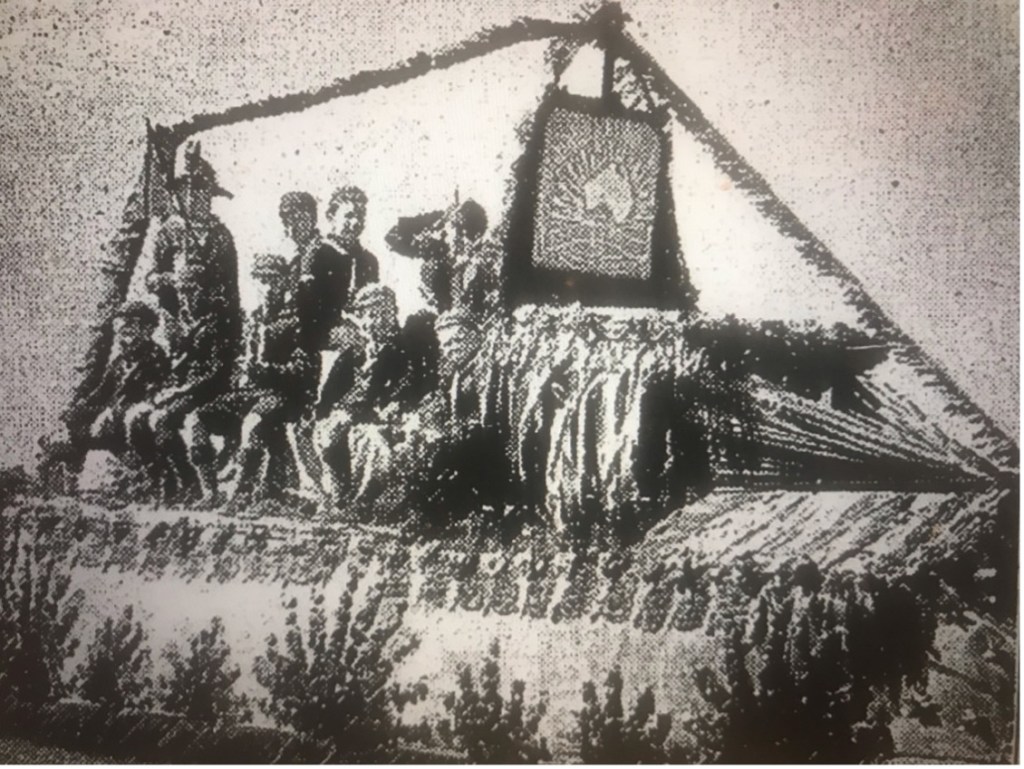
Raymond Terrace Cub’s Float.
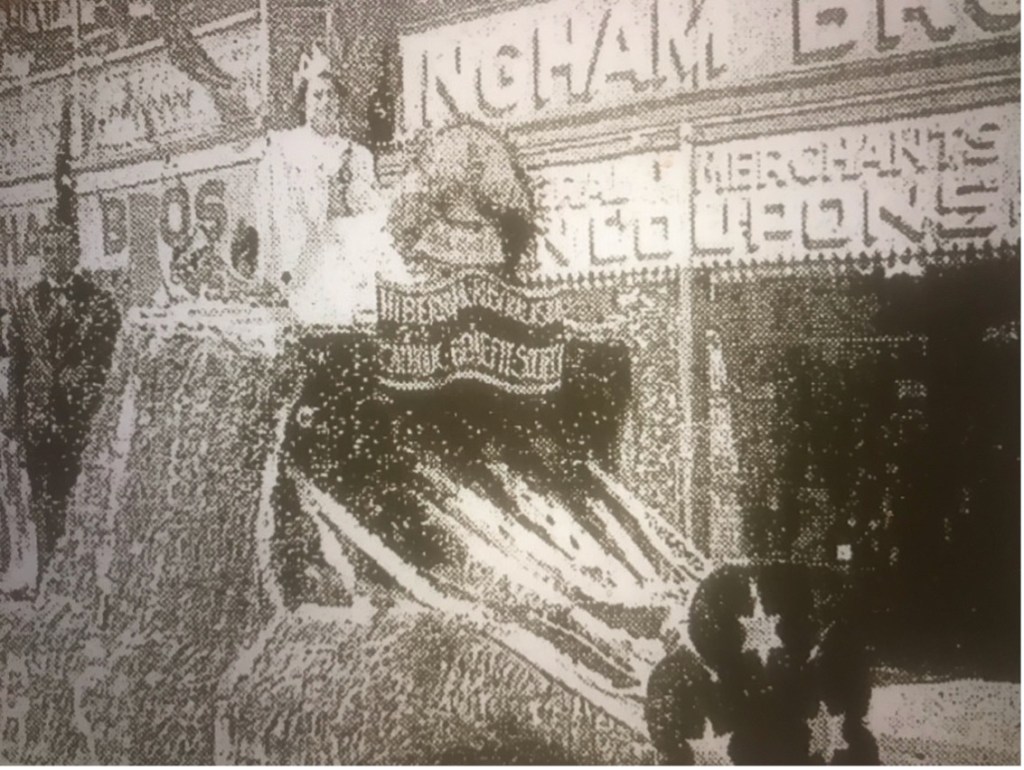
H. A. C. B. S. Float.
Death of veteran Town Clerk with Over 50 Years of service
Four months after the conclusion of the Raymond Terrace Jubilee, the veteran Town Clerk, Mr. Andrew Adam, who had been honoured for his dedicated service during those celebrations, died in January 1935.
The Sydney Morning Herald of 30 January 1935, page 14, reported on his passing:
‘Mr. Andrew Lawrie Adam, who died suddenly at his home at Raymond Terrace today, aged 73 years, had been town clerk of Raymond Terrace since the inception of the municipality more than 50 years ago. Mr. Adam, received a presentation from the citizens of Raymond Terrace during the municipal jubilee celebration held in September last, and a garden in the centre of the town was named Adam Place to commemorate a record of service believed to be unique in the history of New South Wales local government.’
Amalgamation of Raymond Terrace and Port Stephens Councils – 1937
While first mooted during March 1835, actions were intensified early in 1936 and led to upset of the status quo of the small urban based Raymond Terrace Municipal Council.
The issue concerned rumblings of a government enforced merger with the larger and rural based Port Stephens Shire Council. Neither Council supported the proposal and actions continued through to 1937 to thwart the amalgamation.
The Raymond Terrace Examiner and Lower Hunter and Port Stephens Advertiser of 13 February 1936, page 3, first reported on the amalgamation issue, which was to be followed by many others over the course of the year:
‘At the Port Stephens Shire Council meeting on Friday, a letter came before the Council, from the Local Government Dept. which said: — Adverting to previous correspondence in the abovementioned matter, I have now to inform you that the report of the commissioner (Mr. W. R. Wylie), on the result of his enquiry into this proposal, has been submitted to the Minister. The Commissioner recommended that the proposal to unite Raymond Terrace Municipality and Port Stephens Shire be given effect to. The Minister has given very careful consideration to the Commissioner’s recommendation and in view of all the circumstances has decided to submit the matter for the decision of His Excellency the Governor and the Executive Council. In the meantime, it may be stated for the Council’s information, that the intention is, in carrying the proposal into effect that the present municipal area shall form part of ‘B’ riding of the new Shire of Port Stephens. It is proposed, also, to submit for the approval of the Governor, the names of the present six Councillors of Port Stephens Shire to represent the respective ridings for appointment as a provisional Council of the new Shire which shall have all the powers of a Shire Council pending the election of a new Shire Council on a date to be appointed. Will you please inform the Department accordingly of the private addresses of the Councillors of the Shire Council.— Yours fatihfully, H. E. Street, Under Secretary.
The Clerk, Mr. Monkley said they would start off with a new Shire, but all the services would remain the same. The Municipality would form part of ‘B’ riding. Cr. Tranter said that in the event of amalgamation he thought the Municipality should be represented by two Councillors and should not be put in with ‘B’ riding. He thought four ridings would be fair and equitable. They would still be represented by two Councillors. He moved to the effect that the Shire should be composed of four ridings. Cr. Lantry seconded. He thought it would be a good idea if they had the four ridings. Cr. Russell: The area of the new riding will be the same as the Municipality. Cr. Parish supported the motion. The President, (Cr Clode), supported the view that the municipality should be a separate riding and have its own representatives on the Council for all time. He thought ‘B’ riding would be better represented as it is, as the Municipality should have more representation than being included in B riding. Cr. Markey said he was opposed to the amalgamation, but if they had to unite the town should be a separate riding. The community of interest of Raymond Terrace was very different to the districts around in B riding. He also thought the other end of the riding would be always outvoted by the lower and more populous end. The top end may have no representation at all. He thought the separate riding should be given effect to if the change was made. The motion was carried and a letter to this effect will be forwarded the Minister for Local Government.’
Agitation to thwart the Minister’s plan for amalgamation continued for the greater part of the year with the government prevailing in the end. The Dungog Chronicle of 27 March 1936, page 4, reported:
‘The Minister for Works and Local Government (Mr. E. S. Spooner) is determined upon the amalgamation of Raymond Terrace Municipal Council with the Port Stephens Shire Council. A deputation from Raymond Terrace was introduced on Tuesday to the Minister by Mr. C. E. Bennett, M.L.A. It consisted of the mayor (Ald. E. L. Markey), the Deputy Mayor (Ald. J. S. Elkin), Ald. Main, and the Town Clerk (Mr. C. L. Adam). Mr. Spooner was asked to stay his hand in the matter of the amalgamation. The members of the deputation urged that the municipality could conduct its own affairs better and more economically, and give greater service to the rate payers, than would be the case if it were attached to the larger shire area. Mr. Spooner replied that he realised there was a sentimental aspect to the matter. He had to look at it from the wider aspect of local government. He felt that the step he intended to take would be advantageous to the ratepayers of the municipality. They would have a lower rate and would have the use of the shire plant and its engineer.’
By November 1936, Raymond Terrace still continued to derail the Ministers plans. They thought that if they did not nominate two councillors to join the new council, that the merger would not go ahead. They were wrong. The Newcastle Morning Herald and Miners’ Advocate of 7 November 1936, page 10, reported:
‘The Mayor of Raymond Terrace (Ald. E. L. Marley) has been advised by the Department of Local Government that a week will be allowed the council to submit for consideration the names of two persons to act as councillors in the Port Stephens Shire when the municipality is merged with that body. Nearly two years ago the Minister for Local Government (Mr. E. S. Spooner) appointed a representative of the department to hold an inquiry into the proposal to amalgamate the council and the shire, the headquarters of both being in Raymond Terrace. All the witnesses who attended the inquiry, including the mayor, favoured the present system, which provided for the council and the shire to carry on as separate units under the Local Government Act. The Commissioner, however, recommended the merging of the two bodies, and in due course the Minister notified the council of his intention to give effect to the recommendation. A deputation was appointed to visit Sydney and protest but reported little encouragement.
The department then asked that the council furnish the names of two of its members who were willing to act as representatives of the new riding, this being the area embraced in the municipality. The mayor, at the triennial election two years ago was elected to both shire and municipal councils, so that two of the alderman apart from him would have to be appointed. None offered, and the Minister was so informed. Months went by without any further action, the impression of the aldermen being that the deppartment had tired of it and was prepared to allow the council to continue as it has done since its formation in 1884. That the impression was wrong has been proved by the latest communication, repeating the request for the names of two of the sitting aldermen who will be willing to act.
The Mayor said yesterday that the view of the council remained constant. The Town Clerk (Mr. C. L. Adam) has been directed to advise the department that so far there have been no offers. An interview with the Minister will be sought during his visit to Newcastle on Friday.’
A year after the unsuccessful March 1936 deputation to the Minister, the Maitland Daily Mercury of 6 March 1937, page 8, reported on a new deputation that was to be organised, this time to see the Premier:
‘The Government’s proposal to amalgamate the municipality of Raymond Terrace with the Port Stephens Shire was criticised at a well attended meeting of rate-payers at the Oddfellows’ Hall. A deputation was appointed, to make a protest to the Premier (Mr. B. S. B. Stevens). The mayor (Ald. Markey) stated that a Departmental officer had conducted an inquiry but, in the face of unanimous opposition, had reported in favour of the amalgamation. The Shire had also passed a resolution that it was not in favour of the amalgamation. The town had been a municipality for 50 years and had always been in a solvent position.
Mr. A. M. Cunningham said it was important that there should be self-government. He considered that a deputation should be appointed to meet the Premier. Mr. C. H. Boots, one of the oldest residents of the town, who had been an alderman for 37 years, said the municipality had not been a burden to the Government. Stating that main reason why a protest should be made was that the ratepayers were forced to do something which they were very much opposed to. Mr. N. Brown asked why the Government wanted to force the ratepayers into the amalgamation; he could not believe it was Government policy to amalgamate unwilling areas. He thought Raymond Terrace had a promising future with the aerodrome at Motto Farmland the bridge at Hexham. A motion that the Premier be asked to arrange for a referendum of the ratepayers of Raymond Terrace on the question of the amalgamation of the municipality with the Shire, and that the resolution be conveyed to the Premier by a deputation was caried. Messrs. Cunningham and Brown, with two appointed by the Municipal Council will comprise the deputation.’
The absorption of the municipality into the shire took effect on 4 June 1937. The Maitland Daily Mercury of 5 June 1937, page 3, reported on the dissatisfaction still felt about the new amalgamated council that had become operational:
‘No reason has yet been given for the merging of the Raymond Terrace Municipality with Port Stephens Shire beyond the fact that the Minister says it is the policy of the Government to amalgamate small areas with larger. No doubt it is the policy whether the people who pay the rates are in favour of it or not, and also whether there is a community of interests in the areas prepared to be united or not. The policy is one that seems very unpopular here at any rate, and residents feel very strongly on the matter. The town feels that an injustice has been done to it, greater than any that has hitherto beset it, because it establishes in the minds of the people who do not know Raymond Terrace that the town is retrogressing, where as progress, though not so rapid as in some other areas, is steady, and the outlook is more promising than it has been for some years.
A bridge at Hexham is calculated to bring increased building activity. Again, the fact, of the aerodrome being established at Motto will bring an increasing settlement there. The old Local Government Act provided that these matters should be decided by a vote of the ratepayers interested, which was satisfactory to all parties. Now the ratepayers are a secondary consideration; the local government officials have first say, though they pay no rates. The absorption of the municipality into the shire took effect yesterday. The present council of Port Stephens Shire is the provisional council appointed to carry on the business of the amalgamated area.’
The members of the new provisional Port Stephens Council met for the first time during June 1937. The Raymond Terrace Examiner and Lower Hunter and Port Stephens Advertiser of 10 June 1937, page 4, reported:
‘According to the directions given in the unwanted proclamation issued by the Local Government officials and dated May 21st last, the Provisional Council met and swore themselves in on Friday morning last at Raymond Terrace. After, having taken the oaths of office the Council decided that the rate of remuneration to the chairman should be £10. Cr. Tranter, president of the Shire was elected without opposition and Cr. Russell, Deputy Chairman. The committees (Works and Finance) are as before — the full Council. Mr. C. L. Monkley was appointed Shire Clerk, Mr. Payten, engineer and health officer, with power to dismiss and engage employees. Cr. Tranter thanked the Council for the honor they had done him. He did not anticipate any trouble whatever and thought with the usual help of the Councillors he could carry on without difficulty to the satisfaction of the ratepayers of the Shire. Cr. Russell thanked the Council and offered whatever support may be necessary to the chairman. The auditor, Mr. Turner was appointed at a fee of £10/10/. … The municipal bank account will remain till the end of the year.’
The reason for the merger of the two councils can be ascertained from the comments on the issue made by a former alderman of the Raymond Terrace municipality. The Dungog Chronicle of 6 August 1952, page 2, stated”
‘When Mr. J. Feeney, of Raymond Terrace, was in Dungog the other day, the “Chronicle” was discussing the rate of growth of the Terrace. Mr. Feeney was an Alderman of the old Municipality there when, it was wiped out and the town absorbed by the Port Stephens Shire Council. The Minister for Local Government said that it took all the rates to pay the clerk’s salary, and so the municipality had to pass out. ‘The way the town is developing to-day it seems as if the municipality will have to come back,’ said Mr. Feeney. One of the last acts of the Aldermanic Fathers was to accept the grant and carry out the work of making a sports ground in the centre of the town. It is a fine monument to all concerned.’
150th Anniversary of Raymond Terrace Township – 1951
With Australia emerging from the post-war period, the 150th anniversary of the Raymond Terrace town took on a special significance. It served as a point in time to focus on the achievements of the administrative headquarters of both the Raymond Terrace Municipal Council and the Port Stephens Shire Council.
The Newcastle Morning Herald and Miners’ Advocate of 20 September 1951, page 2, reported:
‘There was every evidence of the progress to be made at Raymond Terrace, the Administrator of the Commonwealth (Sir John Northcott) said in officially opening the 150th Anniversary celebrations. Sir John, who visited Raymond Terrace in response to an invitation by the Shire Council, was met on arrival and escorted to the Sports Ground, where there was a large attendance of schoolchildren and residents. The Shire President (Cr. Rodgers) welcomed him. “We are proud of the place that Raymond Terrace has filled in the colony from 1801 to this, the 150th year of its history,” Cr. Rodgers said. Sir John inspected schoolchildren, Boy Scouts and Red Cross members and was introduced to the teachers. Leaving the Sports Ground, he visited the Masonite Corporation, where he was entertained by the Masonite Social Club at afternoon tea. He also visited Courtaulds Ltd. Jubilee Ball. At 7 p.m. Sir John attended a dinner in Raymond Terrace Bowling Club pavilion given by the Shire Council, and later attended the Jubilee Ball and received the debutantes. … Sir John entered the hall through masonite cut out to depict a coach of the pioneer days.’
Proposed merger of Port Stephens Council with Dungog and parts of the Great Lakes Councils – 1975
The local newspaper, News of the Area of 1 September 1975, page 1, reported on a proposed merger between Port Stephens, Dungog and parts of the Great Lakes Councils. While the merger did not proceed, it is interesting to note the arguments for the proposed merged council:
‘On August 25 in the Community Hall, 53 residents, at a meeting convened by the Progress Association and chaired by its President, Mr. C. Hurle, heard a proposal from Councillor Freeman, president of Port Stephens Shire, for amalgamation of Dungog, Port Stephens and portion of Great Lakes Shire.
Mr Freeman explained that whilst Port Stephens, as a first preference desired no amalgamation, their second preference was as outlined above, since if voluntary association was not achieved, a compulsory one would be imposed by the Boundaries Commission. The points he made were that the lines of communication for Dungog and the part of Great Lakes Shire in question were to the south and east and not to the north. The Hunter District Water Board jurisdiction ceases at Karuah, which would preclude extra water rates from that body. (This was in answer to queries, in view of the fact that many residents were amazed at the difference in the cost of our water rates and the figures given in relation to water rates for Port Stephens Shire, under the Hunter Water Board). Mr Freeman intimated that Dungog Shire had not yet indicated any preference in the matter of amalgamation.
He explained that the difficulty of any cost benefit resultant on amalgamation became clear since the Valuer-General’s Department made valuations in different years and variation of land classifications increased each year, compounding the problem. In answer to a question re the local Town Committee and the present Officers of the Great Lakes Shire Council, Mr Freeman said that he saw no reason, if the local Town Committee was proving satisfactory, why it would cease to function and that the officers of the Great Lakes Shire Council would continue in their present positions. He also added that he felt that we would still have the same representation, two Councillors. as now, in the 10 councillors, with headquarters at Raymond Terrace. He indicated that this boundary change would give Port Stephens Shire control over both sides of Port Stephens, which seemed the most logical approach.’
Proposed Merger of Port Stephens Council with Newcastle City Council – 2015
A 2015 review of local government boundaries by the NSW Government Independent Pricing and Regularity Tribunal recommended the merger of a number of adjoining councils.
In the initial proposal, Port Stephens Council was not included in any amalgamation proposals. The Minister for Local Government subsequently proposed that Newcastle City Council merge with Port Stephens Council.
The proposed merger was met with significant opposition. Thousands of residents attended rallies and signed petitions opposed to the proposal while hundreds attended public inquiry meetings. Port Stephens Council claimed that 93% of residents surveyed were opposed to the merger and included the results of its community survey in its submission to the delegate responsible for evaluating the merger. In response to the government’s proposal, Port Stephens Council formally asked the government to evaluate a merger between Port Stephens and Dungog Shire. Although the mayor of Dungog Shire opposed the merger, the proposal had community support within both local government areas.
On 14 February 2017, the NSW government announced it would not be proceeding with further regional council mergers, including any involving with Port Stephens Council.
Port Stephens Council – 2021 Census
Since the introduction of local government in the Port Stephens region in 1843, when the population would have numbered less than 2000 persons, there has been a steady increase ever since.
According to the 2021 Census figures, there were 75,276 persons residing in the Port Stephens Council area which covered an area of 979 square kilometres.
For Raymond Terrace, which is the largest urban area in the council area, there were an estimated 13,995 persons residing there covering an area of 109.5 square kilometres.
Concluding Comments
In the early 1900’s, Port Stephens Shire Council was responsible for making new roads and maintaining the existing ones throughout the largely undeveloped Shire. In those days most roads had a base of gravel. Council placed great importance on locating suitable stone quarries as close as possible to the various road undertakings.
One such stone quarry was established at Seaham, adjacent to the present day Torrence Street. Unearthed by the excavation for suitable road-making materials, a geological gem was discovered in the walls of the quarry with its “varve shale” deposits. These were unusual layers of wave-like rock structures which were laid down by glacial activity in the area many eons ago in the Ice Age.
Further information on the quarry at Seaham , which was dedicated to science, is published on the website at this link.
Information on the Council’s response to the hardship years of the Great Depression during the 1930’s, is also published on the website and can be found at this link.
Prepared by Kevin McGuinness
March 2022
APPENDIX 1
1871 Petition for Establishment of a Raymond Terrace Council [signed by 134 persons]
The petition was signed by the following persons:
Bartholomew Lunny, freehold; Henry D. Portus, freehold; John Scully, freehold; John S. Hart, freehold, Richard Mayo, freehold; Patrick O’Donohue, freehold; Stephen Adams, freehold; James Cameron, freehold; James Barry, freehold; Harry Lemna, freehold; Alexander Fraser, leasehold; Matthew Doughaney, freehold; Thomas O’Brien, leasehold; John Heaslip, freehold; Jacob De Leon, freehold; H. J. Bolding, freehold, Will. Edd Shaw, freehold; James Whaler, freehold; George Murray, household; James Gilbert, household, G. G. Street, household; Benjamin Akhurst, household; William Gilbert, freehold; Daniel Garred, freehold; John W. Cross, freehold; William Haydon Gardner, household, Edwin Tyler, household; Thos. Pettit, freehold; William Garter, freehold; Angus McDonald, leasehold; James Saunders, leasehold; Joseph Healey, household; Edwd. Ryan, household; William Joseph Smith, household; Patrick Daly, leasehold; John Boots, freehold; William Bain, freehold; Thomas Mitchell, freehold; George Otto, household; Edmund Doherty, household; William King, leasehold; Edward Milgate, freehold; Henry Boyle, freehold; George Clarkson, household; William Dodd, freehold; John Morris, freehold; James Barnes, household; George Wattus, freehold; Edward J. Rennix, leasehold; William E. Ireland, household; John Hanlon, leasehold; Robert Clark, freehold; Malachi Keating, householder; Hiram Gilbert, household; Robert Jacob, freehold; Charles Chapman, household; Henry Crichland, leasehold; William Curtiss, freehold; Alex. McPherson, leasehold; Arthur Cs. Bartlett, freehold; W. Martens, household; John Saunders, leasehold; William Bray, household; Thomas McDermott, freehold; William Coombes, freehold; John Bourke, freehold; Henry McNamara, freehold; Michael Martin, freehold; James Sumeville, leasehold; George Sumeville, leasehold; James Elkin, leasehold; John Goswell, leasehold; Adam McDonagh, freehold; Richard Eager, freehold; James Carpenter, freehold, Miller’s Forest; Malcolm Gillies, freehold, Miller’s Forest; Charles Parnell, freehold; Thomas Law, freehold; William Martin, freehold; Michael Carmody, leasehold; Martin Markham, freeholder; John Carmody, leasehold; John Dennett, leasehold; William Dennett, leaseholder; Thomas Dennett, leaseholder; Donald Gillies, freehold; Michael Rose, household; John Feeney, jun., leasehold; Charles Phelps, leasehold; J. W. H. Holdstock, freehold; Henry Paile, household; James D. Donald, freehold; John Delaney, freehold, Edmond Fahey, household; Peter Chaffe, leasehold; Hugh McPherson, household; Leon Kollar, household; John Feeney, leasehold; Geo. Smith, leasehold; A. Henry Meek, household; Luke Priddle, leasehold; John Helmling, leasehold; Jno. Mosman, freehold; Robt. Lea, freeholder; Dennis O’Meara, freeholder; Peter Marky, householder; James Ford, leaseholder; Patrick McDermott, household; Luke Flood, leasehold; Mathew Smith, leasehold; Patrick Donohoe, leasehold; James Nolen, household; Edward Blanch, leasehold; Archd. McPherson, freehold; Philip Hawkins, leasehold; George Kite, freehold; Francis Lynch, freeholder; Brian McGowan, household; Neil McLean, freehold; John Lynch, leasehold; Charles Norley, leasehold; William Dodkin, leasehold; George Lancaster, leasehold; George Bisby, leasehold; Matthew Grice, leasehold; T. D. A. Carpenter, leasehold R. M. Isaac Peacock, leasehold; John Spence, leasehold; John Cochran, leasehold; David Massey, leaseholder; James E. Haddock, household; Thomas Hall, freeholder; George Rose, freeholder; James Gallon, freehold.
APPENDIX 2
1871 Petition Against Establishment of a Raymond Terrace Council [signed by 222 persons]
The petition was signed by the following persons:
John Windeyer, freehold property; Esther Snodgrass, freehold property; Archd. H. Jacob, freehold property; John Biddell Fenwick, freehold property; Thomas Elston Cory, household Edmond Fahey, household; James McDonald, household; Daniel Garred, freehold property; James Whaler, freehold property; Dennis O’Meara, freehold property; Timothy Noonan, freehold property; G. R. Miller, leasehold; Thomas Graves, household; Adam Beeker, householder; James McMahon, household; James Gilbert, household Stephen Adams, freehold; James Barnes, householder; Henry Fenwick, household; Henry Wilmot, freehold; John Morris, freehold; James Moy, freehold; Philip Stone, household and land; Wm. H. Gardner, household; Patrick Donohue, household; William Osborne, leasehold; Arch. H. Jacob; Peter Marker, household; Charles Ash, household; Barnard McGowan, household; Thomas Adams, leasehold; Patrick Moy, freehold; Lott Bishop, freehold; John Jacob Michel, household; Thomas Hanley, household; James Curtin, household and land; P. Hill, freehold; David Deas, freehold; Thomas Mitchell, freehold and land; Hannah Rennix, freehold; John Holdom, household; Margaret Holdstock, household; Antonia Porto, household; Charlotte Grant, household; Ann Phillips, freehold; William Mannix, household; A. Henry Meek, household; James E. H. Haddock, household; Michl. Mulqueeny, household; John Moy, freehold; Kenneth McCrimmon, freehold; Mathias Dougheney, freehold; W. Martens, leasehold; William Curtis, freehold; James Nowlan, household; Hugh McPherson, household; James Cackney, freehold; Christopher Leonard, freehold; William Pringle, freehold; Wm. Ferguson, leasehold; Thos. Pettit, freeholder; Richd. Crawley, household; Peter Hefner, household; Michael O’Brien, freehold; Samuel John Foot, household; Patrick Bussell, leasehold; Thomas O’Brien, household; Patrick Meera, leasehold; James Thorn, leasehold; Michael Carmody, leasehold; Michael Donoghoe, leasehold; William Dodds, freehold; Allen Hickey, freehold; Charles Pratt, leasehold; Jonas Foot, leasehold; N. M. Bussell, leasehold; Eliza Dalzell, freehold; Elizabeth M. Bussell, leaseholder; Margaret Doherty, freehold; Bodger Hogan, household; John Thomas Barnes, household; Thos. Wilson, freehold; George Bowden, leasehold; James Cameron, freehold; William Bowden, freehold; Hugh Fraser, freehold; George Wattus, freehold; Joseph Dennett, freehold; Thomas Dennett, freehold; James Newman, household; Alexander Reid, leaseholder; Henry Sampson, household; Martin Hill, freehold; Patrick O’Loughlin, leasehold; Michael Martin, freehold; Patrick Noonan, freehold; James Elkin, household; George Summerville, freehold; Charles McDonagh, freehold; James Carpenter, freehold; Malcolm Gillies, freehold; Donald Gillies, freehold; Jabez Worhoys, leasehold; Matthew Grice, leasehold; George Bisby, household; William Martin, freehold; John Spence, household; T. D. A. Carpenter, householder; John Greaves, leasehold; John Coote, household; Isaac Peacock, household; Patrick McKee, household; John H. Cochrane, household; Henry Fountain, freeholder; John Newman, leasehold; Michael Cunningham, leasehold; Simon Carney, freehold; Michl. Lynch, freehold; Angus McDonald, property; John Nally, freehold; William Corbett, freehold; Patrick Smith, leasehold; Mary Smith, freehold; Michael Corbett, leasehold; Thos. O’Brien, freehold; Patrick Doherty, freehold; Henry Revel, leasehold; George Lancaster, household; Charles Norley, leasehold; Joseph Minkley, household; John Campbell, household; John Hickey, householder; James Saunders, householder; Jeremiah Ryan, householder; William Dane, leasehold; James Coote, household; Thomas O’Brien, household; H. Carpenter, householder; Richard Osborne, householder; Michael Molony, household; Joseph Molony, household; Edward Purcell, household; Edward Garner, leasehold; Thos. Sullivan, household; W. Morrow, leasehold; R. A. Bowles, household; Francis Haviland, household; Philip Hawkins, leasehold; Robert McGuire, leasehold; Matthew Shields, household; Michael Halpin, household; George Weakley, freehold; Adam McDonagh, freehold; John Jarvis, property; John Pearn, leasehold; Patrick Broderick, property; David Dunn, property; Ellen O’Harn, leaseholder; Daniel Casey, property; Patrick Daley, leasehold; Michael Hill, freehold; John Hill, freehold; Patrick Moy, household; John Simons, freehold; John Burgess, property; John Delaney, leasehold; John Goswell, property; Robert Kilgour, household; Thomas Garrett;, leasehold; Richard Philpot, property; Peter Markey, household; Cornelius Bowen, property; James Hobbs, property; Michael Casey, property; Jacob Uhrig, household; John Giggins, leasehold; Gavin Ralston, freehold; Denis McAuliffe, leasehold; John Keen, porter, freehold; Patrick H. Markless, leaseholder; Patrick Shannon, leaseholder; William Shannon, leaseholder; Richard Watson, leaseholder; Patrick Dermody, leaseholder; Charles Thompson, leaseholder; Thomas Bailey, leaseholder; John Rourke, leaseholder; M. McGifray, leaseholder; John Rourke, jun., leaseholder; Michael Harrabel, leaseholder; John Feeney, senior, leasehold; John Hanlon, leasehold; John Feeney, junior, leasehold; William Crowe, leaseholder; John Eales, landholder; W. Eales; John Koen, leaseholder; Jeremiah Dwyer, leaseholder; Martin Markham, leaseholder.
Signed for, under a misunderstanding, and wish to recall.—
Daniel Bull, leaseholder; Richard Carroll, household; John Carmody, household; John Dennett, leaseholder; William Dennett, leaseholder; Luke Priddle, leaseholder; Samuel Brown, leaseholder; John Brown, leaseholder; Henry Warby, leaseholder; Isaac Pilligde, leaseholder; William Campbell, leaseholder; Hiram Gilbert, leaseholder; H.G. James Hollingsworth, sen., leaseholder; Robert Hollingsworth, leaseholder; George Hollingsworth, leaseholder; James Hollingsworth, jun., leaseholder; William Osborn, leaseholder; William Holwell, leaseholder; Joseph Holwell, leaseholder; Robert Clark, leaseholder; Stephen Davis, leaseholder; Lewis Perrott, leaseholder; Peter Chaffe, leaseholder; Denis McAuliffe, leaseholder.
APPENDIX 3
1884 Petition for Establishment of a Raymond Terrace Council [signed by 65 persons]
The petition was signed by the following persons, who each listed their name, qualification, and residence (all the persons resided in Raymond Terrace):
Richard Mayo, freeholder; A. W. Martens, freeholder, W. C. Bishop, freeholder; H. J. Bishop, freeholder; G. Otto, freeholder; Joseph Clark, householder; Peter Marky, freeholder; Thomas Adam, freehold; D. E. Hunters, leasehold; Geo. C. Martin, householder; Benjamin Akhurst, freeholer; M. Morris, freehold; J. C. H. Haddock, household; Henry Smith, householder; T. J. Bishop, householder; John Keddell Lonmell, freeholder; James Barnes, freehold; James Craddock; householder; Mrs. Masters, householder; Mrs. Cheers, freehold, H. J. Chard, householder; Jno. Malloy. freehold; John Cherrie, householder; George Clarks, householder; Geo. P. Hill, householder; John Beveridge, householder; Will McShaw, freehold; W. H. Holdstock, freeholder; James Lee, householder; D. Morgan freeholder; Jno. Richardson, freeholder; Wm. Scully, freeholder; E. H. Richardson, freeholder; P. A. Flynn, householder; Thos. Adam, jun., freeholder; George Simons, householder; Thomas O’Malley, leaseholder; Charles Healey, leaseholder; A. Mitchell, leaseholder; H. H. Jones, household; E. Francis, householder; Alice Cridland, householder; Sarah Southan, householder; A. L. Adam, freehold; A. Smith, freeholder; John Delany, freeholder; E. D. McPherson; householder; Thomas Greaves, householder; Joseph Keohn, freehold; William Gilbert, freeholder; Hiam Gilbert, freeholder; Henry Cridland, householder; James Campbell, householder; John Boots, householder; Edward Milgate, householder; E. J. Rennix, householder; Mary Kollard, householder; William Bray, freeholder, Thomas Morris, householder; George J. H. Cross, freehold; William Cross, freeholder, Charles H. Boots, freeholder; William Bain, freehold; James Cameron, freeholder; Mrs. G. Walters, freeholder.

 Port Stephens - a history exploration