

Introduction
After many years of lobbying by local groups for the construction of a floating dock at Newcastle and for its mooring there, it finally became a reality on 5 October 1928, when the first of three sections was launched at Walsh Island, Newcastle.
The second section was launched on 15 March 1929. The third, and final section was launched on 20 December 1929. The three sections were designed to be locked together after launch.

Third and final section of the floating dock being launched [Sydney Mail, 1 January 1930]
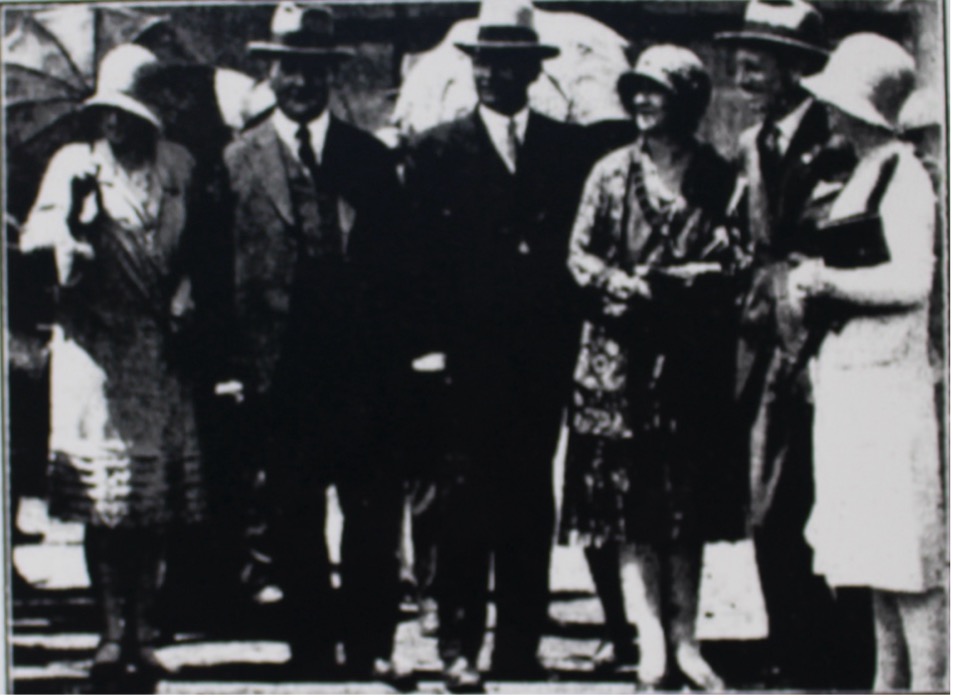
Official launching of the third section of the floating dock [Sydney Mail, 1 January 1930]
Prior to the construction of the first section of the floating dock, the Sydney Branch of the Port Stephens Development League made an unsuccessful effort to have the floating dock moved to Salamander Bay in Port Stephens. The unsuccessful efforts of the League were quickly dismissed, but the arguments to support their case are worth examination.
The floating dock was to have a difficult life in Newcastle as there were several periods when it remained idle. Dock facilities in Sydney were a major competitor for business. By 1936, it was believed that the State Government was planning to move the floating dock from Newcastle but this did not eventuate despite local lobbying.
The Second World War gave the floating dock a much-needed boost in work. In 1941, as part of a review of docking and ship-building facilities by the Commonwealth Government, the Newcastle floating dock underwent a much needed refurbishment. By December 1941, this was completed and the dock could receive vessels up to 15,000 tons.
During the post-war years, the Newcastle floating dock continued to provide a valuable service, however periods of idleness still occurred. A new floating dock, named ‘Muloobinba’ which had been built in Japan, arrived at Newcastle in 1978 to replace the then idle existing one. The new floating dock was later purchased by the Newcastle Port Corporation. The ‘Muloobinba’ left Newcastle on 21 December 2012 after being bought by an overseas company.
First Moves by Port Stephens Advocates for a Floating Dock
The Newcastle Sun of 10 July 1928, page 5, reported:
“Rumors are rife that behind this movement on the Government’s part is the influence of certain interests connected with Port Stephens,” said the Acting Mayor (Alderman Christie), referring to the suggestion that the floating dock is to be moved from Newcastle.
Alderman Light said that centralisation was at the bottom of the objection to having the dock at Port Hunter. Seemingly, he said, it was behind the objection to Port Stephens, also. “Everything possible should be done to force the Government to carry on the undertaking,” he said. Alderman Kilgour: In my opinion, the Government has no intention of holding up the work of building the dock, but we will have to fight to retain it at Newcastle after it is built. The move is to take it either to Sydney or south of Sydney, but the policy of centralisation is behind it in either case. We all know that the harbor is subject to silting up, but that is all the more reason why it should be dredged and deepened, because the port has a distinct influence on the future welfare of the Commonwealth. Alderman Blackall: Hear, hear! To keep the dock here, they will have to keep the harbor right. That will be a great help to us.’
The Dungog Chronicle of 20 July 1928, page 2, also reported:
‘Pursuant to notice, Alderman Hellyer moved in the East Maitland Council ‘That the Minister for Works be advised that this council endorses the action of Newcastle public bodies in their efforts to have the construction of the floating dock completed at Walsh Island [Newcastle]. That in the event of the harbour conditions being deemed unsuitable for the efficient working of the dock at Port Hunter consideration be given to the deeper waters at Port Stephens for its establishment.’ — The motion was seconded by Alderman Eggins and carried.’
Port Stephens Lobby Group meets Federal Minister
The Maitland Daily Mercury of 15 August 1928, page 5, reported:
“Newcastle has only a comic opera harbour,” said Mr. J. Blumenthal, secretary of the Sydney branch of the Port Stephens Developmental League, to Mr. Marr, Acting Minister for Defence. Mr. Blumenthal was a member of a deputation that waited on the Minister asking that the floating dock now under construction should be located at Port Stephens instead of at Newcastle. Mr. Marr promised to place the claims before the Federal Government. “Vessels that go there for coal,” continued Mr. Blumenthal, “have to leave their bunkers half empty in order to get out of the harbour. The Federal Government’s main interest in the dock lies in its efficiency in the event of war, and it would be impossible for warships of heavy tonnage to get into the harbour.
Mr. Stevens, the State Under-Treasurer, told me the other day that £4,000,000 had been spent on Newcastle harbour in dredging alone. That shows what an uneconomic proposition the port really is.” Mr. W. Bennett, M.L.A., declared that Port Stephens had a harbour equal, if not superior to that of Port Jackson. Millions of tons of silt annually, he said, were washed down the Hunter River into Newcastle harbour, and if the dock were established at Newcastle, it would cost enormous sums to keep the basin free and deep.
“The Public Works Department,” he added, “has some scheme for blocking one channel of the Hunter at Mosquito Island, contending that the force of the water concentrated in the other channel will keep the Newcastle basin clear. Anyone who knows the Hunter realises how impossible it is to control its waters in that low-lying district, which in flood time is covered for miles. It will cost £180,000 to prepare a position for the dock at Newcastle and £20,000 annually to keep the basin in condition. In Port Stephens, on the other hand, little silt is deposited, there is deep water all over, and at any tide, big vessels could enter. Moreover, Lord Jellicoe, reported that Port Stephens, or that section of it known as Salamander Bay, was the most admirable position in Australia, for a naval base.’

The deputation from the Sydney branch of the Port Stephens Development League who waited on the Acting Minister for Defence, Mr. Marr [Newcastle Sun, 15 August 1928, page 8]
The Daily Telegraph of 15 August 1928, page 4, also reported:
‘The Home defence of the Commonwealth is not what it should be. Mr. Marr, acting Minister for Defence, told the National Speakers’ Association that last night. After outlining what the Federal Government had done to improve the forces, he said it was “apparent that Australia had established her means of home defence upon a scale which is, but the bare minimum required.” In fact, it fell “much below the strength which could reasonably be regarded as a justifiable provision for home defence.”
Referring to the floating dock being constructed at Walsh Island, Mr. Marr emphasised that in the event of its being made available to the Commonwealth Government because of war, it may be towed to any locality decided upon by the naval authorities. Earlier in the day he promised a deputation to place before Cabinet a suggestion that the dock should go to Port Stephens.’
Port Stephens’ claim to the floating dock discounted
The Sydney Morning Herald of 16 August 1928, page 12, reported:
‘The suggestion that the floating dock now under construction at Walsh Island should go to Port Stephens, made by a deputation which waited on the Acting Minister for Defence in Sydney yesterday, is not taken very seriously in Newcastle.
The agreement under which the dock is being built, it is pointed out, gives the Commonwealth Government the right to move the dock where it chooses in wartime. It is thought likely that the Commonwealth will be satisfied with this stipulation and will not attempt to recommend to the State any change in the site of a dock, the major portion of the cost of which is being paid by the State.
It was pointed out that it was a long agitation from Newcastle interests that secured the construction of the dock. It was hardly equitable that at this time-
of-day other people should attempt to secure the benefit for which Newcastle had fought. To set up the dock at Port Stephens would make its upkeep a certain drag on State finances. Established at Newcastle the dock would be assured of revenue from the beginning of its operations.’
Federal Minister’s reply to Port Stephens Advocates
The Dungog Chronicle of 4 September 1928, page 4, reported:
‘The Minister for Defence [C. W. C. Marr] has informed Mr. S. L. Gardner M.H.R., as follows: — With reference to the deputation which you introduced to me at Commonwealth Offices, Sydney, on the 14th August, regarding the location of the Floating Dock which is being constructed at Walsh Island Dockyard, Newcastle, I desire to inform you that in the agreement between the Commonwealth and New South Wales Governments, it is provided that “in times of emergency (of which the Minister for Defence shall be the solo Judge) or of war or on the stranding of a warship of the Commonwealth or another similar event the Commonwealth may by notice in writing signed by or on behalf of the Minister for Defence to the Minister of Public Works take over immediately the absolute control and management of the Dock and may move it to such place or places in or out of the Commonwealth as the Minister for Defence may from time to time think fit.”
It is also provided that, except for the foregoing, “the dock shall at all times be located at Walsh Island Dockyard and be under the control and management of the Minister for Public Works.” If difficulties are experienced by the New South Wales Government in stationing the dock at Walsh Island Dockyard, it is probable that no objection would be raised by this Department to the removal of the dock to a more convenient position, provided that satisfactory facilities existed for its maintenance and transfer to the Commonwealth in time of emergency, etc.
The control and management of the dock in ordinary times is entirely a matter for the State Government, subject to the foregoing. Without close examination of the subject, it would appear that an appreciable amount of dredging would be required to make Salamander Bay as suitable as the port of Newcastle. This statement takes cognisance of the necessity for dredging at the entrance to Port Stephens and in the channel to site. Furthermore, there are no technical facilities for the maintenance of the Dock at Salamander Bay, no dockyard to assist in docking and repair of ships, no potential sources of industrial labour in Port Stephens at present, and no commercial reason for the visit of ships to the port, whereas Newcastle is an important shipping and industrial centre.’
Reflections on the lack of development at Port Stephens
In the wake of the Government’s decision to again deny a development opportunity to Port Stephens, the Maitland Daily Mercury of 8 October 1928, page 4, published the following views:
‘While the State Premier and party were breaking bottles of wine on the Walsh Island floating dock, and, incidentally, in some danger of being floated out to sea, on Friday afternoon last, a representative conference was sitting at the West Maitland Town Hall discussing matters of even greater importance, the development of Port Stephens.
As was very succinctly put by Mr. Walter Bennett, M.L.A., in the course of his remarks, there was no need to waste time in speaking of the great advantage of Port Stephens. These are recognised on all sides. It is admitted by even the most bitter opponents of the Development League, whose opposition is mainly due to vested interests which they fear will be interfered with, that the construction of a line and the opening of Port Stephens as a deep sea port will be to the immense advantage of the north and north-western portions of the State, particularly, and of the State as a whole because it will facilitate marketing of primary products by lowering the cost of transport, and will, by decentralisation, be a long step in the direction of the development of primary industry.
The whole of the opposition to Port Stephens has come from vested interests, mainly those of Newcastle, whose outlook is so limited as to make them unable to see that they are really standing in their own light, and that the opening of Port Stephens will be a blessing to Newcastle, for it will enable the latter city to concentrate upon its legitimate development in directions for which it is suited, while the rapid development of the inland districts, which must follow, will surely be to its advantage conjointly with that of the State as a whole.
Existing conditions, on the other hand, make for stagnation. Newcastle, as a matter of fact, cannot properly handle the volume of trade of certain classes that passes through it today, and the result of the circumlocution and extra handling costs involved are handicaps on primary production, the removal of which would assist and stimulate development.
As long ago as 1911 a Parliamentary Committee on Decentralisation recommended that a port for oversea shipment should be established at Port Stephens, but different Parliamentary Committees, since that date, while unanimously agreeing in confirmation of this “as action for the future, in the way of a decentralisation port” have bowed to the vested interests, declaring it “premature, until the existing and possible facilities at Newcastle are becoming fully utilised. Vast interests, both Government and private,” say these reports, “have become established at Newcastle, and until these are likely to become overtaxed it would not be desirable nor economical, to open up a new port in so close proximity to existing facilities.”
Even the Railway Commissioners have joined in the vested interests’ chorus, instead of taking a broad national outlook. They would like to continue as long as possible, the haulage of goods to Newcastle or right through to Sydney, rather than have some of the traffic diverted to Port Stephens, no matter how much the latter would be to the public advantage. “If this were done,” they complain, “the railway revenue would suffer a loss by diversion of traffic without any compensating advantage. . . the port of Newcastle will meet requirements of railway transport and development for very many years to come.”
The Development League cannot, therefore, hope for much encouragement from the Railway Commissioners in the present campaign, seeing that it is not yet “very many years” since 1925, when the report above quoted from was issued. The one thing that is outstanding, and which shows how bare these vested interests are of legitimate argument, is the circulation in their propaganda of deliberate falsehoods. A typical sample was the ridiculous statement made at a recent deputation that there was not enough water in Salamander Bay at Port Stephens to float a dock. “Who made such a statement?’ asked the chairman of the Conference, who said the real depth of the water would no doubt be shown in evidence before the Public Works Committee. “Was it made by a responsible or irresponsible person?” He was told to his astonishment that the person who made it was the acting-Mayor of Newcastle, who, it must be remembered, has been during the last week subjected to a good deal of local criticism for having made certain other very irresponsible statements in his very responsible official capacity.
Little more need be said, therefore, beyond repeating Mr. Elkin’s remark that the depth of water at Port Stephens has not varied in the past 50 or 60 years, and that of Mr. Pyman that naval charts show from 40 to 100 foot of water in Salamander Bay without dredging. As a matter of fact, no additional evidence of the deep-sea facilities of Port Stephens is required beyond the fact of the taking over of Salamander Bay by the Federal authorities, as a Naval Base. This fact given the direct lie to all the tales told on behalf of the vested interests of what was not long ago classed as a “comic opera port.” There is a fund of useful information available to the committee appointed to gather evidence to put before the Public Works Committee, and its energies should be specially directed towards the exposure and ridicule of the methods adopted by these vested interests in their selfish campaign against the interests of the public, and the development of the State.’
Last word on attempts to move the floating dock to Port Stephens
The Newcastle Sun of 8 February 1929, page 9, reported:
“A piece of political bluff,” was how Mr. Connolly, M.L.A., describes today the suggestion that the Commonwealth naval base may be shifted to Port Stephens. “It was designed merely to justify and bolster up the refusal of the Prime Minister (Mr. Bruce) to meet his legitimate liabilities respecting Garden Island.”
“Newcastle would be up in arms if there were anything in the suggestion,” Mr. Connolly went on. “It would mean that the floating dock would be shifted to Port Stephens. But it is all bunkum. It would be impossible to establish a naval base at Port Stephens. No facilities are there. Admiral Henderson said so when he inspected the place during the war period. If the naval base had to be shifted from Sydney it would have to come to Newcastle.
This is the only place where Mr. Connolly saidit could be established.” In support of this assertion, Mr. Connolly claimed that Newcastle already had an admirable port with sufficient depth of water; also, coal deposits, a dockyard, the floating-dock, and other facilities. Reminded of the harbor bar, he said that that could be adjusted much more cheaply than a naval base could be established at Port Stephens. “Newcastle is coming into its own,” said Mr. Connolly. “We are getting wool sales and wheat silos here now and have many other signs of progress. And any effort to take away our floating dock would be solidly opposed. If a site must be chosen for a naval base, let it be established here.’
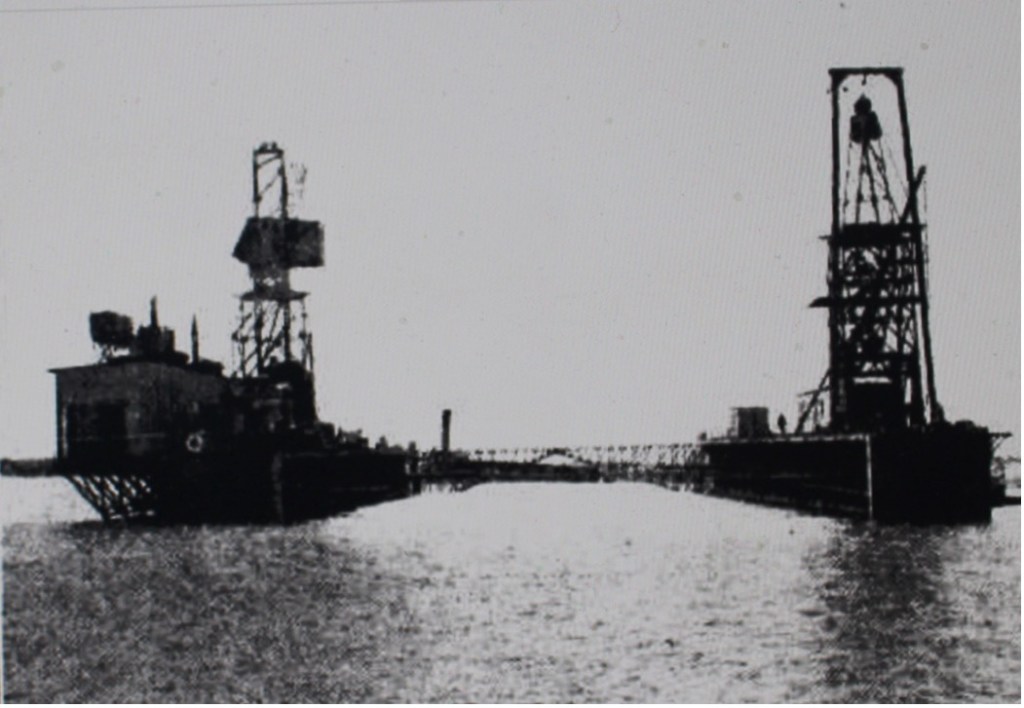
The floating dock awaiting to receive a vessel [Sydney Mail, 1 January 1930]
Concluding Comments
Port Stephens did not get the floating dock nor was it developed as an industrial port. The narrative about efforts to locate the floating dock at Port Stephens was part of a larger set of initiatives, over a great number of years, to develop a working industrial port that would rival Newcastle.
Several other papers concerning efforts to have Port Stephens developed as an industrial port are found on the following links on this website:
Royal Commission on Decentralisation of Railways – 1911;
A Port Stephens Naval Base; Railway Proposals for Port Stephens;
American Development Plans for Port Stephens – 1923;
Two Canal Proposals in the Port Stephens Region 1870-1921;
A ‘City of Peace’ at Pindimar – 1918; Pindimar – A New Planned City at Port Stephens; and
Proposal for an Oil Refinery at Port Stephens.
Researched and compiled by Kevin McGuinness
May 2024

 Port Stephens - a history exploration