
Introduction
Overnight of 19/20 February 1942, following the bombing of Darwin, the Japanese Imperial Army invaded Portuguese Timor. Australian and Dutch forces had arrived in Timor in December 1941 as part of an Allied offensive.
When Dili, the capital of Portuguese Timor, was attacked on 20 February 1942, the Australians forces and many Timorese natives were driven into the hills where they undertook guerrilla warfare against the Japanese. Operations here became untenable, and the evacuation of Timor began in September 1942 with the last of the Australians leaving in February 1943.
The decision was also made to evacuate some 600 Portuguese Timorese inhabitants to Australia, as their lives would have been in danger if captured by the Japanese. The evacuees included natives who aided the Australian soldiers during their attacks against the Japanese.
Upon arrival in Australia, most of the evacuees were housed at Bobs Farm Cadre Camp, Port Stephens for a short period.
A cadre is a small group of people who will be trained for a particular purpose. The Australian Army camp, on a 69-acre site near the intersection of Nelson Bay Road and Marsh Road at Bobs Farm, had been intended to house troops of the 41st Battalion.
The first Timoreses evacuees arrived at the Bobs Farm Camp on 10 January 1943.
Those accommodated at Bobs Farm included Portuguese citizens, government officials and their families, priests and nuns, and native Timorese. The sudden influx of the evacuees caused problems for the Commonwealth Government with regards to quickly finding accommodation and clothing for the evacuees.
The Timorese class system transferred over to the Bobs Farm camp in that senior Portuguese officials were assigned to the limited number of huts available while the native Timorese were housed in Army tents.
Following the conclusion of the Second World War, the evacuees were repatriated back to Timor in November 1945. The Bobs Farm Camp was closed by the end of July 1945, with all fixtures and fittings having been previously removed. No evidence of the camp remains today.
This paper, using the resources of the Australian National Archives and the National Library of Australia’s Trove newspaper collection, tells the story of the brief occupation of the Bobs Farm Cadre Camp by the Timorese evacuees and describes some of their experiences there.
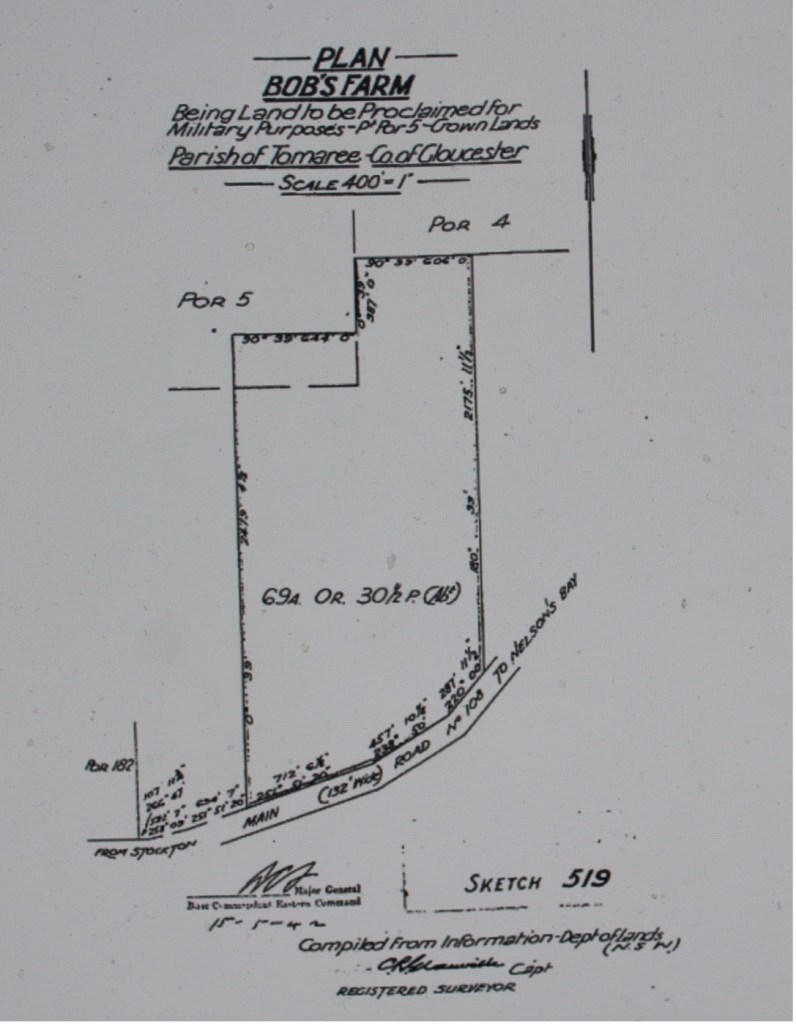
Plan of proposed military camp at Bobs Farm, Port Stephens [Australian National Archives]
A message received in Australia about the dire situation in Timor
The National Archives of Australia holds the following message received by Australian authorities in February 1943 concerning the plight of persons in Timor, which led to the evacuation of further persons to Australia:
‘Just received from Timor advice that a party of about 300 Portuguese including women and children and probably natives who did not comply with Japanese order of concentration some months ago are on the south coast of Timor. They are being attacked by armed natives [acting on instructions from the Japanese] some already having been killed and are in fear of the Japanese. They are in a bad way and beg for food and medical supplies through lack of which some children have already died. They are asking for ‘help’ by which it is assumed they mean evacuation.’
First Report of Timorese Evacuees
The Sydney Morning of 30 July 1943, page 6, reported:
‘A Netherlands destroyer last September undertook the risky evacuation of 952 Dutch and Australian guerrillas from Japanese-occupied Timor to Australia, the Commander-in-Chief of the Netherlands Forces in the East, Vice-Admiral Helfrich, said in London yesterday, according to the N.E.I. Government Information Service. The Netherlands destroyer accomplished the work to schedule and made three trips to Timor.
First Group of Timorese Evacuees arrive at Bobs Farm
The Courier-Mail of 31 July 1943, page 4, reported:
‘Children of all ages, some in European clothes, others in jacket and sarong, lined the walls of the [Brisbane] Railway Institute when a party of 180 evacuees from Portuguese Timor, including 97 children, passed through Brisbane on their way to Newcastle, where a community was established.
Some were pure native, some Portuguese, others of mixed race. Their journey from Timor after weeks of hiding in the hills began on December 18, and they reached Brisbane in February, but the story has only just been released. News of the arrival of an Australian ship ready to take them off the island reached the hills by native boys. On their way to Aliambata Harbour, the point of embarkation, the refugees were pursued by the Japanese, who, said one evacuee, would have killed them if captured. The Japanese killed any natives who refused to help them.
“I like the Australian soldiers. They are good men and great fighters,” said one of the party. The natives could not do enough for the Australians. They fed them, giving them their own meals when they had no other food. Many joined the troops in Timor, and others wanted to join the A.I.F. here. Though the Japanese declared a neutral area where the people of the islands could take shelter, they ill-treated and robbed any natives who went there, said the wife of a Portuguese.
The State Government Tourist Bureau took charge of the refugees after their arrival in Queensland. Members of the New Settlers’ League and V. A. D’s [Voluntary Aid Detachment] attended to them, and the Red Cross Society provided them with the clothing they badly needed, as few were able to bring any of their possessions.
Housing of the Timorese evacuees proves difficult
A letter from the Minister for Interior (J. S. Collings) to the Minister for the Army (F. M. Forde) dated 25 February 1943 as per the National Archives of Australia] states:
‘Five hundred and thirty-five evacuees from Portuguese Timor, comprising 105 men, 179 women and 251 children have now arrived in Australia. Approximately 400 are natives and half castes. The remainder comprise government officials, first and second class and their families and include a number of Roman Catholic Fathers and Nuns.
With the exception of the Deputy Governor (Dr. Taborda), Senhor de Cousa Santos and their families, all of the evacuees are at present being accommodated in a military camp at Bob’s Farm near Newcastle. The placement of the first and second class officials and their families at Bobs Farm has been a temporary expedient only, pending the provision of suitable boarding-house accommodation and their absorption into the Australian community. They are being transferred from the camp as opportunity offers.
The 400 natives and half castes are not capable of being assimilated into the Australian community. They must remain in their present accommodation or some other similar establishment while they are in Australia. When the question of accommodating these evacuees was first discussed with the Army authorities in Sydney, it was understood that the evacuees would not be remaining in Australia for longer probably two or three months and the arrangement to accommodate them at Bobs Farm was made on this basis.
It is now apparent that the evacuees will be remaining here indefinitely. Consideration has therefore been given to the question of improving the facilities provided at Bobs Farm. Alterations and additions are very necessary if the evacuees are to remain there during the winter months.
I understand, however, that Bobs Farm, which is situated in a strategic military area, may be required by the Army authorities at any time and that its permanent allocation for the accommodation of these evacuees could not be agreed to. It will be appreciated that the satisfactory settlement of these evacuees is not an easy problem. It is not practicable to place them in boarding-houses even if such accommodation were available. They must be placed in one establishment and cared for on a community basis. Hospital and schooling facilities must be provided. If they are to live in contentment, employment of a nature within their capacity must be found for the adults.’
Army requests approval to cease management of the Bobs Farm Evacuee Camp
In a memo of a Major-General based at Victoria Barracks, Sydney, dated 21 April 1943, it was stated:
‘There are at present some 600 Portuguese evacuees located at a Cadre Camp, known as Bobs Farm, some few miles from Port Stephens in 3 Sub Area. It is understood that these people were evacuated from Timor and at the request of the Department of the Interior and the Department of Labour, Industry and Social Services, were quartered and rationed by the Department of the Army. It was understood that the evacuees would remain in this area only for a limited period, but months have passed, and no steps have been taken to remove them.
There is at present a civilian manager attached to the farm, presumably by the Department of Labour, Industry and Social Services. His functions are not known.
Army personnel including a quartermaster, cooks and general dutymen, are in this camp and on the beginning, the evacuees depended entirely on these personnel for their existence. Certain labour including cooks, has now been drawn from the Portuguese personnel who carry out all cooking for the evacuees.
A camp hospital of sorts has been set up through the assistance of the Red Cross Society. It houses a variety of patients suffering from various diseases. A large proportion of the evacuees suffer from hookworm and various other tropical maladies.
The camp was regularly inspected by an officer of this H. Q., and the civilian manager stated that he believed his department was considering a more suitable location for the evacuees but had no knowledge of the progress, if any, of the Department’s plans’
Evacuees at Bobs Farm report abusive treatment by the Japanese
The Daily Telegraph of 30 July 1943, page 2, reported:
‘Persecuted and driven from their homes by the Japanese, refugees from Portuguese Timor have been evacuated to Australia. Father James Goulart, Apostolic Administrator of Timor, said yesterday: “We are neutral, but the Japanese do not observe international rules of warfare. “They are savages. At first, they left us alone, but this only lasted for a short time. “Soon they were robbing us and driving us from our homes.” The refugees have been given a military camp as quarters. Class distinction is rigidly observed in the camp.’
The Newcastle Sun of 30 July 1943, page 4, also reported:
‘Evacuated from Timor in a destroyer under the noses of the Japanese, several hundred Portuguese, half-castes and native refugees are being cared for at a camp not far from Newcastle. Their terror at the prospect of meeting sudden death from the brutal Japanese is now a thing of the past.
In the party that made the trip by ship, train and car to the camp, situated in typical Australian bushland, at Bob’s Farm, were 13 priests, 20 nuns, and the Attorney-General of Portuguese Timor. Aid was given the priests and nuns by the St. Vincent de Paul Society, and clothing was provided for members of the party by the local Civilian Aid Services, CUSA and Red Cross. The Commonwealth Government provided accommodation, food, and medical supervision.
Recuperating now in pleasant surroundings, the evacuees are recuperating after their varied ordeals. Sadness at leaving their homeland has been outweighed by happiness at escaping the heel of the oppressor, and smiling faces are to be seen everywhere round the camp. All are intensely grateful to the Commonwealth Government and local bodies for what is being done for their welfare.
Among those in the party is Mr. Vasco Marcal, an accomplished linguist, who acted as interpreter. Before the Japanese came to Timor, he was a “man about town” with plenty of money and a pleasant home. Distinguished-looking Rev. Father James Goulart, Apostolic Administrator of the diocese of Portuguese Timor, who headed the party of priests and nuns to Australia, said that the Japs were conducting a hate campaign against the white people and were endeavouring to win the natives’ favour. At the outset he had been given a pass written in Japanese by the local commander, but later when he had occasion to show this to Japanese soldiers they just laughed. The Apostolic Administrator still has the pass in his possession “as a souvenir,” and is curious to ascertain just what the Japanese writing on it says.
As Rev. Father Goulart was speaking, two Daughters of Charity, clad in long brown uniform topped with a large black shawl, went by and a little later a priest wearing a flowing white soutane hurried past. The sight was an unusual one in what was formerly a military camp. The priests and nuns at the camp ranged in nationality from Portuguese to Italian, and included Filipinos, a native of Timor and two Dutchmen.
Another contrast is provided by the oldest and youngest members of the evacuee party. The oldest is Antonio Pinto, aged 73, and the youngest a baby of a few months. Pinto, a Portuguese, had lived in Timor 40 years. When the Japs came, they robbed him of everything and burned his house down. He took refuge in the mountains.
Thirty-four years old Costodio Noronha, attorney-general, legal adviser to the Government, public prosecutor, and chief of all the prisons in Timor, said: ‘Australia is a beautiful country. We could not have remained over there. We had to get out to save our lives. We like the Commanding Officer in this camp, who is doing everything to help us.’ He mentioned that two wives of Portuguese had come in the party with their babies, leaving their husbands behind to fight on. Almost similar words were used by Mrs. Inoncencia Santa, a Portuguese, in enthusing over Australia’s panoramic views. “I am very happy to be in Australia,” she said simply.
How he was locked up for four days without food by the Japanese was described by Alfredo Vaz, another Portuguese. He was working on a plantation when the Japanese occupied the area near his house. “I said I was neutral,” declared Vaz, through the interpreter. The Japanese locked him in his own house and did not give him any food for four days. The Japs left the area then and let him out. On November 3, he said, the Japanese went to Hatolla and surrounded a Portuguese residence there. They broke down the door, but there was no one at home. Incensed at this, a party, including five Portuguese, ambushed a group of Japs and killed nine, including the local commandant.
Another Portuguese at the camp, Errosto Simoes, said that the Japanese used to patrol to the town where he lived, Alleo, from Dili. Promises were made not to molest or harm the Portuguese there in any way. One day the patrol went as far as Moabisse and was ambushed. On their way back through Alleo, pro-Japanese natives, at the instigation of the invaders, went to the residence of the Portuguese Administrator and beat up all his servants. The Administrator subsequently complained to the Japanese Commandant, who compensated each servant with five dollars. Later the Japs threw away any pretence at sparing the Portuguese and attacked the Portuguese troops’ headquarters at Alleo with trench mortars, hand grenades, and rifles. Six Portuguese were killed at the headquarters, then the Japs went to the Portuguese Commandant’s residence and murdered him, his wife, secretary, a doctor, and others there. Those not killed in this action were taken to a Japanese concentration camp.
“I like the Australians,” said Mrs. Silva, balancing her curly headed daughter, Maria, on one hip. “Japanese I don’t trust them. I was afraid they chop off my head.” All the Portuguese and natives interviewed, accompanied their remarks by flashing smiles and gesticulations that left no doubt where their sympathies lie.’
Progress Report on Bobs Farm Camp
A letter dated 10 August 1943 from the Department of Interior to the Department of the Army, as per the National Archives of Australia, provides the following update on the Bobs Farm camp:
‘Practically all the evacuees of the Portuguese Timor race have now been transferred from Bobs Farm and placed in employment or in private accommodation. There are, however, three hundred and sixty evacuees in the camp, consisting principally of natives, half-castes and quarter-casts. These comprise forty-nine men, one hundred women, one hundred boys and one hundred and eleven girls. This class of evacuee is not capable of being assimilated into the Australian community. They must continue to be cared for on a community basis.
Mr. Rex Cullen-Ward, Consul for Portugal, Sydney, recently visited Bobs Farm in company with Mr. Edwards of this Department. Mr. Cullen-Ward has now made a recommendation that the evacuees now at Bobs Farm should remain there to be cared for on a community basis until the time arrives for their repatriation to Timor. If the evacuees are to remain at Bobs Farm, it would be necessary to improve the amenities at the camp, and an estimate of this work is now being obtained. …..
The recommendation made by the Consul for Portugal is being submitted for the consideration of the Minister. ….. It is understood that Bobs Farm is unlikely to be required for further military purposes in this area.’
Bishop Goulart of Dili, a former evacuee at Bobs Farm, tells of danger in Dili
The Catholic Weekly of 25 October 1945, page 2, reported:
‘War events have forged strong links between Australia and Monsignor James Garcia Goulart, who was last week nominated by his Excellency the Apostolic Delegate, Archbishop Panico, as Bishop-Elect of the newly-created See of Dili, Portuguese Timor.
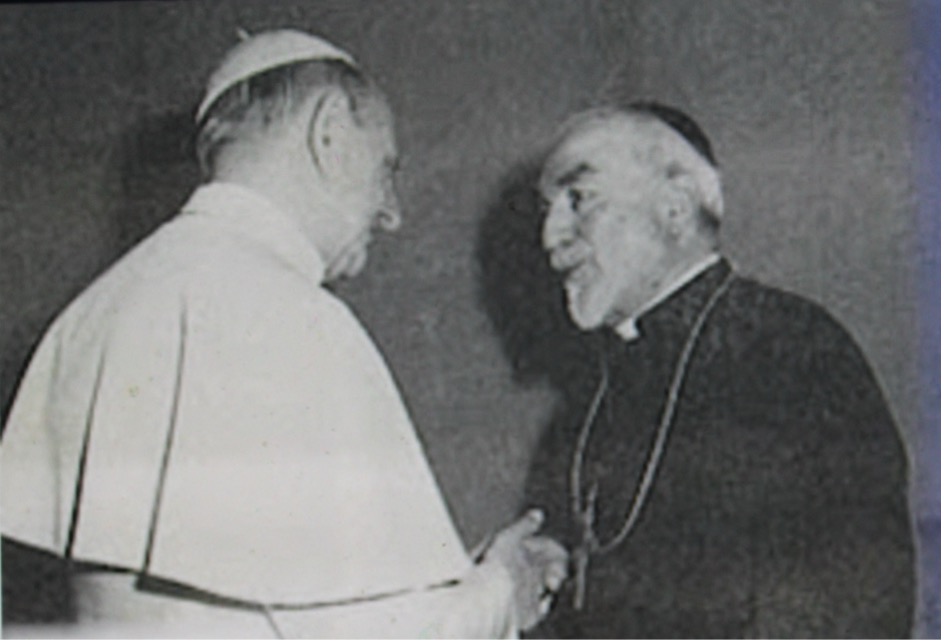
Bishop Jaime Garcia Goulart meeting Pope Paul VI. [Bishop Goulart died on 15 April 1997]
Epic of the dark days of 1942, when the Japanese spectre loomed over Australia, and Australian boys were faced with impossible tasks on northern islands, was the story of a group of Australian commandoes who refused to quit the Japanese-occupied island of Timor and against seemingly overwhelming odds, grimly persisted in harassing the ruthless enemy. Important factor which enabled the gallant Australians to hang on was that there were friends on Timor. They were the natives, the Portuguese community and the Catholic missionaries. Leader of the latter was Monsignor Goulart. To him and his priestly colleagues came Australian jungle hardened fighters from the hills, and jungle hide-outs, to go to Confession and receive Holy Communion, to retain contact with civilisation, to exchange cigarettes and tobacco.
On several occasions the Catholic missionaries refused to divulge to the Japanese the where-abouts of the Australian soldiers, and each time they did so at the risk of their own lives. Once, when Monsignor Goulart admitted to the Japanese that he had loaned his car to drive a wounded RAAF flier to safety, it appeared certain that he would be killed by the Japanese. When the danger to Monsignor Goulart and his mission group was too great, they fled for safety to the hills, and this time it was the Australian soldiers who were the hosts.
Colonel Calligan, Commanding Officer of the commandoes, it was who organised the plan by which a Dutch destroyer sneaked into a little beach on the south coast of Timor, at midnight on December 15, 1942, and brought the missionaries to Darwin and to safety. Today, Monsignor Goulart is still our guest, residing at the Redemptorist Monastery, Pennant Hills, and as Australians join in extending felicitations to the Bishop-elect, they are proud and happy that it is on their soil that his Excellency the Apostolic Delegate, Archbishop Panico, will shortly consecrate him to the elevated ranks of the Catholic Hierarchy.
Incidentally, Monsignor Goulart’s consecration as a Bishop will be the first major religious ceremony in his life that has not taken place in the little village church of his native Candelaria (“Our Lady of the Candles”), on the little island of Pico (“The Peak”), in the Portuguese Azores group………
When, shortly after his consecration, Bishop Goulart will return to his beloved diocese, conditions will, no doubt, be different in many ways from what they were before the war, and even from when the missionaries were evacuated in December 1942. …… At Dili an imposing cathedral, dedicated to Our Lady of the Immaculate Conception, had been erected in 1934, since destroyed by Japanese dynamite and Allied bombs……
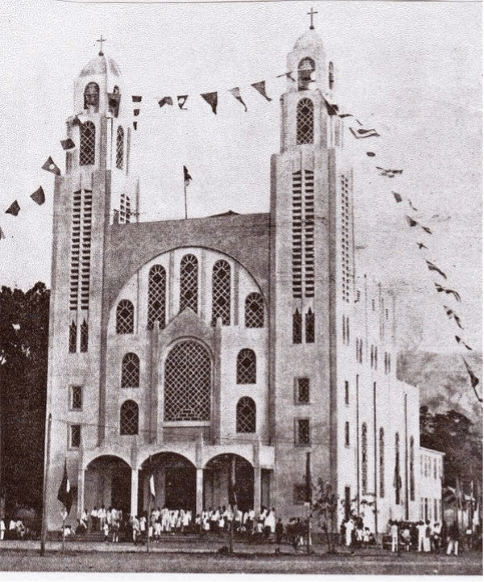
Dili Roman Catholic Cathedral destroyed by Allied bombing on 3 November 1942
Last month, when the Portuguese troops returned, and when the Portuguese authorities were released, the natives welcomed them enthusiastically. One coffee plantation was the only commercial venture of the Portuguese missionaries, but hopes were entertained that the Salesian Fathers would go to Dili, bringing trades, industries and avocations. That was the situation in Portuguese Timor when the Japanese invaders drove out the Australian and Dutch troops on February 19, 1942, and occupied Dili. The Australians had come to Dili on December 17, 1941. By February 20, 1942, they had been driven into the hills. It was not long before the missionaries came under notice of the occupiers.
About one month after the initial landing, the Japanese troops came to Monsignor Goulart’s principal mission at Lahane, a couple of miles out of Dili. They surrounded the mission buildings and ransacked every room from top to bottom. Doors were smashed down; bags torn open; drawers emptied. But, naturally, nothing of an incriminating nature was found. Nominally, the missionaries were free, but the Japanese quarters were not far away, and accosting and questioning were frequent.
Meanwhile, Monsignor Goulart had shifted the nuns from their school on the harbor front to the General Hospital. Behaviour of the Japanese was bad. Slapping was frequent. Homes were seized. Property was grabbed. Bowing and saluting of Japanese were insisted upon. But as yet no crimes had been committed against the nuns or priests. In May 1942, the Allied bombings began. The Portuguese Governor asked for the evacuation of Dili, but his request was refused. Later, however, as casualties grew, the Japanese agreed to the evacuation of Dill, and the Portuguese proceeded to quit the town. In the last stages, however, the Portuguese Governor was arrested. Meanwhile, the original Japanese troops had been replaced, and the newcomers were, in the words of Monsignor Goulart, “very bad.” As well, they began to fan out over the island, which meant graver danger for the missionaries.
Many Portuguese were massacred, mainly for helping the Australian commandoes. It was at this stage that two Catholic Portuguese priests were killed by the Japanese. They were the Rev. Fathers Norberto Barros and Antonio Pires, and they were killed at Ainaro, on October 2, 1942. Two weeks earlier Monsignor Goulart and two other priests had been involved in an incident with the Japanese that reads more like fiction than fact. It happened at Ossu, to which point the priests had gone after their evacuation from Dili. The Japanese had been fighting the Dutch. Feeling was running high. The priests were imprisoned, and Monsignor Goulart was under interrogation. Half-a-dozen soldiers with fixed bayonets surrounded the priest.
A Japanese officer fired the questions. It was the same old story. Where were the Australians and the Dutch? The Japanese officer spoke in Japanese to a Japanese, who addressed a Javanese in Malay, who addressed Monsignor Goulart in “Tetum,” a native language. Was Monsignor Goulart in touch with the Australians? He replied that he was. The Japanese wanted to know why. Some were Catholics and needed spiritual assistance. The Japanese could not understand this. Did the priests do not give them tobacco, coffee and food, too. Yes, but the Portuguese were neutral, and such an act was not an infringement of neutrality; did they not give similar things to the Japanese? That might be so, but it was an infringement of neutrality to help the enemies of Japan in any way.
As the interrogation is proceeding, the mission ‘phone rings. An interpreter answers it, and reports that a voice has inquired whether the missionaries could advise on the whereabouts of the Japanese. The Japanese anger is evident. More questions. The ‘phone rings again. It is the same inquiry. Anger rises. The questions are resumed. The ‘phone rings again. Same question. Japanese anger reaches fury point. Monsignor Goulart is explaining that he cannot be held responsible for other people ringing up. An interpreter has seized him by the throat. Fists are raised to strike.
Another Japanese officer has arrived. He intervenes. He is the Commander in Chief. He apologises for the actions of his subordinates. The Monsignor and his fellow-priests are “at complete liberty.” Next day two native kings, Catholics both, come to the missionaries and tell them that the Japanese have summoned them, offered them arms, and asked them to kill all whites. The missionaries were faced with a grim situation. If they remained, they would be imprisoned and almost certainly killed. If they hid in the hills alone, they would starve in the long run, and, possibly, be killed. The third possibility was to ask the Australians for help. That is what was decided upon.
It took 15 hours to find the Australian commandoes in their hide-outs. Colonel Calligan and his men welcomed them with enthusiasm and assisted them to go to Australia. Priests and nuns were contacted, wherever possible, and plans were made. The party travelled night and day across the hills to a little beach on the south coast, where 11 priests and 10 nuns were among a group taken on board a Dutch destroyer at midnight on December 15, 1942. By 8 o’clock on December 16, they were safe at Darwin, where they were later joined by 10 nuns, who had been evacuated at another point. Six priests, who remained, have recently been liberated. One native priest, Father Abilio Caldas, was killed by some natives, and a Portuguese priest, Father Francisco Maderia, died from starvation.
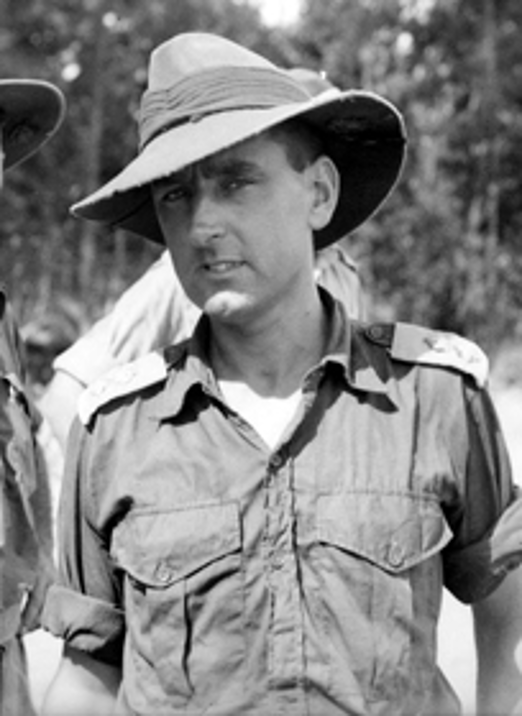
Colonel Bernard James Callinan who led the Australian commandoes in the Timor hills against the Japanese
All told, about 600 Portuguese were evacuated from Timor to Australia. Under the care of the Department of the Interior, they stayed in a military camp at Bob’s Farm, near Newcastle, and were later placed at Armidale, Narrabri, Glen Innes and Sydney. The priests and nuns have cared for their co-nationals, and have taught in the special schools that were established for the children. In addition, some of the priests were received into local monasteries.
Bishop Goulart, personally, feels specially indebted to the Redemptorist and Sacred Heart Fathers. Some of the nuns — Sisters of Charity, they are popularly known as “Canossians,” since their founder was the Italian Marchioness of Canossa — have assisted at St. Columba’s College, Springwood, during their stay in Australia. Monsignor Goulart speaks in the highest terms of gratitude and appreciation of the hospitality and assistance he and his people have received from Australia. But, remembering Timor, it has only been hospitality repaid.’
Priests meet a man at Bobs Farm whom they presumed dead
The Newcastle Morning Herald and Miners’ Advocate of 30 July 1943, page 3, reported:
‘A dramatic meeting between two Dutch priests and a friend whom they thought to be dead occurred at Bob’s Farm, near Newcastle, recently. All three were among a big number of Portuguese priests, nuns, civil servants, residents and natives who had been brought safely to Australia from Portuguese Timor. They found a haven in a special settlement at Bob’s Farm. The number of evacuees originally at the settlement was 520, but there are now 350. The others have found employment and taken their families with them. About the manner of their escape no more can be told than this, that it was achieved by brilliant Australian resource and faultless organisation. This need for them to leave their country brought together in comradeship men of noble purpose, distinguished attainment, and fascinating personality.
I asked if I might speak with the two Dutch priests. They are Fathers Martens and Somhorst. When they arrived, they saw Mr. Marcal, my interpreter, who had arrived only that morning. “Vasco Marcal, Vasco Marcal.” they cried out. “You here! But we thought you were dead.” Mr. Marcal jumped with joy. He could not speak. Tears came into his eyes again. When he could speak, all he could say was: “No, I am dead.” Then they all laughed and asked him did he not mean to say: “No, I am not dead.”
Among the evacuees was the Very Rev. Father James Goulart, Apostolic Administrator of the Diocese of Portuguese Timor, whose fierce, pointed beard and twinkling eyes merge with his other features into an expression of great benevolence, and whose command of languages is such that although he had not spoken English for 12 years, he was almost able to do without the services of Mr. Vasco Marcal, of the flashing eyes and graceful English, his good friend and our interpreter, who is known in Timor as “Man of the Mountains.”
There is the youthful Dr. Custodio Noronha, Attorney-General of Timor, Public Prosecutor, legal adviser to the Government, and chief of all prisons, who saw evil things when the Japanese occupied Dili, his capital. There are the happy, chocolate-tinged Timorese natives, of dauntless loyalty. And their wives, who have a passion for washing their clothes and their children, and who, to the consternation of the authorities, used 12,000 gallons of water the first day they arrived for this washing business. Although, since they had not seen taps before, a lot of water might have been wasted as they turned the taps on, and left them on, and danced around the running water in great glee.
And there are their timidly friendly, walnut-coloured children who dart in and out among the trees and have this peculiarity that, while they have an incessant longing to gulp incredible quantities of soft drinks from bottles, they do not like chocolates. With Father Goulart were nine Portuguese priests and a half-caste priest, in addition to the two Dutch priests. Of the 20 nuns, who are of the order of the Daughters of Charity, and who wear black shawls over their brown habits, several are Italians, several from the Philippines, and one a native nun from Portuguese Timor. She was educated in one of their colleges in Timor. Mother Superior Ossola and her secretary, Sister Rovera, speak English. They said they conducted colleges for European and native children and a convent for native orphans. Father Goulart said he wished to express very grateful thanks to the Australian people who had been so good to him and to the Government.’
Treatment of the priests by the Japanese
The Newcastle Sun of 30 July 1943, page 4, reported:
‘A party of 13 priests and 20 nuns of the Daughters of Charity order, were camped for a time not far from Newcastle, after having mode a hazardous escape from Timor by sea recently. Through an interpreter, Portuguese priests with first-hand knowledge of the fortitude of their gallant brothers of the cloth told the other day how the Japanese had gone to one of the Timor missions. In halting English, two Dutch priests, Rev. Fathers Martens and Somhorst, said that when the Japanese arrived in Dutch Timor on April 1, they made prisoner the bishop, priests and sisters at four mission stations. The prisoners were treated well but were not allowed outside the mission areas.
“The Japs told us,” said Rev. Father Somhorst, “that our religion was ours, but that they needed our church and buildings. They did not respect our sacred buildings at all. They also took most of our belongings for their men.” At the beginning of May last year, the Japanese began interning all the priests and the mission personnel, so the two Dutch priests travelled into Portuguese Timor. On the way they met the two priests who were subsequently killed. “They were very kind men,” commented Rev. Father Somhorst.
The Apostolic Administrator of the Diocese of Portuguese Timor (Rev. Father James Goulart), who came to Australia with the evacuees, said that eight missionaries were still in the diocese. He was in Dili for five months while the Japanese were there. Several times the Japanese came to his house and asked questions but did not harm anybody at the mission. He had thought of taking refuge with the natives in the hills but decided against this because the Japanese would probably have revenged themselves on the natives. He was glad to get out of Timor.
No harm was done to the Daughters of Charity, said Mother Superior Oscola and her secretary, Sister Rovera, but they were always fearful of their safety. The nuns had conducted colleges for girls, one for the natives and one for the Europeans. Languages and music were among the subjects taught. They also had a convent for native orphans.’
Voluntary Help provided to evacuees at Bobs Farm
The Newcastle Morning Herald and Miners’ Advocate of 30 July 1943, page 6, reported:
‘Social service work for evacuees at Bob’s Farm has been one of the outstanding wartime achievements of Newcastle women’s organisations. Various organisations and individuals assisted, in providing clothing, comforts and school requisites for the settlement, but outstanding work was done by the combined Bomb Victims Auxiliaries, the Red Cross Society, C.U.S.A. [Catholic United Services Auxiliary], St. Vincent de Paul Society, the Evacuation Supply committee and R.A.A.F Comforts Fund members.
Within three days of the arrival of the evacuees the Red Cross Society had equipped a 50-bed hospital and sent supplies of fruit juice, condensed milk and other necessities. Newcastle Red Cross branch supplied crockery and cutlery, and furnished the living room for the doctor, Madame Correa Teles. Clothing was sent from Red Cross headquarters for children. The estimated value of the work was about £800.
The combined Bomb Victims Auxiliary made available more than 5000 garments. These were valued at over £2000. In addition, £240 was made available for the purchase of footwear. Three sewing machines were provided by the auxiliaries, and other organisations later donated more machines. The evacuees were unable to use these at first, but under the tuition of the nuns and visitors to the settlement, between 60 and 70 women became able sempstresses. Similar training was given to the women in the care of woollen clothing.
The Evacuation Supply sub-committee also provided garments and dress materials in considerable quantities. A donation of £50 from Tattersall’s club resulted in the early distribution of biscuits, tobacco sporting equipment and indoor games. Several organisations including C.U.S.A., helped to provide school requisites so that a school could be opened at the settlement. The nuns and priests are teaching the children and many of them can now speak fluent English. C.U.S.A. also supplied a sewing machine, clothing, and other articles.
Within three days of the arrival of the nuns in the camp the St. Vincent de Paul organisation made supplies of essentials and comforts available. R.A.A.F. Comforts Fund members provided materials for sewing, as well as sweets, fruit and other articles for the children. The orgnisation of the settlement was done by the C.A.S. Officer (Mr. S. Delves). Mr. W. Crothers was appointed Commandant of the settlement. The various organisations engaged in welfare work at the settlement formed a joint committee known as the Bob’s Farm Evacuees’ Settlement Welfare Committee with Ald. F. Cane as president.
Arrangements were made for dentists, doctors and eye specialists to visit the settlement, some of the work being done voluntarily. A committee within the camp supervised the storage and distribution of clothing and supplies, quantities of which were supplied by the Government.’
Work found for some of the evacuees
The Newcastle Morning Herald and Miners’ Advocate of 13 August 1943, page 2, reported:
‘The Organiser (Mr. J. Wilson) told Newcastle Trades Hall Council last night that 20 Portuguese refugees and their families, who had been evacuated from Timor, had been transferred from Bob’s’ Farm to a pulping plant in Victoria. The council had before it a letter from some of the Portuguese expressing thanks for the council’s efforts to secure work for and improve the conditions of refugees. The letter asked that work be found for some of the men remaining at the camp.
Mr. Wilson said the council had made representations to the Deputy Director-General of Manpower (Mr. Bellemore), then to the Federal Government before action had been taken. A Government official had interviewed the Trades Hall officials and had mentioned the problem of finding suitable accommodation for the men and their families. Eventually two guest houses had been taken over near the pulping plant. Two of the men, not accustomed to the cold, had been sent from the plant to work in the North.
There were five families left at the farm who could be classed as employable. These people wanted work. Mr. Wilson said the men who went to Victoria had attended a meeting of the Trades Hall Council and had marched in the May Day procession. It was decided to ask the executive to arrange employment for the families concerned.’
Christmas party at Bobs Farm for evacuees
The Newcastle Morning Herald and Miners’ Advocate of 16 December 1943, page 4, reported:
‘Evacuee children from Timor, now at Bob’s Farm, will enjoy a Christmas party arranged by the Bob’s Farm Evacuee Welfare Committee on Saturday. Arrangements have been made for a Christmas tree. Santa Claus will be represented by an adult Timorese. The executive of the Welfare committee comprises Ald. Cane (President), and Mrs. Tomlinson (Secretary). For two months, soft toys, dolls, and wooden toys have been made for the evacuees. Toys include sturdy coloured ducks, rabbits, chickens, cats, bears, horses and elephants, made from scraps of materials, skilfully cut and sewn together. Dozens of rag dolls, with brightly painted faces and cotton frocks, will find proud owners.
Mrs. M. Duncan and other members of Newcastle Home Science Ladies’ Auxiliary assisted by Mesdames E. and D. Cremor, were busy yesterday putting finishing touches to some of the toys prior to their dispatch to the camp today. Wooden toys, including wheelbarrows. aeroplanes and hobby horses, were made by Messrs. Shearman (Stockton), and G. Kennedy (Carrington). Mrs. Tomlinson has collected about 70 bags of marbles for the boys.’
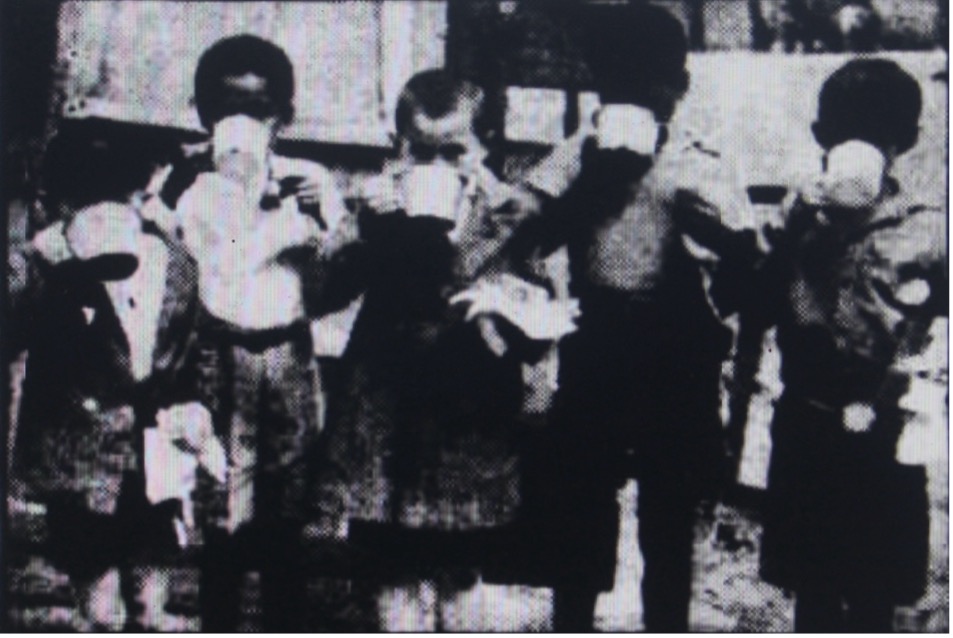
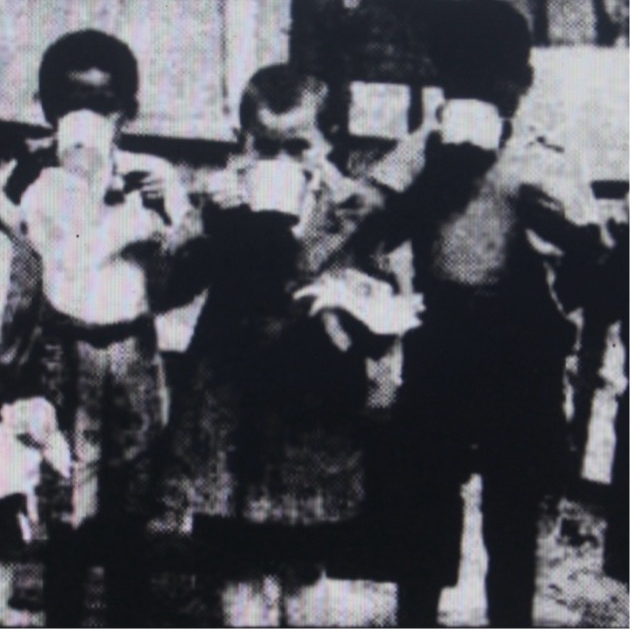
Evacuee children from Timor drink a toast at a Christmas party at Bob’s Farm arranged by Bob’s Farm Evacuee Welfare Committee [Newcastle Morning Herald and Miners’ Advocate, 24 December 1943]
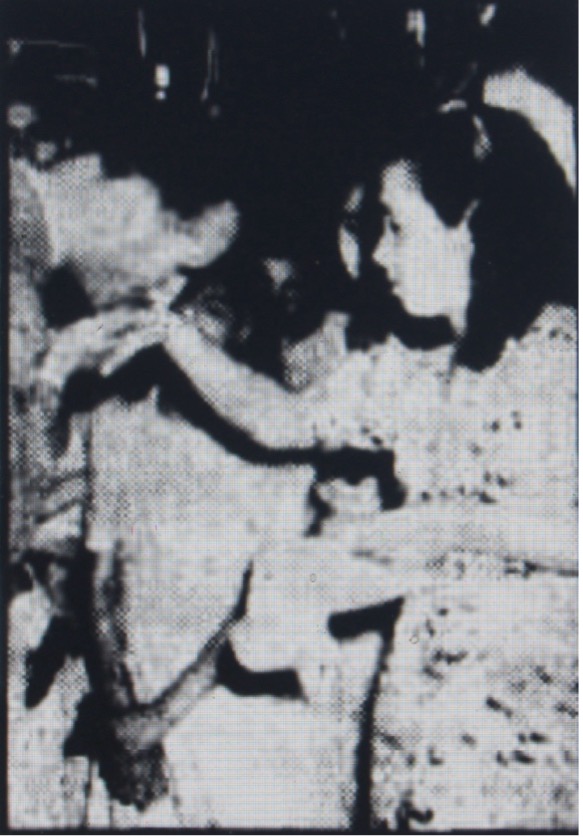
Consul for Portugal (Dr. Laborinho) kisses the hand of Paolina Abilio after she had read an address of welcome [Newcastle Morning Herald and Miners’ Advocate, 24 December 1943]
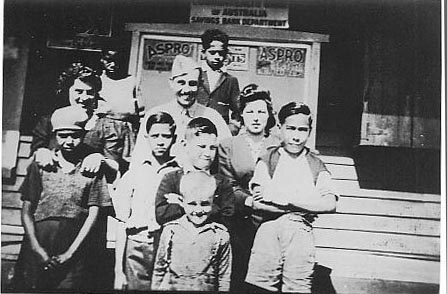
Refugee children from Timor with an American serviceman and two ladies – outside Upton’s Shop at Bobs Farm.
Some evacuees moved from Bobs Farm to Narrabri
The North Western Courier of 20 January 1944, page 4, reported:
‘Harrowing stories of their precarious journey through hills of Timor in the course of their escape from the Japanese and hostile natives are told by some of the Portuguese refugees now accommodated at Narrabri West.
At present arrangements have been made to accommodate about 80 persons, including, whole families, in the old Imperial Hotel at Narrabri West. The refugees come from every part of the Portuguese Empire, including natives of the Macao (South China), near Hong Kong. Of the number stationed at Narrabri West no more than twelve, are true Portuguese. Medical Assistant, Marcelo Nunes, who is in charge of the settlement at Narrabri West, said it is hoped to settle at least 140 persons altogether at Narrabri. Arrangements are now being made for further accommodation in town.
Altogether 600 have found shelter on Australian shores. “They are willing to undertake any kind of work for which they feel they are suited, and they can thoroughly carry out,” said Superintendent Nunes. Already several men have been engaged on charcoal burning. A number of women have been engaged on hotel duties, while other offers have been received, he said.
Part of the company with which Mr Nunes is associated was evacuated to Australia in August. These were moving in the hills for eighteen months evading capture by the Japanese and death by the hands of hostile natives who, driven by threat and fear, often ambushed the Portuguese subjects by night with tragic result. On the other hand, the majority of the natives who were friendly, loyally assisted and supplied them with food. Mr. Nunes pointed out that it was largely because of the assistance of the natives that the [Australian] guerrillas were able to inflict such heavy losses on the Japanese, whose positions were betrayed by native scouts.
Losses among their number were nevertheless heavy. Mr. Nunes, who received his medical training at Macao, carried out medical work among the natives of Timor for twenty-eight years. It had been most difficult to encourage the natives to submit to medical treatment, he explained, but years of untiring work were beginning to show effect on the skin diseases that are rife amongst the 500,000 inhabitants of the island. Now their work, their hospitals and equipment had been totally destroyed by the Japanese. Thirteen out-hospitals had been established throughout Timor with a large central hospital as a base. Altogether five doctors including one women doctor had been stationed there. The woman doctor escaped to Australia, and now is in Portugal. Two took their own lives when there was no alternative to Japanese capture.
Mr. Nunes had a close call on one occasion when they were ambushed by the hostile natives. The Company Commander and his wife, one doctor and two clerks, attached to his company, were unable to make their escape. After shooting his wife, the Company Commander and three others took their own lives. Sometimes the refugees would be without food for days, but they were in better circumstances than one group which lived a homeless existence in the mountainous country, of Timor for about two years, said.
Mr. Nunes. “No one has any idea of the hardships these people have suffered,” he said. Some families will be reunited at Narrabri for the first time since they were scattered by the Japanese invasion two years ago. “Timor is a very fertile island, and has tremendous possibilities for development,” he added. Tropical fruits, rice and coffee were unequalled crops.’
Preparations made for surrender of the Japanese in Timor
The Sun of 5 September 1945, page 3, reported:
‘Australian troops are concentrating at Darwin for the early occupation of Timor. The occupation force will be led by Brigadier L. G. H. Dyke, of Melbourne, who will accept surrender of the Jap commander aboard HMAS Moresby, off Koepang. First task of the force will be location and return to the mainland of about 120 Australian prisoners of war. It is expected that the RAAF will fly liberated prisoners to Darwin. Eight hundred Australian prisoners, reported to be on Ambon, will also be evacuated by RAAF Catalinas.
With the surrender of the Japanese, the scene was set to repatriate the evacuees back to Portuguese Timor.
Evacuees Leave Narrabri, Armidale and Glen Innes to return home
The North Western Courier of 26 November 1945, page 3, reported:
‘By special train leaving tomorrow morning at 2 a.m., the Portuguese evacuees who have added a colourful note to Narrabri’s surroundings for a few years will leave for Newcastle where they will board the Portuguese steamship ‘Angola’ on their journey to Timor.
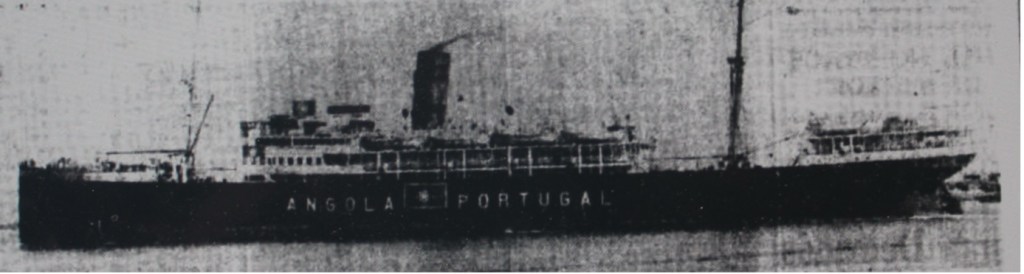
Portuguese steamer Angola [Newcastle Morning Herald and Miners’ Advocate, 23 November 1945]
The train will be joined at Werris Creek by other Portuguese from Armidale and Glen Innes. Those from Sydney are already on board. It was towards the end of 1942 that the Japanese attacked Portuguese Timor. Timor is divided into two parts— the Dutch owning the southern half while the Portuguese are in possession of the northern half. Any organised evacuation was impossible, but the few Portuguese who could make the journey through the jungle to a deserted beach on the south coast were picked up by night by a Dutch destroyer and raced to Darwin.
Though the Dutch in this way evacuated a few Portuguese, they were unsuccessful in effecting the escape of any of the Dutch when Dutch Timor fell some months previously. The only Dutch who escaped were two Dutch priests who had fled to Portuguese Timor and had hidden in the mission station of Alas (which means Tall Trees). These two Dutch priests escaped with the Portuguese. Perhaps it was for them that the Dutch destroyer called. There were only a little over 600 who got away including a few Australians, 11 priests and 22 nuns. Their first Australian Christmas in 1942 was spent in Darwin.
The people evacuated were mixed. First came the true Portuguese of the official type and then the exiles. Portugal has a system whereby the person sentenced to any long term of imprisonment is deported to a Portuguese colony in lieu of the sentence. No restraint is imposed on the convicts in the new colony. They become part of it and live and earn their living just like everyone else. The only proviso is that they cannot leave the colony. Most of the imported Portuguese were convicted for political offences arising out of a recent revolution in Portugal.
Then, of course, there was the native, pure and half caste. These natives, though under Portuguese rule, are of pure Javanese stock and can be correctly referred to as “Javanese.” Of the 600 who arrived in Australia, a few stayed in Sydney, some went to Armidale and Glen Innes and 180 came to Narrabri. They have been good citizens and at one stage the money paid to them by the Portuguese Government and spent in Narrabri amounted to £800 weekly. All the Narrabri subjects were either natives or deported Portuguese. Most of them came from Alas, some 30 miles from Dili, the capital of Timor. Alas is in the mountains which are over 9,000 feet high in places. Height makes a difference to temperature, yet it seems strange to hear a Portuguese wish to be back in Timor away from the Narrabri heat. Of course, compared with the tropical heat of the lowlands, in Timor the Narrabri climate would seem temperate. …….
From reports they have little to which to go. Dili, with all its public buildings and its cathedral [destroyed] , has only 8 houses left standing. All villages have been destroyed and the jungle has crept back again over all the deserted fields. A fresh start will have to be made in an almost virgin country. Some of them are not returning. Several died early as a result of the rigours of the evacuation. Eleven more have joined up with the Australian Merchant Marine and have so widened their world, perhaps for good. The ones here have been the lucky ones. From all reports, a large percentage have been killed by the Japanese.’
The Newcastle Morning Herald and Miners’ Advocate of 28 November 1945, page 5, also reported:
‘When the Japanese landed on Timor Mrs. Angelina da Costa, 72, who is totally blind, fled to the mountains with nine grandchildren, after her daughter, mother of five of the children, died with her small baby. Mrs. da Costa was rescued and evacuated to Australia in 1942. When the evacuee train arrived at Newcastle yesterday, she was cared for by Mrs. R. Tomlinson, who, as a Civilian Aid Service worker, cared for many of the evacuees when they were at Bob’s Farm, near Newcastle. As the train stopped at Newcastle station many children and adults bustled their way towards Mrs. Tomlinson, men shook her hand, and Portuguese misionary sisters, Timorese children and women kissed her affectionately. “It is their way of showing appreciation for the great work she did for them while they were quartered at Newcastle,” said a Portuguese official.
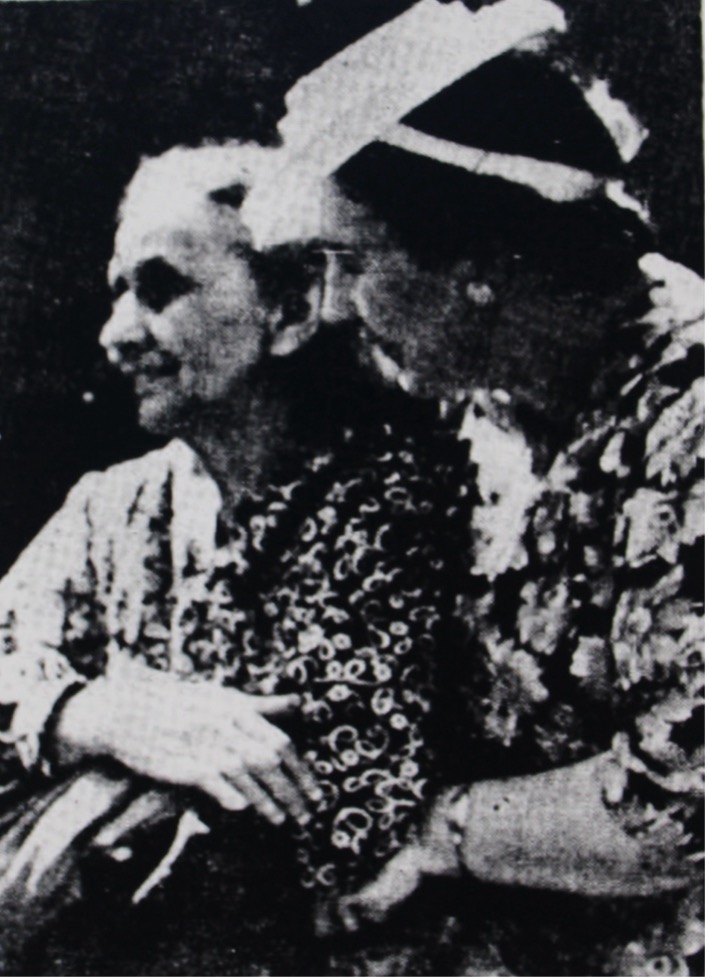
Mrs Angelina da Costa with Mrs R Tomlinson, a Civilian Aid Service worker at Newcastle [Newcastle Morning Herald and Miners’ Advocate, 28 November 1945]
Missionaries return to war-torn Timor
The Newcastle Morning Herald and Miners’ Advocate of 28 November 1945, page 2, reported:
‘Twenty nuns, Daughters of Charity of the Cannossian Order, were among the 400 Portuguese and Timor evacuees who sailed from Newcastle on the Angola last night. They are returning to Timer to rebuild their bombed convents and continue the missionary work their order had been doing in Timor for 70 years before the Japanese came three years ago. Their plans are vague. They know their three convents have been destroyed, but until they arrive do not know how soon they will be able to rebuild or where they will stay until they do so. “We shall start our schools again,” said one of the Sisters. “There are plenty of pupils ready for us.”
The largest of the three convents, at Dili, was a new building, not quite finished, when the Japanese took it a few hours after the nuns had left. It was destroyed by Allied bombers a few months later. The other two convents were at Manatuto and Soibada. They might not have been completely destroyed although they were bombed several times. When the nuns arrived in Australia on a Dutch destroyer three years ago they went to Bob’s Farm, where they spent 18 months. From there some went to Springwood Seminary, some to Narrabri, and others to Glen Innes. At Glen lnnes they taught a Portuguese school of 78 children. Ten priests also left for Timor on the Angola. With them is the new Bishop of Timor (Most Rev. Jaime Goulart), who was consecrated at St. Patrick’s, Manly, on October 28.’
Work of volunteers at Bobs Farm applauded
The Newcastle Morning Herald and Miners’ Advocate of 29 November 1945, page 2, reported:
‘Departure of a large band of Timorese refugees from Newcastle this week recalls the work of Newcastle Civilian Aid Services when the homeless people arrived about three years ago. Less than 24 hours after advice of their coming was received, the refugees were housed at Bob’s Farm, near Newcastle. Within 40 hours the adults had at least one extra suit of new clothing, the children had two changes, and a 16-bed hospital had been established at the farm.
The Mayor of Newcastle (Ald. W. E. Young) was president of C.A.S., with Mr. S. Delves C.A.S. officer. On Friday night the C.A.S. officer was advised that 100 evacuees from Timor would land in Newcastle on the following morning. They arrived next day—those hunted, half clothed, hungry people from Timor. Transport was provided to take them to Bob’s Farm, where they were housed m military huts. The military also undertook feeding. Meanwhile, C.A.S. was preparing clothing.
It was a big task, measuring, fitting, and finding footwear. Yet by Monday morning every adult had a change of clothing. The children had two changes. Members of the St. Vincent de Paul Society cooperated with C.A.S. by attending to the wants of the nuns. The Red Cross Society also came into the picture. It communicated with headquarters. By Sunday morning utility trucks arrived at the camp with hospital equipment. In the afternoon a 16-bed hospital had been established and staffed. For more than 12 months C.A.S. maintained clothing supplies. It also provided toys and playing equipment for the children, with comforts for the adults, while critics were still harping on its inability to operate in an emergency.’
Timorese officials punished for seeking Australian assistance during the War
The Examiner (Launceston) of 22 August 1946, page 7, reported:
‘Dr. Manuel Ferreira Tabords, who was acting Governor of Portuguese Timor for several months during the Japanese occupation, was sentenced to 18 months’ “inactivity” yesterday. He was charged with:—(1) Disobeying orders from the Government to keep strict neutrality by asking Australia and other Allied Powers for help to evacuate to Australia Portuguese citizens, including able military men, without consideration for others remaining at the mercy of the Japanese. (2) Collaborating with Allied troops who were also invaders of Portuguese soil; (3) Abandoning his post and retiring to Australia. The Colonial Office Disciplinary Council is trying other leading Portuguese officials who fled to Australia.’
Concluding Comments
One of the evacuees housed at Bobs Farm was Francisco Horta, who was the father of the President of Timor-Leste, Jose Ramos-Horta (2007-2012; 2022 – )
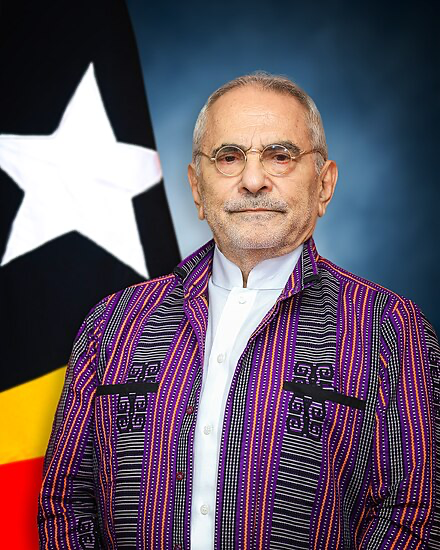
Jose Ramos-Horta
The story of the Timorese evacuees at Bobs Farm Cadre Camp is an inspiration, reflecting the way they had survived the Japanese persecution and the new life they adopted while in Australia.
Driving along Nelson Bay Road, just before the junction with Marsh Road at Bobs Farm, and looking to the left over a small farm area, most motorists would be unaware of the importance of the area to the citizens of Timor-Leste who have descendants who once called the site, home, in the 1940’s.
Researched and compiled by Kevin McGuinness
May 2024

 Port Stephens - a history exploration