
Introduction
By 1900, there were several proposals to construct new tramway routes or extend existing ones in the Hunter and surrounding regions. These were brought to the attention of the NSW Minister for Works.
Engineers and surveyors from the Public Works Department had been engaged in inspecting the proposed routes of no fewer than six suggested lines and reports were to be furnished to the Minister when completed.
The proposals included a tramway from Stockton to Salt Ash with the aim of opening up access to the waters of Port Stephens. Between 1892-1926, there were four such proposals put forward. This paper examines each of these.
First Proposal for a Stockton to Salt Ash Tramway – 1892
At the time of the first proposal for a tramway from Stockton to Salt Ash, the road between the two towns was unsealed and almost un-trafficable in parts after rain. Farmers often found it hard to transport their produce to Newcastle. A tramway was seen as an improved means of sending produce to market in Newcastle.
The Evening News of 18 March 1892, page 3, provided information on the first tramway proposal:
‘A deputation consisting of Messrs. Hart, Fegan, and Scobie, Ms.L.A., and the Mayor of Stockton, waited upon the Minister for Works yesterday, and urged upon him the necessity of constructing a line of tramway from Stockton to the navigable waters of Port Stephens. It was pointed out that the work could be accomplished at a small cost, and the line would open up a large quantity of Crown lands. The distance of the proposed route was 15 miles, and the cost £1000 per mile. The line would materially assist in developing the coal industry. The cost of resuming land for the work would be a very small item. Mr. Lyne, in reply, said he would send an officer from the department to report on the line in question. He could do nothing more.’
The proponents of the scheme received bad news from the Minister eight months later, when it was advised that the proposal was uneconomic.
The Australian Star of 25 November 1892, page 5, reported:
‘The members who recently introduced a deputation to the Minister for Works, which asked that a tramway should be constructed from Stockton to Salt Ash, Port Stephens, have received a reply from the Minister on the matter, it is explained that the line, which would be 15 miles in length, would, it is estimated, cost £65,232, including £20,000 for earthworks. If, however a line with a 2ft. gauge should be constructed the cost would be £32,902. The letter adds that further consideration must stand over, as no funds were available even if the work was shown to be advisable.’
Second Proposal for a Stockton to Salt Ash Tramway – 1901
After a lapse of eight years, calls for the construction of a tramway from Stockton to Salt Ash were renewed.
The Newcastle Morning Herald and Miners’ Advocate of 13 June 1901, page 5, reported on an official visit of inspection concerning the tramway:
‘In pursuance of his list of engagements, Mr. G. Fischer, the Engineer for Tramway Construction, yesterday made an inspection of the proposed line of tramway from Stockton to Salt Ash, a distance of about 15 miles. He was accompanied by his inspector, Mr. D. Reeves. On arrival at Stockton the officials were met by the Mayor (Alderman Warland), Alderman Griffith, Mr. J. K. Wooderson (the secretary of the Medowie Progress Committee), and Mr. S. W. Smith, of Fullerton Cove, an apology being made for the absence of Mr. Barnes, of the Williamtown Progress Committee, who had worked hard (in connection with Mr. R. A. Price, M.P.) to obtain the Minister’s sanction for this line to be constructed.
The real object of Mr. Fischer’s visit was to inspect the route, which the people had suggested the tramway should traverse, and to submit to Mr. O’Sullivan an estimate of the probable cost, anything over £20,000 having, of course, to be referred to the Public Works Committee. Several vehicles were provided for the inspection. It was noticed that the line would pass through some rich country, and it could be seen that if the people had facilities for getting produce to market very great encouragement would be given, leading no doubt to a rapid increase in settlement, there being an abundance of Crown lands some distance further north. The country presents no engineering difficulties for tram construction, being practically level the whole way ; and it is the opinion of the people that the line could be constructed for about £1200 per mile or less than £20,000 altogether.
What Mr. Fischer’s opinion is on this point remains to be ascertained, but those who travelled with him yesterday feel confident that the money for the tramway will be placed on the next estimates. There is not a great population along the route but the progressive Minister for Works has looked upon the project from a “National” point of view, and it will not be Mr. Price’s fault if Mr. O’Sullivan is not kept up to his definite promise, which was, that he would make provision for the expenditure on the next estimates. What will bring great revenue to the line, if constructed, is the carriage of produce. There are farms at intervals for the whole distance, and a great dairying industry could be encouraged. But the chief source of revenue would probably be in the carriage of fish. Several steamers are now engaged in the fish trade to Newcastle, but they are often delayed by bad weather, and it not infrequently happens that cargoes of fish and farm produce are spoiled to say nothing of the great delay and inconvenience to passengers. What was noticed yesterday can, it is said, be taken as a criterion of what occurs from day to day throughout the year.
The engineer noticed several loads of fish going to Stockton, and it was explained that the despatch of these “delicacies of the deep” from Port Stephens by road was equal to something like three tons of fish per day. On a cold day like yesterday, there was the inconvenience of the heavy (and in some places exceptionally heavy) condition of the road. On a summer’s day there would be the greater difficulty of conveying the fish such a distance by a slow process of transit. The Newcastle people should advocate for the construction of this line, for reasons apart altogether from those briefly enumerated.
A tramway to Salt Ash would open up a splendid avenue of trade and afford a healthful “lung” to the recreation resources of the city. The road from Stockton follows the Hunter till nearing Fullerton Cove. It then strikes off in an easterly direction, with a varying course, to Salt Ash. This little settlement is situate upon Tilligerry Creek, which, to all practical purposes, is a continuance of the harbour of Port Stephens. There is direct water communication with Salt Ash and Newcastle—but, of course, only small steamers can get up the Tilligerry Creek.
There was a proposal about a year ago to construct a light line of railway from Stockton to Port Stephens, via Salt Ash. Mr. W. D. Walker’s report upon this was published in full in the “Newcastle Herald” at the time. He suggested that the line, after following the main road half-way to Fullerton Cove, should then leave the population in favour of a course along the swamp leading to the Raymond Terrace-road. Naturally enough, the people objected to this route. If the tramway should be constructed according to Mr. Fischer’s ideas, satisfaction will be given to all concerned—not excepting Mr. Percival. J. M. Brown, who, as secretary of the Salt Ash Progress Committee, had worked hard to have the light railway line.
At different points of his inspection yesterday, Mr. Fischer was met by leading residents, among whom may be mentioned: Mr. G. Nelson, the president of the Salt Ash Progress Committee; Mr. R. West, the treasurer; Mr. P. J. M. Brown, the secretary; Mr. W. Moxey, the president of the Williamtown Progress Committee; Mr. G. Moxey, the treasurer; and Mr. E. Barnes, the secretary; also Captain Dalton, Messrs. Stanley Smith, John McKenzie, G. Gillespie, G. W. West, H. Rooke, G. W. Brown, Peter Johnson, Thos. Hyde, John Boyce, J. Stanson, E. Bryant, and G. M. Mathieson. The latter entertained the visitors at luncheon. Alderman W. H. Goodman was present at Salt Ash. Mr. R. A. Price, M.P., who had been at Williamtown overnight (with Mr. Norman Grant, the Road Superintendent), gave the visitors a hearty welcome. He maintains that the tramway will be profitable to the department and looks forward to the time when it will open up about 80 miles of inland waterways, from Port Stephens to the Myall River, to The Broadwater, to Booloombayt Lake, to Myall Lake, and Smith’s Lake, and thence to Wallis’ Lake and Cape Hawke. He expects to see not two or three tons of fish taken to Stockton each day, but more like twenty tons—sufficient to considerably augment the supply of Sydney. There are, he says, some 60,000 acres of Crown lands available for settlement.’
Proposed Route Examined by Tramway Department – 1902
An official examination of the proposed tramway route was undertaken in 1902. The Daily Telegraph of 28 February 1902, page 7, reported:
‘In his report on the subject of the proposed tramway from Stockton to Salt Ash Creek, in the Port Stephens district, a copy of which has been supplied to Mr. W. T. Dick, M.L.A., Mr. J. I. Haycroft, assistant engineer of tramway construction, states that the route is 15 miles long and follows the course of the present road connecting Stockton to Salt Ash. Of this road 13¼ miles are metalled and the remainder is cleared only. The question of grades did not arise, as the ground was practically level throughout. The earth works would he of a very light nature. Ballast was not easily procurable, the nearest suitable quarry being four miles westward of the proposed route, in the vicinity of Williamtown. In concluding his report Mr. Haycroft says:— “Regarding the probable amount of traffic, I was not impressed with its present or prospective volume. After leaving the Stockton the route for the first seven miles is practically uninhabited, but from 7 to 13 miles is fairly settled with dairy farmers. At the Salt Ash end settlement is sparse, and the land to the west of the route is poor in character.”
Light Railway Line Suggested – 1902
As it became evident that the proposed tramway was primarily for the transport of freight, it was suggested that a line of light railway may be more appropriate.
The Wingham Chronicle and Manning River Observer of 28 June 1902, page 4, reported:
‘For some time there has been an agitation to connect Stockton and Salt Ash by a tram line; but as it would be necessary to utilise the line for freight purposes, and the Commissioners are averse to this, a suggestion has been offered to make the connection by a light line of railway. The Minister for Works will receive a deputation in connection with the matter on Wednesday next; and this deputation will endeavour to get his sanction for the railway proposed. Mr R. A. Price, M.P., has interested himself in this matter for some time, and will, no doubt, continue to use his influence till the end in view is accomplished.
A wider significance is now given to the construction of this line to Salt Ash by the suggestion that it may be made a section of the proposed North Coast Railway. If the route via Salt Ash, for this great national undertaking is suitable, and can be approved of, there may be something in the idea — and the people further north may become interested and assist in obtaining this as an instalment of their line. Of course, this view of the question is one that will require some investigation, yet it may transpire during the interview with the Minister on Wednesday, that it is more than mere speculation.’
The Wingham Chronicle and Manning River Observer, of 5 July 1902, page 7, reported on the deputation:
‘Mr. Price, M.L.A., introduced a large deputation from the Newcastle and Salt Ash districts to the Minister for Works on Wednesday last, to ask for the construction of a light line of railway, or a tramway between Salt Ash and Stockton. A petition, containing 1075 signatures of residents, was handed in in favour of the proposal. It was pointed out that the principal products of the district are vegetables and fish which will not stand long road journey. The length of the line is about fifteen miles, and the cost of construction is estimated at £18,000. The producers along the route promise 21 tons of loading per day.
Mr. O’Sullivan admitted that the proposal, with which he was fairly well acquainted, had much to recommend it. It would open up a new region for a very large population, but he thought it would cost considerably more than the deputation estimated. He would put down the expenditure at over £20,000. He would, however, submit this proposal to the Cabinet when the Government’s railway policy was under consideration, and see that it gets fair representation.’
Tramway Proposal Loses Local Favour – 1905
After three years without approval, the proposed tramway had lost local support.
The Newcastle Morning Herald and Miners’ Advocate of 17 May 1905, page 7, outlined the current views about the tramway proposal:
‘The survey pegs marking the proposed tram route from the port to Salt Ash is still the only advance made toward its erection. The majority of the settlers are very apathetic on the matter. “Give us a good Government road,” say the market gardeners, “and we are content!” …. The residents say they do not expect to hear anything further until the next time they are being wooed by the candidates for Parliament.’
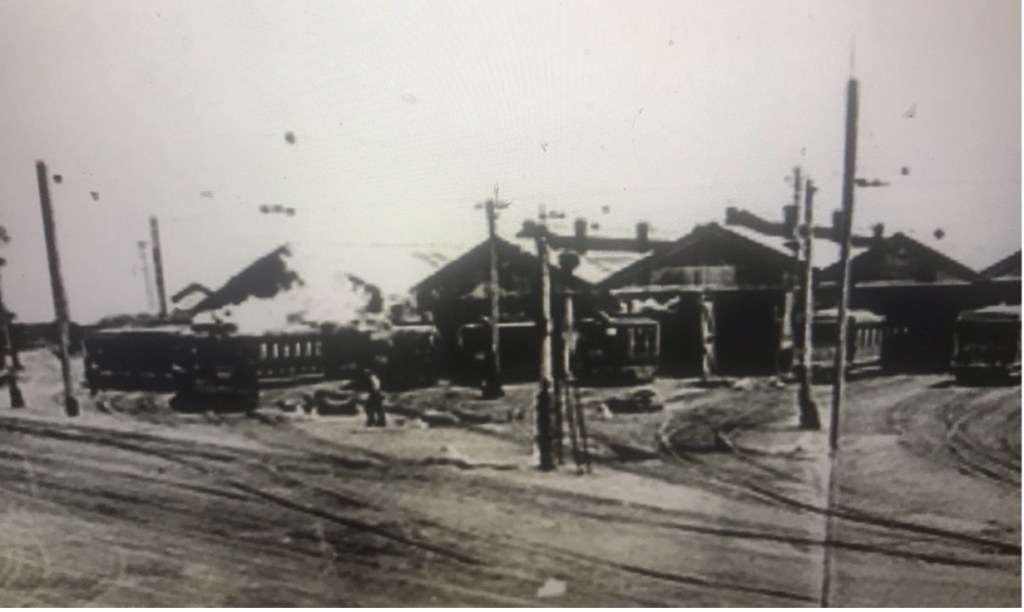
Steam trams at a Newcastle Depot, of a class that would have operated on the proposed Stockton to Salt Ash tramway [Newcastle Library]
Third Proposal for a Stockton to Salt Ash Tramway – 1922
Twenty years after the previous attempts, the proposal to have a tramway constructed from Stockton to Salt Ash was again resurrected.
The Newcastle Sun of 2 March 1922, page 8, reported:
‘At last night’s meeting of the Stockton Progress Association, Mr. Claude Dalby moved that the time is now opportune for the re-opening of negotiations with a view to the construction of a light tramway line to connect Stockton with Port Stephens. This, he said, would probably mean the growth in population and production of vacant areas between Stockton and Port Stephens. Mr. Dalby said that money should not be an excuse. If Sydney could get it, Newcastle and Stockton could get it. It was decided to ask the Port Stephens Shire, Newcastle and Stockton councils, and the Chamber of Commerce to co-operate in the matter. The tramway would also be useful for Garden Suburb residents, it was said, and would prove more profitable than many other lines in the State. “We must be progressive, and keep on keeping on,” said Mr. Dalby.’
Nothing came of the proposal.
Fourth Proposal for a Stockton to Salt Ash Tramway – 1924
The tramway issue was again revisited at the local government level in 1924. However the proposal was not supported as it was believed that the construction of a concrete road would be of greater benefit.
The Newcastle Morning Herald and Miners’ Advocate of 6 August 1924, page 8, reported:
‘Alderman Cody [Stockton Council] moved that representations be made to the Public Works Department through the members of Parliament, to maintain a tramway service between Stockton and Salt Ash. He admitted that it was a large question, but every movement in the public interest must have a starting point. Alderman Quantrill seconded the motion. A tramway would have the effect of opening the route up for tourists. Alderman Williams was of opinion that there was no land suitable for agriculture past Salt Ash, and the tramway would not be needed for the next hundred years. Alderman Griffiths supported the motion. Alderman Rees said that the motion was on the wrong lines. A concrete road formed would be of much more benefit. The returns from the tram would not pay for the wheels, whereas a road right through Nelson’s Bay would be more beneficial. Alderman Rees moved, as an amendment, that the council advocate the formation of a concrete road. Alderman Dalby seconded the amendment. The amendment was carried.’
Tramway proposal comes to an end after a quarter of a century of failed attempts – 1926
The Newcastle Sun of 20 January 1926, page 4, reported on the Government’s final decision to not construct the tramway:
‘The Railway Commissioners consider that a tramway route between Stockton and Salt Ash is impracticable owing to the small revenue that would be collected. Local aldermen agree with the Commissioners. They say that the revenue would not pay for the axle grease.
This matter was before the Stockton Council last night, when the Public Works Department’s reply to an application for a transit service between the two places was read. Alderman Rees pointed out that the council really did not request a tram service, but a good road that would encourage and facilitate motor transport. It was decided to ask the Department to construct a concrete road.
The department’s letter stated that it had called for a report from the Railway Commissioners, who said that from inquiries made at the council chamber it was ascertained that the request for this service was made on behalf of the residents of Williamtown, a small village about nine miles from Stockton. Williamtown, the letter stated, was at present served by a motor ‘bus running two trips daily, except Sunday. The district had been inspected, and it was considered, from a revenue point of view, that the most suitable route would be from the ferry wharf via Mitchell, Carlisle, Hereford, Douglas streets and Fullerton-road.
The revenue prospects for a tramway had been carefully considered, and it was found that a half-hourly service would not bring in more than £1500 a year. The estimated cost of the construction of a tramway had not been prepared, but in view, of the comparatively small interchange of traffic between the districts concerned and Stockton, it was considered by the Commissioners that the revenue would be insufficient to cover the interest on the cost of construction, apart from the working expenses.
In this case, the letter concluded, the Commissioners could not recommend the proposal for favourable consideration. Alderman Rees said that he was under the impression, when the council decided to make the request, that the members were in favour of the construction of a concrete road that would appeal to motorists.’
Concluding Comments
The last electric tram on the original Newcastle network ran on 11 June 1950 when buses took over the various routes.
Following the closure of the heavy railway between Wickham and Newcastle station in 2014, a new light rail service was opened on 17 February 2019 between those two centres.
From time to time there have been calls for the current Newcastle light rail service to be extended to Newcastle Airport. Time will tell if this ever eventuates.
Researched and compiled by Kevin McGuinness,
May 2024

 Port Stephens - a history exploration