

Introduction
Prior to the First World War, there was much dissatisfaction in country regions of New South Wales with the concentration of economic activity on Sydney. Many organisations were formed by concerned citizens throughout the state to lobby for a greater distribution of economic activity. The main concern was that all rail lines led to Sydney.
As there were no oversea ports located in regional areas, agricultural producers had no choice but to send all their produce to Sydney for sale to the domestic or export markets. These farmers advocated for the development of oversea ports in regional areas, supported by a railway infrastructure, to facilitate a more efficient handling of their produce.
To examine the issue, the New South Wales Government established a Royal Commission on the decentralisation of railways entitled: ‘Royal Commission as to Decentralisation in Railway Transit’ which reported in 1911.
This paper examines the factors that led up to the formation of the Royal Commission; its recommendations; and the subsequent Government inaction to implement any of these recommendations, partly due to the opposition of vested financial interests in Sydney and Newcastle.
The paper specifically examines the significance of the Royal Commission for the Port Stephens region. Further Information on Railway Proposals for Port Stephens can be found at this link.
Early Discussions about establishing port facilities at Port Stephens – 1909
In the late 1900’s, several views concerning the decentralisation of economic activity from Sydney were being expressed in newspapers. One such viewpoint was outlined in the Sydney Morning Herald of 12 August 1909, page 6:
‘The most interesting evidence yet adduced by the Public Works Committee in connection with the inquiry into the new wharfage scheme for Newcastle was that given by the principal assistant engineer for harbours and water supply, Mr. de Burgh. This officer pointed out to the committee that the cost of the scheme under consideration would be £1,850,000. For this expenditure the provision for handling coal in Newcastle Harbour would be vastly increased. But it would not guarantee accommodation to meet the probable expansion of the industry for very long into the future; nor would it make Newcastle Harbour a place for the largest ships in all weathers.
On the other hand, there was only a few miles round the coast, and more convenient to the new coalfields which are now being opened up, and which must be the main support of the northern coal industry in future—a spacious natural harbour which, in some respects, does not compare unfavourably with Sydney. It is one of the unhappy accidents which we can now only regret that the present city of Newcastle did not grow upon the shores of Port Stephens in the first instance. Had it done so there can scarcely be any question that it would by now have been a far larger and more important centre than it is, possibly even vying with Sydney as a commercial entrepot. It is scarcely possible at this time of day to quite rectify the early mistake; but it is possible for the State to avoid an aggravation of it. But this mistake it would be committed if it longer neglected to bring Port Stephens into use in the interests not merely of the coal industry, but of shipping in general. ….
From the point of view of Newcastle, it becomes a question whether the trade which it cannot now take shall go just round the corner, and still be a local benefit to it, or whether it shall come south to Sydney, in which case the northern city will obviously not benefit, nor, again, will the coal industry. In this connection it is also to be remembered that more deep-sea ports are needed, not merely to serve industries immediately adjacent, but in the broad interests of State development. It is most desirable that our producers who contribute directly to the export trade should be able to get their produce into ocean-going vessels with the minimum of haulage. Coastal harbours have, therefore, an important relation to decentralisation. We certainly hope that now the subject of utilising Port Stephens has been brought before the Public Works Committee, opportunity will be taken to give it the consideration which it certainly deserves.’
Royal Commission on the Decentralisation of Railways Announced – 1910
The Sydney Morning Herald of 16 May 1910, page 6, reported:
‘Within a few days a Royal Commission will be appointed to inquire, and report exhaustively, into the best means of linking up the tablelands and the interior with natural outlets on the seaboard, and to make recommendations for the general decentralisation of railway traffic.
The Premier, in announcing this determination, said:” When the Government was discussing the question of the duplication of the railways, some few weeks ago, it became manifest that the proposals for the duplication of the main trunk lines and improving the facilities at Darling Harbour were only a partial palliative, and chiefly calculated to give relief to the present congestion on the main systems, which will converge on Sydney. But a further problem had to be dealt with, namely, that production was increasing and promised to extend enormously on the tablelands and in the Central Division generally, and that the time must come in the very near future, if all this trade and traffic were to be converged into the port of Sydney, that even duplication might be found ineffective. There, was, moreover, the position of the producer, which had to he considered, inasmuch as he would be compelled to send his produce by lengthy journeys into Darling Harbour at an unnecessarily high cost for freight.
It was decided, therefore, that some general policy was needed for the purpose of connecting the tablelands and the Central Division with ports other than Sydney, both on the North Coast and on the South Coast. Proposals of this nature have been from time to time investigated, but they were as a rule more or less local in their nature, and the conflict of interest has led to nothing of a practical character being hitherto accomplished.
The Government, therefore decided to appoint an independent tribunal in the nature of a Royal Commission, which should investigate not only the most desirable port or ports, both on the North Coast and the South Coast, but compare on their merits various schemes for bringing traffic down from the tablelands and from the interior to the sea-board. This commission will be asked to inquire, and report exhaustively, to this question, and it will be competent for the commission to recommend such port or ports as it may think fit, and also such lines of railway as it may consider will provide for the further development of the State, and at the same time provide for the general decentralisation of traffic.’
The Australian Town and Country Journal of 15 June 1910, page 54, further reported:
‘The Royal Commission appointed by the Government to investigate the question of the decentralisation of the transport facilities of the State, more particularly in regard to railway expansion, will consist of three members. Mr. C. N. J. Oliver, the late Chief Railway Commissioner for New South Wales, is to be chairman. There will be two other members, Mr. R. R. P. Hickson (President of the Sydney Harbor Trust), and Mr. O’Malley-Wood (one of the Commissioners of the Government Savings Bank). Mr. Oliver will bring to the inquiry the best railway knowledge available for such a purpose, as well as the experience gained by him during a long service in the Department of Lands. Mr. Hickson is the State’s leading official in the administration of harbor matters; and Mr. O’Malley-Wood combines experience in regard to land matters and finance.’
Case for the Creation of a Port at Salamander Bay – 1910
The feasibility of constructing an oversea port at various locations along the New South Wales coast was examined by the Royal Commission. The following report of evidence given by Mr. de Burgh, to the Commission, published in the Sydney Morning Herald of 17 November 1910, page 5, presents a case for the construction of a port at Salamander Bay, Port Stephens:
‘The Decentralisation Commission continued its sittings yesterday. E. M. de Burgh, chief engineer for Harbours and Water Supply, said that since he last gave evidence he had looked into the matter of harbours on the coast, and made estimates of cost. ……
Referring to Port Stephens, he said it was proposed to make the shipping place in Salamander Bay, on the southern shore of Port Stephens, about 50 miles distant by water from Tomeree Head, at the entrance to the port. The connection between the bay and the railway system of the State would be be a means of a line junctioning at Thornton, which was about 35 miles distant from Salamander Bay, and 14 miles from Newcastle. At the bay jetties for coal loading and general purposes would be erected with all necessary railway connections. Certain dredging would be required at the entrance to Port Stephens. There was a channel there with a least depth of about 30ft at low water spring tide. This needed straightening and widening to render navigation by deep draught vessels easy and safe. Improvements in the lighting of the port were also proposed. It was suggested to erect six large coaling jetties in the bay, each 700ft long, and also five cargo jetties, 700ft long, and 150ft wide, and further wharfage having a frontage of 3000ft.
There was a large expanse of water to the north of the shipping place, where it was proposed to construct a basin about 3000ft long by 450 feet wide for small vessels, launches, and boats which would be inconvenienced by the waves running into the bay in certain weathers. The total length of berthage provided in the scheme was 2000ft.
Railway connection would be made with each jetty and wharf, and at the coaling jetties it was decided to have coal bins, and travelling bands for conveying the coal to four points of delivery on each jetty. At two such jetties it was anticipated it would be possible under fair conditions to deliver about 3,000,000 tons of coal per annum. It was also proposed to have a railway compound similar to that at Carrington, Newcastle.
In the first instance two coaling jetties and two cargo jetties should suffice, and a compound to take, say, 2500 trucks. These only were included in the estimate. The cost of making Port Stephens into a shipping port on the lines indicated would be about £875.000.’
Newcastle Interests oppose the opening up of Port Stephens – 1911
The Newcastle Morning Herald and Miners’ Advocate of 23 March 1911, page 4, reported:
‘The Decentralisation Commission continues to take evidence as to the value of Port Stephens as a harbour, apparently with the object of recommending it as a rival to Newcastle. It is unfortunate that the matter should be viewed in this light, as no practical good can result from pitting two ports against one another, which are only separated by a distance of a few miles. It is right that the advancement of Port Stephens should be considered. It will, however, be some years before it can become a port of any magnitude. That it will in the future, when the State becomes more thoroughly developed, grow into a great sister port to Newcastle there is no doubt. In Great Britain, as an example, there are great coal shipping ports within a few miles of each other. But that is because the development of trade has called for an additional outlet.
Port Stephens is to be one of the naval bases of Australia, and in that respect alone will gradually grow in importance. In the meantime, as stated by Captain Hacking, the Acting Superintendent of the Department of Navigation, there is no comparison between the two harbours. There are difficulties to be overcome in improving Port Stephens which do not exist in Port Hunter. The Commission was appointed to consider the best means of decentralising the railway traffic, and for that purpose it is necessary that it should consider the relative merits of various ports. Presumably, it was intended that they should view the matter broadly, and make recommendations which would lead to the railway traffic being led to seaboard at various points, in order to put an end to the centralisation upon, Sydney.
Northern and southern ports require development, and railways should be constructed to lead to the outlets. But to attempt to take traffic away from the second best port in New South Wales to another outlet, which it will take some years to render useful, was certainly never intended by any Government or party. The Commission, indeed, might as well turn its attention to Botany Bay as a possible rival to Sydney Harbour. The Commission, however, can only make recommendations, and it will be for Parliament to come to the final decision.’
Scope of the Royal Commission’s Recommendations – 1911
The Daily Telegraph of 13 May 1911, page 13, reported:
‘The Royal Commission on Decentralisation, which was appointed in June of last year, has just completed its work, and the report will be sent on next week. In the wording of the commission it was definitely stated that decentralisation in railway transit was necessary to deal adequately with the growing traffic of New South Wales, and Mr. C. N. J. Oliver (ex-Chief Commissioner for Railways), Mr. R. Hickson (president of the Sydney Harbor Trust), and Mr. O’Malley-Wood were appointed to inquire into and report as to the terminal points inland and on the sea-coast which should be connected by railway, and generally they were asked to advise as to the best means of giving effect to the policy of decentralisation. Mr. Oliver was appointed chairman.
In carrying out the inquiry it became necessary for the commission to travel over a considerable portion of the State, and evidence of a voluminous character was taken. It will be noticed that the policy of decentralisation was settled by the Government, and it was the commission’s work to show how this could best be carried out. To that aspect of the question, the commission therefore confined its investigations. In the course of the inquiry every port of any importance put forward a claim for consideration as a natural outlet for a very large district, and the commission has had no easy task in dealing, with a somewhat delicate situation.
Whatever the result is there is sure to be disappointment. Outside Sydney there were a few ports which stand out conspicuously, as deep-sea ports. On the north are Port Stephens and Newcastle, and on the south Jervis Bay and Twofold Bay, while Port Kembla, with its breakwater, puts in a strong claim for notice in this respect. Coff’s Harbor, on the north, has also much to say for itself in this direction. It has long been a matter of surprise that Port Stephens with its fine entrance and deep water has not been more fully utilised its proximity to Newcastle and Sydney has, however, been a source of weakness.
Mr. de Burgh strongly advocated the construction of a line of railway from, say, Maitland to the port, so as to relieve Newcastle of the pressure that, as the coal mining industry expands, is likely to be felt; but there are those in Newcastle who resent any assistance this way, and who strenuously oppose any great expenditure in what is regarded as a rival port. The commission, while, it is understood, recognising that in view of the facilities already existing at Newcastle, the money spent and proposed to be spent there, the place will continue a great port, particularly for the shipment of coal, yet realise that there is a big future before Port Stephens, and, it is said, look favorably upon, the question of the connection of that port with the railway system of the State.
Then in the south it is shown that Port Kembla is likely to become a great shipping centre, particularly, for coal. The advantages of Jervis Bay are obvious, and the proposal of the Federal Government to have the bay connected by railway with the Federal capital enhances the value of the place. The Commonwealth has already secured a suitable site for a port at the bay, but there are no engineering difficulties in the direction of providing another port on the bay, should that be deemed advisable. Jervis Bay will therefore, it is believed, also receive favorable notice in this connection in the report.
It is, of course, recognised that it is not possible to force trade to any particular port, but if the port is a good one, and facilities are afforded for shipment, in the way of railway communication and other means, it is believed that in time the advantages of shorter land carriage will overbalance the better arrangements in the metropolis, and that gradually commercial centres will be built up, thus relieving Sydney of the business that the increase in the population and opening up of country make desirable, if not necessary. The report goes very fully into all these questions, and, will prove to be an extremely interesting document.’
The Royal Commission Recommendations – 1911
The Dubbo Liberal and Macquarie Advocate of 27 May 1911, page 2, provided a summary of the Commission’s recommendations:
‘The Decentralisation Commission recommends that a port for oversea shipping be established at Salamander Bay, Port Stephens; that in order to make the proposed port fully effective as a decentralising factor and the following railway lines, arranged in the order of their importance, be constructed: Maryvale via Gulgong, Wollar, and Denman to Muswellbrook; Morpeth to Salamander Bay, Port Stephens; Walcha Road via Walcha, Nowendoc, Woodside and the North Coast Railway to Salamander Bay, Port Stephens; Inverell to Guyra; Warialda to Boggabilla; that arrangements be made with the Federal Government for the establishment of a port for oversea shipping at Jervis Bay, with railway connection from Yass via Canberra and Queanbeyan; that the following railways be constructed for the purpose of linking the New South Wales and Victorian railway system at the border, Finley to Tocumwal and Clear Hills to Mulwala; that railways be constructed for cross-country purposes as follows; Stockinbingal to Forbes, Parkes to Maryvale, Gilgandra to Curlewis, Condobolin via Mount Hope to Broken Hill.’
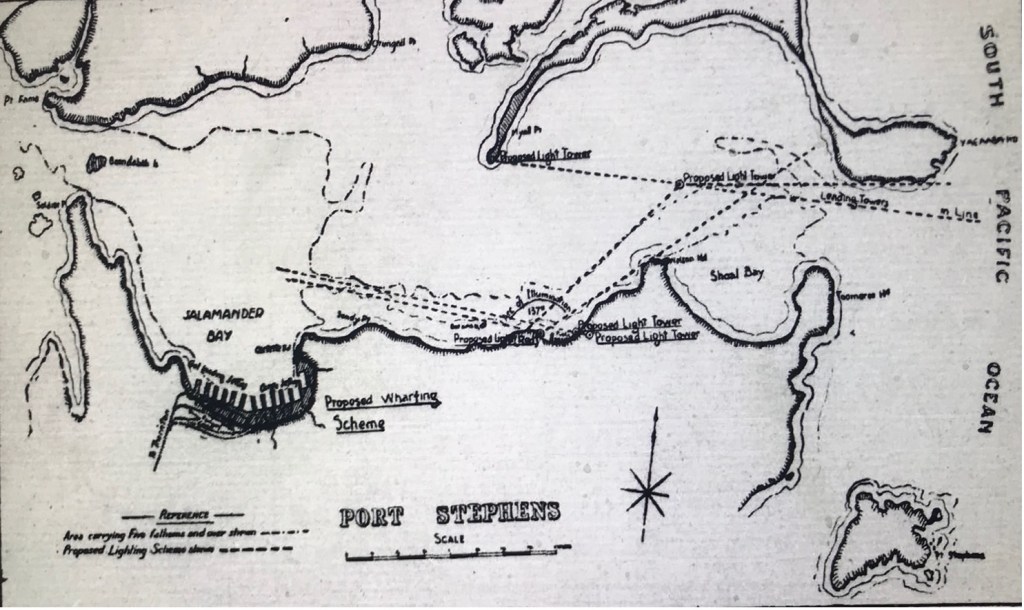
Map showing the Royal Commission’s Recommendations regarding Salamander Bay, Port Stephens. The proposed wharves for coal and general cargo; railway from Thornton; and lighting towers for navigation, are illustrated.
Commentary on the Royal Commission Report – 1911
Following the release of the Decentralisation Report, much commentary was published in newspapers on the various arguments for and against the recommendations. The Nambucca News of 2 June 1911, page 7, published an analysis of the recommendations that illustrates the types of comments being offered at the time:
‘The report of the Royal Commission on Decentralisation may mark the commencement of a period of much more rapid development than has heretofore been achieved in the history of the state. Although it has ‘”turned down” the claims of many minor inlets the report states that the claims of Port Stephens on the north, and those of Jervis Bay on the south, are incontrovertible, and that these harbors ought to be developed accordingly.
The report also indicates a number of cross country railway lines. These, if constructed, would immensely facilitate communication between the several divisions of the State, and would bring into prominence and commercial activity many centres which now languish in comparative obscurity. The Government now has an opportunity of earning genuine distinction. ……
The area which it is estimated would be served by Port Stephens is no less than 125,000 square miles. It includes all the towns of the northern district, except those which are served by the coastal line from Kempsey northwards. It also appears that towns on the western line from Maryvale westward, might find it more economical to send sea-borne produce to Port Stephens in preference to Sydney. It is to be hoped that the significance of the changes which are proposed, and of the new railway lines which are recommended for construction, will not be lost upon those who are interested in the prosperity of the towns affected, and that their Parliamentary representatives will lose no opportunity of impressing upon the Government the importance of carrying into effect the recommendations of the commission. ……
Besides opening up two new sea ports which possess great natural facilities, the construction of the cross-country lines which are proposed would immensely facilitate the transport of stock in bad seasons to localities where pasture was still to be obtained. The lines as at present constructed, give few facilities for training stock anywhere except to the metropolis, where they can certainly get nothing to eat, and where the market, even for stock fit for the butcher, is very soon over supplied. To be able to send stock, on occasion, north or south, or northeast or southeast, instead of being shut up to the present limited routes, would be an immense boon to pastoralists, and would tend in very powerful degree, to conserve the wealth, and promote the prosperity of the State. …..
The statement of the commission to the effect that, in view of the greater advantages presented by Port Stephens, the large expenditure which had been contemplated at Newcastle would not be warranted will, of course, evoke very strong protest from that important district. The commission seems to have forced to this conclusion by the weight of the evidence before it, and to have arrived at a conscientious finding.
The support, however, of the members of the coalmining districts of Newcastle is so important to the Ministry, that they will be under considerable pressure to disregard this portion of the recommendations of the commission. It may be hoped that their conception of public duty will lead them to adopt the right course, whether the Newcastle electorates approve or not. …..
For the rest, it may fairly be held that this report, so long awaited, affords an excellent opportunity of burying the hatchet, of abandoning visionary Socialistic schemes and of concentrating attention on the vigorous development of the resources of the State.’
Opposition to the Recommendations Continues – 1913
The recommendations of the Royal Commission were never implemented by the State Government. Some newspaper correspondents believed that the Government commissioned the Royal Commission, just to show that it was taking the decentralisation issue seriously, and that it was doing something about the issue, while actually having no intention of implementing any recommendations.
While no recommendations were implemented, commentary about decentralisation did not subside over the subsequent years and continued to be covered regularly in newspapers. In addition, numerous regional committees (or leagues) were formed to advocate for decentralisation action.
The Evening News of 19 September 1913, page 8, carried a report that illustrates the ongoing discussions that continued (in this case against decentralisation):
‘Much has been said about the question of decentralisation, but few of the advocates of that policy have attempted to “get down to brass tacks.” Sir Allen Taylor, in his speech yesterday in the Legislative Council, give certain figures of the cost of wharfs and so forth at the proposed ports, but such estimates could hardly be definite. The making of a port is an endless job, and though perhaps three millions of so would “open” a couple of harbors like Jervis Bay and Port Stephens, there would be a heavy annual outlay chargeable to capital, and also a weighty running cost. Dredging, lighting, depreciation, repairs, new public buildings, and a big salary that would have to be provided for, and therefore it is fair and reasonable to ask the supporters of the scheme that these projects would pay.
It must be remembered that the State has only a comparatively small population, and not much money. Both the borrowing and taxing powers have their limits, and if several millions of money are used in the construction of these new ports, the money will be diverted from other developmental works. It is not a question as to whether decentralisation is needed, but of whether it can be afforded. It is stated that many country people are in favour of it, but do they want it at the price of a lessened development of the back country, or of increased taxation.
It seems to be forgotten that decentralisation was tried at Twofold Bay, Jervis Bay and Port Stephens long ago, in the days when cargo, wool, tallow, and hides could be put aboard the old wooden ships and sent direct to the old country. But to-day the task is ten thousand times more difficult, because Sydney, with its huge population, is such a market that it can draw to itself all produce that seeks early sale. It is possible to imagine that the new ports would be useful for the export trade. But take wool for instance. Does anyone suppose that wool-growers will turn aside to Port Stephens or Jervis Bay when, by trucking their bales a comparatively few miles further they would have the benefit of the vast organisation of the Sydney wool market.
The same thing applies to most other products, but in a far greater degree than to wool, for the population of Sydney must be supplied, and the producer would like the option of selling his goods either in the local or the foreign markets. It is therefore incumbent on the advocates of decentralisation to give some proof of the amount of business that these new ports would do. And that business, it must be observed, should carry its share of the cost of the faculties which would be needed to deal with it. The fallacy under-lying much of the arguments advanced in favour of decentralisation is that a shorter line of railway must necessarily mean cheaper freights. That is not the case, the question of the bulk of the traffic carried must be taken into consideration. If millions of tons were drawn along the longer lines to Sydney, and only a few thousand tons to Port Stephens or Jervis Bay, the cost of carrying the single ton to Sydney would be much cheaper than that to the other ports.
Sydney is in fact a vast emporium which, by reason of its enormous volume of trade, can do business on a smaller “overhead” cost per unit than can be achieved by the small trader. What could or should have been done in the past is quite another matter; we have to deal with facts as they are. We have, as a people, to use our money to the best advantage. It is limited in amount, it is hard to get, we already borrow up to our limit, yet are unable to deal with numbers of great public works which are known to be both necessary and reproductive. Before launching into grandiose schemes which would infallibly commit the state to enormous expenditure, both in construction and upkeep, and which would entail greatly increased borrowing, or heavier taxation, or both, we are entitled to ask for more definite evidence as to the financial side of the projects in question.’
Seven days after the above article was published, the Daily Telegraph of 26 September 1913, page 11, carried an article that supported the recommendations of the Decentralisation Royal Commission, particularly as regards Port Stephens:
‘Mr. Mac. Abbott writes as follows: — “One of the honorable gentlemen of the Legislative Council in opposing the Port Stephens aspect of decentralisation, made the astonishing statement that the whole scheme was made on the ‘assumption that it would get the Maitland coal traffic.’ Later on he used the argument that the ‘northern’ wheat is ‘soft’ (I presume, to show that it would be more likely to be milled at home than shipped abroad). Both these references illustrate the misunderstanding that surrounds this scheme. The influence of Port Stephens will be much farther reaching than the Maitland coalfield or the districts at present connected with the northern line. The Maitland coalfield, in fact, has little to do with the matter, and can be well enough served by Newcastle.
The Commission’s report, so far from being based on the assumption suggested, appears to recognise that Newcastle will continue to be the coal port. Further, Newcastle has more reasons than any other point in Australia for becoming and remaining our greatest manufacturing centre, and I do not think that the opening of Port Stephens can retard its progress at all. I believe it has nothing to fear from Port Stephens, and in opposing its establishment it will not add materially to its own prosperity, but will retard the development of the whole northern portion of New South Wales.
I do not use “northern”in the same sense that the honorable Legislative Councillor used it, but in its broadest sense, including the western district from the Queensland border to Bourke, Cobar, Narromine, Dubbo, Gulgong, etc. ……
There is, I believe, a growing force in both country and city which will before long insist on the serious consideration of decentralisation and cross-country line building, with a view to developing the whole country. This, of course, is not to say that duplication (of existing rail lines) is not to go on. …..
In accordance with Mr. Mac. Abbott’s suggestion, we are now publishing the map, together with extracts from the report of the Royal Commission on Decentralisation, as follow: —
“Port Stephens not only offers an economical and easily equipped deep-sea port for the relief of Sydney, but its situation admits also of connections with the trunk railways of the State, which would make it effective from a decentralisation point of view. By means of suitable railway connections, Port Stephens could be made the port of expert for the whole of the North Coast, the northern, north-western, and a considerable portion of the western districts— an area comprising 125,000 square miles. “At the instance of your Commissioners an exploration was made of the country between Walcha-road on the Great Northern Railway, and Woodside on the North Coast line (now under construction), and a practical route has been found which offers not merely the best, but also the cheapest though not the shortest, connection between the New England tableland and the coast. Incidentally it would open up country suitable for closer settlement.
A branch line from the North Coast railway to Salamander Bay would bring Walcha-road within 185½ miles of Port Stephens, as against 321 miles by the existing railway to Sydney. The extension of the railway from Inverell to Guyra on the Great Northern line, and a line from Inverell or Warialdi to Boggabilla, would bring the whole of the intervening country as far as the Queensland border, within the trafficable area of Port Stephens. “Similarly, all the districts served by the north-western line out to Mungindi on the Queensland border, Collarenebri, and Walgett, could, by means of a branch line from Morpeth (referred to in the next paragraph), be brought 84 miles nearer to Port Stephens than they are now to Sydney by existing railway. ….
The cost of equipping Port Stephens for oversea trading purposes appears small when compared with the heavy expenditure which would have to be incurred in the construction of a harbor anywhere else on the North Coast. It has the additional advantage that the necessary works could be carried out within three or four years, whereas treble that time would be required to give effect to any of the other suggested schemes. Deducting from the chief engineer’s estimate, the cost of the railway connection to Thornton and of the bridge over the Hunter River, it is seen that the actual sum allotted for the provision of shipping facilities in Salamander Bay totals only £330,000. Indeed, the initial expenditure in connection with the opening of the port might be placed at a smaller figure.
The estimate includes £140,000 for the construction of two jetties, with the necessary railway sidings, for the loading of coal, but as the coal measures, so far as is known, lie nearer to Newcastle than to Port Stephens, it is possible that the facilities for the shipping of coal may not be required at Port Stephens for some time to come. The weight of expert evidence is entirely favorable to Port Stephens as an oversea port. The Mary Vale-Gulgong section would intersect good wheat land, and from Gulgong to Muswellbrook the line would pass through portions of wheat land, some good agricultural flats, and country suitable for dairying. “This line would supply not merely a direct connection with Port Stephens but that section of it between Mary Vale and Gulgong could be used in conjunction with the existing line from Gulgong to Wallerawang, for the relief of the main western line between Mary Vale and Wollerawang. …..
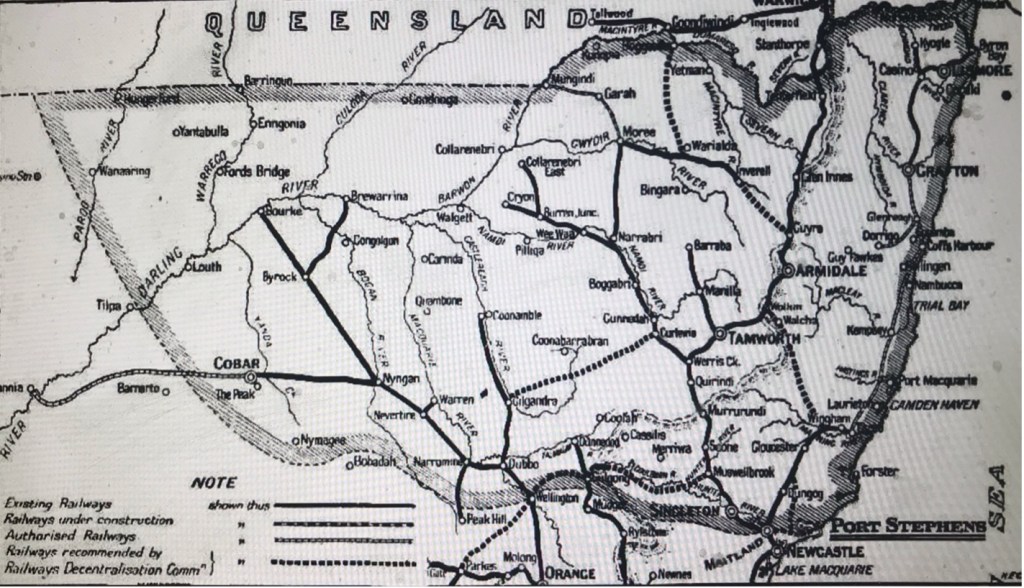
Map showing the traffic area that would be drained if Port Stephens was afforded the facilities recommended by the Royal Commission as to Decentralisation in Rail Transport.
Campaigns for the development of additional Oversea Ports – 1914
While there was opposition by vested interests in both Sydney and Newcastle against the development of Port Stephens as an oversea port, opposition also came from interest groups in other coastal areas that sought the development of a port in their regional area.
An article published in the Farmer and Settler of 19 June 1914, page 2, illustrates the viewpoints of regional interest groups:
‘At last meeting of Gough Farmers’ and Settlers’ Association District Council, held at Glen Innes, a letter was received from the Liverpool Plains branch, requesting cooperation in urging the Government to have Port Stephens opened up.
Mr. J. Wetherspoon, M.L.C., speaking on the position, said that it was a matter in which they should be very careful. Sir Allen Taylor was agitating for a railway, and the opening up of the port at Port Stephens. Such a port would be useless to the people of the tablelands of the north. ….. Mr. Wetherspoon said that Port Stephens was unheard of for a hundred years, until timber began to get scarce. Then the large vested interests got to work, took up the timber reserves, and now wanted a railway and port made to ensure their fortunes.
Newcastle was only fourteen miles away, and, with a little more money spent, could be made a fine harbor. He was a strong advocate for the port of Newcastle, and he would not be a party to Sydney; or anyone, working a “point” on the Newcastle people. What the tableland wanted was a port on the north, such as Byron Bay. Mr. Broadbent also strongly opposed falling in with the idea. If Port Stephens were made a harbor for ocean-going vessels, it would be good-bye for ever to their getting a port further north. It was unanimously decided to oppose the opening up of Port Stephens.’
Decentralisation League formed to promote Newcastle – 1914
The Corowa Free Press of 31 July 1914, page 4, reported on some of the reasons why the producers and the taxpayers generally, of the State, especially those of the North, North-west and North Coast, should support the claim of Newcastle, against that of Port Stephens, to be made the terminal port for the northern portion of New South Wales, as proposed by Mr. E. Flynn, secretary Northern Decentralisation League, Newcastle:
‘Newcastle is a great and well-established port, connected by rail with the main State system, having in its neighbourhood the largest and richest coal-fields in the Southern Hemisphere, and is the second most populous centre in New South Wales. Port Stephens, though it has a fine natural harbour, is surrounded by poor country, producing little besides timber, and is, owing to its barrenness, one of the most sparsely populated districts of the State’s seaboard.
Newcastle, in addition to being the nearest suitable sea outlet for the pastoral and agricultural products of the north, northwest, and north coast, and some parts of the west as well, is by reason of its large and rapidly growing mining and manufacturing industries employing many thousands of men and boys, a splendid home market for the products of the tillers of the soil, sheep and cattle breeders, dairymen, timber getters, and many other country dwellers. Port Stephens has no industries, and consequently no population worth speaking of; devoid of natural resources in its vicinity, it will be many years before a community of even moderato size can grow up around it and enable it to offer the producers anything approaching those advantages which Newcastle now has to give.
The statement, frequently repeated, that the accommodation for shipping in Newcastle Harbour cannot be enlarged to allow of the handling of pastoral and agricultural exports, as well as coal, is absolutely untrue. Plans, providing for an additional sixteen miles of wharfage in the upper harbour, where little, if any, silting up can occur, are now in existence. The cost of this work and of the deepening of the harbour to admit of the departure of vessels drawing 34 feet, would be considerably less than half the amount required to equip Port Stephens, and build the necessary rail. way connections.
The Decentralisation Commission estimated the cost of providing shipping facilities at Salamander Bay, Port Stephens, and the necessary railway lines at, alternatively, £3,194,000, or £3,424,000. With the increases that have since taken place in the prices of labour and material these estimates may safely be raised to anything between £4,000,000 and £4,500,000. Can any intelligent and unprejudiced person seriously contend that Port Stephens could for the next 20 to 30 years earn sufficient to pay anything approximating to working expenses and interest on this sum. Newcastle, by means of its coal trade, already pays current expenses, and returns a big profit to the Government, and, with the expenditure required to carry out the schemes of improvement referred to, its revenue producing capacity would be further and further enlarged, so that, instead of being a burden upon the taxpayers, of the State, it would, year by year, made to the profit the Treasury, through the railways and other channels, now derives from the port and district.
On the other hand, Port Stephens could not possibly, for a generation to come, at least, be made to produce a tithe of the money essential to enable the Decentralisation Commission’s recommendation to be profitably adopted. The result of its adoption would be that the taxpayers as a body would have to bear the very heavy impost involved in the task of making up the annual deficiency that would have to be met for an indefinite number of years. Even if Newcastle did not show the excellent results that it does, for the money spent upon the harbour, it is necessary, in the interests of New South Wales, and of Australia as a whole; that the port should be made and kept as efficient and up-to-date as possible for the sake of the coal trade alone. No such necessity exists in the case of Port Stephens, and it is a ludicrous absurdity to ask or expect any Government and Parliament to spend between four and five millions sterling on opening up a port that will not be needed for a generation ahead, if then, simply because it has a fine natural harbour, “which it is such a pity to see lying unused,” to quote a plea put forth by one newspaper correspondent, with refreshing naivete.
In any scheme of decentralisation that may evolved, the prime need is the provision for the conveyance of produce intended for export from the railway station, platform, or siding nearest the point of production, to the nearest suitable port. To any part of the north, or north-west and the west also, Newcastle stands in this latter relation. Port Stephens does not. Newcastle is nearer by anything from fourteen miles up-wards to every station on the northern line, from Tamworth south, and to every station without exception on the other lines, than is Port Stephens. Would the producers be willing to pay for miles of unnecessary haulage of their goods, for the doubtful privilege of shipping them at Port Stephens, when they could have them handled equally well, if not better, at the nearer end, and, for them, cheaper port of Newcastle.
The preposterous foolishness of the demand that Port Stephens be forthwith opened up, connected with the railway system, and made the terminal port of the north, can be more clearly realised if one reflects that the season proper for the shipment of wool and wheat does not, at the most, extend over more than six months of the year. Assuming that Port Stephens, when ready for the task, secured the whole of the wool and wheat exports of the north and north-west (which is not at all probable), this trade could all be disposed of easily within six months. Upon what would the community subsist for the rest of the year. As already stated, the surrounding country produces nothing worthy of consideration. From what source could be obtained the wherewithal to supply sustenance for the business people and workers, and profitable employment for the costly port equipment, railways, etc., until the next wool and wheat season comes round?
The Decentralisation Commissioners, and certain witnesses who gave evidence before them, seemed to entertain the belief that the South Maitland Colliery Proprietors might be induced to keep Port Stephens going by sending their coal there for shipment. Seeing that to do so would entail some seventeen miles of additional haulage, which would increase the railway, freight charge by one shilling per ton, the folly of such an anticipation should be apparent to all. Newcastle recognises and readily acknowledges that there is need for the creation of commercial ports (which includes, of course, their connection with the railways), at Jervis Bay, or Twofold Bay, and at Coffs Harbour or Byron Bay, and would rejoice to see some— even all — of these established with as little delay as possible. The opening up of Byron Bay or Coffs Harbour on the north, and either Jervis or Twofold Bay down south, is regarded as an urgent necessity.
The financial resources of the State are, however, not illimitable, and it is quite certain that if £4,000,000 to £5,000,000 were spent on Port Stephens, the pressing need of ports and railway development on the northern and southern coasts and their districts would have to remain long unsatisfied. Undoubtedly this would be so as far as Coffs Harbour and Byron Bay are concerned. For more than a century New South Wales has had to manage with practically one port for general trade—Sydney. Now it is proposed to have three ports within a distance on the coastline, of 83 miles!’
Tamworth Decentralisation Conference – 1918
During the hostilities of the First World War (1914 to 1918) action to foster decentralisation was suspended. During this time, Government money was expended on the further development of Newcastle, to support wartime naval activities. An indirect benefit of the additional expenditure on Newcastle port infrastructure, helped it advocates present a stronger case for Newcastle to be retained as the main oversea port for northern New South Wales.
After the ending of the First World War, action again ramped up to secure additional oversea ports. One such pro-active action was a conference held in Tamworth, to support the opening as an oversea port. The Glen Innes Examiner of 21 October 1918, page 2, reported:
‘Twenty-nine delegates from North and North-westem centres met at Tamworth on Wednseday to consider the question of decentralisation, and primarily the advocacy of Port Stephens as the most suitable Northern port. The President of the Tamworth Decentralisation League presided. A motion was carried “affirming the desirability of establishing a port for overseas shipment at Port Stephens with necessary railway connections with the North, North-west, and North Coast”.
A further motion was carried that to give effect to this resolution, leagues be formed in the North and North-west, with a central council, and that the delegates present undertake to form such leagues in their respective districts. Lieut. Col. Abbott, M.H.R., who was present, strongly supported Port Stephens “as the ideal port for the North.” ‘
The Daily Observer of 23 October 1918, page 5, published the following photograph of the delegates who attended the Tamworth Conference, held on 16 October 1918:
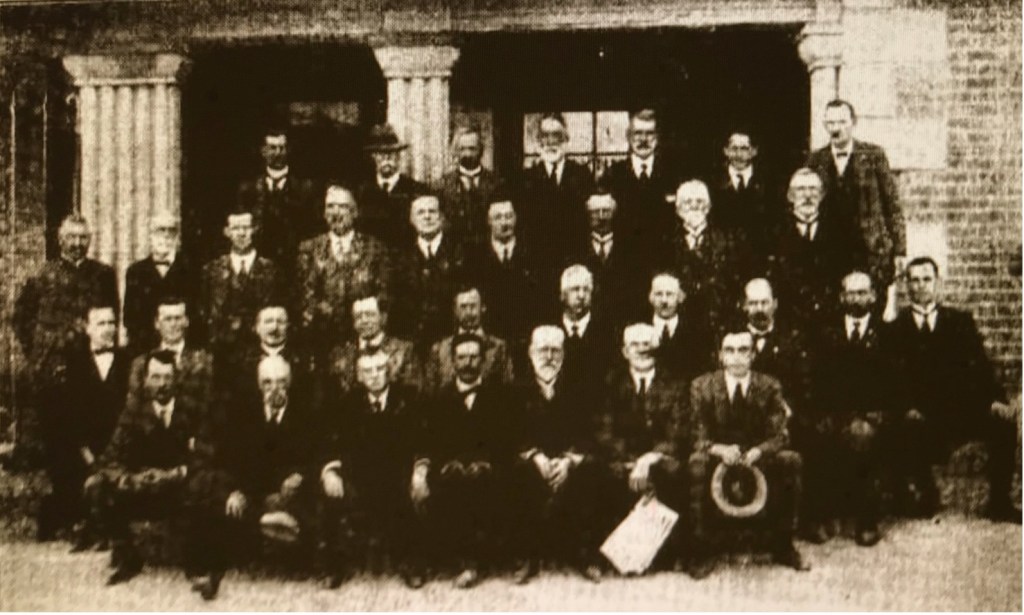
Back Row: Cr. D. Cromarty (Port Stephens), Cr. J. Somerville (Peel Shire) A. Perrett (Gunhedah), F. E. Heywood (Manilla), W. J. Peek (Peel Shire), Cecil Flynn (Peel Shire), W. Bury. Second Row: Greaves (Stroud), Seth Forge (Tamworth P. and A. Association), Cr. R. J. Crosthwaite (Upper Hunter), R. Emmett, D. Groves (Ed. “Austral Briton”), Ald. Walker (Narrabri), R.H. Hawker (Manilla), W. T. Lang-worthy (Manilla), Ald. J. A. Jones (Mayor of Dungog). Third Row: Mr. Allen (Secretary Jarvis Bay Decentralisation League), Ald. C. J. Woollett (Treas. Tamworth Decentralisation League), Ald. Gus Logue (Tamworth Decentralisation League), Lieut.-Col. P. P. Abbott, M.H.R., A. J. Creagh (President Tamworth Decentralisation League), Hon. Austin. Chapman, M.H.R., (Eden-Monaro), H. S. Secomb (Secretary Tamworth Decentralisation League), A. J. Telfer (Tamworth P. and A. Association), Cr. P. Phillips (Stroud), H. M. Engel (Port Stephens). Front Row: E. H. G King (Tamworth P. and A. Association), J. J. Grace (Nowendoc), Scott Griffiths (Town Planning Architect, Sydney), Cr. Rixon (Gostwyck Shire), Cr. L. J. Bailey (Gunnedah), C. Vincent (Manilla Decentralisation League), V. C. Thompson (Editor Tamworth “Daily Observer.”).
Concluding Comments
The various arguments for and against the implementation of the key Royal Commission recommendations, together with the activities of many regionally based organisations, mitigated against any public works reaching fruition.
In 1919, a proposal was floated by Sydney interest groups to make Port Stephens a Quarantine Area by transferring the Manly Quarantine Station. If actioned , this would have had a detrimental effect on efforts advocating the establishment of the area as an oversea port.
Agitation for the establishment of Port Stephens as an oversea port was once again boosted in 1924 when community agitation commenced for the establishment of a New State Movement to cater for the needs of northern New South Wales.
Researched and compiled by Kevin McGuinness
October 2022

 Port Stephens - a history exploration