

Introduction
From the late 1890’s up until the Second World War, organisations and prominent citizens advocated for the development of port facilities at Port Stephens. They also lobbied for the construction of a railway to the harbour to service the port and aid future commercial development.
From 1920s, based on the belief that a railway would be built to Port Stephens, numerous real estate developments were marketed by land speculators on the northern shores of Port Stephens around Pindimar and North Arm Cove.
The main ones were the Pindimar City development, City of Peace at Pindimar and the Port Stephens City at North Arm Cove.
Despite all the convincing arguments about Port Stephens being a wonderful natural harbour, significant industrial and/or real estate development never occurred there. The main disadvantage was its close proximity to Newcastle. On numerous occasions, vested commercial interests in Newcastle and Sydney won the day.
Another issue that hindered the construction of a railway for the Port Stephens region was the numerous conflicting views as to its route, and whether the terminus should be on the northern or southern shore.
A Port Stephens railway was also closely aligned with other current proposals for the region such as decentralisation of railways, defence planning and the New State Movement, in which Port Stephens would be the deep-sea port for a proposed new northern state.
The first significant campaign was fuelled by the recommendations of the Royal Commission as to Decentralisation of Railway Transit – 1911.
The next boost was given in 1924, when the Fuller Government asked the Parliamentary Standing Committee on Public Works to consider and report on the expediency of constructing a line of railway from Stroud Road to Port Stephens.
Prior to 1926, in opposition to the railway, there were other groups advocating for the construction of a tramway from Stockton to Salt Ash, with the prime purpose of allowing farm produce to reach the Newcastle port. From 1892 to 1926 there were four attempts to establish a tramway from Stockton to Salt Ash. See also Proposed Tramway from Stockton to Salt Ash on this website.
This paper examines, in five parts, the various community campaigns to procure a railway terminating on either of the northern or southern shorelines of Port Stephens.
The newspaper records, from the National Library of Australia’s Trove collection, are the primary source of material presented in this paper. Not all of the newspaper reports on the subject have been included given the length of many reports and also the repetitive nature of such material. The material presented aims to present an overview of the main arguments advanced and activities undertaken by community groups to have a railway constructed and the governments responses to such actions.
PART ONE: PROPOSED RAILWAY FROM STOCKTON TO SALT ASH
Proposal for a Railway from Stockton to Salt Ash – 1899
The Newcastle Morning Herald and Miners’ Advocate of 21 November 1899, page 5, reported:
‘At the request of Mr. R. A. Price, M.P., an officer from the Railway Construction Branch of the Public Works Department will leave Sydney tonight, with the object of reporting upon the two proposals for the construction of lines of railway from Stockton to Salt Ash, and from Tarro to the Hunter River, at Raymond Terrace, by way of Miller’s Forest. …… The Stockton to Salt Ash line would be about 18 miles in length and would connect the navigable waters of Port Stephens and the Hunter. The officer will devote tomorrow and Wednesday to the Tarro proposal, and Thursday and following days of the week to the Stockton-Salt Ash proposal.
Mr. Price has advised the Mayors of Newcastle and Stockton of the officer’s visit, with a request that he confer with the Chamber of Commerce and citizens, on the matter. The member for Gloucester has also requested the Progress Committees of Miller’s Forest and the Raymond Terrace and Port Stephens districts to furnish Mr. Walker, the officer in question, with all available information.’
The Newcastle Morning Herald and Miners’ Advocate of 24 November 1899, page 5, further reported:
‘Yesterday Mr. Walker, of the Railway Construction Branch of the Public Works Department, visited Stockton to inspect the route of the suggested railway from Stockton to Salt Ash, and was taken over the cart-road connecting the two places by several representatives of the Stockton Council, and some of the settlers in the district traversed. ….. The route throughout was most carefully examined by Mr. Walker, who took very careful stock of the lie of the land and took ample notes. To all those who made the trip what was seen was well worthy of notice.
The whole of the land between the two places names, which are 15½ miles apart, is, with very small exceptions, settled by dairy farmers, and the industry carried on is of pretty extensive dimensions. It may be roughly stated that the farms carry from 10 to 80 cows. Vegetables are also very extensively grown. The amount of dairy and other produce which the agitators for the line claim that the settlers along the line of route would send to market would certainly be very extensive, but a very much larger district than that actually traversed by the line would be benefited immediately, it is claimed, if it were constructed.
The terminus at Salt Ash would be situated upon the banks of the Tellegarry [Tilligerry] Creek, which connects with Nelson’s Bay, Port Stephens 18 miles distant, and with Broadwater, Myall Lakes, Bulahdelah, Booral, and many other places spread over a very large tract of country, which is very extensively occupied by settlers of various kinds, chiefly dairy farmers. At present the greater part of their produce is conveyed by water to Newcastle via Port Stephens, and the representation of the agitators for the railway is that this traffic is of necessity unsatisfactory. All of the places involved are accessible by water to craft of a draft of from five to six feet, and these, or others slightly larger, after collecting the produce and concentrating it at Nelson’s Bay, convey it to Newcastle. But the best vessels that could make this trade profitable would be such only as would always be considerably subservient to weather conditions, and the result has always been that perishable goods, preponderant among which are fish and milk, have had to rely upon a service which is not so expeditious as railway, and which not seldom fails them.
It is claimed that the desired railway, besides conveying to Newcastle the produce of Fullerton Cove, Williamtown, Parading Grounds [Williamtown], and Salt Ash, would also, at the terminus on the banks of pretty Tellegarry [Tilligerry] Creek and Salt Ash, be used for the conveyance of the products of a very extensive tract of country, some 30 miles long, measured in a southerly direction, which would be collected to this spot in perfect safety and in all weathers by droghers plying in the Myall River, Myall Lakes, Broadwater, and other navigable creeks and rivers. The scheme certainly seems to have a very great deal to recommend it. The country the line would pass through is very nearly all of it very fertile and is nearly level throughout.
In 1892 an estimate of the cost of a tramway over this route was made, the probable cost being set down at £62,000. It is believed that a light railway now could be constructed for a sum not greatly exceeding this. Yesterday so much time was occupied in the careful examination of every feature of the country passed through that Salt Ash was not reached till four o’clock in the afternoon. Several settlers about Salt Ash, Anna Bay, and the various contiguous places had assembled at Salt Ash expecting the arrival of the party at about noon, but they went away disappointed at about 2 p.m. Mr. Matheson of Salt Ash, however, made the explorers very welcome when they did arrive, and regaled them most hospitably.
Mr. Walker remained at Salt Ash for the night to interview some of those settled in the district. The travellers could not fail to marvel regretfully that a road which had been traversed largely for some 30 or 40 years should be still so exceedingly bad, very large tracts of it being still in its virgin state, just marked off and cleared of bush, but that is all. Some of the residents in country passed through have become so accustomed to their sylvan seclusion that they dread the introduction of anything in the way of railway, largely because they fear it will bring with it public houses [hotels] of which there are none at all in the thirty-mile stretch from Stockton to Nelson’s Bay; but the great majority see that it would be of immense benefit to them. As a matter of fact, it would open out and bring within easy reach of the market a great deal of very good country, and it seems very reasonable to hold that the amount of traffic, of which the holiday excursion element could not fail to form a very appreciable portion, would insure the payment of good interest on the cost.’
Official Report on the Proposed Railway to Salt Ash – 1900
The Newcastle Morning Herald and Miners’ Advocate of 6 October 1900, page 5, published the following report of Mr. Walker, on his investigation of the proposed railway line from Stockton to Salt Ash:
‘Mr. Price, M.P., has received from the Railway Commissioners the following report, obtained by the Minister for Works from the officer appointed to investigate into the matter of the proposed railway:— Sir,—I have the honour to inform you that I examined the above proposed line of railway on the 23rd and 24th November, and beg to report as follows:— The town of Stockton is situated at the south end of a long narrow promontory lying nearly north and south opposite the city of Newcastle. On the east of the promontory is the South Pacific Ocean, and on the west is Port Hunter. Communication between Stockton and Newcastle is maintained by small ferry steamers and a horse ferry to accommodate vehicles.
Salt Ash is situated on Tilligherry [Tilligerry] Creek, an arm of Port Stephens. This proposed railway is also designated as Stockton to Port Stephens in the papers connected therewith. There are a few settlers near Salt Ash, where there is a wharf to which vessels drawing 5ft can get at high tide. The wharf is rather too high up the creek. If a quarter of a mile lower down I was informed that vessels drawing 5ft could approach at any tide. By this means direct communication by water through Port Stephens could be maintained as far north as Myall Lake. I was informed that a tramway spans the short distance between Myall Lake and Smith’s Lake, and that passengers and fish are carried by water and overland from around Wallis Lake and about Gooloongolook (which is also an agricultural district) to Myall Lake to board the small steamers running direct from there to Newcastle. The north end of Myall Lake is about 50 miles from Salt Ash by way of the Myall River.
Launches ascend Saltwater and Pipeclay creeks, Karuah River (as high as Booral Wharf), and Larpint River. There are several small centres of population around Port Stephens and on the above-mentioned rivers and creeks. The population is engaged in timber getting, combined with farming, saw-milling, and fishing. There are limited patches of fair agricultural country; for instance, between Bulahdelah and Gooloongolook. There are at present four steamers engaged in the trade between Port Stephens, with its connected inlets and lakes, and Newcastle. These range from 29 to 57 tons, and are suited for getting about the lakes, but not so for rough weather outside, and the heavy sea at the entrance of Pelt Stephens with certain winds prevents their going out. Consequently, passengers are delayed, and fish and dairy produce are spoiled.
There is a good trade in timber between Port Stephens and Sydney and Newcastle, carried on by means of droghers. I think it must be admitted that the population around Port Stephens, with its rivers, creeks, and inlets, as also around the lakes to the north, is sparse and scattered at present, but a railway as proposed would tend to open up the district as far north as Cape Hawke, with mutual advantage to it and Newcastle. I did not receive a favourable account of the trade at the office of the owners of two of the larger steamers running between Port Stephens and Newcastle. They set down the passenger traffic to Newcastle as 20 per week. It was represented that a railway as proposed would open up an additional health resort for Newcastle and neighbouring townships. ……..
Dealing with the country between Stockton and Salt Ash, and that round the latter place likely to be affected by railway communication, it should be said that as far as four-mile the land is of small value. About here the districts of Fullerton Cove is entered, and the land is used for dairy farm purposes. From about five-mile there is more settlement, with small farms. At six-mile there is a settlement known locally as Tremerten. From eight-mile to thirteen-mile an average breadth of sixty chains to eighty chains the farms are very numerous, and the land, especially on the east side of the road, is black alluvial. Dairy farming, agriculture, and market gardening are carried on. At about nine-mile is the small settlement of Williamtown, which is the centre of this district. Beyond twelve-mile the land is chiefly used for dairy farms, and these extend as far as Salt Ash on both sides of Tilligerry Creek.
At about 13¾-mile a road branches off the Salt Ash-road, leading to Anna Bay, distant about three miles from here, where there are about 30 settlers. They are engaged in dairy farming and market gardening, bringing their produce by cart to Newcastle market.
All this district from about Fullerton Cove is confined on the east by a range of sand hills, running parallel to the ocean. On the west from Williamtown to the north-eastward the country is locally called moor land, and most of it is very inferior. There is no coach running on the Stockton-Salt Ash road at present. One used to run in conjunction with a steamer from Port Stephens to Salt Ash, but coach and steamer were not in the hands of the same proprietor, which partly accounted for the business not paying. I was informed that the number of carts carrying produce from the Anna Bay, Salt Ash, and Fullerton Cove districts was only 25 per week. The terminus at Stockton of the proposed railway should be west of Stockton-street, near the patent slip.’
Newcastle Council Supports Proposed Railway from Stockton to Salt Ash – 1900
The Sydney Morning Herald of 23 October 1900, page 6, reported:
‘At tonight’s meeting of the City Council a communication was received from the Port Stephens Progress Committee seeking the cooperation of the council in the agitation for the construction of the proposed light line of railway from Stockton, on the north foreshore of Port Hunter, to Salt Ash. …… The council decided to assist the movement in every way possible, and it was decided to request the Parliamentary representatives of the district to urge the claims of the district in question before the Public Works Department and Parliament.’
The Newcastle Morning Herald and Miners’ Advocate of 26 October 1900, page 5, further reported:
‘The following letter has been sent to Mr. W. T. Dick, M.P., in regard to the Stockton to Salt Ash railway: — “Borough of Newcastle, Town Clerk’s Office, 24th October, 1900. W. T. Dick, Esq., M.P., Sydney. Dear Sir, — I have the honour by direction of the council of the Borough of Newcastle, to request you to be good enough to assist in having the railway from Port Stephens to Stockton proceeded with as expeditiously as possible. There can be no doubt the opening up of this railway will be of great benefit to the trade and commerce of this city, and the colony generally, by developing a large area of land that at present has not been brought under cultivation, and by the opening up of market for produce, fruits, &c., large and regular supplies of fish, and affording at holiday time very beautiful pleasure resorts for those in need of change and enjoyment.
The beauty of the port, the bays, and lakes, are at present known to very few, but when this line of railway is constructed there will be additional beauty to be found in easy reach of all, to whom it will prove an unsurpassed revelation. I may mention that Mr. R. A. Price, M.P., is urging the construction of this line in the interests of all parties, and this council is fully in sympathy with the project, and willing to cooperate, and trust you till do all in your power to further this important work to a successful issue. — I have, &c. (signed), David Miller, Mayor.” A similar letter was sent to Mr. James Thompson, M.P.’
Meeting to Support Proposed Railway Held at Williamtown – 1901
The Newcastle Morning Herald and Miners’ Advocate of 5 June 1901, page 8, reported:
‘Last night, in the Temperance Hall, a largely attended public meeting was held, for, the purpose of obtaining an expression of opinion as to the desirability that a light line of railway should be constructed to connect Stockton with the waters of Port Stephens, at Salt Ash, on the Tellegerry [Tilligerry] Creek. Among those present were a considerable number of the settlers from Fullerton Cove, Williamtown, and Salt Ash, all lying upon the line of route of the proposed railway. The mayor (Alderman T. B. Warland) was voted to the chair. The mayor apologised for the absence of Mr. W. T. Dick, M.P., whose duties on the Public Works Committee compelled his at-tendance elsewhere. Mr. Dick promised that if the matter was proceeded with, he would draft the evidence, in order that the proposition might be laid before the Public Works Committee in the proper form.
The mayor expressed the opinion that in many ways, both for opening up the land and encouraging settlement, and facilitating the conveyance of produce to market, and also for giving easy access to the fine pleasure resorts of Port Stephens, the railway was a thing to be desired. Alderman Rees stated that when he, with other members of the council, went over the route it seemed that most of the settlers were more favourable to a tramway than to a railway.
Mr. Stanley W. Smith, junior, advocated a tramway in preference to a railway. He held that the railway would cost a very great deal more than a tramway, as the latter would run along the roadway already made; also, the railway, in crossing the swamp between Fullerton Cove and William Town, would pass a good distance from the settlers’ residences, and owing to the swamp there would be no facilities for getting to it. Also, in constructing the railway, a good deal of private land would have to be passed through, and its resumption would be expensive.
Mr. Thomas Stratten stated that in a recent interview with the Minister for Works he had said that he was prepared to make a railway from Stockton to Salt Ash, and he spoke of a railway, not a tramway. Mr. J. R. Wooderson, of Medowie (many years ago a resident of Stockton), pointed out that Medowie was further up the country, and he held that owing to the heavy timbers they had thereabouts, and to the known existence of valuable fluxes, and good iron ores in the locality, there was a great future in store for the whole district. His opinion was, however, that a tramway would be too light to carry to market the heavy products he had referred to, and he held that where the real advantage could be derived from the proposed railway would be by bringing these heavier and more valuable products to market.
To bring the dairy products of the nearer settlements to market by a tramway might be fairly well, but that alone would be but a partial good. He added that the people of Medowie had already approached the Government on the matter. It was pointed out that when Mr. Douglas Walker some time ago made an inspection of the line of route he had seemed to prefer the idea of a light railway to that of a tramway.
It was moved by Alderman Rees, “That in the opinion of this meeting it would be a very material advantage to a large district, and the means of increasing settlement therein, and the productiveness thereof, if a light line of railway were laid down to connect Stockton with the waters of Port Stephens, at Salt Ash, on the Tellegerry [Tilligerry] Creek; and that it is highly desirable, in the interests of a large number of people, and of the district generally, that the Government should immediately undertake this work.” This was seconded by Mr. W. Donnelly, who testified highly to the richness of the country involved, which he knew well. The motion was carried unanimously.
On the motion of Mr. J. R. Wooderson, Seconded by Alderman Hudson, it was resolved, ‘That the foregoing resolution be forwarded to the Minister for Works, with a request that a survey may be made, and the work proceeded with as soon as possible, if the Government can undertake it; and that it he recommended that the railway should go by way of the Stockton-Salt Ash road direct to Williamtown, and thence by the main road again to Salt Ash.” It was further resolved, “That the resolutions be forwarded to the Minister, through Mr. W. T. Dick, M.P., by the local council, as an expression of opinion by the people of Stockton, and that Messrs. R. A. Price, A. Griffith, J. N. Brunker, J. L. Fegan, and Alfred Edden, Ms.P., be asked to assist.” A cordial vote of thanks was accorded to the chairman, on the motion of Mr. J. R. Wooderson, seconded by Alderman Griffiths.’
A Tramway Proposed as an Alternative to a Railway – 1901
The Newcastle Morning Herald and Miners’ Advocate of 13 June 1901, page 5, reported:
‘In pursuance of his list of engagements, Mr. G. Fischer, the Engineer for Tramway Construction, yesterday made an inspection of the proposed line of tramway from Stockton to Salt Ash, a distance of about 15 miles. He was accompanied by his inspector, Mr. D. Reeves. …..
The real object of Mr. Fischer’s visit was to inspect the route, which the people had suggested the tramway should traverse, and to submit to Mr. O’Sullivan an estimate of the probable cost, anything over £20,000 having, of course, to be referred to the Public Works Committee. Several vehicles were provided for the inspection. It was noticed that the line would pass through some rich country, and it could be seen that if the people had facilities for getting produce to market very great encouragement would be given, leading no doubt to a rapid increase in settlement, there being an abundance of Crown lands some distance further north.
The country presents no engineering difficulties for tram construction, being practically level the whole way; and it is the opinion of the people that the line could be constructed tor about £1200 per mile or less than £20,000 altogether. What Mr. Fischer’s opinion is on this point remains to be ascertained, but those who travelled with him yesterday feel confident that the money for the tramway will be placed on the next estimates. There is not a great population along the route but the progressive Minister for Works has looked upon the project from a “National” point of view, and it will not be Mr. Price’s fault if Mr. O’Sullivan is not kept up to his definite promise, which was, that he would make provision for the expenditure on the next estimates.
What will bring great revenue to the line, if constructed, is the carriage of produce. There are farms at intervals for the whole distance, and a great dairying industry could be encouraged. But the chief source of revenue would probably be in the carriage of fish. Several steamers are now engaged in the fish trade to Newcastle, but they are often delayed by bad weather, and it not infrequently happens that cargoes of fish and farm produce are spoiled to say nothing of the great delay and inconvenience to passengers. …..A tramway to Salt Ash would open up a splendid avenue of trade, and afford a healthful “lung” to the recreation resources of the city. …..
There was a proposal about a year ago to construct a light line of railway from Stockton to Port Stephens, via Salt Ash. Mr. W. D. Walker’s report upon this was published in full in the “Newcastle Herald” at the time. He suggested that the line, after following the main road half-way to Fullerton Cove, should then leave the population in favour of a course along the swamp leading to the Raymond Terrace Road. Naturally enough, the people objected to this route. If the tramway should be constructed according to Mr. Fischer’s ideas, satisfaction will be given to all concerned—not excepting Mr. Percival. J. M. Brown, who, as secretary of the Salt Ash Progress Committee, had worked hard to have the light railway line.
At different points of his inspection yesterday, Mr. Fischer was met by leading residents. …. Alderman W. H. Goodman was present at Salt Ash. Mr. R. A. Price, M.P., who had been at Williamtown overnight (with Mr. Norman Grant, the Road Superintendent), gave the visitors a hearty welcome. He maintains that the tramway will be profitable to the department and looks forward to the time when it will open up about 80 miles of inland waterways, from Port Stephens to the Myall River, to The Broadwater, to Booloombayt Lake, to Myall Lake, and Smith’s Lake, and thence to Wallis’ Lake and Cape Hawke. He expects to see not two or three tons of fish taken to Stockton each day, but more like twenty tons—sufficient to considerably augment the supply of Sydney. There are, he says, some 60,000 acres of Crown lands available for settlement.’
The tramway proposals examined in the paper all failed to receive government support and funding.
PART TWO: PROPOSED RAILWAY FROM THE MAIN NORTHERN LINE TO THE SOUTHERN SHORES OF PORT STEPHENS
First Proposal for a Railway Line to the Waters of Port Stephens – 1907
The Northern Star of 15 August 1907, page 2, reported:
‘Mr. W. E. Abbott advocates a line from the North Coast Railway to reach deep water on Port Stephens from Maitland, so as to give a better and more certain outlet for coal and other produce from above that point. The distance is only the same as is Newcastle, and Port Stephens has over 50 feet of water at the entrance, with a sheltered area inside more than twice as large as that of Sydney harbour, and quite as well sheltered. Port Stephens is in fact, the best port in Australia, and is now only used by a few timber getters and fishermen, and occasionally as a port of shelter in rough weather for coastal shipping. It ought to be the port of the Hunter, and all the north and northwest, from Bourke to St. George, in Queensland.’
Port Stephens Shire Council Seeks Support for proposed Railway – 1910
The Gloucester Advocate of 9 July 1910, page 10, reported:
‘The Gloucester Shire Clerk has received the following important letter from the Shire Clerk of Port Stephens. Sir. — In accordance with a resolution passed at a meeting of my Council today, I am directed to ask if the President of your Council will join with the President of the Wallarobba, Stroud and Port Stephens Shires together with the member for your district informing a deputation to wait on the Premier to urge upon him the claims of Port Stephens as a terminal port for the North and North West. A deputation from Newcastle is scheduled to wait on [meet with] the Premier on the 13th instant to urge the claims of Newcastle as a terminal port thereby retarding the progress of Port Stephens.’
Appointment of Royal Commission as to Decentralisation in Railway Transit – 1910
In response to ongoing calls by country organisations, such as exemplified above, the for decentralisation of government administrative functions and infrastructure away from Sydney to regional areas, the NSW State Government appointed a Royal Commission as to Decentralisation in Railway Transit. The Sydney Morning Herald of 5 July 1910, page 7, reported:
‘The Royal Commission on the decentralisation question has completed all preliminaries, and on Thursday the inquiry will be formally commenced at 10 a.m. in the rooms of the Public Works Department. …..
The investigations are to be made as to the terminal points inland and on the seacoast of the State which should be connected by rail, and generally the commission will advise as to the best means of carrying out a system of decentralisation in railway transit. Information will be obtained from the Public Works Department in regard to the harbour schemes which have received consideration, and also as to any railway extensions which have been inquired into or are under consideration, with a view to connecting those harbours with the existing railway lines. Following this, the Chief Commissioner for Railways will be asked to furnish any information available as to those proposals.
It is not the intention of the commission to go into detailed evidence at this stage of the inquiry, but to obtain general information in regard to harbour schemes and railway extensions in connection therewith which have, as is the case in some instances, been the subject of investigations, and also those which have only been gone into by a preliminary way. After obtaining general statements on these subjects the commission will proceed with a thorough inspection of the localities of the harbour and railway extension schemes, and any others which may be deemed advisable. The commission will then take evidence in the country, on the coast, and in the metropolitan centres where information which will assist the investigations may be obtained.’
Railway Transit Decentralisation Royal Commission Visits Port Stephens – 1910
The Newcastle Morning Herald and Miners’ Advocate of 6 August 1910, page 4, reported:
‘Mr. C. J. Oliver and Mr, W. H. O’Malley Wood, members of the Railway Transit Decentralisation Royal Commission, visited and inspected Port Stephens on Thursday, and came on to Newcastle yesterday. During the afternoon the members of the commission were shown over the harbour by Mr. P. Allan, district engineer, who was accompanied by Alderman Reid, the Mayor of Newcastle. All the recent improvements and works in contemplation were fully explained, and the commissioners were much interested. Mr. Oliver, who is the chairman of the commission, informed a representative of the “Newcastle Morning Herald” that the commissioners were making a general tour of the coast, and such portions of the inland centres that might be affected by any contemplated decentralisation of the railway system. They had already completed their inspection of the North Coast, and New England tablelands and next week they would enter on an inspection of the South Coast, and that portion of the State that might be benefited by any decentralisation practicable. Later on, after getting a general insight into the whole situation, and conversing with representative people interviewed they would return to such places they might desire to give evidence with a view to taking it in a formal manner. The commissioners returned to Sydney last evening.’
Evidence Favourable to Port Stephens Provided to Public Works Committee – 1910
The Dungog Chronicle of 22 November 1910, page 2, further reported:
‘Mr. De Burgh, Engineer, giving evidence before the Decentralisation Committee recently, gave following facts concerning the proposal to equip Port Stephens as a shipping port: “He proposed to make the shipping place in Salamander Bay, on the southern shore of Port Stephens, about 6½ miles distant by water from Toomeree [Tomaree] Head, at the entrance to the port. The connection between the bay and the railway system of the State would be by means of a line junctioning at Thornton, which was about 31 miles distant from Salamander Bay, and 14 miles from Newcastle.
At the bay jetties for coal loading and general purposes would be erected with all necessary railway connections. Certain dredging would be required at the entrance to Port Stephens. There was a channel there with a least depth of about 31ft at low water spring tide. This needed straightening and widening to render navigation by deep draught vessels easy and safe. Improvements in the lighting of the port were also proposed. It was suggested to erect six large coaling jetties in the bay, each 700ft long, and also five cargo. jetties, 700ft long, and 100ft wide, and further wharfage having a frontage of 3000ft. There was a large expanse of water to the north of the shipping place, where it was proposed to construct a basin for small vessels, launches, and boats which would be inconvenienced by the waves running into the bay in certain weathers.
“The total length of berthage provided in the scheme was 21,000ft. Railway connection would be made with each jetty and wharf, and at the coaling jetties it was decided to have coal bins and travelling bands for conveying the coal to four points of delivery on each jetty. At two such jetties it was anticipated it would be possible under fair conditions to deliver about 3,000,000 tons of coal per annum. It was also proposed to have a railway compound similar to that at Carrington, Newcastle. In the first instance two coaling jetties and two cargo jetties should suffice, and a compound to take, say, 2500 trucks. These only were included in the estimate. The cost of making Port Stephens into a shipping port on the lines indicated would be about £875,000.’
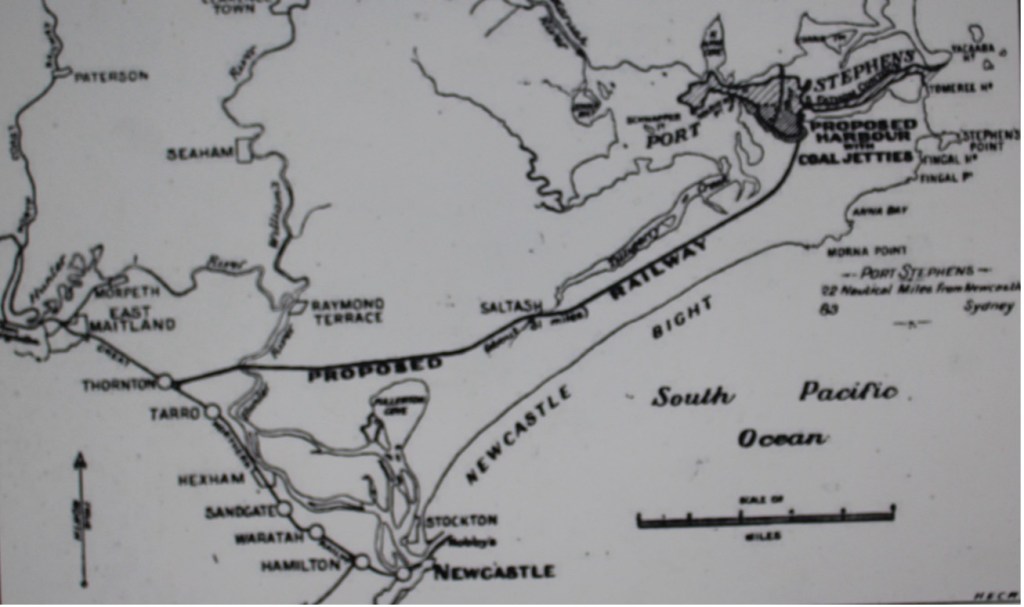
Diagram of the proposed railway line from Thornton to Salamander Bay [Daily Telegraph, 27 April 1910]

Map illustrating Mr De Burghs plan for Port Stephens showing the railway route from Thornton to Salamander Bay. The map also shows the proposed wharfing scheme at Salamander Bay and the proposed light towers on both shores of the bay.
Commentary on the Two Railway Proposals for Port Stephens – 1911
The Dungog Chronicle of 28 March 1911, page 2, reported:
‘Public attention has been called to the necessity of joining that magnificent harbour Port Stephens to the railway system of the State. There are two proposals that have been advanced. One is to connect the present northern line with Port Stephens on its southern shore, at Salamander Bay, by a short branch line from Thornton. This proposal is merely to do Newcastle an injury, by taking away the trade that rightly belongs to it and directing it to Port Stephens. On the face of it, it stands condemned. Why should Newcastle be injured by bolstering up a Port at another place?
The second proposal is to connect the North Coast railway with Port Stephens [on the northern side of the port]. This has everything possible to recommend it. A new and independent Port will be established, doing injury to no other, but founding what will assuredly grow to be one of the finest cities of the Commonwealth. Look at a map of New South Wales, and you will see at once that Port Stephens is the natural seaport for an enormous area of the State. Nothing is required but railway communication to the northern shores of the harbour, and the trade must naturally flow to it, and a great seaport town be established. The trade in timber alone would be enormous. Dairying, corn growing, and other rural industries would swell the volume of outward trade; while the great population that would be attracted would create a very large inward trade.
How this splendid harbour, that is so badly needed for a great portion of the State, should have remained so long unused can only be explained by the fact that in the past the whole policy of the State has been to promote the growth of Sydney, and enrich her merchants. Surely now that decentralization and the benefit of the country district will receive some consideration from Parliament, this, the second harbour in Australia will not be kept any longer in isolation from the State railways.
What is needed, and needed immediately, is a short line of railway from somewhere in the vicinity of Stroud station, to Fame Cove, on the north side of Port Stephens Harbour. The line will run all the way through heavily timbered country, will pick up a great trade on its own length. Then it will enable the farm produce from Stroud, Dungog, and Gloucester districts to reach a deep-sea port by the shortest possible route; and give the back carriage of merchandise to these districts its shortest and cheapest route. Then a line is needed from the North Coast railway to the main Northern line. This would enable the southern New England districts to have short and cheap access to a deep-sea port. The impetus such a railway policy would give to settlement would be unparalleled in the history of the State and would rival the settlement of some of Canada’s western districts. The Minister for Works will visit Gloucester, and Stroud in a few days. His attention ought to be drawn to the urgent importance of a line of railway as indicated above.’
Recommendations of the Royal Commission as to Decentralisation in Railway Transit- 1911
The Maitland Daily Mercury of 24 May 1911, page 2, reported:
‘The report of the Royal Commission appointed to inquire into the question of decentralisation in railway transit has been made available. …..The following are their recommendations: —
1. That a port for oversea shipment be established at Salamander Bay, Port Stephens.
2. That in order to make the proposed port fully effective as a decentralising factor, the following railway lines which are arranged in the order of their importance, be constructed — (a) Mary Vale, via Gulgong, Wollar, and Denman, to Muswellbrook; (b) Morpeth to Salamander Bay, Port Stephens; (c) Walcha-road, via Walcha Nowendoc, Woodside, and the North Coast railway, to Salamander Bay, Port Stephens; (d) Inverell to Guyra; (e) Warialda to Boggabilla.
3. That an arrangement be made with the Federal Government for the establishment of a port for oversea shipment at Jervis Bay, with railway connection from Yass, via Canberra and Queanbeyan.
4. That the following railways be constructed for the purpose of linking up the New South Wales and Victorian railway systems at the border: (a) Finley to Tocumwal (b) Clear Hills to Mulwala.
5. That railways be constructed for cross-country purposes as follows: —(a) Slockinbingal to Forbes (b) Parkes to Mary Vale (c) Gilgandra to Curlewis (d) Condobolin via Mount Hope to Broken Hill.
Following are the reports of the board in reference to Port Stephens and Newcastle: —
After a brief description of the place, which is 21 miles north of Newcastle, the report went on:— To make Port Stephens available for general shipping purposes, the Chief Engineer for Harbours proposed that a port should be established at Salamander Bay, with railway communication from Thornton, on the Great Northern line, 31 miles distant, at an estimated cost of £666,000. This estimate includes £279,000 for the railway, and £57,000 for a bridge and approaches over the Hunter River, the balance of the estimate providing for coal and cargo jetties, a railway compound, and the reclamation, dredging and lighting of the port. It is proposed to widen to 800 feet the entrance to the channel, by dredging the points of sand protruding from the banks on either side.
To obviate the necessity of periodical dredging Mr. Keele proposed the construction of a training wall of stone, starting at Myall Point on the north, and curving in a southerly and south-easterly direction over the Middle Ground to a point opposite Nelson Head. Mr. Keele estimated the cost of this work at £230,000. ……
The cost of equipping Port Stephens for oversea trading purposes appears small when, compared with the heavy expenditure which would have to be incurred in the construction of a harbour anywhere else on the north coast. It has the additional advantage that the necessary works could be carried out within three or four years, whereas treble that time would be required to give effect to any of the other suggested schemes. Deducting from the Chief Engineer’s estimate the cost of the railway connection to Thornton, and of the bridge over the Hunter River it is seen that the actual sums allotted for the provision of shipping facilities in Salamander Bay totals only £330,000. Indeed the initial expenditure in connection with the opening of the port might be placed at a smaller figure.
The estimate included £140,000 for the construction of two jetties, with the necessary railway sidings, for the loading of coal, but as the coal measures so far as is known, be nearer to Newcastle, than to Port Stephens, it is possible that the facilities for the shipping of coal may not be required at Port Stephens for some time to come.
The weight expert evidence is entirely favourable to Port Stephens as an oversea port. Mr. de Burgh, Chief Engineer for Harbours, and Mr. L. A. B. Wade, and Mr. T. W. Keele, both of whom formerly occupied the same position, are generally in accord in this matter, except as regards the training-wall, which Mr. Keele considers necessary in order to keep the entrance free of sand. Mr. de Burgh and Mr. Wade, as well as Mr. G. M. Halligan, hydrographic surveyor, are opposed to artificial works of the kind described being constructed in Port Stephens.
Port Stephens not only offers an economical and easily equipped deep-sea port for the relief of Sydney, but its situation admits also of connections with the trunk railways of the State, which would make it effective from a decentralisation point of view. By means of suitable railway connections, Port Stephens could be made the port to export for the whole of the North Coast, the northern, north-western, and a considerable portion of the western districts— an area comprising 125,000 square miles.
At the instance of your commissioners an exploration was made of the country between Walcha-road on the Great Northern Railway and Woodside on the North Coast line (now under construction), and a practical railway route has been found which offers not merely the best, but also the cheapest, though not the shortest, connection between the New England tableland and the coast. Incidentally, it would open up country suitable for closer settlement.
A branch line from the North Coast railway to Salamander Bay would bring Walcha-road within 185½ miles of Port Stephens, as against 321 miles by the existing railway to Sydney. The extension of the railway from Inverell to Guyra on the Great Northern line, and a line from Inverell to Warialda to Boggabilla, would bring the whole of the intervening country as far as the Queensland border, within the trafficable area of Port Stephens. Similarly, all the districts served by the North-western line out to Mungindi on the Queensland border, Collarenebri, and Walgett, could, by means of a branch line from Morpeth (referred to in the next paragraph), be brought 84 miles nearer to Port Stephens than they are now to Sydney by existing railway. ……
Your Commissioners are of opinion that the proposed expenditure at Newcastle for the purpose of equipping it for general oversea trade would not be justified, in view of the fact that Port Stephens, with the manifold advantages afforded by a natural harbour with unlimited scope for extension, both as regards water and land area, can be converted into a port of general shipment in three or four years at the comparatively low figure of £330,000, or should the training wall suggested by Mr. Keele be found necessary, £560,000.
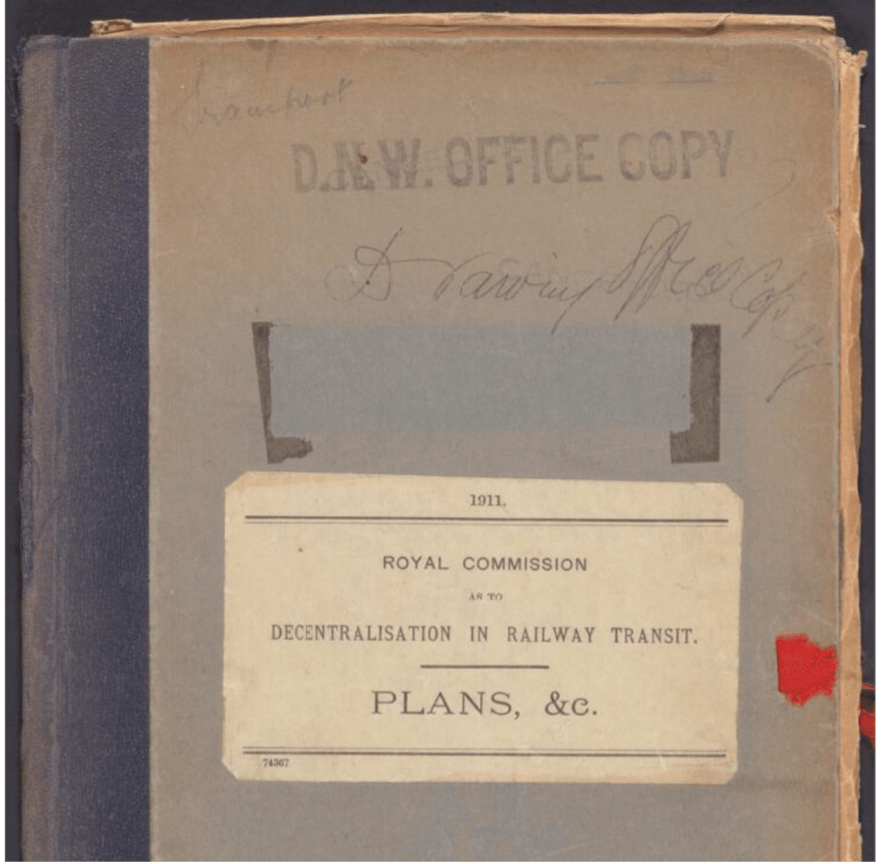
Report of the Royal Commission as to Decentralisation in Railway Transit -1911
Although the recommendations of the Royal Commission resulted in much discussion by community organisations and government officials thereafter, no recommendations concerning a railway to Port Stephens were ever acted upon by the NSW Government. Following the release of the recommendations some follow-up survey work was carried out, however strong lobby groups in Newcastle and Sydney were successful in ensuring no decentralisation action was funded and infrastructure constructed.
PART THREE: FORMATION OF DISTRICT RAILWAY LEAGUES TO LOBBY FOR A RAILWAY TO PORT STEPHENS
Stroud Road Port Stephens Railway League Formed – 1913
The Raymond Terrace Examiner and Lower Hunter and Port Stephens Advertiser of 2 May 1913, page 3, reported:
‘An important meeting was held in the School of Arts, Stroud, on Tuesday last, when the above league was inaugurated. Mr. R. E. Callow presided. There was a good attendance, a pleasing fact being the presence of the country residents who came in to attend the meeting.
Speeches in favour of a line of railway from Stroud Road to Port Stephens were made by Mr. J. V. Daunt, Mr. G V. Collins, Mr. W. Gorton and others. The immense importance of this short line of 30 miles was shown. The timber trade alone would justify the construction of the line. The fact that private companies could be found to construct the line, but for the great difficulties thrown in the way of private enterprise by the Government of the day, shows that the line ought to be constructed. The Rev. R. G. Knox gave the meeting detailed facts of the geographical position of the proposed naval base, the deep waters in Port Stephens, the recommendations of the Decentralisation Commission, and other matters connected with the proposal. He favoured a line of railway from Stroud Road to Fame Cove. A resolution was carried forming the league.’
Inspection of Port Stephens – 1914
The Wingham Chronicle and Manning River Observer of 21 February 1914, page 2, reported:
‘During the weekend the Minister for Education, Mr. Carmichael, visited Port Stephens for the purpose of making an inspection and collecting information which will be useful in regard to the Government’s decentralisation proposals.
In an interview he said: “There will, I think, be a pronouncement before very long relative to the Government’s full decentralisation proposals. They have reached a certain stage already, and I have no doubt that a long way towards the consummation of a definite and concrete plan will be travelled during the next three years. Jervis Bay, of course, is rendered a little complex by the division of territory between the State and the Commonwealth, and the Commonwealth already holding the better portion of the deep water.
This position has also to he considered in connection with Port Stephens. Part of my duty in connection with my visit was to see the position of the land in question, the same way as we view the land at Jervis Bay, as practical experience is the most valuable when dealing with such matters. It is essential if we are going to establish a port there that we should avoid complications in regard to the alienation of land for the Commonwealth, such as we already have at Jervis Bay.”
Questioned in reference to connection of the port by rail, Mr. Carmichael said, “It will be remembered that the decentralisation committee recommended the railway from Morpeth to Port Stephens, either crossing the Hunter below the junction of the Paterson, about a mile from Morpeth, or in the alternative proposal, to branch off from the Morpeth railway, about a mile before reaching the town of Morpeth, the total cost being about £315,000.
There have been six alternative routes proposed, none of which have been definitely decided upon by the Government, but the preliminary work has been done in each, and the reports in regard to each have been published. One would commence at Thornton, about six and a half miles from Maitland; another, suggestion is from Tallow; another one leaving the North Coast railway on the northern side of the Hunter River, and following the northern bank of that river across from the Williams, not very far from Raymond Terrace. Another proposal is from the North Coast railway, where it crosses the Karuah River.’
Like most developmental proposals in NSW, the First World War during 1914 – 1918, placed a temporary hold on activities advocating for the Port Stephens railway.
Post War Calls for a Port Stephens Railway – 1919
The Dungog Chronicle of 17 January 1919, page 2, reported:
‘The movement started in Tamworth to agitate for the linking up of Port Stephens with the railway system of the State is one that should be taken up by the residents of Dungog, Stroud, Port Stephens, and the mid northern districts. Now the war is practically over, and there is a prospect of Australia being recouped for the heavy expenditure entailed in sending our brave boys to help win victory, the State Government will be in a better position financially, and will have to undertake to carry out development works that will open up greater opportunities for the man on the land, encourage settlement, and stimulate production.
Newcastle is jealous of its importance as a port, but the success of that city is assured as a manufacturing centre, which will necessarily attract a large amount of shipping. Outside of industrial interests there are those of the primary industries such as wool, wheat, timber, meat, etc., of the great northwest portion of this State, and also of the North Coast. With the advancement of production there will have to be cheaper and better facilities to get our products to the markets of the world. This can be done by the expenditure of a comparative small sum of money in linking up the deep waters of Port Stephens with our railway system.’
Maryvale – Port Stephens Decentralisation Railway League Formed – 1921
The Mudgee Guardian and North-Western Representative of 27 October 1921, page 2, reported:
‘The proposed railway between Maryvale and Port Stephens, via Gulgong, Denman, and Muswellbrook, is meeting with much support. At a meeting held in Wellington, and presided over by the Mayor, Dr. Wade, it was decided to form a branch of the Maryvale-Port Stephens Decentralisation Railway League.’
Gloucester Council Supports Railway to Port Stephens – 1922
The Gloucester Advocate of 12 July 1922, page 2, reported:
‘The following letter from Stroud Shire Council was read at last Thursday’s meeting of Gloucester Council: ‘My Council had before it at its last meeting the question of the construction of a line of railway from the North Coast line to Port Stephens, and it was decided that the members for Oxley be written to and asked to bring the matter before Parliament at first opportunity, urging the early construction of the line. The co-operation of those Shires, which are interested in the proposal, is also asked. Your Council is no doubt fully seized with the necessity for, and the advantage of such a line, opening up as it will the magnificent harbour of Port Stephens, and providing a nearer outlet for the products of the north-western part of the State; that further comment is unnecessary. I there-fore ask that your Council will grant its cooperation and forward a communication to your members, urging them to push the construction of this line ahead. It was decided to cooperate with Stroud Shire in this matter.’
Federal Government Assistance Sought – 1922
The Macleay Argus of 18 July 1922, page 2, reported:
‘Mr. Theo. Hill, M.L.A., writing to the Macleay Shire Council regarding the proposal to connect Port Stephens by rail to the North Coast line, states that he was fully alive to the importance of the project and gave notice of motion in the House, but did not get the opportunity to move it. He states however the Government is favourably inclined to the construction of a line from Walcha Road to Mount George, and a second line from Stroud Road to Port Stephens, and this project he proposes to urge. He added he understood the State Government was asking the Federal Government to assist in this project.’
Stroud Road to Port Stephens Rail Route Surveyed – 1923
The Sydney Morning Herald of 17 February 1923, page 16, reported:
‘A survey is being made of the proposed railway route from the main North Coast line at Stroud Road down the valley of the Karuah River to Port Stephens. This route is regarded as suitable for the purpose, as there are practically no engineering difficulties, and it would serve to fit in with the proposed line from New England at Wollon to Mount George on the Upper Manning, providing a direct outlet from tableland to coast.’
The Raymond Terrace Examiner and Lower Hunter and Port Stephens Advertiser of 23 February 1923, page 3, also reported:
‘At the Shire Council meeting on Monday, Cr. J W. Boag referred to the trial survey now being made of the railway lines to Port Stephens and said the matter was of great importance to the advancement to the district. He thought the councillors should watch the movement keenly, in order to see that no undue influence operated against the general interests of the Lower Hunter and Williams districts, by those who may, for personal ends, advocate other routes. There was no doubt we want the convenience of a railway for the proper development of the coal fields, and our own district.
Two routes were suggested from Morpeth to Port Stephens, one from Paterson, and one from Stroud Road. We must see that proper representations were made regarding the best route, and for that reason they should exercise the liveliest interest in it. He had written to Morpeth Council regarding the direct route from Morpeth, urging their assistance and attention to the matter. He hoped his fellow councillors would think over the best way of assisting the movement. They had not got the favours of other districts in railways, and he moved that the council cooperate in any movement that may be brought about to assist the railway route from Morpeth to Port Stephens.
They were all agreed as to the value of Port Stephens as a port, and the great advantage it would be to the north and north-west, in a quicker route to the coast, and at the same time assist in decentralisation. Cr. Cromarty seconded the resolution, and fully endorsed Cr. Boag’s remarks. The utilisation of Port Stephens would mark a great development in the State’s resources. Cr. Pearce said he agreed with Cr. Boag, excepting with regard to Morpeth Council. They were written to before on the matter, and no notice was taken of the matter. He thought perhaps they did not like the idea, of the wharves being shifted down the river a bit. He thought the route should go via the two bridges, as this was better than the one at the Paterson junction. But he was satisfied to help it wherever it went. The motion was carried unanimously.’
Railway League Formed at Tea Gardens – 1923
The Dungog Chronicle of 9 March 1923, page 2, reported:
‘At the meeting of Stroud Shire Council on Monday last, reference was made to the proposed railway line from Stroud Road to Port Stephens and to the fact that others were urging the claims of the Morpeth Port Stephens line. Cr. Franklin stated that an influential Railway League was being formed at Tea Gardens to push the matter ahead. That League wanted other Leagues to be formed at Stroud, and also that Stroud and adjacent shires should be asked to help.
Cr. Callow stated that a survey was also being made from Morpeth to the Port. The president (Cr. Flannery) said the Stroud route was the best and should be supported. Cr. Abbott considered that the shire should do what it could to further the interests of this side of the water. Cr. Franklin stated that a line from Morpeth would not strike the deep water that a line from Stroud Road would. Farm Cove [near Pindimar] was an admirable spot for the termination of a railway. Council unanimously decided to call a public meeting at Stroud to discuss ways and means of furthering the matter. A full report of the Council meeting will appear next issue.’
Railway League Formed at Gloucester – 1923
The Gloucester Advocate of 23 March 1923, page 2, reported:
‘On Thursday night the [Gloucester] Shire President, Councillor C. E. Tonks presided over a meeting at the Shire Hall, to discuss the formation of a railway League to advocate the construction of a railway line from Stroud Road to Port Stephens. ……
A letter from Stroud Shire Council was read asking that action be taken in Gloucester to form a League. Mr. O’Halloran also outlined the action Gloucester Shire had previously taken in the matter. It was decided on the motion of Mr. Sellick, seconded by Mr. Waddell that all present in the room form themselves into a Railway League, with the Shire President as Chairman, to forward the interests of the Stroud Road Port Stephens connection. ……
On the motion of Councillors Wilson and Bignell it was decided that the League be known as the Gloucester Shire Railway League. Councillor Bignell stated that the Stratford people intended to call a meeting to form a League but were undecided whether it would be the best plan to have a separate league, or join the Gloucester one. They would like to hear from this meeting. On the motion of Mr. O’Halloran and Cr. Wilson it was decided to ask Stratford to form a sub-branch to work in with the Gloucester Shire League. Mr. Rye stated that as far as he could see the main business of the Leagues would be to gather evidence to place before the Land Advisory Committee, which Mr. Vincent had advised him would inquire into the proposed railway connections with Port Stephens.’
Tea Gardens Railway Meeting – 1923
The Gloucester Advocate of 25 May 1923, page 2, reported:
‘Mr. G. B. Waller addressed a large gathering at Tea Gardens, on Saturday last, on behalf of the Port Stephens Railway League in connection with the proposed Walcha to Port Stephens Railway.
In the course of his address, he urged the people to collect evidence so that he could place it before the Commission which would meet at Gloucester in the near future probably June or July. The proposed line would run from Walcha connecting up with Mount George, then from Stroud Road to Port Stephens. The estimated cost of the line would be £1,500,000 from Walcha to Mt. George and £240,000 from Stroud Road to Port Stephens. He urged the local people to put their whole heart into the matter as it was a matter of vital importance to the district in general.
He also referred to the advantages of the railway in making Port Stephens one of the most attractive harbours from several points of view and would also enable direct transport in all parts of the world and saving over 100 miles in railway freights. Other speakers were Mr. R. A. Elkin (Raymond Terrace), and Mr. J. A. Jones (Dungog). Mr. T. While (President Port Stephens Railway League) occupied the chair.’
Proposed Railway to be Referred to the Committee on Public Works – 1923
The Northern Star of 11 October 1923, page 5, reported:
‘The Premier announced that in accordance with the Government’s policy of decentralisation it is intended to refer the proposal to connect Port Stephens with the railway system of the State to the Works Committee.’
Railway Leagues Encouraged to Collect Evidence – 1924
The Dungog Chronicle of 11 January 1924, page 2, reported:
‘In our correspondence columns a letter from Hon. W. Bennett, M.L.A., appears, in which he advises the residents of interested centres to “get busy” in connection with the forthcoming investigation by the Public Works Committee of the Stroud Road-Port Stephens railway. The inquiry also includes the Morpeth-Port Stephens proposal. This route is not an alternate scheme, Mr. Bennett points out, but part and parcel of the Government’s decentralisation policy.
Railway Leagues are in existence in Gloucester, Stroud and Tea Gardens, and in some of these centres they are active, but in others, there is too much apathy. This is not a time for “sitting back.” People should throw themselves whole heartedly into the movement. Personal interest goes a long way and optimism and confidence have a mesmeric effect. Apart from the fact that such a railway would be of value to the particular districts through which it runs, there is also the fact it will be of great national importance, and Dungog, as well as other towns throughout the north and north-west should lend their moral and financial aid to the “boosting” of the scheme. Dungog could advisedly form a railway league to join in with Stroud, Gloucester and Tea Gardens. The Public Works Committee will commence taking evidence this month so no time should be lost by those who desire to see the line a reality.’
Local Councils to Prepare Evidence Concerning Railway Routes – 1924
The Dungog Chronicle of 29 January 1924, page 2, reported:
‘The Port Stephens Shire and the Raymond Terrace Municipal Council have decided to prepare evidence for submission to the Public Works Committee in regard to the several railway routes to connect Port Stephens. Mr. A. L. Adam, town clerk of Raymond Terrace, in speaking of the matter at the last meeting of the council, said some action should be taken to prepare the evidence. No one appeared to be interesting himself in the Morpeth-Salamander Bay route, which he regarded as the best of all proposals. They should see that the position was properly put before the committee when evidence was taken later on these suggestions. It was a matter affecting the future development of the town and district.
The line from Morpeth would enable them to build a connecting link for coal shipments on the Stockton side and Fullerton Cove — a necessary development as time went on, which would be an augmentation of the line to Port Stephens. Others would be placing evidence before the committee, and the council should do the same. He was invited to attend the meeting of the shire council and agreed to do so.
Councillor A. Boag, who brought the subject up at the shire meeting, referred to the urgency of the council taking an active interest in the Morpeth-Port Stephens line. Others were putting the case for the Stroud line, the construction of which meant much to Raymond Terrace and these districts, as well as to Port Stephens. If they did not move in the matter, they would get “left.” He moved that the district members be requested to urge consideration of the project.
Councillor Cromarty, who seconded the resolution, said the line would be useful for shipping purposes, not only at Port Stephens, but also on the Hunter River, at Smith’s Bay and Stockton, which could be met by a spur line. The deep water was at Salamander Bay, and that was the place where the wharves in the Port should be. Councillor Ralston, in support, thought the line should connect near Hexham. The motion was carried, and Councillor Cromarty moved that evidence be prepared for presentation to the Public Works Committee, which was to visit the locality. The motion was seconded by Councillor Shearham and carried, the clerk being also directed to obtain the names of those who desire to give evidence.’
Railway Commissioners Oppose Railway to Port Stephens – 1924
The Daily Telegraph of 30 January 1924, page 10, reported:
‘The New South Wales Railway Commissioners are opposed to the construction of a railway line from Stroud Road to Port Stephens and the establishment of a port at Salamander Bay in competition with Newcastle. So much appears from their statutory report on the proposal, which has been placed before the Public Works Committee by Mr. Selkirk, acting-secretary for public works. The commissioners hold that the railway revenue would suffer a loss, by diversion of traffic from existing lines without any compensating advantage to the primary producer by the line, and that, in addition, there would be a serious deficiency in meeting working expenses and interest on the new line; also that the local traffic between Stroud Road and Port Stephens would be negligible.
The commissioners add that the circumstances do not warrant the establishment of two overseas shipping ports in such close proximity, and that the port at Newcastle will meet requirements of railway transport and development for many years to come. The Royal Commission on decentralisation in railway transit recommended the establishment of an oversea shipping port at Salamander Bay. Later, the official committee on land development and settlement endorsed that recommendation. At its suggestion, trial surveys of lines to the northern side of the port were put in hand.‘
Residents Object to Terminus of Railway at Pindimar – 1924
The Newcastle Sun of 30 April 1924, page 6, reported:
‘A representative meeting of residents of Port Stephens was held in Francis Hall on Saturday night for the purpose of protesting against the selected site for the terminal point of the branch railway from Stroud-road to Port Stephens. Mr. Hewlett, of Newcastle, pointed out the necessary expense in taking the line to the present proposed terminus at Pindimar. He proposed that the terminal point should be on the northern side of the harbor, somewhere in the vicinity of Bundabah Creek or North Arm. By making this the terminus, deep water to the edge of the school would be obtainable, free from the southerlies and westerlies; while at the present proposed terminus a jetty 200 yards long would be required to get to deep water, and this would be open to the full force of the southerly and westerly winds.
By terminating at North Arm a saving of thousands of pounds would be made, as the line would be through more level country and could be made nine miles shorter. Several members of the Local Progress Association spoke on the matter, and it was finally decided to protest to the authorities against the present position of the terminus. Messrs. J. B. Morante and J. Johnson were appointed to lay before the Commissioners for Railways the various points in favour of the new terminal station.’
Public Works Committee Takes Evidence at Stroud – 1924
The Daily Telegraph of 19 August 1924, page 6, reported:
‘The Public Works Committee was in Stroud during the weekend, taking evidence on the proposal to construct a railway from Stroud Road to Port Stephens.
Evidence was given that the proposed line was the key of success for a decentralisation scheme embracing the north coast, New England, and north-west, with Port Stephens as its base. This area, which was equal to any in the State, was capable, with proper railway connection, of supporting three or four times the present population, and could provide sufficient trade to maintain a modern deep-sea port at Port Stephens. The saving in haulage, compared with Newcastle, would be 30 miles, and compared with Sydney 100 miles.
Vast reserves of high-grade hard-wood timber would be tapped, and carried by the line to Port Stephens. One shipping company alone, in a year, had loaded 21,500 tons of timber in Port Stephens. With the removal of the timber more land could be opened up suitable for dairying. Gloucester and Karuah Valleys contained very large deposits of coal which could be worked at a profit with railway connection to Port Stephens. A port could be made for deep-sea shipping for less than £500,000, against the Newcastle Harbor expenditure to date of nearly £3,750,000. Evidence is being taken today on the proposed alternate route for a railway from Bundook to Port Stephens.’
Railway to Port Stephens Rejected – 1925
The Daily Telegraph of 8 April 1925, page 6, reported:
‘Proposals to construct railway lines from Wollun to Mount George and from Stroud Road to Port Stephens, were rejected by the Public Works Committee yesterday.
It was estimated in official evidence that the Wollun to Mount George line would cost £2,540,310, the length being 122 miles 2 chains. The Stroud Road to Port Stephens line would have cost, it was estimated, £489,292 — the length being 33 miles.’
The Dungog Chronicle of 17 April 1925, page 2, also reported:
‘The Standing Committee on Public Works has delivered judgment regarding the proposed railway from Stroud Road to Port Stephens and has turned down the proposition. To secure railway connection with the great harbor of Port Stephens, seems to be about the most difficult power of vested interests is too strong, one cannot say, but it cannot be denied that, despite a present heavy expenditure and probable loss for some years, it would be most advantageous to the State to have the harbor connected to the railway system.’
Conclusions of the Committee on Public Works – 1925
The Dungog Chronicle of 20 November 1925, page 4, published the full conclusions of the Public Works Committee:
‘We have received from Mr. R. S. Vincent, M.L.A., the Public Works Committee’s report in regard to the above, which was as follows: — According to local evidence the chief value of the proposed line lies in the fact that, in conjunction with the construction of a connection between Walcha Road and Mount George, it will open up a new port, which can be brought into general use for deep-sea trade at a comparatively low cost, and afford facilities to shippers which are not now given at Newcastle. The latter port is claimed to possess certain advantages on account of the frequent necessity for dredging, due largely to floods in the Hunter River, and the fact that large sums still require to be spent upon it to enable vessels of 30 feet draft to safely negotiate the bar — inconveniences which are stated to be altogether absent from Port Stephens on account of its configuration, depth and situation.
Whilst it is admitted that from a passenger point of view the Stroud Road-Port Stephens connection is one to which serious consideration need not be given, it is claimed that it will open up large areas of timber, principally held as State forests, encourage farming and dairying, and give an impetus to intense culture and closer settlement, particularly in the Stroud and Gloucester districts. In both these localities back from the North Coast line, are (the evidence indicates) large areas capable of supporting many new settlers. Dairying, it is stated, has practically doubled its output within the last ten to twelve years and the indications are stated to be that it will be again doubled in the next ten years if given sufficient local markets and more direct communication to export centres.
With regard to local development, the claim has been submitted that within 20 miles of Stroud are 100,000 acres which could be subdivided and settled upon. Large areas of this country are still covered with timber, and it has been represented that when cleared 500 acres would be sufficient for a living area under dairying and mixed farming. Whilst greatly improving the development of the district through which it would pass, it has been admitted locally that the proposed line would be of little value without a further line between the North Coast and the Northern line to give an outlet for the New England and north-western portions of the State.
The interests of Gloucester in connection with the construction of the proposed line are confined principally to the possibilities of coal development along the banks of the Gloucester River, where several coal seams are stated to have been opened up: but in view of the cost of carriage to Newcastle, the consumption is confined principally to towns in the North Coast area. The difference in freight from Gloucester to Newcastle and Gloucester to Port Stephens, via the proposed line, is stated to be 3s 4d. per ton in favour of the latter, and with railway construction as proposed Gloucester it is assumed would be able to despatch its coal to Port Stephens at the same cost as coal now conveyed from Cessnock to Newcastle, and would be able to compete in the world’s markets.
In connection with timber traffic prospects, it has been represented that the total outward tonnage of timber between Stroud Road and Mount George for the twelve months ended 30th June 1924, was 32,680, which gave a return to the Railway Department of £20,630, this being regarded as a fair average for many years to come. The sixteen sawmills in the district mentioned have an annual cutting capacity of 26,800,000 superficial feet; and it is estimated that the saving in freight on the carriage of timber to Port Stephens instead of Newcastle would amount to approximately one-eighth or the amount now paid and would enable timber getters to extend their operations into the timber country for a distance of at least 2 miles.
Inconvenience is stated to be experienced by the timber industry on account of the difficulty of reaching Port Stephens, and the absence of efficient wharfage accommodation. At the same time it has been pointed out that during 1923 the timber exports from Port Stephens amounted to 5,500,000 superficial feet for oversea, and 7,500,000 superficial feet for coastal ports. The tonnage of timber vessels calling at the port ranges from 2,500 to 5,000, and their draft from 19 to 24 feet. These, it is affirmed can load in Salamander Bay on the southern side, and on the northern side anywhere along the harbour from Duck Hole to North Arm, a distance of 10 miles. On the foreshores the depth of water is, on an average, 30 to 60 feet. The depth of the entrance is 30 feet at low water. Generally, it is claimed that with the construction of the proposed line fully 80 per cent. of the timber now shipped at Newcastle would be forwarded to Port Stephens.
In view of the fact that the principal argument in favour of the construction of the proposed line is that it will open up Port Stephens, the areas of deep water of which are admittedly so well defined as to make the provision of wharfage and other works necessary for shipping exceptionally convenient, the Committee have deemed it advisable to obtain official evidence as the possibilities of the port and also as to the limitations of Newcastle Harbour, situated 15 miles to the south. Although on the northern or Pindimar side of Port Stephens to which the proposed line runs, it would be necessary to dredge for over a mile from the shore to obtain water suitable for deep-sea vessels, there is no doubt that on the southern side, better known as Salamander Bay, improved conditions prevail to a present depth of 30 feet, which, with intensive dredging could be improved to 32 feet, in addition to which there is a 30-feet channel from the entrance.
The Departmental evidence reveals that the low-lying Pindimar side of the port generally, compared with the southern side, is not likely to be satisfactory either for the berthing of deep-sea vessels or the loading of coal and general merchandise. At Salamander Bay the foreshores being comparatively high, adapt themselves to the convenient construction of coal bins, and the gravitation of coal into ships, thus avoiding the necessity for erection of elevating machinery — a condition of things which does not exist at Pindimar. In this connection it has to be pointed out that to tap Salamander Bay with the North Coast line from Stroud would necessitate the crossing of the Karuah River and a detour round the western shores of the port, and thence along the south side, thus considerably increasing the length of railway construction and cost.
Although Port Stephens has natural advantages over Newcastle Harbour, and can handle vessels up to 20,000 tons with very little dredging, it has to be borne in mind that in view of the improvements contemplated in the older-established port which will render it suitable for the berthing of all shipping likely to be attracted there for the next twenty-five years, and of the trade which has already been developed it will be more economical policy to proceed with these improvements for the time being than to incur any great expense in connection with Port Stephens. The departmental view which is supported by the Committee as a result of their inquiries and inspection, is that Newcastle Harbour is able to cope with all present and prospective demands of shipping for many years, and that increased wharfage accommodation on the southern side of the port as far as Wickham Basin.
In addition, it is proposed to deepen the south channel as the extension of trade warrants. For ordinary deep-sea vessels, apart from coal carriers, deep sea wharfage over a length of 2,000 feet, the whole of which will be accommodated west of Merewether-street in the neighbour-hood of Wickham Basin is being aimed at, as well as 3,000 feet east of Merewether-street. At the latter deep sea as well as coastal steamers will be accommodated. Generally, in the immediate future a water area of 800 acres with a depth of from 25 to 30 feet, is expected to be acquired; the ultimate objective, however, is 3,000 acres.
It is anticipated that during the next fifteen years these improved facilities will have been extended to a certain point; and as, to the official evidence, it is proposed to go on extending them there need be no anxiety in regard to Newcastle meeting all requirements for the period stated.
The Committee have given consideration to the question of the construction of a railway from Morpeth to Port Stephens. The evidence submitted shows that the latter would serve interests altogether different from those affected by a line from Stroud Road to Port Stephens and could not under any circumstances be considered as a rival or alternative proposition. It has to be added that a rough estimate gives the cost of a line from Morpeth to Port Stephens at £670,000; and it has been pointed out that traffic east of West Maitland to the latter port would require to traverse several additional miles of railway compared with the present line to Newcastle.
A further route, submitted by local railway leagues, between Mount George and Port Stephens, and running from either Bundook or Somerset along the valley of the Myall River, and passing through Bulbi, Markwell and Bulahdelah districts has been considered, its principal claim being that it will serve a better and more extended stretch of country than the proposed line, and still effect the linking up of the Port Stephens area with the northern and north-western country. The suggested route, according to local representation, has a length of 62 to 68 miles, but as a counterbalance to its greater distance compared with the submitted proposal, it is claimed that it would save a haulage of 47 miles between Mount George and Stroud Road, and in the event of the Walcha Road and Mount George line being constructed, save the duplication of the same length — a circumstance which, it is submitted, the demands of traffic to the port via Stroud Road would render necessary.
The alternative route is claimed to possess benefits over its rival both from the point of view of stimulating production and settlement, and the opening up of Port Stephens. The land along the valley of the Myall to Bulahdelah, 41 miles is, according to local evidence, capable of being used for agricultural purposes, including the growth of lucerne, citrus and stone fruits, and vegetables; and the fact that, in spite of the absence of convenient transport facilities, butter factories have been established at Bulahdelah and Dyer’s Crossing may be regarded as an indication of its value from a dairying point of view.
The area to be served within a radius of 20 miles on either side of the suggested route as far as Bulahdelah is computed at approximately 250,000 acres, and in parts is being used on a small scale for the growth of maize, lucerne, &c. The cream of the district is carried from distances extending to 18 miles to the factories mentioned whence it is forwarded by drogher along the Myall River to Duck Hole, thence transported to boats, which take it to Newcastle, from which port it is conveyed by steamer to Sydney.
Of the agricultural and dairying country which exists principally between Mount George and Bulahdelah, it is estimated that with railway conveniences 300 acres would be sufficient for a living area, much more being required of the balance of the country to Port Stephens, which is suitable for grazing only. A large traffic is anticipated from the exploitation of the timber forests in the area described. In this respect the proposed route is said to have the advantage over the Stroud Road to Port Stephens area, where the bulk of the woods are stated to have been cut out. The suggested route will not affect the country between Stroud Road and Port Stephens, and cannot, therefore, be regarded as an alternative from the local point of view.
From a national aspect, however, the route is regarded as offering superior possibilities to those likely to be derived from the construction of the Stroud Road connection. For the reasons mentioned in preceding paragraphs, particularly those relating to the present and prospective capabilities of Newcastle, the Committee are of opinion that the construction of the proposed railway would be premature.
The resolution passed by the Committee is shown in the following extract from the Minutes of Proceedings. Mr. Dick moved: That, in the opinion of the Committee, it is not expedient the proposed railway from Stroud Road to Port Stephens, as referred to them by the Legislative Assembly, be constructed. Mr. Cameron seconded the motion, which was passed.
(The only comment this paper [Dungog Chronicle] has to make on the finding of the Committee in regard to the Wollun-Port Stephens Railway proposal is that it is blindly prejudiced in favour of Newcastle. The resolution rejecting the proposals are against the evidence and even against the Committee’s own summing up. It is apparent that the developing of the lower North Coast and Tablelands and the Northwest must be sacrificed that the trade of the port of Newcastle shall in no way suffer.)’
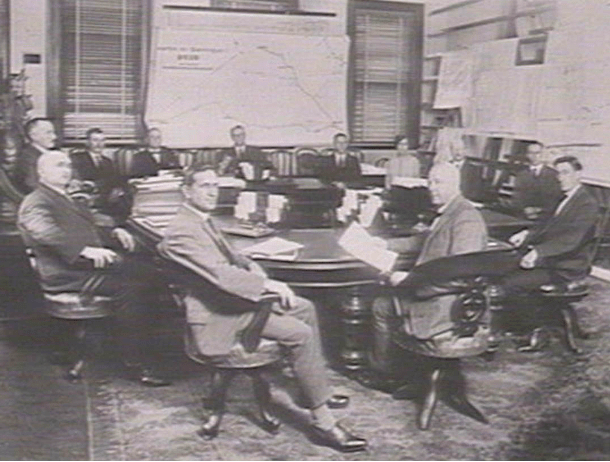
Public Works Committee, 1925 [State Library NSW]
PART FOUR: RENEWED ACTION TO HAVE THE PORT STEPHENS RAILWAY CONSTRUCTED
Initial Action to Have the Railway Reconsidered Fails – 1926
The Maitland Weekly Mercury of 3 April 1926, page 11, reported:
‘A deputation waited upon Hon. J. F. Coates, Honorary Minister, at Stroud Showground to ask him to endeavour to persuade Cabinet to have the matter of the proposed Stroud Road-Port Stephens railway again placed before the Works Committee. Hon. W. Bennett, M.L.A., in the absence of the members for Oxley, introduced the deputation comprising fifteen representatives of Stroud and district.
Mr. Bennett said that the future success of the old established but undeveloped district depended upon access to Port Stephens. There was great timber wealth, coal, limestone, iron ore, etc. Most of this wealth was lying dormant through lack of facilities in getting it away at a reasonable cost. If the North Coast and New England lines were connected to the port, a great amount of produce would be shipped from that harbour. It was a national sin that this magnificent harbor was not connected with our railway system.
In reply to Mr. Coates, he said the land was mostly privately owned, but could be accoutred cheaply. The distance is 26 miles. The line is surveyed. Several others urged the claims of the proposed line. The Minister in reply said that seldom had a deputation put its case so clearly as had been done on this occasion. One remark struck him, “this was not a thought that came overnight.” Seemingly it had come into the minds of their grandfathers, and for fifty years they had been asking for the railway and had not yet got it.
He hoped that the development of the district would be as expected. They could not expect to do much until there was railway communication with the port. With their member, Mr. Fitzgerald, he would put their case before Cabinet. ….. The Minister assured the deputation that their case would not suffer, because in his limited way, he would place it before Cabinet.’
The Dungog Chronicle of 20 April 1926, page 2, further reported:
‘Hon. J. F. Coates, M.L.C., has forwarded the following letter which was received by Hon. J. J. Fitzgerald from the Minister for Works and Railways (Hon. M. Flannery): — I have to acknowledge your personal representations in relation to a communication from the Hon. J. F. Coates. M.L.C., who forwarded notes of a deputation which waited upon him at Stroud on the 20th instant with regard to the question of a further reference to the Public Works Committee of the proposed railway from Stroud Road to Port Stephens. I desire to say that I shall give the matter consideration.’
The Dungog Chronicle of 12 October 1926, page 5, reported that the final decision of the Minister for Works and Railways concerning on the renewed efforts of the deputation to have the railway progressed:
‘In the circumstances, and in view of the [Public Works] Committee’s considered opinion, I do not feel that any good purpose would be served by my referring this proposal to the new Committee at the present juncture.’
Renewed Efforts to Have a Railway Constructed – 1928
The Newcastle Morning Herald and Miners’ Advocate of 18 May 1928, page 7, reported:
‘Urging the construction of a railway line from Morpeth to Pindimar, a deputation was introduced to Mr. Buttenshaw, the Acting Premier, by Mr. W. H. Bennett, M.P., at Parliament House tonight. The deputation comprised Sir Thomas Henley, and Messrs. Carter, Shand, and Walmsley, Ms.P., Messrs. G. K. Wright (president of the Tamworth branch of the Graziers’ Association, representing the West Maitland Chamber of Commerce), Mr. G. B. Waller (president of the Port Stephens Development League, and Messrs. Blomenthal and D. T. Pern (members of the league).
The members of the deputation pointed out that the line would enable coal to be shipped by large vessels, which would be unable to enter Newcastle. It would also enable timber from the North Coast to be shipped at Port Stephens, as well as wheat, wool, and other products from the great north-west. The area which the port would serve if the railway was constructed would cover 100,000 square miles. Further, the railway would give the people of Maitland, the coal fields, and the Hunter Valley access to the numerous beaches. One speaker claimed that the amount which would be saved in freight on wool alone would pay the interest on the capital cost of the construction of the line. It was estimated that the cost of the railway, together with the necessary wharves and lighting of Port Stephens, would be less than £1,000,000.
Mr Buttenshaw, in reply, said it was the policy of the Government to open up additional ports, and afford the producers an opportunity of getting their produce to seaboard by the shortest route. The matter of money would prevent him from making any definite promise. He promised to bring the matter before Cabinet, and recommend that the request of the deputation be referred to the Parliamentary Public Works Committee for investigation. The matter could not be referred to the Public Works Committee this session, which was regarded as a financial one. He could assure the deputation, however, that the matter would be submitted to the committee next session.’
The Dungog Chronicle of 22 June 1928, page 6, also reported:
‘The Maitland Chamber of Commerce wants the construction of the proposed Morpeth-Port Stephens railway line to be begun immediately. In a report submitted to the annual meeting of the chamber tonight, it was stated that if the line were built it would mean new life for Maitland. “At present,” it was stated, “Maitland is being drained by Newcastle, which, in its greed, wants Port Stephens connected to that harbor by means of a canal.” This was claimed not to be in the interests of the State in general, and would only benefit Newcastle. Should the railway line be built, the whole of New South Wales would materially benefit, because wool and wheat from the west, north-west, and New England, could be shipped from Port Stephens without its being taken to Sydney as at present. The port, it was pointed out, was ideal for shipping, and the foreshores lent themselves to the establishment of industries. The chamber refuses to let the matter drop.’
Primary Producers Union Seeks Railway Route to Salamander Bay – 1928
The Maitland Daily Mercury of 30 August 1928, page 4, reported:
‘The district council of the Primary Producers’ Union, at its meeting at Gloucester on Tuesday, considered a resolution that the organisation should agitate for the construction of a railway line from Tarro to Salamander Bay, on the banks of Port Stephens.
Mr. G. Russell (Lower Hunter), in moving to that effect, pointed out that a line of rail to Port Stephens had been for years the subject of agitation. There was a movement for a line from Morpeth to Pindimar. To his way of thinking, and as one who was well acquainted with the localities, the better line, as well as the nearer and the cheaper, was that projected from Tarro to Salamander Bay. Crown lands would be traversed for the greater part, and by the disposal of such land the cost of the railway could be nearly paid for. A bridge across the Hunter River at Hexham could be built that would accommodate railway as well as road traffic. Salamander Bay was a beautiful harbour, with an area of about four-square miles, and a depth of water all over it of from 32ft to 72 ft.
At Port Stephens, the overseas boats could load with ease, and it should be the place where all the wool and other heavy produce from the north should go. As things were, Sydney had the hold over Newcastle, where there were no facilities for the handling of such produce. The producer should have the benefit of the one hundred miles of freight that such a line would save. Commencing at Tarro, the railway would start right from the door of the populous centres adjacent to Newcastle and would tend to make people move towards Port Stephens and open it up more quickly. He was, however, not opposed to a line to any other part of the port.
The main issue was to get the railway there, and he thought the route suggested by him was the one that should be recommended. Mr. A. Boag (Seaham) seconded the resolution. The Port Stephen railway had, until recently, never been tackled with sufficient seriousness, or it would have been further advanced. The Parliamentary Public Works Committee, when it met in Maitland, would not listen to the Tarro-Salamander Bay proposal. Pindimar, in the members idea, was the touching point of the port. He did not think the Pindimar route so serviceable. There appeared to him to be speculative interest behind it, and that should not be. Careful consideration had been given to the proposal by Mr. Russell, and it seemed to be considered in the best interest of the State. Such a line would, too, benefit Newcastle. …..
Mr. H. Ralston said that he had been informed by Mr. G. B. Waller, president of the Port Stephens Development League, that it was intended to call another conference. The league was not bound to any one route. That could be left for decision by the conference. After further discussion a resolution was moved that the point of contact by rail with Port Stephens he left an open question. The members agreed to this.’
Port Stephens Development League Conference at Maitland – 1928
The Newcastle Sun of 5 October 1928, page 7, reported:
“It is nature’s gift, and very little in the way of expenditure is required to make it one of the best ports in the world.,” said Mr. G. B. Waller, president of the Port Stephens Development League advocating the construction of a railway, linking Port Stephens with the north and north-west of the State at a conference at Maitland today. The conference was representative of local governing and public bodies in the district. “It will be the first definite move in decentralisation in New South Wales,” continued Mr. Waller. “The production of northern New South Wales has been held up by Newcastle for years, and now we desire to bring about a change. “There are many reasons why the line should not go to Salamander Bay,” he declared, “and advocated the Morpeth-Pindimar route as the most direct and the least expensive. “I fail to see that the scheme is in opposition to Newcastle, and I think that when it is carried out, and a city springs up at Port Stephens, it will do a greater uplift than Newcastle has had for many years,” he concluded.
“The day of constructing branch railways is practically over, as motor transport is taking its place,” said Mr. Bennett, M.L.A., “but with Port Stephens the position is different. “We want to educate the people of the north-west,” he continued, “and show them the advantages of the scheme.” He said that despite the fact that large sums of money had been spent on Newcastle Harbour, it was no better today than it was seventy or eighty years ago. “Newcastle can afford to make Port Stephens its port, and it would be a benefit to Newcastle if a city was built at Port Stephens, rather than to see such an enormous amount of trade going to Sydney as at present.
It was unanimously decided to support the move for the construction of a railway from Morpeth to Pindimar. “In constructing the railway, we are taking the first step to safeguard our national primary industries, wool and wheat,” Mr. O’Hearn, M.L.A., told the gathering. He said that he recognised that the strongest opposition would be met with from Newcastle but considered that in the northern part of N.S.W. there was room for both Newcastle and Port Stephens.’
Port Stephens Railway Referred to the Public Works Committee – 1929
The Maitland Daily Mercury of 9 May 1929, page 6, reported:
‘The proposal to build a railway from Morpeth to Port Stephens will be enquired into shortly by the Public Works Committee. Various bodies which favour the proposal have decided to collect evidence to place before the Committee, and it is probable the Maitland and District Chamber of Commerce will appoint a sub-committee for the same purpose.’
The Manning River Times and Advocate for the Northern Coast Districts of New South Wales of 11 May 1929, page 3, also reported:
‘The [Public Works Committee] inquiry was opened in Sydney last week and adjourned. The committee is expected to sit in Newcastle shortly to take local evidence. The cost of the line has been estimated at £20,867 a mile, exclusive of the exchange of land and compensation, based on the trial survey made in 1923. The ruling grade would be one in 80 with load, and one in 100 against load, and the minimum curve of 12 chains radius.’
Railway Conference Held at Maitland – 1929
The Dungog Chronicle of 21 May 1929, page 4, reported:
‘There was an excellent attendance at a conference, convened by the Port Stephens Development League and held in the Maitland Town Hall on Wednesday evening last, to consider the question of placing evidence in support of the proposed Port Stephens railway before the Public Works Committee. Mr. G. B. Waller, President of the League, was voted to the chair. ….
The chairman said the meeting was called for all those interested in the construction of the railway from Morpeth to Pindimar. The result of the activities in this direction was that the proposal was now before the Public Works Committee, and it was probable that an inquiry would be held at Maitland at an early date for the purpose of taking evidence. The sub-committee appointed at a previous conference held at West Maitland had not yet met. They should realise that Maitland was the storm centre of the agitation at the present time, and it naturally followed that the strenuous part of the fight would have to be put up at West Maitland. It was necessary to educate the public in the matter, and the proposal that evening was that they should form a financial and propaganda committee in Maitland to carry out a proper programme, as this would be necessary. These were the principal items he wished to put before them.
Mr. J. H. F. Waller asked if Pindimar was to be the essential terminus. In reply, the chairman stated that when the deputation waited upon, the Minister in connection with the proposal, Hon. W. Bennett, M.L.A., stated, that it was the wish to have the line constructed from Morpeth to Pindimar, no other place being suggested at the time. Mr. R. L. Pender, Mayor of West Maitland: Where will the line cross the water? The chairman: Karuah.
Alderman J. Cook said it was strange that this part had been picked out, as most of the land was owned by city landowners, when, on the other hand, 15,000 acres of the land around Salamander Bay was owned by the Federal Government. Mr. J. H. F. Waller said the proposed railway to Pindimar was going to meet with considerable opposition. To carry this railway on ten miles to Pindimar and end on a mud bank was the veriest folly. They knew that there was influence on the Pindimar side but, on the other side, the land was owned by the Federal Government. Mr. C. H. Bennett: It is the same at Salamander Bay.
The chairman said that no man could influence him to Salamander Bay or Pindimar. He did not own any land there, and it did not matter to him. He pointed out that the engineers, who would survey the line, would pick out the best route and terminal, irrespective of any other opinion. If they had anything against the proposal, they could bring it before the Public Works Committee, but to say that they would not support the railway was childish. He thought they had got beyond that stage. He did not care whether they turned down the scheme or not. He was going to give evidence that it was the best possible way out of decentralisation.
In referring to the necessity for calling evidence Mr. W. F. O’Hearn, M.L.A., said that they should see that everything was placed before the Works Committee. Every aspect would have to be dealt with, and the different sections should be assigned to different witnesses, to prevent overlapping of evidence. He suggested that to make a strong case each witness should have his evidence prepared beforehand. He believed that every person in the north believed in decentralisation. The question of syndicates owning the land at the proposed terminal point, should not be allowed to defeat the proposal. These people should not block this great proposal, and it would be a crying shame if they allowed this to be done. As far as the proposition was concerned, he thought it would be the most successful railway line in the State.
Newcastle would fight the proposal tooth and nail, but there was room in the State for these two ports, and if the line was constructed, it would considerably benefit the people of the north including the Hunter District. If Pindimar was not the best place the Committee would soon find out what was the best position. Mr. A. S. Foster, Mayor of East Maitland, thought they should be unanimous in their decision of a terminus before placing the matter before the Public Works Committee. They should consider the proposal from a national standpoint, not from an individual one. Mr. R. A. Elkin supported. Mr. J. H. F. Waller moved ‘That a finance and propaganda committee be formed for the purpose of carrying on the agitation and the work of preparing evidence to place before the Public Works Committee, in connection with the proposal to construct a railway line between Morpeth and Port Stephens. …. The motion was seconded by Mr. R. A. Elkin and carried unanimously.’
Local Governments Unite to Support Port Stephens Railway – 1929
The Dungog Chronicle of 24 May 1929, page 4, reported:
‘As a result of the Stroud Shire’s move proposed by Cr. W. F. Harris, Deputy President, to secure the cooperation of other shires and municipalities in the North, North Western and Western districts of the State the following have replied intimating their willingness so to do.
Shires : Macquarie, Wellington, Namoi, Narrabri; Hastings, Wauchope; Gloucester, Amaroo, Cummock; Coonabarabran, Mandowa, Manilla; Tweed, Murwillumbah; Apsey, Walcha; Bolwarra, Lorne; Wallarobb, Dungog; Liverpool Plains, Gunnedah; Gwydir, Bingara; Macleay; West Kempsey; Yallaroi, Warialda; Port Stephens, Raymond Terrace; Manning, Taree; Taroo, East Maitland. Municipalities: Gunnedah, Parkes, Morpeth, Singleton, Barraba, Forbes, West Narrabri; Coonamble, Murwillumbah, Uralla, Narrabri, Cessnock, Greta, Walcha, East Maitland, Scone, Nyngan, Inverell, Gulgong, Wingham, West Maitland, Dungog, Tamworth.’
Inspection of Rail Route by the Public Works Committee – 1929
The Newcastle Morning Herald and Miners’ Advocate of 5 July 1929, page 8, reported:
‘The members of the Public Works Committee will make an inspection next week, of the route of the proposed railway from Morpeth to Pindimar, Port Stephens. Mr. W. F. O’Hearn, M.P., has been informed that the committee will visit the district the week following that, to take evidence at different places, including Maitland, Morpeth, and Port Stephens.’
Committee Hearings Commence – 1929
The Gloucester Advocate of 12 July 1929, page 2, reported:
‘Hon. Walter Bennett, M.L.A., informs us that the Parliamentary Standing Committee on Public Works, having now under consideration the expediency of constructing a line of railway from Morpeth to Pindimar, will take evidence respecting the proposed line in the Court House, West Maitiand, on Thursday and Friday, 18th and 19th July; and at Tea Gardens on the afternoon of Thursday July 25th, and on the morning of Friday, July 26th.’
The Public Works Committee again convened to consider the Port Stephens railway issue at the instance and influence of the Hon. Walter Bennett as M.L.A. for Gloucester.
Numerous newspapers reports were published concerning evidence given at the various places where the Public Works Committee convened. Much of the evidence was a repeat of that provided during 1924 and 1925 to the previous Public Works Committee. In addition, much of the evidence reported was lengthy and often contradictory in nature to that provided by others, and therefore is not covered further in this paper.
The opinions expressed to the Public Works Committee concerning the Port Stephens railway did not see the light of day because the Government responsible for it went out of office, together with members of the committee. No further newspaper reports on committee and the railway issue were published.
Public Works Committee, 1929 [State Library NSW]
PART FIVE: END OF THE PORT STEPHENS RAILWAY PROPOSALS
Port Stephens Railway Not Warranted – 1931
The Raymond Terrace Examiner and Lower Hunter and Port Stephens Advertiser of 31 December 1931, page 3, reported:
‘Hon. W. Bennett, M. L. A., has received the following: — Dear Sir,— With further reference to your personal representations, in regard to relief work for the unemployed suggesting that the time would be opportune for the opening of a branch railway from Stroud Road to Port Stephens Waters, I forward herewith a copy of a report received from the Railway Commissioners, in response to my representations concerning the matter. Yours faithfully, John T. Lang.
The copy referred to is as follows,:— The Secretary, The State Transport Coordination Board, The Treasury, Sydney. Subject: Proposed construction of branch line of railway from Stroud Road to Port Stephens Waters. …. I am directed to say that the necessity for railway connection to Port Stephen’s depends primarily upon the establishment of an overseas port. The Commissioners are of opinion that the facilities provided at the port of Newcastle are capable of meeting the requirements for many years to come and that until such time as an auxiliary port is necessary the construction of the suggested railway line from Stroud Road to Port Stephens is not warranted. W. H. Newman, Secretary.’
Port Stephens not to be the Port for North – 1938
The Sydney Morning Herald of 13 June 1938, page 8, reported:
‘The Minister for Transport, Mr. Bruxner, at a railway rally meeting here [at Guyra] yesterday said that Port Stephens would not be the port chosen to be linked up with any cross-country railway line which might be built to open up communication with the west, the north-west and the coast. ….. The Government understood clearly that any communication must serve the northern parts of the State to the best advantage. Port Stephens he said was too near Newcastle.’
Concluding Comments
The concept of a railway line to either the southern or northern shores of Port Stephens was resurrected again after the the Second World War. The same supporting arguments for the construction of a railway were again put by a new generation of advocates, but their efforts never resulted in any further government interest or action.
The improvement of road networks finally removed all justification for a rail connection.
Researched and compiled by Kevin McGuinness
May 2024

 Port Stephens - a history exploration