
Introduction
The arrival of the sister steam ships, Surrey and Sussex into Port Stephens in May and September 1907 respectively, created much interest as they were the largest ships to have entered the Port.
The Surrey (built in 1899) and the Sussex (1900) were large ships for the time, each of 10,000 tons dead weight capacity. They were operated by the ‘Federal-Houlder Shire Line’, which was formed in 1904. This company operated trading vessels to various worldwide ports including Sydney, Melbourne and Brisbane.
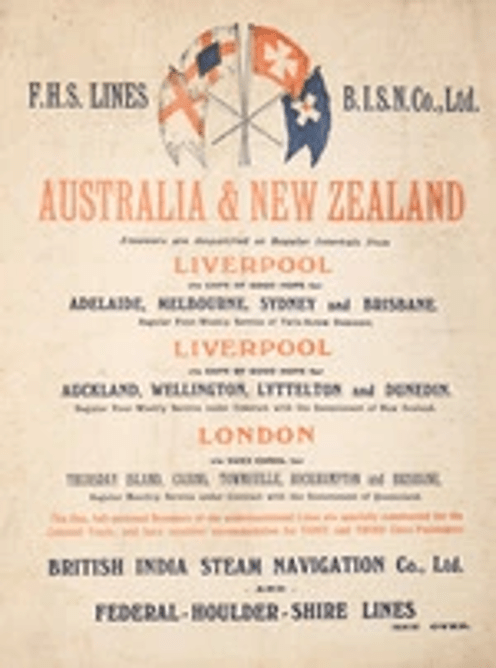
Advertising poster for the ‘Federal-Houlder Shire Line’ (F.H.S.) [National Library of New Zealand]
The purpose of the visits of the Surrey and Sussex to Port Stephens in 1907 was to load cargoes of hardwood sleepers for the South African Railways, enroute to Sydney and Capetown.
The successful entry into the port and the loading of the cargoes gave weight to those who saw the great potential for the devolvement of Port Stephens as a commercial port.
This paper is the story of the visits of the steamships Surrey and Sussex to Port Stephens in 1907, sourced from newspapers reports from the National Library of Australia’s Trove collection.
Interest in the Forthcoming Visit of the Surrey to Port Stephens
The Maitland Daily Mercury of 28 May 1907, page 4, reported:
‘A good deal of interest is being manifested in shipping circles in connection with the forthcoming visit of the Federal liner Surrey, a steamship of about 5500 tons, to Port Stephens, where she is to load about 1500 tons of hardwood sleepers for the South African railways. ….. The experiment will be watched with interest, and if the Surrey succeeds in loading there without difficulty Port Stephens, with its great natural resources, may in a very little time become an important shipping centre.’
Surrey Waits off Port Stephens
The Australian Star of 31 May 1907, page 4, further reported:
‘At 8 o’clock this morning the big Federal-Houlder-Shire liner Surrey arrived off Port Stephens, and a little later was reported to be ‘lying off.’ She is to proceed into the port to load 1500 tons of sleepers, but foggy weather prevails thereabouts, and she is doubtless lying off until it clears. There is only a moderate sea running there. As previously stated, the Surrey, which is from Brisbane, will be the largest vessel to enter Port Stephens.’
Surrey at Port Stephens
The Sydney Morning Herald of 1 June 1907, page 14, reported:
‘The Federal liner Surrey safely entered Port Stephens yesterday from Brisbane, and, was piloted into the port by Captain Nelson, who, as master of the coasting steamer Storm King which trades regularly between Newcastle and Port Stephens, has an intimate knowledge of the local conditions.
The Surrey moored at noon in Salamander Bay to load 1600 tons of sleepers for South Africa and will leave on Tuesday next for Port Kembla to coal. She is due here on Saturday next to continue loading for Durban, Algoa Bay, and Capetown, and will complete at Melbourne.’
The Daily Telegraph of 1 June 1907, page 10, also reported:
‘Interest attaches to the arrival of the Federal-Houlder-Shire liner Surrey at Port Stephens yesterday, from the fact that she is the largest vessel to visit that port. The Surrey, which came from New Zealand via Brisbane, anchored in Nelson’s Bay at 11.45 a.m. yesterday. The object of her visit is to load 1500 tons of sleepers for South Africa. The Surrey is a steamer of 5455 tons, in command of Captain Aitcheson. Messrs. Birt and Co. are the agents.’
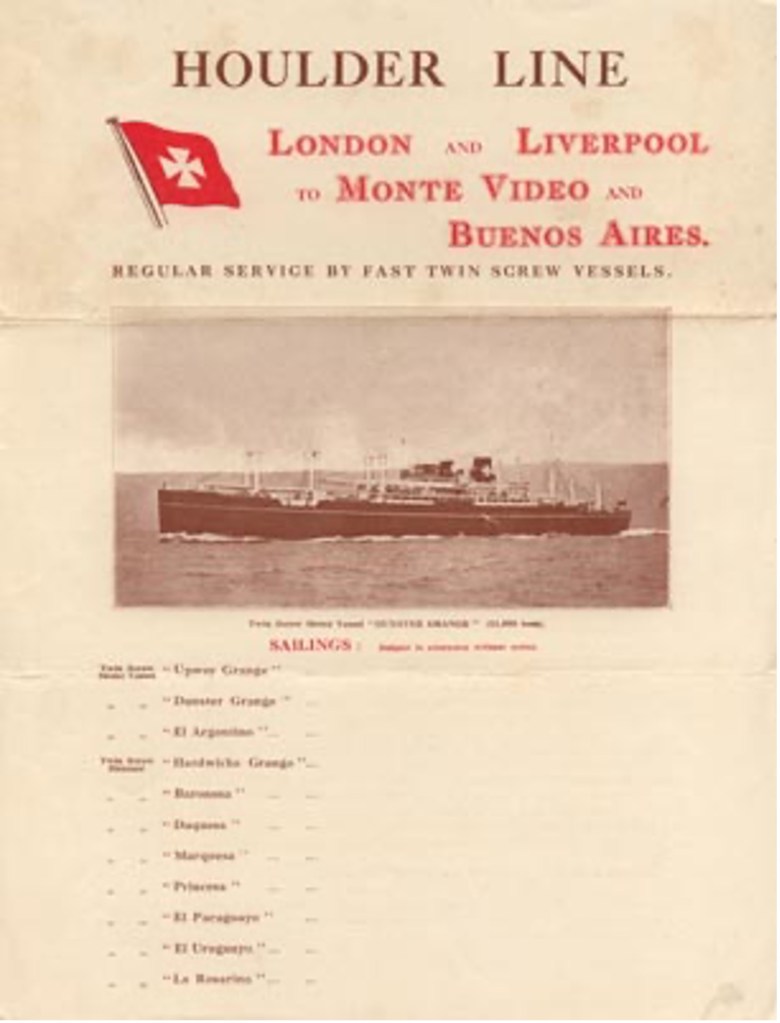
Advertising poster for the Houlder Line [which later became part of the ‘Federal-Houlder Shire Line’ company] showing a company ship that would have been similar in size to the Surrey which entered Port Stephens.
Cargo of Sleepers Loaded
The Maitland Daily Mercury of 1 June 1907, page 4, reported:
‘The experiment of sending a big oversea steamship of 5500 tons into Port Stephens to load cargo, …. was successfully carried out on Friday, when the Federal liner Surrey was safely navigated to moorings in Salamander Bay. The Surrey, which has been loading at Brisbane, arrived off Port Stephens at 8.40 on Friday morning, and was there boarded by Captain Nelson, the master of a little coasting steamer Storm King, whose services were secured to pilot the big liner on account of his intimate knowledge of the local conditions.
The Surrey remained hove-to off Port Stephens for some hours, awaiting slack water, but at 11.30 she entered, and by noon was securely moored. She at once commenced loading a cargo of 1500 tons of hardwood sleepers on behalf of Mr. J. S. Gam who is consigning them to South Africa, where they will be used in connection with railway construction.
It is anticipated that the Surrey will leave Port Stephens on Tuesday next, and on account of the coal-lumpers’ difficulty at Sydney, will steam direct to Port Kembla to replenish her bunkers. On Saturday, next she will arrive at Sydney to continue loading for South Africa, and will complete at Melbourne, from which port she will steam direct to Durban, afterwards calling at Algoa Bay and Capetown.’
Surrey Focuses Attention on the Commercial Prospects of Port Stephens
The Evening News of 1 June 1907, page 6, reported:
‘Since the announcement was made that the large F.H.S. steamer Surrey is to visit Port Stephens and take in a cargo of sleepers for South Africa considerable discussion has taken place in shipping circles as to the condition of Port Stephens. The opinions have all been favourable, the general impression being that the time will come when the place will be more frequently used by oversea vessels.
At present only small steamers and sailing vessels trade there, but in times of bad weather the bays are eagerly sought by all kinds of craft as a haven of safety. The Newcastle Company maintains a regular service between Sydney and Port Stephens with the steamer Hawke and intend building a much larger vessel for the trade. Small steamers also run there from Newcastle. It has been said that had coal been first discovered at Port Stephens instead of at Newcastle, the Government would have had a much better return for the money expended in making Newcastle the port it is.
Captain Brown, a master mariner, who is very well acquainted with Port Stephens, in conversation with an ‘Evening News’ reporter, described, the port as a first-class one, which only requires developing. He said it could already accommodate large ships, having plenty of water in the channel, enabling vessels to find comfortable anchorage in Nelson’s and Salamander, Bays. The Heads— Tomaree on the south and Yacaaba on the north – are somewhat striking, but the shoal just at the entrance has to be avoided. This, however, is made easy, for the channel carries from six fathoms — 36 feet — and upwards at low water springs.
Said Captain Brown: ‘It does not matter how heavy the sea may be on the coast, there is never any dangerous break on the southern head, so that small vessels can slip round the corner into Shoal Bay. When we are approaching Port Stephens from the southward, we sheer for the north head, keeping Point Stephens open of the south head (Tomaree) until we close Little Island. Then we run in through the heads, clear of the sand spit: charted as the entrance shoal. The course then is practically west, until we open the Red light on Nelson Head. There is no difficulty about navigating the channel, except that we were always prepared for the strong tides which run there.’
The Newcastle Morning Herald and Miners’ Advocate of 5 June 1907, page 4, also reported:
‘The entering of the s.s. Surrey to Port Stephens on Friday morning last to load 20,000 railway sleepers for the South African Government, marks an epoch in the history of that port, and indicates in a measure its possibilities, especially as the surrounding district abounds in mineral, timber and agricultural wealth, which if developed and fostered by direct shipments abroad, would tend to make Port Stephens second to none in the State.
After some negotiation, Mr. J. S. Gam, the charterer of the steamer, was successful in inducing the agents to allow her to call there enroute from Brisbane to Sydney, and any misgivings they may have had in regard to the safety of the port were allayed when on Friday morning last she steamed through the heads, and proceeded to Salamander Bay, where she dropped anchor, in 30ft of water.
The charterer had everything in readiness and loading operations were commenced forthwith. As the harbour is still in its natural state there is no wharf on which to accumulate the cargo, and in consequence all available lighters were requisitioned. Despite the limited facilities, however, Mr. Gam expects to have the steamer ready so as to enable her to get outside on this evening’s tide. The Surrey is a steamer of 10,000 tons dead weight capacity, length 420tft, beam 54ft, and depth 42ft. She will complete loading at Sydney and proceed thence to Capetown. Mr. Gam is satisfied with the Surrey shipment and will arrange for a further shipment from Port Stephens at an early date.’
Arrival of the Sussex at Port Stephens
The Sydney Morning Herald of 24 September 1907, page 10, reported:
‘The steamer Sussex is due to arrive on the port tonight from New Zealand and will be ordered on to Port Stephens to load a cargo of sleepers. This year quite a number of large steamers have entered Port Stephens, which is a fine harbour, possessing great depth of water. Earlier in the year the Surrey, a sister steamer of the Sussex, entered Port Stephens and loaded sleepers.’
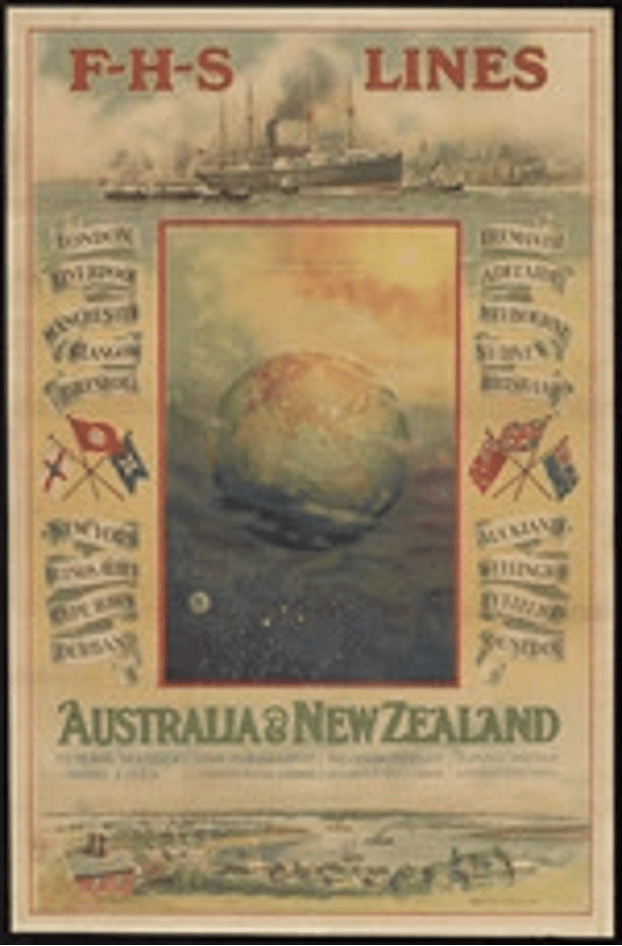
Advertising poster for the ‘Federal-Houlder Shire Line’ (F.H.S.) [National Library of New Zealand]
Cargo of Sleepers Loaded
The Evening News of 3 October 1907, page 2, reported:
‘The F.H.S. steamer Sussex, 10,000 tons, went to Port Stephens, and loaded 1100 tons of hardwood for South Africa. This is the second of the Federal line to go to Port Stephens and receive a cargo, thus providing further evidence in favour of establishing that place as a port for deep sea shipping. The Sussex shipment was put on board in less than three days, which is a good performance. ‘The vessel is now at Brisbane but will call at Sydney to complete loading for South Africa and the United Kingdom. Her sailing date homeward from Port Jackson is October 12.’
Sussex Again Focuses Attention on the Commercial Prospects of Port Stephens
The Maitland Weekly Mercury of 26 October 1907, page 6, reported:
‘Before the Karuah (Port Stephens) Progress Association Mr. E. J. Paton lectured on the “Future of Port Stephens.” The lecturer dealt first with the importance of possessing such a magnificent natural deep-water port, within easy access to almost limitless coal deposits. During the present year the Shire-Houlder liners Surrey and Sussex have shown with what ease ocean-going steamers of heavy tonnage can enter and leave the port.
As a harbour for coastal defence, it was unrivalled in Commonwealth. Its magnificent Heads, if fortified, would almost equal Gibraltar in strength, and be able to defy a hostile fleet, while within the two harbours war vessels and torpedo craft would find ample shelter, out of sight and out of range, with boundless coal deposits within easy reach if a few miles of tramline were laid. To fortify Newcastle and leave Port Stephens in its present condition was to court defeat.
The day was not far distant when Port Stephens, from its geographical position and natural facilities, might become a strong naval station. Port Stephens held premier position of any port in the Commonwealth in regard to oyster culture and production. “Port Stephens,” the speaker concluded, “may be comparatively little known or valued, but the day is not far distant when, as a port for deep-sea commerce and a naval base, it will force itself on the attention of the powers that be, and its value as a national possession will be realised.”
Large Overseas Steamer Loaded for Canada
The Daily Commercial News and Shipping List of 21 December 1927, page 4, reported:
‘It is some years since an oversea vessel has been in port at Port Stephens. Yesterday the Union Co.’s vessel Waitemata arrived there from Newcastle to load piles for Vancouver and Victoria, B.C., and it is probably the first time that a vessel of such tonnage as the Waitemata has been in the port to load for overseas.
The Waitemata is due at Sydney tomorrow, and will berth at No. 5 wharf, Darling Harbour, to complete, and is to leave again on December 24 for the Canadian ports.’
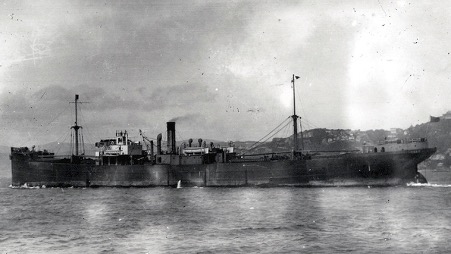
Waitemata
Japanese Steamer visits Port Stephens
The Newcastle Sun of 3 October 1931, page 7, reported:
‘One of the first foreign steamers for many years to sail direct to New South Wales coastal ports, the Japanese vessel Assama Maru arrived at Port Stephens this morning to load a cargo of sleepers.
The object of considerable interest in shipping circles, the Assama Maru left Miike last month for Eden, on the South Coast. There she loaded sleepers, and continued her voyage to Sydney. After the Assama Maru has loaded her Port Stephens cargo, she will sail for Byron Bay, on the North Coast, where a further load of sleepers will be taken on. The Assama Maru is the first foreign steamer to call at Port Stephens for many years.’
Concluding Comments
Although many steamers traded in Port Stephens, it was not until 1943 that the true capability of the port as a deepwater harbour was realised when three large naval ships, the HMAS Manoora, HMAS Kanimbla and HMAS Westralia, were stationed at Port Stephens.
They were attached to the military training facility, HMAS Assault, which was primarily situated at Nelson Bay.
Researched and compiled by Kevin McGuinness
May 2024

 Port Stephens - a history exploration