
Introduction
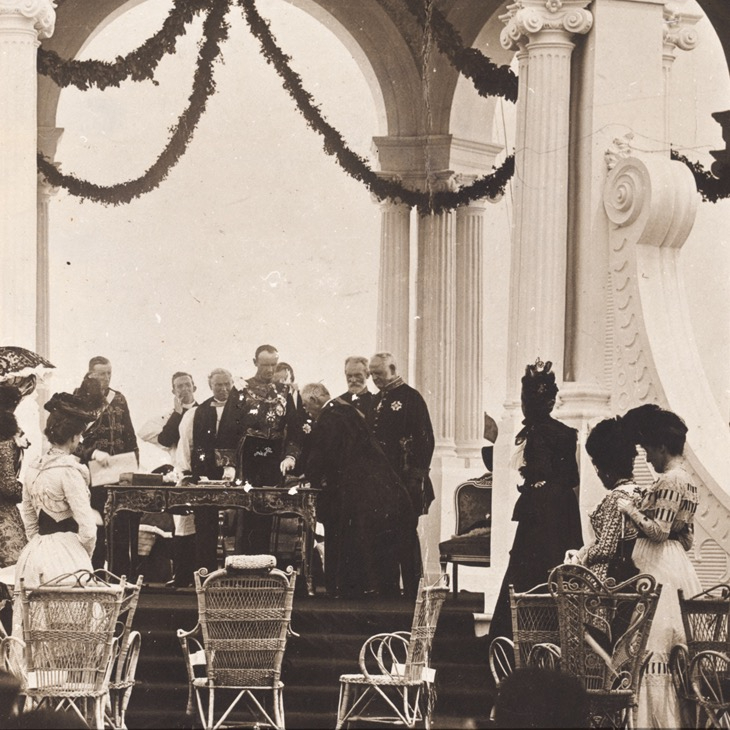
The Commonwealth of Australia was proclaimed on 1 January 1901. The historic occasion was celebrated throughout Australia, in its cities and towns. This is the story of the Federation celebrations held in the Port Stephens area, and also the nomination of the area as a site for the Federal Capital.
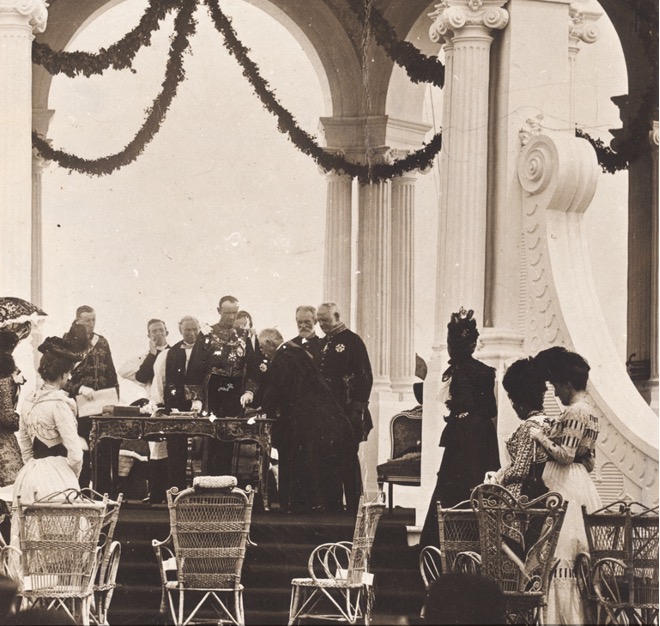
Lord Hopetoun being sworn in as Australia’s first Governor General, on 1 January 1901
Part One: Festivities Held at Port Stephens – 1901
Throughout the new Commonwealth, many festivities were held to mark the occasion and Port Stephens celebrated in style.
The Newcastle Morning Herald and Miners’ Advocate of 5 January 1901, page 7, reported:
‘Commonwealth festivities were held at Tahlee, Port Stephens, the beautiful residence of Mrs. R. H. D. White. In previous years all the residents of the district were invited to a Christmas tree, but this year, owing to the absence of the family, this was dispensed with. Mrs. White, feeling that something should be done to celebrate the consummation of the Federation of the colonies commissioned Messrs. J. A. Smith and F. Lee to arrange a picnic and sailing race for all in the district.
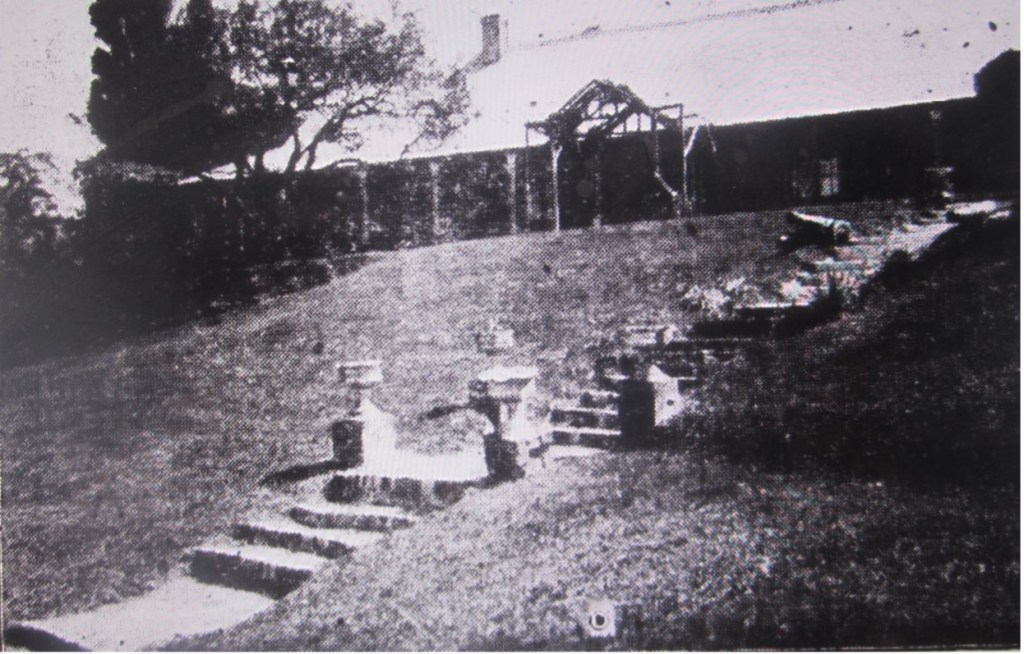
Tahlee House, Port Stephens
The day opened hot and sultry, though this did not deter fully 150 persons from putting in an appearance, everyone thoroughly prepared to have a good time. Proceedings were to have commenced by sending the six boats entered for the race on their journey, but owing to the light wind it was decided to wait till after lunch. All wended their way to the chosen ground, where the usual picnic games were indulged in till the lunch was ready, when they sat down to a spread consisting of all the delicacies of the season, to which justice was done.
The wind commencing to rise a start was made with the race. …… The course was over 12 miles, and after a good race Florence, which was splendidly handled, won, with Valkyrie close up second. The others were not in it. During the time the race was in progress, there was racing amongst the youngsters, boys and girls. In addition to the prize won every boy and girl on the ground was presented with a toy.
Just as the boat race was finishing one of the heaviest squalls ever seen here came up. The Vesta and Seagull were two miles away in the full force of it, and wives, mothers, and sweethearts had an anxious half-hour till it lifted a little, and the boats were seen scudding under bare poles, and all safe. Everyone got drenched, and this stopped all further sport. Alter a cup of good tea, and giving three hearty cheers for Mrs. White, and three more for the federated colonies, all wended their way home thoroughly satisfied that they had had one of the best days ever spent in Port Stephens.
Choosing a new Federal Capital
In the lead up to Federation, action had commenced to choose a site for the new Federal Capital. Many locations had been put forward for consideration by local Councils and other groups. Port Stephens was one the locations submitted by local interests for consideration.
The following article from the Maitland Daily Mercury of 13 February 1899, page 6, promoted the idea that a canal between Fullerton Cove and Tilligerry Creek would assist the claim of Port Stephens as the best site:
‘Mr. R. A. Price, M.P., has asked the Premier if he will take into consideration the advantages offered by Port Stephens as a site for the Federal Capital. The member lays stress upon the fact that a light line of railway could be constructed to connect with the main north railroad at Hexham or Tarro, and that water communication could be provided by deepening the channel between Fullerton Cove and Tilligerry Creek.’
Although Port Stephens was not on the eventual short list, the selection of the site for the Federal Capital is an important part of our regional history.
This paper gives the background story of the selection process.
Part Two: History of the Federal Capital Site Selection
The new Australian Constitution of 1901stated that the Seat of Government must be in the State of New South Wales and be at least 100 miles from Sydney.
Commissioners Report on the Choice of a National Capital Site – 1900
The Sydney Morning Herald of 10 October 1900, page 5, reported:
The report of the Commissioner (Mr. Oliver, president of the Land Appeal Court) who was appointed to inquire with reference to the sites for the seat of Government of the Commonwealth was laid upon the table of the Legislative Assembly last night by the Premier. The report is a very lengthy one. The first portion is introductory and recounts the various difficulties with which the commissioner had to deal. ……
Summing up the conclusions reached on the foregoing review of the various groups of sites proposed, the Commissioner considers that any one of the three sites—(1) Orange (or Canobolas), (2) Yass, (3) Bombala-Eden (Southern Monaro), will be suitable for the establishment therein of the seat of Government of the Commonwealth; and whether for the area originally proposed, or enlarged as suggested, or as may subsequently be determined.
If the final selection is to be governed mainly by considerations of cost of acquisition, and present accessibility as between New South Wales and Victoria, Yass would be entitled to first place; but the resources of that site for an effective water supply for a large population are not as satisfactory as could be desired.
If the quality of the soil and the character of the climate are accepted as the controlling factors, Orange (or Canobolas) would be entitled to first place but the cost of resuming land within this area will be very heavy, and the water supply from the Canobolas catchment is not very promising for a large population. This site has the additional draw-back of not being, in respect of accessibility, a fair compromise as between Sydney and Melbourne.
If the federal territory is, within reasonable limits, to be selected independently of cost and of present accessibility, Southern Monaro combines more distinctively appropriate features than either Canobolas or Yass.
On their own merits, apart from the considerations indicated above, and having regard to the future rather than the initial requirements of the Commonwealth, Southern Monaro is entitled to the first place, and Canobolas and Yass may be bracketed as about equally suitable.’
In February 1902, several sites within the State were visited by government representatives to evaluate their potential. Areas considered included Bombala, Monaro, Orange, Yass, Albury, Tamworth, Armidale, Tumut and Dalgety. Port Stephens was not one of the areas visited or actively considered.
On 15 August 1904, the Seat of Government Act, 1904, confirmed Dalgety, on the banks of the Snowy River between Sydney and Melbourne, as the site of the new capital. The NSW Government subsequently refused to cede this location and instead agreed to cede land in the Yass and Canberra region. The 1904 Act was repealed on 14 December 1908 and the Yass-Canberra was chosen as the capital site instead of Dalgety.
On 1 January 1911, with NSW ceding 2,360 square kilometres of land including the seaport of Jervis Bay, the Federal Capital Territory comes into being. On 18 March 1918, the plan prepared by Walter Burley Griffin for Canberra City was published. On 12 March 1913, Canberra was announced as the new name of the national capital.
Concluding Comments
From the 1890’s, many efforts were made by organisations and prominent persons to promote the case for the development of Port Stephens as a major commercial centre, but they all failed. Vested interests in both Sydney and Newcastle were always able to neutralise the efforts of those advocating the economic growth opportunities of Port Stephens. The most prominent of the development campaigns was that advocated by the New State Movement, that sought to have a new northern state established in New South Wales, with Port Stephens as its overseas port.
Researched and compiled by Kevin McGuinness
March 2024

 Port Stephens - a history exploration