
Introduction
At the turn of the 20th century at Port Stephens, the main economic activities were timber getting, mining of alum at Bulahdelah, oyster cultivation and fishing.
Timber and alum products were destined for both the domestic and export markets. This required the loading of these cargoes onto ships for transport from Port Stephens.
The work involved the movement of heavy loads by manual labour and was dangerous. Most ship loading activities occurred in the Tea Gardens area on the northern side of the port.
This work was carried out members of the Waterside Workers Federation of Australia. This trade union operated from 1902 until 1993, when it merged with the Seaman’s Union of Australia to become the Maritime Union of Australia.
The members of the union who were based in Port Stephens did not rely solely on waterside employment as their only source of income and would have supplemented their earnings from other activities such as oyster cultivation or fishing. They were, nonetheless, a close-knit group, and regularly held family picnics and participated in other community events.
The Port Stephens waterside workers were members of the union zone which included Newcastle, Grafton, Coffs Harbour and Port Stephens.
The operators of the fishing vessels and the passenger boats that regularly plied between Port Stephens, Newcastle, and Sydney, did not utilise members of the Waterside Workers, as their own workers carried out loading and unloading operations.
This paper is the story of the activities of Waterside Workers Federation in Port Stephens in the first half of the 20th century. It is sourced from the National Library of Australia’s Trove newspaper collection.
Further information is published in A Jounal of the Waterside Workers Federation at Port Stephens – 1924 at this link on the website. The journal was kept by Percy Ward, longtime secretary of the Federation at Point Stephens.
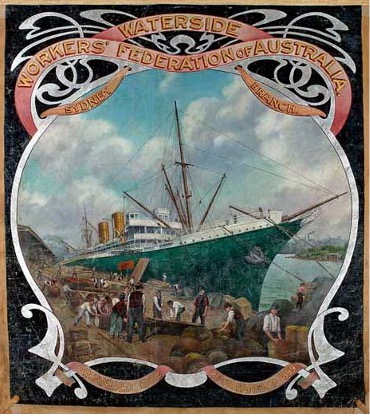
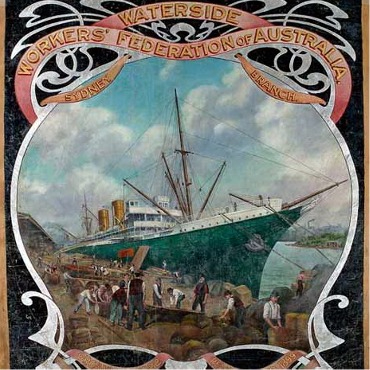
Early banner of the Waterside Workers’ Federation of Australia – Sydney Branch, circa 1920 [National Museum of Australia]
Steamer Karuah from Port Stephens unloaded at Newcastle during Strike – 1911
The Sun of 24 October 1911, page 7, reported:
‘The wharf strike is moving slowly and is not providing any excitement. There are no startling developments, and nobody seems to know what is going to happen. ….
The steamer Karuah, which arrived from Port Stephens, had a large quantity of perishable cargo, comprising 200 dozen crayfish and 100 baskets of fish. but no trouble was experienced in getting it off the vessel. The crew, under the seamen’s agreement with the companies, are required to remove all perishable stuffs, and consequently the Karuah’s fish was placed on the wharf without delay and removed to the markets’.
Steamer Allyn River from Port Stephens delayed by Newcastle Strike – 1917
The Northern Times of 18 September 1917, page 5, reported:
‘A trip around Newcastle Harbour this morning revealed that there are at present few vessels in port. This is not remarkable in view of the continuation of the determined stand of the seamen and the waterside workers in connection with the industrial trouble. This morning, at the Newcastle and Hunter River Steamship Company’s Wharf, the steamer ‘Archer’ was lying, and the wharf around was strewn with cargo outward and inward. At this wharf was also the Allyn River which trades between Newcastle and Port Stephens. The wharf work proceeds with volunteer labour.’
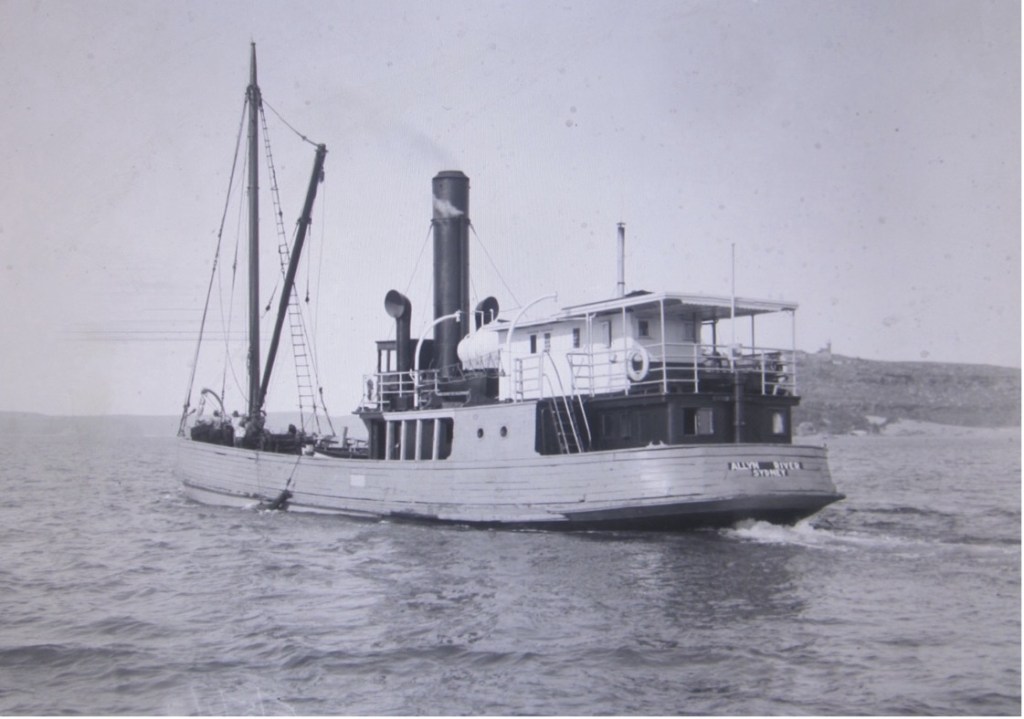
SS Allyn River in Sydney Harbour, circa 1920 [Fairfax Archive of Photos]
First Annual Picnic and Dance of Port Stephens Waterside Workers – 1924
The Newcastle Morning Herald and Miners’ Advocate of 26 March 1924, page 9, reported:
‘The first annual picnic of the Waterside Workers’ Union of Port Stephens was held at Nelson’s Bay on Friday. The s.s. Reliance conveyed the picnickers from the northern shores to the scene of the festivities. During the day sports were indulged in by young and old, and a dance ended the day’s enjoyment, held in the Arcadia Hall [at Nelson Bay]. As a fair attendance was registered, the initial sports meeting of this branch proved a success.’
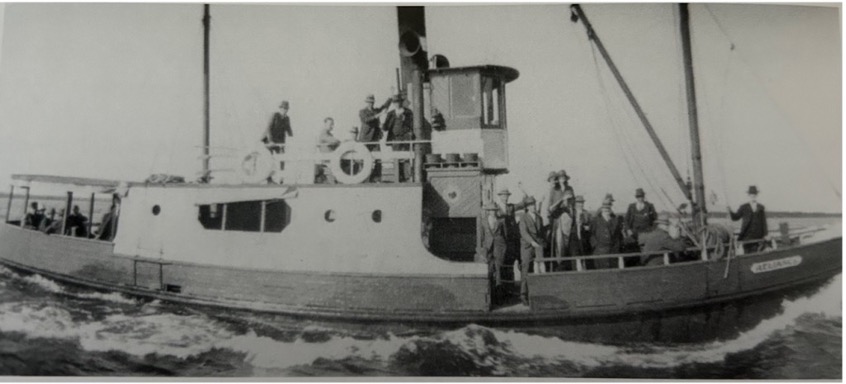
SS ‘Reliance’
Waterside Strike at Port Stephens – 1924
The Dungog Chronicle of 18 November 1924, page 2, reported:
‘A big sailing ship (5 masts) is at present in Salamander Bay, Port Stephens, loading timber for Mr. Gus Brown for New Zealand. The captain has refused to employ wharf laborers. An attempt was made to get the seamen to strike, but they informed the union officials that they were under American articles and refused to comply with the request.
The secretary of the Waterside Workers’ Union has wired that the ship should be loaded by the waterside workers, but his advice had no effect. An effort was then made to get the Merchant Service Guild to refuse to run to the ship, but that body claimed that it was running to the lighter from which the ship is being loaded, and not to the ship. The effects of the strike in Salamander Bay are therefore nil, except that the waterside workers have to scratch their heads and see the ship loaded and good money lost to them.’
Waterside Workers Union Meeting at Tea Gardens – 1924
The Newcastle Morning Herald and Miners’ Advocate of 23 June 1924, page 7, reported:
‘A meeting of the Waterside Workers’ Union was held at Tea Gardens on Saturday. Mr. J. J. Fitzgerald, M.P.. attended. and in the course of an address to the members, dealt with the conditions in the industry, and outlined the principal clause in the new claims.’
Schooner at Tea Gardens declared ‘Black’ by Waterside Workers – 1924
The Raymond Terrace Examiner and Lower Hunter and Port Stephens Advertiser of 14 November 1924, page 3, reported:
‘The schooner K. H. Hall is loading poles at Tea Gardens, and she has been declared black by the waterside workers of the Port. The secretary says the reasons are that the wharfies applied for work and were refused. Therefore, she is black. It is stated the vessel comes under the award.’
Second Annual Picnic and Dance of Port Stephens Waterside Workers – 1925
The Newcastle Morning Herald and Miners’ Advocate of 24 March 1925, page 5, reported:
‘The second annual picnic of the Port Stephens Waterside Workers’ Union was held at Karuah on Saturday last. Thurlow and Co.’s s.s. Reliance, and Motum Bros.’ launch Britannia were chartered by the union to convey the picnickers from Tea Gardens, Pindimar, and Nelson’s Bay to Karuah.
On the Karuah ground a good day’s sports was held. ….. During the evening a dance was held in the Karuah Hall. It was estimated that about 200 people attended the picnic. Credit is due to the promoters for the efficient manner in which the programme was carried out, and for the arrangements for the comfort of the picnickers.’
Shortage of Waterside Labour at Port Stephens – 1927
The Dungog Chronicle of 24 June 1927, page 2, reported:
‘Three steamers loaded timber in Port Stephens last week for export. Two of them came in together and the demand for waterside workers was so great that the Port Stephens branch of the union could not supply it. Alter all the members available had been picked, there were several men short and the town had to be combed to get men to go out and assist loading.
The energetic secretary, Mr. P. Ward, of the union was able to get the required labour and everything went well, the steamers getting away to schedule time. It is seldom that there is a shortage of labour in Port Stephens, more often there is a shortage of work.’
Waterside Workers at Port Stephens Unemployed – 1927
The Dungog Chronicle of 26 July 1927, page 2, reported:
‘There has been a big slump in the timber trade in Port Stephens lately, with a consequence that the number of unemployed is gradually increasing. The Waterside Workers are also having a very lean time, it being several weeks since the steamers have loaded timber in the port. If things don’t brighten up shortly many of the families will have a hard time ahead of them.’
Waterside Workers’ Picnic and Dance – 1930
The Dungog Chronicle of 4 April 1930, page 6, reported:
‘The seventh annual picnic of the Port Stephens Waterside Workers, which was postponed from the 15th March on account of inclement weather to March 29th, eventuated under ideal weather conditions. Notwithstanding that a large number of the members of the port, did not attend the picnic it was a pronounced social and financial success.
The Secretary, Mr. P. Ward, who needs “no bush” was the soul of the day’s function. The secretary received valuable assistance from Messrs. A.C. Frost, A. McRae, senr. (President), A. E. Davies, H. S. Milne, V. Edmonds and Sheather. The sports were scheduled to start at 2 p.m. but owing to the bad habit of coming late a start was hot made till 3. 10 p.m. A special feature of the afternoon was the secretary’s thoughtfulness in providing every child attending the sports with a bag of sweets, and was much appreciated by the children, who must have a sweet spot in their hearts for Mr. Ward.
The usual beverage “John Barleycorn” furnished the afternoon proceedings with a touch of eclat which buoyed the spirits far into the night. A perusal of the events of the day will establish the opinion that it was a Ward’s day out. For the members of the family gained no less than 3 out of 4 events while Miss Scott — Mr. Alf. Ward’s fiancee, won the stepping event for ladies, and Mr. P. Ward, secretary, was the winning dancing partner in a choco-late waltz at the ball.’
The Dungog Chronicle of 4 April 1930, page 6, further reported:
‘The Waterside Workers’ dance was held in the Australia Hall [at Tea Gardens] on Saturday evening, being the first held for a number of years, and proved both a social and financial success. About fifty couples enjoyed old time and modern dances to the pleasing strains of the Tean Gardens orchestra. Mr. Allan McRae was M.C. and carried out his duties in a pleasing manner. Mr. A. McRae, senr., filled the office as doorkeeper, very satisfactorily, having collected £3/9/-. Only a nominal charge was made, as the dance was regarded in a social sense, and the waterside workers desired to broadcast a spirit of good fellowship amongst the community, in which they succeeded.’
Waterside Workers’ Picnic – 1932
The Dungog Chronicle of 24 March 1932, page 4, reported:
‘A large crowd gathered on the reservation at Tea Gardens on Saturday the 19th March, where the above association [Waterside Workers] held their annual picnic. Good entries were received, and some very close finishes were witnessed in the various events. Everything went off smoothly and Mr. Ward, secretary, ran off the events to time and to the satisfaction of everybody. Owing to the time being limited the committee was unable to complete the programme, the remaining events will be concluded in a fortnight.’
Waterside Workers’ Picnic – 1933
The Dungog Chronicle of 24 March 1933, page 4, reported:
‘The above annual picnic was held in Tea Gardens on Saturday, March l8th, on the camping area, and although clashing with other attractions around the district, it proved to be a success; both socially and financially. The energetic secretary, ‘Mr. Percy Ward, had everything in apple pie order, and although his working committee were not present in full strength, substitutes were available, and the programme with the exception of three events was carried out in true sporting manner. ….
A bag of sweets was distributed to all school children on the ground and there being a balance of sweets left over, they were used. as a scramble. This body which organised the day’s sports are to be complimented on their thoughtful action in making provision for the children.’
Tenth Annual Waterside Workers’ Picnic and Dance – 1934
The Dungog Chronicle of 23 March 1934, page 4, reported:
‘On March 17th, on the Urban Area Camping Ground, the Port Stephens Waterside Workers’ held their 10th annual picnic sports under ideal weather. The picnic secretary, Mr. P. Ward, reports that the sports were a financial success.
The gathering was largely represented by the members and their wives and families, and the school children, declared it their harvest. It was very noticeable to the picnic committee the absence of quite a number of the parents of the children who were present and competed for prizes, they not being waterside workers or their wives. ….
Every event on the programme was run off, and a dance and euchre party was held in the evening in conjunction with the sports to conclude the day, where the presentation of prizes was made. The dance was also successful in helping the committee to attain their object in making sufficient funds to hold another annual picnic. The door takings amounted to £4/8/- and the following euchre prizes were won by Messrs. J. A. Ringland and N. Ringland. …. The total takings of the waterside workers on the day amounted to £ 23/7/9, and the expenditure was £15/0/1½, making a final balance of £8/7/7½.’
Waterside Workers Load Fourteen Thousand Sleepers at Port Stephens – 1934
The Dungog Chronicle of 14 September 1934, page 4, reported:
‘The s.s. “Nelore” called in Port Stephens during last week and loaded fourteen thousand sleepers for China ports. Allen Taylor and Co. were the shippers, and the cargo was handled by the Port Stephens Waterside Workers under the direction of Captain Smith, stevedore for that line of steamers.
This vessel runs a timetable (passenger’s and cargo) between Tasmanian ports and China, via Sydney and Melbourne, and at the time of calling here had a part passenger list, also a quantity of mixed general cargo. Quite a number of passengers made the trip to Newcastle by motor whilst the vessel was in port here.
A ship of between seven and eight thousand tons she was manned with a crew of Chinese sailors and firemen numbering one hundred and twenty-five, and eighteen British officers, also four Malayans, as quartermasters. Two Customs officers from Newcastle met her on arrival here and remained aboard whilst she was in port. On the Thursday night while the crew were loading a party of young folk from Tea Gardens were entertained by the Captain and officers. A dance was held and a tasty supper served. A delightful evening was spent by all.’
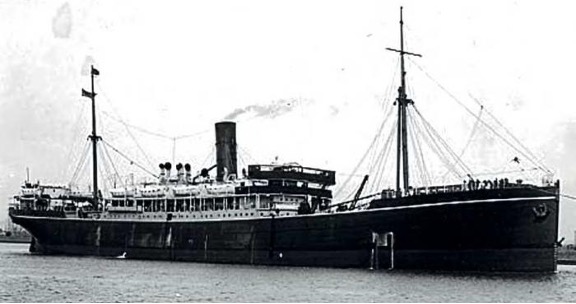
SS ‘Nelore’
Port Stephens Waterside Workers’ Transfers Strike Problem – 1934
The Dungog Chronicle of 5 October 1934, page 4, reported:
‘Eight members of the Port Stephens Waterside Workers drew their clearance and placed their transfers with the Newcastle branch. The Articles of their Association led them to believe that everything was in order, and some of the members sold their boats and fishing’ nets, etc., before going away. Their transfers were dealt with at a meeting of the Newcastle branch on Monday morning, and all were refused admission. The local secretary (Mr. P. Ward) states that the Newcastle branch is breaking the rules of the Association.’
Waterside Workers’ Picnic and Dance – 1935
The Dungog Chronicle of 22 March 1935, page 4, reported:
‘The Port Stephens Waterside Workers held their 11th annual picnic on the urban area camping reserve last Saturday. The weather was all that could be desired. The president and secretary with very little assistance ran off a big programme which was enjoyable, and a financial gain. All school children were given a bag of sweets free. Mr. P. Ward distributed them. A new item on the programme for Tea Gardens was the iron quoit tournament. This was arranged and run by Mr. J. Asquith of Nelson’s Bay. ……
The prizes were presented by Mr. P. Ward at the dance which was held in the Australia hall at night. The euchre party had a big muster and was conducted in a very capable manner by Mr. R. V. Franklin. …… An enjoyable evening was spent by all.’
Waterside Workers’ Picnic, Dance and Cycle Race – 1936
The Dungog Chronicle of 27 March 1936, page 4, reported:
‘The annual picnic of the Port Stephens waterside workers was held on the Urban camping area last Saturday afternoon. A shower of rain during the afternoon did not interfere with the sports programme. Mr. P. Ward the secretary was a busy man and was attending to everything. Mr. Ward was ably assisted by Messrs. A. E. Davies, H. Davey, R. Marquis and J. Franklin. Several of the events were keenly contested. ….. Sweets were distributed to the children and all prizes were presented at the social in the evening.’
The Dungog Chronicle of 27 March 1936, page 4, also reported:
‘The Myall Cycle Club conducted another race last Saturday afternoon. The Port Stephens waterside workers picnic committee presented the prizes for this race and it was run in conjunction with their picnic.’
The Dungog Chronicle of 7 March 1936, page 4, further reported:
‘The Port Stephens waterside workers held a social in the Australia Hall last Saturday evening as a conclusion to their picnic. Mr. R. Marquis was the doorkeeper, while Mr. P. Ward sold the tickets and later presented the prizes won at the picnic. Mr. R. A. Blanch was M.C. and was ably assisted by Mr. Tom Foster. Mr. A. E. Davies was in charge of the euchre.’
Waterside Workers Busy at Tea Gardens – 1937
The Dungog Chronicle of 25 June 1937, page 4, reported:
‘The timber trade has brightened things up in Tea Gardens of late. Mr. Perry Ward, the genial secretary of the waterside workers has been kept very busy getting the men to load the boats. The numerous motor lorries engaged in carrying the sleepers, poles etc., together with the droghers constantly loading, make things busy, especially along the waterfront.’
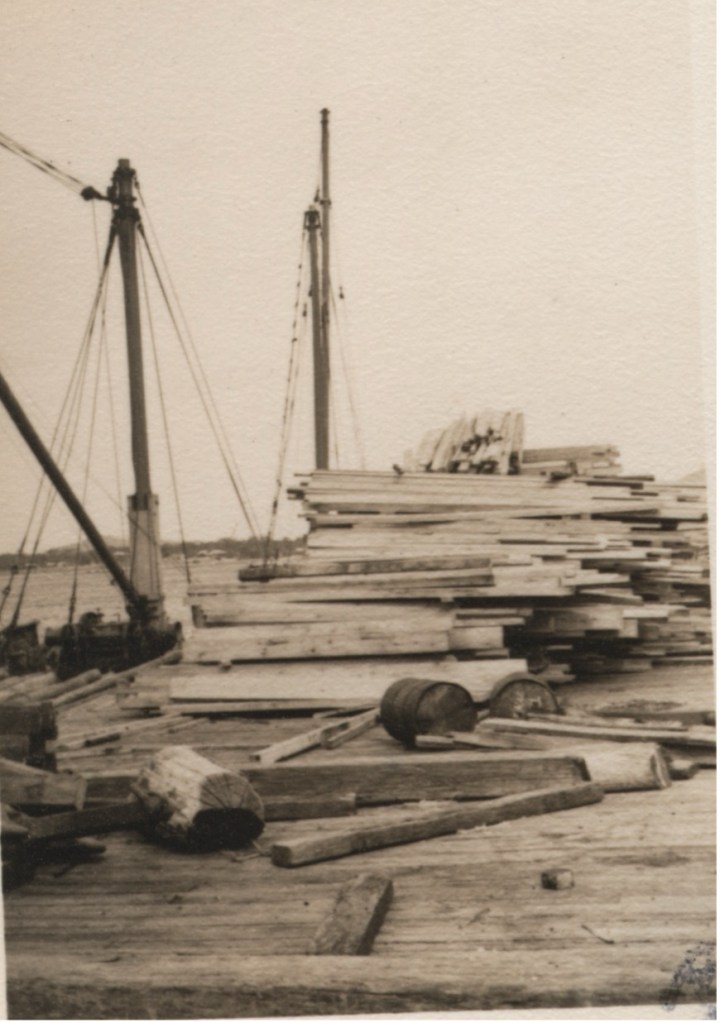
Timber awaiting shipment at Tea Gardens [National Museum of Australia]
Waterside Workers’ Picnic and Dance – 1938
The Dungog Chronicle of 25 March 1938, page 4, reported:
‘This annual event, held at Tea Gardens on Saturday last, attracted a large crowd of people and was a great success. The euchre party and dance held at night was also a very happy affair and successful both socially and financially. …. The door takings amounted to £6/3/6, while the novelty waltzes realised £1/11/.’
Waterside Workers Federation Assists the Local Branch of the Red Cross – 1938
The Dungog Chronicle of 5 August 1938, page 4, reported:
‘Members of the local branch of the Red Cross Society have established at Tea Gardens a stretcher and two pair of crutches for the use of the general public. Many a time a stretcher has been needed, and none was available, or a pair of crutches when somebody broke a leg. To get these necessities the president (Mrs. H. Davey) and the secretary (Mrs. C. Kidd) approached the Waterside Workers’ Federation for assistance, and they assisted with a donation that enabled a pair of crutches, adult size, to be purchased.
Waterside Workers’ Picnic – 1940
The Dungog Chronicle of 21 March 1940, page 4, reported:
‘The 16th annual picnic of the Port Stephens Waterside Workers was held at Tea Gardens last Saturday in ideal weather. The secretary (Mr. P. Ward) had been busy for weeks preparing for this event, and everything was well organised. The various events were well competed for and close finishes made them interesting to watch. A team of camels gave children rides around the grounds, introducing a novelty for Tea Gardens. Sweets and ginger beer were distributed to the children. Mr. Ward was assisted by a live committee, who had a busy time getting the events run off before dark.’
New Office Bearers of the Port Stephens Waterside Workers – 1940
The Dungog Chronicle of 5 July 1940, page 3, reported:
‘At the meeting held last Sunday morning officers were elected to fill vacancies, and the office-bearers now are: President, Alex McRae, senr.; vice-president, W. J. Motum; secretary, P. Ward; assistant secretary, J. B. Hough; treasurer, J. Gazzard; committee of management, F. H. Holbert, C. Worth, W. J. Motum, J. B. Hough, G. F. McRae, A. J. Dries and J. Gazard; committee of references, W. Ireland, M. Blanch, W. E. Dries; auditors, A. Ward and R. Burrows; trustees, Alex McRae, senr., W. E. Dries and D. Davey; picnic trustees, G. P. Godwin and P. Ward; door guardians, N. Ninness and R. Marquis.’
The Dungog Chronicle of 1 November 1940, page 4, also reported:
‘Mr. P. Ward is at present in Sydney, representing the Port Stephens branch at the waterside workers’ conference.’
‘Smoke-o’ to Replace Annual Picnic and Dance – 1941
The Dungog Chronicle of 7 March 1941, page 4, reported:
‘Mr. P. Ward, secretary of the Waterside Workers’ Union [at Port Stephens], is a busy man at present making arrangements for the ‘smoke-o,’ and explaining to the ladies why they are having a ‘smoke-o’ instead of the usual picnic and dance.’
Special Ports Committee Visited Port Stephens – 1941
The Newcastle Morning Herald and Miners’ Advocate of 30 October 1941, page 4, reported:
‘A log of claims for a new award by the Waterside Workers’ Federation and counter claims by the owners will be dealt with by the Special Ports Committee at a meeting in Newcastle next Wednesday. The Chairman will be the Commonwealth Conciliation Commissioner (Mr. A. R. Milddlemiss). The committee will arrive in Newcastle on Monday and will visit Port Stephens on Tuesday. It will leave for Coffs Harbour on Wednesday night. The committee will visit Grafton and Brisbane on award matters, and is expected to return to Sydney in the following week. ….. The The union Is seeking improved conditions and higher rates for certain cargoes.’
Proposal that Port Stephens Wharfmen be Sent to Newcastle – 1946
The Newcastle Sun of 12 August 1946, page 5, reported:
‘Investigations are proceeding in Newcastle to select a tentative camp site for about 100 wharf laborers from other ports. The camp will probably be constructed by the Federal Department of Works and Housing if some other accommodation for the men cannot be found.
Plans are being made to bring the men to Newcastle to assist in the loading of thousands of tons of manufactured goods which are awaiting shipment to other ports, where they are urgently needed. It is understood that arrangements were made for an officer of the Stevedoring Industry Commission from Sydney to discuss the accommodation problem with the chairman of Newcastle Port Committee (Mr. N. H. Thorpe) today.
The men will probably be housed in hotels and boarding houses if vacancies for them can be found, but this is doubtful. Though Brisbane has been mentioned as the port which the men woold possibly be brought, it is believed that volunteers would be drawn from any port where the volume of work is not sufficient to absorb fully all the labour available. Work on the Brisbane wharves lately has been comparatively slack.
It is possible that a number of men may be brought from northern New South Wales river ports, including Port Stephens, Kempsey, Coffs Harbour, Grafton and Lismore. The total number of waterside workers registered at these centres is approximately 175.Work Work in these ports is intermittent and is treated by the watersiders really as casual labour. They spend the bulk of their tune in other local occupations, such as timber-getting and fishing. When, during the war, wharf laborers, were taken to Sydney to help relieve a congestion of work there, approximately 30 men from these northern river ports volunteered for the work.’
Commentary of Percy Ward, of the Local Waterside Workers Federation – 1952
The Dungog Chronicle of 20 August 1952, page 3, reported:
‘The Union Co. has had a vessel loading timber and poles for New Zealand since Friday week. This ship is the first to lay at the new mooring buoy placed at the end of schooner channel into Duck Hole [at Port Stephens]. Unfortunately, the wet weather stopped work on Wednesday and although the wharfies sat on their rudder for the half day, then refused to place hatches on the ship hole when asked to do so. Just why, is hard to understand, for the few disruptionists in this organisation should not be members of the Wharf Labourers Federation for they are in businesses of their own.
Try anything, they put over shipping coys., and then hear the squeal. The cry of ‘unionist’ is simply ‘bunk,’ for records of labour will show that the so-called members of Port Stephens rely on free labour to load ships. Should the fishermen and other businesses have things to suit them, the ship to load can be forgotten and only free labour solves the problem of getting cargoes away. Sometimes a whole sawmill has to stop and their men help load the ships and then have to be dictated to by a hand full of the so-called Waterside Workers Federation men who had to fill in time on some ship to entitle them to be members of the Federation.
The secretary of the Union in this port has our sympathy for the knocks that he has to take from the Shipping Coys., free labour men, punt men and the public when it is necessary to depart from some infringement of the union’s regulations to clear ships droghers and lighters that are working under adverse conditions, and he is not allowed to do it, because some so-called unionist objects. Mr. Ward is loyal and true to his union and it’s up to the shipping companies to apply to the general secretary of the Federation to allow the secretary in the Port of inconveniences to depart from any regulation in order to clear ships, if he thinks fit.’
Concluding Comments
The histories of the Timber Industry at Port Stephens and the Mining of Alum at Bulahdelah are found on this website.
The need for waterside workers at Port Stephens to load timber and alum products onto ships had waned considerably during the early 1950’s.
The heyday of timber getting and milling in Port Stephens and the Myall area was over by this time. Many areas of native forests had been cut and forest plantations were established to provide for further timber needs. Oxen and droghers were generally no longer used for the transport of timber. The large number of workers who carried out many types of dangerous timber jobs were no longer required due to mechanisation having taken over forestry operations.
Alum mining at Bulahdelah ceased in 1952.
Researched and compiled by Kevin McGuinness
March 2024

 Port Stephens - a history exploration