

Introduction
HMAS Assault at Nelson Bay ceased to function as a military training base when the British Royal Marines left there in March 1946.
Prior to the Royal Marines vacating the facility, the New South Wales Government had earmarked the facilities for conversion into a mental hospital facility.
This paper is the story of the proposal and its eventual demise.
Plan for Mental Hospital Facility Announced
The Newcastle Morning Herald and Miners’ Advocate of 27 February 1946, page 2, reported:
‘Huts at Nelson’s Bay previously used as barracks by the United States Navy would be converted into a mental convalescents’ home. Mr. Hawkins. M.L.A., said yesterday. Situated on a hill and covering about 36 acres, the new home will accommodate 160 patients. The announcement follows representations to Mr. Hawkins by officers of the Stockton Mental Hospital. Organisation and control would be under the jurisdiction of the Superintendent of Stockton Hospital (Dr. Kinna) and his staff. There would be a small permanent staff at the institution, but patients generally would be in the care of nurses who had brought them from the institutions.
The department intended to make a model home, complete with lawns and gardens. It would have its own dairy and poultry runs. Inmates would be “quiet” cases needing rest treatment as the final part of their cure, an official of the Stockton Mental Hospital said yesterday. They would be free to roam as they pleased, and no restraint would be placed upon them. Overlooking Little Nelson’s Bay, the site was ideal from a health aspect, he added. Full water and power facilities were available at the hutments, which were on the eastern side of the present RA.N. barracks.’
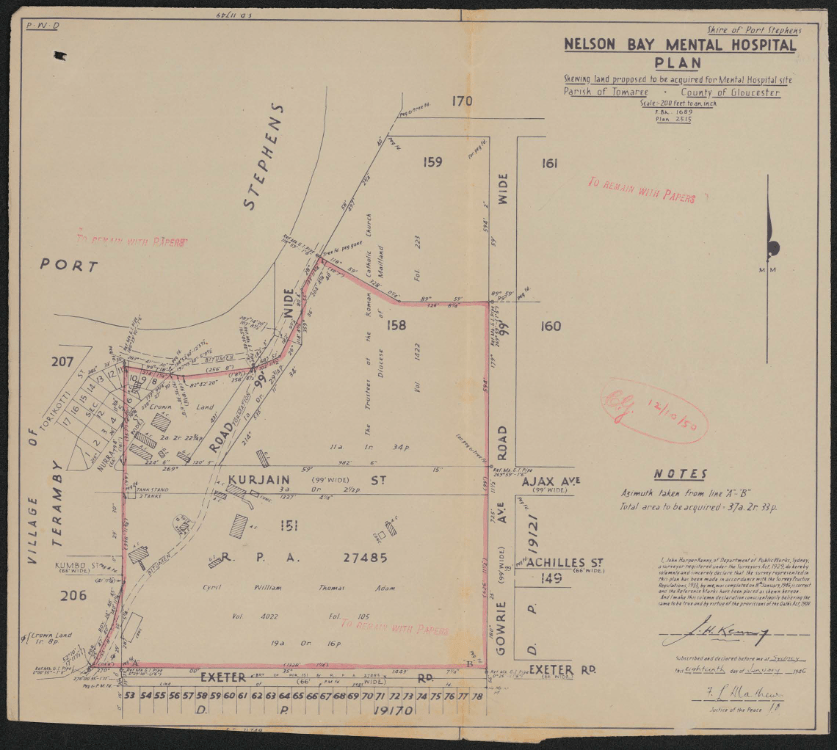
Plan of the area resumed for the Nelson Bay Mental Hospital Facility. [Museums of History NSW]
Community Opposition to Proposed Mental Hospital
The Newcastle Sun of 7 March 1946, page 2, reported:
‘Opposition is developing in the Nelson’s Bay area to the Government’s proposal to establish a mental hospital there, on the site lately occupied by American and British forces. Residents claim that this will spoil the development of one of Australia’s most promising tourist areas. They point to the keen demand for land in the Sandy Bay area, where, following a recent subdivision, one house has already been completed, and others are building, as evidence of what may be expected when building conditions return to normal. The matter will be raised on Friday night at the regular meeting of Port Stephens Shire Council.’
Minister for Health Explains Proposal
The Newcastle Morning Herald and Miners’ Advocate of 14 March 1946, page 4, reported:
‘Preliminary work had begun to convert the former United States amphibious training camp at Nelson’s Bay into at recreation and holiday hostel for convalescent patients from mental hospitals throughout the State, said the Minister for Health (Mr. Kelly).
The hostel will have accommodation for 150 persons. It is proposed to collect batches of patients from mental hospitals up to an aggregate of 75 at the one time for transfer to Nelson’s Bay. They will be accompanied by nursing staffs of hospitals from which they are transferred. The site, comprising privately owned and Crown land was acquired by the State Government. The official gazettal stated that the sum involved in the scheme was not to exceed £20,000. The State Government will buy the buildings from the Commonwealth Disposals Commission.
The Minister said the Division of Mental Hygiene had placed a caretaker in charge of the premises. The grounds had been cleaned up, and all wooden buildings sprayed with preserving oil. To adapt the property to requirements of a hostel, all the site would be fenced in, alterations and additions would be made to buildings, and modern equipment installed to accommodate convalescent patients.
About 12 reliable working patients would be domiciled at the hostel and would proceed with the preliminary work as soon as the Public Service Board approved the appointment of an officer in charge. The Public Works Department, which had been asked to proceed with the reconstruction work, would also install new electrical services throughout the hostel. Mr. F. H. Hawkins, M.L.A., who discussed plans with the Minister, said the hostel would be an important acquisition for the final stages of treatment of mental patients. He expected the hostel to be ready for occupation in a few months. The hostel would be almost self-contained as far as food was concerned, he said. Patients would raise pigs and fowls, grow vegetables, and would probably fish. Lawns and garden plots would be arranged.’
Council Raises Objection to Mental Hospital Facility
The Raymond Terrace Examiner and Lower Hunter and Port Stephens Advertiser of 21 March 1946, page 3, reported:
‘At the Shire Council meeting on the 8th March, the Council was advised that a Gazette notice had proclaimed an area at the back of Fly Point, or Little Beach an area for a site for a mental hospital. This rightly raised objections from the Council.
Cr. Upton said the proposal to put a mental hospital at Nelson Bay, would if carried into effect be hard on the residents of the Bay, and also those who had property there. A mental hospital was not desirable where the area was residential and a resort of thousands of tourists and the area would be required for residential purposes later on. There was plenty of land farther back. He moved that the Council object to the proposal. Cr. Russell seconded the motion. They make no reference he said, to the local authority but simply gazette the resumption without any enquiry whatever as to the suitability of the area, or whether the residents should be consulted or not. The fact of a mental hospital being there would not be a benefit to Nelson Bay on that site. If they proposed Fingal Bay, or further out the Council, he thought might not object. The Council should emphatically protest against the site near Fly Point.
Cr. Morgan supported the motion. He said, while they were all very sympathetic to those poor people who were afflicted, there were other sites that could be chosen and would be better from all points of view. The area chosen was too close to the tourist area, and there was possibility of £1000 being spent in Shoal Bay not far from the area gazetted, within a few hundred yards practically. Every Sunday about 15 or 20 buses visit Nelson Bay and it was hardly reasonable that they should be brought into close proximity to the mental hospital. There were other more beautiful places that can be used. The Council should protest, as further developments are sure to take place at Nelson Bay.
Cr. Lantry said Nelson Bay was a health resort, and it was unfortunate that the Department took action before consulting the Council. He was strongly opposed to the site selected. Cr. Tranter said Nelson Bay was a very suitable area for a mental hospital, but the locality selected in view of all the circumstances was not suitable. But the fact of mental subjects being at large and wandering about, among people was often good for the patients if not convenient or congenial to the public. He thought the Council should get assistance in protesting against this site. Maitland, Cessnock and other areas from where the people frequent Nelson Bay. This was agreed to and the motion.’
Hospital Commission Replies to Council Objection
The Raymond Terrace Examiner and Lower Hunter and Port Stephens Advertiser of 9 May 1946, page 4, reported:
‘A letter was read at the Shire meeting on May 3rd from the Hospital Commission on the establishment of a mental hospital at Nelson Bay. The letter was in reply to Council’s objections and stated that only convalescent patients would be sent there. Buildings that were now there could be used for hostels for patients.
The Greater Newcastle Council advised the Port Stephens Shire Council that they would cooperate with them in any action that may be necessary to prevent the hospital from being established at Fly Point. Cr. Russell said he did not object to the hospital being established at Port Stephens, but he did protest against the area being taken that would be where the town of Nelson Bay and tourist homes would extend to. There were other areas where they had facilities for the hospital without interfering with the town’s development.
Cr. Tranter said he presumed the Hospital Board should know the best site. Sometimes it was beneficial for partially recovered mental subjects to mix in with other people. Cr. Lantry said he supported Cr. Russell’s view. They should not take this proposal, to put the hospital there, sitting down. The area was necessary for Nelson Bay’s development. Cr. Tranter asked if there were not large areas still available at Nelsons Bay for building the town on. The President said the area was the locality where future building sites would be selected.
Cr. Upton said by taking this site they were taking some of the best building sites in the Bay, and it would be a detriment to the development of the Bay. Cr. Morgan moved that a letter be written the hospital authorities pointing out that they did not object to a mental Hospital in Port Stephens, but the Council objected to the proposed site. Crs. Russell and Upton supported the motion, which was carried. It was also agreed to thank Greater Newcastle for their proffered support.’
Proposal for Mental Hospital Abandoned
The planned Mental Hospital Facility was abandoned by the NSW Government in February 1948, when the Commonwealth Government reversed its previous decision to sell the former military site and retain it for use by the Royal Australian Navy.
The abandonment of the proposal forced the NSW Government to re-transfer all land acquired back to Comminwealth Governement.
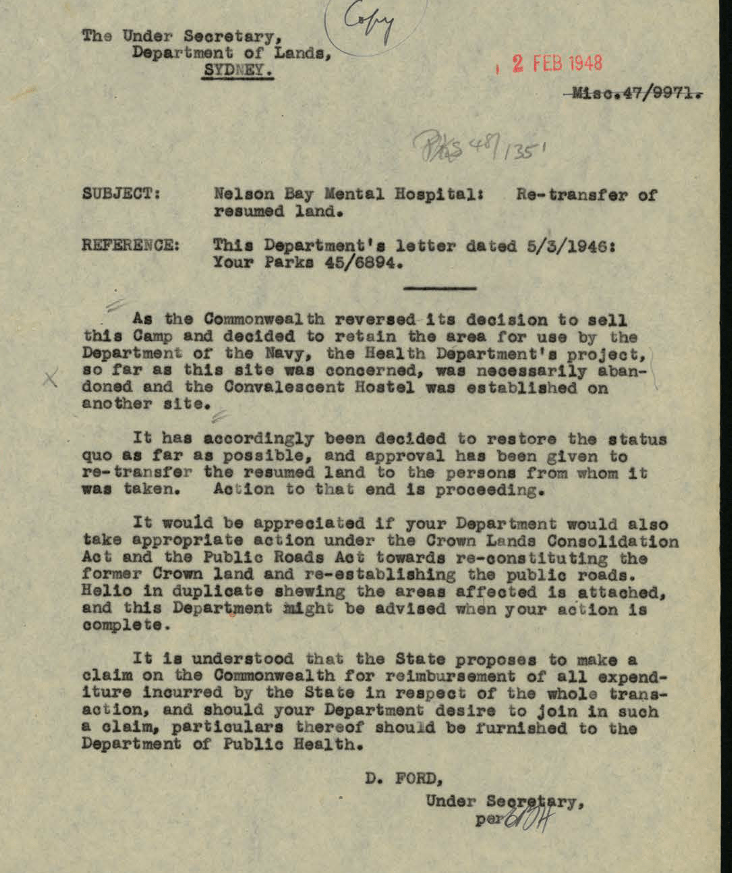
Letter held by Museums of History NSW which sets out the background to the abandoned project.
Concluding Comments
Despite local opposition to the proposed convalescence facility, the NSW government authorities did commence work to update the buildings on the HMAS Assault site to make them fit for purpose.
However, the facility did not become operational. The Commonwealth Government’s immediate need for the area was stated to be for future military purposes but that did not eventuate either.
Following the end of the Second World War, Australia put in place the Displaced Persons Scheme, to obtain a share of the many skilled migrants displaced by that war and to settle them in Australia.
Where possible the Commonwealth Government established migrant hostels, by upgrading existing vacant facilities such as former military establishments, to house the new skilled migrants.
The former HMAS Assault military camp at Fly Point, Nelson Bay was one such facility, that was suitable for conversion to a migrant hostel. In early 1949, an initial intake of 49 migrants helped to set up the new migrant hostel at Nelson Bay. A history of the Nelson Bay Migrant Hostel is found on this website.
An alternate site for a convalescent facility for mental health patients was developed by the NSW Government which established the Tomaree Convalescent Hostel in 1947 on Tomaree Headland. Information on this facility is found at the above link on the website.
Researched and compiled by Kevin McGuinness
March 2024

 Port Stephens - a history exploration