
Introduction
In March 1854, the Governor of New South Wales, Sir Charles Augustus FitzRoy, sailed to Port Stephens on board the British naval ship, H.M.S. Calliope.
The Calliope was a ship of 750 tons that had previously sailed from Plymouth in England, via Van Diemen’s Land, landing at Port Jackson on 20 July 1851.
After his arrival at Port Stephens, the Governor travelled up the Karuah River and inspected the operations of the Australian Agricultural Company at Stroud.
The newspaper articles set out in this paper are written in a style that was common during the early colonial period of NSW, and the Governor is referred to as the ‘Governor-General’. By the time the Governor arrived at Port Stephens, in 1854, the lifestyle of the local aboriginal communities had been severely compromised by the intrusion of the colonial settlers.
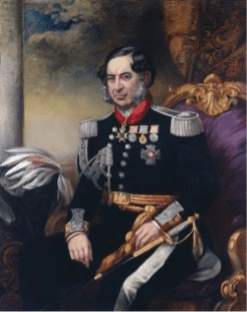
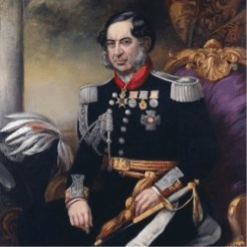
Charles Augustus FitzRoy (1796-1858) [State Library NSW]
Purpose of the Governor’s Visit
The Sydney Morning Herald of 3 March 1854, page 4, reported:
‘At four o’clock this afternoon, His Excellency the Governor General will embark on board H. M. S. Calliope, on his projected tour through the Northern Districts. The subordinate objects of His Excellency’s visit, his detention at Port Stephen and at Moreton Bay, are scarcely yet open to comment. No doubt, at the latter place, His Excellency’s presence will call forth some expression of public opinion.
The main and chief object of the trip is, however, to establish a settlement at Port Curtis [near Rockhampton, Queensland] – to form, in fact, what may hereafter be considered by geographers, under whatever name it may be denominated, the Northern Province of the Australian Continent. An object like this is of great importance to the whole community. A Government resident for the district has been appointed, and competent people have been sent down to report on the natural capabilities of the country. To predict anything of good, to augur anything of evil, would be most improper; but we shall look most anxiously for the results of this expedition.
The plan of His Excellency’s trip is as follows:- The Governor-General will embark from Fort Macquarie [present site of Sydney Opera House] at 4 p m., this day, on board H.M.S. Calliope. Captain Gennys, attended by his private secretary and aide-de-camp, and heads of departments are expected to attend. At daylight on the following morning (Saturday) the vessel will cast anchor. His Excellency intends visiting the Australian Agricultural Establishments and stations at Port Stephens and at Stroud, and thence to proceed to Moreton Bay. After remaining as long as may be necessary or expedient at Brisbane, his Excellency will proceed on a tour through the Darling Downs.
He will then return to Brisbane, and proceed to Port Curtis, where the length of his stay is uncertain, but it is anticipated his Excellency’s absence from Sydney will extend to about six weeks.’
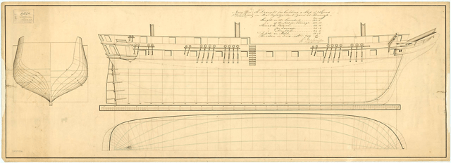
Body plan of the Calliope (1837), a 28-gun sloop [Royal Museums Greenwich]
Governor Arrives at Port Stephens
The Sydney Morning Herald of 16 March 1854, page 5, reported:
‘On the 6th instant, H.M.S. Calliope, having left Sydney on the previous Saturday, sailed into this Harbour [Port Stephens], with the Governor-General and his suite on board; and, although the weather was boisterous and rainy, His Excellency was not deterred from proceeding at once in the ship’s cutter up the Karuah River to Booral, accompanied by Captain Brownrigg [General Superintendent of the Australian Agricultural Company], as whose guest he was to spend a few days on the estate of the Australian Agricultural Company.
On Wednesday morning, the Governor-General and his party rode up to Stroud, the principal establishment of the Company, a number of gentlemen riding out thence to meet him; and at half-past one, having previously visited the Church (erected by Sir Edward Parry at his own expense) and school, and witnessed a short but satisfactory examination of the scholars, proceeded on to a temporary building, decked out with boughs and flags, under which a lunch had been prepared, to which all the gentlemen resident in the neighbourhood had been invited to meet His Excellency. About fifty persons sat down, amongst then many officers of the Calliope; and the weather being warm, the guests were enabled to do justice to the wines which had been liberally provided.
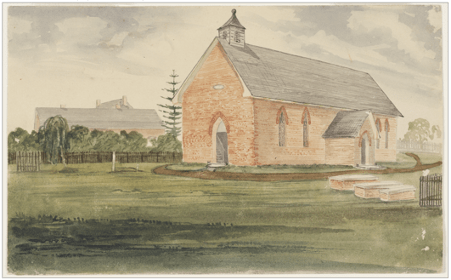
Stroud Church built by Sir Edward Parry, second Commissioner of the Australian Agricultural Company, that was visited by Governor FitzRoy [State Library NSW]
At the proper time a bumper toast was called for by the Chairman, Captain Brownrigg and “the health of Her Majesty the Queen,” [Queen Victoria] was drunk with all the honours. “The health of Prince Albert and the Royal Family” met with an equally enthusiastic reception; and then “the Governor-General’s health” was drunk, and the toast loudly cheered. The worthy Chairman was in excellent spirits, and spoke well; commenting on the presence of the Governor of the colony for the first time at Port Stephens. His Excellency, in returning thanks, expressed his gratification at the reception he had met with, and, in return, proposed “the health of Captain Brownrigg,” with whom and with Mrs. Brownrigg he had been formerly acquainted at the Cape of Good Hope, and in connection with whose names he would also wish prosperity to the Australian Agricultural Company.”
On rising from the lunch, His Excellency was requested to proceed to the cricket ground, to receive an address from the assembled residents of the place, a copy of which, with His Excellency’s reply, is subjoined [see below], shortly after the presentation of which about 300 persons sat down to a long table under a booth, and enjoyed themselves in partaking of the refreshments which had been provided.
During the remainder of the afternoon a cricket match was played, which afforded His Excellency some amusement. Altogether the event was a happy one; all present seemed to be pleased, and the day will long be remembered by the inhabitants of Port Stephens, and it is to be hoped it will not lose its salutary effect upon the minds and feelings of the rising population.
On Tuesday next, the 14th inst., His Excellency and suite will re-embark on board the Calliope, and leave the same day for Moreton Bay and Port Curtis.’
Address to the Governor from the Inhabitants of Stroud and Governor’s Reply
The Sydney Morning Herald of 16 March 1854, page 5, published the following address to Governor FitzRoy from the inhabitants of Stroud and also his reply:
Address to the Governor: –
‘To Sir Charles A. FitzRoy, Knight Companion of the Royal Hanoverian Guelphic Order [Order of Chivalry instituted in 1815], Governor-General of all Her Majesty’s Australasian Possessions, and Captain General and Governor-ln-Chief of the colony of New South Wales, and its Dependencies. May it please Your Excellency.
We, the assembled residents of Stroud and its vicinity, being chiefly officers, servants, and dependants of the Australian Agricultural Company, approach your Excellency’s person with feelings of satisfaction and pleasure, in witnessing your Excellency’s presence amongst us, and to thank you for the opportunity you have afforded us of expressing the sentiments of respect we entertain towards you as the representative of our gracious Queen and of the attachment we feel to her Royal Person, and to that glorious Constitution which, is the boast of every true hearted Englishman.
We have the greater reason to feel proud and gratified at the event which we are here to celebrate today, for since the former wilderness which existed where we here stand was reclaimed from the wandering aborigines, never before have we had the honour of a visit from any of your Excellency’s predecessors and we hail this, the first advent of her Majesty’s representative amongst us, with infinite satisfaction, sensible that we partake in some measure of those loyal feelings which arise in the hearts of our more favoured countrymen in England when honoured by the presence of her Majesty herself.
It is not our intention to trespass on your Excellency’s time, but as it is possible that in the course of events, we shall not again have the pleasure of seeing your Excellency amongst us, we would seize upon this opportunity of tendering our congratulations upon the happy and prosperous nature of your Excellency’s administration pf the Government of this colony — a colony which has risen under your Excellency’s auspices from one of the least to perhaps the most important of Her Majesty’s colonial possessions, and we hope that when you relinquish the high trust which has been committed to your care, you will carry with you a lively remembrance of your sojourn in Australia, and receive that meed of praise from the hand of your Sovereign which you deserve so well.
Signed on behalf of all the assembled residents of Stroud, &c.: Marcos F. Brownrigg, Stroud, 8 March 1854′
The Governor’s Reply: –
‘To the Residents of Stroud and its vicinity. Gentlemen – I have to thank you for this Address, and for the expression of your sentiments towards me as Her Majesty’s Representative, and of your loyalty and attachment to our gracious Queen.
It is gratifying to find that in this distant portion of the Empire those loyal feelings towards Her Majesty’s Person and Government are so warmly evinced.
I thank you for your kind congratulations on the prosperity of the colony during my administration, and in paying this visit to the Australian Agricultural Company’s estate, it has afforded me much pleasure to renew an acquaintance of many years standing with your esteemed Superintendent.
(Signed) Stroud, 8th March, 1854: Chas. A. FitzRoy.’
Remainder of the Governor’s Visit to Queensland and Return to Sydney
The Sydney Morning Herald of 11 May 1854, page 4, reported:
‘Early yesterday morning, a ship-of-war was signalled to the northward [of Sydney], and about nine o’clock she was ascertained to be the Calliope, with the Governor-General on board. The usual salute was fired, and several Heads of Departments hastened to meet His Excellency, on board.
We rejoice to say His Excellency’s tour through the Northern districts of this colony has been of the most pleasant description; and it has been a source of delight to him to see the loyal feeling which was universally manifested, and of self-congratulation, to see such cordial respect and hearty welcome accorded to him as the Representative of the Sovereign.
It is impossible not to recognize in the demonstrations which have waited on his Excellency throughout his tour to the North, a general approval of the principles on which the administration of his Government has been conducted; and while we trust His Excellency returns from his tour with renovated health, we are certain that he must have confirmed and assured himself of the loyalty of the colonists at large, and, we are happy to be able to add, of their approval of the general conduct of Her Majesty’s Representative in this colony.
We append a few brief notes of that portion of His Excellency’s tour from his arrival at Port Curtis [in Queensland] to his return to Sydney:
Port Curtis, Sunday, April 16: ‘Our expectations were fulfilled this afternoon by the arrival of H.M.S. Calliope, Captain Fitzgerald, with His Excellency the Governor-General and suite.
The frigate dropped anchor about five miles from the encampment on the site of the future capital of North Australia. As soon as she appeared off the Heads, the schooner Tom Tough, which arrived with the Government establishment a few days ago, sailed with the Government Resident, Captain O’Connell, and his lady, to meet her. The Calliope made an excellent passage from Moreton Bay, having sailed thence on Friday last. It being too late for the Governor to land today, Captain and Mrs. O’Connell dined on board, and then returned in the schooner, their place of residence for the present, to her anchorage off Gladstone.
Monday.- This morning the soil of Port Curtis was trodden for the first time by her Majesty’s representative, accompanied by G.H. FitzRoy, Esq., Private Secretary; E. Maitland, Esq., Acting Aide-de-camp; Captain Fitzgerald, and Captain Gennys, H.M.S. Fantome.
The whole population of the canvas town, some sixty in number, turned out to meet the Governor, who at once repaired to Captain O’Connell’s tent, where the constabulary were drawn up in military array. The protective force was presently increased by the arrival of the Mounted Native Police, under Lieutenant Murray.
Horses were provided for the viceregal party, and accompanied by Captain O’Connell and a detachment of police, his Excellency visited the settlement on Auckland Point, and the camp of the native police, and then rode to the summit of a lofty hill, commanding a panoramic view of the bay, with its picturesque variety of hill and dale and islets fair, basking in the noonday sun; solitudes as yet untrodden by the pale face, but ere long to be roused from their dream of ages by the sound of his industry.
The equestrians on returning to Gladstone sat down to a superb luncheon at Captain O’Connell’s, and shortly afterwards repaired on board the frigate for the night.
Tuesday:- An excursion was planned for today, to the Surveyor’s camp on the river, fourteen miles from Auckland Point. About three o’clock the Calliope’s boats arrived at Mr. McCabe’s, bringing the Governor and several of the officers belonging to the ship. Another party on horseback arrived about the same time. The surveyors are encamped on a noble plain skirted by the river, which his Excellency christened “The Calliope.” The scenery on the banks is very pleasing, and our visitors had an opportunity of learning the nature of the country, both near the river, and inland from it.
Some gentlemen being present possessing considerable experience in the exploration and working of goldfields, arrangements were entered into for the purpose of ascertaining the probability of a paying deposit existing in the neighbourhood, where it has already been found in trifling quantities. But the project had to be abandoned, the period fixed for the cruise of the Calliope not affording time for properly carrying it out. We are looking forward to the arrival of M. Stuchberry, the geologist, part of whose duty it will be to determine the question. His Excellency and party took their leave in the evening, expressing much interest in the success of the infant colony, and much pleasure in the beauty and commodiousness of the splendid harbour, and the promising aspect of the surrounding country.
We understand that the Calliope did not sail from Port Curtis until Friday, being detained in harbour by S.E. winds, accompanied by heavy rains. The intention of His Excellency to visit Norfolk Island was not carried out, in consequence of a loss of five days occasioned by calms and light baffling winds . Tempestuous weather from the S.W. succeeded, from which the Calliope took refuge, anchoring under the lee of Lord Howes Island on the 2nd of May. A small party braved the weather and visited this beautiful and remarkable spot. It is inhabited by three or four families, comprising about twenty persons. The interesting ceremony of baptizing five children was performed by the Rev. Mr. Carwithen, chaplain of the Calliope; he is the first clergyman who was ever there.
The frigate lay still on the following day, visited by a rapid succession of heavy squalls. At three o’clock on the morning of the 5th instant, she was struck by a squall of unusual violence; her cable snapped, and she was forced to put to sea in very heavy weather, which did not moderate until the morning of the 7th. She fortunately sustained no further damage. H.M. steamer Torch was at Howe’s Island on the 26th ultimo, leaving letters and papers for the Calliope up to April 19.’
Concluding Comments
The various descriptions of the Governor’s tour of Port Stephens and the northern regions, provides an insight to the life of the European settlers and also the rapid the rapid dispossession of aboriginal culture.
In the words of Marcos Brownrigg, when addressing the Governor at Stroud he boastfully stated: “We have the greater reason to feel proud and gratified at the event which we are here to celebrate today, for since the former wilderness which existed where we here stand was reclaimed from the wandering aborigines.”
Researched and compiled by Kevin McGuinness
January 2024

 Port Stephens - a history exploration