

Introduction
In 1923, it was mooted that an American business syndicate had plans to undertake major industrial development on a large tract of land on the northern shores of Port Stephens, in the vicinity of Tea Gardens.
It is believed that the syndicate was associated with the Kelly Investment Company of New York, acting in conjunction with Messrs. Cowan and Company, of Canada. Mr F. C. Emery was sent to Australia to enter into negotiations.
It was announced that the American syndicate had obtained an option over 20,000 acres of land near Tea Gardens, on which it proposed to establish various large business operations. Industries proposed included a large factory assembling American made machine parts; a cement works; a Ford car making factory and a paper manufacturing factory.
Although it never progressed past the planning stage, the story of the syndicate is reflective of the development potential of Port Stephens in the early years of the twentieth century, and also the speculative nature of some land developments proposed at that time.
Using the resources of the National Library of Australia’s Trove newspaper collection, this paper tells the of the American industrial plans and the community response to them.
American Money Waiting to Develop Port Stephens
The Dungog Chronicle of 9 February 1923, page 3, reported:
‘The “Daily Mail” is able to state that negotiations between a Sydney group of businessmen and American moneyed interests are far advanced in the direction of opening up Port Stephens, to the north of Newcastle, and transforming the town into a hive of industry. This news will be welcomed by those who deplore the congestion caused by the existence of Port Jackson as the sole commercial entrance to our mainland. For some months negotiations have been proceeding between a group of Sydney businessmen with two important American land and estate companies, which are associated with a group of manufacturing and traction companies, with the idea of opening out Port Stephens and making it the headquarters for the group’s operations. This will necessitate the laying out of a model industrial city, combined with the erection of factories and the making of concrete roads, etc.
The scheme is on a comprehensive scale. Representatives of the group have been to Port Stephens and have returned to New York. The latest cable advices are of a favourable character, and intimate that the American group have become highly interested. Further details are expected by the American mail due early in February.
The development of Port Stephens has been a subject of controversy for the past fifty years, and it would be an immense benefit to the State if an energetic group of financial interests came over and thoroughly opened up the port and made it an industrial centre. Another thriving shipping and manufacturing port on our coast would give the necessary fillip to a much-needed extension of our shipping and manufacturing industries.’
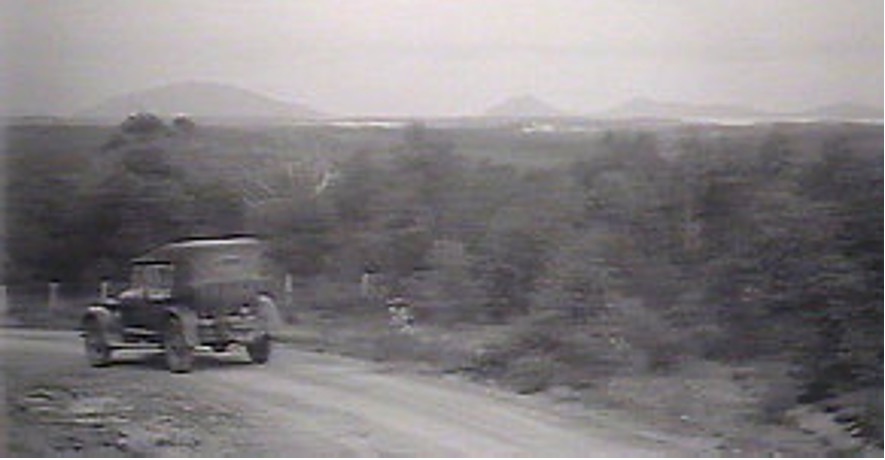
Early view over the Tea Gardens area of Port Stephens proposed for development by the American syndicate.
Land Secured at Port Stephens
The Maitland Daily Mercury of 14 February 1923, page 3, reported:
‘A large area of land on the north side of Port Stephens has been secured by an American firm for the establishment of works in that part of the district. The same firm has also purchased land at the Tea Gardens, the price paid being stated to have been satisfactory.
The Government railway surveyors have reached Stroud, and are now at Stroud-road, for the purpose of permanently marking the railway line from Stroud-road to the north arm of Port Stephens.’
Crown Lands Not Affected by Proposed American Development
The Newcastle Morning Herald and Miners’ Advocate of 7 March 1923, page 9, reported:
‘It was announced in a recent issue of the “Newcastle Herald” that a large area of land had been purchased by an American firm on the north side of Port Stephens. The extent of the area was made the subject of inquiry by Mr. M. Cromarty, M.P., who has received the following communication on the matter from Mr. E. P. Fleming, Under-Secretary Department of Lands:—”Referring to your personal inquiry of February 16, 1923, regarding the above mentioned matter, I have to inform you that from inquiry it has been ascertained that the lands referred to formed part of a private subdivision of the Australian Agricultural Company’s grant of 464,640 acres, county Gloucester, and that no Crown lands changed hands or will be affected by the proposed operations.”
Residential Land Sales Opposite Proposed American Development Site
The Newcastle Sun of 28 March 1923, page 6, reported:
‘During the Easter Holidays, Messrs. R. A. Elkin and Son, of Raymond Terrace, will hold private sales of land in the office on the Waterview Estate, Tea Gardens, and arrangements have been made for intending purchasers to inspect on application. The land for sale is right opposite where the American syndicate engineers and surveyors are at work every day.’
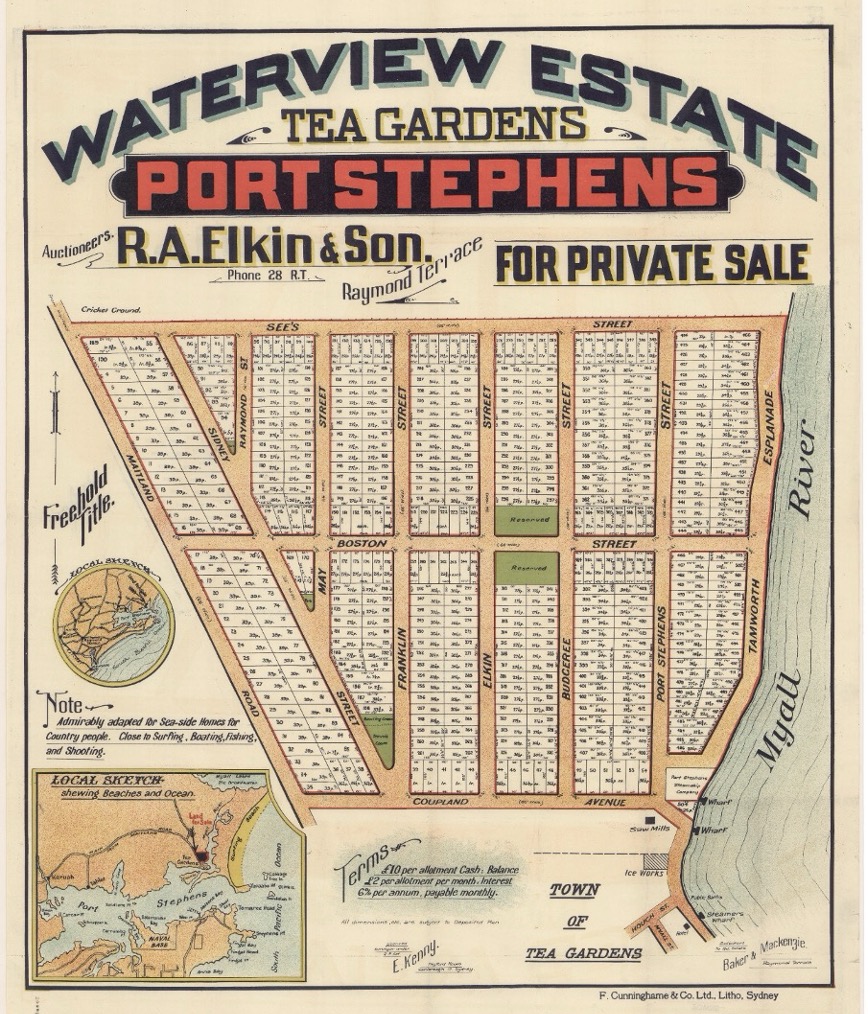
The estate plan for the second portion of the Waterview Estate’ land development at Tea Gardens, marketed by R. A. Elkin & Son [State Library NSW]
Further Details About the American Plans
The Maitland Daily Mercury of 15 June 1923, page 2, reported:
‘For the last twelve months, the Sydney representatives of an American company have been investigating the potentialities of Port Stephens. All available reports on decentralisation, the soundings of the harbour, and projected railways have been sent in full detail to America, and after very thorough consideration of these, options, have been asked for from a number of settlers on the Tea Gardens side of Port Stephens, and extending westerly, with a view of acquiring a large area. it is stated that, if negotiations are satisfactorily completed, it is intended to establish a factory or factories, which, in addition to finding employment, for a large number of men, will ensure that the employees have their home sites in proximity to the works, and of sufficient requirements as to make a large city. This would be developed on modern lines, with regard to employees’ conveniences.
Whether the negotiations will be finalised is dependent upon the American company getting options in one area, so that developments created by them will not be used by land speculators, who would enrich themselves at the expense of the American people. The sole object of acquiring such a large area, even at enhanced prices, is that when the works are once commenced, they will control enough land to enable them to have a city and a rural area of self-supporting industrialists.
By a coincidence a departmental committee dealing with decentralisation has authorised the survey of a railway line from Stroud-road on the North Coast railway to the waters of Port Stephens. It is anticipated that the construction of this line will be laid before the Public Works Committee during the ensuing six months. Whether the line will be constructed or not, the American people are stated not to be dependent upon it, as, if necessary, they are prepared to put down an expensive road which will suffice to connect the present railway with Port Stephens. They will use the road for motor traffic and use Port Stephens as their harbour.
Should the negotiations which are said to be almost complete be effected, it is in the mind of the company to confer with representatives of the Government with a view of cutting a canal from the head of the waters of Port Hunter to meet the waters of Port Stephens at the head of Tilligerry Creek, which for nine miles runs down to meet the waters of Port Stephens Harbour. This, in the opinion of the representatives of the company, is the largest and best in Australia, and it is this fact that has made the Americans enthusiastic in regard to the potentialities of the harbour, which has for years been used simply as a channel for small steamers dealing in a minor way with timber and farming products within convenient range of the harbour.’
American Representative of Financial Syndicate visits NSW
The Newcastle Morning Herald and Miners’ Advocate of 2 July 1923, page 8, reported:’
‘Mr. F. C. Emery, the American representative of a private syndicate with headquarters in New York, London, and Paris, has been for two months in New South Wales investigating the development and possibilities of Australian in-dustries. Part of the time was occupied in the northern district, investigating the possibilities of Port Stephens as a commercial harbour and shipping port. “I think,” he said, in referring to the mater before proceeding to Queensland, “if it were properly developed it would be a finer harbour than Port Jackson. The development of Port Stephens would have a very beneficial influence on New South Wales, because it would mean a step towards decentralisation, which is badly needed in this State.” …. In proceeding to Queensland his principal reason was to gain first-hand knowledge of the cotton industry and its possibilities.’
Keep Port Stephens for the People
The Gloucester Advocate of 13 July 1923, page 3, reported:
‘The first enterprising Americans who set eyes on Port Stephens realised what a magnificent commercial proposition lay there going to waste and on arrival home they told the incredible story to their dollar-hunting compatriots who decided that if Australians were too lackadaisical or stupid to make use of the opportunities nature had given them Yankee intelligence should supply the deficiency.
American capitalists do not mind how far afield the opportunity is, so long as it is somewhere. Neither do they invest money at home or abroad for the sole benefit of mankind. Port Stephens is to them an opportunity to make big profits and they are shrewd enough to offer any amount of capital for its development. There is no objection to an American syndicate developing Port Stephens, provided it is not permitted to acquire the freehold of the remaining Crown lands comprising the foreshores and the surroundings. Any Government which would allow a group of private capitalists either local or foreign, to grab what is undoubtedly the people’s heritage at a time when lack of local enterprise has given a low and altogether fictitious value to the land in the vicinity, is an enemy to the country and deserves worse punishment than defeat at the polls.
Port Stephens is regarded as the second best deep sea port in the Commonwealth and it ranks among the world’s first-class harbors. It is now in its virgin state — exactly where Port Jackson was 135 years ago. Australia will want this port soon. A magnificent and unique opportunity is presented to Northern New South Wales which must before long become a separate State, to retain the land values of this Cinderella port, the site of a future great city for prosperity. Portion of the land has unfortunately been alienated but this disastrous error can be remedied by the re-purchase of the freehold for the State before the port is opened up and developed. Whatever petty private interests suffer in this legitimate transfer back to the community will be infinitesimal compared with the tremendous suffering of the whole population of the Northern State in the years to come if the error is not repaired before it is too late.
A comparatively trifling sum would suffice now to buy back all the alienated land at Port Stephens. Countless millions will be required if the step is left for another 50 years. The advantage to the future New State of holding the freehold of every foot of land at Port Stephens is obvious. The day the port is opened land values will commence to soar. The inevitable diversion of a large portion of the trade of the rich Northern area to this natural outlet — including probably the bulk of the future trade of Newcastle— will make land that is now worth pounds an acre hard to secure at hundreds and even thousands of pounds a foot. All history teaches that this tremendous increase in land values must come when the virgin forest gives way to the bustling city. What astounding folly it would be to permit this golden opportunity to slip through the fingers of the people of Northern New South Wales who will in this Heaven-sent city site have the solution of all their future financial difficulties.’
Acting Premier Comments on the American Development Proposal
The Daily Examiner of 24 July 1923, page 5, reported:
‘The Acting Premier (Mr. Oakes) said tonight that it had been represented to him than an American syndicate was willing to develop Port Stephens. He had asked the interests concerned to put their proposals in writing so that they could be considered officially.’
Further Comments on the American Development Proposal
The Tweed Daily of 3 August 1923, page 4, reported:
‘An American syndicate, with practically unlimited funds at command, is anxious to open up in New South Wales. Mr. Emery, the representative of the syndicate, has secured options over extensive areas in the Port Stephens district. He had an interview with Mr. Oakes, during his acting Premiership, and Mr. Oakes promised to visit Port Stephens in order to get first-hand information of the district and its possibilities.
It is understood that the syndicate asks for no material concessions. What it wants is an assurance that its proposal will not meet with hostility from the Government or the people of the State. Mr. Emery came with the impression that there was a deep-rooted aversion in Australia to anything American. He has expressed pleasure that his experiences have not borne out that idea. As a matter of fact, Mr. Emery was recently the guest of the Queensland Government, and intimated that if all the conditions were favourable, the company he represented would be prepared to spend up to £1,000,000 in developing works in the Northern State.
The idea so far as Port Stephens is concerned is to develop large areas for suitable cultivation, and dispose of the improved land to settlers. The crops would be tested, concrete roads built, and the farms made reproductive before being offered to prospective buyers. If Australians are not prepared to take the farms, the syndicate plans to bring settlers from America. It is possible that the operations of the company would involve the construction of a line of railway from Port Stephens to join the North Coast line, and a line from Mount George on the North. Coast railway to Walcha Road to give access to the North-West.
There would also be the development of Port Stephens as a shipping centre, which would necessitate the construction of wharves, but it is claimed that these improvements would provide an outlet for the whole of the produce of the North Coast and North western districts. Among the options held by Mr. Emery is one over a large area of limestone country, which would be valuable for the manufacture of cement for the construction of the contemplated concrete roads. Mr. Oakes, who is about to take a holiday, will probably include Port Stephens in his itinerary.’
Possibility of a Paper Mill at Port Stephens
The Newcastle Sun of 18 October 1923, page 5, reported:
‘For some time past Port Stephens has been the focus of attention regarding the proposed activity of a certain American syndicate which is reported to have obtained options over a large area of country in the vicinity. It now seems probable that paper mills are to be established there.
Recently the Kelly Investment Company, of New York, acting in conjunction with Messrs. Cowan and Company, of Canada [foundary and woodworking equipment manufacturer based in Canada], despatched a Mr. Emery to Australia for the purpose of entering into negotiations regarding the possibility of starting an industry at Port Stephens. It is understood that the Government was approached with regard to certain concessions, but up to the present no official particulars have been made available.
Inquiries made from leading men in Newcastle indicate that something tangible is likely to result from the negotiations. Mr. A. F. Hall is at present in Sydney, and it is thought that he might be able to throw some light on the matter when he returns to Newcastle.
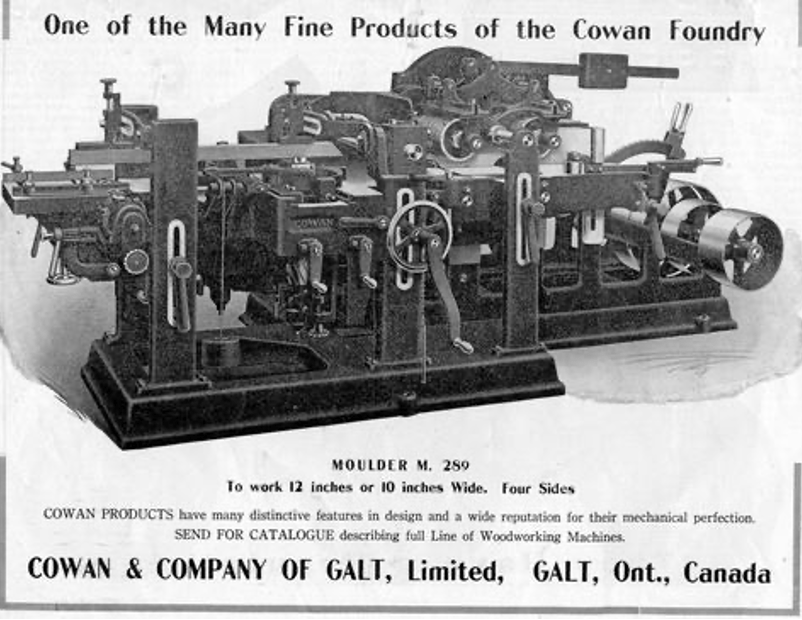
Advertisement for Cowan & Company from ‘Waterloo Outlook, 1914’
Mr. H. Halloran, of Messrs. Halloran and Co., land and estate agents, who have big interests at Port Stephens, recently made a trip to London, where he has opened an office in Australia House. He is at present in America, where it is thought that he is making inquiries regarding the port. He is due to return to Australia at an early date. Regarding the firm of Messrs. Cowan and Co., inquiries show that they are a firm of great repute in Canada, and are very strong financially. They are well known as manufacturers of paper, and have several mills there. It is quite likely that the proposed scheme is one for the manufacture of paper, an industry that is needed in Australia, as large supplies of paper are imported from Sweden and Canada.’
Possible Ford Car Factory at Port Stephens
The Daily Examiner of 22 October 1923, page 2, reported:
‘The American syndicate which has been formed to exploit Port Stephens for industrial purposes has secured an option over 20,000 acres of land, much of which comprises deepwater front-shores.
Definite financial arrangements have been made to bring the scheme to fruition, and it is expected that no time will be lost in commencing the vast undertaking. It is stated that two of the principal activities will be the manufacture of cement and the establishment of a big factory for assembling machinery, parts of which have been made in the United States of America. Rumours that a Ford motor car factory will be opened have not yet been confirmed, or denied. It is also said that when the industries are set up a regular shipping service between Port Stephens and American ports will be inaugurated.’
Premier’s Update on the Development Proposal
The Northern Star of 24 October 1923, page 5, reported:
‘The Premier told Mr. Murray today that he had been informed that a syndicate, half English and half American, had obtained an option over some land at Port Stephens. The exact area he did not know as the Government had entered into no agreement with the syndicate.’
Doubt Raised About the Development Proposal
The Glen Innes Examiner of 25 October 1923, page 6, reported:
‘Some of the Sydney papers have again got hold of the idea that an American syndicate intends to exploit Port Stephens. Probably the idea originated in the fertile mind of some imaginative Sydney journalist, who found himself short of interesting “copy”.
It is not very likely that the Sydney Government would give any outside company much chance of pushing a rival port ahead, though possibly operations in a small way might be begun. If so, it will be better than leaving the port lie idle, for it will be the beginning of the time when Port Stephens will commence to grow and will gradually develop, on the strength of its own merits into a big seaport.
New Staters [New State Movement] do not like the idea of all the foreshores of the harbor being held by private people as they rightly realise that such land should belong always to the Crown. As soon as the new state, which is to control Port Stephens, is established, a remedy for the evil can easily be found. For the rest, it would be a great thing for this country if we could induce American investors to put their hundreds of millions into Australia.’
Optimism Concerning Development Proposal Remains
The Mudgee Guardian and North-Western Representative of 25 October 1923, page 18, reported:
‘The American scheme for the exploitation of Port Stephens for industrial purposes is now past the preliminary stage. Details are not yet available, but it is known that definite financial arrangements have been made to bring the scheme to fruition, and it is expected that no time will be lost in commencing the vast undertaking. The area of land over which the American syndicate has secured options aggregates 20,000 acres. Much of the land comprises the foreshores along the side of deep water.
Paper milling will form one of the industries at the port. This will be only one of many industrial concerns which have not been enumerated, but it is stated that cement works and a big establishment for the assembly of machinery made in America will be two of the principal activities. Nothing is yet known to confirm or deny the rumours circulating that a Ford motor car branch factory is to be established at Port Stephens.
When the industries are working a special shipping service will be inaugurated to carry the goods monthly between Port Stephens and American ports. If the syndicate does not work a coal seam near the port for the provision of fuel to run the industrial machinery, in all probability a canal will be cut to link up the port with the Hunter River and Newcastle. The establishment of these industries will involve the employment of thousands of men.’
Proposed Sale of Debenture Bonds for Proposed Development
The Newcastle Sun of 27 October 1923, page 6, reported:
‘The proposal to form a company in Australia, with £600,000 capital to raise £1,000,000 debenture bonds in America and England, for the industrial development of Port Stephens, has aroused widespread interest. The scheme is being furthered by Mr. F. C. Emery, an American, who was in Australia some months ago. The success of the proposition depends upon the raising of close on £1,500,000.
The Premier, Sir George Fuller, has stated that Mr. Emery requested him to consider the scheme, but he declined to commit the Government in any way until some concrete proposal was laid before him. Mr. Emery had publicly declared that he had been successful in securing options over certain land at the Port. Included in these were said to be some 20,000 acres, the property of the Crown.
However, in answer to a query by Mr. Murray, M.L.A., the Minister for Lands denied the accuracy of the report. “No agreement,” he said, “had been entered into between the Government and any syndicate.” Speaking to a “Sun” representative this morning, Mr. M. Cromarty, M.L.A., remarked that he was certain no options had been granted over lands at Port Stephens. But, added Mr. Cromarty, the Government is willing to grant options, if it were found necessary, and would help to facilitate the scheme over land that might be required. But there would not be any special concessions. The matter would be dealt with on the same footing that usually governs transactions of that nature.’
Warnings to Potential Port Stephens Speculators
The Tweed Daily of 5 November 1923, page 2, reported:
‘There is a big string being pulled somewhere in connection with the opening up and development of Port Stephens. Very alluring propaganda concerning the millions of dollars mythical American capitalists are going to spend in establishing industries of all descriptions at this port has been judiciously circulated at precisely the correct moment. It all harmonises beautifully with Sir Joseph Carruthers’ plans for a railway from Walcha to Mt. George and the same astute politician’s dream of a line from Killarney to Grafton to Port Stephens.
A little bird has whispered to the “Tweed Daily” that a syndicate has secured some 20,000 acres of the foreshores of Port Stephens with a view to future unearned increments. And what better way can unearned increment be created at Port Stephens – than by that form of boosting which procreates the possibility of vast sums of American money being invested there?
This paper warns its readers to beware of those specious tales which tempt them to invest money there in the belief that Henry Ford thinks Port Stephens an ideal spot for a Ford manufactory in Australia, and so on, ad lib. Henry Ford is an American businessman with un natural instincts for doing the right thing; so he is not going to establish a Ford manufactory in a place which will take another half-century “to arrive.” Why Lizzie would get left waiting that long! No, clear reader, the ways of the subdivision artist are “ways and means” to a desired end — and that purpose is to “sell Port Stephens subdivision blocks at a big premium to” those who lend all too willing ears to very cunning propaganda. Take our advice and don’t be proper geese.’
The Smith’s Weekly of 10 November 1923, page 3, further commented:
‘It has remained for the financial exploiters of another country to seize upon and develop the marvellous resources of our century-neglected Port Stephens. The vanguard of an army of American speculators has already advanced upon the place. Some four months ago there arrived, unheralded, in Sydney, a certain Mr. Amery, American citizen and businessman. Unlike the usual type of visiting Americans, this Mr. Amery gave no interviews to the press, explaining his intentions or views. He maintained a discreet silence and did what he had to do without publicity.
One of his first acts was to visit Port Stephens with a party of engineers and surveyors, and spend some weeks on mysterious errands about that district. A good deal of time was put in by him subsequently at Newcastle and on the Maitland coalfields. He also paid lengthy visits to Queensland and Victoria. During his three months in Sydney Mr. Amery transacted a great volume of business from his suite at the Hotel Australia, where he had half a dozen clerks and typists working at high pressure the whole time. Among those with whom he held confidential conversations were the New South Wales Premier, Sir George Fuller, and Mr. C. W. Oakes, Chief Secretary. He was also in intimate association with certain financial and manufacturing interests.
One Sydney public man who saw a good deal of Mr. Amery during his visit here learned from him that he represented the Schwab-Pierpont Morgan financial group, an American trust that controls the copper market of the world. Port Stephens would not be the first big territory developed by this group, which controls all the copper and silver mines in Sayonora County, California, where it owns most of the cities, railways, and public utilities.
Another financier interested in Mr. Amery’s mission is the Duke of Devonshire, Secretary of State for the Colonies. The Duke is also interested in Henry Ford’s Canadian motor business to a substantial extent. What Mr. Amery’s actual business was about Port Stephens only he and his trusted agents know. Certain it is that representatives of Henry Ford have been negotiating to establish a motor lorry and tractor factory in N. S. Wales. This has been announced definitely to the Sydney Chamber of Manufactures.
Last, week J. French and W. Brookes, two direct representatives of Henry Ford, landed in Sydney from the “Niagara.” They have admitted to interviewers that their business is in connection with the proposed establishment of motor factories here. Port Stephens would have a tremendous attraction to a group of speculators who have unlimited capital to expend on the establishment of industries on its foreshores.
One man with whom Mr. Amery was in constant touch during his Sydney visit has secured options over large areas of privately-owned land about Port Stephens on which there is coal, iron, limestone, and fireclay. There is little doubt that the optioneer is merely intermediary for the Americans. What part the Government will play in the development of Port Stephens is not known. But railway connections between Morpeth and Pindimar, and Stroud Road and Tea Gardens are to be referred to the Works Committee at once.’
Optimism Concerning the Port Stephens Development Remained High
The Smith’s Weekly of 1 March 1924, page 4, reported:
‘The development of Port Stephens as an American colony seems weekly nearer its accomplishment. Direct evidence is still unobtainable, but the activity of a group of optioneers known to be operating in U.S.A. interests places an unmistakable interpretation upon current activities.
The general public was given the first real clue to the imminence of some big move a fortnight ago, when the daily papers announced that the Commonwealth Government had made a special grant of £26,000 for the construction of roads from Salt Ash to Nelson’s Bay and to Lemon Tree Passage. The road construction will bring Port Stephens within half-an-hour’s motor run of Newcastle.
During the past month, four Americans have landed in Sydney and proceeded to Port Stephens. At Port Stephens the American visitors proved themselves to be either engineers or surveyors. One was a cement expert and spent considerable time examining the limestone deposits on the Myall Lakes, 30 miles above the main inlet. So far as can be ascertained, no Australian money will be utilised in connection with the Port Stephens development scheme. The a whole project will be financed from America, where it will be submitted to speculators as a concrete scheme.
So far as the Sydney representative is concerned, all that he appears to have done is to secure options over vast tracts of country around the foreshores of the Port. All this land is privately owned, being portion of what was formerly the Australian Agricultural Company’s grant and alienated from the Crown in 1824. On the area thus secured is a 30ft. seam of coal, tested and proved in 1856 by Odernbeimer, the greatest European geologist of his time, who was specially engaged by the A. A. Company to report on the mineral resources of their lands. In association with the coal is hematite and magnetic iron ore, and an inexhaustible deposit of limestone of high grade.
Options have also been secured over the whole of the northern foreshores of the bay, where subdivisions of residential blocks on a gigantic scale can be affected. In addition, arrangements have been completed with landowners between the Port and Stroud Road siding, on the North Coastline, to secure concessions for a proposed private railway. Numbers of Sydney investors have been endeavouring to elucidate the mystery surrounding Port Stephens, but those connected with, it, particularly the American visitors, maintain profound silence.’
Concluding Comments
The above newspaper article was the last shred of information published about the American development scheme. Due diligence undertaken in America after the preliminary investigation had been completed in Australia, may have uncovered financial weaknesses with aspects of the scheme. As stated in the last paragraph above, thereafter ‘the American visitors, maintain profound silence.’
Other land developments proposals for Port Stephens that never came to fruition are published on this website at the following links:
A ‘City of Peace’ at Pindimar – 1918′;
Proposal for an Oil Refinery at Port Stephens;
Pindimar – A New Planned City at Port Stephens.
Researched and compiled by Kevin McGuinness
March 2024

 Port Stephens - a history exploration