
Introduction
For many years, Sydney and other large urban areas enjoyed the benefits of a reliable mains water supply to homes and businesses. The Tomaree Peninsula had to wait until the after the Second World War before the need for such a water supply to Nelson Bay and surrounding areas was addressed. Up until this time, the water supply was obtained either from tanks or water spears driven into the ground. These were small bores typically used in coastal or alluvial areas to draw water out of shallow groundwater systems. A public well was still situated at Fly Point, Nelson Bay, in the 1950’s. The quality of the water from this well was often questioned.
Many holiday visitors to the Nelson Bay area are probably unaware that the source of the water they drink and use lies literally below their feet in the sand aquifer of the Tomaree Sandbeds.
This paper examines the early development of a mains water supply to Nelson Bay and surrounding areas. The delivery of the water service was not to be without a few hurdles, which delayed its implementation.
First Agitation for a Water Supply – 1945
The Raymond Terrace Examiner and Lower Hunter and Port Stephens Advertiser of 12 April 1945, page 2, reported:
‘At the [Port Stephens] Shire Council meeting on April 6th— a letter was read from Mrs. Cartwright, secretary of the P. and C. Association, asking the Council to make application for a water supply for Nelson Bay.
Cr. Russell said a supply was urgently needed. It would be advisable to apply to the Board to make available the supply as previously given to the United States navy. It presented a good opportunity to get a supply. He moved they send the requisition on to the Water Board asking that the supply be granted. The residents would fall in line by calling a public meeting supporting the request. Cr. Upton supported the need for a water supply. The town was growing and a water supply was a matter of health consideration. He seconded the motion. Cr. Lantry supported the motion. One of the hardest things he found at Nelson’s Bay was to get a drink of water. The President, Cr. Morgan said the interests of the residents as well as the large number of tourists and campers made it almost imperative to have the supply made available. The resolution was agreed to.’
Water Guarantee Issued by Council.
For the Hunter Water Board to consider the expansion of the water supply into the Nelson Bay area, it was first necessary for the Port Stephens Council to agree to fund any financial deficiency incurred by the Board each year due to a shortfall in the payment of water rates. To its credit the Council took on this financial responsibility to ensure the delivery of water service as soon as possible.
The Dungog Chronicle of 15 October 1946, page 2, reported:
‘Some months ago the President of Hunter District Water Board (Mr. C. Schroder), met the people of Nelson’s Bay regarding a water supply to that area. The proposition put up by Mr. Schroder was acceptable to the meeting. The Water Board has now advised the Port Stephens Shire Council that the scheme will cost £14,500 and asks whether Council will guarantee the deficiency estimated at £561 per annum. If Council is prepared to do so, the Board will revise the preliminary estimates of the capital cost and annual revenue and then submit the scheme for consideration of the Minister. Council agreed to guarantee the deficiency, subject to the people of Nelson’s Bay being agreeable to the scheme. It is not expected that any objection will be raised.’
The Raymond Terrace Examiner and Lower Hunter and Port Stephens Advertiser of 14 November 1946, page 3, reported that the Board’s proposal was formally considered at a meeting of the Port Stephens Shire Council:
‘Mr. Monkley, Shire Clerk, reported at the Shire meeting on the 8th as follows: A copy of the letter from the Hunter District Water Board read at last meeting was sent to the Nelson Bay Urban Area Committee and the Nelson Bay Progress Association, with a request that these bodies advise the Council if they were in favour of the Council giving the Water Board a revenue deficiency guarantee in respect of the proposal to provide a water supply for Nelson Bay. Both bodies replied that they were definitely in favour of the Council giving the guarantee. In accordance with the resolution of Council at last meeting, the, Hunter District Water Board has been informed that the Council is prepared to give the required revenue deficiency guarantee.’
Water Supply to be Delivered – 1947
The Dungog Chronicle of 11 February 1947, page 2, reported:
‘The Hunter District Water Board has informed the Port Stephens Shire Council that the work for the carrying out of the water supply for Nelson Bay has been authorised. Fresh estimates are being prepared for submission to the Government in connection with the Government’s subsidy towards the work.’
Temporary Water Tank to be Constructed – 1947
The Dungog Chronicle of 13 May 1947, page 1, reported:
‘The Chief Engineer submitted to the Hunter District Water Board a plan showing a site selected for a balance tank in connection with the Nelson Bay Water Supply Scheme. The tank proposed to be erected on this site would be superseded in the future by a reservoir at a high level, therefore the occupation should be regarded as temporary. The present proposal is to erect a steel storage tank of 10,000 gallons capacity, on a stand approximately 5 feet above ground level. Access to the rear of the allotments referred to in his report will not be obstructed. The Chief Engineer recommended that permission of the Port Stephens Shire Council be now sought to the occupation by the Board of the site referred to. The Water Supply Committee recommended the Board to approve of the Chief Engineer’s recommendation.’
Water Supply Postponed – 1947
The Dungog Chronicle of 29 July 1947, page 1, reported:
‘Until such time as the position in regard to the trusteeship of land in the area is clarified, the Hunter District Water Board will not be able to proceed with the establishment of a water supply for Nelson’s Bay. The water supply committee reported to a meeting of the board that the president (Mr. C G. Schroder) had discussed with Mr. W. Davidson, surveyor and property officer, Department of the Interior, Sydney, the question of declaring an area as a water reserve for the purpose of a catchment. Mr. Davidson was unable to furnish the president with any definite information regarding the Federal Government’s plans to acquire nearly half of the area referred to including lots recently purchased by the board. He stated that he had taken the matter up with the military authorities but, to date, had not been able to ascertain definitely their intentions in regard to the area which was probably required for defence purposes. In the circumstances, it was agreed to allow the matter to stand in abeyance until the Defence Department would be in a position to advise the board of its intentions, following the visit of Field-Marshal Montgomery. The president pointed out that the board had promised Nelson’s Bay a water supply for the coming summer. Now there was no alternative but to wait until such time as the land position was clarified.’
The Raymond Terrace Examiner and Lower Hunter and Port Stephens Advertiser of 4 September 1947, page 4, further reported:
‘Mr. Abbott, M. H. R. has received the following from the Department of Defence: “With further reference to your letter of the 22nd July, covering correspondence from the Hunter District Water Board concerning the Board’s proposals for the development of a water-supply for the town-ship of Nelson Bay, I have now been advised by the Secretary, Department of the Army, that a proposal is at present under consideration in regard to the acquisition of certain property at Port Stephens for a special combined Training Centre. It appears that portion of the area desired by the Hunter District Water Board is included in that area, and the Secretary, Department of the Army, states that until a decision is arrived at as to whether or not the acquisition will be proceeded with, it will not be possible to reach a decision in relation to your representations. Further advice on the matter will be furnished to you as soon as practicable. In the meantime, I return herewith the plan of Nelson Bay, which accompanied your letter.’
Water Supply Arrangements Proceed – 1948
The Dungog Chronicle of 5 June 1948, page 3, reported:
The President reported to this week’s meeting of the Hunter District Water and Sewerage Board that, with Mr. Cooper, he met Colonel Long and Major Duffey, both representing Eastern Command, in the Board Room on Thursday, 20th May, 1948, and discussed the question of the vesting in the Board as Trustees of water-bearing areas in the Nelson’s Bay area. A field inspection at Nelson’s Bay was made on the same day at which representatives of the Army, Air Force and Navy were present.
The President outlined the matters discussed at the conference. The Water Supply Committee decided: — (a) that a letter be written to the Prime Minister expressing Board’s appreciation of his action in bringing this matter to a successful conclusion; (b) to approve of the Nelson’s Bay water supply works being given the highest priority and also approved of the work being proceeded with as soon as material can be obtained, and (c) to approve of the President’s action in agreeing to the Board taking over the additional pumping station and also acquiring the additional land as suggested by the Military Authorities.’
‘Fibrolite’ Pipes Used for the Mains – 1948
The Raymond Terrace Examiner and Lower Hunter and Port Stephens Advertiser of 19 August 1948, page 1, reported:
‘At the [Port Stephens] Shire Council meeting recently Cr. James reported that everything appeared to be going well for the water supply at Nelson Bay. Mr. Cooper, the Board engineer, had assured him it was hoped to have the supply finished before the hot weather. The asbestos type of pipe will be used for the mains.’
The Dungog Chronicle of 23 October 1948, page 3, further reported:
‘Further satisfactory progress has been made with Nelson Bay water supply, says the report of the Hunter District Water Board. The tank site has been levelled off and old tank has been re-erected. Commencement has been made with the laying of water mains and to 14th instant 417 yards of 6in. fibrolite pipe have been laid. Mechanical aids to work are being used as far as possible including the Barber Greene Trench Digger and a Road Grader for back filling. Twelve men are employed on the work.’
‘Fibrolite’ Water Pipes
The ‘Fibrolite’ pipes that were installed in the Nelson Bay area, were manufactured by James Hardie & Coy. Pty Ltd. The following two extracts are from a promotional catalogue published by the company in 1953.


Water Catchment Area to be Proclaimed – 1948
The Newcastle Morning Herald and Miners’ Advocate of 24 November 1948, page 2, reported:
‘A recommendation of the Chief Engineer (Mr. Attwood), that a catchment area be proclaimed for a water supply to Nelson’s Bay, was adopted by the Hunter District Water Board. The source of supply will be the water bearing sandbed south of Shoal Bay at Port Stephens. Steps have been taken to acquire part of the privately owned land and have the adjoining Crown land reserved for the purpose.’
The Newcastle Morning Herald and Miners’ Advocate of 16 October 1948, page 4, reported:
‘A start has been made to reticulate the water supply for Nelson’s Bay. This week the first pipes were laid by modern machinery. Water is expected to flow through the taps soon.’
Water Catchment Area Proclaimed – 1 January 1949
The supply of mains water to the Nelson Bay township became operational on January 1, 1949.
The Government Gazette of the State of New South Wales of 7 January 1949 (No.2), page 10, published the following Proclamation that defined the area of the Water Supply Catchment Area, under the Hunter District Water Sewerage and Drainage Act, 1938-1945 [Note: the village of Teramby is the present day Nelson Bay area]:
‘I, Lieutenant-General John” Northcott, Governor of the State of New South Wales in the Commonwealth of Australia, with the advice of the Executive Council, in pursuance of the above named Act, and on the recommendation of The Hunter District Water Board, do hereby proclaim the land described in the Schedule hereto to be a Catchment Area in accordance with the provisions of the said Act. ……..
All that area of land being part of the Village of Teramby, and parish of Tomaree, county of Gloucester, State of New South Wales: Commencing at the intersection of the prolongation northerly of the eastern boundary of portion 141 with the shore of Shoal Bay; and bounded thence by a line bearing southerly being the eastern boundaries of portions 141 and 142 successively, and part of the western boundary of portion 173 to a point being the intersection of the prolongation easterly of the southern boundary of portion 127 with the aforesaid western boundary of portion 173 ; thence westerly by the afore-said prolongation of the southern boundary of portion 127 and the said southern boundary to the south-west corner of portion 127; thence northerly by the western boundary of portion 127; thence easterly by part of the northern boundary of portion
127 to the south-east corner of the Village of Teramby; thence northerly by the said village boundary and the eastern side of Gowrie-avenue successively; thence easterly by the southern side of Exeter-road; thence northerly by the eastern side of Harwood-avenue and the suburban boundary of the Village of Teramby to the shores of Shoal Bay; thence generally south easterly, easterly and north-easterly by the shores of the afore-said Bay to the point of commencement.’
The water catchment area would be expanded in following years to cater for the greater need of the expanding surrounding areas.
Water Requirements of the Nelson Bay Area Reviewed – 1949
The Newcastle Morning Herald and Miners’ Advocate of 23 April 1949, page 4, reported:
‘It was essential for the progress of Nelson Bay that an area of land of about five square miles, between Port Stephens and Anna Bay, in the parish of Tomaree, should be reserved as an underground water supply source, the Chairman of Newcastle Regional Development Committee (Cr. Butler) said yesterday.
The Hunter District Water Board has applied for the land to supplement water bearing land being used to provide the town’s water supply. The land is being sought to meet the possible requirements of the town in 20 years’ time. Cr. Butler said he understood that the Lands Department had not granted the board’s application for the area. The land was well away from the town and ocean front. It was practically useless for farming or pasture. “Now that Nelson Bay has a water supply, the next step is to make sure that the supply will be adequate as the town progresses,” he said.
“The Water Board plan would provide for the town’s development for many years ahead. In the past, the area has suffered from lack of planning.” Cr. Butler said the Development Committee was behind the board in its efforts to guarantee a water supply for the town. Cr. Butler made his remarks when the Regional Development Committee was discussing factors of economic planning after it had inspected the Nelson Bay-Raymond Terrace district.
Cr. James (Port Stephens Shire) said the water supply for Nelson Bay was one of the best in the region, but in the years to come it would be inadequate. The area selected by the board as a water supply reserve was the only logical solution to what would become a pressing problem.’
The Newcastle Morning Herald and Miners’ Advocate of 30 June 1949, page 5, further reported on the conflict presented between the need for additional catchment land to ensure a greater water supply and the need for available land to provide for future development:
‘Reservation for about five square miles of water bearing lands between Port Stephens and Anna Bay was necessary for the economic and industrial development of Nelson’s Bay, the President of the Hunter District Water Board (Mr. G. Schroder) told the Newcastle Regional Development Committee yesterday. Mr. Schroder said the area’s water-yielding capacity had been assessed at four million gallons. It was the only source from which a major water supply could be obtained at reasonable cost. The water-bearing land being used to supply the township with water was adequate, but it would not cater for probable requirements of the area in 20 years.
The committee had before it a letter from the Department of Lands which said: “Your board’s additional request for control of an extensive area adjoining on the south is being investigated, and further advice will go forward to your board in this regard. “A report obtained indicates that the wholesale reservations of water bearing sand beds adjacent to centres of expanding population are of doubtful advantage to the community, other than as a temporary expedient. “It is appreciated that the sand-beds provide a cheap and ready method of obtaining water within well-defined limits depending on rainfall and area, but, as the demand increases, it can only be met by extending the area drawn from, with the resultant locking up of land and possible blocking of legitimate development. “The Commonwealth Authorities already hold a large area of land at Soldier’s Point and Salamander Bay, and it is apparent that, if requests by the Commonwealth and your board are carried out, they will effectively limit the future development of this highly attractive locality.”
Mr. Schroder said the present scheme could supply only 2000 people. When this maximum was reached it would be, necessary to look elsewhere for an adequate supply of water to meet the needs not only of domestic consumers, but industrial consumers who would eventually establish themselves in the area.
If the board was not permitted to exploit an additional area suggested, the alternatives were costly. The cost of laying 30 miles of pipeline from the Chichester line was about £750,000. The cost of laying 60 miles of pipeline to a dam to be constructed on the Karuah River would be nearly £2 million. The extended sand bed scheme, on the other hand, would cost about £250,000.
Mr. W. G. Wileman said that before the committee decided to support the board’s move to have the five square miles reserved, it should be given information on how much land was left for the industrial and residential development of Nelson’s Bay. It should see if there was enough land to support a population of, say, 20,000, with attendant industries. The matter was deferred to allow the information required by Mr. Wileman to be supplied to the next meeting.’
Small Extension of Water Supply Within Nelson Bay – 1951
The Newcastle Morning Herald and Miners’ Advocate of 13 June 1951, page 6, reported:
‘The Hunter District Water Board yesterday advised Port Stephens Shire Council that it would make extensions to serve public showers on the reserve at Victoria parade, Nelson’s Bay. The council would have to supervise the showers to prevent waste of water and a possible failure of general water supply. The maintenance of an adequate water supply to Nelson’s Bay in summer was a difficult job. A free supply of up to 10,000 gallons a year would be provided for the showers. The council referred the matter to Nelson’s Bay Urban Area Committee.’
Acquisition of Further Water Catchment Land at Shoal Bay- 1951
The Dungog Chronicle of 15 September 1951, page 3, reported:
‘The Water Supply Committee reported to last meeting of the Hunter District Water Board, having considered correspondence from the Surveyor and Property Officer, Department of the Interior, Sydney, regarding acquisition of land at Shoal Bay required by the Board for water supply purposes together with a letter from Messrs. Fleming, Henderson and Stedman, Solicitors, Albury, acting on behalf of the owner of the land referred to. The Committee recommended that the sum of £2,000 be offered to Messrs. Flemington, Henderson and Stedman for the purchase of the land referred to and that failing acceptance of such offer, the land be acquired by resumption.’
Water Expansion Plans Delayed – 1952
The Newcastle Morning Herald and Miners’ Advocate of 13 February 1952, page 6, reported:
‘The Hunter District Water Board hoped to provide a much improved water supply to Nelson’s Bay before next summer, the board advised Port Stephens Shire Council yesterday. The board said the failure of a contractor to finish a steel tank had handicapped the board in improving the supply. The contractor had been unable to finish the work because of the shortage of steel and the board was negotiating to buy a tank outside the present contract. The shortage of Nelson’s Bay storages, which were part of the scheme for the reticulation of the area, had also handicapped the board. The letter was received.’
Shortage of Water – 1952
The Dungog Chronicle of 14 June 1952, page 1, reported:
‘Nelson Bay was short of water, Cr. Randall reported to the Port Stephens Shire Council on Tuesday. He said water was off at a late hour on Monday night and caused inconvenience. It was the belief of residents that the 20,000 gallon storage tank was insufficient for the area. It was resolved to acquaint the Hunter District Water Board of the position and to enquire what steps are to be taken to improve the matter.’
Extension of Water Service – 1952 and 1953
The Newcastle Morning Herald and Miners’ Advocate of 9 April 1952, page 5, reported:
‘Ald. A. S. McDonald told Port Stephens Shire Council yesterday that the Hunter District Water Board had approved extension of water supplies to Shoal Bay and Fern Bay. …. Shortage of materials and finance had held up the Shoal Bay extension. …. The shortage of water in Nelson’s Bay would be overcome by the installation of an extra water storage tank, he said.’
The Newcastle Morning Herald and Miners’ Advocate of 11 March 1953, page 5, reported:
‘The Hunter District Water Board advised [the Port Stephens Shire Council] that scrub land under its control at Shoal Bay would be cleared as early as possible. It would be financially impracticable to extend the watermain south along the main road to Nelson’s Bay. Extension of 143 yards of 4in. fibrolite pipe in Thurlow avenue, Nelson’s Bay, had been approved.’
The Raymond Terrace Examiner and Lower Hunter and Port Stephens Advertiser of 12 March 1953, page 2, reported:
‘The Hunter District Water Board informed the Port Stephens Shire Council at its meeting on Tuesday last that inspection reveals that the five residences concerned would return revenue below the average. This was in reference to extensions along Stockton Road to premises in Salamander Estate, Nelson Bay. The extension of main required would be 1,100 yards of 4 inch pipe, which would cost approximately £2800. The annual return to meet the expenses required by the Board is 11 per cent, of the capital cost as ascertained on completion of the work. On this basis the revenue required of the above extension would be £308 per annum. The Board decided in the circumstances that the extension, applied for is financially impracticable at the present time. The Board also advised that approval had been given to the extension of the water main along Thurlow Avenue in the Dutchman’s Bay estate, Nelson Bay. The Board advised that the work of clearing land under its control at Shoal Bay, will be carried out as soon as possible.’
The Dungog Chronicle of 20 June 1953, page 1, further reported:
‘The Hunter District Water Board wrote regarding an application by Mr. E. J. Grant for extension of water main in Thurlow Avenue, Dutchman’s Bay, Estate, Nelson Bay. This extension necessitates an extension of 80 yards of 4in. fibrolite main at an estimated cost of £230. The Board wished for this work to be carried out under the revenue deficiency guarantee already given at Nelson Bay. Council agreed to accept the deficiency cost.’
Nelson’s Bay Water Main “Too Small” – 1953
The Newcastle Morning Herald and Miners’ Advocate of 29 December 1953, page 2, reported:
‘The water main at Nelson’s Bay was too small to meet the present demand, particularly with the influx of holiday visitors, the President of Hunter District Water Board (Mr. Finnan) said yesterday. He said Nelson’s Bay pumped its own water. The main was too small and the board intended to enlarge it next year. Some residents of Nelson’s Bay have had no showers or water for gardening over the holidays and have had to store water in coppers and baths for cooking and washing. Mr. Finnan said there was no question of insufficient storage or shortage of water at Nelson’s Bay. Knowing that the influx of holiday visitors would increase the demand for water, board officials had been to Nelson’s Bay over the holidays to try to educate residents in economising in the use of water, particularly in using sprinklers for gardens. He and board officers would confer on the general water supply position this morning. “We have to keep in mind the fact that industry resumes today, but if there is a possibility that some or all of the restrictions may be removed, they will be considered in the light of the storage position.” he said.’
Nelson Bay Water Supply to be Improved and a Sewerage Scheme to be designed – 1954
The Raymond Terrace Examiner and Lower Hunter and Port Stephens Advertiser of 18 February 1954, page 4, reported:
‘The Water Board has informed the Port Stephens Shire Council that it is prepared to go on with the provision of an adequate water supply for Nelson Bay at a cost of £78,040.
This scheme would provide for all reasonable contingencies in Nelson Bay-Shoal Bay area. There would be a government subsidy of 50 per cent. The Board would be prepared to honour its original agreement which provided for a return of 8 per cent. on outlay, even though it would a loss of £1452 per year as the cost to the Board on the present day basis would necessitate a return of somewhere near 11 per cent to cover. The deficiency of approximately 3 per cent would be borne by the Board.
The delegation from the Water Board also informed the Council that they would have estimates prepared of a sewerage scheme designed to cater for the business section of Nelson Bay.’
Further Expansion of the Water Supply Proposed – 1954
The Dungog Chronicle of the 3 July 1954, page 6, reported:
‘The Secretary reported to the Hunter District Water Board as follows: — (a) The Board on the 12th January, 1954, considered the extension and amplification of water supply in Nelson Bay and Shoal Bay areas and de-cided to make application to the Treasury for the extension of the State Government subsidy to cover the works in the Nelson Bay area estimated to cost £78,040. (b) The Shire Clerk, Port Stephens Shire Council wrote the Board on the 15th February, 1954 that the Council had agreed to include the proposed amplification works in the Revenue Deficiency Guarantee given by the Council.
The Under Secretary and Comptroller of Accounts, the Treasury, wrote the Board on the 22nd June, 1954, as follows: — “The Minister has approved of the revised scheme for provision of water supply to Nelson Bay including the proposed extensions to the Shoal Bay area and to the Tomaree Convalescent Mental Hostel and necessary amplification works being endorsed as an approved scheme, eligible for financial assistance under the arrangement for assisting with water supply and sewerage schemes in outlying parts of the Board’s area, and of a capital grant being provided, as and when required, to meet half the capital cost of the combined scheme currently estimated at £78,040).”
The Secretary reports that the probable total cost of the provision of water supply to Nelson Bay and further extensions to Shoal Bay to the 30th June, 1954, is £28,150. The estimated additional expenditure for the year 1954-55 as provided for in Board’s Loan Estimates is £31,000. This figure may have to be reviewed later in the light of the Loan Council’s allocation of loan funds to the Board. The Secretary reports the arrangements made with the Treasury and the Port Stephens Shire Council are very satisfactory and recommends that contingent upon material and labour being available the work proceed and be carried through to completion as soon as possible. The President endorses the secretary’s recommendation.’
The Newcastle Morning Herald and Miners’ Advocate of 18 August 1954, page 7, further reported:
‘It was hoped to have some Water supplies to Tomaree before the end of the year, the President of the Hunter District Water board (Mr. Finnan) said yesterday. Mr. Finnan was replying to Ald. Breen at a board meeting. He said the work should be started soon. The present Nelson’s Bay supply had to be amplified and a new high level tank built. The Chief Engineer (Mr. Attwood) said the board was getting materials for the work.’
Sewerage Plan for the Central Area of Nelson Bay Proposed – 1955
The Raymond Terrace Examiner and Lower Hunter and Port Stephens Advertiser of 13 January 1955, page 1, reported:
‘A scheme has been prepared by the Hunter District Water Board, for the sewering of part of the more closely settled areas of Nelson Bay. …. It has been designed so that it can be efficiently operated now and later on incorporated into the comprehensive scheme for the whole area without costly alteration. The scheme provides for the sewage to gravitate by 6 inch and 9 inch pipes to the park near HMAS Assault workshops and from there through a 12 inch main to duplicate septic tanks. After having primary treatment and a detention period of eight hours the effluent will be gravitated through an outfall into deep water off West Point. The Board says that it must be realised that the area is necessarily restricted, and extensions should not be effected outside this area. If extensions be effected outside this area, the system would soon be overloaded.
The Department of Health and Maritime Services Board have been informed of the proposal to discharge septic tank effluent into the water and replies are being awaited from these Departments. The estimated capital cost of the modified scheme is £24,500. The scheme is one that could be recommended for a subsidy from the Government. There would be no deficiency to be met by the Port Stephens Shire Council. However, the Board would require the Council to enter into an agreement as a safeguard which might occur against any revenue deficiencies which might occur in the future.
The Council could either raise by way of loan their share of £12,250 of the cost or allow the Board to raise it. The Board has decided to charge the actual operating charges to the particular work with a limitation of the maximum charge of 5 per cent of the estimated capital cost. Should operating costs exceed 5 per cent, the excess will be borne by the Board. It was agreed by the Port Stephens Shire Council to accept the scheme.’
Proposed Sewerage Scheme Challenged – 1955
The Raymond Terrace Examiner and Lower Hunter and Port Stephens Advertiser of 17 November 1955, page 7, reported:
‘The Department of Public Health objects to the proposed discharge of sewerage effluent into the Port.
At the last meeting of the Port Stephens Shire Council the following letter was read from the Hunter District Water Board. ‘With reference to the above matter, it is desired to advise that this Department after close inspection and consideration is of the opinion that the installation of a sewerage scheme designed to discharge partially treated sewage or effluent into the waters of Port Stephens in proximity to recognised bathing areas should not be permitted. From data available it is apparent that pollution would result, and the Department would not be prepared to approve of the proposal submitted by your Board’
The Water Board’s letter also said that any alternative scheme of what the proposed modified scheme for the sewerage of Nelson Bay such as would involve the construction of treatment works, etc. would be very much more costly. Owing to the restricted loan moneys available to the Board, further consideration cannot be given to any alternative scheme at the present time. Crs. Scott and Norburn moved that the Engineer and Health Officer endeavour to get the Board to reconsider the matter of sewerage for Raymond Terrace and Nelson Bay. This was carried.’
The main sewage treatment plant today is the Boulder Bay Wastewater Treatment Works at Fingal Bay.
Tomaree Sandbeds
The years from 1947 to 1955 were an important period in the establishment of the mains water service in Nelson Bay and the Tomaree Peninsula.
Today the area is fully reliant on the Tomaree Sandbeds for the supply of high-quality water.
The system consists of twenty-one bores within the Anna Bay, Glovers Hill and Nelson Bay sandbeds.
The Tomaree Sandbeds are mainly covered by the Tomaree National Park. The catchment area is 16 square kilometres, with a water holding capacity of over 16,000 million litres. Water obtained from the sandbeds is treated at the Anna Bay and Glover’s Hill Water Treatment Plants.
The Glovers Hill treatment plant is in the area behind the Tomaree Community Hospital at Nelson Bay.

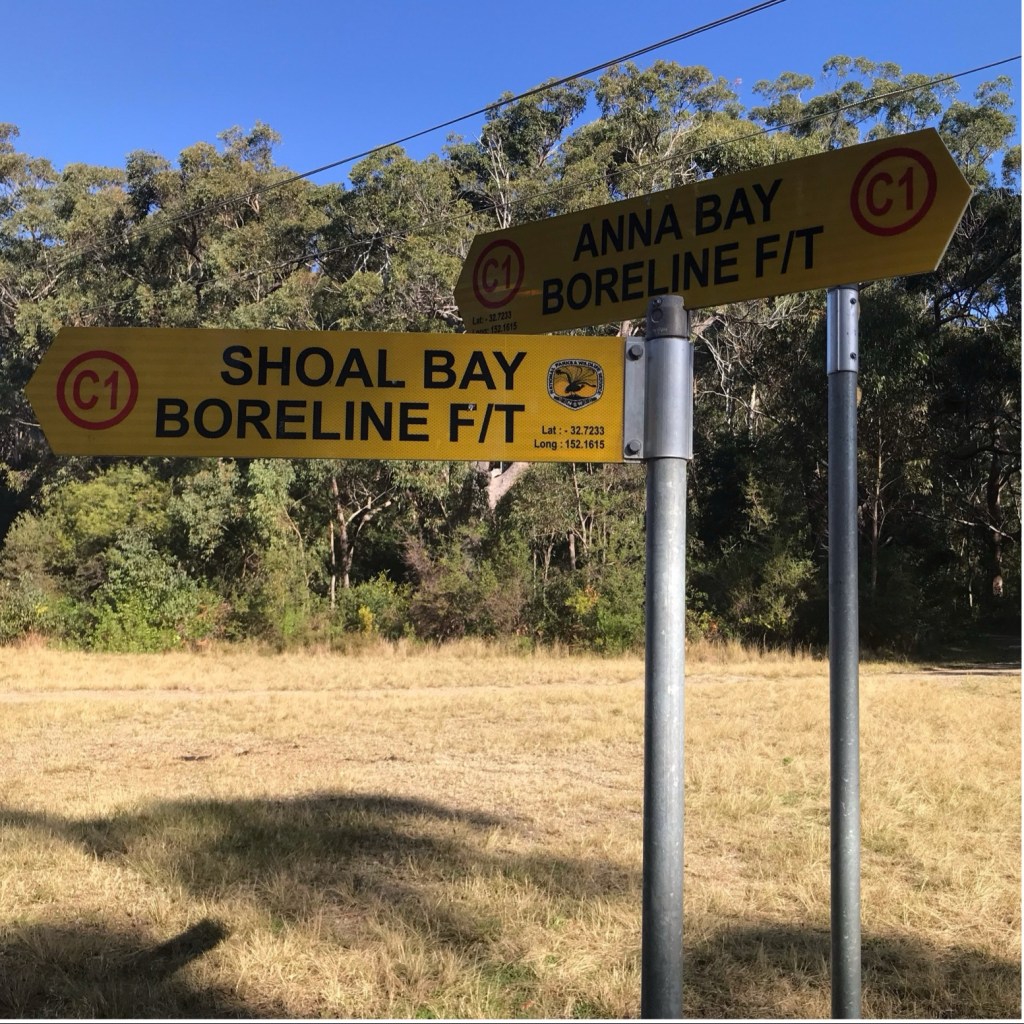
Signage at base of Glovers Hill, Nelson Bay, with the road to the water tanks in background [Author photo, July 2022].

Two water tanks near summit of Glovers Bay, Nelson Bay [Author photo, August 2015].
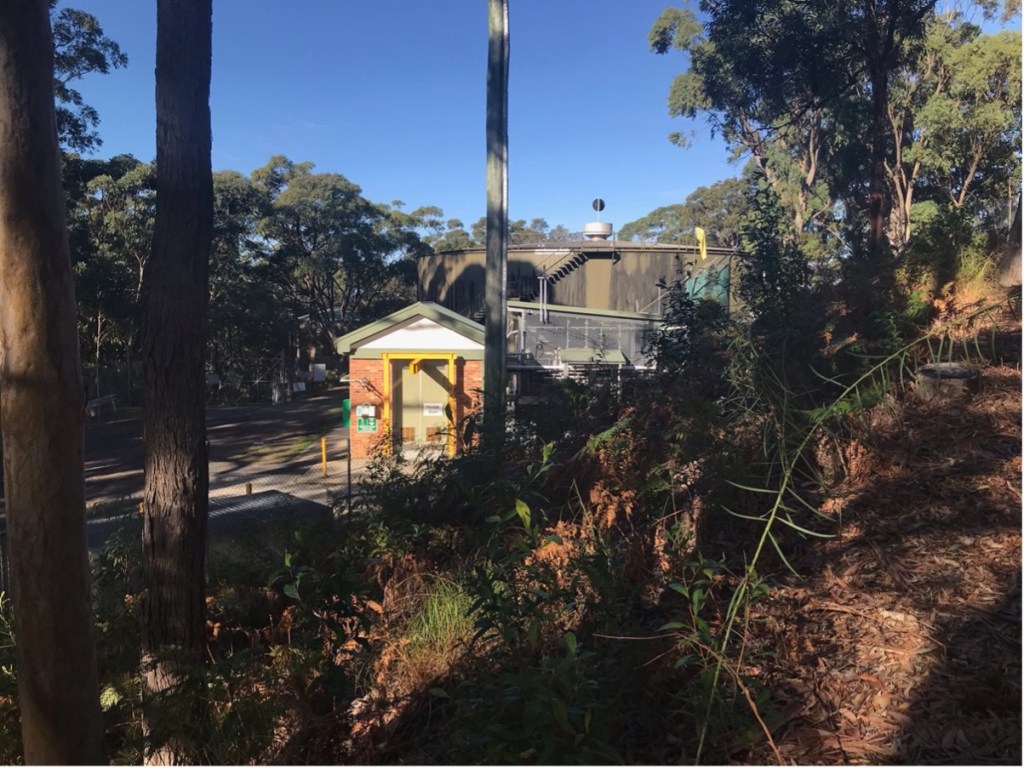
Water tank and associated facilities near summit of Glovers Hill, Nelson Bay [Author photo, July 2022].
It was in this area also that one of the original pumping stations was located along the Shoal Bay Boreline.
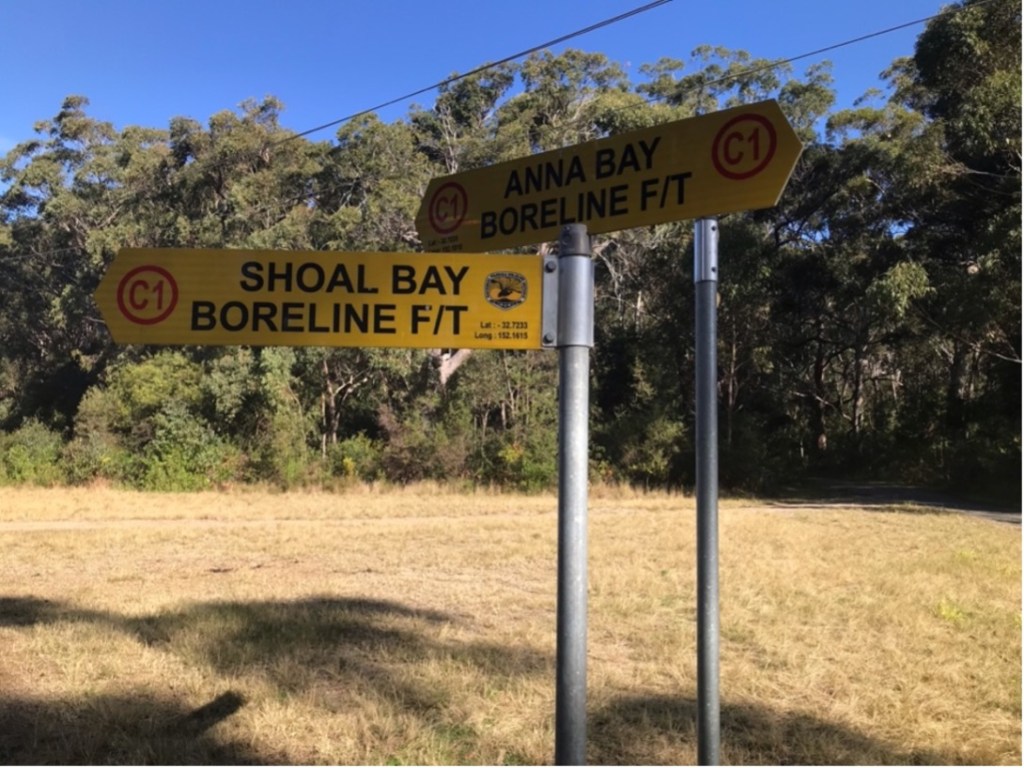
Boreline signage in the Water Catchment Area near Nelson Bay.
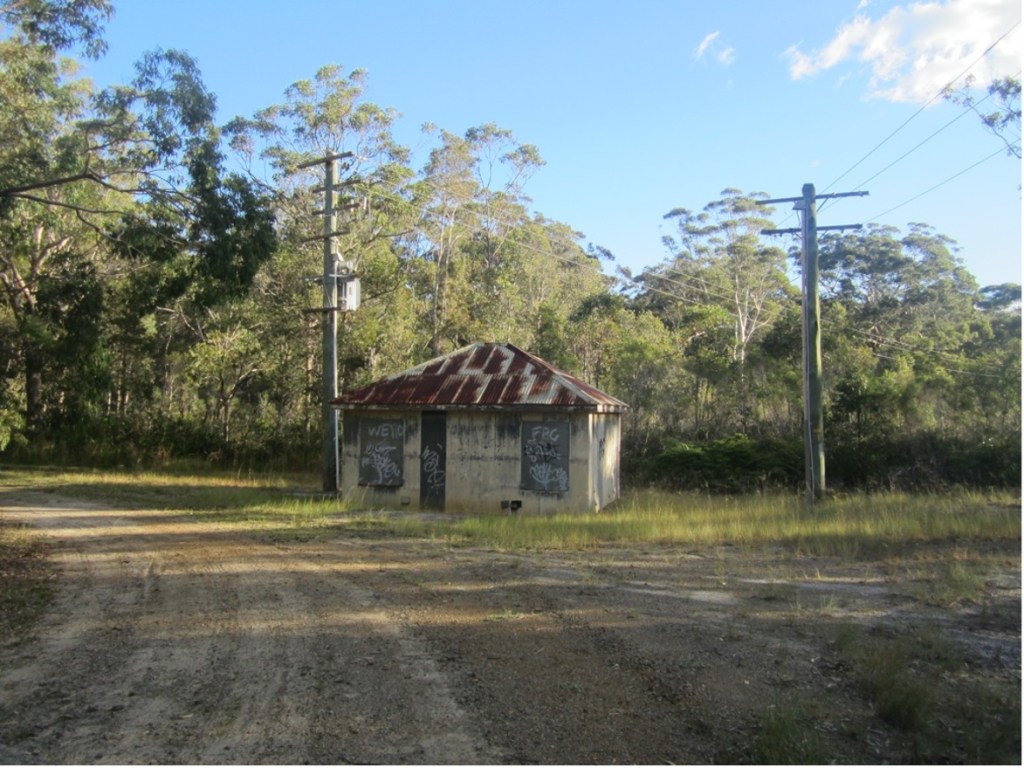
Original water pumping station (now demolished) on the Shoal Bay Boreline [Author Photo, May 2013]

Detail of original pumping facility (now demolished) on Shoal Bay Boreline, [Author photo, May 2013].
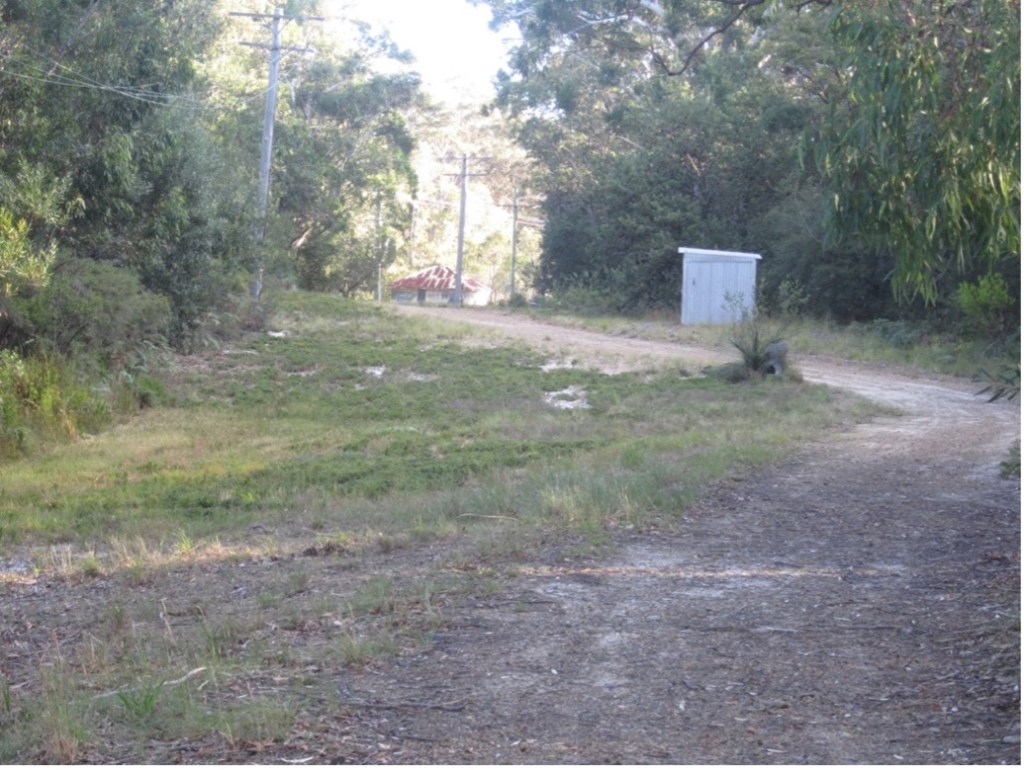
Small shed on pump on the Shoal Bay Boreline with the larger pumping station in the background. Both now demolished. [Author Photo, May 2013].

Disused bore on Shoal Bay Boreline [Author photo, July 2022].
Researched and compiled by Kevin McGuinness
July 2022

 Port Stephens - a history exploration