
Introduction
The age of tourism to the Port Stephens and mid north coastal region arrived in October 1907, when the New South Wales Government Tourist Bureau launched a new travel route between Newcastle and the mid-north coast, via Port Stephens and the Myall Lakes. The story of the Lakes Travel Route is found on this website.
Featured below is the story of a Sydneysider who ventured north to Port Stephens, up the Myall Lakes to Forster, no doubt inspired by the opening up of the new Lakes Travel Route. The description of their experience and of the sights along the way has both an historical component and a an appreciation of a wonderful marine environment just waiting to be explored.
The travelogue was published in two parts in the following editions of the Daily Telegraph, 21 November 1908, page 19, and 28 November 1908, page 6, by a correspondent:
Part One – Stockton to Bungwahl.
‘Shortly after two o’clock on a recent Wednesday afternoon we set out from Stockton, bound north. Salt Ash, sixteen miles away, on one of the arms of Port Stephens, was the first stage of the journey. This was soon over. Good “cattle,” a competent driver and a steady coach, landed us on the Reliance, a handy type of harbor tug and pleasure steamer, somewhat after four o’clock. Once “aboard the lugger” lines were cast off, and we were soon punching our way down Tilligerry Creek, heading for the upper half of Port Stephens.
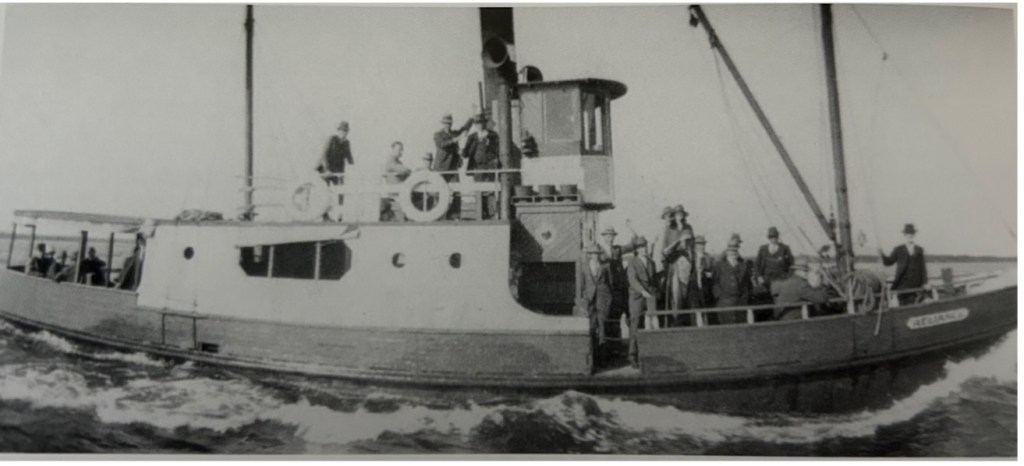
s. s. Reliance
There were three of us in our party. A commercial, who knew every inch of the way and preferred the lakes route to the uncertain sea trip, a bushman from somewhere on the Hastings, who turned out to be ten times quieter than he looked, and myself. I was bound for Tuncurry, a little village just inside “The Hawke,” and was out to see all that could be seen, and to make the best of everything that came along.
Leaving the creek, where dense masses of mangroves hold a monopoly of all the foreshores, we soon opened out the inner half of this magnificent harbor. Port Stephens surprised me. I had looked for something like Botany Bay, but soon found that my fancies had tricked me. Port Stephens is no bay. It is an inland sea divided in two, with a nicely wooded island laying right in the neck, where the northern and southern shores draw almost together. I am prepared to praise this place, even though my home-harbor is said to be one of the best in the world.
There is a bigness and a beauty about Port Stephens which Port Jackson does not possess. Our waters may be deeper, but they are more confined. The natives love it much as we do ours. And they are not afraid to tell you that if it were not for the vested interests in Newcastle and Sydney, Port Stephens would easily lead them and probably leave them behind. “What about the depth of the water?” I ventured to ask. “Depth of water! Great snakes,” replied the engineer of our liner. “Why, we have loaded the Devon and the Dorset right down to the plimsoll with sleepers, and have several times had to do for coal ships what Newcastle was unable to perform.
Salamander Bay, over there (we were in the outer half of the harbor at the time) will provide accommodation for 14 American fleets.” “How is the entrance?” was my next question. “Good as gold, and quite safe and deep,” came the reply. “You Sydney folk know nothing of us. And it seems to me that you do not care to find us out.” “I don’t know about that,” I was forced to say. “My own opinion is that there are thousands our way who will be quite as surprised and delighted as myself. Port Stephens hither-to meant a rough-and-tumble trip in one of the little fish and coal steamers. Not one man in a million knows of the work you are doing.” “Then,” said my friend quietly, “you make yourself a mouthpiece for the neglected Port, and noise her charms abroad.” I made a mental note of the fact there and then, promising to see if some word of praise could not be given to what seems to me to be a place full of the picturesque and full of possibilities.
The seascape after one has turned into the main portion of the port is a grand one. Nelson’s Bay lies away to the right. Eastward towers the great Tomeree Head, on the southern entrance. On the north another half mountain, with an Island or two on the horizon in between. About here I made the acquaintance of Mr. Waddingham, who has had more than 12 years about the port and picked up some useful information in regard to the timber and fish trades, the two industries which are at present the mainstay of the place.
Having no passengers for Nelson’s Bay, we headed north-east for the Tea Gardens, where the night was to be spent. On the run round one passes much low-lying foreshore, which seems not to be of any great value. Through the “Duck Hole” we passed into “Windy Whopper,” [Winda Woppa] the timber depot, where a flat-bottomed steam sea-punt and the “clipper-like” Gleaner were loading.
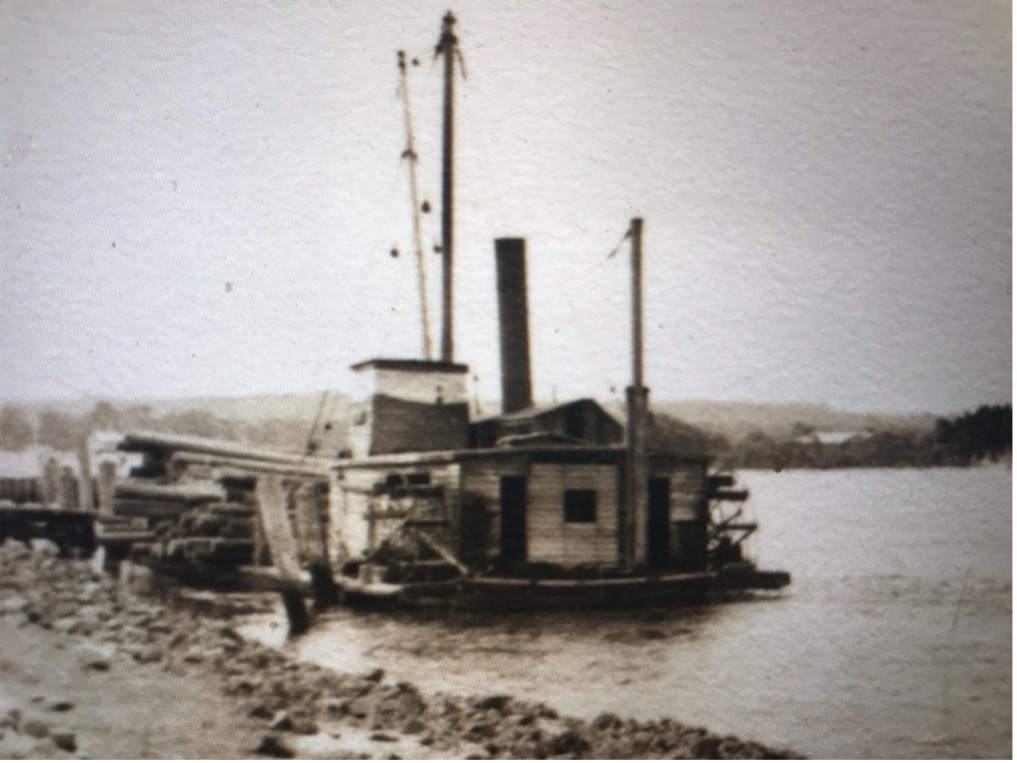
A flat-bottomed drogher at Tea Gardens loaded with timber
On through the narrowing river the ‘Reliance’ takes us, until we at last head in towards the western shore, at what we thought was a little “one-horse” waterside place very improperly named the Tea Gardens. But a veritable tea gardens the village turned out to be. We were hungry, and just a shade angry at having an edge on an appetite without being able to dull the feelings with something, of soft or “hard tack.” Once ashore the feeling wore off in the comfortable dining room of the Tea Gardens Hotel. Tea over, a stroll in the half-moonlight took us back to the water’s edge, where we met one of the Broughton Island lobster crews, and discussed the fish business and the rabbit microbe. This latter person and his host, we heard, are flourishing on the experimental station. Occasionally one falls to the gun of a fisherman and is promptly potted and eaten without fear or apparent injury to those who rather welcome a change of diet.
Off the island a lot of lobstering is now being done. “Fish” are plentiful, and the catches large, but the prices are low and the losses by death (lobsters are not supposed to be safe eating if they die before reaching the boiler) rather heavy. Still the life has its charms. A night at the Gardens, a very early breakfast, and the third stage of the journey begins. Half-past 6 finds you aboard a comfortable little motor launch, in charge of Captain Thurlow, one of the brothers who have been doing pioneering work in opening up this capital tourist trip.
Up the lower reaches of the Myall River you pass very quickly, and are soon on the river proper, running between two low-lying banks that are heavily wooded with scrub and timber, with here and there natural fern glades full of bungalows, staghorns, and cabbage-tree palms. Mile after mile of this sort of river is run over. Fish steamers, sand dredge, stern-wheel log and timber punts are the only signs of life which one sees on the run towards the Broadwater, which comes before the main lakes. In several places on the bank, where the land is a little sandy, acre patches of snow-white flannel flowers are seen. These are not the low growers which we find struggling through our own country, but are often 5ft. and 6ft. high, with masses of blossom that would bring delight and profit as well to many of those who make a living from gathering native flowers.
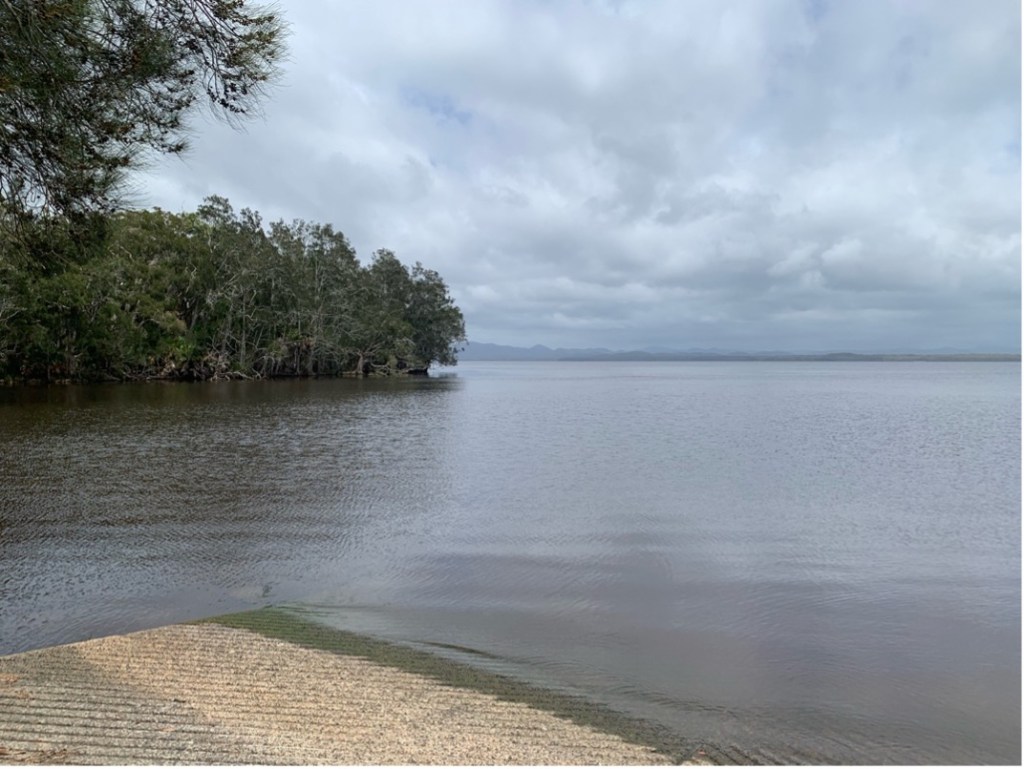
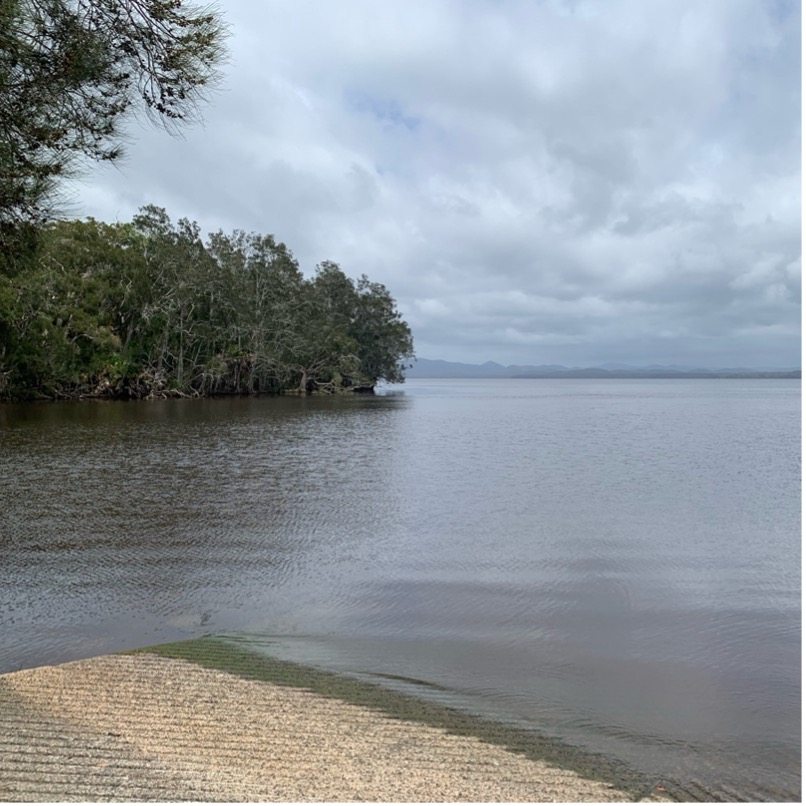
The Broadwater at Myall Lakes [Author photo – March 2024]
Out of the river the launch passes into the big broad water to find the northern shore rising into three or four great mountains, which one of my companions said were out at the back of Bulahdelah, one of the several big timber-getting centres which lay around the lakes. On we go, steaming quickly, putting mile after mile behind us, passing through the lower Booloombayte, where the land (as is most of the country around the lakes and rivers) is heavily timbered right down to the water’s edge, until we enter the big Myall Lake. Here comes the surprise of the trip. This place is another big inland sea. On its great blue bosom thousands of waterfowl feed or float lazily. Duck, swan, and pelican are there, the former in thousands. What a country for those of the gun brigade! Here the expert shot could make himself at home for weeks. When he got tired of the waterfowl, he could turn his interest to the pigeons and wallabies, which Captain Thurlow told me could be had in plenty anywhere among the hills which run right down to the water’s edge. If the pigeons are as plentiful as the ducks, one would need an army of men to thin them down.
As a picnic and camping ground these Myall Lakes offer more interests than anything within the same distance of Sydney. They are practically virgin country, with no end of game for the sportsmen. For the fisherman there is little line work above the Tea Gardens. The lakes are worked by net and give big hauls over to those who labour. Boats and launches are procurable at moderate rates. These are supplied either from Nelson’s Bay or the Tea Gardens.
Across the lake we still travel, heading for Bungwahl, another timber town, where the 43-mile motor-boat trip comes to an end. There is very little here save sawdust, and rough, dry hillside. A few houses lay about the lake shore, while the sound of the mill saws keeps the place alive. A few minutes before 11 o’clock we stepped on the wharf, and finished the third stage of the trip, having had a most enjoyable run in Thurlow Brothers’ little steamer.
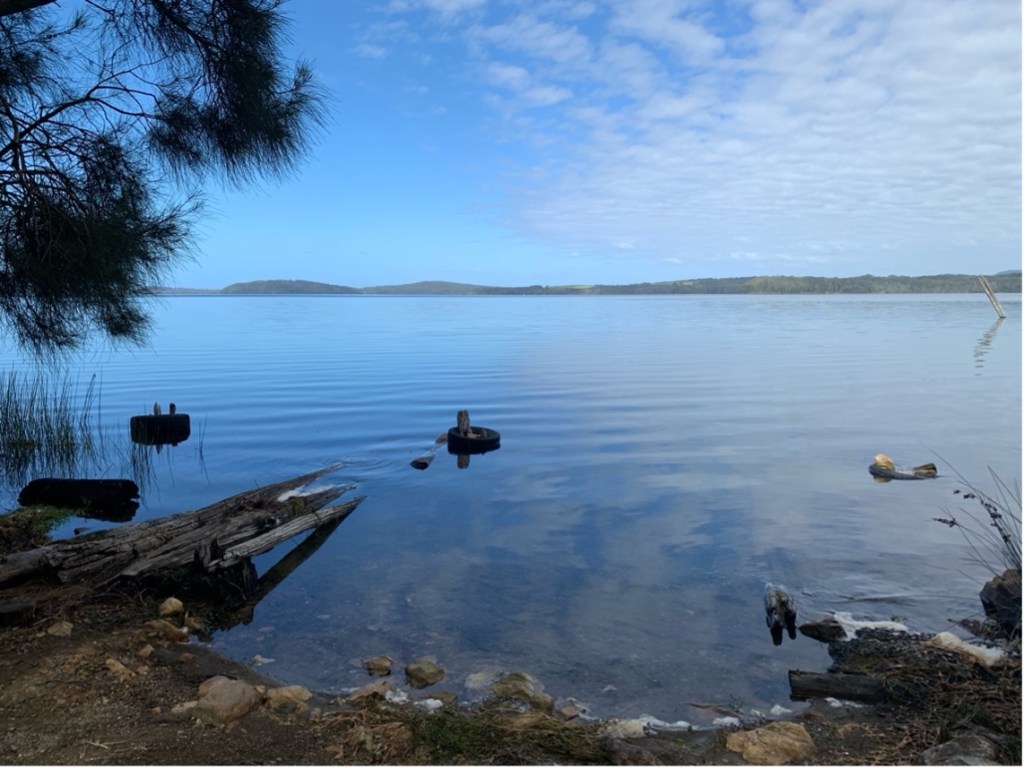
Remains of the Bungwahl Wharf on Myall Lake [Author photo – March 2024]
Like Port Stephens, the lakes had been a big surprise packet. We have something there that is a big asset for the hard-worked city man, who can enjoy a simple outdoor life in the midst of surroundings rather unique. To those in search of rest and quiet the Myalls are a veritable Paradise. And for the men and women who cannot travel by sea the route is all one could wish.’
Part Two – Bungwahl to Tuncurry
‘Ten minutes after we landed on the wharf at Bungwahl, Mr. J. A. Godwin and his coach showed up over the hill, and come leisurely towards us. My Hastings friend, who had been so silent all the way from the Tea Gardens, brightened up considerably on the coming of the horses. He now found his tongue. “They are good ‘cattle,’ mate,” said he, eyeing the horses over. “They’ll do the journey, rough an’ all as it is.” Then off through the lakeside village of Bungwahl, a village which has remained practically the same for the last half-century. It is not the privilege of every inland hamlet to prosper and rise into fame. There must be some small out-of-the-way places which are always to remain among the insignificants. But Bungwahl is not one of those. Though it has hitherto been among the partially lost, its day is not far distant. It is one of the connecting links on a long chain of interesting lakes, which must always remain worth doing, even after the railways have been run far into the north.
Up the steep roadway and over the hill we went, bumping and jolting on the bad pieces of road, much to the annoyance of the “commercial,” who thought it best to stand on the back step to avoid occasional inconvenience. “You’ll soon need a new coach, Godwin,” he called on one occasion, as we rose out of a big rut that had rattled us fore-and-aft. “No fear,” replied the driver. “This ‘un will see me through. She only wants a new top, and a coat or two of paint to see her through with many a good load. When the Government vote a few ‘quid’ for the making of this road I’ll do the ‘caravan’ up. It’s no use me doing all the spending. If they don’t soon get a hustle on, and mend the bad bits, I’m thinking I’ll have to keep the bullock team handy to get me out of difficulties.” Just here the bushman made some remark about the slow ways of “them as look after the roads. It’s just the same up our way,” he continued. “You can’t get a chain of metal [ballast] down without pulling a mile or two of red tape off the reel.”
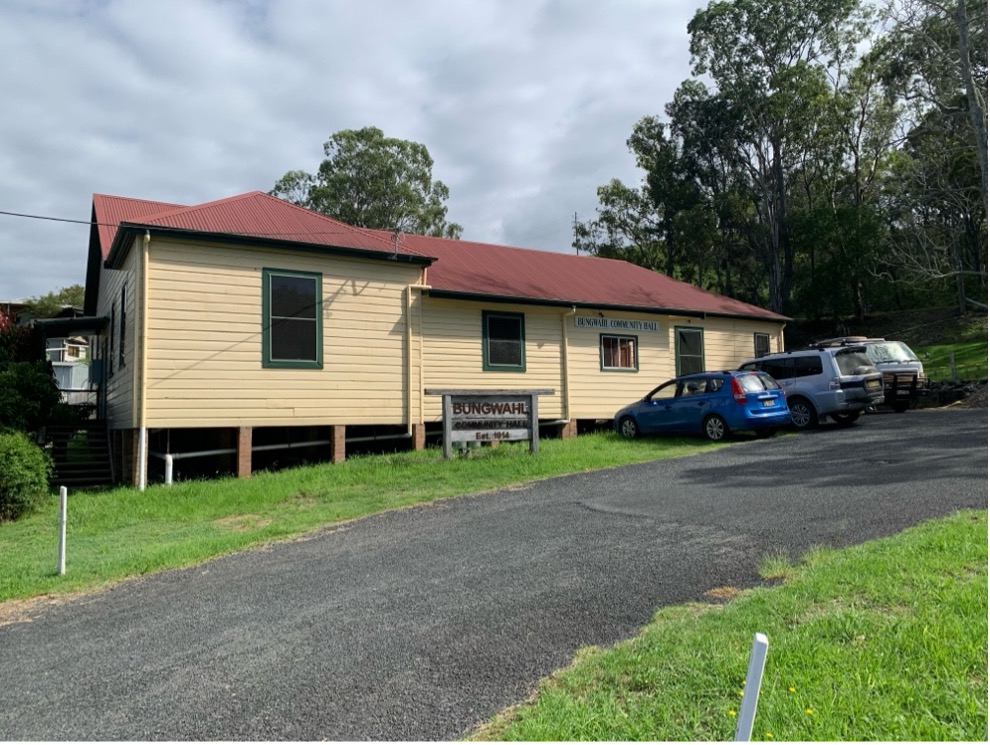
Bungwahl Community Hall c 1914 at the top of a steep incline from the wharf [Author Photo – March 2024]
A few miles out of Bungwahl, the rough ruts came to an end, and the road ran flat and straight, skirting mile after mile of Smith’s Lake, which lies in landward from Seal Rocks. Though much smaller than either Broadwater, Big Myall, or Wallis’s Lake, Smith’s has every appearance of being a nobby place for a holiday company. It is said to be teeming with fish. In bad weather an outlet is made into the ocean through a narrow neck of low-lying, sandy beach, which one can see some miles away to the eastward. No signs of life or habitation are to be seen in this road. It is one of the lonely ones so far. An hour and a half in the coach carried us over the seven or eight miles which separate the Myalls, from Wallis Lake. On the shore of the latter, by the side of a shallow, convenient creek, which is overhung with moderate sized she oaks, and bordered with rough reeds and grasses, the Forster launch awaited.
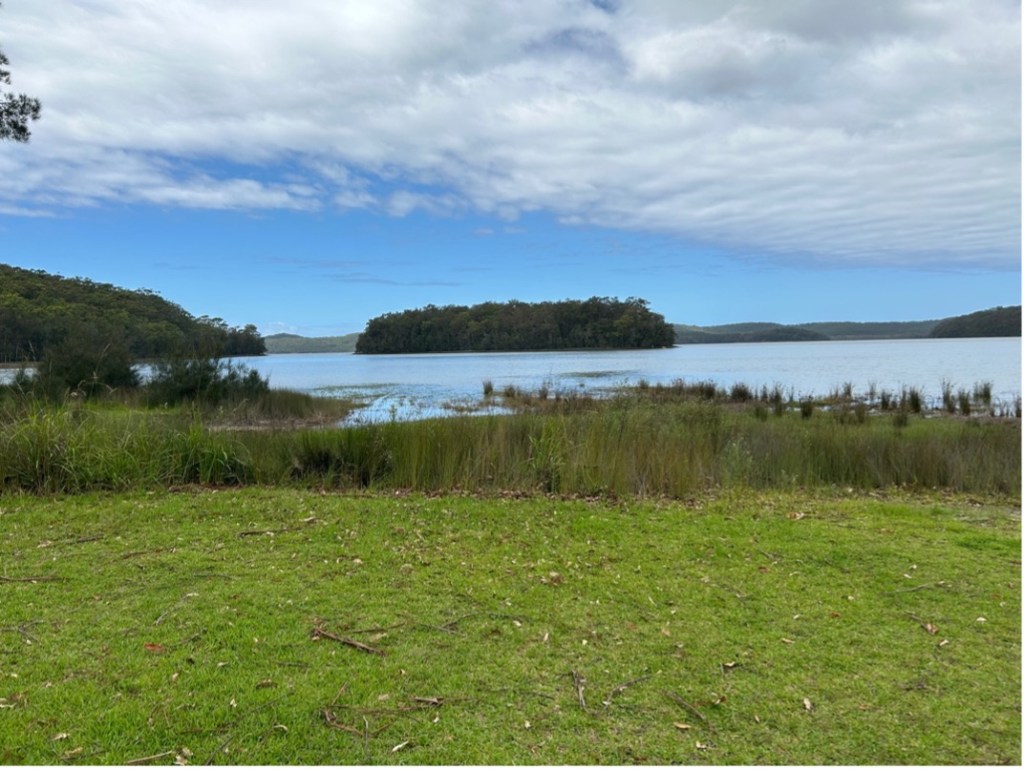
Smiths Lake [Author photo – March 2024]
No time was lost in getting men and baggage aboard. In a few minutes we had poled round and were on our way. The first view of this Wallis Lake is not a good one, but as one works down the creek and opens out into the broader waters, the scenery improves. Indeed, one very soon comes to thinking that the last lake is the prettiest of all. There is rather more variety in the surrounding foreshores. The mountains away in the westward wear bolder outlines. They seem to carry bigger and better timber. Whether this is so or not I cannot say. Perhaps the knowledge that my journey was ending on the other side of the lake had something to do with the improvement of the land and sea scape. Still, I hardly think this possible.
Wallis Lake really holds a greater variety of scenery. It is less of an inland sea, and has more of the harbour about its make up. Of bird life there was a better variety. Ducks were absent, but of swans, both black and white, of pelicans and other big-winged things there was a goodly company. One thing I regretted leaving behind— my field glasses. These would have brought the hills and mountains and the birds very much nearer. I Just longed for a closer look at some passing pelican or a flying-fish hawk, or a stately white swan that lay like a short alabaster column a few miles away on our port or starboard bow. Wild things in their home ways are so full of interest that it seemed a pity to lose the opportunity of seeing all they had to show.
The upper half of the Wallis is quiet country. Little sign of anything there but bird and fish life. An occasional fishing boat might be seen beating her way about as the crew keep a lookout for the “school” fish which are a harvest to them. Beyond this everything is peaceful and full of charm. There is much here that a tired man who, can rough things, requires for a perfect holiday. One can retire into the bosom of these myalls and forgot there was ever a worry in the wide world. You might even get lost, if you felt so inclined, and find yourself miles away up the river at Failford, or on some other arm which is tenanted only by an occasional fisherman, dairyman, or log hopper. And what a life it would be! And what a holiday!
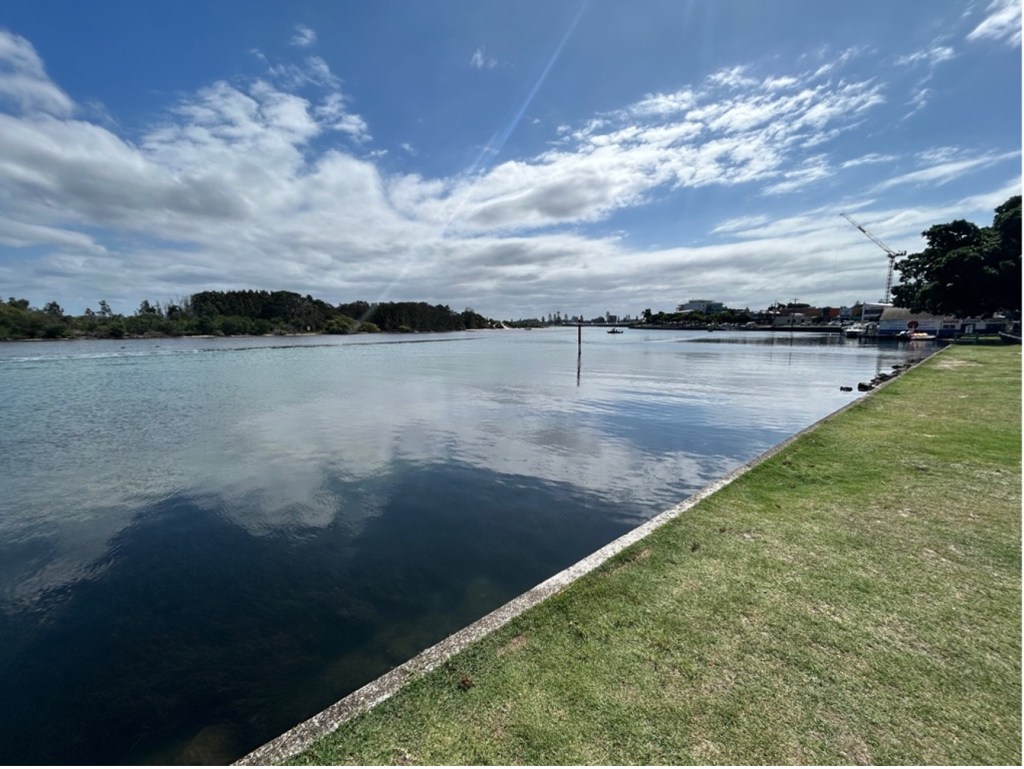
Wallis Lake looking towards the Forster-Tuncurry bridge [Author photo – March 2024]
By half-past 2 we had run to within half a mile of Forster and were skirting the pretty foreshores on the way down to the entrance of “The Hawke.” Here the journey almost ended. A brief stay at Bower’s Hotel for lunch, and then across the river to Tuncurry, which was to be my home for two or three days at least.
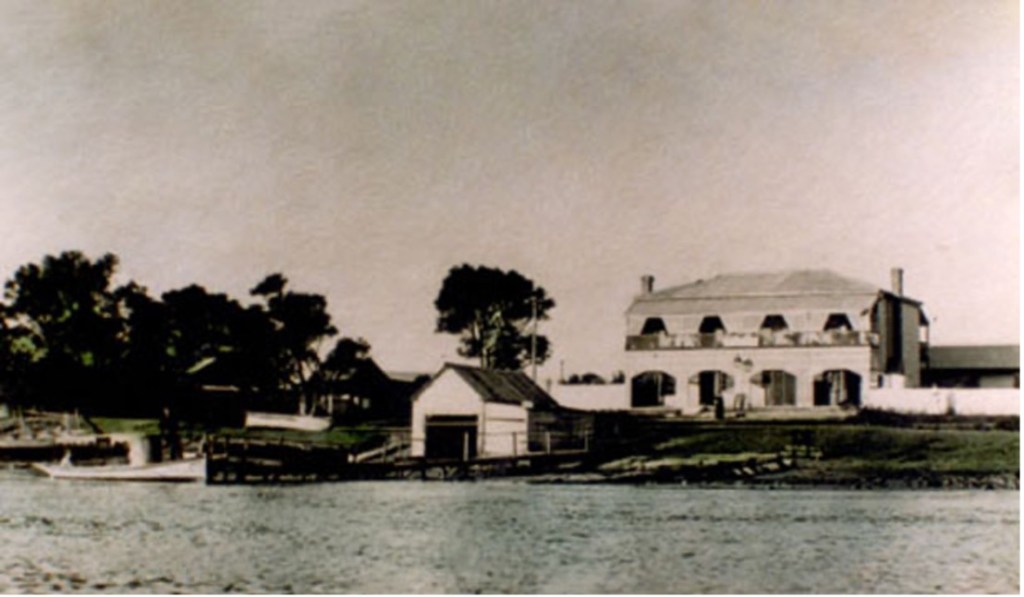
Bowers Hotel Forster, circa 1910 [Great Lakes Museum]
Tuncurry is a fisherman’s paradise. Any man who is fond of sport can take a big toll of the finny tribe here. The place literally teems with fish of all classes. There is no sitting on the rail of your “hooker” to wait for the black bream to grow. You cast your line and got a nibble or a run before you have hawled in the slack, and if you be a duffer or an expert the struggling scaly one is soon floundering at your feet. You can fill either a basket or a boat. The only trouble is this: You might tire before you make any appreciable difference in the quantity of fish which make “The Hawke” their home.
Two very pleasant days were spent in and about Tuncurry and Forster. Flowers were plentiful and show interests [Tuncurry show] were keen. Never before had I seen so much work or so much enthusiasm in a good cause. It soothed as if the whole village was bent in making the gathering a success. Each day’s performance was a triple affair, beginning with the exhibition, and running into a concert, to end up with a bit of a “hop,” which ran into the small hours of the morning. Great business was done in Tuncurry on the show days, and although I flatter myself on having seen a “thing or two” in flowers, I must confess to having added several items of interest to my store.
The home journey was by sea. Of this little need be said, I spent the long, weary hours “wedged” in a bunk on the upper deck of the staunch little trader which Captain O’Beirne navigates skilfully from port to port. We had run into a “snorting” southerly gale, and the Tuncurry just bumped into everything she dis-liked. But she fought her way to the southward. In spite of wind and sea, and landed me back home early one Monday morning with “gills” that wore either light green or yellow, with a pain across the small of my back such as might have come from a hard “rope’s-ending,” and a feeling of emptiness in my lower hold, such as I had never known before. Still it did not matter. Seasickness and soreness and other discomforts soon wore away. But the lonely Myalls and the kindness of the people at the other end of them will be remembered for quite a long time.’
Concluding Comments
The Lakes Way today, which branches off the Pacific Highway, north of Bulahdelah and ends at Forster, allows the modern motorist, once Bungwahl is reached, to travel over much of the route covered by the author of the featured newspaper articles.
Researched and compiled by Kevin McGuinness
March 2024

 Port Stephens - a history exploration