
Introduction
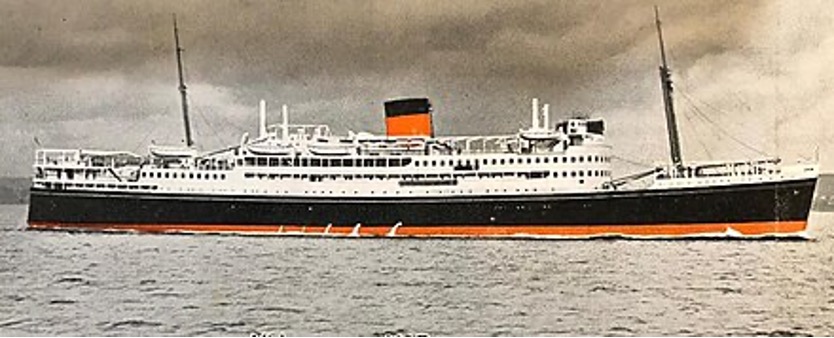
This is the story of the Kanimbla, a luxury passenger liner that was built in Belfast for the shipping company, McIlwraith, McEacharn Ltd of Melbourne. It was launched in 1935 and began operating as an interstate cruise liner along the Australian coastline in 1936. It was named after the Kanimbla Valley in the Blue Mountains area of New South Wales.
Kanimbla was a luxury liner for its time and attracted much interest from travellers. After its arrival in Australia, McIlwraith, McEacharn held balls on board in ports visited, to aid fund raising for various charities, and as a means of promoting the ship’s luxury travel. The Kanimbla had a radio station and was one of the first ships licensed to broadcast programs throughout Australia from sea to shore.
The days of passenger cruising along the Australian Coast on the Kanimbla was however cut short, after only three years of operation, in 1939 with the outbreak of World War Two.
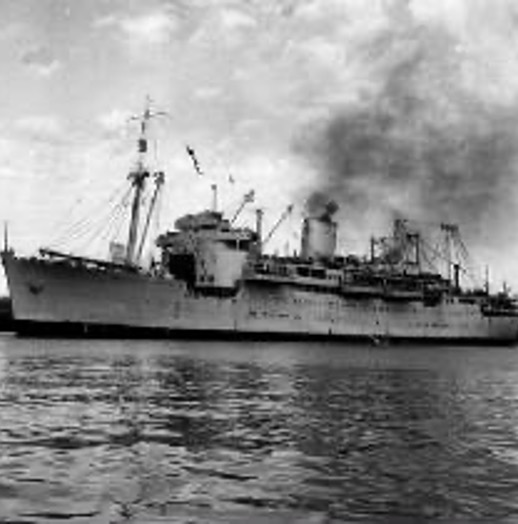
Kanimbla (among other ships including the passenger liners, Manoora and Westralia) was requisitioned by the Commonwealth Government in December 1939. It was converted into an armed merchant cruiser and commissioned as HMS Kanimbla in the Royal Navy. In 1943, the ship was converted into a Landing Ship Infantry [LSI] and transferred as HMAS Kanimbla into the Royal Australian Navy. It remained in military service for eleven years.
In 1943, the HMAS Kanimbla was based at Port Stephens, together with two other Australian naval ships, HMAS Westralia and HMAS Manoora, to provide military landing training support to the Royal Australian Navy (RAN) naval base ,HMAS Assault, in conjunction with the Joint Oversees Operational Training School (JOOTS) which had been set up as a joint training facility by the Australian and USA Governments. See HMAS Assault and JOOTS – 1942/43.
During JOOTS manoeuvres, HMAS Kanimbla, HMAS Manoora, and HMAS Westralia, all of which had been converted to ships that could land infantry forces from Navy transport ships onto land, were involved in simulated landings on Zenith Beach, Wreck Beach and Box Beach at Port Stephens (and also within Port Stephens) in readiness for the amphibious invasions in the Southwest Pacific region.
After JOOTS ceased operations at Port Stephens in October 1943, HMAS Kanimbla saw extensive service in the Pacific region. After the War, she was involved in extensive repatriation missions and the transportation of troops.
The Kanimbla has a fascinating history, before, during and after the Second World War, the story of which is told in this paper in five parts.
M.V. Kanimbla
PART ONE – KANIMBLA PRIOR TO ITS ARRIVAL IN AUSTRALIA
New Liner Named after a Blue Mountains Valley – 1935
The Katoomba Daily of 12 January 1935, page 1, reported:
‘Messrs. McIlwraith, McEacharn Limited, of Melbourne, whose interest in Katoomba has been proven on many occasions, has just placed an order with Messrs. Harland and Wolff Limited, Belfast, for a new passenger and cargo motor vessel for service in Australia. This well-known firm has further favoured the Mountains by naming the new vessel “Kanimbla,” after Kanimbla Valley, and the vessel should provide an added link of friendship between Mountain folk and Mcllwraith McEacharn [The shipping company also operated a passenger ship named ‘Katoomba’].
Kanimbla Launched – 1935
The Newcastle Morning Herald and Miners’ Advocate of 14 December 1935, page 10, reported:
‘According to cable advice from London, the new motor-ship Kanimbla, which is being built for McIlwraith, Mc Eacharn Ltd., by Harland and Wolff, Ltd., was successfully launched on Thursday. The vessel was christened by Mrs. T. N. G Jennings, a daughter of the late Mr. Andrew McIlwraith, one of the founders of the firm.’
Australian Made Radio Equipment Installed in the Kanimbla – 1936
The Daily Commercial News and Shipping List of 19 February 1936, page 1, reported:
‘Australian enterprise is again much in evidence in the very fine range of radio equipment that has just been shipped from Sydney for the Mcllwraith McEacharn Line’s new motor vessel Kanimba, which is nearing completion at Belfast. The wireless equipment was designed and manufactured in Australia by the Amalgamated Wireless Company.
The Kanimbla will be equipped with a 1½ k.w. valve transmitter, which will ensure excellent communication at all times during voyages along the Australian coast and over quite considerable ranges during any voyages overseas, but in order to assure communication over very long distances the Kanimbla is also being fitted with special short-wave wireless equipment. This latter station will enable the owners to keep in daily direct touch with the commander of the Kanimbla throughout the voyage from Belfast to Melbourne or Sydney.
Two complete wireless telegraph transmitting and receiving sets of smaller power and special construction will be installed in two of the ship’s lifeboats. One of the latest developments is the echometer depth sounding apparatus, which makes use of wireless principles and enables the navigating officers to see at a glance the depth of water under the vessel. This apparatus is set in operation by the mere pressing of a switch. The ingenious automatic reception set known as the auto alarm will also be fitted. This set is brought into operation when the operator goes off duty, and in the event of another ship within 100 or perhaps 200 miles sending out a distress call it will be automatically received. The receiving of the call in the instrument sets up the ringing of bells on the ship, which can only be stopped by the operator going to the wireless cabin and taking up duty.
In keeping with the very up-to-date construction of the ship and the owners’ plans for providing excellent facilities for the convenience and enjoyment of passengers, there will also be a particularly extensive loudspeaker installation. There are to be 14 loudspeakers in all, and the equipment will permit of three different programmes being made available in the ship at the one time. A broadcast receiver will permit of sporting results being reproduced from certain selected loudspeakers. A phonograph turntable may be used for the dance music records, which will be fed to other loudspeakers, and a third programme might be the relaying of a concert in one part of the ship to certain other parts.’
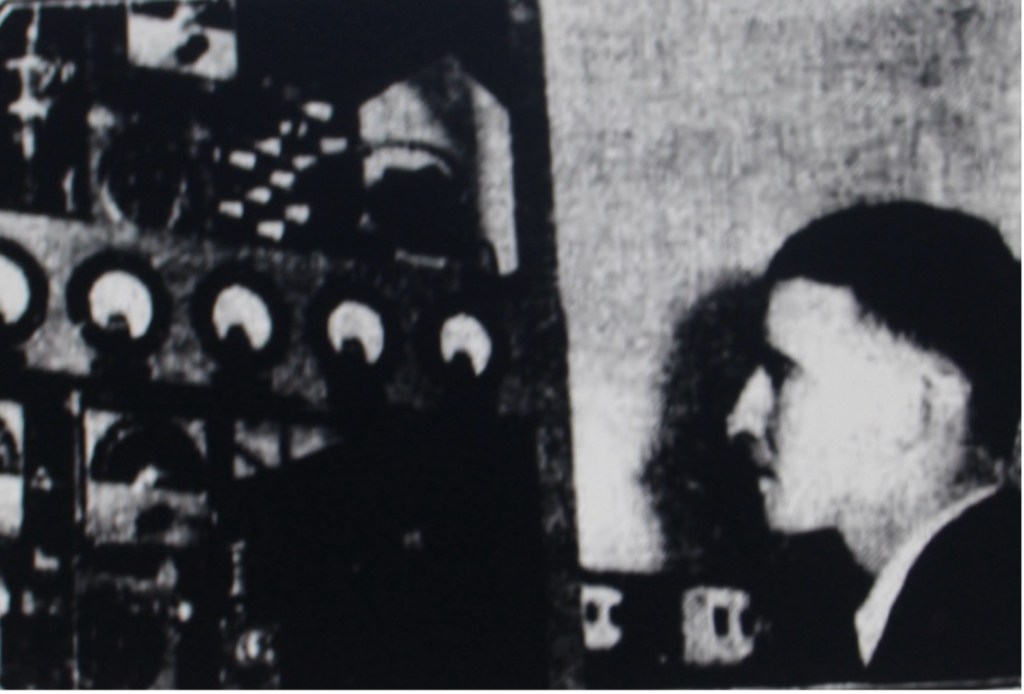
Wireless officer on the Kanimbla with the short-wave broadcasting transmitter [The Sun News-Pictorial, 13 June 1936]
Kanimbla Commences Journey to Sydney – 1936
The Sydney Morning Herald of 28 April 1936, page 17, reports:
‘The new passenger motorship Kanimbla, which was built In Belfast for McIlwraith, McEacharn, Ltd., for the Interstate passenger trade, sailed from Belfast last Sunday for Sydney direct, and is due here on June 1. She will take the Cape of Good Hope route. The liner completed her trials satisfactorily. She is commanded by Captain F. J. Smith, formerly master of the Karoola, and Mr. R. E. Thompson, superintendent engineer of the company, who supervised her construction, is also on board. Since leaving Belfast the master has reported direct to Sydney on the short-wave wireless set that the performance of the ship had exceeded all expectations.’
Kanimbla to Broadcast While at Sea – 1936
The Daily Telegraph of 29 April 1936, page 2, reported:
‘The first vessel in the world to carry a broadcasting station is the new Mcllwraith, McEacharn liner, Kanimbla, now on her way from Belfast to Sydney. Mr. E. T. Fisk, chairman of Amalgamated Wireless, said last night that programmes from the ship would be heard by Australian listeners immediately the Kanimbla took up her Australian running. In addition to the broadcasting station, the Kanimbla is equipped with radio for the lifeboats. She carries also a depth-sounding appliance, which reveals at a glance the depth of water. The whole of the equipment was de-signed and manufactured by Amalgamated Wireless in Australia.
First Broadcast from the Kanimbla Studio – 1936
The Sun of 28 May 1936, page 2, reported:
‘The new Mcllwraith, McEacharn motor ship Kanimbla will be broadcasting, en route to Australia from Britain, at 9 tonight, and will be picked up by 2FC. Sydney, and 2NC, Newcastle. The Kanimbla is now approaching Australia, and the broadcast will include an introduction by the Prime Minister (Mr. Lyons).’
The Kanimbla Ferry Surrenders Name to New Liner – 1936
The Daily Telegraph of 30 May 1936, page 5, reported:
‘In view of the arrival on Monday of the new interstate motor vessel, Kanimbla, Sydney Ferries, Ltd., has altered the name of its ferry Kanimbla to Kurraba to avoid confusion. No two ships of the same name can be registered, and the changing of the ferry’s name is purely a courtesy.’
Kanimbla Arrives in Sydney – 1936
The Sydney Morning Herald of 2 June 1936, page 10, reported:
‘Yesterday morning, the latest addition to the Australian passenger fleet, Messrs McIlwraith, McEachern’s Kanimbla, arrived in Sydney, and after medical inspection, took a berth in Darling Harbour. She came direct from the builders’ yards Harland and Wolff, Belfast, via Capetown, where a call was made for fuel.
The new vessel was a fine sight as she came through the Heads on a blight morning spick and span in her newness, and with colours flying. She is inclined to sturdiness in appearance, the great beam (66 feet), the rounded white deckhouse front, with two tiers of square-shaped windows, and the short thick funnel lending an air of massive stability. The stem is the modern rounded prow raking down to the keel, the stern the cruiser shape. She is 494 feet overall with a tonnage of 11,000 tons.
The wide decks provide comfortable accommodation for passengers. The dining-room situated below the main deck is the full width. Smoke rooms, lounges, music-room, and play spaces are extensive with bay windows in places an unusual amount of plate-glass everywhere giving a fine open effect, particularly in the promenade decks, where the space afforded by the beam is fully used. All the vestibules’ entrances, staircases, and rooms are panelled in Australian woods, which with an infinite variety of patterns and contrasts in colour, are an attraction to the eye. No lamps are visible, the lighting throughout being soft and diffused, and a pleasant sense of colour in gradual changes in the invisible ceiling lighting of the dance deck is a novelty. There is a big sun deck with tennis courts. The swimming pool is in the open with lights for night bathing and in a position so that it can be used by the two classes of passengers.
Bedrooms are available for 200 first-class passengers and 198 second-class. In the first class are several suites with sitting and bathrooms and all have the ventilating system whereby the cabin is cooler than the deck in the warm latitudes. The second-class accommodation aft is equipped on an equally generous scale. The woods used for decorative effect and utility are jarrah walnut, myrtle, cherry, blackwood, maple, and silky oak, polished to perfection of glass-like surfaces. In the music-room an oil painting of the Kanimbla Valley, after which the ship was named hangs above the fireplace.
The Kanimbla has two eight-cylinder engines, working on the four stroke cycle with airless injection and pressure induction the air for pressure induction being supplied to the inlet manifolds by turbo-blowers driven by the exhaust gas from the main engines. The hull has nine compartments divided by eight watertight bulkheads extending to the awning deck. A continuous double bottom is fitted for carrying water ballast, fresh water and oil fuel.
There are three cargo holds forward and two abaft the machinery space. Stalls are provided for 31 head of cattle or horses in the main ‘tween decks. Insulated compartments are available for cargo meat fish and fruit. Fire protection arrangements include fire detecting and extinguishing systems fire resisting bulkheads fire doors and the sprinkler system throughout the accommodation. The lifeboats are under the type of davits which swing out mechanically.
The Kanimbla is a broadcasting station. A special licence has been issued to her as a short wave station The broadcasting room is off the dance deck, where there is a room for musicians adjoining the control room. From there also is broadcast the music for the ship’s entertainment. Yesterday as the vessel came up the Harbour the music transmitted was “The Kanimbla Theme Song,” written by Larry Maiden and sung by Bryan Lawrence. The broadcasting is in charge of Miss Eileen Foley. The station is said to be the first in the British Empire licensed to transmit programmes for broadcasting throughout Australia from sea to shore [call sign of 9MI].
The Kanimbla came with a small number of guests of the company. Among them were Mr Eric McIllwraith who has been representing the family in England and Mr. R. E. Thomson, marine superintendent and superintending engineer of the company, who was mainly responsible for the building. Mr. Eric McIlwraith described the vessel as highly satisfactory in every way. Captain F. J. Smith, who is in command said she is a handy vessel which will be extremely serviceable on the Australian coast.’
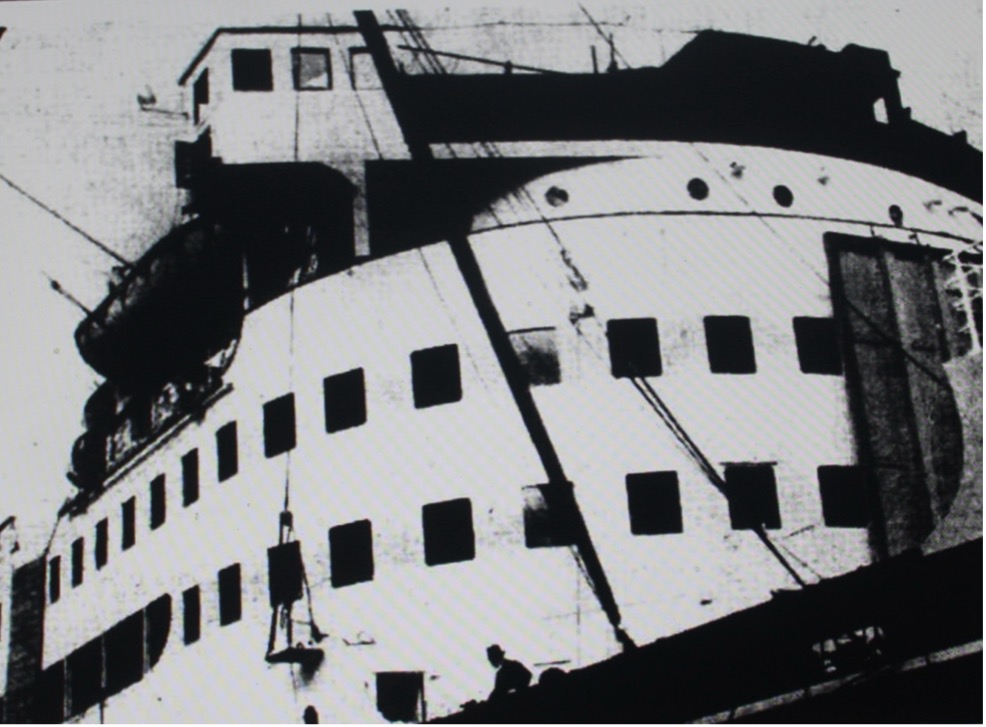
Kanimbla at Port Adelaide after arrival on its maiden voyage [News (Adelaide), 15 June 1936]
Broadcasting Facilities on the Kanimbla – 1936
The Sydney Morning Herald of 2 June 1936, page 5, reported:
‘Any woman would enjoy working in the studio on board the Kanimbla, McIlwraith, McEacharn, Limited’s new coastal liner, which arrived here yesterday on her maiden voyage from Belfast. The studio is the workroom of Miss Eileen Foley, daughter of Mrs. J. A. Foley, of Greenwich, who conducts the ship’s broadcasting station, claimed to be the only one afloat conducted by a woman.
All the instruments in the studio and the big sliding oak doors are of highly polished wood; thick dark green felt is on the floor, and heavy dark green curtains can be drawn across the doors and window. There are two rooms—one where the cream painted piano and music-stands and stream-lined chairs form the main furniture; and the other where the controls and record cases are the most prominent features.
Miss Foley, who was for some years a hostess and pianist on board other ships owned by the same company, was selected last October to go abroad to study broadcasting in London, and on the Continent. …..
Miss Foley concluded a broadcast from the ship on May 28, and on the voyage she has spent much of her time carrying out tests frequently rising at 3.45 a.m. for this purpose.
Part of Miss Foley’s work while in England was to select records of music and prominent people speaking. Among the latter one of her most interesting she said, is an address by the Dowager Lady Swaythling, who visited Australia last year, and has a great admiration for Australians.’
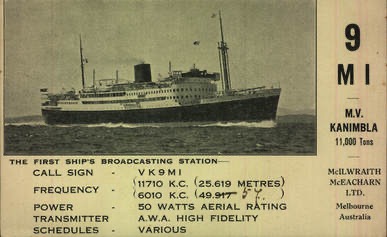
Technical details of call sign VK 9MI
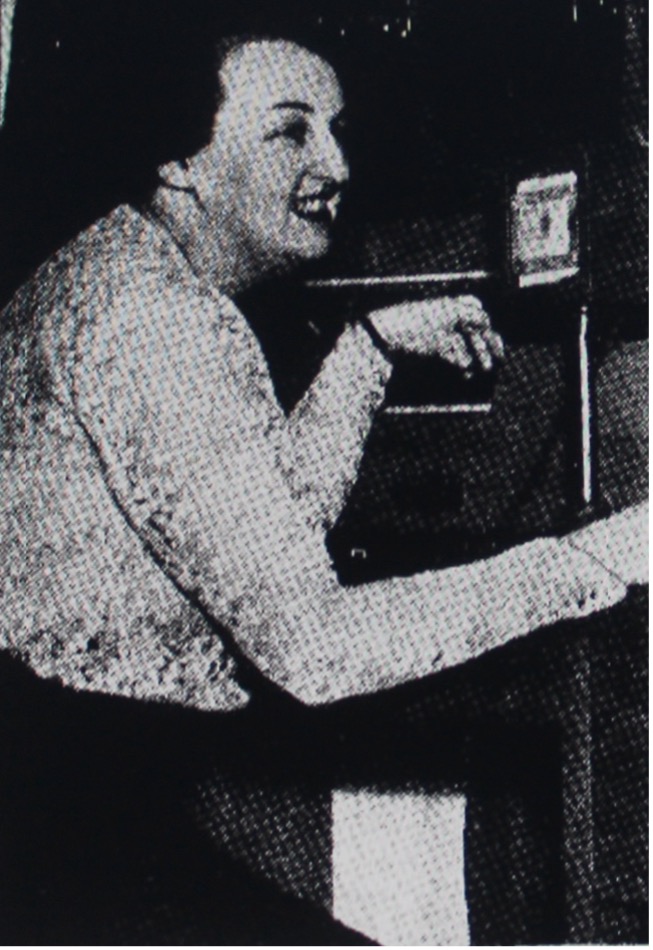
Miss Eileen Foley, in charge of the broadcasting studio on board the Kanimbla [The Daily Telegraph, 2 June 1936]
PART TWO: KANIMBLA COMMENCES LUXURY CRUISING IN AUSTRALIA
Party On Board Kanimbla – 1936
The Daily Telegraph of 10 June 1936, page 11, reported:
‘Between motor lorries, bales, and packing cases, which left hardly a square inch of space on the wharf at No. 4 Darling Harbour yesterday afternoon, six. hundred guests made their way to the afternoon tea and cocktail party held on board the Kanimbla. For many of the guests, the opportunity of inspecting a brand-new ship was a novel and enjoyable experience, and some of them quite forgot afternoon tea, so intent were they on making a thorough tour of this latest addition to the McIlwraith, McEacharn fleet. For the feminine guests, the attractive nursery seemed to have the most appeal. Another feature of the decorative scheme was the painting of Kanimbla Valley, which holds pride of place in the lounge, and after which the ship was named. The Mayor of Katoomba (Ald. W. Soper) and his fellow aldermen, who came from Katoomba especially for the party, beheld this painting with no small degree of pride.’
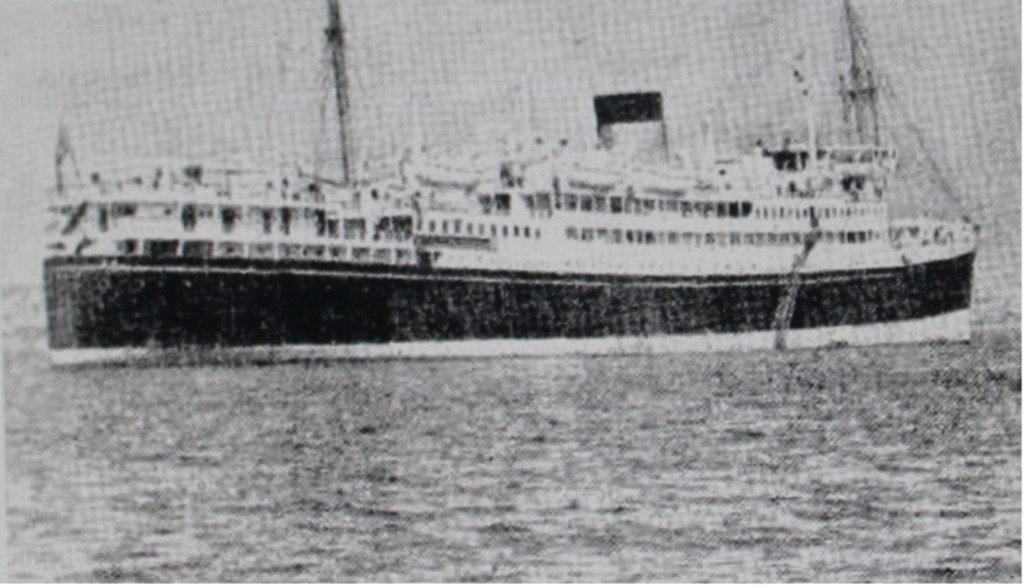
Kanimbla after arrival in Sydney Harbour [The Daily Telegraph, 2 June 1936]
Kanimbla Commences Maiden Australian Voyage – 1936
The Daily Commercial News and Shipping List of 8 June 1936, page 4, reported:
‘Mcllwraith, McEacharn’s new motor ship Kanimbla will leave Sydney at 3 o’clock on Wednesday afternoon [10 June 1936] on her maiden voyage in the interstate trade, to Melbourne and Port Adelaide, under the command of Captain F. J. Smith. The Kanimbla will sail from No. 4 Darling Harbour wharf.’
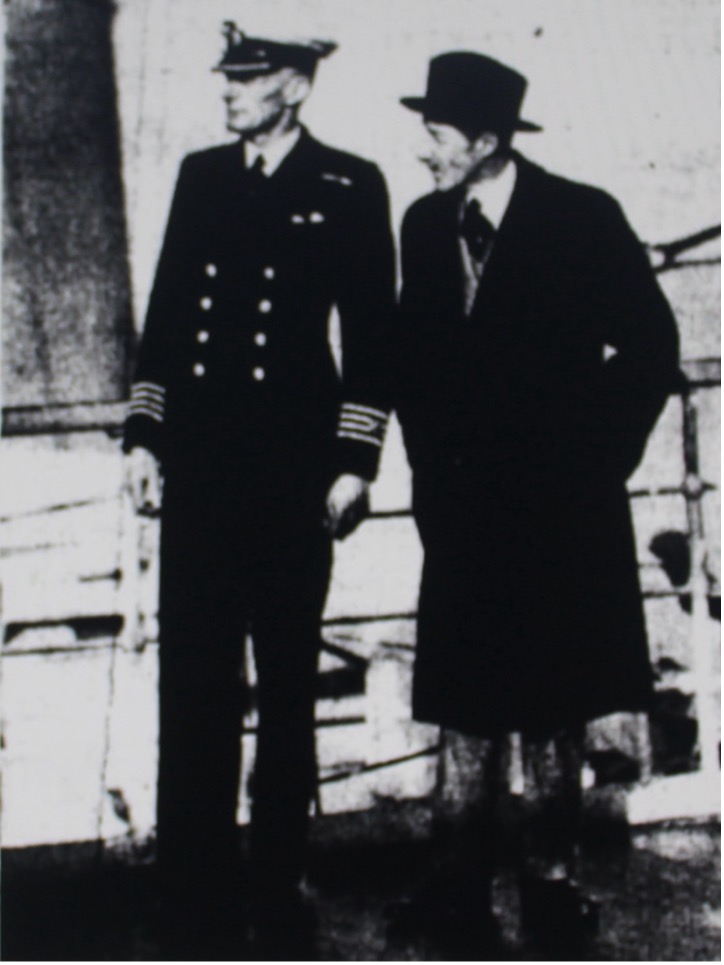
Governor of Victoria, Lord Huntingfield, with the master of the Kanimbla, Captain F. Smith, on board the ship after its arrival at Brisbane on its maiden trip [The Telegraph (Brisbane), 18 June 1936]
Ball Held on Kanimbla – 1936
The Daily Telegraph of 25 September 1936, page 11, reported:
‘Towering above the wharf at Darling Harbor, and ablaze with a myriad coloured lights, the T.S.M.V. Kanimbla looked very festive last night, for the dance held on board in aid of the Renwick Hospital for Infants. Lovely spring flowers, arranged in the lounges and smoke-rooms, added to the gay effect of the colourful floral satins and chiffons worn by many of the 850 dancers. Dancing took place on the spacious decks, and on the sports deck squash tennis, deck cricket, and other shipboard games were arranged, an innovation popular with the younger guests.
Enjoyable interludes in the dancing were provided by the Kanimbla Entertainers, and a monster lucky dip was the centre of much interest as guests tried their luck for one of the 500 prizes. The ship was lent by courtesy of Messrs. McIlwraith, McEacharn, Ltd., and the company’s colours, Chinese red and old gold, were featured in the distinctive place-cards on the supper tables.’
Ball Held on Kanimbla – 1937
The Daily Telegraph of 18 May 1937, page 9, reported:
‘Sparkling jewels, pretty frocks, and lovely flowers made gay the decks of the Kanimbla last night, when hundreds of well-known people attended the ball held on board in aid of the Women’s Hospital, Crown Street.
The festive atmosphere began on the wharf, where a long gangway covered with bright red and white awning and huge flags, and lit with coloured lights, led to the ship. Dancing took place on the spacious decks, which were cosily enclosed against the chill night air and gaily decorated with flags. …..Chrysanthemums and dahlias were also arranged in the lounge, where guests were received by the ball committee. Many people preferred bridge to dancing, and the card rooms were well occupied.’
Unique Broadcast from Kanimbla to the Grafton Region – 1937
The Daily Examiner of 8 September 1937, page 4, reported:
“Calling the motor vessel, Kanimbla, 9MI. This is station 2GF, Grafton, calling you and now going over to the receiver. Come in please.”
Listeners of 2GF, Grafton, who heard this unusual message broadcast by the announcer at about 9.55 last night, were amazed shortly afterwards to hear the voice of the ship’s lady announcer come over the air calling the local station and extending to residents of Grafton and district all good wishes from the passengers on board the luxury liner, travelling from Sydney to Melbourne.
Following arrangements received by the 2GF Grafton office yesterday, the engineer (Mr. J. L. Proust), called the vessel on the local station’s wavelength of 248 metres. His message was picked up by the vessel which was passing Jervis Bay at the time. The vessel in turn called Grafton on a wavelength of 49.571 metres, from the ship’s station 9MI.
The short-wave transmission was received at 2GF on the studio’s all wave receiver and rebroadcast. The announcer, Miss Eileen Foley, in a short address to Grafton listeners stated that the Kanimbla, which belongs to the McIlwraith, McEacharn line, and travels from Cairns to Perth, left Sydney at approximately 4 p.m. yesterday and was passing Jervis Bay when contact with Grafton was made. She stated that the weather at sea was perfect, and the sea smooth, with a slight breeze from the north-east. She conveyed the good wishes of Captain E. T. Smith, master of the liner, to the listeners, after which a programme of music was broadcast until 10.30.
A feature of the unique programme, which is really the first of its kind to take place from the vessel, was that the Kanimbla’s musical programme was broadcast to 2GF Grafton, which was picked up by a receiver on the vessel. Thus, the passengers on board heard the ship’s programme after it had been transmitted approximately 900 miles going out on the ether on 49.571 metres and returning to the ship on 248 metres. Except for slight static, the transmission came through excellently.’
PART THREE – KANIMBLA RE-FITTED AS A SECOND WORLD WAR SHIP – DECEMBER 1939
Australia Prepares for War – 1939
The Inverell Times of 30 August 1939, page 1, reported:
‘The Royal Australian Navy is now virtually on a war footing. Though reserves have not yet been mobilised, intensive preparations which have been going on at Garden Island since last week reached their climax yesterday afternoon. Reservists have been warned to hold themselves in readiness for service. A large number of ratings arrived in Sydney yesterday for posting to ships.
Several more large ships along the Australian coast are being requisitioned by the naval authorities under orders from the British Admiralty. The New Zealand passenger vessel Arawa, 14,462 tons, which carried passengers between New Zealand and London, via the Panama, arrived unexpectedly in Sydney harbor last night. She carried no passengers or cargo and is now under naval orders.
It is understood also that the Aberdeen and Commonwealth passenger ship Esperance Bay (14.204 tons) will also be placed under naval orders when she reaches Sydney on September 7th. In Melbourne yesterday it was announced that the interstate passenger ship, Kanimbla, 10,985 tons, had been requisitioned for naval purposes, and it is believed that the steamer Marella (7475 tons) will also be requisitioned when she leaves Sydney docks today.’
The Daily Examiner of 1 September 1939, page 5, also reported:
‘Ships along the Australian coast have been requisitioned by the Commonwealth Government. Included among the vessels is the Mcllwraith, McEacharn motor ship, Kanimbla (11,000). The Kanimbla, due in Brisbane from Cairns on Friday, will leave for Sydney on Saturday. She was to leave Sydney for Fremantle on September 9, but this sailing was cancelled on Tuesday.’
HMAS Kanimbla on German List of Enemy Ships to be Sunk at Sight – 1939
The Sydney Morning Herald of 17 November 1939, page 9, reported:
‘Included among the 28 British merchantmen which the German Press asserts are armed, and, therefore, may be sunk at sight, is the McIlwraith, McEacharn passenger liner Kanimbla, which is well known in the Australian interstate trade.’
War Time Service of the HMAS Kanimbla
The Daily Mirror of 20 September 1949, page 17, published the following comprehensive summary of the wartime operations undertaken by HMAS Kanimbla:
‘H.M.A.S. Kanimbla, veteran liner which is now laid up at Cockatoo Dock being refitted for the Australian coastal trade, has a magnificent record of eight years on His Majesty’s service in every corner of the world, which includes at least one unique distinction— that of being the only Australian warship to capture a Russian ship. The Russian craft was a suspected blockade-runner, and was captured by the Kanimbla in the China Sea with a cargo of war supplies believed to be consigned to Germany.
As an armed merchant cruiser, she captured many enemy ships, and even a town on the Persian Gulf. Converted in 1943 to an assault landing ship, she nosed her way into some of the hottest beach-head landings in the war, and survived bomb, torpedo and suicide-plane attacks.
When the fighting ended, Kanimbla became the principal link with our occupation forces in Japan; and between runs to the East, she sandwiched in such tasks as taking rice to Britain and bringing migrants back. In one such trip her crew was embroiled in a savage dockside brawl at Genoa. ….Named after the Kanimbla Valley in N.S.W. Blue Mountains, she was designed with an eye to conversion as an armed cruiser, and her decks had been strengthened in building to take heavy guns if the need arose.
On the fateful day of September 3, 1939, when World War II broke out, Kanimbla was at sea between Brisbane and Sydney loaded with tourists. At Sydney, her passengers were disembarked and she was taken to Garden Island for immediate conversion by the Royal Navy. Luxurious fittings and glossy furniture were ripped out, part of the upper deck was cut away and seven six-inch guns, and two three-inch high-angle anti-aircraft guns, were fitted. The holds were filled with blue metal as ballast, and the tween-deck spaces were packed with empty 44-gallon drums for buoyancy in case she was holed. By October 6, Kanimbla was ready to be commissioned as H.M.S. Kanimbla and was manned by Australian ratings commanded by an Australian, Captain F. E. Getting, R.A.N. (later mortally wounded on the bridge of the cruiser H.M.A.S. Canberra).
As a warship she adopted the motto “Cry Havoc” from a line in Shakespeare’s play “Julius Caesar” — “Cry ‘Havoc’ and let slip the dogs of war!” After a “shakedown” cruise, Kanimbla left for the China Station on December 13, 1939. She did not see her home port again for more than two years. From Hongkong, she began a six-months patrol of the Sea of Japan, with the two-fold task of intercepting German merchantmen hiding in the then neutral Japanese ports if any tried to slip out, and of enforcing a blockade of the Russian coast against the ships which were known to be running supplies to Germany, via Russia, from the U.S. and Mexico. For Kanimbla’s crew, these were days that smacked of the Spanish Main. In the time of Drake, merchant ships were often armed as warships, and Kanimbla was repeating history.
Frequently she changed her appearance to avoid becoming too well known on her lonely patrol. Some days she flew Dutch colours, at other times the Stars and Stripes. The funnel was painted over and over again in different colours and deck fittings and boats were constantly shifted about. Nine times she was shadowed by suspicious Japanese aircraft.
On February 29, 1940, Kanimbla put into Yokohama to land a party of Germans over military age who had been seized from a Japanese ship on their way from the U.S. to Germany. Behind the breakwater the Kanimbla’s crew saw a number of German ships skulking, but they were in a neutral port, and could not be touched. When Kanimbla resumed her patrol of the Japanese Islands, a signal was received from London that an attempt was to be expected by Russian ships to reach Vladivostok with war supplies for Germany. On March 15 she was about to give up and return to Hongkong when a suspicious ship was sighted in rough weather in the strait between the Japanese islands of Honshu and Hokkaido. This ship turned out to be the 5000-ton Soviet freighter Vladimir Mayakovsky, named after the Russian poet. Kanimbla lowered the neutral flag she was showing, hoisted the White Ensign and ordered the Russian to stop.
“Don’t understand,” the Russian skipper replied in the international code. Meanwhile, his radio operator was trying to jam Kanimbla’s wireless and send a message away at the same time. Kanimbla then signalled “Heave to, do not communicate,” and fired a shot across the Russian’s bows. When no notice was taken two more shells were sent across the Russian’s bow and she finally hove to. It was not until the following afternoon that the weather abated enough to enable a boarding-party under Sub-Lieut. A. Farquhar- Smith, to get aboard the captive. The Russian skipper was furious. He was 60 days out of Acapulco, Mexico, was running short of fuel, food and water, and had taken such a dusting coming across the Pacific, that his steering was almost jammed. Just as he was nearing port, and his troubles seemed over, he was being forced to go to Hongkong by a foreign ship. He did not like it, and he forcibly said so. Examining the cargo the Australians found that it included a large amount of slab copper, a case of aeroplane parts, and barrels of molybdenite — all top-priority war supplies.
The captain was informed that he must come to port for investigation, and that if his crew refused to work the ship, the boarding party would take over. After much argument, he finally agreed, and for two weeks the Australians lived aboard the Russian ship while she made her way to Hongkong. They found conditions aboard much like those of a British ship. The skipper and officers maintained excellent discipline, and the ship was better kept than many British tramps. But many things were different; there was, for instance, a woman member of the crew, and there had been another one who fell sick in Mexico. Again, in place of the usual pin-up girls, the crew had pictures of Stalin and Marshal Viroshilov in their cabins.
The Russian Chief Officer, who spoke good English, produced a bundle of pictures of the British Royal Family, particularly the two Princesses, in which he displayed a great interest, questioning the Australian officers about them. On March 27 Kanimbla handed the V. Mayakovsky over to the French cruiser Lamotte Picquet in Bias Bay, near Hongkong. Kanimbla during the course of her resumed blockade patrol sent eleven ships into Hongkong, each in charge of an officer and two ratings, for investigation. After the fall of France, in June 1940, she was assigned to take Admiral Sir Percy Noble to Saigon, where he unsuccessfully tried to persuade the French Admiral to join the Free French.
For the next year Kanimbla was operating in the Indian Ocean and Persian Gulf. Late in August 1941, a party of Kanimbla’s crew, disguised as Arabs in sandals and flowing robes, with faces blackened with boot polish, took a converted native dhow up the Khar Musa River at the head of the Persian Gulf for a reconnaissance. A few nights later Kanimbla led eight boarding vessels, including a sloop, a corvette, a former river gun boat and two tugs, in a stealthy approach to the important oil port of Bandar Shahpur, 50 miles up the river. At dawn the motley force surprised a large bag of enemy shipping: Eight big German freighters, two Italian tankers, an Italian freighter, two Iranian gunboats, and a valuable floating-dock. The Iranian ships at once hoisted the white flag. The Germans and Italians, however, made desperate efforts to scuttle their ships. Kanimbla went alongside the tanker Bronte, which had been set on fire, and fought the flames, while boarding parties swarmed up the sides of the other ships.
After two Germans and four Iranians had been killed in scuffles the town and the enemy ships surrendered. One German freighter was scuttled in deep water and lost; another was scuttled but raised intact by Kanimbla’s engineers during the six weeks the ship was in charge of the captured town. During this time — the railway having been destroyed by Kanimbla’s shelling— the 2500 inhabitants of the town had to be fed from Kanimbla’s stores. All the captured ships were sailed by prize crews to Allied ports before Kanimbla left Bandar Shahpur on October 11, 1941.
When war came in the Pacific, Kanimbla led the first convoy out of Singapore after the Japanese onslaught on Malaya. In May 1942, she escorted a convoy of U.S. troops to Tonga while the battle of the Coral Sea was being fought out a few miles to the north. After continuous convoy work in the Pacific theatre of war, she arrived in Sydney flying a long paying-off pennant in April 1943. The career of the armed merchant man H.M.S. Kanimbla had ended; but the career of the assault landing ship H.M.A.S. Kanimbla was just beginning.
Off came the deck guns, to be replaced by huge landing-barges. What remained of the pre-war luxurious furniture was ripped out; the stylish wooden panels were removed and replaced with galvanised iron; and in every available space ‘tween-decks wire-netting bunks were fitted. On June 1, 1943, Kanimbla was ready for sea again. In the next two years, she was “in it” at the landings at Tanamerah, Morotai, Leyte Gulf, Lingayen Gulf, Brunei Bay and Balik Papan. In these assaults, in all many thousands of men, Australians and Americans, clambered down the scrambling-nets along her sides into landing barges bound for the beach heads.
Many American veterans swore by Kanimbla’s ability to get them safely there. She was small enough to approach the beaches, large enough to carry at least 1600 men, fast and manoeuvrable enough to make a difficult target. Although she was near missed on many occasions by Jap bombs and suicide planes, Kanimbla was never once hit. One of her closest escapes was in January, 1945, while she was heading in convoy for the Lingayen Gulf Landings with 122 U.S. officers and 1563 enlisted men aboard. A nearby U.S. transport was hit near the waterline by a Japanese suicide plane. Then a Zeke-type plane with a suicidally-inclined pilot aboard made a fast run on Kanimbla. Every gun on the port side, from machine-guns to the four-inch “ack-ack,” was set blazing away at the diving plane. After a few seconds that seemed like as many hours, the plane was hit and crashed in flames into the sea. As the plane dived it dropped two bombs. One missed the Kanimbla’s port bow by 30 feet; the other landed 100 yards away.
When the war ended, Kanimbla was busy for a year bringing Australian troops home. Then she joined the run between Sydney and Kure, Japan, calling en-route to supply the R.A.A.F. post, at Dreger Harbor, New Guinea, where she had to berth almost among the trees with only a tiny diesel tug to help her in and out of the treacherous anchorage. Between times she made runs with Japanese prisoners and with migrants from Europe; one run from Fremantle with 113 women migrants and a jazz band aboard was a happy echo of her gay pre-war days.
In June last year [1948], Kanimbla — still in her wartime drab and with her corrugated-iron furnishings, took a crew to England for the new H.M.A.S. Sydney, and included a cargo of 1500 tons of rice that made her thrice welcome. On the return trip Kanimbla brought 300 British recruits for the R.A.N., and called at Genoa, Italy, for 432 “New Australians” who were waiting there for transport. It was there that the notorious “Genoa Incident” occurred. The rights and wrongs of the affray are still obscure, but a Navy inquiry of the most searching kind cleared the Kanimbla’s men of any blame. There are several accounts of the incident which began it — a quarrel over a wine bottle, a “haughty stare” from an Australian sailor, and an insult to a beggar woman, are sample Italian versions.
At any rate, a sailor who was surrounded by a menacing crowd of Italians within sight of the Kanimbla’s berth drew a knife to protect himself from a bottle attack, where upon several Italians drew pistols and opened fire, after which civilians from the wineshops and more sailors from Kanimbla ran to join the battle. Most of the wild shooting was done by a squad of Italian militia with tommy-guns who were sent to rein force the police. One English rating was shot dead, and four others were wounded. The Italian police boarded the ship and took 100 of the crew off to the police-station, including Kanimbla’s commander, Captain A. P. Cousin.
Reports printed by the Italian press, which were published all over the world, included lurid tales of how the Australians had “poured off the ship” with machine-guns and dragged three policemen aboard as hostages. These stories were quite untrue. The only rating who was armed was the usual dock-side sentry, who was fortunate to escape being sniped by Italian civilians who took pot-shots at him.
Another trip to Japan followed, after which Kanimbla “paid off” as a Navy ship, with a grateful message from General MacArthur, and headed for Sydney to put on her pre-war glamor. Several of Kanimbla’s men served in her throughout her varied career. At least two of the officers, Eng. Commander J. S. D. McGuffog, O.B.E., and Eng. Lieut.-Commander G. Milne, stood by Kanimbla in Belfast while she was being built, served in her when she was a tourist tripper, joined the Navy when she did, served in her throughout the war as naval officers, and are now standing by her at Cockatoo Dock while she has her post-war face-lift. A brave ship, and a lucky ship, it may be hoped that it will be long before the graceful Kanimbla will be called on to doff her gay new dress and assume the drab garb of war again.’
PART FOUR – PEACE TIME MILITARY OPERATIONS OF HMAS KANIMBLA
HMAS Kanimbla Returns to Australia – 1945
The Daily Examiner of 24 March 1945, page 1, reported:
‘The former well-known interstate liner, Kanimbla, has returned to an Australian port after 14 months’ service in the northern waters. The Kanimbla is now an assault ship with this Royal Australian Navy, and in that role she has landed thousands of American troops in the South West Pacific campaign.
When she tied up in the Australian port she was hardly recognisable. She was dirty and weather worn, with every space on decks crammed with landing barges and other heavy equipment. The Kanimbla, with the H.M.A.S. Westralia and H.M.A.S. Manoora, took part in four major landings in General MacArthur’s northward advance, culminating in the assault on the Philippines through Leyte and Luzon. The Kanimbla came through undamaged, and without casualties, although she had several grim encounters with enemy planes.’
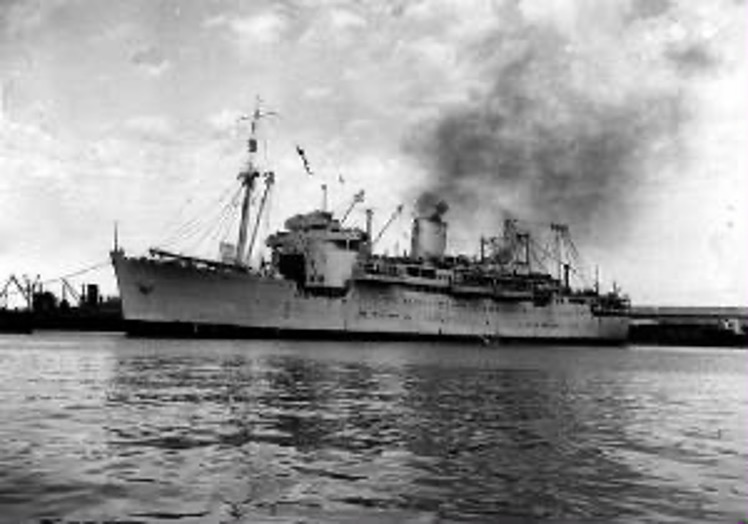
HMAS Kanimbla in Freemantle Harbour – 1945
HMAS Kanimbla’s Landing Ship Detachment Described – 1945
The Tweed Daily of 18 July 1945, page 3, reported:
‘Sapper Norm Wilson, of Tweed Heads, is a member of one of the most unusual units in the Australian Army — the Landing Ship Detachment. The detachment to which he belongs is aboard HMAS Kanimbla…….
With the conversion of the ship to a Landing Ship, Infantry, the Landing Ship Detachment came into existence. Its members are unique in that they rarely set foot on land and perform their duties wholly on the sea. What are these duties? Briefly, they are the tactical billeting of the troops who embark on the vessel; the training of these troops to shipboard life and to the drills and procedures of amphibious operations; the loading and unloading of the stores and equipment which must go with the assault formations. During the trip to the scene of operations, life is strenuous, the maintenance of gear, cleaning of portion of the ship and participation in emergency training all occupy time.
At the landing itself, however, things are really hectic. The troops must be dispatched from the ship speedily, and with split-second timing; the cargo must follow them after the briefest possible pause. All this is done under difficult conditions of perhaps an open roadstead and the ever-present possibility of enemy air or artillery attack. Since August 1943, the Kanimbla Landing Ship Detachment has been on the job.
Home leave in March gave the boys a chance to get acquainted with Australia again after their experiences in the more exotic places of the Southwest Pacific, and on the next mission they were associated with Australian troops for the first time in an assault landing. The troops they carried were the boys of the 9th Division; the objective was Brunei Bay, Borneo; and the manner in which the job was carried out is to be read in the accounts of that invasion.’
Congratulations to Australia’s L.C.I.’s – 1945
The Border Morning Mail of 3 August 1945, page 6, reported:
‘Australian LCI’s, Manoora, Westralia and Kanimbla have received a message of Congratulation from Vice Admiral D. Barbey, USN, Commander of the 7th Amphibious Force of the US 7th Fleet, with which they have worked throughout the drive from New Britain to the Philippines and Borneo. Praising the loyalty and efficiency of personnel. Vice Admiral Barbey said that their work has been a source of confidence and satisfaction to him The admiral offered his commendation to all hands on a job well done and expressed his pride of having these ships under his command.’
Returning Troops Welcomed in Brisbane – 1945
The Daily Examiner of 5 September 1945, page 1, reported:
‘A contingent of five-year servicemen arriving on the troopship Kanimbla, received a tumultuous welcome in the city streets today. All States were represented in the contingent, numbering 300. The troopship berthed amid the terrific din of ships’ sirens, factory whistles and the lusty cheers of thousands of onlookers.’
Troops Arrive from the Islands – 1946
The Barrier Miner of 6 February 1946, page 4, reported:
‘More than 4,500 troops from battle areas haye returned to Brisbane in three ships. The Kanimbla arrived at 7 a.m. Tuesday with 1,500 men from Celebes, Labuan, and Morotai. She was followed at 11 a.m. by the Duntroon with 1,500 from Rabaul and Lae; while at 3.30 p.m. the Georgetown Victory berthed with 1,500 men from Labuan. The Winchester Victory is expected to reach Brisbane on Friday with troops from Ambon and Morotai.’
Troops Return to Sydney – 1946
The Sydney Morning Herald of 18 March 1946, page 3, reported:
‘About 9,000 new tyres, many still in paper wrappings, had been burnt at Morotai recently, an officer who arrived in Sydney in H.M.A.S. Kanimbla yesterday alleged. A tremendous amount of equipment had been destroyed, he said. This included new trucks, generators, motors, and other machinery. Some of the trucks had been reconditioned before being pushed over a cliff.
Kanimbla brought 1,378 troops from Labuan and Morotai. The ship carried 128 convicted Japanese war criminals from Labuan to Morotai. Some of these had been concerned with the Sandakan death march.
HMAS Kanimbla Transports Volunteer Troops to Rabaul – 1946
The Sun of 23 March 1946, page 3, reported:
‘Many women wept openly when they farewelled the troopship Kanimbla at Pyrmont today. The Kanimbla, carrying about 1100 garrison troops, sailed for Rabaul at 1 pm.
The men are volunteers and troops of less than 126 points, who have not had service in the Darwin area or overseas. They are from all States. Friends and relatives were allowed on the wharf about an hour before the ship sailed, and streamers were well in evidence. Eastern Command Band played the ship out to the tune of “Wish Me Luck.”
Dutch Nationals Shipped from Australia on HMAS Kaminbla – 1946
The Newcastle Morning Herald and Miners’ Advocate of 20 July 1946, page 3, reported:
‘All Dutch nationals and servicemen and Dutch equipment was being removed from Australia, the Minister for the Navy (Mr. Makin) said. The Manoora had taken from Brisbane a large number of Dutch nationals and a quantity of equipment, he said. The remainder would be lifted in a second movement to be made soon. Only Dutchmen who were permanent residents of Australia would be allowed to remain.
Those being evacuated were Dutch servicemen who came here during hostilities and women and children escapees from Japanese occupation of Dutch territories. The movements were under the control of S.E.A.C. [South East Asia Command], Mr. Makin added.
An Australian Navy rating, with fixed bayonet, today guarded the gangway of the Australian auxiliary cruiser Kanimbla, as Dutch troops loaded the ship with Dutch military equipment and civilian cargo. White officers supervised the operations, as coloured troops loaded jeeps, mobile workshops, machinery and X-ray equipment belonging to the Dutch Army. Civilian cargo and a small quantity of flour was also taken on board. Kanimbla is scheduled to sail on Sunday for Timor and the Netherland East Indies with about 200 Dutch troops.’
The Newcastle Morning Herald and Miners’ Advocate of 22 July 1946, page 3, further reported:
‘More than 200 Dutch sailors, soldiers and airmen left Sydney today for the Netherlands East Indies on H.M.A.S. Kanimbla, a former passenger liner. Hundreds of Dutch servicemen loaded the ship last Friday afternoon. Elaborate precautions were taken to keep the departure a secret. It had been feared that, if it became known, waterfront unions might have hindered the ship’s departure.’
Troops Load Potatoes onto HMAS Kanimbla – 1946
The Sydney Morning Herald of 16 October 1946, page 5, reported:
‘Troops loaded potatoes on H.M.A.S. Kanimbla last night, when the vessel was delayed for four hours because of lack of labour. It sailed at 10 p.m. The potatoes were supplies for the Australian occupation forces in Japan.
Army trucks began to arrive at Pyrmont in the morning with crates of potatoes. Only one gang of wharf labourers was available to begin loading. At 3.30 p.m., when the quay was piled with crates, and a queue of lorries was waiting to be unloaded, heavy rain began. The waterside stopped work and, although the rain stopped when those on board had collected their gear and come ashore, they did not resume loading.
A party of soldiers took over, but their lack of experience delayed completion of the job for some hours. The Kanimbla was due to sail at 6 p.m. for Kure with 1,032 reinforcement troops, the largest contingent since the end of the war with Japan. Many are re-enlisted men. …..
Included among a group of special passengers are 15 former prisoners of war, who will give evidence of Japanese atrocities before the War Crimes Tribunal in Tokyo. They include Brigadier A. S. Blackburn, V.C., Lieutenant-Colonel A. E. Coates, who operated on men on the Burma railway with improvised instruments; Captain (Sister) Vivian Bullwinkel, sole survivor of the Banka massacre of women; and Pte. K. Botterill, one of the three survivors of the death march from Sandakan (Borneo).
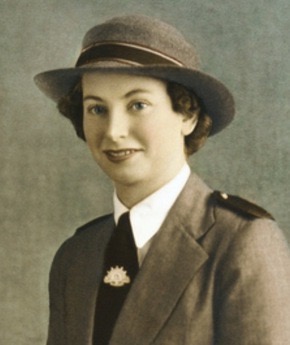
Vivian Bullwinkel, AO, MBE, ARRC, ED, FNM, FRCNA [Australian War Memorial]
A party of eight entertainers included the comedian, George Wallace. Relatives and friends were allowed on the quay, but many left before the ship sailed.’
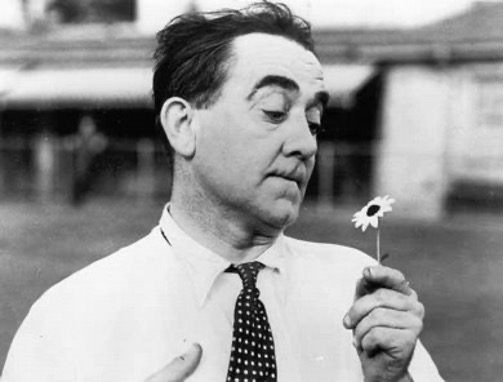
Comedian, George Wallace
HMAS Kanimbla Delayed by Steel Hawser – 1946
The Daily Mirror of 20 November 1946, page 21, reported:
‘A steel hawser [thick wire rope] twisted around the starboard propeller of H.M.A.S. Kanimbla prevented the ship from sailing late yesterday for Kure, Japan, with 881 reinforcements for the Australian Occupation Force. The hawser twisted around the propeller after the ship left No. 2 Woolloomooloo. Naval divers cleared the hawser from the propeller shortly before noon and the Kanimbla passed through the Heads at 12.56 p.m.’
HMAS Kanimbla Sails for Japan – 1947
The Tweed Daily of 6 January 1947, page 2, reported:
‘The troop-ship Kanimbla sailed for Japan yesterday with nearly 1,000 troops. Most are reinforcements. Others are returning to their units after leave. Also on the ship were two Japanese women, being repatriated from Australia, a Dutchwoman and her children, and 16 Australian civilians, including 12 women. The Australians are going to canteen service at Kure. Several thousand people farewelled the ship.’
Ship’s Company Host Dance – 1947
The Daily Telegraph of 26 March 1947, page 17, reported:
‘The ship’s company of H.M.A.S. Kanimbla will be hosts tomorrow night at a dance to farewell men who saw wartime service m the ship and to welcome new hands. Nursing sister Mavis Weight, A.A.N.S., who has a long war record, and who has made several trips in the Kanimbla, will entertain a party. Captain of the ship, Commander S. H. Crawford, will be present. Each member of the company has invited three friends. More than 400 dancers will be present.’
Union ‘Black Ban’ on HMAS Kanimbla – 1947
The Tribune of 1 April 1947, page 6, reported:
‘NSW Labor Council Disputes Committee has decided to impose a black ban on all engineering work at Garden Island naval workshops. The committee has also put a ban on work on the ship Kanimbla, which is being repaired at Garden Island. The assistant secretary, Mr. J. D. Kenny, reported this to the last meeting of the Labor Council. Two hundred and fifty members of the Amalgamated Engineering Union employed at the workshop are on strike in support of a demand for lifting of penalties imposed because they took part in a stop work meeting last October. Workers at Cockatoo Dock last week refused to allow overhaul of the Kanimbla’s propellers when she was brought to Cockatoo from Garden Island.’
Protest Over Ship’s Quarters – 1947
The Daily Mirror of 19 April 1947, page 2, reported:
‘Troops and members of two Concert parties who sailed today in H.M.A.S. Kanimbla for Japan, complained about their quarters. At one stage women members of a concert party threatened to walk off the ship. They refrained from doing so when a promise was given that mattresses and curtains in their cabins, would be replaced. Mr. Morrie Rooklyn, who is taking a concert party of eight, said later that the officer commanding the troops (Lieut.-Col. P. M. Shanahan) had promised to replace all mattresses and curtains when the ship left the wharf.
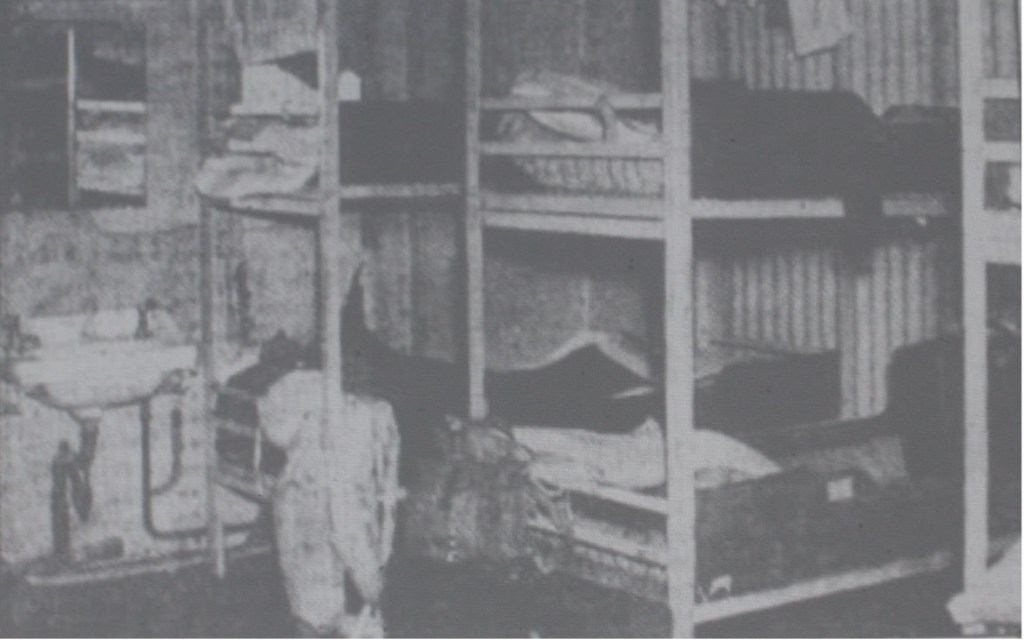
Cabin on HMAS Kanimbla which drew criticism from members of a female concert party [The Sun, 20 April 1947]
Troops complained that because of the shortage of water no clothes could be washed until the ship reached Finschhafen in five or six days. They had been informed that leave would then be granted to permit washing to be done. The Kanimbla is taking 750 R.A.A.F. and Army personnel, 29 A.M.W.A.S., 3 Y.W.C.A. representatives and two concert parties. Half the troops, and airmen are returning from leave in Australia, and the remainder are making their first trip.
Only a sprinkling of relatives, who were not allowed on the wharf, waited at barricades to farewell the troops as they arrived in special buses. Miss A. S. Burchmore, who is in charge of the Y.W.C.A. representatives, said they were going to Japan to establish recreational huts. Eight other women representatives would follow later, she said. Mr. Morrie Rooklyn, known as the ‘Amazing Mr. Rooklyn,’ has a concert party of eight, and Mr. Ike Beck has 10 in his company. They will each tour all areas where Australian troops are stationed and expect to be away from three to six months.’
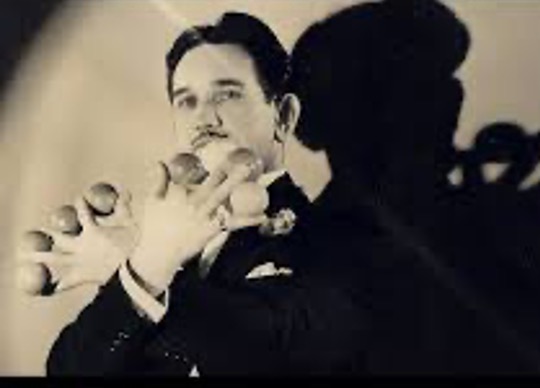
Morrie Rooklyn known as ‘Amazing Mr. Rooklyn’
The Sydney Morning Herald of 21 April 1947, page 3, further reported:
‘After the troopship Kanimbla had left Woolloomooloo at noon on Saturday, with 843 servicemen tor Japan, many people arrived at the wharf, believing that the ship would not leave until the officially announced time of 3 p.m. Although only about 200 people were on No. 4 wharf when the vessel sailed, an estimated number of 1,500 arrived between noon and 3 p.m. Some women in the crowd wept on learning of the departure. As the Kanimbla was in the stream for more than two hours, many tried to hire launches to go alongside the ship, but few succeeded.
An Army spokesman said that the only time schedule which concerned the military authorities was that of embarkation, 10.30 a.m. Most men on board were from other States. Of the 450 Army personnel aboard, about 200 are returning to units and the rest are volunteers or reenlisted men. Two entertainment units, including Tivoli Theatre artists, and 14 A.A.M.W.S. also left on the ship.’
Troops Return from Japan – 1947
The Newcastle Sun of 24 May 1947, page 3, reported:
‘At dawn today the trooper Kanimbla entered Sydney Heads with more than 840 Australian soldiers who have spent 15 months in Japan. Many have not been home for three years. At Walsh Bay wharf hundreds of relatives waited outside the gates while the men underwent Customs formalities. Since dawn the men had been lining the ship’s rail seeking a first glimpse of the city through the dawn. Behind them were pries of kitbags decorated with Japanese idols and the inevitable Samurai swords. Many of the men, through their service in Japan, spoke with a smattering of Japanese. Most are due for discharge.
The position of troops in Kure was worse than when they originally landed, said some of the men. One soldier said: ‘When the Australian wives land there they will die. ‘The way the houses are laid out shows there is going to be plenty of distinction between officers, N.C.O.’s and other ranks.’ Dozens more soldiers chorused approval of these remarks, but none of the men would give their names for publication. However. Colonel Ian Hunter of B.C.O.F. Headquarters, who was aboard, returning to Australia for reposting, belittled these remarks.’
Customs Officers Search HMAS Kanimbla for Pearls and Other Goods – 1947
The Truth of 25 May 1947, page 34, reported:
‘Customs officers combed the Kanimbla for contraband when the ship arrived in Sydney yesterday from Japan. Soon after the Kanimbla berthed, officers began their search of the ship, looking for pearls. While the search was on a group of Australian soldiers approached a Press photographer and asked him to take some pearls ashore. When the photographer refused a soldier told him: “You can easily take them ashore. I’ll give you a string if you do the job.” The photographer again refused, and the soldiers then left the ship.
A Customs officer said later that no pearls had been found in the Kanimbla. There were 911 men who were not searched by the Customs, he said. “There was little we could do about it. By 1 p.m. most of the troops were ready to go on leave from Marrickville L.T.D.,” he said.
Because of a mistake in a tele-gram more than 50 Customs officers waiting at 8 Walsh Bay thought they had to inspect the gear of 800 troops. A telegram was sent from the ship to Army authorities stating that 43 servicemen had declared goods. The distorted telegram said that more than 800 men had declared foods. Each man’s gear, was thoroughly examined by Army officers before the Kanimbla reached port, and 43 men were asked to make declarations.’
Customs officers routinely searched all ships returning troops from overseas countries.
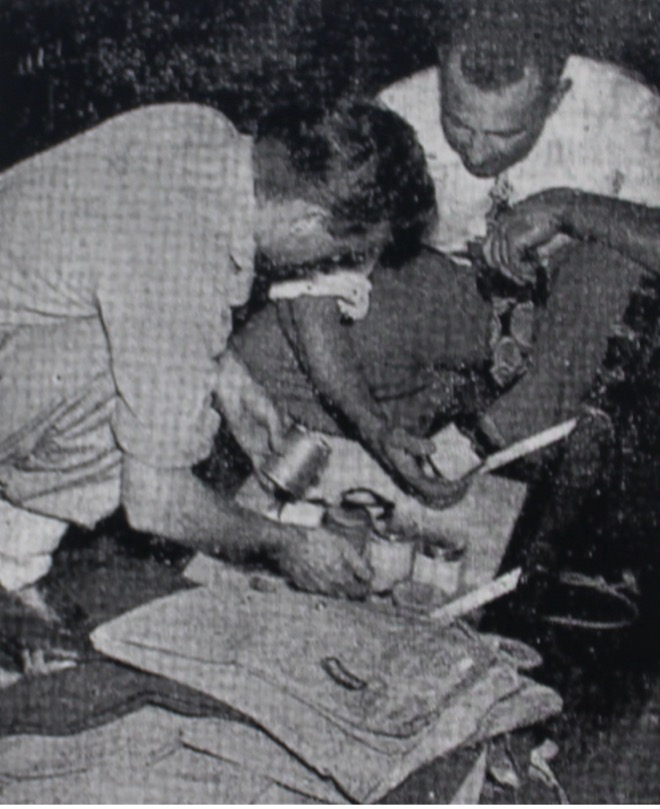
A soldier’s bag being checked by a Customs officer after the Kanimbla arrived back in Sydney from Japan and Rabaul [Wellington times, 24 February 1947]
Troops Leave for Japan on HMAS Kanimbla – 1947
The Newcastle Morning Herald and Miners’ Advocate of 2 June 1947, page 1, reported:
‘The Kanimbla left Sydney this morning for Japan. On board were 250 troops and several nursing sisters and members of the A.M.W.A.S. The ship also has mails and supplies for the occupation forces. Port Moresby will be the first port of call. All personnel were embarked on Friday. Friends and relatives were allowed on the wharf about 20 minutes before the ship sailed.’
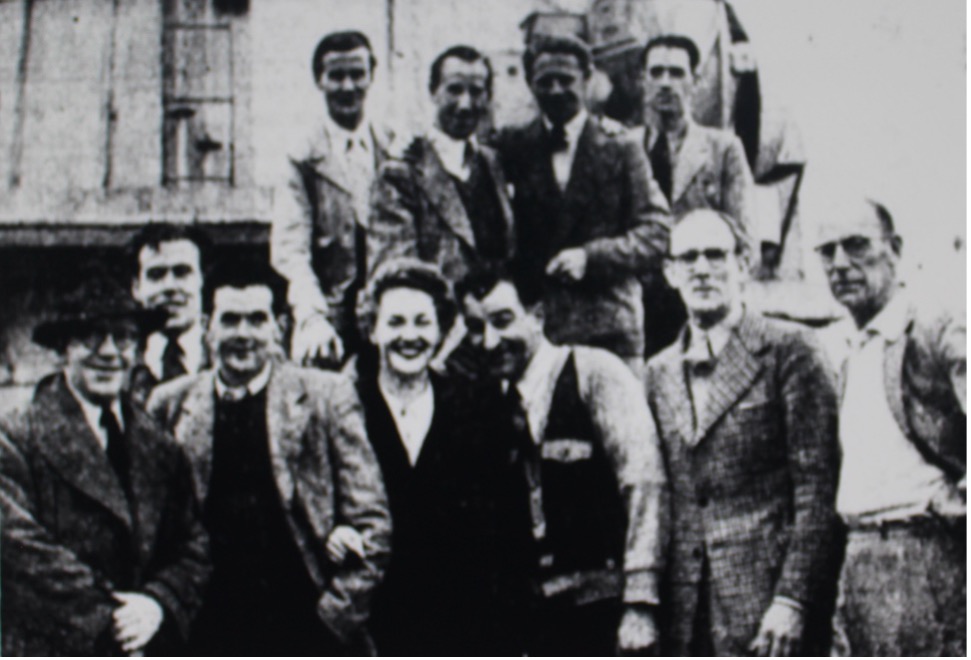
Army Amenities entertainment unit on board the Kanimbla to entertain troops in Japan [Daily Advertiser [3 June 1947]
Troops Return from Japan on HMAS Kanimbla – 1947
The Daily Telegraph of 5 July 1947, page 10, reported:
‘Nearly 1000 troops, more than half of whom are for discharge, will arrive from Japan in the troopship Kanimbla this morning. Kanimbla is due to berth at No. 1 Circular Quay at 8 a.m. Troops include 409 men for New South Wales, 266 for Victoria, 136 for Queensland, 79 for Western Australia, 72 for South Australia, and 29 for Tasmania. Interstate troops will leave for their home States by train later today. Kanimbla is also carrying 198 members of the R.A.A.F. for leave or discharge. Customs officers have completed arrangements for a search of the ship. They are said to have been advised that Kanimbla is carrying a quantity of valuable contraband cargo.’
Federal Minister Leaves Sydney for Japan on HMAS Kanimbla – 1947
The Daily Mirror of 11 July 1947, page 11, reported:
‘Travelling in minimum comfort, the Attorney-General and Minister for External Affairs (Dr. Evatt) left in H.M.A.S. Kanimbla today for Japan. Mr. Evatt accepted a longstanding invitation from General MacArthur to go to Japan. Before, the Kanimbla sailed from Circular Quay, Dr. Evatt declined to make any statement or to say what he would discuss with General MacArthur. “I shall have something to say when I return on August 13,” he said. Kanimbla is still an infantry landing ship, and from the point of view of civilian travellers is an austerity vessel. ….. Kanimbla is taking to Japan more than 400 Armed Force personnel, including 350 A.M.F. Also in the ship are nine Army Nurses returning from leave and a concert party, which will tour B.C.O.F. [British Commonwealth Occupation Forces] areas.’
Conditions on Board HMAS Kanimbla Criticised – 1947
The Sydney Morning Herald of 22 August 1947, page 4, reported:
‘Accommodation in H.M.A.S. Kanimbla for businessmen who are to visit Japan was described by one of them yesterday as “an insult to businessmen.” Twenty-two businessmen — 11 from Melbourne and 11 from Sydney—are to visit Japan to resume private trade between Australia and Japan.
The secretary of the Australian Exporters’ Federation, Mr. A. J. R. Birch, said they would be accommodated in dormitories, each with a cement floor, with 14 beds and no washing or other facilities. These dormitories were used by military officers during and since the war. The Kanimbla will also take from Sydney 821 troops for the Army of Occupation in Japan and pick up other troops in Auckland. The ship will sail from No. 4 Circular Quay at 4.15 p.m. tomorrow.’
Streamers Ablaze at HMAS Kanimbla’s Side – 1947
The Sydney Morning Herald of 17 October 1947, page 4, reported:
‘A crowd of about 1,000 yesterday farewelled the Kanimbla when she sailed with ‘ Service personnel for Japan, including 50 officers, 600 troops, 150 naval men, 26 Y.W.C.A. workers, and 12 Air Force personnel.
During the farewell scene streamers, believed to have been ignited by a lighted cigarette, burst into flames on the wharf at 9 Walsh Bay. The fire, which was fanned by a brisk breeze, was extinguished by the crowd on the wharf.’
Troops Protest on HMAS Kanimbla – 1947
The Barrier Daily Truth of 26 August 1947, page 3, reported:
‘Troops on the Kanimbla and screaming, hysterical women behind barriers keeping them from Circular Quay wharf yesterday counted out Lieut.-General Sturdee, Chief of the Australian General-Staff, shortly before the vessel sailed.
A crowd of more than 3,000 had been kept behind the barrier in driving rain so that the wharf could be kept clear for the arrival of Lieut.-General Sturdee. As the general stepped from the car, police and Army guards could not hold back the throng. Women hurled abuse at the general, who was counted out by troops lining the ship’s rails. Several women fainted in the crush. Others slipped on greasy planking, but no one was seriously injured. A police officer said the crowd was the most bad-tempered he had ever experienced.’
Troops Return on HMAS Kanimbla – 1947
The Sydney Morning Herald of 19 November 1947, page 14, reported:
‘A crowd of about 2,000 was allowed on to No. 5 wharf, Circular Quay, yesterday afternoon, to greet Australian troops arriving on the H.M.A.S. Kanimbla. People massed outside the wharf gate when the ship berthed, and streamed through to the wharf when the gate was suddenly opened. Of the troops on board, 822 were from Kure and 70 from Rabaul. Most of the men had been away for about one year.’
Deportees Leave Sydney on HMAS Kanimbla – 1947
The Sun of 22 November 1947, page 3, reported:
‘An Italian woman who married an Italian POW two days ago, wept today as she farewelled her mother before sailing on HMAS Kanimbla with her husband, who is being repatriated. She met him at the wharf when he arrived in a wired-in truck. An official said that the POW was one who had escaped and was caught again a few days ago. While free, he became friendly with the girl. Two days ago, the official said, police allowed “the two to be married in a police cell.
A German deportee, described as a psychopathic, was brought to the ship from Long Bay. An official said he would be under restraint during the trip.’
The Sun of 23 November 1947, page 3, also reported:
‘A member of the crew of the Kanimbla was married 90 minutes before the ship left Sydney at 3.30 pm yesterday. He is AB [Able Bodied] Angus McDonald, 19, of Melbourne. He and his bride, who was formerly Joyce Bradbury, of Auburn, rushed on to the wharf after the ship had cast off. He missed the ship getting married at St. Thomas’ Church, Auburn. Instead of taking place at 12.30, the wedding was delayed till 2 pm — “signing papers,” Mrs. McDonald said. He and his best man, Roy Waters, of Queensland, jumped 15 feet down into a barge, and sped after the ship. “See you in Melbourne;” he yelled to Joyce. Joyce said they decided to get married on Thursday when he returned to Sydney from Japan. With dripping hair, white carnations on her black coat lapel, Joyce watched her husband go out of sight.’
HMAS Kanimbla Transports Deportees – 1947
The Newcastle Morning Herald and Miners’ Advocate of 24 November 1947, page 3, reported:
‘A contingent of deportees would be transhipped from H.M.A.S. Kanimbla to the U.S. ship General Heintzelman, at Fremantle, said the Minister for Immigration (Mr. Calwell). Mr. Calwell said the Kanimbla would leave Melbourne early next week with the deportees, who are being returned to their European homelands. The General Heintzelman was bringing to Australia 843 European displaced persons-all Balts. At Fremantle the ships would exchange the passengers. The General Heintzelman would take deportees back to Europe and the Kanimbla would take on the migrants and bring them to Melbourne, he added.
From Melbourne the migrants would be taken to the Bonegilla staging camp, where they would be instructed in simple English by a staff of 20 teachers. They would also be taught reading, writing, civics, hygiene, sanitation, also weights, measures and money. Mr. Calwell said the average age of the Balts was 24. All were unmarried. There were 729 men and 114 women. After training they would go to jobs awaiting them in various States. “In most cases the men will be employed in country areas on rural constructional and maintenance work for which Australian labour is not available, said Mr. Calwell.’
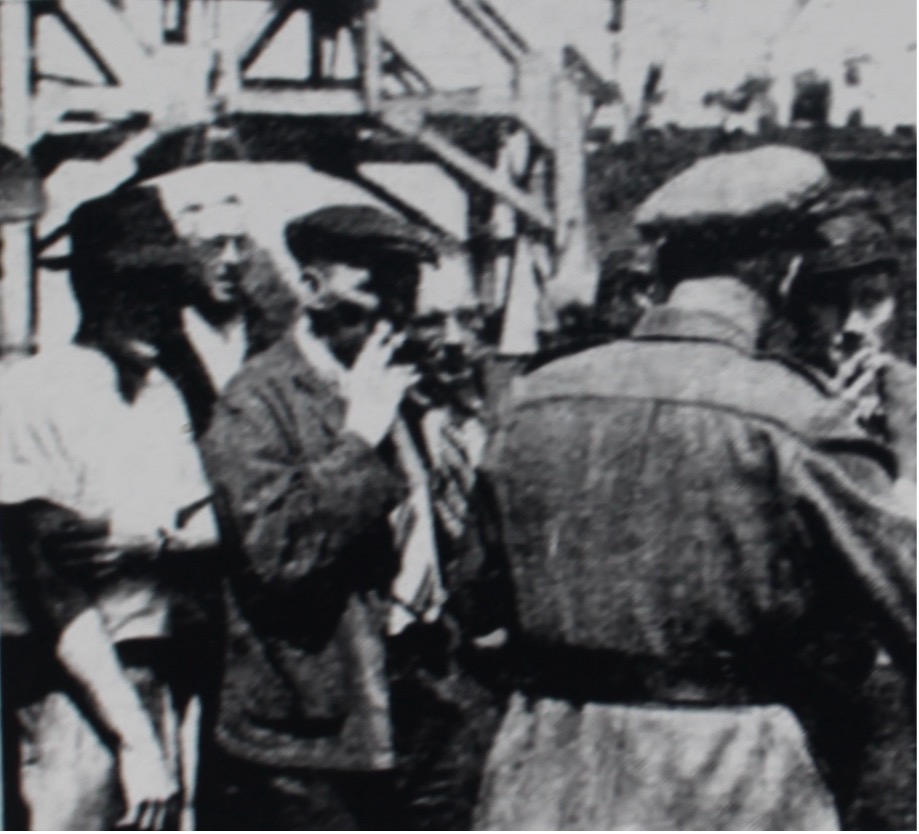
Accompanied by Australian escorts (in uniform) deportees leave HMAS Kanimbla at Freemantle for work on the wharf [Mirror (Perth), 29 November 1947]
The Daily Mirror of 24 November 1947, page 1, further reported:
‘Six demented Italian prisoners of war tried, to overpower their guard and escape while being escorted aboard H.M.A.S. Kanimbla at Port Melbourne today to be deported to Italy. More than 400 German deportees and Italian prisoners of war were embarked this afternoon. The Italians tried to escape as they were being led up the gangway by two armed military officers. The Italians said the prisoners of war intended to attack the crew of the U.S. ship General Heintzelman to which they would be transferred at Fremantle. Waving his arms, the Italian yelled: “When we reach Italy we will see our comrades, and together we fight the crew of the ship before it leaves Naples. Australians and Americans are no good.”
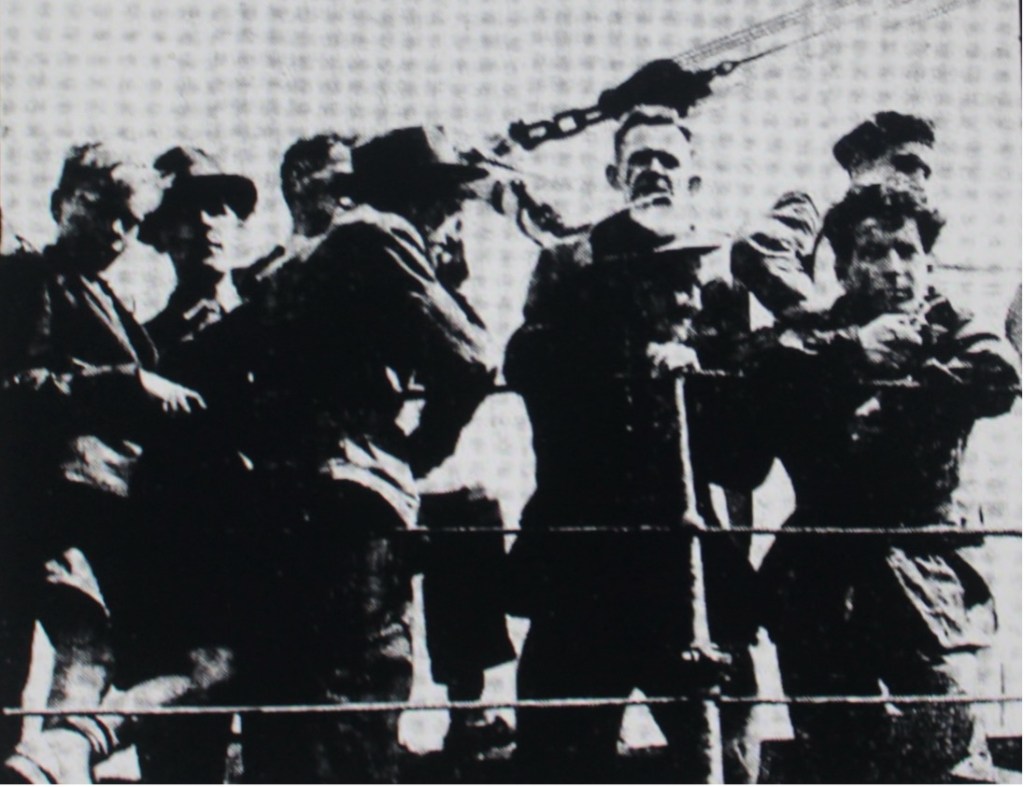
German and Italian deportees line the HMAS Kanimbla’s rail while awaiting transfer to the ship that would take them from Australia [The Daily News (Perth), 29 November 1947]
Ugly Scenes on Wharf as HMAS Kanimbla Sails – 1948
The Daily Examiner of 19 February 1948, page 1, reported:
‘There was an ugly scene at the Woolloomooloo wharf today when the H.M.A.S. Kanimbla sailed for Kure with over 500 troops on board. Hundreds of troops shouted abuse at two provosts who were hustling a soldier along the wharf to a military truck. Ten minutes later they released him and escorted him on board. In a struggle, the soldier’s shirt was torn and as he was being taken along the wharf he tried to kick newsreel and newspaper photographers.
Provosts said the man had no right to be on the wharf at the time. He should have been on the ship. A girl who recently arrived from Tasmania, said she had married the soldier three days ago and he had received permission to remain on the wharf with her until the ship sailed.’
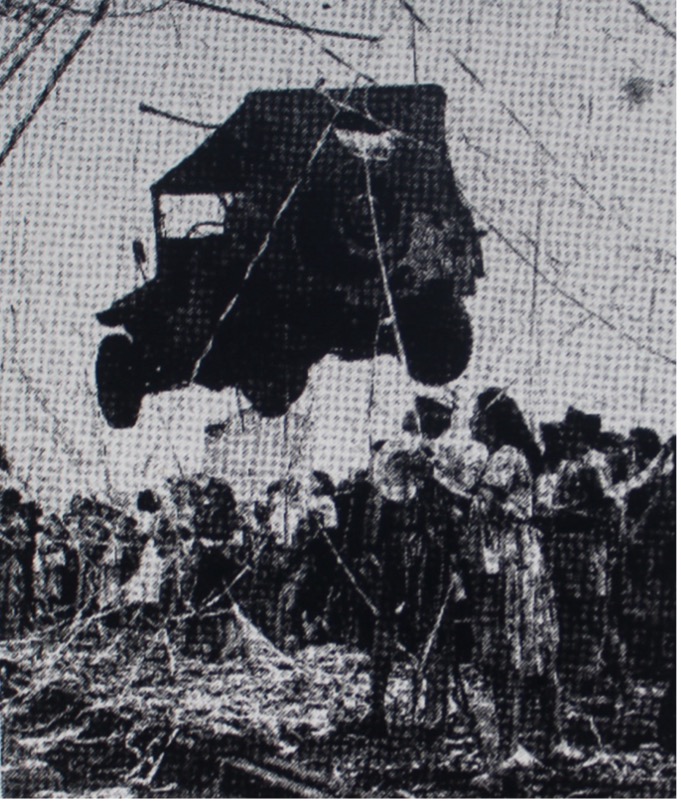
A jeep being lifted through masses of streamers on to the troopship HMAS Kanimbla shortly before the ship left Woolloomooloo [Daily Telegraph, 19 February 1948]
HMAS Kanimbla Brings Bulldozers from Japan – 1948
The Tweed Daily of 10 May 1948, page 5, reported:
‘H.M.A.S. Kanimbla berthed inside the Captain Cook graving dock when she arrived from Japan with troops to discharge 45 bulldozers, each weighing 20 tons. The bulldozers were part of surplus American equipment bought in Japan by the Commonwealth Government. The bulldozers, are packed so tight in the ship and are so cumbersome that it is expected that wharf laborers will take 10 days to land them, even assisted by the dock’s heavy cranes. Probably about the end of June the Kanimbla will sail to Britain with 600 RAN personnel, who will take over the aircraft carriers Sydney and Melbourne. Rush work will be done at the dock to make the ship more comfortable for the carriage of British immigrants on the return passage to Australia. Maximum number of immigrants the vessel can carry will be 900.’
Gift of Foodstuffs for Two English Cities – 1948
The Daily Mirror of 27 May 1948, page 3, reported:
‘The H.M.A.S. Kanimbla sails from Sydney to England next month, with officers and ratings for the new Australian aircraft carrier, it will carry a substantial gift of foodstuffs for the people of Plymouth and Devonport. The cost has been met by individual subscriptions from officers and men of the R.A.N. and from canteen and other funds. The gifts are in recognition of the long, association between the two cities, and ships of the Australian Navy.’
Navy Personnel Sail to England on HMAS Kanimbla – 1948
The Daily Mirror of 23 June 1948, page 3, reported:
‘The 500 officers and men of the R.A.N, who will form part of the company of H.M.A.S. Sydney, Australia s first aircraft-carrier, left for England in H.M.A.S. Kanimbla today. Several thousand people were at Station Pier, Port Melbourne, to see the ship leave. Opportunity was taken of the ship’s departure to send several internees back to Europe. One was taken on board handcuffed to his guard.’
The Barrier Miner of 30 July 1948, page 3, further reported:
‘The Admiralty announced yesterday that more than 900 RAN officers and men would arrive at Devonport [Plymouth, England] on Friday in the infantry landing-ship Kanimbla. They would include 635 officers and men who would be engaged in naval aviation duties in the United Kingdom.
About 450 of them would help man the light fleet carrier H.M.S. Terrible, which, it was expected, would commission as H.M.A.S. Sydney in November, as the first of the two carriers to be acquired by the Royal Australian Navy.’
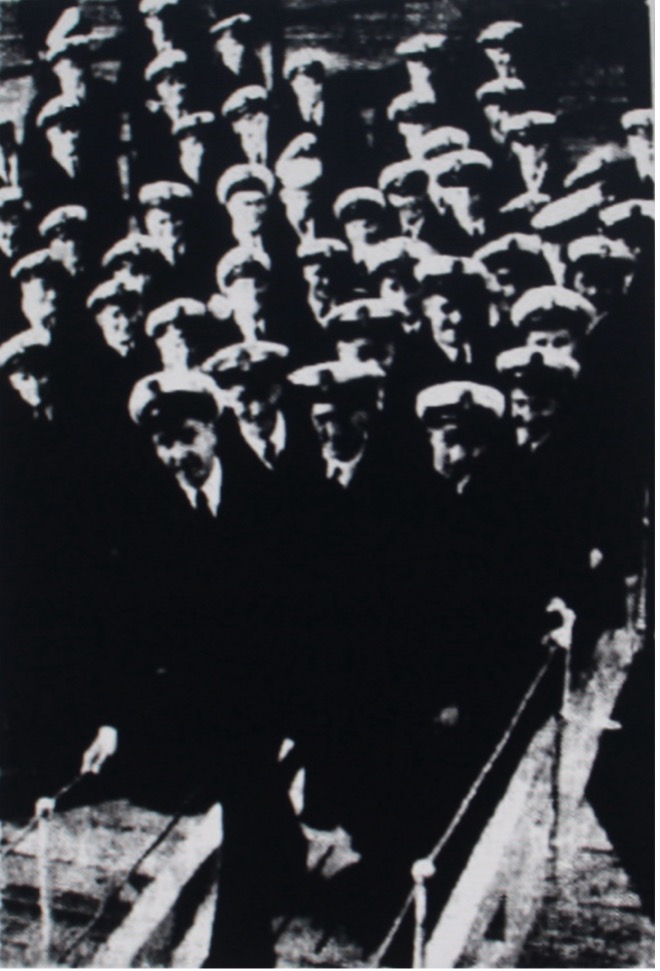
Victorian Petty Officers boarding the Kanimbla at Port Melbourne for travel to England [The Herald (Melbourne), 21 June 1948]
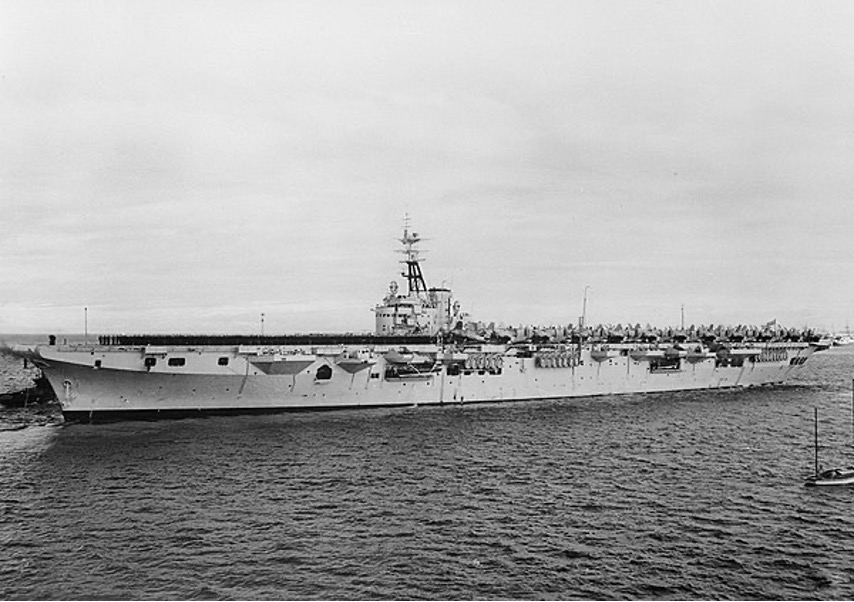
HMAS Sydney arriving in Port Melbourne – 1948
Italian Police Arrest Men from HMAS Kanimbla- 1948
The Daily Telegraph of 18 September 1948, page 1, reported:
‘Italian police detained three officers and 100 ratings from H.M.A.S. Kanimbla after a fight last night between ratings and Italian civilians at Genoa. The fight developed soon after Kanimbla arrived at Genoa yesterday on her way back to Australia from England. Three ratings from Kanimbla got into a dispute with Italian civilians, says Reuter’s Genoa correspondent. The Italians accused the ratings of being drunk and of having molested an old beggar woman. The ratings and civilians began to fight with fists, sticks, and bottles. More civilians joined in and hundreds of ratings poured ashore from Kanimbla to help their comrades.
The fight developed into a riot, which continued until 2 a.m. Kanimbla’s commander and officers assisted Italian police, Customs guards, and carabinieri in an attempt to stop the fighting. The Italians fired warning shots over the heads of the crowd. Later one officer and 20 ratings were treated on board Kanimbla for injuries. One rating was shot in the stomach and is critically ill. The ratings are reported to have disarmed one Italian policeman and one carabinieri and held them on board Kanimbla.
After order was restored Kanimbla officers confined the sailors on board the ship. Kanimbla (10,985 tons) arrived in Plymouth at the end of July with 700 R.A.N. personnel to man the carriers Sydney and Melbourne. Australian officials in London said in May that on its return voyage Kanimbla might carry displaced persons from Germany. Expansion plans for the R.A.N., involving enlistment of ex-R.N. personnel, caused a change in this proposal. The ship took on board 100 Royal Navy supernumerary officers and 350 former Royal Navy ratings.’
The Daily Mirror of 21 September 1948, page 2, further reported:
“Certain signals” which he had received from the captain of H.M.A.S. Kanimbla had indicated that Press reports concerning a disturbance in which several ratings from the ship were involved in Genoa last Thursday were exaggerated. The Minister for the Navy (Mr. Riordan) said this in the House of Representatives today in answer to Mr. Ryan (Lib., Vic.). Mr. Riordan said that a report, which was being forwarded from the vessel, would be made available to the House as soon as it was received. The advice to hand at present indicated that one rating had been killed and four others injured when the ship called at Genoa to embark German migrants for Australia. He said that when the vessel reached Australia the Navy Board would hold an inquiry. [The Kanimbla was carrying as passengers a number of former Royal Navy ratings who have joined the Australian Navy.]’
HMAS Kanimbla To Return to Civilian Service – 1948
The Sydney Morning Herald of 20 December 1948, page 2, reported:
‘Tomorrow H.M.A.S. Kanimbla will arrive in Sydney from Japan, completing her last voyage in the naval service that she begun within a few days of the outbreak of war in September 1939.
After Christmas she will undergo the traditional naval process of paying off, a long while pennant flying from her mainmast Then she will be refitted for civilian service. Her ships company proudly record that since the outbreak of war she has steamed more than 470,000 miles a distance equal to a return trip to the moon.
Before the war the Kanimbla followed the sun as a tourist ship between Cairns and Fremantle. The Royal Navy took her over and armed her as a merchant cruiser. Her motto as a warship was ‘Cry Havoc’. …..
In April 1943, Kanimbla was paid off as an armed merchant cruiser and converted for use as an assault landing ship infantry. As H.M.A.S. Kanimbla she led a charmed life in the danger spots of the Pacific, transporting troops and equipment and taking part in the landings at Tanamerah, Morotai. Lcyte Gulf, Lingayen Gulf, Brunei Bay, and Balikpapan. …… The Navy and the Merchant Navy alike are proud of her record of service.’
HMAS Kanimbla Brings Troops Home – 1948
The Daily Mirror of 21 December 1948, page 2, reported:
‘Hundreds of troops who returned from Japan on the Kanimbla this morning loudly booed and shouted at Army provosts who removed three women and a small boy from the wharf at Circular Quay. The women and the boy had climbed an iron picket fence surrounding the wharf to welcome soldier relatives who were on the ship. A crowd of more than 500 was waiting outside the wharf to welcome the 1146 servicemen in the Kanimbla. Of the servicemen aboard the ship 918 were Army and 220 members of the R.A.A.F. Nearly 60 per cent, of the Army men returned for discharge, but only 8 per cent, of the R.A.A.F. men are leaving the service.’
HMAS Kanimbla enters Dry Dock for Refitting as a Merchant Vessel – 1949
The Daily Mirror of 1 March 1949, page 3, reported:
‘The Captain Cook Dock accommodated its first merchant ship last Friday when the Kanimbla was docked for cleaning and scraping. After leaving the Captain Cook Dock, the Kanimbla will go to Cockatoo Dockyards to be completely refitted as a merchant vessel.’
British Government Plans to Charter HMAS Kanimbla as a Troop Ship – 1949
The Daily Mirror of 17 August 1949, page 12, reported:
‘Sydney shipping authorities today denied a morning newspaper report that the Westralia was being ‘secretly’ refitted as a troopship for the British Government. They said it had been publicly announced that the vessel was to be retained as a trooper on the Eastern run, first by the British Government and then by the Minister for the Navy (Mr. Riordan). It was said that the British Government tried to charter the well-known Australian liner, Kanimbla, but her owners were anxious to reconvert her from an assault ship to a passenger vessel. The Westralia then became the subject of these negotiations and the Navy decided to retain her as a troopship for eventual use by the British Government.’
PART FIVE – KANIMBLA RECOMMENCES INTERSTATE PASSENGER CRUISING
Kanimbla Becomes a Cruise Liner Again – 1950
The Daily Mirror of 13 December 1950, page 2, reported:
‘Eleven years ago today, H.M.A.S. Kanimbla sailed from Sydney Harbour for an action-packed naval career as a landing ship (infantry) and troop ship. Today, the Kanimbla loses the H.M.AS., and reverts to M.V. (motor vessel), to become the most modern passenger liner on the Australian coast. The Navy, represented by Rear-Admiral H. E. Showers, is handing her back to the owners, McIlwraith, McEacharn. Sea trials for the Kanimbla were completed yesterday, following 19 months of reconversion at Cockatoo Dock.’
Transformation of the Kanimbla Back to a Cruise Liner – 1950
The Sun of 13 December 1950, page 27, reported:
‘Twelve months hard work by successful Sydney decorator Margaret Lord, working in conjunction with architects and the Cockatoo Island workshops, has transformed the interior of the motor vessel Kanimbla from a troopship to a luxury holiday ship.
When the Kanimbla, which was officially handed back from the RAN to the owners, Mcllwraith, McEacharn, at noon today, made her sea trials yesterday, Miss Lord was one of the passengers. Reconversion of the ship began in April, 1949, and Miss Lord first went aboard a year ago, when the hull was being chipped completely internally and sandblasted. The whole of the teak decking had been lifted, and Miss Lord and the architects had to climb under and over ladders and past blowlamps to make their first investigation. “We were fortunate in having the complete plans for the pre-war Kanimbla, which we were able to consult when we brought the furniture out of store,” she said.
Furnishings from UK “Hide-covered chairs were able to be used after cleaning, but all the carpets except one was moth-eaten, and we had to plan new floor coverings.” All soft furnishings are entirely new and have been imported from the United Kingdom. “After collecting samples of fabrics and getting quotes, we imported the huge quantities we needed from overseas,” she said. Two lots of slipcovers have been made for every chair and settee, but matching curtains are in single sets.
Because of the pipes and beams which necessarily break the ceiling line in cabins, Miss Lord has avoided having stark white ceilings. She has chosen, instead, a paler version of the wall colours which will not attract attention to the irregularity. The attractive first-class lounge and music-room has painted walls in satin-finished sienna pink and is floored in beige rubber tiles. Above the original marble fireplace, now restored, is Will Ashton’s painting of the Kanimbla Valley. Curtains are green and biege floral print linen, and the loose covers are in pink damask, plain burgundy cottons and striped Italian damask.
Miss Lord will be a passenger to Melbourne when the Kanimbla sails next Wednesday. She will do the full coastal journey to Fremantle and back in March. “Completion of the Kanimbla decor makes the third ship Miss Lord has decorated. Her other jobs were the Monowai and the Manoora.’
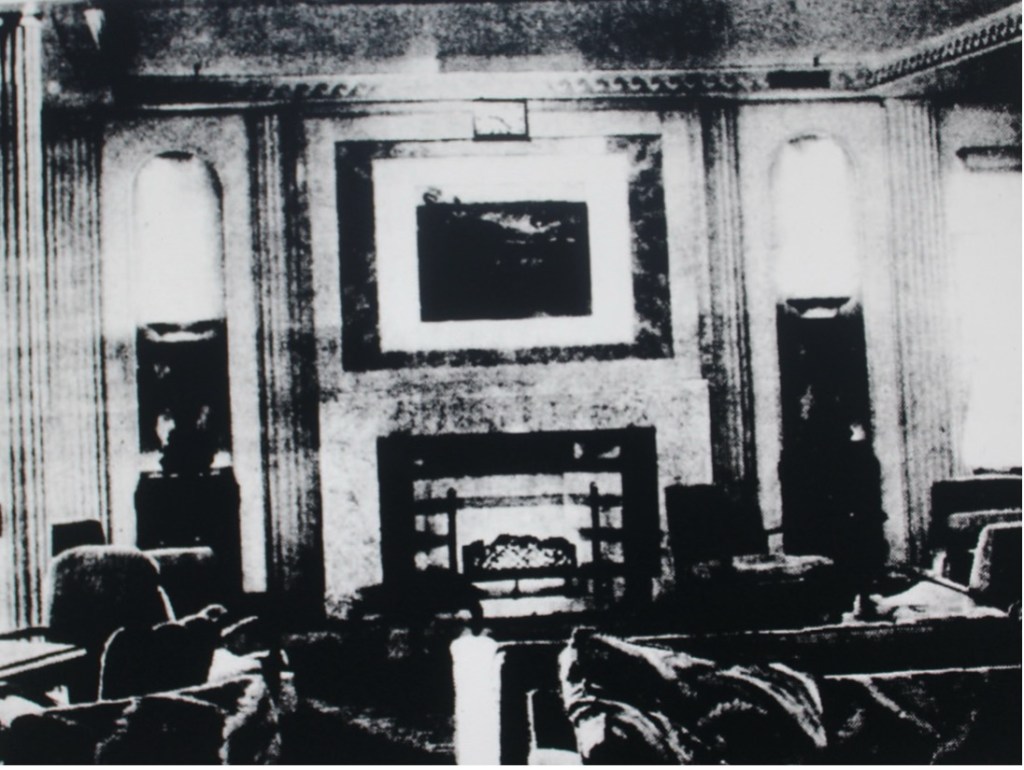
Original lounge with the Will Ashton painting over the fireplace, prior to the post war restoration in 1950 [The Advertiser (Adelaide), 17 June 1936]
Plaque Unveiled on the Kanimbla – 1950
The Sydney Morning Herald of 14 December 1950, page 8, reported:
‘A plaque commemorating the war service of the interstate liner Kanimbla was unveiled yesterday during the ceremony in which the ship was handed back to its owners, McIlwraith McEacharn Ltd.’
Kanimbla Disabled by Heavy Seas – 1952
The Daily Telegraph of 15 June 1952, page 1, reported:
‘With 307 passengers on board and eight feet of water in one hold, the interstate liner Kanimbla (11,000 tons) was crawling through mountainous seas towards Brisbane last night. Thirty-foot waves battered the crippled ship as she limped along behind two tugs.
Her steering gear was out of action, and her bottom holed. Kanimbla pitched and rolled heavily as the big seas struck her, making most of the passengers violently seasick. Below decks, her crew worked the pumps continuously to keep the water in the hold at eight feet. The ship’s master (Captain O. K. Snowball) emphasised that neither the passengers nor the ship were in danger. He said he expected Kanimbla to reach Brisbane this morning.
The ship, on a tourist cruise to Townsville and Cairns, struck the bottom while negotiating the tricky 54-mile passage through Moreton Bay at 7.20 yesterday morning. The impact damaged the rudder, threw the propeller shaft out of alignment, and holed the hull. Water started to pour into the ship, and was soon eight feet deep in No. 2 cargo hold.
Captain Snowball dropped anchor immediately and started the pumps. He refused an offer of aid by the whale chaser; Kos, when he saw the ship was not in danger. Kanimbla’s agents, MacDonald Hamilton and Co., sent the tugs Carlock and Coringa from Brisbane to tow Kanimbla back to port. The tugs got several 411-inch steel hawsers aboard her at dusk, then began the 45-mile tow back to Brisbane. By that time the crew had repaired the damaged propeller shaft, but the steering gear was still out of action.
A reporter who went out to the ship in the Caloundra surf boat said that only a handful of passengers were on deck. They told him the others were sick in their bunks. One passenger said the impact when the ship struck the bottom hurled many people to their cabin floors. The reporter added that Kanimbla was pitching heavily in 30-foot waves, which several times threatened to swamp, the surfboat.’
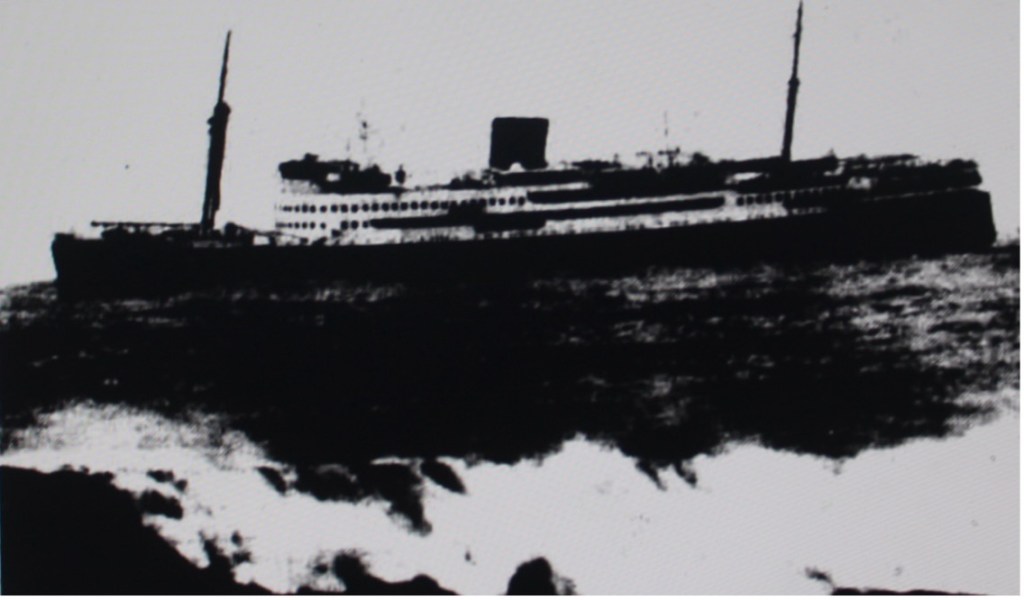
Disabled Kanimbla lying off Caloundra Beach, Queensland [The Sunday Herald, 15 June 1952]
Water-logged cargo being unloaded from the damaged Kanimbla [The Courier Mail, 20 June 1952]
Inquiry into the Grounding of the Kanimbla – 1952
The Daily Commercial News and Shipping List of 25 June 1952, page 1, reported:
‘Tourist officials in Brisbane said that the mishap to the Kanimbla would cost Queensland more than £20,000 in holiday spending. The ship’s agents, Macdonald Hamilton and Co., announced that repairs would take about three months and that her cruises to North Queensland this season would be cancelled. A preliminary inquiry into the grounding of the Kanimbla was opened in Brisbane on June 17 by the Deputy Navigation Director (Captain A. Moore). Captain Moore had heard evidence from the master of the Kanimbla (Captain Snowball) and Chief officer Roberts and from two engineers on duty at the time of the grounding and the helmsman.
After the inquiry Captain Moore will report to the Director of Navigation, Melbourne, who will decide whether further action is warranted. The Kanimbla grounded on a sandbank off Caloundra early on June 14. The Kanimbla entered Cairn-cross Dock on Sunday for minor repairs and later last week moved to a general-purpose wharf to discharge 1,400 tons of cargo. The Kanimbla will return to Cairn-cross for permanent repairs.’
The Barrier Daily Truth of 19 July 1952, page 4, further reported:
‘Captain of the interstate liner Kanimbla, Captain O. K. Snowball, was completely exonerated of any blame for the ship grounding on June 14. A court of marine Inquiry heard evidence concerning.the ship’s grounding off Caloundra while attempting to round a buoy in the north-west passage. Mr. Justice Simpson said the mishap was the result of an unexpected increase in the velocity of wind. The Judge said Snowball was justified in proceeding through the passage at full speed and the ship’s navigation was carried out with skill, care and vigilance.’
Concluding Comments
When Kanimbla recommenced passenger services in 1951, the golden era of interstate passenger cruising was entering changing times. In post-war Australia, the use of cars and planes to travel to interstate destinations was becoming more common.
In 1961, Kanimbla was sold to the Pacific Transport Company and renamed Oriental Queen. From then until 1964, the Oriental Queen operated between Jeddah and Indonesia. Thereafter, the ship operated between Guam and Yokohama, having been sold to a Japanese shipping firm. The ship was sold for scrapping in 1973.
Researched and compiled by Kevin McGuinness
March 2024

 Port Stephens - a history exploration